“In the U .S., usage grew 129 % over last year, and we're seeing these baskets expand 40 % as customers are able to find more of the items they want and need.”
Shows early adoption and basket-size lift from Walmart's Sparky shopping agent.

Walmart (WMT) · Retail
Results filed 19 Nov 2026 · Quarter ended 30 Oct 2026 · Call 67 min · John Furner (CEO), John David Rainey (CFO)
Read the transcriptSlides (38 pages)Official transcript (PDF) ↗Press release ↗Investor relations ↗
Summaries and transcripts are machine-generated and can contain errors.
Walmart launched a $120-a-year Walmart Plus and Sam's Club Plus bundle and scaled its Sparky shopping agent, using stores as fast-delivery hubs to widen its e-commerce lead.
Walmart's omnichannel model drove the quarter. Global eCommerce net sales grew 17%, with store-fulfilled delivery, marketplace and advertising all growing faster. The new Walmart Plus and Sam's Club Plus bundle launched on October 20 and drew strong sign-ups. Sparky, the shopping agent, expanded to Mexico, Canada and Sam's Club. Restaurant delivery, Vizio connected TVs and a wider marketplace assortment added new ways to reach customers, and share gains in food were among the biggest in three years.
Management is steering toward more essential memberships, agentic shopping and using stores and the delivery network for more services. Digital is expected to grow another 10 to 15 percentage points of the business over five to seven years. The tension is that these higher-margin businesses raise selling and delivery costs. The bundle also weighs on Sam's Club profit until it anniversaries, and price investments and fuel costs continue to pressure margins.
Open the slide deck (PDF, 38 pages) ↗
Showing the first 6 of 38 pages.
From Walmart investor relations
SEC filing
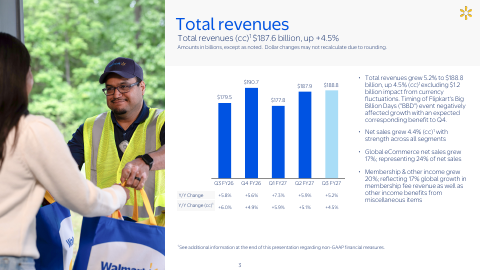
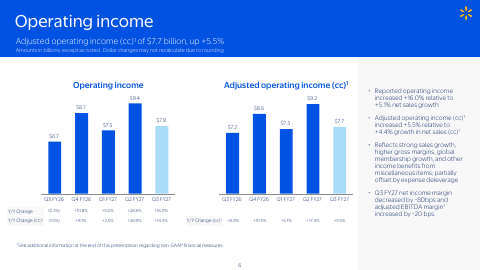
up 4.8%
up +5.5%
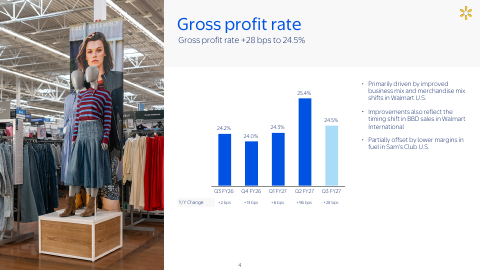
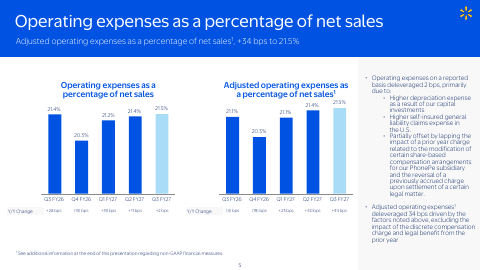
+28 bps
| Segment or metric | Value | Change |
|---|---|---|
| Walmart U.S. net sales | $125.0 billion | +3.6%; eCommerce +23% |
| Sam's Club U.S. net sales | $25.9 billion | +10.0%; eCommerce +30% |
| Walmart International net sales (cc) | $34.7 billion | +3.3% |
| China net sales (cc) | $7.9 billion | +28.5% |
| Walmex net sales (cc) | $13.3 billion | +3.6% |
| Canada net sales (cc) | $6.4 billion | +6.2% |
Copied from the press release ↗ and other documents in the SEC filing ↗. A figure is published only if its sentence is in those documents.
XBRL figures for this quarter arrive with the 10-Q or 10-K; the numbers above are from the press release.
| Metric | Period | Outlook |
|---|---|---|
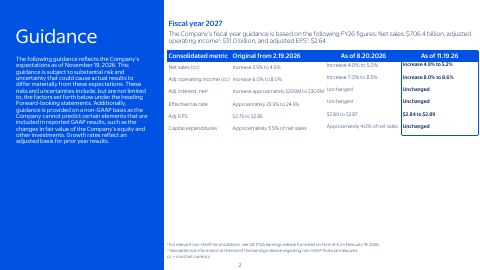
| Net sales growth (constant currency) | fiscal year 2027 | Increase 4.9% to 5.2% |
| Adjusted operating income growth (constant currency) | fiscal year 2027 | Increase 8.0% to 8.6% |
| Adjusted EPS | fiscal year 2027 | $2.84 to $2.89 |
| Effective tax rate | fiscal year 2027 | Approximately 23.5% to 24.5% |
| Capital expenditures | fiscal year 2027 | Approximately 4.0% of net sales |
| Implied Q4 enterprise sales growth (constant currency) | fourth quarter of fiscal 2027 | 4.5 % to 5.5% |
| Implied Q4 operating income growth (constant currency) | fourth quarter of fiscal 2027 | 4 to 6% |
| Implied Q4 EPS | fourth quarter of fiscal 2027 | $0.73 to $0.78 |
Walmart Plus and Sam's Club Plus are now offered together for $120 a year, launched October 20. Sign-ups and upgrades are running well ahead of expectations, and Walmart Plus membership grew double digits in the first few weeks.
U.S. Sparky usage grew 129% and baskets expanded 40%, and the agent now supports voice, images, Spanish and French. Walmart also launched an Agent Gateway and agentic terms so outside agents can shop with customer-set limits.
Stores fulfill more than 80% of U.S. eCommerce orders and can reach 96% of U.S. households in under three hours. Store-fulfilled deliveries grew over 40%, which management says lifts conversion.
Walmart U.S. Marketplace and Fulfillment Services net sales rose 49%, and U.S. advertising rose 37%. Faster delivery of a broader assortment drives seller and customer conversion, and Vizio TV unit volume is up nearly 150%.
Walmart now delivers for more than 2,700 restaurant locations, adding Dunkin', Subway and Papa John's. It lets customers combine meals with groceries and fills existing delivery routes at lower cost.
Fourth quarter worked out from the annual figure.
| Q3 FY25 | $169.6B |
| Q4 FY25 | $180.6B * |
| Q1 FY26 | $165.6B |
| Q2 FY26 | $177.4B |
| Q3 FY26 | $179.5B |
| Q4 FY26 | $190.7B * |
| Q1 FY27 | $177.8B |
| Q2 FY27 | $187.9B |
| Q3 FY25 | $0.57 |
| Q1 FY26 | $0.56 |
| Q2 FY26 | $0.88 |
| Q3 FY26 | $0.77 |
| Q1 FY27 | $0.67 |
| Q2 FY27 | $0.80 |
Fourth-quarter EPS appears once the press release is read; filings report it only for the full year.
| Q3 FY25 | 4.0% |
| Q4 FY25 | 4.4% |
| Q1 FY26 | 4.3% |
| Q2 FY26 | 4.1% |
| Q3 FY26 | 3.7% |
| Q4 FY26 | 4.6% |
| Q1 FY27 | 4.2% |
| Q2 FY27 | 5.0% |
| Q3 FY25 | $372.0M |
| Q4 FY25 | $6.4B |
| Q1 FY26 | $425.0M |
| Q2 FY26 | $6.5B |
| Q3 FY26 | $1.9B |
| Q4 FY26 | $6.1B |
| Q1 FY27 | -$1.9B |
| Q2 FY27 | $7.5B |
Operating cash flow minus capital expenditure, from cash flow statements.
Each quote matches the transcript word for word.
“In the U .S., usage grew 129 % over last year, and we're seeing these baskets expand 40 % as customers are able to find more of the items they want and need.”
Shows early adoption and basket-size lift from Walmart's Sparky shopping agent.
“a delivery membership a warehouse club and a streaming service can add up to nearly $400 a year we're offering all that and much more for $120, the equivalent of $10 a month.”
Explains the pricing logic of the new bundled membership.
“We know that Mindshare and WalletShare grow when customers convert to members. Our members spend approximately four times more than non-members.”
Gives the strategic rationale for pushing membership even at the cost of near-term fees.
“if you exclude advertising and you just look at our e-commerce business without that, we're actually getting to a point where we're pretty close to break even without advertising, which was pretty remarkable.”
Shows U.S. eCommerce economics improving from delivery densification and supply chain investment, not just ads.
“Our customers are loving the ease of ordering via the Walmart app and these restaurant merchants are piggybacking on our existing delivery route densification at a lower cost.”
Describes how restaurant delivery builds on the existing last-mile network.
“What hasn't changed in customer behavior, even through agentic shopping, is the desire to learn about new products and discover new products and brands.”
Management's answer on protecting the advertising business as shopping shifts to AI agents.
Advertising and membership shift mix toward gross profit but add SG&A pressure, so management focuses on operating income and won't call 50 basis points a run rate; speed is the flywheel for e-commerce. — John David Rainey, Dave Gugina
Food share gains were among the largest in three years, and U.S. e-commerce incremental margins topped 12% and should stay in the low double digits, with e-commerce near break-even excluding advertising. — John David Rainey
The $120 bundle serves dual members, who are the most valuable customers, and early results include a couple million new Sam's members, double-digit Walmart Plus growth and 80% higher online spend. — John Furner, Seth Dallaire, Dave Gugina
The customer is stable and resilient; rollbacks fell to about 7,700 from just over 11,000 but remain above the usual 5,000 to 5,500, and management expects a strong holiday season. — John Furner
Reported marketplace sales are commissions and fulfillment fees rather than GMV, while a broader assortment, faster delivery and denser networks are lowering unit costs. — John Furner, John David Rainey, Dave Gugina
Management says it remains confident operating income will grow faster than sales next year, as higher-margin businesses grow fastest, and expects the next five years to be better than the last five. — John David Rainey
It captures more meal occasions and builds delivery density; it now covers over 2,700 restaurant locations with Dunkin', Subway and Papa John's, and is in its early days. — Executive
Vizio TV unit volume is up nearly 150%, growing the installed base for advertisers, and Vibe was recently integrated to offer sales attribution on connected TV. — Seth Dallaire
Inflation has run 1% to 2% and rollbacks drove share gains, but outlook depends on diesel, transportation and input costs that Walmart does not control. — John Furner
It is a balance of all three: over $2 billion of diesel and transport costs, a rising digital mix and deliberate Sam's delivery investment, while platforms built once are scaled globally. — John David Rainey, John Furner
Growth comes from more sellers and assortment exposed to customers, plus forward-deploying marketplace items into stores and clubs to ride express delivery. — Executive
Walmart is engaging with agents to learn how prompts work, and believes the desire to discover new products and brands still supports brand advertising. — Seth Dallaire
Walmart is learning from Flipkart Minutes, China's Sam's Club Clouds and U.S. Walmart depots, and will invest in more capacity if needed. — John Furner
Agentic features are being tested for TV search and used in Vibe's ad platform, and Walmart is sharing advertising, Sparky and Walmart Plus across North America. — John Furner, Seth Dallaire
It launched a bundle of Walmart Plus and Sam's Club Plus for $120 a year, or $10 a month, on October 20. Management says sign-ups and upgrades are running well ahead of expectations.
Its Sparky agent added voice, image, Spanish and French support, saw U.S. usage grow 129% and launched in Mexico, Canada and Sam's Club. Walmart also introduced an Agent Gateway and agentic terms for outside agents.
Stores fulfill more than 80% of U.S. eCommerce orders and can reach 96% of U.S. households in under three hours. Store-fulfilled deliveries grew over 40%.
Walmart U.S. Marketplace and Fulfillment Services net sales grew 49%, and U.S. advertising including Vizio and Vibe grew 37%. Vizio TV unit volume is up nearly 150%.
Walmart now delivers for more than 2,700 restaurant locations, adding Dunkin' and Subway and announcing Papa John's. It aims to capture meal occasions and strengthen delivery density.
Call recording on YouTube ↗. Official replay ↗. Timestamps jump to the moment.
Walmart also publishes its official transcript (PDF) ↗.
Greetings. Welcome to Walmart's third quarter fiscal 27 earnings call. At this time, all participants are in listen-only mode. If anyone should require operator assistance during the conference, please press star zero from your telephone keypad. I'll now turn the conference over to Steph Wissink, Senior Vice President, Investor Relations. Thank you, Steph. You may begin.
Welcome, everyone. Joining me today from our home office in Bentonville, joining me today from our home office in Bentonville, our CEO, John Ferner, and CFO, John David Rainey.
We'll begin with highlights of the previous quarter and our outlook for the year. Then we'll open the line for your questions. During the question and answer portion, we've invited Seth Dallaire, our Chief Growth Officer, as well as segment leadership to join Dave Gugina from Walmart U .S., Chris Nicholas from Walmart International, and Latrice Watkins from Sam's Club U .S. So we can address as many of your questions as possible, please limit yourself to one question. For additional detail on our results, including highlights by segment, please see our earnings release and supplemental presentation on our website.
Today's call is being recorded and management may make forward-looking statements. These statements are subject to risks and uncertainties that could cause actual results to differ materially from these statements. These risks and uncertainties include, but are not limited to, the factors identified in our filings with the SEC. Please review our press release and slide presentation for a cautionary statement regarding forward-looking statements, as well as our entire Safe Harbor Statement and non-GAAP reconciliations on our website at stock .walmart .com.
That concludes my introduction. John, over to you.
Good morning. Thank you for joining us and thank you to our associates around the world for the strong results we delivered this quarter. We're proud of our performance, which reinforces that our strategies working and driving growth. Globally, sales grew 4.4 % and adjusted operating income grew 5.5%, both in constant currency. E-commerce was the primary driver again this quarter. We continue to gain market share, units and transactions are strong, and looking ahead, we expect a strong holiday season.
As a result, we're raising our outlook for both sales and profit. We've spent years investing in our people-led, tech-powered, omnichannel approach so we can better serve customers and members. That starts with our everyday low-price philosophy and our commitment to invest in price. This, combined with the strengths of our stores, clubs, e-commerce, and agentic experiences, shows our value proposition transcends technological change by giving customers more of what they want. Great value, a broad assortment, and experiences that make their lives easier.
We're seeing the benefits of this across the company. As shopping with us becomes more convenient, customers are turning to us more often. That grows our retail business and creates more opportunity for membership, marketplace, and advertising. As those businesses grow, they improve our economics and strengthen our ability to invest in the customer experience. And that's what we meant last quarter about the pieces powering each other. And that's why we're confident and the durability of our model. What encourages me is how our teams continue to build new capabilities, scale new ideas across markets and formats, and deliver consistent results.
I see this when I spend time with our teams across our markets. Our associates are finding new ways to leverage our capabilities, connect more of our businesses, and bring successful ideas from one market to another. Now let me talk about three strategic areas we advance this quarter that show how we're getting more from our omni-channel capabilities. Those are membership, agentic commerce, and leveraging our assets. First, membership. We introduced a new bundle that brings Walmart Plus and Sam's Club Plus together at an incredible value.
A lower price than purchasing the two membership separately. We've spent years expanding our assortment and making shopping more convenient at Walmart. And Sam's Club has continued to refine its value proposition with great items, expanding the members mark brand and growing its fast delivery service each membership sam's club plus and walmart plus is valuable on its own bundling them lets us do more for the same household while helping them save on the combined cost we think about it this way a delivery membership a warehouse club and a streaming service can add up to nearly $400 a year we're offering all that and much more for $120, the equivalent of $10 a month.
Only Walmart can offer the broad assortment of a super center, a marketplace, a warehouse club, all at everyday low prices and deliver it quickly. We're very encouraged by the early results and we believe we're building the most essential membership in the United States. Our next steps in agentic commerce also build on our Omnichannel Foundation. We continue to see strong e-commerce growth, up 17 % globally, even with the timing changes for big billion days. And in the U .S., Walmart was up 23%, and Sam's Club was up 30%.
Our Omnichannel model has enabled a high level of flexibility for our customers and our members, and we continue to find new ways to meet them where they are. Agents are beginning to play a bigger role in more shopping journeys, and we believe Walmart is well positioned as these new ways of shopping develop. We're creating an environment where agents can help a customer discover new items and decide what to buy. Our omni-channel capabilities allow us to connect that digital experience to our locations, inventory, and the people who can fulfill the order and at the prices people expect.
We continue to add new capabilities of Sparky, our shopping agent. An example is the ability to use voice and images to shop. We added new languages like Spanish and French. In the U .S., usage grew 129 % over last year, and we're seeing these baskets expand 40 % as customers are able to find more of the items they want and need. We also recently launched Sparky in Mexico, Canada, and at Sam's Club in the U .S.
We also announced new ways for customers to shop and stay in control when they choose to shop with their own agent. By assigning profiles to agents, customers will be able to set permissions and spending limits, see agent purchases separately, and turn access off at any time. Our new Walmart Agent Gateway gives approved agents a better way to interact with us while helping protect customer information. And agentic terms set clear expectations for how agents must operate, including what agents can and cannot do.
Our business, it's built on trust. Whether customers shop directly with us or through an agent, they should be able to count on accurate pricing, reliable availability, and clear delivery options. Now, I've talked a lot about how we're bringing capabilities together to generate stronger growth and profitability, and we're also using our assets differently. Our stores, they're a great example. They are the key to proximity and the cost advantages we have. When I was a store manager, we focused on driving sales inside the building.
And today, our team serve customers in the aisles while also fulfilling pickup and delivery orders, handling returns, and providing services. In many cases, the footprint is largely the same, but the volume moving through it is much greater, often double what it once was. We no longer see stores and e-commerce as separate, but connected parts of an integrated ecosystem. We can now reach 96 % of U .S. households in less than three hours and 60 % in less than 30 minutes.
We have a unique ability to get closer to customers, use inventory more effectively, and deliver with speed at a low relative cost. Over 80 % of e-commerce orders in the U .S. are fulfilled from stores, including our marketplace orders. By placing select marketplace inventory in stores, it brings more of our online assortment closer to customers and makes it available fast for local delivery. We can offer customers more choice while enabling our stores to support a larger marketplace business.
We're also using our delivery capabilities to support fast and convenient delivery for quick serve restaurants. We have a number of partners today and more to come. With a few clicks in the app, customers can get restaurant food delivery and a marketplace item, along with groceries, pharmacy, and fashion. Only Walmart can deliver on a promise like this, and we're moving fast to scale it. But it doesn't stop there. We're looking across the company with that same omni-channel mindset, asking what else our assets can do for our customers, members, and shareholders.
As I look ahead, I see a strong business with more opportunities to grow and a team that's excited to pursue that growth. We're earning more of our customers' business, expanding what our assets can do, and building capabilities we can take across markets. The opportunity is to keep bringing our advantages together in ways that improve both the customer experience and our economics. We feel good about the results we're delivering today and our ability to create durable growth and long-term value for shareholders.
I'll now turn it over to John David to discuss the quarter and our outlook in more detail.
Thanks, John. I want to share my appreciation to all of our associates for helping us deliver a strong quarter with consistent sales growth and improved profitability. The durability of our earnings streams is becoming more obvious. We're delivering on our annual financial framework of growing operating income faster than sales. We're also demonstrating greater flexibility within the model to manage through near-term factors that are outside of our control.
We're pleased with how our teams are executing on behalf of our customers and members, and we're excited about where we're headed. I'll begin with highlights from our third quarter, and then I'll discuss guidance. There are three things I'd like you to take away from my remarks. First, our business is strong. Our customer value proposition is resonating, and we're gaining share. Second, our strategic growth drivers are accelerating across the enterprise. E-commerce momentum is enabling strong growth in higher margin commerce solution businesses while improving our business mix and profitability.
And there's still a long runway of opportunity ahead. And lastly, we're delivering on our commitments to shareholders. Today, we're once again raising our sales and earnings guidance for the year. Now, turning to the financial and operational highlights for Q3. Enterprise net sales in constant currency grew 4.4 % and exceeded the top end of our guidance of 3 to 3.75%. As we previewed on last quarter's call, we faced a 100 basis point headwind to top line growth in Q3 due to the timing of Flipkart's Big Billion Days event or BBD in India, which will be reported in International's fourth quarter results this year.
Walmart U .S. comp sales improved sequentially versus last quarter and increased 2.9%, including an approximately 70 basis point headwind from health and wellness, which I'll discuss in more detail shortly. Importantly, share gains in grocery categories were some of the highest in three years as we leaned into our customer value proposition with low prices and faster delivery speeds. E-commerce momentum continues to be strong, up 23%, including nearly 50 % growth in marketplace sales again this quarter.
From a merchandise category perspective, grocery sales increased mid-single digits, while general merchandise sales increased low single digits. Our U .S. e-commerce marketplace is a key component of our long-term strategy. Momentum has been building in this business as more sellers join and we expand our product catalog with the brands customers want. It's important to note that within our comp sales disclosure, we include the commission and services fee portion of an e-commerce marketplace transaction, but not the overall value of that transaction, which is defined as gross merchandise value or GMB.
Because our e-commerce marketplace is heavily indexed toward general merchandise items, this distinction can have a meaningful impact on reported comp sales. In Q3, Walmart U .S. general merchandise GMB grew mid-single digits, which was higher than the low single-digit reported comp sales for this category. This context reinforces the confidence we have in the health of the underlying business and the share gains we're seeing in general merchandise categories. We outlined last quarter that Walmart U .S.
health and wellness sales would be pressured this year and next year due to ongoing impacts from maximum fair pricing, or MFP, regulation. Similar to Q2, MFP impacted the reported Q3 comp by approximately 125 basis points, which was partially offset by approximately 60 basis points of growth, primarily from higher GLP-1 cells. Importantly, this is specifically a sales headwind that doesn't impact profitability, as these branded pharmaceuticals have little margin benefit associated with them. Excluding health and wellness, the Walmart U .S.
comp increased 3.6%, which is more representative of the strength of our business. As we did last quarter, we provided additional disclosure of underlying U .S. comp sales trends in our supplemental slide deck, which is on slide 14. Sam's Club U .S. sales increased 10%, with comps excluding fuel up nearly 5%. International grew over 3 % in constant currency, reflecting strong growth in China of 28%, partially offset by the impact from Flipkart's BBD timing shift. Enterprise adjusted operating income on a constant currency basis increased 5.5%, and adjusted EPS increased approximately 5%.
This reflects improved incremental margins in our digital business with strength in high-margin commerce solutions and the favorability and timing of Flipkart's BBD. As we outlined last quarter, our gross profit performance also reflects the investments we made in price and customer initiatives using the tariff refunds we received. We now have approximately 7,700 rollbacks across categories in the U .S. When looking at Q2 and Q3 together, underlying operating income growth increased double digits over that period.
From an operational perspective, we're making good progress optimizing our omni-channel fulfillment capabilities to provide greater speed. Digital is driving our sales growth, deepening our engagement with customers, and contributing to share gains across operating segments, merchandise categories, and customer cohorts. Something that people sometimes overlook is the role our stores play as fulfillment nodes in driving digital growth. Our stores are a key competitive advantage with their proximity to customers. They serve multiple purposes, including in-store shopping as auto care service centers, pharmacy hubs, and digital fulfillment nodes.
Between in-store shopping and digital fulfillment, we have more volume going through our U .S. stores than ever before. In Q3, Walmart US store-fulfilled deliveries increased over 40%, and expedited deliveries were up more than 50%, with stores being the last mile fulfillment nodes for more than 80 % of our e-commerce orders. Faster delivery speeds are leading to higher customer and member conversion. We continue to invest in our store network and explore additional ways to leverage this infrastructure to drive durable and profitable growth.
Our last mile network is another competitive advantage. As John mentioned, over the past several months we've broadened our delivery marketplace to include over 2,400 quick service restaurant locations and we're off to a great start. Our customers are loving the ease of ordering via the Walmart app and these restaurant merchants are piggybacking on our existing delivery route densification at a lower cost. We also see these service partnerships broadening our total addressable market into new verticals. We firmly believe that our combined omni capabilities, stores with e-commerce at scale, alongside a large and engaged customer base, position us well to sustain our growth and share gains.
In Q3, global e-commerce net sales grew 17%, led by the 11th consecutive quarter of 20 % plus growth in the U .S. segment. Sam's Club e-commerce accelerated to 30 % growth with club fulfilled deliveries up triple digits for the second consecutive quarter. And in our international segment, both Canada and China grew e-commerce more than 30%, which was partially offset by Flipkart. This momentum enables the growth of our commerce solutions businesses like marketplace, advertising, and membership.
Walmart U .S. Marketplace and Fulfillment Services had another strong quarter, with net sales up 49%, the third consecutive quarter with growth above 45%. Merchandise categories, including furniture, hard lines, and toys, all performed very well. Nearly 50 % of Marketplace GMV flows through Walmart Fulfillment Services, with units delivered same and next day increasing more than 60%. Faster delivery on a broader marketplace assortment continues to drive higher seller and customer conversion. Strength in marketplace has also been a driver of advertising growth.
As more sellers join the marketplace, they see sales increase by utilizing Walmart Connect advertising capabilities. U .S. advertising, including Vizio and Vibe, grew 37%, led by Strength and Walmart Connect, which was up 36%. Membership fee revenue grew 17 % globally again this quarter, led by strong double-digit growth from Walmart Plus in the U .S. and continued momentum in the Sam's Club businesses in China, Mexico, and the U .S. As John mentioned, we're encouraged by the response to our new U .S.
bundled membership offering. with strong new member signups and upgraded memberships running well ahead of our expectations. This was an important milestone in our journey to become the most essential membership program for consumers. We know that Mindshare and WalletShare grow when customers convert to members. Our members spend approximately four times more than non-members. This new membership bundle is expected to be accretive to the enterprise, but will impact the allocation of membership fee income and cost across the Walmart and Sam's Club U .S.
segments. The brands will remain distinct, and as such, sales will continue to be reported in the segment where member spend occurs. Membership fee income and related benefit costs are split between the two segments based on the attributable value per member. This has the effect of weighing negatively on the Sam's Club U .S. operating income growth while benefiting Walmart U .S. profitability until we anniversary the program launch in October of next year. Turning to incremental margins, the profitability of e-commerce continues to improve, even as we provide greater convenience and speed to customers.
In Q3, Walmart U .S. e-commerce once again achieved double-digit incremental margins aided by strong ad and membership revenue, further densification of our delivery network and growth in fee-based expedited deliveries, and benefits and costs to serve from supply chain automation. We continue to prioritize growth investment, especially as we see attractive returns from projects across supply chain, stores, and technology infrastructure. During the quarter, we issued approximately $6.5 billion in long-term debt at favorable rates.
Our strong balance sheet and financial strength provide the flexibility to continue to invest in the business while providing strong returns to shareholders. Turning to guidance, we're raising our full-year enterprise sales growth outlook to 4.9 % to 5.2 % from 4 % to 5 % previously. For Q4, this implies enterprise sales growth in constant currency will be 4.5 % to 5.5%. There are several assumptions worth highlighting. First, the upward revision reflects the pass-through of year-to-date outperformance and assumes underlying sales trends will continue in Q4 with sustained share gains.
Second, the timing shift of Flipkart's Big Billion Days event is expected to benefit Q4 sales growth by approximately 100 basis points. And lastly, maximum fair pricing in the U .S. business is expected to be an approximately 125 basis point headwind to Walmart U .S. comp sales, partially offset by an approximately 50 basis point tailwind from GLP-1 sales, which is unchanged from a prior guide. For operating income, we're raising our full year guidance on a constant currency basis to growth of 8 to 8.6 % versus 7 to 8.5 % previously, with implied Q4 growth of 4 to 6%.
If currency exchange rates stay where they are currently, we would expect a 70 basis point benefit to full year sales growth and a 130 basis point benefit to operating income growth with the implied Q4 impact from currency a net neutral. As a reminder, we also expect costs related to the acquisition and integration of VIVE to be an approximate 20 basis point headwind to full year operating income growth. We are raising our full year EPS guidance to $2.84 to $2.89 from $2.80 to $2.87 previously.
For Q4, that implies EPS of $0.73 to $0.78. In closing, our teams continue to focus on what we do best, serving customers and members with everyday great value, exceptional convenience and speed, all while pushing our business model forward, diversifying our profit mix, and leading in agentic experiences. We're now happy to take your questions.
We'll now be conducting a question and answer session. If you'd like to ask a question, please press star 1 on your telephone keypad and a confirmation tone will indicate your line is in the question queue.
You may press star 2 if you'd like to withdraw your question from the queue. For participants using speaker equipment, it may be necessary to pick up your handset before pressing the star keys. Thank you, and the first question is from the line of Greg Mellick with Evercore ISI. Please receive your question.
Hi, thanks, and congrats on a good quarter. I guess I wanted to double-click on the new businesses. and also the growth in digital and how those are impacting the gross margin expansion, particularly in the U .S.
And if you think about it going forward, is that the thing that we should just expect this regularly, a 50-bip expansion in gross margin in the business?
Hi, Greg. This is John David. I'll take that, and Dave may want to jump in and out a little bit. But generally, the trends that we're seeing in terms of the composition of the P &L are with additional businesses like advertising and membership. We're going to see some shift, and that's going to result in more gross profit expansion.
It also puts pressure on the SG &A line, as we've talked about. But that's why our focus is on the bottom line, operating income, and we continue to see expansion there. Within the quarter, we had another good quarter of advertising and many of the other commerce solution businesses that helped drive that outsized impact on gross profit. I'm hesitant to say that 50 basis points expansion is the new run rate, but we like what we see in the business.
And Dave, maybe you can add a couple things.
Yeah, what I would say is one of the things driving our e-commerce growth, which is a flywheel for these mix improvements, is speed. Speed's becoming increasingly important for our business, and it's a competitive advantage for us. We can reach 96 % of U .S. households in three hours or less. We can reach 60 % of U .S. households in 30 minutes or less. And mind you, that assumes a 15-minute pick time in the store.
So if we pick faster, we can either reach further and get to more customers in 30 minutes, or we can deliver more quickly to our customers. And you saw the improvements this past quarter. We had over 50 % growth in fast delivery, and deliveries in 30 minutes or less increased almost 3x this past quarter, and that's resonating with our customers.
The next question is from the line of Simeon Gutman with Morgan Stanley. Please proceed with your question.
Hi, good morning, everyone. I have a two-part question, both related to incrementals. First, incremental market share. The way we measure it in what we look at is our funnel. It looks like it picked up a little bit quarter to quarter. Curious how you look at incremental market share. And then the other incremental is on margins. John David, you talked about double digits. I thought there was a reference in the prepared remarks how it accelerated in e-commerce.
So can we talk about the upward pressure, if there are, there are upward drivers to push incremental margins even higher in e-commerce?
Sabine, good to speak with you. On incremental market share, we were really pleased with what we saw in the quarter. I noted in my prepared remarks that the gains we saw on food in particular were some of the largest that we've seen in three years. We compete, though, in a global competitive marketplace, and we scratch and claw for driving the attention of our customers and members every single day.
But what we're seeing is that the value proposition, importantly, some of the price investments that we made in the third quarter, customers are responding to. And so we love the results that we see. On incremental margins, you're right. Within the U .S. e-commerce business, we saw over 12% incremental margins in the quarter. That is an acceleration from the rate that we've seen in more prior quarters. But I think it really underscores the improvements that we've seen in that business.
And generally, we should expect to see that level in the low double-digit range going forward. But a lot of that, too, is driven by things like advertising and membership. But that alone is not what's driving the improvement in the business. In fact, I would say if you exclude advertising and you just look at our e-commerce business without that, we're actually getting to a point where we're pretty close to break even without advertising, which was pretty remarkable.
And the progress that we've made over the last several years by the densification of our network, by the supply chain investments that we've made, the delivery networks, they're all driving these returns. And so we're really excited about what we're seeing there.
The next question is in the line of Chris Patricieri with BNP Parma. Please receive your question.
Hey, everyone. My question is on the Walmart-Sams Club Plus membership combo. Can you talk more about the strategic rationale for doing this and what the initial earnings have been so far?
But also, if you can get some historical perspective on the ramp timeline you've seen with new Walmart Plus members to get to the current 5X.
Hey, good morning, Chris. This is John. First, we're really excited about this bundle. This is something that we've been thinking about for quite some time. and when you just step back and you look at the two memberships individually, Sam's Club Plus is a great proposition for Sam's Club members. Walmart Plus is a great proposition for Walmart customers to move up to.
And both programs have had pretty significant momentum as we led into making this decision. We wanted to get out, obviously, before the holiday. That's why we launched on October 20th. And we've been really pleased with the results we've seen so far. And when you think about the cost of a Wholesale Club membership, The retail membership with the entire super center available the way Dave described it, 60 % of the country in under half an hour, 96 % within three hours.
A broad marketplace and the other services that are offered. We combine that with the streaming membership and you add them up individually. That can be up to almost $400 per year. So we're always looking for ways that we can use our assets to better serve customers, to lower prices, to save them time, to create value and take friction out. And for $120 a year, $10 a month, you get all that bundled together. But we're really excited about the early results.
In particular, at SAMS, we've seen already a couple million new members come in and shop. So we're off to a good start. But I want to turn it over to Seth and talk about how the data informed this decision and how we got to deciding that this was the right thing to do for the business long term.
Great. Thanks, John. When we looked at our customer and member data, we learned two things prior to the launch.
First is that the customers that were paying for both a SAMS Club Plus membership and a Walmart Plus membership separately were our most valuable customers, meaning they were spending the most money with us, visiting stores and clubs most frequently. And then secondly, that that group of dual members was really not that large. And additionally, when we spoke with Sam's Club members, they told us the number one benefit that they wanted was access to Walmart Plus. So those factors and that data gave us a lot of confidence in bringing this membership bundle to market.
And as you mentioned, John, the early indications from the launch have been really positive and it reinforces our belief that this bundle is the most essential membership available. The members that have either linked their Sam's Club and Walmart Plus memberships, upgraded, or newly joined the bundle are spending even more than the cohort of dual members that we had observed before launching the bundle, which is great news. And Dave, you may want to share some of the specifics that you've seen from members in the store since the launch.
Yeah, absolutely. I'll share what we're seeing in the U .S. And I want to pause for a moment and recognize something. We are coming off record W Plus membership growth in Q2. And this bundle has just increased that momentum as we moved into Q3. In the first few weeks following the launch, our Walmart Plus membership base grew double digits. And we're seeing our new bundled members using their benefits, fast delivery, fuel, streaming. And that means that they're shopping more frequently with us.
And they have increased their spend online with Walmart more than 80 % compared to before the launch. So we are really excited about the momentum here. I want to remind folks that Walmart Plus members spend approximately four times more than non-members. They visit our e-commerce site seven times more, and they visit our stores two times more. So as more members activate, upgrade, and engage, we're just going to create more and more value for customers.
A couple of things we're seeing from our members at Sam's Club. 75 % of them shopped in the first seven days. They're digital. Our app downloads are up 20%. And members who are shopping with us digitally have chosen delivery as a first option. One thing I don't want to forget to mention is part of this launch, we were able to make sure that the biggest ambassadors that we have for Walmart and Sam's Club and the membership are associates.
And our associates, as a part of this launch, also received dual membership as one of their benefits. And we're proud of the work that they're doing.
Our next question is from the line of Kate McShane with Goldman Sachs. Please receive your question.
Hi, good morning. Thanks for taking our question. We wanted to ask just about the overall health of the consumer, what some behaviors you saw this quarter versus last quarter, and how you're thinking about the holiday season.
And can you help us reconcile what's happening with price in Q4 with the fact that the number of rollbacks are less than what they were over the summer? And what does that mean for ticket-in transactions in the fourth quarter?
Hey, Kate, it's John. I'll take that one. As it relates to the customer, I think the words we would use to describe the customer are stable, resilient. We've noted a couple times this year that we did see some pressure in the first quarter in April, and then again in the second quarter, we saw some softness in June.
So we thought long and hard about how we could help. And in the summer, as you just mentioned, we had just over 11,000 rollbacks in Walmart U .S. when we completed the second quarter. Sam's Club had also invested in price, particularly in fresh food and other categories. The result of that we're really pleased with, which is food share gains that we haven't seen in about three years. So I think we're in good shape in terms of customer response, but we'll always do whatever we can to continue to lower prices as we look ahead.
At the end of The third quarter, we noted we have about 7,700 rollbacks. Again, that's Walmart U .S. just as an example, which is still higher than our historical average. Most quarters, we'll talk about rollbacks in the 5,000 to 5,500 range, so pretty significant increase. Inflation in the quarter, particularly in food, has ranged 1 % to 2%. And if you look back historically, it's a pretty normal to even low range for where we have been.
And so we're going to do everything we can, like we've always done, to try to keep prices as low as we can, as long as we can. Our merchants, they're thinking about mix and where we can gain efficiencies. We've had some cost pressures throughout the year on fuel and transportation. I think some of those will remain true as long as diesel fuel remains elevated. And then the final part of your question regarding the fourth quarter, I'll give you one example where we've been aggressive about trying to help customers, and that's our holiday meal basket in Walmart U .S.
Just as an example, it's 26 items, and for the items that were like the same items as last year, the prices are down about 12%. So for just over $3.50 a person, you can buy a Thanksgiving meal. And, Dave, I think you said already this month we've sold a million more turkeys than we did a year ago. So the customer response is strong. And then the last thing is we're looking forward to a pretty strong holiday season.
John David mentioned it in his remarks. The room we're in is full of all sorts of great gift ideas for our customers, and we'll be ready to serve them, whether it's at the curb, it's at their driveway, or at the counter. We're going to be really flexible, and we're going to speed things up to make sure our customers find value at Walmart.
Our next question is from the line of Chris Horvors with JP Morgan. Pleased to see you with your question.
Thanks and good morning. Can you help us link the mid-single-digit GMB growth in GenMerch with marketplace sales growth of 50 % recently? What is the underlying GMB growth? Any fee changes that flow through that number? And then related to that, the comment on e-commerce, ex-advertising near flat profitability, is that driven by fulfillment, the marketplace becoming less of a headwind as this GMB scales? That seems like a pretty massive unlock to the overall flywheel and incremental margins as we look forward.
Thanks so much.
Chris, it's John. I'll start and then turn it over to John David to talk about Mix. The first thing to keep in mind is we are always trying to look at the assets that we have around the world, including U .S., Canada, Mexico, the other markets we're in, to try to use those assets the best way we can to help customers with the things they want and need. And marketplace with the extended assortment is one of the ways that we believe we can offer value to a few groups.
One of those, obviously, is our customers. We think our supply chain network that we've built over many decades is quite valuable for our sellers. And then finally, we've talked about this a few times, marketplace growth is important because it tends to indicate where our advertising business and some of our other businesses will go over time, which helps with mix. But when you really look at the GMB question in particular, the reason we made that comment is I want you to keep in mind what we report are the commissions and the fulfillment service fees that you see with the marketplace, which are really happy with the growth there.
But we are going to do everything we can to keep costs as low as possible for our sellers. And if our sellers find that our platform is competitive with other platforms or lower costs, that's an incentive for them to try to sell more at Walmart. So we're thinking about this in two ways. how we save money for the customers and how we save money for our sellers, and then the value of the efficient network we built, hopefully, and should over time, which you see in the results, will help both groups.
So, John David, turn it over to you to talk about mix.
Sure. I think there's two things there, Chris, and I think the headline is that value and speed is a winning combination. When we look at the value that we're providing to our customers and the broader assortment, just using Marketplace as an example, Marketplace, we're almost 50 % this quarter. There are categories like fashion that are growing north of 40%. So we're really pleased with what we're seeing there and how our customers are responding.
You take another category like beauty. We added 100 new brands in the quarter, and those brands drove 75 % of the sales growth. And so this shows that the expansion of our assortment and the broader cohort of customers that are coming are helping to drive a lot of this growth. And so that's the value piece. On speed and in particular as it relates to e-commerce, ex-advertising, getting to a point that's more or less break-even, we just continue to see that as we get faster, we're gaining share and customers are responding to that.
We've made a lot of supply chain investments over the last few years, and we're continuing to densify our delivery network that's helping to lower our unit cost. And that's what's driving some of those results. There are other elements like membership that go into there, which again, like you heard some of the excitement that we have around the opportunity we have in membership going forward. But all of this is helping to drive momentum in the business that fundamentally results in our margins growing or margins going up and operating income growing faster than sales.
And John, David, just maybe building on the speed point. In Q3, WFS really continued to make progress on speed, with units promised next day or faster, increasing 81 % year over year. And that same day and next day delivery remains the fastest-growing segment within WFS, with volume growing 2x faster than the rest of WFS items. So this is really confirming the value of the fast and convenient delivery across the assortment for customers and members.
Our next question is from the line of Michael Lasser with UBS.
Please receive your question.
Good morning. Thank you so much for taking my question. As you look to 2027, can Walmart sustain its algorithm of 4 % top line growth and up to 8 % operating income growth? As you lack carefree funds, fuel prices might remain elevated. The base effects of working off a much larger base might usher in some deceleration in key growth rates, and the spread between in-store sales and e-commerce sales may continue to widen.
If those continue to be headwinds, what are you going to be able to see that's going to offset those hurdles if indeed we should be expecting next year as a normal algorithm year? Thank you so much.
Michael, thanks for the question. This is John David. We remain confident in our ability to continue to grow operating income faster than sales. And despite some of the headwinds that you mentioned, next year is no exception. Our business is fundamentally changing as these parts of our business that have higher profit margins are also the fastest growing ones.
And it's just math that those continue to have an outsized contribution to our profits. But I think it's also important to note that we often focus on growth as well. And sometimes there are tradeoffs. And membership is a good example of that. If we were just focused on maximizing profit in the next quarter or the next several quarters, we'd never do the membership offering that we just suggested. You know, we're cannibalizing and refunding fees that members have paid by essentially giving one of those memberships away for free.
But we take a long-term perspective, and we know that there's 130 million households in the U .S., and the vast majority of those are not one of our members, and that's what we're going after. So the luxury that we have in our business because of the profit profile of it is it allows us to both invest but also drive outsized operating income growth. We'll continue to do that. We'll give guidance as we get into, as we always do on the fourth quarter call.
But we've got a lot of conviction in what we're doing here and the progress that we're making. And we expect the next five years to look better than the last five years.
The next question is in the line of David Bellinger with Mizuho. Pleasure to see if your question.
Hey, good morning. Thanks for the question. I want to ask about restaurant delivery. Any data points you can share on the initial markets and the 2,400 locations where this is live?
And as this strategy widens out, how should we think about the ultimate goal here? Can you take a chunk of volumes away from the incumbent players? Or is this more of an internal way to drive some margin and potentially subsidize the broader Walmart express delivery program?
Yes, I'll take that one. Thanks for the question. We think about restaurant delivery as a natural extension of our omni-channel strategy, and we're seeing really strong interests not only for customers, but also from restaurant partners.
If you think about it from our standpoint, it helps us capture more meal occasions, which then drives traffic, as well as increased frequency to our site and to our app. And we have some unique advantages in this space. About 90 % of QSR spend happens within a few miles of a Walmart. So in Q3, we leaned in. We've now expanded to over 2,700 restaurant locations. We added Dunkin' this past quarter. We expanded Subway and we announced our partnership with Papa John's.
I think the other thing I would say is we're differentiated in this space. Customers can combine their restaurant meal with groceries. with general merchandise, with health and wellness, that's Ford deployed in 4,600 stores. And they'll receive that order from shopping one app. They'll have one consolidated delivery. They're going to have transparent fees and a focus on everyday low prices supported by our everyday low cost. And another key benefit here is that restaurant delivery also helps keep our drivers engaged and improves our utilization and builds last mile density.
And that strengthens our delivery economics over time. So I will say that we are in the early days, but we're excited about this business and the early response.
The next question comes from the line of Kirsten Ardoun with Bank of America. Pleased to see with your question.
Thanks, team. Good morning. Can you talk about some of the opportunities you have across your U .S. advertising business, inclusive of Walmart, Connect, Vizio, and now Vibe .co? What are some capabilities you could look to add to your overall business in the future?
And as this business continues to scale, how should we think about the opportunity to flow through more of this profits in the future?
Hey, thanks for the question. We're really excited, actually, and encouraged by what we're seeing so far with Vizio. So in a couple dimensions. So the first is that we're selling a lot of these TVs. This is a great TV. It's at an everyday low price, and that offer is really resonating with our customers and members at the right time as we're heading into holiday here.
The TVs that are powered by Vizio OS have been the number one sellers in the U .S., and our unit volume for those TVs is up nearly 150 % year over year. So that unit volume, the installation basis that continues to grow allows advertisers more opportunity to speak with the owners of those TVs, our customers and members. So that's been really encouraging. We're seeing that contribution to the advertising revenue growth even in Q3, and we'll continue to see that into Q4.
Now, the Vibe contribution is encouraging as well because that platform was just integrated into Vizio and our connected TV offering a few weeks ago. So we're now able to deliver capability for sales attribution through those Vizio television sets in ways that we've never been able to do before. So we see that connected TV offering as being complementary to what we've been so successful with with retail media to date. And we have a lot of room to run as we continue to sell more TVs.
Maybe one fun anecdote that I'll share is in our AE event from the 12th to the 15th, the number one selling item, Seth, was the 50-inch Vizio TV.
The next question comes from the line of Kelly Bania with BMO Capital Markets. Please receive your question.
Hi, good morning. I was wondering if you could just share an update, if you can, on your outlook for food inflation. A lot of questions from investors if that appears to be maybe accelerating in coming quarters.
It seems like some of the fresh categories are pretty low. And if you can just help us kind of think about the next couple quarters and your capacity to continue to invest against that food inflation pressure, particularly in light of still elevated fuel costs.
Kelly, we've done a decent job this year of maintaining pretty low inflation. I think I said it earlier, but we've run between 1 % and 2%. Last year, we had quite a bit of inflation from categories like dairy, in particular eggs, that have helped pull that number down.
And we're starting to lap some of those numbers. We will do everything we can in terms of efficiency, low pricing, to keep prices low. We saw really good responses in the second and third quarter from the rollbacks, which they were broad based. They were all across the assortment, but did have a concentration on food and that helped us gain share. As far as looking ahead, you know, it is hard to call diesel prices are coming down, but it is a real cost.
We've noted that it was a significant impact over the course of the year that we were able to manage through and use tariff refunds as a way to offset those. So I think it really depends on transportation costs and input costs as we move forward. We'll watch the markets very closely. Those are things that we do not control, but what we can control are the things we do internally to ensure that we're operating with an everyday low-cost philosophy to try to keep prices as low as we can.
Our next question is from the line of Seth Sigmund with Barclays. Please receive your question.
Great. Hey, good morning, everyone. I wanted to ask about the SG &A pressures that you're seeing. Can you frame how much of that is externally driven versus deliberate investment versus simply just the changing mix of the business? And as you look ahead, are there meaningful productivity unlocks here from either automation or AI that could really start to change that and become more visible into next year?
Seth, it's a good balance between the three categories that you mentioned. And I'll start with the external pressures because it's already been talked about. Diesel prices have been, between diesel and transportation, it'll be over $2 billion of incremental costs that we've had to navigate this year. And even in the face of those headwinds, if you take the top end of our guidance on operating income for the year on a reported basis, we'd be growing 10-ish percent.
So we feel good about our ability to do that. We've also, as I noted in a prior answer, we continue to see this shift in the digital mix of our business. So today, roughly 25 % of our overall business is digital, is e-commerce. And the way the expenses are allocated, that hits SG &A more than an in-store transaction. But as you think about the next, call it five to seven years, our digital business is only going to continue to grow, maybe another 10 to 15 percentage points over that period of time.
So you're going to continue to see that shift that is simply a reflection of the changing dynamic or changing mix of our business. But you also hit on another really important point, and that's the intentional investments that we make. And I'd use Sam's as an example right now. We're on a similar journey with Sam's in terms of our delivery network and what we're doing there around fulfillment as we were with Walmart US a few years ago.
And so I would characterize that as we are in more of an investment phase there and will continue to be. But that's the luxury that we have as a business to be able to be very intentional about these investments and still actually grow our profits faster than sales. We think, as I mentioned earlier, we have confidence in our ability to continue to do that. And the importance of that, the takeaway from that, is that results in the durability of what you're seeing right now.
This isn't something that's just happening in one quarter or one year, but we're making very intentional investments that allow us to continue this profit trajectory into the future.
Seth, one of the other things to keep in mind as we operate in 19 different countries around the world and throughout this year, as we have always, but I think we've really accelerated this year, is the idea that, first, innovation, great ideas come from our associates. And second, we can build things once and we can scale things globally.
And there's been a lot of progress in the year, and I see this accelerating from the next few quarters, to leverage what we've done with platforms, everything from marketplace, fulfillment services, advertising, core operations, devices for associates. So they have the information they need in their hand across Canada, our market in Mexico. So there are a lot of things that we have in place that we can scale and leverage and run on top of. The U .S.
business, both Sam's and Walmart, have done a great job with efficiency and productivity, and more of that succumbed to our markets around the world.
Our next question is from the line of Peter Keith with Piper Sandler. Pleased to see you with your question.
Good morning, everyone. I wanted to look at the marketplace growth, which has been a run rating at roughly 50 % growth the last three quarters. It's seen meaningful acceleration in 2026. I'll stop and you can unpack what you think are the key drivers to this recent growth so we can understand, I guess, the sustainability as we look forward for a couple of years.
Things like the Who Do Add campaign come to mind to me as well as adding new suppliers. But I hope you can provide some more detail.
Yeah, thanks for the question. In terms of marketplace growth, I think that a lot of the growth comes from just the increase in assortment and our efforts to bring in more sellers into the platform, drive more assortment, make it more available to our customers and members through our e-com offering.
That's been really helpful in terms of when that assortment is exposed to customers and members. It's oftentimes new, and it's novel to them. They buy it. that encourages more sellers to come in and give us more assortment. I'd also say that some of the innovation that John referred to related to forward deploying marketplace items into our super centers and clubs is a new approach that we're taking where we think that as we get that seller assortment closer to customer homes and can ride on the rails of all the investments we've made in express delivery, which we know our customers and members love, that we should see continued acceleration in that business and that we're able to serve sellers in ways
that maybe we haven't in the past.
The next question is from the line of Scott Cigarelli with Truist. Please receive your question.
Good morning, guys. Thanks for the time. So I know it's still early, but there are some concerns in the investment community around the value of advertising in a agenda-dominated world. So can you help us understand how you plan to protect your advertising earnings in a agentic world, especially since one of your largest competitors out there is basically borrowing third-party agents from its site?
Thanks.
Sure. Thanks for the question. We see our strategy with engaging with agentic commerce and leaning into the opportunity is one where we can learn a ton. You know, firstly, we want to be where our customers and members are. And if they're engaging with these agents and shopping via those agents, then we think we can continue to serve them and do so in ways that are not only great for our business, but maintain the values that we've had in serving customers through our physical super centers.
But in terms of the advertising components and the way that customers and members are shopping in these agents, we're still learning a ton. You know, conversational commerce and the way that people are creating queries and prompts in these agents is quite different than what we've seen historically. But we are learning about those prompts and how to serve customers and allow marketers and brands to get their products in front of customers. What hasn't changed in customer behavior, even through agentic shopping, is the desire to learn about new products and discover new products and brands.
That's been consistent throughout shopping, whether it's digital, physical, or agentic. And we believe that our strategy right now is allowing us to learn about that and serve members, and we'll continue to do so. And the important part of that is brand advertising. So we're looking at that and being aware of how we're enabling that in these new environments.
The next question is in the line of Christina Katai with Deutsche Bank. Pleased to see you with your question.
Hi. Hi, team. Good morning, and thanks for taking the question. I wanted to ask on capacity. So as e-commerce continues to grow 20 % plus and 30-minute delivery scales, is there a point where the supermarket just becomes a constraint versus an advantage? And how are you evaluating dark stores or dedicated fulfillment nodes in higher-density markets? And what would need to be true economically for that model to make sense? Thank you.
Christina, thanks for the question.
And let me start with what I spoke about a couple minutes ago. Being in 19 markets around the world, we have a lot of opportunity inside the company and looking outside the company to learn about the most effective ways we can serve customers. And a few examples, in India, we have Flipkart Minutes, where the average transaction time, Chris, is 13 to 14 minutes. Small, dark stores, easy to scale quickly. They've scaled really quickly. It's been impressive what they've done.
And our business in China, in particular, Sam's Club led with Clouds a few years ago, which is a great model because it takes the head of the assortment, the top of the assortment. It forward deploys it near the clubs, but it enables customers, members in that case, to offer the best part of the top of the assortment, meals, you know, think center of plate, and have it delivered in a short time. Last year in the U .S., we opened what we would call Walmart depots, which are also expanding.
We have some examples of where we put those markets. But they do more than just the top of the assortment here in the U .S. They're also delivery stations for e-commerce orders. So it's for deployed inventory, but it's also a way that we can get, as Dave said earlier, more dense network with our drivers. So we'll continue to learn around the world, and we're going to expand the way we deliver from stores, from fulfillment centers, the way that stores and depots are flow-throughs.
And one thing I can say about this team for sure is they're innovative, and they will find ways to expand our reach. Dave mentioned a few minutes ago that 96 % of U .S. households, 130 million roughly households, are now reachable within three hours and 60 % under 30 minutes. So we'll continue to push, and if we need to invest in more capacity, we will. We are, and we'll continue to find ways to grow for our customers.
Our final questions from the line of Peter Benedict with Baird. Please receive your question.
Good morning, guys. Thanks for sneaking me in here. So first, a follow-up and then a question, a follow-up kind of on the Agentec Commerce impact on advertising question that was asked earlier. You did a nice job addressing kind of the retail media side of that. I'm just curious if there's anything to add there in terms of what Agentec might mean for the Vizio business or the Vibe .co business.
Are those different and what are the opportunities there in an agentic world if they're impacted at all. But my main question is really around expanding these commerce solutions, you know, beyond the core U .S. business. John, you talked about taking Sparky into Mexico and Canada. I'm just curious kind of your view, bigger picture, into opportunities to do things like that within the franchise over time.
Yeah, Peter, great question. We are excited about expansion of these platforms across international markets.
I mentioned a few things earlier, but we are definitely thinking about advertising data services as one team across the markets, in particular in North America. We've had exciting launches with Sparky in Canada and Mexico. Walmart Plus was also a fast follow for those markets. And then the third is the talent we have in the company. We have a lot of associates who have worked in Mexico or the U .S. or in Mexico or expats in Canada, vice versa.
So, you know, we're trying to think about this as a business that doesn't necessarily always see the geographic borders, but rather sees a way that capabilities in our capacity can expand to other markets so we can accelerate. But let me turn it over to Seth to pick up on Vizio and Vibe and the opportunities.
Yeah, in terms of the agentic capabilities there, we're looking at it in two dimensions. One would be a consumer facing or TV owner dimension.
And there's a lot of really interesting things that we're experimenting with as it relates to that user experience on the TV that may relate to search and discovery of content programming and other ways that we can serve content through the Visio operating system. And then secondly, as it relates to Vibe, we use a lot of agentic capability within the technology and Vibe to power all of the offerings that are available for that small, medium-sized advertiser that we're chasing through the connected TV space.
So it's not only agentic as it relates to the consumer experience, but it's also agentic capability that we're using on the actual machinations of how the platform works for the advertisers that are buying advertising with us.
This now concludes our question and answer session. I'd like to turn the floor back over to John Furner for closing comments.
First, I'd just like to thank everyone for the time and the interest of the questions this morning. I have three points.
The team at Walmart and around the world, I'm really proud of their performance. Our associates in stores, clubs, distribution centers, our offices have momentum, and I'm really, really grateful for the way that they're focusing on growth, value, and they're executing in a disciplined way. The second is also exciting to see some of these capabilities coming to life across markets. I love the innovation, whether it's agentic commerce, the announcement on membership. We are really bullish on the capabilities this can create for members over time.
Things like food delivery. We're able to do those things in a creative, innovative way without in any way distracting our focus on the customer and what we do in our retail business. And then number three, it's the holiday season. It's game time. So we are focused on delivering for our customers for the holiday meal, for gift giving. It's a busy time for a lot of people all around the world, and we'll be ready to take care of them as we get into the busiest part of the year.
So thanks again for your interest, and we will talk to you soon.
Ladies and gentlemen, thank you for your participation. This does conclude today's teleconference.