0:29:53 · Kate McShane, Goldman Sachs · Price investment
Has the tariff-refund price investment already accelerated unit growth, and how do vendor support and Walmart's own funding sustain lower prices into next year?
Furner said share gains were broad, especially in food, that the price investments will be managed across Q2 and Q3, and that these gains tend to be durable. — John Furner
0:32:35 · Simeon Gutman, Morgan Stanley · Consumer elasticity
Is the pressure on lower-income consumers worse with high gas prices, and how quickly does elasticity from price rollbacks show up?
Rainey said fuel above $4 forced trade-offs, especially in June, and that price cuts pay off with a lag through cumulative share gains. — John David Rainey, John Furner
0:36:01 · Greg Millick, Evercore ISI · Tariffs, profit growth
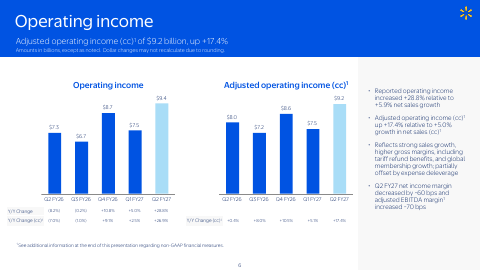
Where are tariff rates heading, and should operating income still grow faster than sales into FY27?
Rainey said guidance assumes current tariff and fuel levels and that he is confident profit can keep growing much faster than sales, helped by membership, advertising and marketplace. — John David Rainey
0:38:12 · Brad Thomas, RBC Capital Markets · Health and wellness
What is the multi-year outlook for health and wellness given maximum fair price regulation?
Management said it remains pleased with pharmacy volume growth and share gains, and that health and wellness customers spend three times more than the average customer. — John Furner, Dave Gugina
0:40:31 · Michael Lasser, UBS · Comp outlook
Have you seen the expected Walmart U.S. comp acceleration yet, and would you add price investment if it does not come?
Furner said July was stronger than June and back-to-school started well, and that price investments will be balanced against market conditions and operating income commitments. — John Furner
0:42:41 · Chris Nardone, Bank of America · Incremental margins
What are the incremental margins in digital, and how will Walmart lap its rollbacks next year?
Rainey said U.S. eCommerce incremental margins have run high single to low double digits and may rise with advertising growth, and that lapping 19% EPS growth will be a challenge. — John David Rainey
0:46:03 · Christopher Horvitz, J.P. Morgan · General merchandise
How much of the general merchandise slowdown was stimulus fading versus gas prices, and is back-to-school helping?
Rainey said Q1 benefited from stimulus payments and Q2 saw higher gas prices, while Guggina said back-to-college was strong and Walmart sells roughly 50% of school supplies by units. — John David Rainey, Dave Gugina
0:52:12 · Bob Durbel, BTIG · Inventory, inflation
Are there inventory concerns, and what inflation does Walmart expect for the rest of the year?
Furner said inflation is between 1% and 2%, fuel is the main watch item, and inventory is in good shape with no big concerns. — John Furner
0:54:07 · Kelly Bania, BMO · Tariff refunds
How is Walmart communicating the tariff-refund price cuts and allocating them between grocery and general merchandise?
Furner said the investments are spread across food, general merchandise, consumables and fashion, and are promoted through in-store signage and the homepage rollbacks tile. — John Furner
0:56:07 · Paul Leshway, Citigroup · Comp mix, SG&A
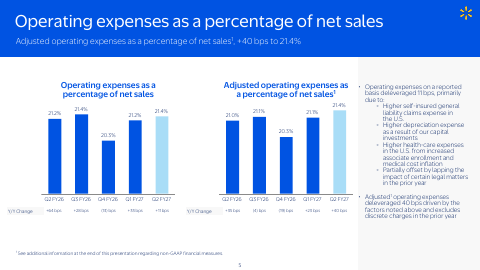
How do price investments shape the traffic versus ticket assumption, and why did U.S. operating expenses grow 7%?
Furner said transactions and units both grew, and Rainey said depreciation, self-insurance costs including group health and claims, and some investments pulled forward drove the expense growth. — John Furner, John David Rainey
0:59:31 · Jihan Ma, Bernstein · Store comps
Is the decline in Walmart U.S. in-store comps due to pharmacy, gas prices, or a structural shift to delivery?
Furner said pharmacy weighs heavily on store comps, and that stores are an asset because they fulfill delivery orders, so more volume runs through stores than ever. — John Furner
1:02:06 · Seth Sigmund, Barclays · Basket mix
Why is average ticket running below inflation, and is there trade-down or a category mix shift?
Guggina pointed to broad-based share gains, mid-single-digit grocery growth, and value offerings such as the grilling basket and Better Goods brand, with traffic, ticket and units rising. — Dave Gugina