“We expect capital markets to grow from 8 to 10% or more of total company revenue over the next three to five years by focusing on three strategies.”
It sets the scale of the strategic bet behind the BTIG acquisition.

U.S. Bancorp (USB) · Banking
Results filed 15 Oct 2026 · Quarter ended 30 Sep 2026 · Call 61 min · Gunjan Kedia (CEO), John Stern (CFO)
Read the transcriptSlides (40 pages)Press release ↗Investor relations ↗
Summaries and transcripts are machine-generated and can contain errors.
U.S. Bancorp pushed deeper into capital markets and small business, with a full quarter of BTIG, the Amazon co-brand card onboarded and a USBDC stablecoin pilot.
BTIG contributed $226 million of fee revenue in its first full quarter, and legacy capital markets also grew. The bank onboarded the Amazon small business card portfolio, launched the Business Essentials card suite and added new banker teams in expansion markets. Corporate payments grew on market share gains and new business. Commercial demand was broad, covering food and beverage, energy and technology, while consumer deposits hit another record.
Management wants capital markets to grow from 8% to 10% or more of revenue within three to five years. It also plans to spend more on new branches, make small business a 2027 priority and use AI for productivity. The main tension is balance sheet capacity. Loan growth and the Amazon onboarding used up capital, and share buybacks are paused until capital rebuilds, rates settle and regulatory rules become clearer.
Open the slide deck (PDF, 40 pages) ↗

Showing the first 6 of 40 pages.
From U.S. Bancorp investor relations
SEC filing
year-over-year increases of 5.6% in net interest income and 14.9% in fee revenue
up 10.0% year-over-year
up 9.8% year-over-year
improved year-over-year
up 9 basis points year-over-year
| Segment or metric | Value | Change |
|---|---|---|
| Wealth, Corporate, Commercial and Institutional Banking net income | $1.6B | up 29.8% from a year ago |
| Consumer and Business Banking net income | $633.0M | up 6.7% from a year ago |
| Payment Services net income | $175.0M | down 31.4% from a year ago |
| Capital markets revenue | 640.0M | up 69.3% from a year ago |
| Corporate payment and treasury management revenue | 457.0M | up 12.3% from a year ago |
| BTIG fee revenue contribution | $226 million |
Copied from the press release ↗ and other documents in the SEC filing ↗. A figure is published only if its sentence is in those documents.
| From the filing | Q3 2026 | vs year ago | vs last quarter |
|---|---|---|---|
| Revenue | $8.0B | +8.7% | +3.3% |
| Net income | $2.2B | +10.0% | +1.1% |
| Diluted EPS | $1.34 | +9.8% | −0.7% |
Calculated by code from XBRL, not by the model.
| Metric | Period | Outlook |
|---|---|---|
| Net interest income growth year-over-year (taxable-equivalent) | fourth quarter of 2026 | 6 % to 7 % |
| Total fee revenue growth year-over-year | fourth quarter of 2026 | 13 % to 14% |
| Noninterest expense growth year-over-year | fourth quarter of 2026 | approximately 8% |
| Total net revenue growth | full year 2026 | 8 % to 9 % |
| Positive operating leverage | full year 2026 | approximately 300 basis points |
BTIG added $226 million of fee revenue in its first full quarter, and legacy capital markets grew about 10%. Management expects capital markets to rise from 8% to 10% or more of company revenue over three to five years through core growth, shared clients and new products.
The bank onboarded the Amazon co-brand card portfolio, launched the Business Essentials card suite and set up new banker teams in expansion markets. It serves more than 2 million small businesses and calls the segment an important priority going into 2027.
Annual branch investment is moving from about $200 million to $300 million, mostly for new branches inside the existing footprint. Client centers give small business and other national teams a faster way to reach new markets.
Corporate payments grew about 19%, driven mostly by new business and higher client spending. The USBDC stablecoin is only a pilot, and management says there is client curiosity but little real demand until regulatory approvals arrive.
The bank is leaning into card, commercial and industrial, and commercial real estate lending, which bring fees and deposits. Floating-rate loans were 36% of earning assets, and mortgage is expected to shrink to the mid-20s as a share of the loan book.
Fourth quarter worked out from the annual figure.
| Q4 2024 | $7.0B * |
| Q1 2025 | $7.0B |
| Q2 2025 | $7.0B |
| Q3 2025 | $7.3B |
| Q4 2025 | $7.4B * |
| Q1 2026 | $7.3B |
| Q2 2026 | $7.7B |
| Q3 2026 | $8.0B |
| Q1 2025 | $1.03 |
| Q2 2025 | $1.11 |
| Q3 2025 | $1.22 |
| Q1 2026 | $1.18 |
| Q2 2026 | $1.35 |
| Q3 2026 | $1.34 |
Fourth-quarter EPS appears once the press release is read; filings report it only for the full year.
Each quote matches the transcript word for word.
“We expect capital markets to grow from 8 to 10% or more of total company revenue over the next three to five years by focusing on three strategies.”
It sets the scale of the strategic bet behind the BTIG acquisition.
“We have a truly differentiated set of products and an enviable client footprint with small business. And this segment will be an important priority going into 2027.”
It names small business as a core investment area for next year.
“we have real meaningful opportunity to get to 8 % to 10 % branch share in those markets within our footprint that have high household formation rates.”
It explains why the first phase of branch expansion is inside the existing footprint.
“our thought process very much is that it's a relationship loan. So where you get fee revenue, you get deep relationships, You get sticky deposits. That's where we want to extend our balance sheet.”
It states the rule for which loan categories get balance sheet priority.
“I very clearly have to say there is not much client demand at all. What there is now is client curiosity.”
It tempers expectations for near-term stablecoin revenue.
“we haven't seen any AI cash sorting third-party agents try to interact with the bank. The logistics of doing something like this are very complicated.”
It addresses a competitive threat to deposits from AI agents.
Loan pipelines and consumer and small business deposit growth stay strong, the Amazon card book adds a full quarter, and margin should rise by a similar amount again. — John Stern
The bank is shifting toward floating-rate assets, about $10 billion of fixed assets reprice each quarter at roughly 125 basis points better, and it assumes a deposit beta of about 50%. — John Stern
Revenue growth drives the higher operating leverage, and management says the business can generate both operating leverage and investment in balance. — John Stern, Gunjan Kedia
Loan demand, interest rates and pending regulatory rules will decide whether buybacks resume this quarter or next, with a 70% to 75% payout commitment unchanged. — John Stern
Core commercial and industrial growth was healthy, but runoff in non-depository financial institution loans and deals that missed return hurdles flattened balances, and pipelines are robust for the fourth quarter. — John Stern, Gunjan Kedia
Rates, risk-weighted asset growth and regulatory changes are the three components, and buybacks will glide back up to the 70% to 75% payout. — John Stern
Both: the bank will first densify branches within its footprint while using client centers as a faster interim route to a national presence. — Gunjan Kedia
Adjacent sectors like energy and telecom benefit, but growth is broad-based across retail, food and beverage and insurance, with small business momentum on top. — John Stern
Corporate payments grew about 19% and treasury management grew in the mid-single digits, while capital markets should keep growing at double digits with BTIG near $200 million a quarter. — John Stern
Little has changed; pricing after the rate hike is as expected, and loan spreads are competitive but stable. — John Stern
Mortgage will be hit by higher rates, merchant stays near zero growth, and other revenue should normalize to $125 million to $150 million after unusual gains. — John Stern
Management still sees a path to 3% at some point in 2027 through asset repricing, better asset and funding mix and disciplined deposit costs. — John Stern, Gunjan Kedia
No change so far: consumer spend and employment are strong and commercial clients are healthy, with commercial real estate the main watch item. — John Stern
Management expects continued action, such as lowering the investment portfolio in favor of cash and repaying Federal Home Loan Bank advances. — John Stern
It has gone very well, with strong cultural fit, deepening client relationships and benefits to BTIG from the bank's leveraged ETF trading book. — Gunjan Kedia
It likes bolt-ons and treats them like organic investment, but it finds its organic deposit strategies more compelling than a depository deal. — Gunjan Kedia
AI is a growing but not sole productivity lever, with cheaper models swapped in for expensive ones, while client-facing uses are being more measured. — Gunjan Kedia
No such agents have approached the bank, so no near-term impact is expected, and the bank competes on value propositions rather than only deposit price. — Gunjan Kedia
Yes, management believes funding mix, asset mix and fixed asset repricing are enough to offset deposit beta pressure. — John Stern
Buybacks depend mainly on risk-weighted asset demand and rates, and the bank is not counting on any Basel benefit. — John Stern, Gunjan Kedia
The bank will keep leaning into card, commercial and industrial, and commercial real estate lending, with residential mortgage falling toward the mid-20s as a share of loans. — John Stern, Gunjan Kedia
Robust capital markets growth would push toward the high end, and AI productivity could push toward the low end. — John Stern, Gunjan Kedia
No; it is a pilot built in anticipation of demand, with client curiosity mainly in corporate payments and a full launch needing regulatory approvals. — Gunjan Kedia
BTIG added $226 million of fee revenue in its first full quarter, and legacy capital markets grew about 10%. Management expects capital markets to reach 8% to 10% or more of company revenue over three to five years.
It onboarded the Amazon co-brand card portfolio, launched Business Essentials cards, added new business bankers and set up client centers in expansion markets. Management calls small business an important priority going into 2027.
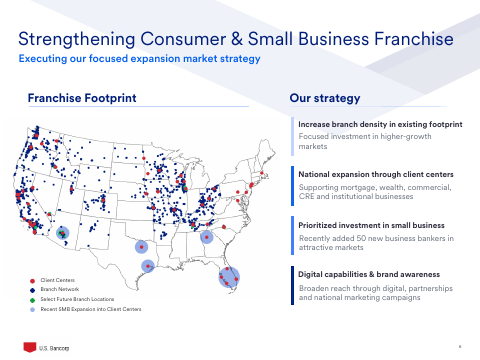
It is raising annual branch investment from about $200 million to $300 million, starting with new branches in high-growth markets inside its footprint. Client centers give national teams a faster route into new regions.
Not yet. The September launch was a pilot, and management says clients are curious but demand is not robust, with a full product launch needing regulatory approvals.
AI is a growing contributor to productivity, but management is being more measured on client-facing uses. It has seen no AI cash-sorting agents interact with the bank and expects no near-term impact on deposits.
Call recording on YouTube ↗. Official replay ↗. Timestamps jump to the moment.
Welcome to the U .S. Bancorp third quarter 2026 earnings conference call. Following a review of the results, there will be a formal question and answer session. If you would like to ask a question, please press star then one on your phone. If you wish to withdraw your question, please press star then one again. This call will be recorded and available for replay beginning today at approximately 10 a .m. Central Time. I will now turn the conference call over to Brian Mauney, Director of Investor Relations for U .S.
Bancorp.
Thank you, Operator, and good morning, everyone. Today, I am joined by our Chairman and Chief Executive Officer, Gunjan Kedia, and Vice Chair and Chief Financial Officer, John Stern. In a moment, Gunjan and John will be referencing a slide presentation together with their prepared remarks. A copy of the presentation, our press release, and supplemental analyst schedules can be found on our website at ir .usbank .com. Please note that any forward-looking statements made during today's call are subject to risk and uncertainty.
Factors that could materially change our current forward-looking assumptions are described on page two of today's earnings presentation, our press release, and reports on file with the SEC. Following our prepared remarks, Gunjan and John will be happy to take any questions that you have. I will now turn the call over to Gunjan.
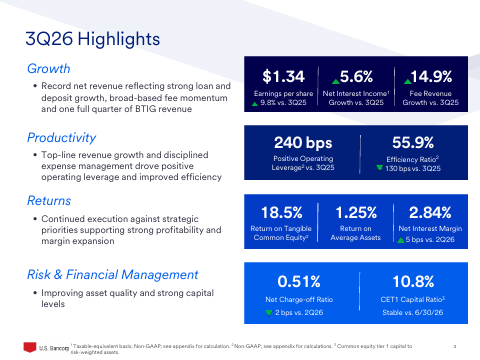
Thank you, Brian. Good morning, everyone. Beginning on slide three, we delivered another the strong quarter highlighted by record net revenue of approximately $8 billion and diluted earnings per share of $1.34, up approximately 10 % from a year ago.
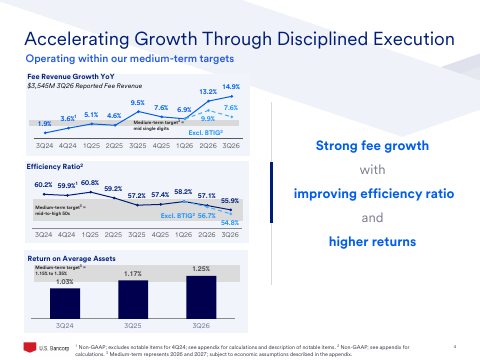
Results in the quarter reflect strong execution against our three strategic priorities. Net revenue grew 8.7 % year-over-year. Disciplined productivity drove 240 basis points of positive operating leverage, and in payments, our transformation efforts continued to gain traction with total payments revenue growing 6.5 percent year-over-year. Turning to slide four, fees continued to grow nicely and contributed 44 % of total revenue again this quarter. Our fee complex is diversified and deepens client relationships, generates attractive returns, and contributes to a more balanced earnings profile.
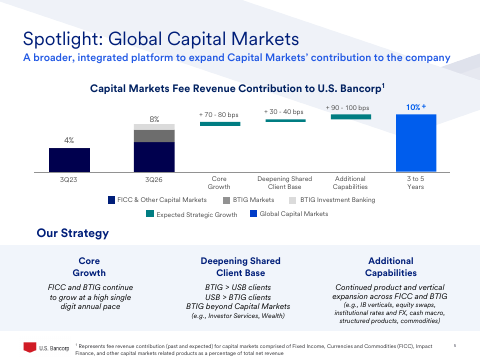
While fee growth does come with higher expenses, productivity initiatives, including from our AI programs, helped improve our efficiency ratio and increased return on average assets year over year. On slide five, we spotlight global capital markets and attractive growth opportunity across a range of economic scenarios. We closed the BTIG acquisition in June and it contributed $226 million of fee revenue in the third quarter. Our combined businesses are off to a wonderful start and already working very closely together to broaden how we serve our clients.
We expect capital markets to grow from 8 to 10% or more of total company revenue over the next three to five years by focusing on three strategies. One, continue to drive robust core organic growth across both franchises in line with their historical performance. Second, deepen wallet share with our clients where we deploy significant balance sheet resources. The addition of BTIG strengthens our ability to serve a broader range of needs and capture greater fee revenue over time.
And third, by adding product capabilities across both platforms. We look forward to sharing more on our capital market strategy at a conference later this fall and are committed to providing more disclosures in due course as the business becomes a larger part of our revenue mix. With fees and expenses in a healthy place, This year, we have increasingly turned our attention to strengthening net interest income and margin. An important lever of this growth is expanding our consumer and small business franchise, which provides a highly attractive source of funding.
Slide six is a busy chart. It captures our footprint and expansion strategies. We are densifying our branch presence and leveraging client centers that have long supported our national businesses. We are supporting this ground game with targeted brand investments, including through our NFL partnership and new brand ambassadors, such as Fernando Mendoza, Christian McCaffrey, and most recently, Jessica Alba for our small business segment. Turning to slide seven, we highlight small business banking. We serve more than 2 million small businesses through a scaled interconnected platform that contributes meaningfully to company revenue and is an invaluable source of stable, well-priced deposits.
Over the past several years, we have built a unique foundation of banking, payments, and cash management capabilities. This quarter, we launched several major initiatives to expand our reach with small businesses, as we onboarded the Amazon Co-Brand partnership, expanded the business essentials suite of products and established new banking teams in expansion markets. We have a truly differentiated set of products and an enviable client footprint with small business. And this segment will be an important priority going into 2027.
Finally, on slide eight, I want to spend a moment on corporate payments and treasury management, which together represent approximately 6 % of our company revenues. The corporate payments landscape has the potential to be transformed by the growing convergence of treasury management rails like ACH and wires, card rails, and new stable coins and tokenized deposits. These businesses have delivered a strong quarter, benefiting from market share gains, as well as tailwinds from fuel price increases in our fleet and freight businesses.
Earlier this quarter, we launched our first USBDC Stablecoin Pilot. While these trends are emerging, we are uniquely positioned to succeed in corporate payments and we are investing to create interoperability across these rails to deliver both the benefits of new technologies and the safety and soundness of the banking system. Let me now turn it over to John.
Thanks, Gunjan, and good morning, everyone. Third quarter results reflected another strong quarter and demonstrated continued execution against our strategic priorities, generating meaningful revenue growth and significant positive operating leverage.
Results remain firmly within all of our medium-term target ranges. If you turn to slide nine, we provide highlights for the third quarter. We reported earnings per common share of $1.34, with approximately 7 cents impact from reserve build this quarter. This equates to 10 % year-over-year EPS growth, or 16 % excluding the reserve build. Revenue was a record $8 billion, up 8.7 % from a year ago, or up 6.4 % adjusting for BTIG and securities losses.
Meanwhile, expenses grew 7.1 % year-over-year or 2.0 % excluding BTIG, implying 440 basis points of positive operating leverage excluding BTIG. Balance sheet trends remain constructive. Loans grew 1.0 % and deposits grew 2.2 % sequentially, while the net interest margin expanded five basis points to 2.84%. Credit quality metrics remained healthy across the board. Linked quarter, non-performing assets declined 1.6%, and net charge-offs declined two basis points to 51 basis points.
CET1 ratio remained stable at 10.8%, and tangible book value per share was up 5.4 % year-over-year. Slide 10 provides our key performance metrics. Our profitability metrics continue to move up and to the right, while our efficiency ratio improved toward the better end of our medium term target range. Slide 11 provides a summary of our loan and earning asset mix evolution. Average loans grew 8.0 % year over year and 1.0 % sequentially.
Versus the prior year, growth continues to be driven by C &I, credit card, and commercial real estate, categories that typically deepen relationships and deliver incremental fee opportunities. The Amazon small business credit card portfolio contributed approximately $900 million and $1.7 billion to the third quarter average and period end loans, respectively. Importantly, our focus in these loan growth areas is naturally positioning our balance sheet to become more asset sensitive. For example, floating rate loans comprised 36 % of earning assets as of quarter end, up from 32 % four years ago.
Slide 12 provides a summary of our deposits and funding mix. Total average deposits grew 2.9 % year over year and 2.2 % sequentially. Growth was driven by another record quarter of consumer deposits, along with strong growth in relationship-based deposits in businesses like investment services. Importantly, we achieved growth while staying disciplined with respect to pricing. Deposit costs increased seven basis points sequentially, with approximately two basis points of impact from the September Fed rate hike.
Notably, our total funding costs are up just one basis point quarter over quarter as our funding mix continues to improve. Turning to slide 13, net interest income on a fully taxable equivalent basis increased 5.6 % year-over-year and 2.3 % linked quarter. The increase was driven by continued relationship-based loan and deposit growth and improving earning asset and funding mix and ongoing benefits from fixed asset repricing. Net interest margin improved five basis points sequentially to 2.84%, driven by improving loan yields and fixed asset repricing benefits.
We currently expect net interest margin to increase by a similar amount in the fourth quarter. Slide 14 highlights fee revenue trends within non-interest income. Total fee income increased 14.9 % year-over-year, with broad-based strength across most fee categories. Capital markets growth of 69 % year-over-year reflects a full quarter contribution from BTIG and approximately 10 % growth across legacy capital markets. Moving to slide 15, non-interest expense increased 7.1 % versus the prior year, reflecting BTIG and continued investment in growth initiatives, marketing, technology, as well as compensation associated with a strong revenue generation for this quarter.
These increases were partially offset by ongoing expense discipline across the bank. Slide 16 highlights the broad-based favorable trends we are seeing in credit quality. On the right side of the page, we highlight the longer-term evolution of our credit card portfolio. Card balances have increased at a brisk pace in recent years as our payments transformation takes hold. At the same time, FICO bans have marginally improved and net charge-offs and delinquencies have trended lower. In short, we are growing the portfolio without compromising on underwriting standards.
Turning to capital on slide 17. As of September 30th, our common equity tier one capital ratio was 10.8 percent stable compared to the prior quarter. Adjusting for ALCI, the CET1 ratio declined 30 basis points to 9.1 percent. On slide 18, we break out the components that drove the sequential changes in the AOCI adjusted CET1 and tangible common equity ratios this quarter. As it pertains to the adjusted CET1 ratio, strong earnings generation, net of dividends, added approximately 30 basis points of capital.
This was offset by $12 billion of risk-weighted asset growth associated with heavy loan demand in the quarter and impact from a recently onboarded strategic small business partnership. Additionally, the significant increase in treasury rates and widening credit spreads during the third quarter impacted the ratio by an additional 40 basis points. Conversely, the tangible common equity ratio remained stable at 6.6 % at quarter end. Strong earnings growth and lower ending assets offset the AOCI drag from higher rates.
Despite a sharp move in rates this quarter, we maintained healthy capital levels and continue to have flexibility in how we manage the balance sheet. We expect our capital ratios to build from here, positioning us to resume share purchases over the next quarter or two. Turning to forward-looking guidance on slide 19 for the fourth quarter and full year 2026. For the fourth quarter, on a year-over-year basis, we expect net interest income growth of 6 % to 7 % on a fully taxable equivalent basis, total fee revenue growth in the range of 13 % to 14%, with roughly half of the growth coming from BTIG, and non-interest expense growth of approximately 8%, or closer to 4%, excluding BTIG.
For the full year, 2026, we now expect total net revenue growth of 8 % to 9 % compared to the prior year, or 6 % to 7 % excluding BTIG. This is improved from our prior guidance range of 5 % to 7%. We now expect to deliver approximately 300 basis points of positive operating leverage for the full year, or approximately 400 basis points excluding the impact from BTIG. This is up from prior guidance of 200 and 300 basis points, respectively.
Moving to slide 20. This was another strong quarter for us, reflecting continued execution comfortably within all of our medium-term target ranges. We continue to see momentum across our business, which gives us confidence in our ability to build on these results and deliver consistent, sustainable returns over time. Let me now hand it back to Gunjan for closing remarks.
Thank you, John. As we look to the end of 2026, we are executing well against the strategic priorities we outlined at the beginning of the year and seeing their progress translate into stronger performance across the bank.
Our diversified business mix, customer-centric approach, and disciplined execution position us to deliver attractive returns and long-term shareholder value. With that, we'll now open the call for your questions.
At this time, as a reminder, if you would like to ask a question, press star, then the number one on your telephone keypad. We'll pause for just a moment to compile the Q &A roster. Your first question comes from a line of John McDonald from Truist Securities.
Your line is open.
Thank you. Good morning. Gunjan mentioned the increased focus on growing net interest income and strengthening the margin. John, could you unpack some of the drivers of your NII outlook from here, including what you see ahead for loan growth and deposit trends?
Sure. Good morning, John. You know, we're going to see similar themes in the fourth quarter that we just saw in the third quarter. loans have been strong and they remain strong from a pipeline standpoint.
So we expect similar type growth there. Of course, as a reminder included in that, we have the Amazon small card book that we get the full quarter impact as well. Deposits are performing well. We continue to see nice growth in our consumer franchise as well as small business and we see continued trends there. And then, you know, in terms of the net interest margin, we made the comment that margin should increase by a similar amount this next quarter, and that's going to be just aided by the funding and asset mix that we have that is improving, as we've been talking about.
So, you know, there's a lot of momentum that we have, and that's going to be reflected in our guide and what we discussed.
And just to follow up on that, in terms of the net interest margin drivers, could you give us a little feel for how rates, rising rates impacts it, maybe an update on fixed asset reprice and your deposit data assumptions?
Sure. So, you know, we aim to be as neutral as we can be from an interest rate risk perspective.
However, given this environment, we have been shifting more into asset sensitivity, and you're starting to see that come through in terms of loans. We've been shifting more into C &I, commercial real estate, and card, all predominantly floating rate assets, as you know. And then in the investment portfolio, that has been coming down and we've been doing more in cash. So we have been shifting there a bit. In terms of, I think you asked about fixed asset repricing, I would say there that we continue to see about $10 billion or so per quarter of fixed rate assets that reprice, whether that's in the securities book or in the loan book.
And that's coming on probably at about 125 basis point improvement or so. And that's improved a little bit just because of the backup in rates as we've seen. And then finally, you asked about deposit betas. You know, we think that betas pick up right where they left off from the last rate hike. So we're assuming about a 50 % or so deposit beta to start out with and likely to continue as we see a couple of hikes kind of coming up in our forecast.
So those are kind of the main points.
Got it. Thanks, John.
Your next question comes from a line of Scott Cyphers from TD Cowan. Your line is open.
Morning, guys. Thank you for taking the question. Hey, I guess first one, just sort of a top level one. It's ended up being a much better year. I think we knew it was going to be a good year from the standpoint of positive operating leverage. It looks like it's coming in even better than expected.
I guess as you think about things looking ahead, maybe just sort of top level thoughts on balance between profitability, improvement, investment, just sort of top level how you're thinking about those things.
Yeah, sure, Scott. Yeah, I mean, from our seat, obviously, we had strong growth in revenue, and that has been increasing and gaining momentum as the years come on. And so that's going to be the fundamental driver for why the increase in operating leverage this year, from that 200 basis points now up to 300 basis points.
You know, we obviously have been onboarding a lot of revenue with the Amazon card book and BTIG coming online. That's north of $1 billion of revenue we've onboarded. And we signaled this at the beginning of the year. We said that operating leverage, we wanted to be more of a driver from revenue growth because we know we can manage the expense side. We have a lot of leverage to do that. So, you know, as we look forward, you know, and we're early in the budget process, so we're not giving any guidance, but we anticipate operating leverage next year, just kind of given similar drivers that we're seeing this year.
And, Scott, I would just add that we have runway on productivity initiatives. As you know, we have materially invested in our digital capabilities over five years, and that just delivers ongoing productivity, and we continue to be very intentional about how much we spend on technology investments. All in all, I would say it's not a trade-off. We don't think about operating leverage for shareholders or investing into the business. The business model is capable of generating both of them in balance.
Perfect. Okay, thank you for that color. And then, John, just maybe on the repurchase comment, there's been a lot of focus following just sort of the pause that you disclosed a month or so ago. Sounds like you'll restart either this quarter or next quarter. Maybe just thoughts on kind of main factors you're thinking of as you anticipate returning to repurchase and maybe just sort of balance between common equity tier one build, TCE considerations, et cetera. Sure.
Yeah, so maybe just to recap, you know, the third quarter had a lot of unique events in it for us. We had strong loan growth. We obviously had the Amazon book that added some capital demands. and then obviously the large rate move, which we all saw, of course. But, you know, for us, you know, given our unique position and just our prudent nature, we decided to pause. But we have a high degree of confidence in our ability to generate capital.
I mean, this quarter, after dividend distribution, we generated 33 basis points of capital. So we know we can build that back very quickly. I would just say what we're looking for this quarter is we're looking at loan demand. Where does that actually end up shaking out? Obviously, we believe that there will be growth, as I mentioned in a previous comment. But interest rates, we're watching that very closely. And then, obviously, you have the added component of regulation.
We anticipate some new rules coming down. So the combination of all that, we are watching, and that will be the driver of whether it's this quarter or next. But in the meantime, we obviously are very much committed to the 70 % to 75 % payout from a capital distribution standpoint.
Perfect. All right. Thank you.
Your next question comes from a line of Menangasalia from Morgan Stanley. Your line is open.
Hi. Good morning. I wanted to ask on commercial loan balances.
the average loan balances were essentially flat sequentially. And I think utilization rates declined slightly. Can you talk about what you're seeing in terms of underlying corporate borrowing demand, given that rates were expected to go up, most of your clients borrow on the short end of the curve? Is there some reduction in demand overall? or in terms of the slowdown this quarter, was any of that related to, I guess, capital levels and the ability to deploy capital given the shift in the long end of the curve?
Sure, thanks, Manana. What I would say is that the underlying core CNI growth was very healthy and strong. We did have some runoff in some balances related to more in that NDFI space. And some of this is just new deals coming to market, didn't hurdle areas, and we've been more thoughtful on that of late. And so that's really the reason that you see the C &I component being pretty flat on a linked quarter basis. We do anticipate that to increase as we look into the fourth quarter.
So the pipelines remain robust. And it's in all the areas that we've talked about in terms of food and beverage and energy and technology. Those are obviously very strong demand for loans at this point. So those are kind of the core things, I'd say, on the C &I line.
Manon, I would add that the only place we've seen a little slowdown is commercial real estate and residential mortgage continues to be very muted. but otherwise, CNI loan demand is quite robust and broad-based.
Got it. And can you unpack those comments you just made on the capital side a little bit more? So you mentioned the potential for regulators to change the tailoring rules and how that might give you some flexibility. So I guess are you saying that if the tenure kind of stays where it is, plus you get some more color from the regulators in which way they're taking it, that you can start buybacks as soon as the fourth quarter?
Yeah, I mean, that's a component. Obviously, you know, we're all anxious for Basel III in-game. We've signaled that that's about a 5 % or so improvement to the RWA. But that's from the proposal. You know, things can change, so we need to see that. The Teal Arena's comments have been in the news, And so, you know, we're watching for that to see if anything comes online in that regard. So those are incremental pieces of information.
But also, you know, it's going to be rates and RWA slash loan growth. I mean, those are the three main components. And we'll clearly update you. But it's clear we're going to be, you know, we'll be starting that back up and we'll glide back up into that 70 to 75%. As we just mentioned, we have a high degree of confidence in our capital build.
okay thank you thanks
your next question comes from a line of Ibrahim Pooniwalla from Bank of America your lines open
good morning morning I guess maybe this is the first question the slide six where you have the national footprint just talk to us in terms of what the strategy around the client centers is obviously
you've seen many of your peers announce significant branch expansion in new markets. Is this a precursor to adding a ton of branches or is this an indication that you don't see a ton of value adding hundreds of branches and the client centers allows you to achieve and reach the same outcomes? I would love just your strategic sort of thought process behind that.
Good morning, Ibrahim. So I'll just start by saying we do see value in branches, and we do see them as anchoring very high-quality customer relationships.
Just to back up a little bit, we had been on a journey for really a decade to transform our branch network from what used to be a lot of small tier three service outlets to to more advice hubs with most of our products being represented there. That was a renovation strategy that is finishing up now and we are beginning to lean into new branches. We have shared that our branch investment has increased from 200 million or thereabouts on average to 300 million which is what we expect to do going forward.
and those will be more new branches. Our first phase of that work is to densify within our own footprint. As you see from the blue dots, we are in a vast territory, and we have real meaningful opportunity to get to 8 % to 10 % branch share in those markets within our footprint that have high household formation rates. There, our brand is already known. We are, our operations already established and the return is very high. It is fully our expectation that over time, we will inch out from that footprint to other branches.
The client centers on the other hand are an interim answer that is faster for us to establish national presence. This is not a new strategy. Our commercial teams, our wealth teams, our mortgage teams and our commercial real estate teams have been operating out of a footprint. The Northeast is a big site for capital markets type of businesses as well. And what we have done more recently is to say small business can also operate out of client centers.
So the strategy is both and it's a matter of sequencing.
Got it. So I guess safe to say over time those red dots which feel quite lonely will get accompanied by more blue dots, I guess.
We hope to make them less lonely, Ibrahim.
Yes, thank you. Understood. And just one separate question on the broad-based CNI growth. Obviously, even in the last week, your markets are once again questioning the AI CapEx build-out. To the extent you have visibility, just talk to us when you think about broad-based CNI growth.
How much of that are you able to see is a second, third derivative of the data center build-out versus just other industries we're seeing growth, which may be less connected to the AI CapEx cycle.
Thanks, Ibrahim. Yeah, you know, it's a topic that comes up frequently for us. We are looking to see if there's clues as to how much of growth and credit impact there is related to AI. I mean, obviously, you have adjacent sectors like energy and telecom and things like that, areas that are seeing benefit in loan growth.
But then there's other areas that are more broad-based that are beyond that in terms of retail and food and beverage and insurance and all these other sorts of things. So it is broad-based. And I would actually add on top of that, small business with SBA loans and things like that, there's a lot of momentum in the business community to want to grow. And so that is on our mindset right now. and so we're watching for that, but it is a topic we certainly look at.
Got it. Thank you.
Your next question comes from a line of John Penparry from Evercore ISI. Your line is open.
Morning, John. Morning, John. I want to see if you can maybe unpack a little bit of the trends you're seeing within the fee income space, particularly around Treasury management and merchant processing and corporate payments, just some of the business color that you're seeing in terms of demand as well as kind of as you look going into 2027, what's a good reasonable pace of growth as you continue to emphasize those businesses and maybe similar color around the underlying pipeline that you're seeing in the capital market side.
Sure. So, yeah, a couple of things there. So I'll start on the treasury management and corporate payment side. Obviously, we saw some very strong growth on that side of the equation. You know, there's obviously on the corporate payment side, we saw about 19 % year-on-year growth. Most of that is new business as well as the spending from corporates and government is up quite a bit from last year at this time. And recall this time last year there was the impacts of tariffs and all that sort of thing.
So we've lapped all that, and so there's good growth there. There's a little bit of fuel spend as well in there, but that's pretty nominal in terms of the growth rate. So we do expect continued growth in the CPS or corporate payment side of the equation. And then the Treasury management side is continuing to see nice growth in that mid-single-digit area. It's an important business. We've been making a lot of investments of late. And so we are doing a lot in terms of the payable and digital channels and capabilities.
And so, you know, going forward, we have high hopes in these two areas, for sure. On the capital market side, we continue to see strong growth there into the next quarter. Obviously, we had a very strong growth of 69 % or so this quarter. and BTIG will continue to be a strong component of that at about $200 million or so. But our core, FIC or legacy capital markets led by commodities, foreign exchange, and impact finance are really showing some nice growth, and that's going to help us get some more in the double-digit type of growth on a year-over-year basis.
So we feel very good about those areas.
Okay, thanks, John. It's helpful. And then on the margin side, just looking for a little bit more color, just what you're seeing in terms of competition. Like I heard you on the deposit beta commentary. What are you seeing there on deposit pricing in terms of market trends and how that's influencing your actions on the deposit side? And then similarly on the loan side, I know you mentioned a little earlier that, you know, within the C &I book, a couple of deals didn't hurdle.
but you expect to pick up. What are you seeing, I guess, in terms of pressures on spreads and loan pricing on the lending side? Thanks.
Sure. The answer is going to be pretty boring. We're not seeing a whole lot of change in both deposit and the loan side of the equation from a pricing standpoint. The post-hike, the pricing that we are seeing is very consistent with what you would expect. There's nothing out of the ordinary.
And I would say similar on the loan side. There are, you know, loan spreads by and large tend to be pretty stable and it's competitive, of course, but it's completely, it's manageable. You know, on the C &I side of the equation, as I just mentioned, some of those things just didn't hurdle. And some of that is a little bit more, we've been more prescriptive with the businesses in terms of making sure that things hurdle and so it's a little bit of a dial turn for us that that that that that that occurred but you know we see broad-based growth in the cni portfolio
okay great thanks john
your next question comes from a line of ken who's getting from
autonomous research your line is open
good morning hey good morning hey john can i just can i just ask you to just walk through a couple more things on fees. So, you know, obviously the guide implies sequentially lower fees for the fourth quarter. And I know a lot of that is seasonal. Can you just kind of remind us what usually happens in the payment lines? Does, you know, does capital markets hold up at the third quarter level?
I know you're saying 200 BTIG versus 226. And then, you know, can you size the amount of equity gains that were in the other line and what that line should usually look like? Thanks.
Sure. Yeah. So, you know, we are, you know, the fourth quarter from a year-over-year growth standpoint is going to look a lot like the third quarter with a couple of exceptions, which explains the slightly down growth rate, although it's still very, very strong.
You know, mortgage is going to be impacted by higher rates. And so we anticipate there to be more of a limited or low year-on-year growth, if any. And then other revenue, we did have some gains that were more unique to that this quarter. And so our other revenue tends to be in that $125 to $150 million range. So we anticipate that to kind of normalize into that. So other than that, I think things like corporate trust continues to be very strong.
I talked about capital markets and many of the payments lines. We see strong growth in corporate as well as retail cards. Merchant will probably be still in that 0 % area for the next couple of quarters, as we've talked about. And then all the other areas are about as expected. So it's shaping up to be a lot of momentum for us on the fee side of the equation.
Perfect. Thanks, John. And then secondly, you know, with the NIM up five this quarter and you're saying up about the same amount, you know, it's a 290-ish exit.
Can you just talk about, I know balance sheet size and mix will be an important part of this answer, but your comments previously about getting to a 3 % NIM in 27, can you talk about just, you know, how that looks and what needs to happen in terms of, you know, the mix and size of the balance sheet vis-a -vis prior questions on rates and such? Thanks.
Yeah, you know, Ken, we continue to see a path on the 3 % NIM at some point in 2027.
You're starting to see that thesis play out, as we've talked about. It's a constant formula of just consistent asset repricing. As I just mentioned, obviously, the asset and funding mix is continuing to improve. And then we're just being thoughtful in terms of deposit acquisition versus cost. So those are the formula. That's the formula and the ingredients that we need to continue to do what we're doing on the NIMS side. You know, obviously the curve and deposit competition may have something to say about that in the end.
But we have a lot to like about in terms of the trajectory we are making on that path. So we feel good about it.
I'll add one thing, that we are very disciplined about improving both the deposit mix and the loan mix, which is helping the situation. And for the fourth quarter, we have the full-year impact of the Amazon deal, which is a nice tailwind. But we are continuing to focus on credit card receivables, which are going very well, the CNI loan and CRE.
And as that becomes a bigger part of our loan book and deposits become more relationship-oriented, it gives us strengthening NIM and NII growth for some time.
I got it. Thank you very much.
Your next question comes from a line of Chris McGrady from KBW. Your line is open.
Great, thanks. Chris, maybe a question on credit, maybe the higher rate environment, any comments from the team on the impact you've seen so far on consumer, and also health of the commercial customer.
Now, you talked about moving some of the NDFI lending out in the quarter. Thanks.
Sure. Morning, Chris. So, on the credit side, we haven't really seen a whole lot of change in that. It's obviously a watch item when we think about the impacts of higher rates. Right now, we're not seeing anything on the consumer side. Spend levels are high. Employment is strong. So there just continues to be strong patterns there despite sentiment and things of that variety.
And then on the commercial side, corporates and commercial clients are well managed. They have strong balance sheets. They've been going through a lot over the last several years, and they've been very nimble. I think the area we are watching, obviously, is going to be in the commercial real estate side. You know, you always want to watch when rates go up. And obviously, when we underwrite, we build in a cushion for rate moves. So it's well understood and managed.
But, you know, it's going to be an area that we watch, but nothing at this point to call out.
Okay, thanks, John. I think I may have asked this in prior quarters, but just in the broader balance sheet optimization discussion today with where rates have moved and the growth that's occurred, anything additionally that might be ripe for optimization, whether it be the funding base, perhaps syndicating more production into the capital markets for a quarter or two, anything we should be aware of there?
Thanks.
Yeah, you know, I think we're doing the actions, and I would just anticipate continued action from us. In this environment, you want to be very active in your management of the balance sheet, and I've already mentioned several of those things that we've done. Maybe some other things you've probably noticed. You've seen that our long-term debt fell a couple $1 billion, as well as the investment portfolio. we did repay some home loan bank advances that were long-term debt, but really there wasn't much maturity left in them.
So we're just being, and as I mentioned, the investment portfolio, we've been lowering that amount and going more into cash. So we're just doing a lot of things to kind of optimize the balance sheet for the rate environment that we're entering, and we feel good about taking action as needed.
Great. Thanks, John.
Your next question comes from a line of Gerard Cassidy from RBC. Your line is open. Good morning, Gerard. Hi, Gerard. Hi, Gerard. Hi, Gerard.
Hi, Gerard.
Back in your Investor Day, Gunjan, in I guess it was the fall of 24, you talked a lot about interconnectedness. And when you look at your slide five on the BTIG, you talk about deepening the client base. Can you share with us how that opportunity for the cross-sell into your existing client base for BTIG products and vice versa, how is that proceeding and what are the opportunities that you folks see for growing that business through that interconnectedness?
Thank you, Gerard. It's actually gone very well. As you know, when we did the BTIG deal, the biggest questions were around cultural fit. And the chemistry is very good. And the substantive ability to deepen relationships is very good. As you know, we deploy a very significant balance sheet to our corporate relationships. And having more product to get your fair share of free revenue is an important part of the interconnected pieces. And it's coming through very nicely.
It's also been very encouraging to see it on the other side, we have developed a very sizable book in leveraged ETFs. And a lot of the trading opportunity that comes from that helps BTIG too. So we expect that this will be a very good deal for us, and we're very confident in getting the combined capital markets business to about 10 % of total net revenue or more over time. And that completes our product set. I'll also answer a broader question on interconnectivity, which is really playing out with deposits right now.
There's a lot of discussion around deposit costs, deposit betas, and the Smartly product that we launched about two years back now, just around the investor day, connects our banking products to our credit card products and allows a person to optimize their card rewards based on their deposit relationships. That product has been very successful for us. You've seen the funding mix improvements based on that. And that's exactly the thesis we are taking now to small business. So this theme of interconnectedness is very present in the company.
It takes incentive changes, some changes to oak structures, some development of skill sets, but we've had a lot of momentum there and will continue to be a very big part of our strategy even into next year.
Very good. And then as a follow-up, obviously, maybe you can update us since you've been very active in doing some bolt-on acquisitions, just as BTIG, for example, as well as the portfolio acquisition. Where are you guys standing now in terms of either more bolt-on acquisitions as you look out into the future or possibly even a depository acquisition?
Sure. Our point of view remains consistent. We like bolt-on acquisitions. We are good at it. And they give us local scale in products. And we don't think of them as fundamentally different from investing organically into our business. On deposit reacquisition, we find our organic strategies to have compelling strategic financial and execution characteristics. And we are very, very focused on that part of the strategy and have a lot of momentum there.
Appreciate it. Thank you, Gunji.
your next question comes from a line of mike mail from wells fargo your line is open
hi uh so you increased your guide for operating leverage this year by 100 basis points and i think you said one reason related to ai um and um that's a little surprising because it's hard for banks to actually quantify benefits. And banks usually talk about AI benefits in more general terms and productivity and stuff like that. Were you talking in a more general sense, or do you actually have numbers around it?
And how are you using AI, and why do you think it's helping to improve your efficiency?
Good morning, Mike. So I think AI is, one, not the only reason to drive good productivity, but it is an important lever and has growing momentum and growing use cases for productivity within our world. And we do continue to expect it to be a contributor to productivity. You know, some of the discussions around whether the token costs are overtaking returns is a relevant discussion.
We have invested in developing the capabilities to swap out expensive models for cheaper models and we have some confidence over time that we'll continue to get positive returns from our AI program on productivity. More broadly though, the place where we are being more measured is on client-facing applications just as we fully understand the concerns around privacy and some of the customer confidence issues around it, these things will get resolved in due course. So we remain quite focused on the AI program and do have confidence around its contribution to our productivity.
And as it relates to the cash sorting concerns that personal AI agents will drain deposits from the banking industry, how do you think about that potential threat? threat and the value that U .S. Banquart provides to depositors, say, for privacy and trust.
So, Mike, just first, we haven't seen any AI cash sorting third-party agents try to interact with the bank. The logistics of doing something like this are very complicated. So we do not expect it to be a near-term impact to us.
Our customer base is very digitally savvy. The adoption rates are very high. Our digital tools allow a fairly high amount of deposit price discovery and the ability to optimize automatically should a depositor choose to do that. But all of these capabilities will strengthen with AI over time. We are not counting on it not to be that. But again, our strategy is not to attract depositors only through deposit price. We have invested a lot in creating meaningful value propositions that help people manage their lives and manage the transactions.
and we are quite comfortable with transparency around deposit pricing. So I would say a lot of discussion around that topic. We do not see it yet in day-to-day life.
All right. Thank you.
Your next question comes from a line of Erica Najarian from UBS. Your line is open.
Hi. Good morning. I had a few follow-up questions. Good morning. You know, going back to the exit rate on a net interest margin, and I just wanted to drill down on this given Gunjan's remarks about focusing on strengthening NII.
John, in the past you've mentioned that you're liability sensitive to the short end. So as we think about the path from the fourth quarter to that 3%, you know, is the optimization on the funding side and the asset remix enough to offset that sort of initial liability sensitivity, assuming, you know, the curve flattens from the rate hikes? In other words, you know, does that balance sheet optimization overwhelm that static positioning on the short end?
Sure. So, you know, on the mix and all this sort of thing, We have continued to and want to improve our asset mix to be more floating rate.
That has been an area that we've talked about here and even put a slide in to show how much we've moved over the last couple of years and been methodical about that. So, you know, so the answer is yes. We think that the funding and the asset mix and the fixed asset repricing are enough to offset any competition on the beta side. That is what we're developing on the balance sheet side of the equation, and that's what gives us confidence, as I mentioned, just in terms of NIMPATH and all that sort of thing.
So, you know, obviously we'll watch the curve shape and what that looks like and how deposit competition fans out, but that's what our assumptions are at this particular juncture.
Got it. And just a follow-up question, you're certainly in a unique position in terms of, you know, category two, and there's a big difference between sort of a cliff vest of your AOCI and a five-year phase-in. And, you know, we're hearing that Basel III endgame will be finalized by year-end, and it just feels like tailoring has to come with it, right, just given the phase-in component.
it and I guess I guess like do you have a sense on whether or not you know if we do get finalization of Basel III endgame if that would be sort of the superseding rule for you versus the quote cliff vest on a OCI in other words you get to enjoy a five-year phase-in versus the cliff vest and if so does that change anything in terms of how you're thinking about buybacks from either a timing or magnitude perspective?
Yeah, you know, I'll go back to my comments that, you know, we're looking certainly at the regulation as a component of deciding on buybacks, but it's going to be probably more dependent on RWA demands as well as interest rates, particularly in the short run. We are very much interested in rule changes that we expect to see here in the fourth quarter. That can shift what our ultimate RWA and capital demands are or what that looks like.
We're also interested, obviously, if there's tailoring and how that gets applied. It's speculation at this point, right? We know just as much as you do and what we see in the press, but we're not planning on it. We're planning on growing our capital base. We're planning on all the things that we talked about in terms of balance sheet stewardship and optimization and all these things that are going to help us on our path.
Eric, I just want to double underline that.
We are fully ready to transition into CAT, regardless of the timing of the BASIL 3 endgame. We've been preparing for it for a long time. And when John talks about starting buybacks in the next one or two quarters, We are not counting on any benefit from Basis 3 and GIM. This is just capital accretion we get based on normal course business.
Got it. Thank you so much. Thanks, Erica.
Your next question comes from a line of Ben Gerlinger from Citi.
Your line is open.
Good morning. Good morning, Paul. It's helpful to hear the thoughts on overall growth and then kind of bolt on opportunities if they do arise if you do go that route just kind of thinking about the loan portfolio itself you've kind of had some organic growth and you've had some remixing with with the card just kind of think not necessarily a fourth quarter comment or even 27 comment but just down the road how should we think about the relative mix and weighting between some of the loan categories in the areas that you would see more appealing today?
Sure. Ben, I can start on that. You know, I think what you've been seeing on the loan side of the equation, over the past several quarters, you'll continue to see for the next several quarters in terms of leaning in on CARD, leaning in on CNI, and commercial real estate. Now, there may be some bumps like commercial real estate may not be as robust in the next quarter or two, just given the backup and rates. But all in, we're focusing in that way.
You know, when we started the year, I believe our mortgage, residential mortgage area, our loans was in the 30 % area in terms of loan mix. We do see that coming down and more because of the growth in the other categories. So we're growing into it. So we anticipate the mortgage area will probably be in the mid-20s at some point over time. But again, it's going to be because of the growth in the other areas, not because we're diminishing our focus on the residential mortgage book.
We continue to think that's a strong business over the fullness of time.
Ben, our thought process very much is that it's a relationship loan. So where you get fee revenue, you get deep relationships, You get sticky deposits. That's where we want to extend our balance sheet. And the categories that lend themselves to this are credit cards. It's a big fee-based business. The CNI loans with our corporate payments, our treasury management, and our investment services products makes that a very attractive loan.
And then as we build out the capital markets, that becomes a good use of balance sheet as well. So the categories that we would be more measured on would then become auto, mortgage, and some of these more standalone, loan, which over time will still be very important products for us, but as Sean said, just become more measured.
Got it. That's helpful.
Your next question comes from a line of David Ciaverini from Jefferies. Your line is open.
Hi, David.
Morning. Thanks for taking the question. I wanted to ask about the efficiency ratio outlook, your guide mid to high 50s. What could take U .S. Bank Corp to the high end versus the low end, and to what extent does the interest rate environment influence that?
Sure. So, you know, right now, obviously, we're around 56, just under that, which we're very proud of in terms of making good progress there. And, you know, it's been obviously the operating leverage has helped with the revenue growth that we've seen.
And, you know, we continue to anticipate strong growth and continuing that operating leverage. And so our desire is to get into, you know, closer to that mid part of the versus the mid to high 50s. That's an area that we're focused on. Obviously, the rate environment and the macro will drive things here and there. But that's been our focus and what we've been talking about.
I would say the high end will be if capital markets growth turns out to be very robust.
It will be a good reason to be on a high end. That's a high efficiency ratio business. And the low end will be our AI program. There's a lot to be discovered there. There's a lot of potential there. And it's quite, you can see a path where that accelerates and really begins to impact the productivity of the firm.
Thanks for that. And then I wanted to ask about USBDC. You mentioned about how it launched in September.
Did you launch this due to strong client demand, or is this more of getting the capability up and running in anticipation of increased client demand down the road?
It's certainly the latter. I very clearly have to say there is not much client demand at all. What there is now is client curiosity. Even from two quarters back, we have quite a few clients wanting to experiment with us on what this might do. The launch, as you know, is a pilot.
The actual launch of the product will take some regulatory approvals here. We do think that as companies think about combining the benefits of the banking system, which they do really appreciate, with some of the shortcomings, mostly what we've heard is 24-7 real-time availability, especially over the weekends, cross-border. Most central banks don't have that kind of capability. So we are building out the product set in anticipation of being able to do something that creates value to customers.
But we would not say that there is very robust demand just yet that has developed. And most of the conversations are around the corporate payment space.
And there are no further questions at this time. Mr. Money, I turn the call back over to you.
Yeah, thank you to everyone who joined our call this morning. Please contact the Investor Relations Department if you have any follow-up questions. Rob, you may now disconnect. This concludes today's conference call.
You may now disconnect.