Summaries and transcripts are machine-generated and can contain errors.
In brief
Tokio Marine is steering toward higher-return businesses while holding underwriting discipline in softening markets, and has settled all Greensill litigation.
Growth came mainly from International, led by North America, where small-business specialty insurance and medical stop loss rate increases drove demand. Japan benefited from auto rate increases and better results in fire and specialty lines. In Japan Life, a variable-accumulation whole life product launched in September 2025 sold strongly. Softer pricing in Europe and the U.S. and tougher competition in Latin America trimmed some premium plans.
Management is rotating capital released by selling business-related equities, targeted at zero by FY2029, into businesses with higher returns. It is also leaning on bottom-line-focused underwriting rather than chasing premium as pricing softens. The tension is that equity sales swell net assets and hold ROE near 13% for now. Softening markets, rising Japanese auto claim costs and increased cyber incidents could pressure the plan.
Insurance revenue and revenue from Solution business
4,348.4 billion yen
up 483.6 billion yen from the same period of the previous year
Diluted EPS · GAAP
16.78 yen
from 15.44 yen a year ago
Adjusted EPS (post-split basis) · non-GAAP
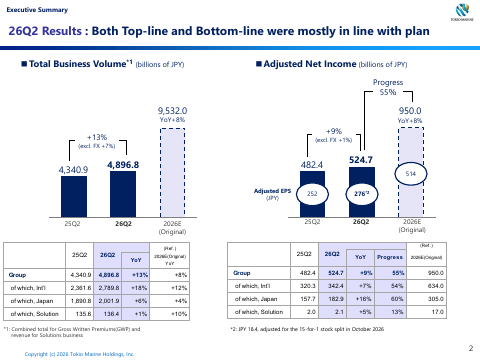
JPY 18.4
Adjusted net income · non-GAAP
524.7 billion yen
up 42.3 billion yen from the same period of the previous year
Insurance service result
695.8 billion yen
up 96.9 billion yen from the same period of the previous year
Segment or metric
Value
Change
Japan insurance business revenue
1,709.8 billion yen
up 74.6 billion yen
International insurance business revenue
2,532.1 billion yen
up 386.6 billion yen
Solution business revenue
136.1 billion yen
up 5.5 billion yen
Japan Life contractual service margin balance
1,145.8 billion yen
down 3.8 billion yen from March 31, 2026
Where each number comes from
Insurance revenue and revenue from Solution business: “Insurance revenue and revenue from Solution business increased by 483.6 billion yen to 4,348.4 billion yen from the same period of the previous year.”
Diluted EPS: “Earnings per share - Basic 15.45 yen 16.79 yen Earnings per share - Diluted 15.44 yen 16.78 yen”
Adjusted EPS (post-split basis): “*2: JPY 18.4, adjusted for the 15-for-1 stock split in October 2026”
Adjusted net income: “Adjusted net income increased by 42.3 billion yen to 524.7 billion yen from the same period of the previous year.”
Insurance service result: “Insurance service result increased by 96.9 billion yen to 695.8 billion yen from the same period of the previous year.”
Japan insurance business revenue: “In the Japan insurance business, Insurance revenue increased by 74.6 billion yen to 1,709.8 billion yen from the same period of the previous year.”
International insurance business revenue: “In the International insurance business, Insurance revenue increased by 386.6 billion yen to 2,532.1 billion yen from the same period of the previous year.”
Solution business revenue: “In the Solution business, Revenue increased by 5.5 billion yen to 136.1 billion yen from the same period of the previous year.”
Japan Life contractual service margin balance: “Contractual Service Margin balance decreased by 3.8 billion yen to 1,145.8 billion yen from March 31, 2026.”
Net incurred natural catastrophe losses, Japan insurance business
FY2026
91.0 billion yen
Key takeaways
North America outperforms as markets soften
Management says its North American business has kept profitability above competitors and stays relatively resilient. Strong small-business specialty underwriting and medical stop loss rate increases offset softening in some lines.
Softening forces premium forecast cuts, not price cuts
North America specialty and EMEA premium forecasts were lowered because of softening, while management keeps bottom-line-focused underwriting. Latin America faces intensifying price competition but still grows in auto.
Greensill litigation fully settled
Settlements with Greensill Bank, Credit Suisse and the remaining plaintiffs ended all related litigation. The remaining reserve development was small and sits in APAC, removing an overhang on International.
Equity sales release capital for higher-return businesses
Business-related equity sales continue until zero holdings in FY2029, and the full-year sales plan was raised from JPY 430bn to JPY 490bn. The released risk capital is redeployed to higher-return businesses, but higher net assets hold ROE near 13% meanwhile.
Japan auto repriced; Japan Life variable product sells
Japan auto average claim cost is rising about 7.5% on inflation, which auto rate increases are meant to offset. In Japan Life, variable accumulation whole life insurance launched in September 2025 lifted new-policy sales, while fire underwriting was tightened for profitability.
What management said
Each quote matches the transcript word for word.
“We are currently seeing the impact of market softening in Europe and the U.S. Although we have built a diversified portfolio that is less susceptible to rate cycles, we are not immune to softening.”
Management openly acknowledges pricing pressure in its core overseas markets.
“Looking at the financial results of our North American peers, we believe our North American business has maintained profitability above that of competitors overall and remains relatively resilient.”
It is a direct competitive claim about the company's largest overseas market.
“we are in the process of reallocating the risk capital released through the sales of business-related equities to businesses with higher ROR, thereby achieving further profit growth and improving ROE.”
It states the core capital allocation strategy behind the equity sales.
How is Tokio Marine responding to softer insurance pricing?
It is keeping disciplined, bottom-line-focused underwriting rather than chasing premium, and lowered premium forecasts for North America specialty and EMEA because of softening.
What is driving growth in International?
Underwriting growth in North America, notably small-business specialty and medical stop loss rate increases, plus yen depreciation. Malaysia and Singapore also performed well in APAC.
What happened with Greensill?
All litigation is resolved, with settlements reached with Greensill Bank in May, Credit Suisse in September and the remaining plaintiffs in October. Only a small additional loss was booked in FY2026.
Why is ROE flat near 13% despite profit growth?
Selling business-related equities realizes unrealized gains and raises net assets, which temporarily pressures ROE until holdings reach zero in FY2029. Management is redeploying the freed capital to higher-return businesses.
What is happening in Japan's auto and Life businesses?
Auto profit is helped by rate increases, though average claim costs are rising about 7.5% on inflation. In Life, strong sales of variable insurance and whole life with a variable accumulation rate lifted new-policy premiums.
Good afternoon and good evening, everyone. I am Endo. Thank you very much for joining this conference call today despite your busy schedules. I also want to express my gratitude for your continued support of Tokio Marine. ⚫ Let’s get started. Please turn to page 1 of the material.
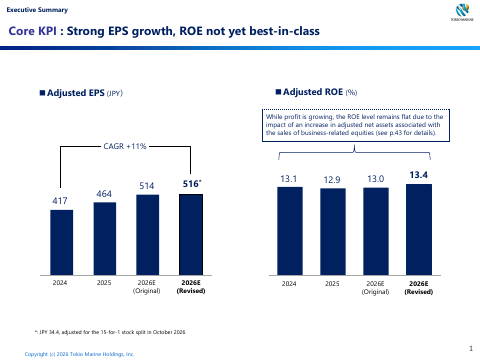
[Core KPI] ⚫ Here are our Core KPIs, EPS and ROE. ⚫ First, EPS, shown on the left. To facilitate comparison with the original projections, I will refer to figures on a pre-stock-split basis. Our revised FY2026 projection is JPY516, up from the original projection of JPY514, driven by profit growth in Japan and International businesses. ⚫ ROE, shown on the right, has also been revised upward by 0.4 percentage points from the original projection to 13.4%. Breaking this down into the numerator and denominator, this reflects steady growth in profit, the numerator, together with a lower-than-originally-projected level of Adjusted Net Assets, the denominator, due to share buybacks and the decrease in the JPY-translated net assets of overseas entities resulting from JPY appreciation. ROE is currently remaining flat at approximately 13%. This is because, as unrealized gains are realized and converted into cash through the sale of business-related equities, net assets, the denominator, increase, creating temporary downward pressure on ROE until we achieve zero business-related equities in FY2029. We appreciate your understanding that we are in the process of reallocating the risk capital released through the sales of business-related equities to businesses with higher ROR, thereby achieving further profit growth and improving ROE. Please also refer to page 43 of the Appendix for details of the ROE trend and calculation.
[FY2026 2Q Results] ⚫ Next, I will explain the 1H FY2026 results. Please turn to page 2. ⚫ Total Business Volume, or the top line, shown on the left, increased by 13% YoY for the Group. Growth in Japan and International insurance businesses drove the
increase, and progress is solid against the 8% growth assumed in the original projections. Within this, International increased by 18% YoY, reflecting JPY depreciation and steady underwriting growth, primarily in North America. Japan, comprising both P&C and Life, also increased by 6% YoY. Overall, the Group is progressing mostly in line with plan. ⚫ Next, Adjusted Net Income, shown on the right, increased by 9% YoY to JPY524.7bn. The progress rate against the original full-year projection was 55%, also in line with plan. ⚫ By business, International recorded a 7% YoY increase in profit despite large losses related to the Middle East conflict and loss reserves development for Greensill. The progress rate against the original projection was 54%, slightly ahead of plan. We are currently seeing the impact of market softening in Europe and the U.S. Although we have built a diversified portfolio that is less susceptible to rate cycles, we are not immune to softening. In this environment, we believe it is important to maintain disciplined, bottom-line-focused underwriting. Looking at the financial results of our North American peers, we believe our North American business has maintained profitability above that of competitors overall and remains relatively resilient. ⚫ Regarding Greensill, I would like to report that all related litigation has now been resolved and concluded. Specifically, we reached settlements on terms that we consider acceptable and reasonable with Greensill Bank in May, Credit Suisse in September, and the remaining plaintiffs in October. Most of the losses had already been reflected in our FY2025 financial results. Although a small additional loss was recorded in FY2026, its impact on the overall performance of International was limited. This loss is included in APAC on the slide. ⚫ Japan increased profit by 16% YoY and achieved a 60% progress rate against the original projection, exceeding plan, due to the impact of auto rate increases and improved profitability in Fire and Specialty, among other factors.
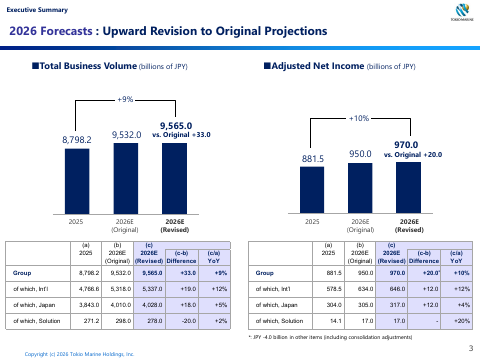
[FY2026 Forecasts] ⚫ Next, please turn to page 3. I will explain our revised FY2026 full-year projections. ⚫ The top line, shown on the left, is projected at JPY9,565.0bn, an upward revision of JPY33.0bn from the original projections and growth of 9% YoY. ⚫ By business, International is revised upward by JPY19.0bn, reflecting strong 1H results, primarily in North America, as well as expected underwriting growth and
rate increases on renewals across entities in 2H. Japan is revised upward by JPY18.0bn from the original projections, mainly due to higher revenue in Japan Life. ⚫ Adjusted Net Income, shown on the right, is revised upward by JPY20.0bn from the original projections to JPY970.0bn. By business, International is revised upward by JPY12.0bn. Despite the impact of the Middle East conflict and Greensill, this reflects lower-than-expected Nat Cats, robust underwriting despite market softening, and higher expected investment income due to higher U.S. interest rates. ⚫ Japan is also revised upward by JPY12.0bn. Although auto loss costs have deteriorated, this reflects lower-than-expected Nat Cats, improved profitability in Specialty, and strong investment performance. ⚫ As has also been reported in the media, cyber incidents have recently increased. Our role and stance as an insurer are described on page 47, and the revised projections reflect the latest conditions.
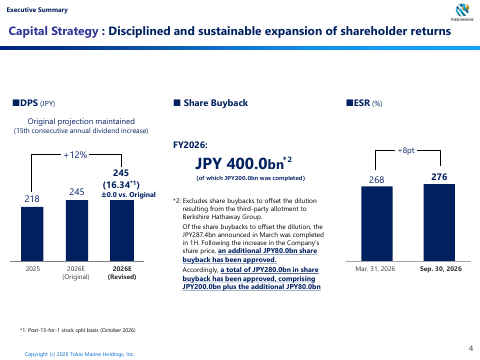
[Capital Strategy] ⚫ Finally, I will explain our capital strategy. Please turn to page 4. ⚫ There is no change in our view that the expansion of shareholder returns should be consistent with our business’s profit growth. ⚫ First, dividends, which are the basis of our shareholder returns. Our basic policy is to continue increasing dividends in line with profit growth. Our standard approach is to apply a payout ratio of approximately 50% to the three-year average of IFRS Adjusted Net Income. However, because this fiscal year marks the transition in accounting standards and the dividend calculation method, we also considered continuity with the previous JGAAP-based calculation and announced an original projection of JPY245. We have decided to maintain this original projection of JPY245. ⚫ Next, share buybacks. In May, we announced a full-year plan of JPY400.0bn, of which JPY200.0bn has already been completed. ⚫ Separately, to offset the dilution resulting from the third-party allotment to Berkshire Hathaway, we completed by July the JPY287.4bn share buyback announced in March. However, because the increase in our share price prevented us from repurchasing the planned number of shares, we have decided on an additional JPY80.0bn share buyback.
⚫ Accordingly, the Board of Directors resolved today to conduct JPY280.0bn in share buybacks, comprising the remaining JPY200.0bn under the JPY400.0bn full- year plan and the additional JPY80.0bn to offset the impact of the third-party allotment.
[Conclusion by CFO Endo] ⚫ That is all for me. ⚫ As we work toward achieving Aspiration 2035, we will continue to steadily implement our management strategies and increase both EPS and ROE through sustainable profit growth, thereby meeting the expectations of capital market participants. ⚫ We very much appreciate your continued support. End of Document