“And as we all know, in multiple sclerosis, with so many options, it starts with safety.”
Explains why remibrutinib's clean safety profile is central to its multiple sclerosis positioning.

Novartis (NVS) · Pharmaceuticals
Results filed 27 Oct 2026 · Quarter ended 30 Sep 2026 · Call 74 min · Vas Narasimhan (CEO), Mukul Mehta (CFO)
Read the transcriptSlides (91 pages)Press release ↗Investor relations ↗
Summaries and transcripts are machine-generated and can contain errors.
Novartis won FDA approval for Rhapsido in a second disease and posted positive remibrutinib multiple sclerosis data, lifting Rhapsido's peak sales target to USD 4bn+.
Priority brands including Kisqali, Kesimpta, Scemblix and Leqvio grew fast enough to more than offset generic erosion, mainly Entresto in the US. Rhapsido, the new oral treatment for chronic spontaneous urticaria (CSU), has treated over 15,000 patients in the US and won FDA approval in symptomatic dermographism. Pluvicto gained US and China approval in earlier-stage prostate cancer, and remibrutinib succeeded in two Phase III multiple sclerosis trials.
Management is steering toward remibrutinib's multiple sclerosis filing, Pluvicto's earlier-stage launch, and bolt-on deals in oncology, radioligands and RNA. It will update its 2026-2031 outlook at its November investor event. The main tension is that the pipeline lost ground on del-desiran and pelacarsen, while generics in Europe and Xolair biosimilars add pressure, so near-term growth rests on launches executing.
Open the slide deck (PDF, 91 pages) ↗
Showing the first 6 of 91 pages.
From Novartis investor relations
SEC filing
up 4% from a year ago (+4% cc)
down 70% from a year ago (-71% cc)
down 69% from a year ago (-70% cc)
up 9% from a year ago (+8% cc)
down 59% from a year ago (-61% cc)
up 2.3 percentage points from a year ago
up 11% from a year ago (+10% cc)
down from USD 6.6 billion a year ago
| Segment or metric | Value | Change |
|---|---|---|
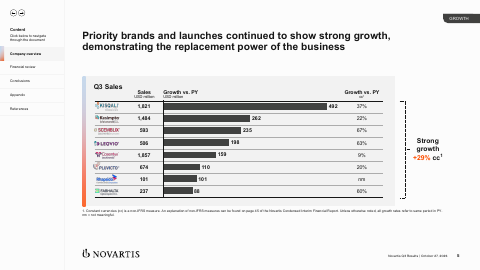
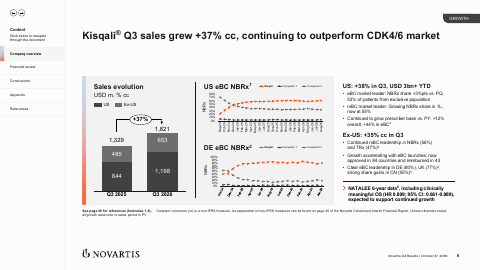
| Kisqali | USD 1 821 million | +37% cc |
| Kesimpta | USD 1 484 million | +22% cc |
| Scemblix | USD 593 million | +67% cc |
| Leqvio | USD 506 million | +63% cc |
| Cosentyx | USD 1 857 million | +9% cc |
| Pluvicto | USD 674 million | +20% cc |
| Rhapsido | USD 101 million | |
| Zolgensma Group | USD 404 million | +35% cc |
Copied from the press release ↗ and other documents in the SEC filing ↗. A figure is published only if its sentence is in those documents.
| Metric | Period | Outlook |
|---|---|---|
| Core net financial result (expense) | full year 2026 | around USD 1.7bn |
| Core tax rate | full year 2026 | around 16.5% |
| Sales CAGR (cc) | 2025-2030 | 5-6% |
| Rhapsido peak sales in CSU and CIndU | peak sales | USD 4bn+ |
The FDA approved Rhapsido for symptomatic dermographism, the first treatment for that condition, and Novartis plans global filings across three subtypes of chronic inducible urticaria in Q4 2026. Prescribers overlap fully with CSU, and peak sales guidance rose to USD 4bn+.
Both Phase III REMODEL trials met their primary endpoint, with no liver safety signal, and a US filing with a priority review voucher is expected by year-end. Management sees it as a USD 4bn+ medicine in multiple sclerosis, on top of the urticaria opportunity.
US and China approvals in earlier-stage disease complete the label, but management expects only modest uptake in Q4 and acceleration in 2027. The patient referral pathway, treatment site access and a 5-10 week lead time shape the ramp.
Del-desiran missed its Phase III primary endpoint in DM1 and will probably need another Phase III, while pelacarsen missed in elevated Lp(a) cardiovascular disease and will not be submitted. Novartis reaffirmed its 5-6% sales CAGR through 2030.
Priority brands grew 29% and Kisqali, Kesimpta, Scemblix and Leqvio all grew strongly, offsetting Entresto and Promacta generic erosion. Kisqali's six-year NATALEE overall survival data is meant to defend its early breast cancer position against a competitor.
Each quote matches the transcript word for word.
“And as we all know, in multiple sclerosis, with so many options, it starts with safety.”
Explains why remibrutinib's clean safety profile is central to its multiple sclerosis positioning.
“So we really think next year is when we'll see further acceleration with the HSBC launch.”
Sets expectations that Pluvicto's earlier-stage prostate cancer launch ramps in 2027, not this year.
“we do believe that physicians trust endocrine therapy that they've had established for many years, maybe more than is currently being assumed in the market.”
Lays out Novartis's defense of Kisqali in early breast cancer against a new competitor.
“we can do the M &A deals that we find attractive and maintain share buybacks.”
Clarifies that Novartis sees business development and buybacks as compatible, shaping its deal appetite.
Management expects fewer generic headwinds and continued growth from Kisqali, Kesimpta, Leqvio, Pluvicto, remibrutinib and ianalumab, but will give detailed 2027 guidance in January. — Vas Narasimhan, Mukul Mehta
The idea is to show that remibrutinib can maintain control after an anti-CD20 has managed inflammation, without B-cell depletion and in an oral form, with further switching studies being considered. — Vas Narasimhan
Productivity is a core pillar, with SG&A down 7% against 4% sales growth, and third-party spend of upwards of $11 billion a year targeted, including through AI. — Mukul Mehta
ORION-4 is event-driven and was partly run during the pandemic, V2P reads out next year, and management expects both to support Leqvio's USD 4 billion-plus outlook. — Vas Narasimhan
Novartis remains committed to 40% by 2029, driven by SG&A productivity against generic and Xolair biosimilar headwinds, and sees no impact on site behavior from the proposed regulation. — Mukul Mehta, Vas Narasimhan
Novartis is analyzing the data, expects to need another Phase III, and says the impairment reflects the timeline shift with similar probability assumptions. — Vas Narasimhan
Label discussions with the FDA are ongoing, and Novartis expects an action before year-end. — Vas Narasimhan
Uptake should be steady but slow as physician behavior changes, with Japan and China adding growth and no change to peak sales; the competitor data cannot be judged yet because the programs and mechanisms differ. — Vas Narasimhan
Novartis named several programs and plans to highlight one to three assets per therapeutic area, but reserves peak sales for drugs with an approval and will update them for growth drivers. — Vas Narasimhan
It does not need competitor Lp(a) readouts and is still assessing patient segments and trial design, and any IL-6 trial in post-ACS patients would be high risk, high reward. — Vas Narasimhan
Novartis only counts peak sales for indications that have read out positive in Phase III, so the HS readout and others would inform further updates. — Vas Narasimhan
The safety assessment and regulator engagement should take a few more months, with a hope to restart studies next year. — Vas Narasimhan
They are not about the endpoint, which is robust, but about how best to describe which patients benefit most. — Vas Narasimhan
Efficacy in the range of biologics for a safe oral drug would be attractive, but results will hinge on how the placebo group behaves, with two readouts expected before the November investor event. — Vas Narasimhan
Novartis will give 2027 guidance with Q4 results, and says SG&A as a percentage of sales is where margin improvement toward 40% by 2029 comes from. — Mukul Mehta, Vas Narasimhan
Buybacks, dividend growth, core investment and mostly bolt-on M&A under $2 billion all remain priorities, with the USD 10 billion buyback pace modulated by market conditions. — Mukul Mehta, Vas Narasimhan
Anti-APRIL drugs are now the IgAN standard of care, so Novartis is tailoring positioning by geography, with strength in Japan and China, while continuing to develop its ADPKD and rare renal programs. — Vas Narasimhan
Growth is broad, and Novartis points to physician trust in endocrine therapy, its OS data, combination data and ex-US strength to support its USD 10 billion peak sales guidance. — Vas Narasimhan
No Q4 impact is expected, and timing will vary country by country as Novartis seeks injunctions to defend its patents. — Vas Narasimhan
Novartis sees no impact from injectable competitors, is watching a possible competing subcutaneous launch, and does not expect disruption to Kesimpta's peak sales outlook. — Vas Narasimhan
An FSHD FDA meeting is expected before year-end to argue for accelerated approval, and a pelabresib accelerated approval discussion is also expected before year-end. — Vas Narasimhan
Novartis expects profit contribution to fall as biosimilar activity grows and sees margin pressure over the next couple of years, though limited biosimilar impact would limit that pressure. — Mukul Mehta
Novartis does not see a trade-off, since free cash flow supports attractive deals and buybacks together. — Vas Narasimhan
Rhapsido gained FDA approval for symptomatic dermographism, the most prevalent form of chronic inducible urticaria, and Novartis raised its peak sales guidance for Rhapsido in CSU and CIndU to USD 4bn+. Remibrutinib also met its primary endpoint in two Phase III multiple sclerosis trials.
Priority brands grew 29% and led growth, including Kisqali, Kesimpta, Scemblix and Leqvio, more than offsetting generic competition, mainly Entresto in the US. Novartis calls this the replacement power of the business.
Pluvicto is now approved across all stages of PSMA+ metastatic prostate cancer, with US and China approvals in the earlier setting. Management expects some Q4 uptake but acceleration mainly in 2027, with no change to peak sales.
Del-desiran missed its Phase III endpoint in DM1, leading to a USD 1.9 billion partial impairment, pelacarsen missed in Lp(a) cardiovascular disease, and the remibrutinib myasthenia gravis study was stopped for futility. Novartis reaffirmed its 5-6% sales CAGR outlook to 2030.
It completed the Myricx acquisition, exercised an option on Sironax's brain delivery platform, and licensed assets in radioligands and RNA-encoded therapeutics. It will present updated 2026-2031 guidance at its November 18-19 investor event.
Call recording on YouTube ↗. Official replay ↗. Timestamps jump to the moment.
Thank you, Sharon. Hi, everyone, and welcome to our Q3 earnings call. Let me briefly read the Dave Harper statement before we can begin. The information presented today contains forward-looking statements that involve known and unknown risks, uncertainties, and other factors. These may cause actual results to be materially different from any future results, performance, or achievement expressed or implied by such statements. For a description of some of these factors, please refer to the company's Form 20S and its most recent quarterly resizing Form 20K that respectively were filed with and furnished to the U .S.
Security and Exchange Commission. And with that, I'll hand over to Bob.
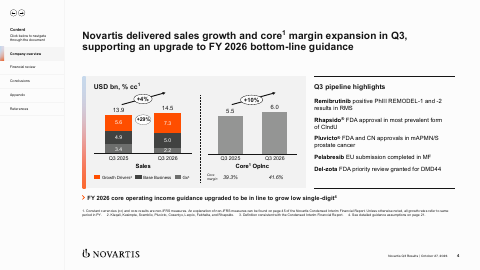
Thank you, Isabella, and thanks, everybody, for joining today's call. If we could move to slide four. So in the quarter, although one second, we're just getting our slides moving here. In the quarter, Novartis delivered sales growth and core margin expansion, and that supported an upgrade to our full year 2026 bottom line guidance. You can see sales were up 4 % in constant currency. Core OpBank was up 10%.
McCool will go into the numbers in more detail, but we also had a good margin performance in the quarter. A number of important pipeline milestones, notably, of course, as you all know, the Remi Brutenev data, but also Rhapsido received FDA approval. Pluvicto also with important approvals in the U .S. and China for HSPC. pelabresib was also filed in Europe. And Del Zona received FDA priority review for DMD44. for. Overall, this allowed us to increase our guidance, and we'll go through that in a bit more detail on the call.
So moving to the next slide. Priority brands continue to perform well in the quarter. They were up 29%, very strong performance across Kisqali, Kesimpta, Scemblix, and Lectio, a solid quarter from Cosentyx. Pluvicto, we're still in the midst of launching in HSBC, so we haven't seen that pick up yet, and we'll talk more about that in a bit. And Rhapsido, also with a very strong performance as well in the quarter. Moving to slide six, Cascali grew 37 % and it continued to outperform the CDK 4.6 market.
You can see that our EBC shares, both in the U .S. and Germany, are very stable and at a very healthy level. Turning to the U .S., first, 38 % growth in the quarter, $3 billion year to date. We are the leader in EBC, and our NVRX share was up three points versus prior quarter. 53 % of the patients now on Qiskali are from the exclusive population. In metastatic, we're continuing to grow our NVRX share in first line, which is now at 55%.
And we continue to grow our prescriber base as well. It was up 12 % versus prior year and up 44 % in early breast cancer. Outside of the U .S., we had 35 % constant currency growth, continued leadership in metastatic breast cancer. Our growth is accelerating now in many of our key markets with the early breast cancer launch, now approved in 84 countries and reimbursed in 43 countries. And I think some of the benchmarks that demonstrate the performance, Germany 80%, EBC share, UK 77%.
In China, relatively recently after the launch, already reaching 55%. We also released a few weeks ago last weekend the Natalie's six-year data, which showed a clinically meaningful overall survival with a hazard ratio of 0.809. And we expect that data to continue to support our growth in the adjuvant setting. I think notably, having that OS data and showing that CDK4-6 combined with endocrine therapy in those Node 0 and Node 1 patients gives us a strong case to have physicians provide patients with CDK4-6 inhibitors like cascally.
Casimpton grew 22%, fueled by strong demand. U .S. growth was up 21 % in the quarter. Our TRX growth is outpacing the market. We were up three points overall in the MS market to 16 % share. We were up four and a half points in the B-cell class, getting to 27 % share. We see a continued trend to prescribing the medicine earlier and earlier lines of therapy. 77 % of our NBRXs now are first-line or first-switch.
Outside of the U .S., also very solid performance. We have 80 % of EU4 patients are from first-line, first-switch, and we see strong growth across Europe as well. We continue to generate evidence to demonstrate Cosimpta's activity in various lines of patients as well in longer-term follow-ups. I think that just allows us to continue to support this medicine and very strong performance. Moving to slide eight, Povicco grew 20 % in constant currencies. It was driven more by the ex-US momentum as well as by U .S.
pre-taxing growth. The U .S. was up 9 % in the quarter. That's primarily driven by the MCRPC pre-taxane setting, with use predominantly after the first ARPI. The first-line NBRX share is up 15 % now, and we expect further share gains over time, and that remains our top priority to continue to drive that early utilization in the MCRPC setting. We are in the very early days of the PSMA Edition launch, and I'll cover that in a little bit further detail on the next slide.
Outside of the U .S., we see great performance, 68 % growth. We see accelerating adoption in Europe and many of our key markets, Canada and Japan, as well as early momentum in China. Japan became the fastest market to reach 1,000 patients, supported by ongoing site expansion, and also we are building a facility there. China, we had the approval of the PSMA addition indication in August, and I would expect that to support growth as well. So moving to slide nine, turning to the PSMA addition launch, I think first it's important to highlight the strong foundations in place for the brand.
Two-thirds of hormone-sensitive prostate cancer patients are managed by physicians who are already using Plavicto or are connected to established referral pathways. We see broad treatment capacity with 9 out of 10 patients within 30 miles of a site. And we're also continuing to address the non-clinical barriers you can see are the images of both the availability of an infusion and the scaled availability of the pre-fold syringe. It's important to note we expect about five to ten weeks of lead time for new patients to be treated, a combination of doing the testing required as well as the scheduling.
We do expect the fastest uptake in high tumor burden patients as well as the de novo patient segments where there is unmet need versus the current standard of care. We also expect continued expansion in the community, particularly in urology. Overall, I think we're encouraged by the early uptake indicators, but we do think through quarter four we will see some uptake, and also important to note we will hit the holidays, Thanksgiving and Christmas. So we really think next year is when we'll see further acceleration with the HSBC launch.
Leqvio continuing to perform extremely well, up 63 % in the quarter. And this is demand around the world. In the U .S., we're up 60%, 60 % outgrowing the advanced lipid lowering market. Our multi-TRX growth going well ahead of the market and our main competitor. And I think that's in part driven by Leqvio's persistency and the high compliance rates we're seeing. We see very strong performance in Medicare, which is a good indicator of our performance in buy and build.
We're up to now 22 % share. We also see increasing depth in our key healthcare systems, and we really focus on patients post-event where there's a high propensity to want to get patients to their LDL goals. And then we also had our U .S. label updated with a cardiovascular outcome statement, and we're on track for the Orion 4 and B2P readouts that are expected in quarter four and in 2027, respectively. Outside of the U .S., 65 % growth.
China growth continues post-NRDL, and we've noted previously very strong growth in China. as well as sustained growth in Europe. And then we're continuing to expand the elective evidence base. The challenge was presented, which showed LDLT lowering better, is superior to pempadoic acid. Moving to slide 11, Semplex was up 67%, driven by strong U .S. momentum. In the U .S., we continue to see very strong performance in first line. We have reached 33 % share. And so you can see we're edging towards market leadership.
We're really at market leadership now. And we're maintaining leadership as well in later lines where we expect continued shift in the treatment mix from second, third line towards first line. So very pleased with the U .S. performance. Outside of the U .S. as well, we're building off a very strong third line leadership where we have 77 % share across key markets. The early line indication is now approved in 69 countries outside of the U .S. Japan has sustained first-line NBRX leadership at 56 % share, and Germany already at 33 % share.
So very excited about the trajectory of semblance as we move forward. Now, Cosentics have a solid quarter, up 9 % in constant currencies. I think when you net out some of the growths, we're in the mid-single-digit growth range, so I think that's very solid performance with growth in both HS and the SPA indications. In the U .S., you can see our HS share is very stable in the high 40s. The spa business is remaining resilient, so you can see as well in the bottom panel here, our share is steady at 14%.
Outside of the U .S., continued growth in Europe and most emerging markets, stable in China. And we expect continued indication expansion as we move towards the end of the life cycle for Crescentic. PMR, polymyalgia rheumatica, was approved by the European Commission. We expect the FDA decision in quarter four. And the HSIV was added to the label as well in October. Now, Rhapsido has had really strong launch momentum. You see that in quarter three. And we also had the additional approval of symptomatic dermographism, which covers about two-thirds of patients with chronic inducible urticaria.
Let's start with CSU. We continue to see the launch trajectory in the U .S. on a steady, strong pace, over 6,000 subscribers split between allergists and dermatologists, over 15,000 patients treated. Our NDR share is about 26 % and that's up about three points for prior quarter. We've been very disciplined with the contracting, so that performance is in the context of about 50 % access to label. We do expect further access expansion over quarter four and into 2027.
And, of course, as that access expands, we expect continued acceleration on the sales. Outside of the U .S., we're now launched in seven markets, and we're steadily getting reimbursement step-by-step, market-by-market. We do see strong early uptakes in Germany and China. When you turn to inducible urticaria, as a reminder, symptomatic thermographism, This is the first ever approved treatment for this condition. There's about 100,000 U .S. Sindhu patients who are uncontrolled on antihistamine out of about 500,000 patients total, and two-thirds of those with ST.
We have 100 % overlap with the CSU prescribers, so that should enable us to get to a very efficient launch. And we're already rapidly working towards filing the medicine across all three subtypes around the globe. So we're upgrading our peak sales guidance for Rhapsido and CSU and Sindhu combined to over $4 billion. And moving to the next slide, we had some important readouts in the quarter, which you're well aware of. Remy Brudinib, hopefully many of you heard the call on Friday, so you know well.
So I won't belabor, but we'll go a little bit into further review on the next slide. But we were really pleased with the results. We show that we achieved disease control with outstanding, consistent safety. and the FDA submission is on track for quarter four with a priority review voucher. del-desiran, we didn't meet the endpoint in Harbor, but we did have the evidence of clinical activity in the secondary exploratory analyses. We'll present that data in an upcoming Medical Congress.
We're doing a lot of work now to prepare the next steps and engage with health authorities to chart out the next right steps for the development of the medicine. We did take a partial impairment charge of $1.9 billion, primarily driven by the timeline shifting out by the additional clinical work that needs to be completed. And then lastly, pelacarsen, the Phase 3 of Horizon, a study did not meet its primary endpoint. We will have that full data set presented at AHA and published in a major medical journal, and I think that will provide further insights into that data.
Further development of DII-235, our once-annual FR &A for LT-LLA, is still under consideration. All of that taken together, we reaffirmed our 5 % to 6 % constant currency sales guidance for 25 % to 30 % and our mid-single-digit constant currency long-term growth outlook. We've done all the modeling. We feel very comfortable with those numbers. And turning to remodel, remirutinib, you know, we were really pleased with this data. It delivered comprehensive disease control.
You can see here on the left all the data that was reviewed, including the six-month PIRA, so independent of relapse progression impact reduced by 30%. Very favorable safety profile, robust, consistent, no liver signals, no infection imbalances, nearly 50 % fewer discontinuations due to AD immunomodulation without B cell depletion. And as we all know, in multiple sclerosis, with so many options, it starts with safety. And if you can't demonstrate a clear, clean safety profile, understandably, a neurologist will look for other options.
So we think having that safety profile and then showing disease control is why we're so excited about the medicine. So the filings are ongoing, as I already mentioned. And if you go to slide 16, as a quick review for anyone who is not on the call, we see an opportunity in the naive population. So that's about 30 % of that naive population we think would be open to take a medicine like remebrutinib. In the oral switch population, 40 to 100 % of patients over time could prefer remebrutinib given its excellent safety profile and comprehensive disease control.
We expect over time as patients are fully controlled under anti-CD20s, patients who might want to be switched to an oral medicine, about 45 % of those patients in the U .S. And then the other segment, which is some of the older injectable medicines, over time we hope to be able to address 100 % of that patient population. Outside of the U .S., we estimate about, you know, around 38 % is addressable. All of that taken together gives us confidence in a $4 billion-plus medicine with a further upside with the non-relapsing SPMS population.
And as well, we will read out data in two years on the Ocrivus switch data, which could provide further momentum to these forecasts. Now, going to slide 17, I won't go through the slide in detail, but just to highlight, we have multiple readouts coming out in 2026 and a strong catalyst path for 2027. We can cover it on the call with your questions, but all of the milestones that we have for the remainder of this year as well as next year are on track.
So moving to slide 18, and with that, I'll hand it over to Ms. Paul.
Thank you very much, Vass. Good morning, good afternoon, everyone. I will now share more details on the financials for the quarter. And as a reminder, my comments, as always, refer to growth rates in constant currencies, unless otherwise noted. Moving to slide 19, yeah. So in the third quarter, net sales grew 4 % to $14.5 billion, while core operating income grew 10 % to $6 billion, mainly driven by our growth drivers as well as continued productivity in our business.
Order 3 core operating income margin was at 41.6 % of net sales. This is an increase of 2 percentage points versus prior year and this is mainly driven by gross margin improvements as well as continued productivity initiatives primarily in our SG &A business, SG &A part of our business. core EPS grew 8 % to 2.46 dollars on a reported basis in quarter 3 operating income was operating income was negatively impact was 1.8 $1 billion which is a decline of 61 % mainly due to higher R &D expenses the higher R &D spend includes the 1.9 billion dollar partial impairment of Delta Ceron this impairment follows the phase three harbor readout in DM1 and it reflects our
updated assessment of the value of the asset as we evaluate the full data set and engage with the health authorities on the future development path for the product net income for the period was at 1.2 $1 billion which was a decline of 71 % mainly due to lower operating income and higher interest income and free cash flow for the period was at 5.1 $1 billion which is bellow prior year primarily due to lower net cash flow coming out of our operating activities for the first nine months of the year net sales were flat and co-operating income declined 2% core operating income for the nine month period was a decline of 0.8 percentage points and free
cash flow for the same period was at $14 billion moving to slide 23 we remain committed to our shareholder friendly capital allocation strategy balancing discipline growth investments in the business with meaningful capital distribution back to our shareholders in quarter three we completed the acquisitions of my bio adding to our early stage oncology pipeline we also exercised our option to acquire zero access blood-brain barrier delivery platform and at the same time we continue to invest in our internal R &D programs on capital distribution front in the first nine months of the year we have now repurchased 2.8 $1 billion worth of our shares under the current up to 10 billion dollar share buyback program please note we still
have 4.9 $1 billion of the program still to be executed slide 21 moving to guidance so given us very strong bottom line performance in the quarter we are raising our full year 2026 guidance for co-operating income we now expect for the full year 2026 co-operating income to be in line to growing low single digits for reference this is an upgrade from the previous guidance of co-operating income of low single digit decline for the full year at the same time we are maintaining our full year guidance of net sales expecting to grow net sales at low single digits for the year for 2026 we also continue to expect core net financial results to be an expense of
1.7 $1 billion and the core tax rate to be around 16 and a half percent this is in line with our previous guidance this one moving to slide 22 so beginning of the year we talked about 2026 the year of two halves and with this quarter really with this quarter reading out pretty much sticking to that outlook as a reminder in h1 net sales declined 2 % co-operating income declined 7 % both were impacted by the US interest or generic erosion with a strong QC delivery we now expect a stronger H2 performance for H2 we expect net sales growing with mid to high single digit and core operating income growing high single to low double digit.
After stepping up in Q3, quarterly sales growth is expected to accelerate further in Q4 as we move beyond the impact of the US interest to generic erosion. On the core margin, we do expect a decline in Q4 versus Q3. This reflects the typical year-end phasing of our spend. Also higher royalties as growth driver scale-up would play a part and finally we will also see the impact of lower other income as a result of the Zoller biosimilars in the US.
As a reminder for 2027 we will provide our full year guidance with a Q4 results in February next year. Moving to slide 23. If exchange rates remain at late October levels we expect positive one percentage point impact on the full year net sales and a positive one percentage point impact on our full year co-operating income. If these rates also prevail in 2027, we would expect a negative one percentage point impact on top line and no impact on co-operating income.
As a reminder, we publish updated FX estimates monthly on our website. And that concludes my remarks, and I will hand it back to us.
Great, thank you, Mukul. Thank you, Mukul. So turning to slide 25, we delivered strong growth in the quarter, driven by our priority brands and launches, which really shows the replacement power of the business. We've been able to successfully navigate the entrusts of Sigma from ACTA X-Breeze in the U .S., demonstrating we grew through the year.
We will grow through the year, which I think really shows the power of the company. We advanced the pipeline with positive readouts for our RMS and for Rhapsido, as well as the Plobicto label expansions. We're upgrading our full-year guidance for core operating income, and we remain on track to deliver our midterm guidance of 5 % to 6 % sales in 2025 to 2030 and our long-term growth outlook. If you go to slide 26, we're excited to also host, hopefully, many of you at Meet Novartis Management.
We will provide an update on our midterm guidance from 2026 to 2031, as well as our long-term growth outlook. We'll update our peak sales potential for key growth drivers. We'll also focus on our mid - and late-stage pipeline assets, which we believe will support our long-term growth. We'll have, as usual, breakout sessions by therapeutic area, and we'll also have a panel session on AI in R &D. So we'll look forward to seeing you there.
And with that, we can open the line for questions.
To ask a question, you will need to press star 1 and 1 on your telephone and wait for your name to be announced. Please limit yourself to one question and return to the queue for any follow-up. To restore your question, please press star 1 and 1 again. We'll now take the first question. And the first question today comes from the line of Saxon Jane from Bank of America.
Please go ahead.
Hi, thanks for my question. Maybe I'll just kick off this one of you. It's usually helpful to hear pushes and pulls. The 27 growth, so number of launches next year, perhaps some calm what you're most excited about. Limited LOE, it seems, into next year. So just to wrap the question, is the implied 4Q sales growth rate the best possible you have to think about at 27?
Yeah, thanks, Sachin. I think overall, when you look at next year, as you say, we have less generic headwinds.
We will be navigating the Entrust of Europe headwinds, which will just navigate country by country. And so I think that's important to factor in there. But we do expect continued dynamic growth from our key growth drivers, brands like Cascali, Cisemta, Lifebeo, Plovicto, HSPC. Of course, Remi Brutinib and CSU and Sindhu showing acceleration. We'll also have Semblix. And then, of course, we'll also expect the Inalumab launch as well. So a number of things that will provide us the opportunity to have a strong 2027.
I mean, I think it's important to note in quarter four, we are lapping a number of growth to net dynamics in the previous year. So I think it'd be best for us to provide more detailed guidance as always in January. But I'd say overall, we do expect to get back to where we were dynamic growth in 2027.
Next question, operating. Your next question comes from the line of James Gordon from Barclays. Please go ahead.
Hello, James Gordon from Barclays.
Thanks for taking the question. So I noted the comment on the OQAVAS to Remy switching study and the focus on switching on Friday's call. But can you just talk, assuming the approval, what do you think the initial rationale for switching would be? And then what do you hope the trial will show? because with caveats of cross-trial comparison, I know the percentage of naive patients might make a difference. OQFIS does look a bit more effective in terms of relapse and disability, but is that just due to different patients?
So what's a good outcome on the trial, and what would that show?
Yeah, absolutely. So, I mean, I think it's important to note, obviously, we have to run, you know, complete the study, but our expectation is that once an anti-CD20 manages the inflammation, particularly in controlling from an MRI standpoint the overall inflammatory burden on the patient, that remebrutinib's ability to manage disease, achieve disease control, particularly when you look at the disability progression and the PIRA, without complete depletion of B-cell antibodies, which has advantages for patients, or if patients no longer want injectable therapies.
So the idea would be to show patients once they're under control with the anti-CD20 that we can maintain control with MRI as well as other measures. And I think that would give you the opportunity to kind of treat and then maintain, you know, with Remy. We're certainly also evaluating to do additional studies, again, with all of the NTCD20s, just to demonstrate that Remy can control regardless of the NTCD20. And I think when you have patients that have been on NTCD20s for five to eight years, there is a desire for many patients, you know, And we put our estimates in our forecast to get control through a safe oral medicine.
But we're also equally excited by new starts in patients who don't want it to start on an anti-TD20, switching oral patients who are not feeling like physicians are not comfortable with the level of control, or also switching older injectable patients onto Remy. So we think we have many opportunities to grow this brand. Next question.
Your next question comes from the line of Simon Baker from Rothschild & Co. Redburn. Please go ahead.
Hello, it's Michael on for Simon.
Thank you very much for the commentary on the SG &A line in 3Q and I appreciate the seasonality in 4Q but I'm just wondering what the durability is of that cost reduction and how we should think about that line going forward. So Mukul?
Yeah, thanks for the question. So productivity remains a very, very strong key pillar of how we run the company. If you look at SG &A for the quarter, we've actually seen SG &A 7 % lower in Q3 versus previous year, while the company from a top-line perspective has shown a growth of 4%.
So this will, as we have previously said, focus on driving the company forward while looking at productivity, SG &A productivity in particular, as means for us to get to those profit margins of 40 % plus by 2029 latest would remain a focal point for the company. We've also, starkly we've said, we are spending upwards of $11 billion every year on third-party spend. And this is the year, the last couple of years, I think the extreme focus on those cost categories which includes things like agency cost travel cost consulting or professional services cost and trying to get some of these categories we know have been significantly impacted by use of technology use of AI and to get both from a
demand as well as cost perspective our fair share of the benefits that these categories are deriving is leading us this productivity advantage which is very durable as we look forward from an outlook perspective for the company. Perfect. Thanks, Makul. Next question. Thank you.
Your next question comes from the line of Florence Sespides from Odo BHS. Please go ahead.
Good afternoon. Thank you very much for taking my question. Florence Sespides from Odo BHS. A question related to Leggeo.
Now the Orion 4 results are expected by the end of this year. Could you come back on why it is earlier, it's even driven? And also, could you remind us what kind of profile there is for this product? And if the results are positive, is it fair to assume an acceleration of the sales next year for this product?
Yeah, thanks, Laurent. So we have two studies. We have the Orion IV, and then we have the Victorian II Prevent.
Both are looking at outcomes. Orion IV focused primarily in the U .K. The Victorian II Prevent is a global study. We expect Victorian II Prevent to read out next year. I think both studies were designed in such a way to really look at, if you look at the fixed time, So falling up over a fixed time point, but holding for much longer than the competitor PCSK9s, could you demonstrate a greater CVRR than the high teens that the other PCSK9s demonstrated?
So we'll see how that works. It's important to know Orion IV was partially conducted during the pandemic. So I think that's something we're going to have to see how that data plays out. Nonetheless, we would expect both of these studies, given the cholesterol lowering for L .A .L. lowering is so clear to ultimately read out positive. And I think it would support the continued growth of L .A .B. We've guided it to be a $4 billion plus medicine, very strong and dynamic growth around the globe.
You're seeing that in the U .S. You're seeing that in China. And we're certainly looking at the peak sales potential of the medicine longer term. So I think certainly the outcome studies would support that. We also have V1P, which is the primary prevention outcomes trial, which we would expect to read out in 2029. So a number of things I think that can support, a number of readouts that can support the longer term growth of LifeBO. Next question, thanks Ron.
Your next question comes from the line of Graham Parry from CIGI Group. Please go ahead.
Great, thanks for taking your question. So you now have two quarters in a row with margins of 40%. I think the guide has been a suggestion to return to above 40 by 2029. So can you maybe just talk to how we can see that progressing into next year? Could you see 40 % earlier than 2029 and maybe even into next year?
And then if I could just throw in a quick follow-up on the Victo, and do you see any potential impacts of the draft proposed new DGAT70 guidelines for patient release after radioligand therapy and any impacts on the ability of sites to administer radioligand therapies in general?
Thanks, Graham. So on the margin, Mukul.
Yeah, thanks for the question, Graham. So we remain confident on our commitment to get to 40 % margin by 2029. And the main drivers of getting for us to get back to that would be continued momentum on the top line as well as continued productivity movements.
And as I've previously answered, I think most of it would come from SG &A as a percentage of sales. Now, what we have to understand is what mentioned previously, I think during this time, we'd also have to deal with interest of XUS geneticization, as well as the US Zoller biosimilar competition coming and hence impacting other revenue, which is essentially pretty much a dollar on other revenue, all comes down to the bottom line. So I think give or take, we're talking of between two to two and a half percent percentage of erosion to deal with from this other revenue perspective so I think yes we've had a fantastic performance year-to-date I think a year-to-date numbers of 40
.1 percent from a margin perspective but we do expect Q4 to be lower as it is always been with the spend going up in Q4 and then from there on I think we would see continued investment in R &D continued productivity measures especially on the SG &A line, erosion on the margin as a result of other revenue wiping off or other revenue because of Xolair biosimilar wiping out, and then we're getting back to 40 % latest by 2029.
And then, Graham, on the pool, Victor, we don't see an impact from this regulation. I mean, we did provide input, so we don't see, you know, any changes in site behavior from what we can tell. Certainly, we're working with the authorities to continue to educate them on the appropriate standards for radiation exposure and manage that appropriately. But we don't see that. And if anything, we're having ongoing programs to look at Pluvicto re-administration in multiple settings.
So it could be given an HSBC and an MCRBC to give physicians more confidence that they could use Pluvicto and not have to reserve it for patients who are further progressing. So I will keep you of course posted if we see anything different, but at the moment no impact from those regulations. Next question.
Your next question comes from the line of Terry Holford from Berenberg. Please go ahead.
Thank you for taking my question. I wonder if you could give us a little bit more insight into the plans post-Harbor.
Are you considering different endpoints and updates on the timelines? Also on the impairment, noting it was only around a quarter of the total carrying value, perhaps the price up to not the largest. So you did mention the delay to launch. Was that the key reason for the write down? There should be a few. there's been minimal change to your probability assumptions, your peak assumptions for that product.
Yeah, thanks, Gary. So, you know, with cell difference, early days, I think it's hard for us to, I think, give you too much blood.
What we're doing is a deep analysis of the trial data and really trying to learn as much as we can. We have an ongoing open-label extension, which is also providing us further insights and using that to further understand the profile of the medicine. And I think that will inform our approach for the next steps in development. So I think once we have clarity and really alignment with regulators, we'll provide updates on what that next study will look like.
We still assume we'll need to do another Phase III study to ultimately bring the medicine to patients. In terms of the math for the write-off, I mean, when you have to do an additional study, Of course, the phase three program, you know, the timelines are the timelines. We assume a similar probability of success.! We, of course, make various assumptions. The scenario assumptions with respect to competition, and that's how we arrive at the number. I would note that we also, when we have accelerations, it may not always be the case, we mark up assets as well.
So, I mean, I think this is, I wouldn't read too much into these numbers. I think it's more important that we just keep working as fast as we can to get the medicine forward to patients, and that's what we're focused on. Next question.
Your next question comes from the line of Steve Scarlett from TD Cowan. Please go ahead.
Thank you so much. On the second quarter call, Novartis said that Ionalumab was on track for a Q3 approval.
So we're now a third of the way through Q4 and no news. On the second quarter call, the company also referred to data FDA was requesting, so real-time requests at least as of that point. So curious on the reason for the delay and what is the outlook.
Yeah, thanks, Steve. So we're in ongoing label discussions with FDA and providing them the analyses that they're requesting to finalize their review, as well as to support them on their approach to labeling.
We do expect an action by the end of the year. So I'd say everything is on track, and we're providing that information on a real-time basis, and we'll look forward to giving you an update, but we do expect the action before the end of the year. Next question.
Your next question comes from the line of James Quigley from Goldman Sachs. Please go ahead.
Great. Thank you for having my questions. On Plavicto, you flagged the speed of uptake for PSMA Edition, which is helpful, but for the past four quarters or so in the US, sales have been flat.
So is the PSMA 4 indication sort of fully penetrated from a Romeo perspective in the US? How should we think about the impact here with respect to PSMA Edition? So should we expect a similar pattern with a step up in Q4 or the first half and then to plateau relatively quickly and then ex-US will drive most of the growth? So interested on how you think that's going to play out, particularly with respect to Europe, following the withdrawal of the application for PSMA edition.
And also a very, very quick follow-up on Steve's question on Yanomab. How do you expect the market to develop given the positive data from a competitor? I know we haven't seen their S-by benefit, but how are you thinking about the potential scenarios around that?
Yeah, thanks, Steve. So on Fluvicto, I think there's a couple of dynamics. We see most of the demand, as I noted, in the MCRPC setting, and we continue to work to get physicians not to cycle ARPIs and then ultimately to – ARPIs, excuse me, and to use Clivicta for the first ARPI where it is indicated.
So that's something we're working through, and I think we do very well after multiple rounds of cycling, and we're trying to get earlier and earlier in the treatment paradigm. And we do think there's a lot more opportunity in the MCRPC, but it does take time to change those physician behaviors, particularly in the community. So we do want to see continued growth in MCRPC. And then on top of that, HSPC as well. We do expect there to be steady uptake.
I do think that it's important to note that this is going to take time to develop. There's certain patient groups that the physicians are particularly interested in. So I mentioned high burden patients or patients who are de novo. I think over time, as physicians get more comfortable in the community urology setting, we'll hopefully see broader use for Pluvicto in that setting, and that could then also take us up to further sales momentum. As you also note, I would say particularly we're excited about the growth we see in Japan and China, where we see a lot of dynamic growth on the outlook for the brand and could be quite substantial.
We also do see very solid performance in certain European markets, markets like France and, to some extent, some of our other European markets. The reason, of course, we always think through our indications in Europe is just because of some of the pricing considerations. And sometimes it's not, unfortunately, the best move to add additional indications depending on what the various reimbursement agencies' perspectives are on the trials. So we have to make those decisions in real time. But all of that taken together, no change in our peak sales outlook for Ploovicville.
We think this is just the nature of you see a ramp initially, and then you have a slower climb as you try to change behavior in the physician offices. Now, with respect to Sjogren's, I mean, very hard to comment. I mean, of course, we don't know the competitors' data in detail. And, of course, they ran a different program, So I think we need to also understand their data as well in the high symptom burden patients. We're running a separate study in the high symptom burden patients.
We ran duplicate studies in the systemic patients, replicate studies. So I think the profiles of the studies are a little bit different. And so I think we'll have to see. Also, the mechanisms are very different. Tissue B cell depletion with unalumab and CPD-40 ligand is targeting a different pathway. So I think there also could be nuances as to which patients respond, all to be determined, but hard to know until we see the full data set.
Great. Next question.
Your next question comes from the line of Chong Huin from RBC. Please go ahead.
Hi, guys. Thanks for taking my question. Just on your slide on the meet the management, you've noted this focus on mid-stage and late-stage pipeline efforts to support growth. I don't want you to give too much away here, but can you frame which three or four phase two assets do you believe to be the next assets for the next decade?
And at the event, will you help with guidelines for peak sales, timelines, anything to really help us start thinking about these for our forecasts?
Yeah, I think I don't want to get into it, so I want you guys to actually come. So I won't get into all the details. But, you know, I think we have a number of programs. first advancing in Phase III or expanding programs that we've not talked a lot about. And certainly abilatomab is high on our mind and fine to describe not only the pivotal study, but also the full spectrum of indications that we'll have pursuing for abilatomab.
It's a drug we're very excited about. Programs like Actinium, PSMA, Flabrasib, we haven't spoken a lot about, but we're advancing Flabrasib. But, of course, we can provide further updates on some of the programs we acquired from Avidity. And then there's going to be additional mid-stage programs that we've not previously gone into. I don't want to get into it here on the call, but I think our goal would be in each one of the therapeutic areas to identify, you know, let's call it one to three assets that we want to get you guys to start thinking about.
We'll provide you at least some perspectives on how we think about it. Peak sales, we tend to reserve to indicate drugs where we actually have an approval and at least one indication, but we will provide updates on peak sales for our growth drivers as well as recent launches as well. Next question.
Our next question comes from the line of Tiwo Bothering from Morgan Stanley. Please go ahead.
Thank you very much. Just on the cardiovascular pipeline, the LPLA, LCA, and a follow-on drug, the II-235, you mentioned is under assessment.
What instrumental data are you waiting for to make a decision? Are you waiting for competitor data on LPLA following the lack of signal that we've seen with pelacarsan? And similar for Fasibakitug, IA6 and ACVD, we obviously have the adapting data from Zitivakimab in ACVJ and CKD. So what could you depend on what you have from the IA6?
Yeah. Yeah, thanks a lot for the question. I think on LP little a, we don't need to wait for necessarily competitor readouts.
I think we have a lot of insights based on the study, and you all will see that from Dr. Nissen at AHA. And so I think we have a good understanding, and I think we're just trying to evaluate what is there a patient segment where we think that the medicine could make sense and how best to then ultimately, you know, run that study. And I think that assessment is just ongoing. And so I don't want to supersede his presentation and the publication of the data, but I think we still have things to think through as we learn from that very large, robust data set from the Horizon trial.
I think your point on Fatsy Beckertook is well taken. I mean, we are carefully assessing, given the readouts that we've seen from our competitor, what is a reasonable development path. We're still working through that and trying to identify, is there a patient group? And we focus on the ACS patients, so patients who are post an acute coronary event. Is there a trial design? Is there something where we believe we have conviction to think that there's a reasonable probability of success?
I think given what we've seen, I mean, anything we do would have to be considered a high-risk, high-reward approach. But we're willing, of course, to take those beds in cardiovascular as appropriate. But that's still something we're working through. I mean, we can discuss that further in meat management. But, you know, we still have to, I think, do some more analysis and thinking to finalize that phase three program. Next question.
Our next question comes from the line of Matthew Weston from UBS.
Please go ahead.
Thanks very much. Class, you raised the Remy peak for CSU and Sindhu to 4 billion plus, but you said wait for the CMD for other peak increases. I'm just curious as to why the two-tier timing. Is it because you wanted to reinforce the overall potential of Remy, given maybe the market expected more for MS? I'm just interested.
Yeah, Matthew, nothing too, I think our thinking is not too sophisticated here. 4 billion for CSU and Sindhu, 4 billion for the current MS readout, that's the nine including non-reliopsy and SQMS, that indeed equals 8 billion plus.
And I think once we see the HS readout, that would help us then, I think, inform kind of the overall number that we want to head to. I mean, we acknowledge we have food allergy as well. We have chronic caritis of unknown origin. We have rosacea. As you know, our standard is usually not to include peak sales for drugs that have not actually read out positive in the Phase III study. So any Remy peak sales we give has to be based on indications that have read out positive.
And so HS would then inform, I think, our thinking on the overall Remy peak sales. And then if we ultimately were to be successful in food allergy, we would revisit the peak sales and then CPUO and rosacea. Does that make sense?
Yes, it does. Thank you. Next question. Thank you.
Your next question comes from the line of Peter Fadult from BNP Paribas. Please go ahead.
Hi, Peter Fadult from BNP Paribas. Apologies for any background noise, but just the one for you, Vaz.
When we think about the key debate in the market, the mid-aspiration of growth beyond 2030 and what could help drive that from the pipeline, one asset we haven't talked about is RAPCEL. So I just wanted to check in, is there anything implemented to say on those autoimmune studies that have paused over the summer getting restarted? I know when we saw you in September, you were talking about patients and docs clamoring to get these trials restarted but our regulators moving at the same speed is anything you can say there thank you
yeah thanks Peter I think we're still working through you know that safety assessment and we have to obviously now because we're on hold prepare a full package and
ultimately engage with regulators so I don't have a specific timeline and all I can say we're very committed I mean we we've seen the efficacy it is impressive and almost every indication that we've taken the medicine into. And I think now we just need to figure out exactly what is the right approach to mitigate this particular safety issue that we've identified at the IEC-IHS. And so I think that will take us a few more months.
It's probably the best guess I have at this point, and then we hope to get those studies started up again, you know, next year. I think on the market debate, I mean, I think to your earlier part of the question, our plan certainly in meet the management is at least the outlines for you how we see, at least from where we sit today in 2026, how that first part of the 2030s will unfold, where you've got the LOEs, but then what we see from our inline brands that have protection in the 2030s, what we have from the new launches that we have coming online, what we see from the pipeline, and help you guys bridge to where why we're where
we're at in the mid 2030s 2035 2036 versus that there's a few few calls there are right now for the consensus thank you
next question thank you your next question comes from the line of Michael Leuston from Jefferies please go ahead
thank you that sucker please go back to you and I'm up in fragrance I just wanted to talk to push it a little bit further on the inconsistency that we had in the data around regulatory STI and clinical STI and other sort of subgroups of the endpoints that worked better than others.
When you talk to label discussions with the FDA, is it about the definition of the endpoint and what the benefit is, or is it about defining patient populations that should be the target population?
Yeah, I think it's not about the endpoint. The endpoint results are robust. This is about how best to describe the benefits, which patients derive the greatest benefit, I think is the best way to put it. And we're providing them the necessary data to do that in the way they see best within the label.
And that's probably as much as we know as well, but we're providing all that information as we continue to try to finalize the label with the agency.
So the next question comes from the line of Richard Potter from JP Morgan.
Hi, thanks for taking my question. Quick question on going back to Remy and HS. We've obviously seen in the last week or so the lutezikizumab data which came in a little bit on the underwhelming side. So just that's latest thinking on Remy and HS.
What types of patients have you got in the trial? I think there was differences between the two doses in phase two. So just latest thoughts there. Thanks very much.
Yeah, thanks, Richard. You know, I think we obviously saw that data. And as you know, an immunology study, particularly in a situation like this where the placebo group can move around quite a bit, you know, we'll have to see. I think our hope is that if we can show efficacy in the HRA-SDR-75, also 50, but really the 75 in the range of biologics as a highly safe oral drug, especially if we can show that that persists over time.!
This can be a very attractive medicine. And then, of course, the upside would be we can demonstrate what we showed in the phase two data where we had at least cross trial comparison superiority to the biologic. There's a lot of this will come down to how the placebo group behaves. And we think we've done all of the right things to manage that, but that is the kind of wild card in this whole situation. So we'll have to see, but we have the two readouts sequentially, and then we'll provide that update.
Hopefully, I think, you know, we should hopefully get this done before meeting management. Next question.
Your next question comes from the line of Rajesh Klumar from HSBC. Please go ahead.
All right. Thanks for taking my question. just thinking to 2027 I know to provide guidance in January but if we think of the mechanics of it gross margin wise should be sort of assumed that to be the trophy and then we had a very strong performance of SG &A seasonally should reverse in fourth quarter a bit.
But on a run rate basis, you know, the 14 billion order of magnitude for 27 looks like a sensible ballpark number which consensus currently is modeling.
Yeah, go ahead, Mukul.
Rajesh, you were talking about your estimates for next year. I think this is, as we've previously said, I think we would wait for Q4 to give our estimates, but from a mid-term perspective, I think we stand 25, 35, 6%. We've historically said that this will not be a linear growth path.
There will be years like 2026, which will be more impacted because of generalization, and then there will be years like 27, where we will have less generic impact but we would wait for end of the year to provide the necessary guidance for next year.
I appreciate that. The question, the implicit question was that the SG &A we have seen, the reduction we have seen in third quarter, are there any structural elements there that we need to factor in when we are thinking about the future like AI driven productivity or you know certain cost reductions which means for future you won't have those costs or all of it is at the moment you know you know cost containment as you go
through the LOE phase
yeah I think I just okay sorry I got it now so on SG &A is a percentage of sales I think we've historically said that that's the place where our margin improvement over the next four years is going to come so we spoke about getting to 40 % by 2029 we've actually said that that margin improvement will come from SG &A and if I look at Q3 I think one taking one quarter and saying that's the estimate now for the next three years I think it's analyzing it for the full year is not the right thing, but from, if we needed a data point to say how we get to that 40 % margin by 2029
through SG &A, then I think here is a good data point that we have that we are absolutely on the right path.
Very clear. Thank you very much.
Next question. your next question comes from the line of Ervin Fritcher from ZKB please go ahead
yes hi everybody thanks for taking my question just a question on next allocation you have been setting up share buybacks quite quite a bit after after there was your own failure so what's your thinking going forward is you still share buybacks you will they stay on that level also taking into account that your shares have been nicely rebounded and how should we how do you think about you know having those gaps open now from from
the recent failures and feeling those versus share buybacks my question thanks
so maybe on the first part of the question on the pace of the buybacks yeah so as you know I think share we share buyback is is a care pillar of our overall capital allocation priority and this will not change going forward you also know that we do the share buybacks on the secondary line here in Switzerland which are clearly we have certain constraints in terms of the amount of volumes that can go we do the share buyback to an independent independent partner and independent bank who does it and we modulate how much we buy depending on market conditions so this is what we have done in the
past and we would continue to do so absolutely right that as a share price took an inordinate significant reduction we actually increase the pace but we have to I think going forward we would continue to modulate it up or down and we remain committed to doing getting to that $10 billion share buyback program by end of 2020
and then I think on the broader capital point versus M &A. There's no change in our thinking. I mean, we grow the dividend in Swiss francs every year, as we have now done for almost 30 years.
We are at 430 years. We are committed to investing in the core business. We do primarily bolt on M &A under $2 billion, very selectively doing larger deals when we see something that's very compelling. And then with excess capital, we're committed to also returning capital to shareholders via the share buyback program. So all four pillars are things that are priorities for us. We do them in balance and no change based on any of the recent events.
Next question.
Your next question comes from the line of Seamus Fernandez from Guggenheim. Please go ahead.
Oh, thanks so much for the question. So my question is actually on your approach in kidney disease. You know, Vaz, I was just hoping, you know, you have a number of assets in the space across IGAN and other immunologic disorders on the kidney disease side of things. But just wanted to get a better sense of how you see Novartis' presence in kidney disease evolving from here, just given the intensifying competitive landscape in particular.
Thanks.
Yeah, thanks, Seamus. So I think clearly the anti-Aprils have changed the landscape. And I think the data has been clear and compelling and really demonstrated that they are the standard of care. And so I think now we continue to believe Enraffia will be a blockbuster medicine. We also continue to believe Fabhalta across all of its various indications. We'll get to the $3 billion sales we've outlined for that medicine. But I do think we've had to think carefully now on how to position these medicines in the context of the anti-April.
So I think the Gikai board, of course, will have the readout next year. That will be an important milestone for us, and then to determine how best to kind of position these medicines in the context of potentially having four different anti-aquals in the market. And so, you know, that's kind of how we're looking at IGAN. I would say outside of the U .S., the story is very different. In places like Japan and China, where we have very strong positions, we're seeing significant opportunities for our IGAN portfolio also in certain other markets around the globe.
So this will literally be geographically tailored for iGAN. We remain committed to adult polycystic kidney disease. We have parobarsin. We're continuing to advance that in the clinic. We also have ongoing efforts for other rare renal diseases. And so those generally are early states, and that continues to be a focus area as well. So that's kind of how we're thinking about it. But we're in a state of flux at the moment as we kind of think through how best to position Van Raffia and Sub-Halta in the context of the anti-acels.
Next question.
We will now start round two for the Q &A. Please limit yourself to one question and return to the queue for any follow-up. The next question comes from the line of Steve Scala from TD Cowan. Please go ahead.
Thank you so much. Regarding Kiskali, what portion of growth is attributed to the adjuvant setting, and what is the risk that Russia's gerdesk rent captures a majority of that growth? Is Novartis' defense solely based on having achieved OS and the duration of experience with Kiskali?
I mean, that's a good argument, but it didn't work for Lilly with Versenio when you were launching Kiskali.
Yeah, I think, Steve, we have very solid growth across all lines. I don't know if we can get to the exact number, but I think metastatic continues to be an area where we're strong with our NBRX share, as I mentioned, in the first-line setting. As I mentioned, over half of the patients are coming from the node zero, node one, where we're alone, and then the other half in the early breast cancer setting from the overlapping population with our competitor.
The way we think about it is we have a couple of things going for us. You know, one, as you know, we have a very long history here in the market, and we do believe that physicians trust endocrine therapy that they've had established for many years, maybe more than is currently being assumed in the market. And so I think that's not an insignificant task. We learned that in many, many parts of different therapeutic areas. to displace established therapies that are safe and effective is not always a straightforward task.
Second, with Cascali plus endocrine therapy, you do have a long history and you have OS data now, which we think is something that we can use to significant effect, especially when you look at the overall benefits here for patients. This is something that's proven. You have the OS as well. And then lastly, we continue to work to generate data with Cascali and the appropriate oral surge to show that you could also use these in combination as well.
And we're, of course, thinking about that for our CDK2 and CDK24, CDK4 portfolio as well to make sure we have those combination data. So we think when you look from here, 27, 28, 29, 2030, we'll be able to manage this and achieve our $10 billion peak sales. You yourselves can see where Castelli already is. And then I would say outside of the U .S. should not be forgotten. I mean, we do extremely well. You saw our very high shares outside of the U .S., given our strength ex-U .S.
We're not MFN-constrained. We're not constrained by any of these other dynamics. China and our DL is obviously helping us quite a bit as well. So taken together, we feel very comfortable with the peak sales guidance on Castelli. Next question.
Your next question comes from the line of Graham Parry from Citi Group. Please go ahead. Graham Parry, Citi Group, please go ahead.
Great, thanks for taking my follow-up. I'm just really interested in European generics. I think regulatory data protection expires next month.
But I think there were some SPC rulings on your SPC's to 2028 that might provide some protection in additional countries. So maybe you could just help us understand the timing of the expected launches across different European territories and if they differ at all.
Yeah, so, I mean, right now, you're all correct, Grand SBC expires next month. We don't currently expect any impacts in quarter four. And then I think we're continuing to now work through the various cases in individual countries.
I think each country has a different dynamic. And so I think it's really going to be – it's really a country-by-country situation where we do have to make the filing for an injunction, and then, of course, then go through the various legal. But we are absolutely committed to defending our patents in every one of these markets, and we believe we have a case to be made. And so we're actually doing our best to extend based on those valid patents and trust those protection across Europe.
But for a variety of reasons, I don't want to get into individual countries at this point in time. And then, of course, when we have clarity, we'll, of course, pull that into any updates that we give in the various quarters. Next question?
So, our next question comes from the line of Tiwo Watherin from Morgan Stanley. Please go ahead.
Thank you very much. Just a quick question on the . The main competitor has been searching increasing competition from the U .S.
market. I know it has a little bit of a channel, but can you comment if you notice any shift in competitive intensity in the U .S.? Any color here because you seem to paint a different picture for Casimta in the U .S.?
Yeah, thanks for the question. I think, you know, for Casimta, what we do see is, you know, the market has split into but physicians who are more oriented towards buy-in bill, and there is a competitive dynamic there.
And as you're aware, in the self-administration market, we've been able to go on our own, which is why our market share high 20s for the B-cell class, and it continues to grow overall. We are working very hard to get the readout for the Q2 month, get some to next year, and we're on track for that. And then continue to look at other lifecycle management options. And, of course, we have remybrutinib as well now coming as well in MS.
But we don't see impacts from the injectable competitor or the various at-home infusions and pumps, et cetera, for Kesimpta right now. We are watching closely the potential launch of a sub-Q from one of the competitors. But I think also there it's really very important to look at safety profile. Can you get around the ejection site reactions and any sort of premedication? And, you know, Kesimpta is a very clean, very comfortable for neurologists to use.
So we're not expecting that to disrupt the Kesimpta peak sales outlook. And so I think overall we're very pleased. And then, again, outside of the U .S., Kesimpta performs extremely well. In many markets, we have 80 % plus share for Kesimpta. So I think that just demonstrates that the brand is performing extremely well. Next question.
your next question comes from the line of satin dane from bank of america please go ahead
hi thanks for following just after an update on bota plan and fshd uh timing of the sda meetings and how those interactions are going thank you
yeah thanks uh question so we do expect the uh bota plan engagement in the coming months and i think uh you know
i think that then appropriate updates will happen based on the two-year follow-up uh data and i think particularly focus on the intermediate advanced patients to the intermediate disease patients. With SSHD, we are expecting the FDA meeting again before the end of the year, and I think we're doing our best to make the case for an accelerated approval filing based on the data package we have, which we think is compelling, but of course, this is first-in-class medicine, a disease that's never had a therapy before, and we're, of course, going to have that discussion with FDA.
I will also add in that before the end of the year, we also expect Polabrasib potential accelerated approval discussion based on Manifest 2. We're running Manifest 3 right now, so that will give us confirmation that if the FDA agrees, which we still have to see, we'll be able to file this medicine as well. So Polabrasib would be a nice uplift as well, something we're quite excited about. And then lastly, since it's not been asked, we did pass the avalacimab interim result.
It was a very, very high bar. We ultimately, the study will continue, but without any changes. So we feel really good about that and excited now to get that study to completion. And as I mentioned, we already have a program. I think I've mentioned in other settings that we are planning a study to start next year. Infectinary stroke prevention and also evaluating additional clinical trials for abilafimab, which we can discuss further adne to management. Next question.
Your next question comes from the line of .
Hi, thanks for taking my call up. Just wanted to go back to the Xolair erosion. I think your partner was suggesting that Xolair might not go down next year. So just wanted some clarification or clarity on the profit share agreement and how you're thinking about that going into 27. Thanks very much.
Yeah. Thanks, Richard. So, Richard, I think we can work with the assumptions that we have right now in the market.
We know that there is biosimilar right now in the market. There's potential for further biosimilars to come. And I think as we go into the next couple of years, as there'll be more biosimilar activity, Zollia sales will go down and hence the profit contribution that we have that comes to us in terms of other revenue will go down and which essentially that other revenue comes into our core operating income that puts this pressure that we will have now you're absolutely right that if if the amount of biosimilar impact next year is limited then we would also have that that impact that we would have on the margin would also be limited for us But I think we'd have to see
how this pans out in terms of biosimilar activity. But what is very clear is that we would see pressure on the margin in the next couple of years as a result of solar biosimilars in the US. Does that answer the question, Richard?
Yes, it does. Super helpful. Thank you very much. Sorry for that grand noise. Next question.
We will now take our last question for today. and the question comes on the line of Rajesh Kumar from HSBC please go ahead Rajesh your line is on mute
hi hi so just in terms of your comment about share buyback I know it's a core pillar of how you add value what would you need to see in an acquisition opportunity for you
to rethink that capital allocation decision to buy or do business development would be worth more than share buyback? What would change your mind?
Yeah, I think it's for us, given the free cash flow that we generate and our core operating income outlook, a five-year plan, we don't see this as a tradeoff at all. I mean, we can do the M &A deals that we find attractive and maintain share buybacks. And since we're not contemplating deals that are so large that we'd have to compromise our share buybacks, we don't see this as a tradeoff.
Actually, we think it's something that can all work. And then we, of course, have to pay things based on a number of factors, financing costs, debt load, et cetera. But I think overall, this is not a trade-off. This is a balanced approach that we plan to maintain over time. Very good. So thank you, everybody, for joining. Always appreciate it. Always excellent questions. And we hope you got almost all of your questions. We'll look forward to seeing everybody at Meet Novartis Management, where you'll get to interact, as always, with our R &D teams, our commercial teams.
We think it's a great event. We always look forward to it and always appreciate all of your participation. So thank you very much, and we'll see you in a few weeks.