Transcript · Gokul Hariharan, JPMorgan · Second ASIC schedule
Is the second-generation AI ASIC still on schedule for 1Q28 volume production, and what revenue or share can it reach in 2028?
Rick Tsai said it is on schedule, with a couple of dies already taped out and the largest die a few weeks behind; David Ku said 2027 is aimed at the high end of the US$16 billion range and 2028 should be another year of strong growth. — Rick Tsai, David Ku
Transcript · Gokul Hariharan, JPMorgan · Packaging yield
How confident is MediaTek in its US IDM packaging choice, and is packaging the main limit on serving demand?
Rick Tsai said the packaging process is the top priority, with a new manufacturing team working with the IDM partner and substrate suppliers, and he expects yields to rise quickly. — Rick Tsai
Transcript · Sunny Lin, UBS · Third-generation ASIC
What progress is there on a third-generation ASIC and the long-term addressable market?
Rick Tsai said the team is working closely with the customer on the next generation but would discuss it when the time is right, given the focus on ramping the first two. — Rick Tsai
Transcript · Sunny Lin, UBS · New customers
What progress is there on new cloud ASIC customers and their potential 2027 sales?
David Ku confirmed a second, different customer whose project is kicking off, with first revenue in 2028. — David Ku
Transcript · Hass Liu, BofA · ASIC ramp margins
What drove the raised US$2.5 billion cloud ASIC outlook, and why are gross margins holding up?
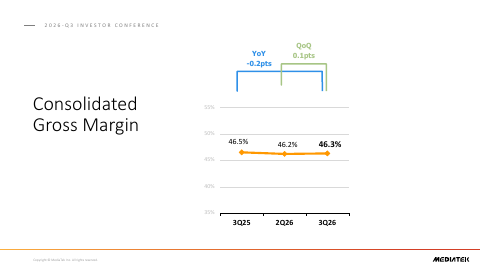
Rick Tsai cited robust customer demand and success in securing suppliers such as substrates; David Ku said data center gross margin is below the corporate average, which is why gross margin guidance is down one point, alongside price adjustments for supply chain cost increases. — Rick Tsai, David Ku
Transcript · Hass Liu, BofA · Operating margin accretion
Will ASIC operating margin be above the corporate average from the fourth quarter?
David Ku confirmed the operating margin of the data center business becomes attractive for the whole company starting in the fourth quarter. — David Ku
Transcript · Hass Liu, BofA · Second customer timing
Is the second customer's chip already in design given the 2028 revenue timing?
David Ku said the project has already kicked off and more detail will come later. — David Ku
Transcript · Charlie Chan, Morgan Stanley · Operating margin
How much more accretive is the AI data center business to operating margin than the company average?
David Ku said it is higher but declined to quantify it, noting that a price adjustment on non-data-center business also affects the fourth quarter. — David Ku
Transcript · Charlie Chan, Morgan Stanley · Second customer, AI spending
Can you describe the second customer, and would customers favor ASICs or GPUs if AI budgets shrink?
David Ku said the second customer is not from China and gave no other detail; Rick Tsai said AI compute demand will keep growing and he believes MediaTek's chips will be competitive in a tougher market. — David Ku, Rick Tsai
Transcript · Robert Sanders, Deutsche Bank · Packaging dependency
Does reliance on EMIB-T packaging create risk if Intel ties packaging to its foundry?
Rick Tsai said MediaTek is not dependent on one supplier, called TSMC its most important partner, and said it is investing in packaging technology, people and ecosystem partners. — Rick Tsai
Transcript · Robert Sanders, Deutsche Bank · Vendor financing
Should MediaTek engage loss-making frontier-model companies given a competitor's aggressive vendor financing?
David Ku said MediaTek would consider vendor financing if the market requires it and it has the right customer, citing improving signals from frontier-model companies. — David Ku
Transcript · Arthur Lai, Macquarie · Operating margin outlook
Is the fourth-quarter operating margin sustainable, and what is the longer-term outlook?
David Ku said the fourth quarter is the starting point for improving operating margin and next year's full-year operating margin should be above 20%. — David Ku
Transcript · Arthur Lai, Macquarie · Competitive barrier
How high is the entry barrier if MediaTek masters EMIB-T and HBM5, and how far ahead is it of competitors?
Rick Tsai said the barrier is the ability to integrate many technologies into a manufacturable, scalable product, and that MediaTek does not assume it is far ahead of strong competitors. — Rick Tsai
Transcript · Gokul Hariharan, JPMorgan · NVLink Fusion
How is NVLink Fusion integrated, and what benefits does it give customers?
Rick Tsai said MediaTek and NVIDIA built a chassis that lets customers add their XPU or CPU more easily into a rack, speeding time-to-market and time-to-revenue. — Rick Tsai
Transcript · Gokul Hariharan, JPMorgan · NVLink Fusion feedback
What feedback are customers giving on NVLink Fusion?
David Ku said MediaTek and NVIDIA are in discussion with several potential customers, feedback is positive, and he hopes to announce a case in the near term. — David Ku
Transcript · Gokul Hariharan, JPMorgan · Competitive position
What does the second-generation chip do for MediaTek's competitive position with its lead customer?
David Ku said the chip's performance per watt and TCO are multiple times better and that competing projects are not even close, so MediaTek feels comfortable. — David Ku
Transcript · Analyst · 448G SerDes
Is the 448G SerDes for the third-generation project or the second customer, and how far along is it?
Rick Tsai said the current customer comes first, 448G PAM6 SerDes has taped out and will not be on the critical path, and the IP will be adapted for a broader customer base. — Rick Tsai
Transcript · Analyst · Second customer size
What revenue size and margin profile can the second customer reach in 2028?
David Ku said it is too early for detail because 2028 supply is still being finalized, though demand looks strong. — David Ku
Transcript · Analyst · Packaging supply
If EMIB-T supply falls short, will the first-generation project's life be extended or demand shift to a competitor using TSMC CoWoS?
David Ku said generation-one demand is covered by current guidance, he is comfortable with generation-two yield and timing, and the team is working with suppliers to add upside. — David Ku