OpenNashEarnings

MediaTek (2454) · Semiconductors

MediaTek Q2 2026 earnings call: transcript, summary & key numbers

Results filed 31 Jul 2026 · Quarter ended 30 Jun 2026 · Company's own call transcript · Rick Tsai (CEO), David Ku (CFO)

Read the transcriptSlides (20 pages)Press release ↗Investor relations ↗

Summaries and transcripts are machine-generated and can contain errors.

In brief

MediaTek's first AI accelerator ASIC for a major US cloud customer enters production in Q4, and the company raised its 2027 data center share target to 15% to 20%.

MediaTek's business is shifting toward AI infrastructure and edge computing while smartphones weaken. Its first custom AI accelerator, built with a major US cloud provider, begins production in the fourth quarter. Smart Edge Platforms grew on share gains in connectivity, computing and automotive, plus DRAM content in TV chips. Mobile Phone fell as higher component costs hurt smartphone demand, and management still expects the smartphone market to shrink by about 15% in units this year.

Management wants to move from selling AI chips to selling full systems and platforms. That means a second accelerator in 2028, pre-validated subsystems and engagements with several other data center customers. A discretionary US$5 billion financing budget is meant to secure supply chain capacity. The main risks are execution on complex advanced packaging, dependence on one large customer for the first two projects, and ASIC gross margin that will dilute the corporate average.

Slides & documents

Open the slide deck (PDF, 20 pages) ↗

MediaTek Q2 2026 slide deck, page 1MediaTek Q2 2026 slide deck, page 2MediaTek Q2 2026 slide deck, page 3MediaTek Q2 2026 slide deck, page 4MediaTek Q2 2026 slide deck, page 5MediaTek Q2 2026 slide deck, page 6

Showing the first 6 of 20 pages.

Results documents

Key numbers

Revenue · GAAP
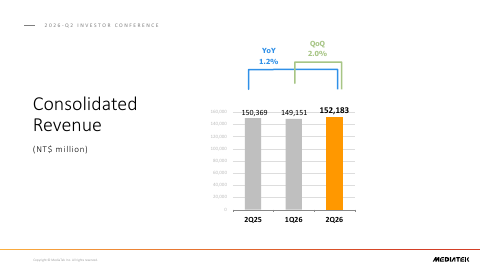
NT$152,183 million

up 2.0% quarter-over-quarter and 1.2% year-over-year

Gross margin · GAAP
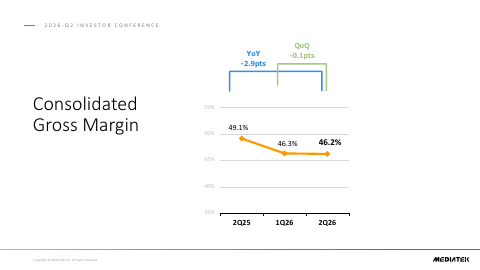
46.2%

down 2.9 percentage points year-over-year

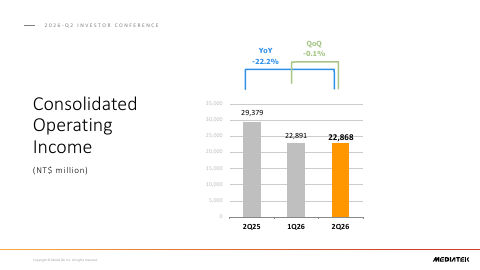
Operating income · GAAP
NT$22,868 million

down 22.2% year-over-year

Operating margin · GAAP
15.0%

down from 19.5% in the year-ago quarter

Net income · GAAP
NT$24,605 million

up 0.9% quarter-over-quarter and down 12.3% year-over-year

EPS · GAAP
NT$15.28

down from NT$17.50 in the year-ago quarter

Non-TIFRS EPS · non-GAAP
NT$15.71

Operating cash flow · GAAP
NT$24,251 million

compared with net cash used of NT$17,657 million in the previous quarter

Segment or metricValueChange
Smart Edge Platforms (share of revenue)53%up 19% quarter-over-quarter and 26% year-over-year
Power IC (share of revenue)6%up 11% quarter-over-quarter and 6% year-over-year
Where each number comes from
  • Revenue: “2Q26 consolidated revenue of NT$152,183 million, up 2.0% quarter-over-quarter and 1.2% year-over-year”
  • Gross margin: “2Q26 consolidated gross margin of 46.2%, down 0.1 percentage points quarter-over-quarter and 2.9 percentage points year-over-year”
  • Operating income: “2Q26 consolidated operating income of NT$22,868 million, down 0.1% quarter-over-quarter and 22.2% year-over-year”
  • Operating margin: “Operating margin for the quarter was 15.0%, down from 15.3% in the previous quarter and 19.5% in the year-ago quarter.”
  • Net income: “2Q26 consolidated net income of NT$24,605 million, up 0.9% quarter-over-quarter and down 12.3% year-over-year; EPS of NT$15.28”
  • EPS: “EPS was NT$15.28, up from NT$15.17 in the previous quarter and down from NT$17.50 in the year-ago quarter.”
  • Non-TIFRS EPS: “EPS for the quarter was NT$15.28 dollars, up from NT$15.17 dollars in the previous quarter and down from NT$17.5 dollars in the year-ago quarter. Non-TIFRS EPS for the quarter was NT$15.71 dollars.”
  • Operating cash flow: “Net cash provided by operating activities during the quarter was NT$24,251 million, compared with net cash used in operating activities of NT$17,657 million in the previous quarter”
  • Smart Edge Platforms (share of revenue): “In the second quarter, this group grew 19% quarter-over-quarter and grew 26% year-over-year, accounting for 53% of total revenue.”
  • Power IC (share of revenue): “This group accounted for 6% of total revenue in the second quarter and grew 11% quarter-over-quarter and 6% year-over-year.”

Copied from the press release ↗ and other documents in the company's results page ↗. A figure is published only if its sentence is in those documents.

Outlook

MetricPeriodOutlook
Consolidated revenuethird quarter of 2026NT$152.2 billion ~ 159.8 billion
Consolidated gross marginthird quarter of 202646% ± 1.5%
Operating expense ratiothird quarter of 202631% ± 2%
Data center revenue2026exceed 2 billion US dollars

Key takeaways

  1. First AI accelerator ASIC enters production in Q4

    Built with a major US cloud provider, the chip is scheduled to start production in the fourth quarter. Management expects data center revenue to exceed 2 billion US dollars in 2026 and keep scaling in 2027.

  2. Data center ambition raised for 2027

    Management now sees an 80 billion US dollar serviceable market in 2027, accelerators only and excluding HBM. It raised its share target to 15% to 20% from 10% to 15%.

  3. Second ASIC and subsystems widen the data center plan

    The second accelerator is on track for high-volume production in 2028 with improved performance per TCO. MediaTek is also offering pre-validated memory, I/O and connectivity subsystems and says it is engaged with several data center customers.

  4. Smart Edge growth offsets a weak smartphone market

    Smart Edge Platforms grew on share gains in connectivity, computing and automotive, and a 2nm flagship SoC launches in Q3. The NVIDIA RTX Spark Windows PCs ship for the holiday season. Mobile Phone fell 14% sequentially as component costs hurt demand.

  5. US$5 billion financing budget targets supply capacity

    The Board approved a discretionary budget to secure supply chain capacity and support the move from chips to full systems. Management says it is optional and may be used to support key suppliers' expansion.

What management said

Each quote matches the transcript word for word.

“Through close partnership with a major US CSP customer, we have successfully built our first AI accelerator ASIC with leading performance. Production of this product is scheduled to begin in the fourth quarter of this year.”

Confirms the first custom AI accelerator's customer type and production timing.

Transcript · Rick Tsai (CEO)

“we offer best-in-class, pre-validated subsystems solutions for memory, I/O, and connectivity. This largely reduces design complexity and shortens time to market for our data center customers to scale from AI ASIC chips to full-scale system and platform deployments.”

Shows the strategy of moving from selling chips to selling integrated data center building blocks.

Transcript · Rick Tsai (CEO)

“As rising costs across the supply chain have become an industry-wide reality, we are taking pricing actions to ensure these increases are appropriately reflected in our product pricing.”

Shows how MediaTek is responding to component cost inflation.

Transcript · Rick Tsai (CEO)

“During Computex this year, we announced our collaboration with NVIDIA on RTX Spark - a new class of Windows PCs built for agentic AI applications and best-in-class graphics capabilities.”

Marks a broadening of MediaTek's computing business into Windows PCs.

Transcript · Rick Tsai (CEO)

“I think in general, the gross margins generation after generation will be similar. Okay? It will not be higher, but the dollar value and the scale will be much bigger.”

Sets expectations that future ASIC generations add scale rather than higher gross margin.

Transcript · Evelyn Yu (Goldman Sachs)

“To secure supply chain capacity and fuel our strategic expansion from AI ASIC chips to full-scale systems and platforms, the Board has approved a discretionary US$5 billion financing budget today.”

Shows the size of the commitment behind the supply and systems strategy.

Transcript · Rick Tsai (CEO)

Analyst Q&A

  1. Transcript · Gokul Hariharan, JPMorgan · ASIC market share

    How will the second-generation ASIC affect the serviceable market estimate and MediaTek's share?

    The second ASIC is much more powerful, the 2028 market should be quite a bit larger than 2027's, and having both ASICs in production in 2028 should significantly enhance share. — Rick Tsai

  2. Transcript · Gokul Hariharan, JPMorgan · Customer share

    Could MediaTek become the majority source for this customer?

    Management declined to address market reports and said it will keep executing and hopes to earn a better-than-fair share. — Rick Tsai

  3. Transcript · Gokul Hariharan, JPMorgan · SerDes IP

    Where does the 448G SerDes stand and what other IP is offered?

    The 448G SerDes should be ready around the second half of next year, and MediaTek is packaging its IP into subsystems for faster time to market. — Rick Tsai

  4. Transcript · Sunny Lin, UBS · Second ASIC timing

    Is the second ASIC on track for early 2028 production, and what about EMIB-T?

    Early 2028 is the right assumption, with design and tape-out on track and packaging yields improving. — Rick Tsai

  5. Transcript · Sunny Lin, UBS · EMIB-T packaging

    Is EMIB-T maturing well enough for 2028 mass production?

    Yes, the CEO agreed that yield and technology maturity are making good progress. — Rick Tsai

  6. Transcript · Sunny Lin, UBS · Financing budget

    What is the US$5 billion financing budget for, and could it support suppliers' expansion?

    It is optional financing on top of a strong balance sheet, and the CFO confirmed it could be used to strengthen supplier relationships. — David Ku

  7. Transcript · Hass Liu, BofA · ASIC revenue drivers

    Is the 2026 data center revenue driven by a single project, and does supply chain capacity limit upside?

    It is the first project, and management is comfortable with foundry, substrate and memory capacity for this year and next. — David Ku

  8. Transcript · Hass Liu, BofA · Market definition

    What does the 2027 market estimate include?

    It covers accelerators only and excludes HBM. — Rick Tsai

  9. Transcript · Hass Liu, BofA · ASIC pipeline

    Which kinds of customers is MediaTek engaged with on ASICs, and when will other projects contribute?

    Several initiatives are under way, but details will come only when MediaTek is allowed to discuss them. — David Ku

  10. Transcript · Laura Chen, Citi · Advanced technologies

    Do the new memory, CPO and process technologies go with the second ASIC or with other customers?

    Details were not disclosed, but management says the whole industry needs these technologies and MediaTek is investing heavily and hiring. — Rick Tsai

  11. Transcript · Laura Chen, Citi · Supply and demand

    With better supply visibility, is there more share potential for the first ASIC next year?

    Management sees strong demand in both 2027 and 2028 and says it is working with partners to fulfill all customer demand. — Rick Tsai

  12. Transcript · Felix Pan, KGI · Rack design

    When will the rack design service contribute meaningful revenue?

    The pre-validated subsystem is advancing, now including NVLink Fusion connectivity, and talks with potential customers are ongoing with details to come later. — Rick Tsai

  13. Transcript · Felix Pan, KGI · Pricing

    Will price actions raise gross margin, and which segment sees the largest increases?

    The goal is to pass through cost increases and maintain margin, not raise it, and he declined to rank segments but said it should be broadly even. — David Ku

  14. Transcript · Charlie Chan, Morgan Stanley · Packaging supply

    Does the second ASIC need TSMC CoWoS as a backup, and what about a third generation?

    He declined to comment on a third generation, said the focus is 2027 and 2028, and said MediaTek is confident of delivering the second project on time in 2028. — David Ku

  15. Transcript · Charlie Chan, Morgan Stanley · AI smartphones

    Will AI change smartphone chip design or the business model to stimulate demand?

    AI models like Doubao are gaining popularity in China, and MediaTek is balancing compute capability against chip cost so customers remain profitable. — Rick Tsai

  16. Transcript · Charlie Chan, Morgan Stanley · Edge AI devices

    Can MediaTek discuss opportunities with LLM providers outside China?

    Various potential customers are exploring different edge device formats, and it is unclear which will win, but MediaTek can build power-efficient, high-compute SoCs for any of them. — Rick Tsai

  17. Transcript · Robert Sanders, Deutsche Bank · HBM alternatives

    Are customers pursuing LPDDR-based alternatives to HBM?

    Several approaches exist because of HBM supply issues, but hyperscalers needing top performance still require HBM, which stays mainstream near term. — David Ku

  18. Transcript · Robert Sanders, Deutsche Bank · SerDes roadmap

    What is the roadmap beyond 448G SerDes?

    448G is taping out on schedule, and beyond it MediaTek will most likely need optical, which it is also developing. — David Ku

  19. Transcript · Evelyn Yu, Goldman Sachs · ASIC margins

    Will the second ASIC carry a higher gross margin than the first?

    Gross margin should be similar across generations and slightly dilutive to the corporate average, while dollar value and scale grow much bigger. — David Ku

  20. Transcript · Evelyn Yu, Goldman Sachs · Operating leverage

    How large is the operating margin accretion, and how will opex dollars grow?

    The opex ratio should fall substantially while opex dollars rise slightly, with more operating margin guidance possible after the third quarter. — David Ku

Questions

What is MediaTek's AI data center ASIC plan?

The first AI accelerator ASIC, built with a major US cloud provider, starts production in Q4 2026, and a second ASIC is on track for high-volume production in 2028. MediaTek expects data center revenue above 2 billion US dollars in 2026 and is engaged with several other customers.

How big does MediaTek think its data center opportunity is?

It now sees an 80 billion US dollar serviceable market in 2027, covering accelerators only and excluding HBM. It raised its share target to 15% to 20% from 10% to 15%.

How is the smartphone business doing and what is MediaTek doing about it?

Mobile Phone revenue fell 14% sequentially on weak demand from higher smartphone component costs, and MediaTek expects the market to shrink about 15% in units this year. It will launch a 2nm flagship SoC in Q3 and is raising prices to reflect supply chain costs.

Where is edge growth coming from?

Smart Edge Platforms grew 19% sequentially on share gains in connectivity, computing and automotive, plus DRAM content in TV SoCs. New connectivity and automotive projects and the NVIDIA RTX Spark Windows PCs, due for the holiday season, should add to it.

Why did MediaTek approve a US$5 billion financing budget?

It is meant to secure supply chain capacity and support the move from AI ASIC chips to full systems and platforms. Management calls it optional financing, usable when needed, on top of a strong balance sheet.

Transcript

Official transcript (PDF) ↗

Speaker

MediaTek 2Q26 Earnings Call Friday, July 31, 2026, 3:00pm Taiwan Time

PREPARED REMARKS

Jessie Wang, IR Deputy Director

Jessie Wang (Investor Relations)

Good afternoon, everyone. Joining us today are Dr. Rick Tsai, MediaTek CEO and Mr. David Ku, MediaTek CFO. Mr. Ku will report our second quarter results and then Dr. Tsai will provide our prepared remarks. After that, we will open for Q&A.

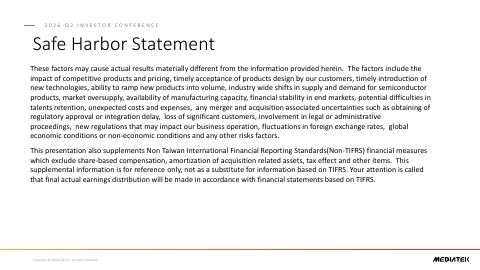
As a reminder: Today’s presentation will provide forward looking statements based on our current expectations. The statements are subject to various risks and factors which may cause actual results to be materially different from the statements. The presentation materials supplement Non-TIFRS financial measures. Earnings distribution will be made in accordance with financial statements based on TIFRS. For details, please refer to the safe harbor statement in our presentation slides.

In addition, all contents provided in this teleconference are for your reference only, not intended for investment advice. Neither MediaTek nor any of independent providers is responsible for any actions taken in reliance on contents provided in today’s call.

Now I would like to turn the call to our CFO, Mr. David Ku, for the second quarter financial results.

David Ku, Chief Financial Officer

David Ku (CFO)

Now let’s start with the 2026 second quarter financial results. The currency used here is NT dollar and the average exchange rate for the second quarter was NT$31.6 to US$1.

Revenue for the quarter was NT$152.2 billion dollars, up 2% sequentially, and up 1.2% year-over-year.

Gross margin for the quarter was 46.2%, down 0.1 percentage points from the previous quarter, and down 2.9 percentage points from the year-ago quarter. The year-over-year decrease was mainly due to a one-time benefit in the year-ago quarter.

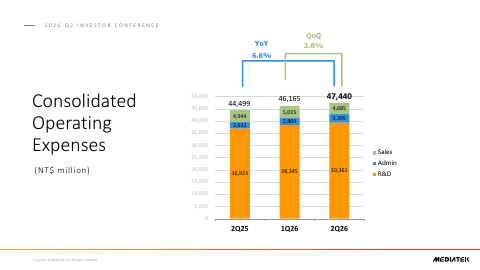
Operating expenses for the quarter were NT$47.4 billion dollars, compared with NT$46.2 billion dollars in the previous quarter and NT$44.5 billion dollars in the year-ago quarter.

Operating income for the quarter was NT$22.9 billion dollars, down 0.1% sequentially and down 22.2% year-over-year. Non-TIFRS operating income for the quarter was NT$23.7 billion dollars.

Operating margin for the quarter was 15%, down 0.3 percentage points in the previous quarter and down 4.5 percentage point year-over-year. Non-TIFRS operating margin for the quarter was 15.6%.

Net income for the quarter was NT$24.6 billion, up 0.9% sequentially and down 12.3% year-over-year. Non-TIFRS net income for the quarter was NT$25.3 billion dollars.

Net profit margin for the quarter was 16.2%, down 0.1 percentage points from the previous quarter and down 2.5 percentage points year-over-year. Non-TIFRS net profit margin for the quarter was 16.6%.

EPS for the quarter was NT$15.28 dollars, up from NT$15.17 dollars in the previous quarter and down from NT$17.5 dollars in the year-ago quarter. Non-TIFRS EPS for the quarter was NT$15.71 dollars.

A reconciliation table for our TIFRS and Non-TIFRS financial measures is attached in our press release for your information.

That concludes my comments. Thank you.

Jessie Wang, IR Deputy Director

Jessie Wang (Investor Relations)

Thank you, David. And now I would like to turn the call to our CEO, Dr. Rick Tsai for prepared remarks.

Dr. Rick Tsai, Chief Executive Officer

Rick Tsai (CEO)

Good afternoon, everyone. Thank you for joining us today. MediaTek second quarter revenue achieved 152 billion NT dollars, exceeding the high end of our guidance range, primarily driven by solid business momentum across Smart Edge Platforms products. Second quarter gross margin was around the mid- point of our guidance range, in line with our expectation.

Recently, the release of increasingly capable frontier AI models, together with the rapid transition toward agentic AI, has become a key driver of compute demand across both cloud and edge AI. Agentic AI, which executes a series of actions including planning, reasoning, execution, and self-correction, further increases workloads. This represents a compelling growth opportunity for MediaTek, as we are well-positioned to support both the scaling of AI data centers and the proliferation of agentic AI experiences across a broad range of edge devices.

In data center, demand for customized solutions to pursue optimized performance per TCO and performance per watt at scale remains strong. Through close partnership with a major US CSP customer, we have successfully built our first AI accelerator ASIC with leading performance. Production of this product is scheduled to begin in the fourth quarter of this year. We expect our data center revenue to exceed 2 billion US dollars in 2026 and will continue to scale substantially in 2027, primarily driven by increasing customer demand for our solution with superior TCO. With that, we now believe the 2027 SAM will be 80 billion US dollars, and we are raising our share target to 15% to 20% from 10% to 15% that we guided last quarter.

Meanwhile, our second AI accelerator ASIC is progressing well with a meaningful upgrade in compute performance with further optimized TCO. Additionally, with close collaboration with our advanced

packaging partner, the yield and reliability of the second ASIC are on track for high volume production in 2028, and we’re confident in capturing additional market share when this ASIC ramps up.

Furthermore, we continue to deepen our engagements with several customers for data center ASIC opportunities. Backed by our industry-leading IPs, deep ecosystem partnerships, and proven execution capabilities, we believe we can secure more design wins in the data center market.

Building on our industry-leading IP portfolio, we offer best-in-class, pre-validated subsystems solutions for memory, I/O, and connectivity. This largely reduces design complexity and shortens time to market for our data center customers to scale from AI ASIC chips to full-scale system and platform deployments. In addition, our development of 448G SerDes is progressing well, delivering best-in-class performance and power with our Co-Package Copper (CPC) system solution. Looking beyond 448G, we continue to develop CPO system solutions on TSMC’s COUPE platform to enable next-generation system connectivity. In addition, we offer end-to-end 3.5D platform with best-in-class 3.5D IP, packaging, and design flows, for large data center designs on 3.5D.

Furthermore, we serve as a major enabler for data center customers in this increasingly complex global supply chain environment. Through deep design-technology co-optimization (DTCO) with TSMC and close collaboration with key advanced packaging partners, we leverage our experience in advanced node design such as 2nm and strong engineering and architecture capabilities to develop high-performance ASICs across a broad range of very-large chip sizes using CoWoS and EMIB-T technologies. We also create significant value beyond semiconductor by orchestrating other key components throughout the supply chain such as memory and substrate to drive successful execution.

Looking ahead, as data center architectures and the broader semiconductor ecosystem continue to evolve rapidly, we are confident in our ability to support our data center customers’ innovative roadmap as their trusted long-term partner.

With that, I will now talk about the recent business performance for our three revenue groups.

In the second quarter, Mobile Phone declined 14% quarter-over-quarter and 20% year-over-year, primarily due to weak demand as a result of increasing smartphone BOM costs. Mobile phone accounted for 41% of total revenue in the second quarter.

Our view for global smartphone shipment remains unchanged and we continue to expect the market to decline by about 15% in units this year. Specifically, we have observed that customers are prioritizing both flagship products with differentiated user experiences and entry-level products for price-conscious demand.

For the flagship segment, we will launch our 2nm SoC in the third quarter to power customers’ next generation agentic AI models. The SoC delivers strong agentic AI computation with a step-up in user experience at a more efficient cost structure. Together with ongoing engagements with global players, we will increase our presence continuously in the flagship smartphone market in 2027.

For the entry segment, we continue to support customers with our leading SoC portfolio and memory utilization technologies to optimize their cost structures.

As rising costs across the supply chain have become an industry-wide reality, we are taking pricing actions to ensure these increases are appropriately reflected in our product pricing.

For the third quarter, we expect Mobile Phone revenue to be flat to decline mid-single digit percentages sequentially as the ramp of our flagship SoC is expected to largely offset weakness in other segments.

Moving on to Smart Edge Platforms. In the second quarter, this group grew 19% quarter-over-quarter and grew 26% year-over-year, accounting for 53% of total revenue. The sequential growth was primarily driven by our continued market share gains across connectivity, computing and automotive products as well as contribution from DRAM content in TV SoC.

Our strengths in advanced computing and connectivity continue to help us gain shares in multiple areas. During Computex this year, we announced our collaboration with NVIDIA on RTX Spark - a new class of Windows PCs built for agentic AI applications and best-in-class graphics capabilities. The products will be on shelves for the holiday season this year. This represents a meaningful step in broadening our computing business and a strong validation of our capabilities in the high-performance CPU system integration.

For the third quarter, as several new connectivity and automotive projects are scheduled to enter mass production, we expect Smart Edge Platforms revenue to grow mid-to-high single digit percentages sequentially.

Moving on to Power IC. This group accounted for 6% of total revenue in the second quarter and grew 11% quarter-over-quarter and 6% year-over-year. The revenue strength in the second quarter was mainly from share gains in computing and data center businesses.

For the third quarter, we expect Power IC revenue to be flattish sequentially.

Moving to the guidance, in the third quarter of 2026, we expect the revenue growth from Smart Edge Platforms to offset the weakness in Mobile Phone and gross margin to be within the current range.

We expect our third quarter revenue to be in the range of NT$152.2 billion dollars to NT$159.8 billion dollars, flat to up 5% sequentially, and up 7% to 12% year-over-year at a forecasted exchange rate of 32 NT dollars to 1 US dollar. Gross margin is forecasted at 46%, plus or minus 1.5 percentage points, and operating expense ratio is forecasted at 31%, plus or minus 2 percentage points.

With that, we now aim to achieve the high-end of our full year revenue target range, which is high-single digit percentage growth in US dollars. For gross margin, through our disciplined pricing strategy that reflects the rising costs throughout the supply chain, we aim to deliver our full year gross margin within the current quarter guidance range.

To secure supply chain capacity and fuel our strategic expansion from AI ASIC chips to full-scale systems and platforms, the Board has approved a discretionary US$5 billion financing budget today. This flexible framework provides us with the optionality, when needed, to agilely support our long-term growth and capitalize on massive datacenter opportunities.

In summary, we will continue to focus on executing our growth strategies across both edge and cloud AI. Supported by our technology leadership, broad portfolio, and strong ecosystem partnerships, we believe we are well positioned to deliver sustainable long-term value for our shareholders.

This concludes my prepared remark. Thank you.

各位午安,感謝各位的與會。聯發科技第二季營收達新台幣 1,520 億元,超越營運目標的上緣, 主要來自智慧裝置平台業務穩健的成長動能。第二季毛利率達到營運目標區間的中間值,符合我 們的預期。

近期,能力日益提升的前沿 AI 模型陸續推出,以及 Agentic AI 的快速發展,已經成為帶動雲端與 邊緣 AI 運算需求的關鍵動能。Agentic AI 要執行一系列包括規劃、推理、執行與自我修正的任務, 進一步提升整體運算負載需求。這為聯發科技帶來絕佳的成長機會,憑藉聯發科技的優勢,能支 持不論是 AI 資料中心的持續擴增,或是加速 Agentic AI 體驗在各種邊緣裝置上的普及。

在資料中心方面,客戶為了追求最佳化的單位整體擁有成本效能(Performance per TCO)與單位 功耗效能(Performance per Watt),對客製化解決方案的需求依然強勁。聯發科技透過與美國 一家大型雲端服務商的緊密合作,已成功打造我們首款具備領先效能的 AI 加速器 ASIC,並預計 於今年第四季進入量產,2026 年資料中心營收可望超過 20 億美元。基於我們的解決方案為客戶 帶來更優異的整體擁有成本(TCO),我們預期資料中心營收在 2027 年加速成長。我們認為 2027 年的可服務市場規模(SAM)可達 800 億美元規模,而我們也將市占率目標從上季所預估的 10% 至 15%,提高至 15% 至 20%。

與此同時,我們的第二款 AI 加速器 ASIC 也進展順利,不僅在運算效能上有顯著提升,也進一步 優化整體擁有成本(TCO)。此外,透過與先進封裝合作夥伴的緊密合作,第二款 ASIC 的良率與 可靠度表現皆符合開發進度,持續朝 2028 年量產目標推進,我們有信心市佔率會隨著這款 ASIC 放量而增加。

此外,我們持續深耕與多家客戶在資料中心 ASIC 的合作機會。憑藉聯發科技業界領先的矽智財 (IP)、深厚的生態系夥伴關係,以及優異的執行實績,我們相信能在資料中心市場中取得更多 設計導入的機會。

基於我們業界領先的智慧財產(IP)3 組合,我們提供業界頂尖、預先完成驗證的記憶體、I/O 與 連接技術等子系統解決方案,大幅降低設計複雜度,並縮短上市時程,協助資料中心客戶更快速 地從 AI ASIC 晶片,擴展到全方位系統與平台的部署。此外,聯發科技在 448G SerDes 的開發上進 展順利,透過共封裝銅互連(Co-Package Copper, CPC)系統解決方案,提供業界頂尖的效能與功 耗表現。接續 448G SerDes,我們也持續在台積電的 COUPE 平台上開發 CPO 解決方案,以實現次

世代的系統連接能力。同時,我們也提供端到端的 3.5D 平台,結合業界頂尖的 3.5D IP、封裝技 術與設計流程,滿足大型資料中心在 3.5D 的設計需求。

此外,在日益複雜的全球供應鏈環境中,聯發科技也是資料中心客戶的的重要合作夥伴。我們透 過與台積電深度的設計技術協同優化(Design-Technology Co-Optimization, DTCO),以及與主要 先進封裝合作夥伴緊密合作,加上我們在 2 奈米等先進製程設計上的經驗,以及強大的工程與架 構設計能力,協助客戶運用 CoWoS 與 EMIB-T 技術,開發各種超大晶片尺寸的高效能 ASIC。除了 半導體,我們更透過整合供應鏈關鍵零組件如記憶體、基板等,為客戶創造更多價值,協助其專 案順利執行。

展望未來,隨著資料中心架構與整體半導體生態系持續快速演進,我們有信心以我們堅強的能力, 作為資料中心客戶值得信賴的長期合作夥伴,並支持他們不斷創新的技術藍圖。

接下來,我將說明三個營收類別近期的營運狀況及展望。

第二季手機業務營收較前一季下降 14%,較去年同期下降 20%,主要因智慧型手機物料成本 (BOM Cost)上升,導致市場需求疲弱。第二季手機業務佔總營收的 41%。

我們對全球智慧型手機出貨量的看法維持不變,仍預期今年出貨量將衰退約 15%。我們並觀察到 客戶聚焦於兩類產品,一是提供差異化使用者體驗的旗艦機種,另一種是滿足價格敏感需求的入 門機種。

在旗艦產品方面,我們將於第三季推出 2 奈米 SoC,為客戶次世代的 Agentic AI 手機提供強大運 算能力。這款 SoC 具備強大的 Agentic AI 運算能力,在更具成本效益的架構設計下,為使用者體 驗帶來明顯躍進,加上我們持續拓展與全球客戶的合作,我們預期 2027 年的旗艦智慧型手機市 佔率將進一步提升。

在入門產品方面,聯發科技持續以領先的 SoC 產品組合支持客戶,並提供可提升記憶體使用效率 的技術,協助客戶優化成本結構。

隨著供應鏈成本全面上升已成為產業普遍現象,我們正採取必要的價格調整措施,以確保這些成 本增加能適當反映在產品定價上。

展望第三季,我們預期旗艦 SoC 放量可大致抵銷其他產品的疲弱,手機營收可望與前一季持平至 下降中個位數百分比(mid-single digit percentages)。

接下來是智慧裝置平台,第二季營收較前一季成長 19%,較去年同期成長 26%,佔公司營收 53%。 本季的季增長主要來自我們在通訊、運算以及車用產品市佔率的持續提升,以及反映電視晶片中 DRAM 的貢獻。

聯發科技在先進運算與通訊技術上的優勢,持續協助我們擴大在多個領域的市佔率。聯發科技與 NVIDIA 在今年 Computex 宣布合作推出 RTX Spark-專為 Agentic AI 應用打造的全新 Windows PC,

並具備業界頂尖的繪圖效能,預計於今年年底銷售旺季正式上市。這不僅是聯發科技拓展運算業 務的重要里程碑,也充分展現聯發科技在高效能 CPU 系統整合上的堅強實力。

展望第三季,隨著多項新的通訊與車用專案陸續進入量產,我們預期智慧裝置平台營收將較前一 季成長中高個位數百分比(mid-to-high single digit percentages)。

接下來是電源管理 IC,第二季佔公司營收 6%,較前一季成長 11%,較去年同期成長 6%。第二季 的營收成長主要來自運算及資料中心業務的市佔率提升。

我們預期第三季電源管理 IC 營收與前一季約略持平。

展望第三季,我們預期智慧裝置平台業務的成長,可抵銷手機業務所帶來的影響,並預期毛利率 將維持在目前的區間內。

我們預期第三季營收以美元對台幣匯率 1 比 32 計算,將在台幣 1,522 億元至 1,598 億元之間,較 前一季持平至成長 5%,較去年同期成長 7%至 12%。營業毛利率預估將為 46% ± 1.5%;季費用率 預估將為 31% ± 2%。

基於此,聯發科技 2026 年全年美金營收可望達到高個位數百分比(high-single digit percentage)的 成長,在原先目標區間的上緣。至於毛利率,透過反映供應鏈成本全面上升的嚴謹定價策略,預 期全年毛利率維持在本季財測目標的區間內。

為確保供應鏈產能,並推動聯發科技從 AI ASIC 晶片擴展至系統與平台的策略布局,董事會於今 日核准一項總額 50 億美元的彈性融資預算案,提供靈活的框架,讓聯發科技在必要時快速取得 資金支持的彈性,協助聯發科技在龐大資料中心商機中的長期成長。

總結來說,我們將持續專注於執行邊緣與雲端 AI 的成長策略。憑藉聯發科技在技術上的領先地 位、廣泛的產品組合,以及強大的生態系夥伴關係,我們相信能為股東創造可持續的長期價值。

以上是我的說明。謝謝。

[Q&A]

Gokul Hariharan (JPMorgan)

Good afternoon, Rick, David, and Jessie. Thank you for taking my question. First of all, I think Rick, you mentioned your second-generation ASIC is on progress for mass production in 2028. Could you talk a little bit about how does it influence your SAM estimate? I think you updated your SAM to $80 billion in 2027, but as this project starts to ramp up, how does the SAM start to look like? Definitely feels like the compute component within that chip is much bigger than the first generation that you're going to ramp in the next quarter.

And could you also talk a little bit about how much market share can you take within this family of projects? Given that you seem to have some confidence that the market share will continue to expand, can you potentially be the majority source within this larger customer when it comes to 2028-2029 kind of time frame? That's my first question.

Rick Tsai (CEO)

Thank you, Gokul. I understand your question. I think first I want to point out that the second ASIC certainly is a much more powerful chip from both performance per TCO and performance per watt point of view. So while we are not ready today to guide the 2028 revenue range through the SAM yet, but we are certainly confident our 2028 SAM will be quite a bit higher than 2027’s. And our share, because of the also the strong capability demonstrated by our first ASIC, I think in 2028, we are looking forward to both the first ASIC and the second ASIC to be in production in the same year. And that we believe certainly will enhance our market share. Well, I would say in a very significant manner. Thank you.

Gokul Hariharan (JPMorgan)

Do you see any line of sight into you becoming a majority source for your customer, or you still think that you will be the smaller vendor, when we think about the next couple of generations? Gokul, we will -- we are not going into this, because we know there are a lot of, shall we say, reports in the market. What we are doing basically, as we have always been doing, is to stay on the ground to solidly execute what we have committed to our customer, as we have, and continuous building a very strong trust between us and the customer. As such, we believe we will get our hopefully better-than-fair share of the market share. So that's really what we are doing and we will continue to execute that way. Thank you.

Got it. Thank you very much, Rick. So second question is on your 448-gig 2-nanometer-based SerDes, could you give us a little bit more color on where we are in that process? Like when do we have the IP ready to kind of talk to your customers, given I think the third generation of the family of ASICs kind of right now seems to be in RFQ stage? And any other IP that you are kind of putting forth to the customer in addition to the strong supply chain support that you have when it comes to the key enablers for the next project which is in discussion? Thank you.

Rick Tsai (CEO)

Well, 400G or 448G SerDes IP is really going well. We certainly expect that to be ready sometime next year, maybe second half of next year. We are having kind of a middle-of-the-road SerDes now already well proven. I can say that. We have certainly very, I would say really at least equivalent industry-leading D2D IPs in terms of performance and power consumption. But however, that's some IPs. We are also providing leading-edge packaging technology capability for very large size, chip size applications. In addition, our team, I think, is working with some other key partners to put all those IPs together, as I mentioned in my text, a subsystem with which maybe some

different data center customers can use to -- because those chips are all very complex and people want to go to the system level as soon as they can. We can provide the time-to-market needs to the customers -- some different customers. So I think we are moving into, compared to say a year ago or not to mention two years ago, the company is moving to not only provide very competitive IPs but also integration of those IPs into a chassis format so the customers or various customers, can utilize for fast time-to-market and to achieve their complex design. Thank you.

Sunny Lin (UBS)

Good afternoon. Thank you for taking my questions and congrats on the very steady progress, especially for the cloud ASIC side. So my first question is I want to follow up for the second cloud ASIC project and so one is in terms of timeline for mass production, should we be looking at early 2028 and also how should we think about the execution? You mentioned pretty steady progress, but I guess the market has some questions around like tape-out schedule, whether it's on track for and also how should we think about Intel EMIB-T?

Rick Tsai (CEO)

Yes, you can assume early 2028 for early production for second chip. And the progresses both in design, tape-out date are on track. We are working really closely with our customer, especially with the experiences we both have learned during the first trip. We really know even more how to leverage each other's capabilities in getting the design out on time. So I'm quite comfortable with that. The back-end technology, the packaging technology, of course, is another key component of the whole complex ASIC chip. We work really again also well, probably more than closely with our supplier mainly in ensuring the yields from the subsequent vendors continue to improve very well. The supply of the capacity, the cycle time from our supplier, we're working on all those down to the operation details. So far, those technologies are very challenging. We all understand that. And that's also those challenging technologies are also the ones that will enable the performance, great performance per watt and per TCO for that chip. And we are, I think, on way to make that happen. Thank you.

Sunny Lin (UBS)

Thank you. So sorry, maybe just to follow up on a bit more color regarding EMIB-T. So would it be fair to say -- I definitely feel that today you are sounding a bit more constructive, even more than like a quarter ago. And recently like earlier this week, Unimicron in Taiwan, the substrate maker, they are also sounding more committed regarding EMIB-T. So can we conclude that overall EMIB-T technology is making good progress in terms of the yield rate improvement and also the technology maturity for mass production for 2028?

Rick Tsai (CEO)

Yes. In short, yes you can, Sunny. I think you're saying that probably better than I am. Thank you.

Sunny Lin (UBS)

No problem. Thank you very much. And my second question will be to follow up on your announcement regarding this $5 billion for financing budget regarding the supply chain. And so would you be able to provide a bit more color on what you are going to do? Are you going to support some of the expansions from your key suppliers and some of the key areas that you are looking to put into the investment? How should you think about that support that you just came out?

David Ku (CFO)

Okay, Sunny. It's David here. I think first of all I need to start with we have a very strong balance sheet. I mean, currently we actually have ample cash, $7 billion plus on our balance sheet. As you guys can see right now, the industry is moving very fast, especially for two elements. One is the whole supply chain situation and also the possibility for different AI ASIC business models. So what we get from our Board today is really just an optionality, a flexing plan, a financing budget plan when we need it. So we can actually just power it up when we need it on top of our strong balance sheet. I think that's the general idea.

Sunny Lin (UBS)

So should we take that as a flexibility that you can further strengthen relationships with key suppliers by maybe supporting their expansion?

David Ku (CFO)

Yes, yes.

Hass Liu (BofA)

Yes, thanks. Good afternoon. Thanks for taking my questions and congrats on the very great results. So first question is just on ASIC. You updated your expectation for data center sales contribution to be more than $2 billion this year and raised the related TAM to $80 billion in 2027. Would you be able to share more detail if it is mainly driven by a single project or includes the other parts of the NRE contribution from other projects and if you are going to see further upside on this market expansion if you can secure more capacity support from your supply chain partners? Thank you.

David Ku (CFO)

I think that's our first project and currently, based on the supply chain situation, we feel comfortable to provide that capacity for the whole supply chain, which including the foundry, the substrate and also our customer side, the memory. I think supply chain for the revenue target both for this year and also for next year, I think we feel very comfortable.

Hass Liu (BofA)

Okay, yeah. And I think just a quick follow-up to this one is that if you can define the boundary of the TAM, is it just custom AI accelerator only or does it include other content like CPU or network switch?

Rick Tsai (CEO)

Right now it's accelerator only for now. Yes, the SAM estimate.

Hass Liu (BofA)

Okay, so $80 billion only includes AI accelerator?

Rick Tsai (CEO)

And no HBM.

Hass Liu (BofA)

Okay. Got it. And second question is just regarding, on your ASIC pipeline, you just mentioned in your prepared remarks that you are engaged with several customers. I think this is probably the first time you mentioned that you are engaged with several customers. Would you be able to share more detail on this? Whether this just is more focused on tier-one hyperscalers or you are diversifying into tier-two hyperscalers and also enterprises as well? And when can we expect more design or manufacturing contribution from the other parts of the projects? Thank you.

David Ku (CFO)

There are several initiatives and projects going on. Unfortunately, we won't be able to provide detail right now. I think we will provide detail when it becomes -- when we're allowed to talk about that. Q – Laura Chen, Citi

Laura Chen (Citi)

Thank you very much for taking my questions. So I'm just wondering that for these technologies, including like the process, memory, or CPO, et cetera, do they go with the second project of your ASIC or other potential, like engagement with other customers. That's my first question.

Rick Tsai (CEO)

I'm afraid we cannot disclose those details. What I can say is these technology, be they a different form of memory or memory on silicon or CPC, CPO, we firmly believe these are the technologies that we need, and also the whole industry needs to move into the next-generation XPU, AI accelerator. You see that it's a matter of time. So what the company is doing is to invest heavily in building these capabilities while we also continue to hire many key talents in order to make that happen. Thank you. Q – Laura Chen, Citi

Laura Chen (Citi)

And also, just wondering that because of now you have a much better visibility in terms of the component supply chain’s supply, do you see that there will be more market share potential for first- generation product for next year? And also I recall last time, we discussed about the potential -- assuming that we have higher dollar content for the AI accelerator. So do we have any expectation of dollar potential, the market share, or potential revenue contribution? We certainly believe the -- there is demand both in 2027 and 2028. I mean a strong demand for the chips that we're building. But we are also as I said just earlier, we always want -- doing a very solid execution job. So what we know right now for sure, what we have said earlier, you can be assured that we are working with our supply chain partners and our customers and the -- of course our own people to fulfill any and all the demand from customer in both years ahead. Thank you.

Felix Pan (KGI)

Hi, good afternoon, Rick, David, and Jessie. First of all, congrats for very solid and strong outlook for the ASIC and also more content value for the next generation. My first question regarding for the AI ASIC, I think in your pre-Computex analyst event, MediaTek showcased that you guys have the rack design solution as well. I just wonder is there anytime soon we can see any contribution or any timeline we can see the contribution that you have more meaningful revenue contributing from your current rack design service. That's my first question.

Rick Tsai (CEO)

Yes, we are, I think, further advanced now in building what we said, pre validated subsystem, or I would say similarly a rack design. Actually, we are having our own IPs be they SerDeds, D2D, or with 3.5D packaging. Together also we are incorporating NVLink fusion connectivity onto that subsystem. We believe this can be very attractive for various kind of needs from different CSPs or enterprise customers potentially. So these are things are ongoing. We are talking to potential customers with that in offer. We will provide more details when time is right. Thank you.

Felix Pan (KGI)

Okay, my second question regarding to the price action. You mentioned you guys are going to take the price action to reflect the value and also reflect cost. But in terms of the gross margin guidance, it's pretty much flattish or maintained at current level. So is that just reflect the passing through the cost or do we expect more positive trend in the next few quarters to reflect on the margin side based on your price action? And is that possible? Is that possible to rank by your three different segments which one has the largest of the price hike by category? Thanks.

David Ku (CFO)

I think for passing through the supply chain cost increases to our customers, I think the objective is really just to get the whole industry to share that the whole supply chain ecosystem situation. We are not trying to actually increase the price to increase the gross margin. So the goal is really to passing through the cost pressure and share with our customers. but for the gross margin, the goal is actually just trying to maintain the gross margin rather than increase the gross margin. I think that's not our objective.

Felix Pan (KGI)

Okay, so is that possible to rank by the three business units like which one probably will see the higher price spike?

David Ku (CFO)

For that one, we won't be able to comment. Okay. But in general, it should be pretty fair to all different business units because, again the supply chain cost is actually pretty universal across all segments and nodes in general.

Charlie Chan (Morgan Stanley)

Hi, good afternoon. Thanks for taking my question, and congrats for a very good execution and outlook. So Rick, David, maybe first question is allow me to follow up on this kind of foundry supply chain, so do you think you need TSMC’s CoWoS to back up your second-generation project or it seems like the current

EMIB-T is working pretty well, right? Do you still need that backup and need to book capacity at TSMC earlier? And for the third generation, I believe you also have some engagement, right? So do you think at that generation you will consider to move back to TSMC, for example CoPoS for larger reticle size? Thank you.

David Ku (CFO)

First things first, I think for the third generation we won't be able to comment. I would say right now probably let’s focus on the next two years, you know 2027 and also 2028, because we do believe the current two projects will provide pretty strong growth and also will keep us busy for the next few years. In terms of the packaging technology backup, I think we’re always working on different packaging technologies. Sometimes switching the packaging technology will take time. So right now, given all the positive readings and also the results from the second project, we are confident actually we're going to deliver this on time and start to have the volume production in 2028. I think that's the current plan.

Charlie Chan (Morgan Stanley)

Got it. Thanks, David. So my second topic is always on this AI smartphone side. So again, Rick or David, do you think going forward there will be kind of significant change of the chip design, the way of the chip design for the smartphone business model given AI? For example, we learned that your smartphone SoC competitor is introducing very very aggressive wafer-on-wafer sort of packaging, so they can include more memory for the smartphone SoC is the example one. And secondly, regarding business model, do you think in the future you need to do some custom chip for LLM customer? And at some point, actually, the hardware could be subsidized and the volume for the AI smartphone will ramp up. Because over the past three years, we have been trying to upgrade the hardware, but AI smartphone doesn't really take off. Right. So I'm wondering whether there could be any business model change to stimulate the AI smartphone demand. Thank you.

Rick Tsai (CEO)

I think AI smartphone business, yes, you're right to talk about the last two, three years, what we believe is now, at least in China market, you can see there's already a pretty major shift for instance to -- I think a good example is ByteDance’s Doubao model. I think it's running very, very popularly in China market. And that, I think the example like that would thrive I think in the coming years of chip design. Saying all that, however, we have to also bear in mind the cost of the chip or we have to balance the needs of the compute capability and cost of the chip. So we look at the architecture -- that is an architecture question. We look at the various architecture and try to decide from this generation next to the further one whether we can build a chip with very, very, good computing capability to meet most, many if not most, of the agentic AI requirements for the model makers, but also still at a cost structure that our OEM customers can still have their good business. So this is a very dynamic environment. We work on those technologies, but we want to also make sure our customers can still do very well with our chips financially. Thank you.

Charlie Chan (Morgan Stanley)

Thank you. So Rick, are you comfortable to talk about future opportunity outside of China with LLMprovider? Because as you know, one of the leading LLM vendor, they hire lots of ex-Apple designers, technology leaders, but I feel like this kind of AI smartphone is kind of not just about China. It's a kind of a global phenomenon. Are you okay to talk about the business opportunity there?

Rick Tsai (CEO)

Yeah, I can certainly comment in a more generic manner. We are certainly seeing various -- and I do mean various, potential customers, end customers who are working on, I would say, probably different formats of the edge devices to meet or enjoy this agentic AI era. But I think the jury definitely is out, still out as to which format will win or maybe formats, more than one format. We do not know for sure. But what we do know is we have this capability in building the most power-efficient and high-computing- capability SoC chips to serve different needs. At the end of the day, we have those fundamental architecture capability and computing system capability and of course, the leading-edge process capabilities. Those, the combination of which will satisfy, I would say, all of those demands from various formats and customers. Thank you. Q – Robert Sanders, Deutsche Bank

Robert Sanders (Deutsche Bank)

Yeah. Hi, thanks for taking the question. One of your competitors announced something called HMC, which is basically using LPDDR instead of HBM. Are you seeing any customers pursuing that kind of line? And similarly, on the tech roadmap beyond 448-gig SerDes, do you see any roadmap? It doesn't seem like there is any sort of copper-driven roadmap out from your main competitor. Do you see a potential to go up to higher speeds than SerDes, or is that kind of the end of the road? Thanks.

David Ku (CFO)

I think for the data center, I understand actually there are several different approaches trying to replace HBM due to the supply issue. But so far, based on what we see for the hyperscalers who actually require absolutely high performance, I think HBM is still a must. So for the segment we're aiming on right now, we still believe HBM will be the mainstream at least for the near term. Q – Robert Sanders, Deutsche Bank

Robert Sanders (Deutsche Bank)

And on the SerDes?

David Ku (CFO)

I think SerDes right now actually for the 448 is taping out on schedule. I think for the next generation, for the beyond that, most likely we need to go on the optical. So the optical side, we are working on that as well. And we have a product roadmap which are seen in line and on schedule, which is actually all we updated earlier.

Evelyn Yu (Goldman Sachs)

Thank you for taking my question. My first question is actually also around the AI ASIC. You mentioned last call that the next generation chip actually carries more value and higher pricing, but does that

necessarily translate into a higher gross margin than the first project? And how wide is that gap of gross margin versus corporate average for the second generation project?

David Ku (CFO)

I think in general, the gross margins generation after generation will be similar. Okay? It will not be higher, but the dollar value and the scale will be much bigger. And compared to the corporate average, that’s the same guidance we provided earlier, will be slightly diluted compared to the current corporate gross margin. But on the operating margin side, once we start to scale, I think it will be accretive meaningfully and sizably.

Evelyn Yu (Goldman Sachs)

Thank you. Yeah, actually, my second question is follow-up on that. I think since day one, you’ve mentioned that this is operating margin accretive. How should we think about the magnitude of that accretion? And on opex specifically, should we expect absolute opex dollar growth into 2027 and into even in 2028 to run at a similar pace as we’ve seen versus past few years?

David Ku (CFO)

I think for the opex ratio, due to the revenue growth strongly, I think the opex ratio will definitely come down substantially. But in terms of the absolute dollar, because we are still investing in so many new technologies, I think we will actually increase slightly. But the ratio will come down substantially. In terms of operating margin accretive, we will probably show that until the third quarter. I think once we see that’s more clear for the overall operation plan, we’ll provide some guidance. Right now, actually, we probably only provide a directional guidance rather than the number guidance.

Evelyn Yu (Goldman Sachs)

Got it. So is it fair that we assume the operating, like dollar wise, opex dollar will grow higher versus --

David Ku (CFO)

Yeah, will grow higher, but the ratio will come down.

-End of Q&A session-