
LG Energy Solution (373220) · Industrials
LG Energy Solution Q2 2026 earnings: summary, key numbers & outlook
Results filed 30 Jul 2026 · Quarter ended 30 Jun 2026
Slides (16 pages)Press release ↗Investor relations ↗
Summaries and transcripts are machine-generated and can contain errors.
In brief
LG Energy Solution is pivoting to ESS: it now makes up the high-20% range of first-half revenue and it has won new orders above KRW 3 trillion, including AI data centers.
Energy storage (ESS) drove the quarter. Five North American sites are producing ESS cells, and the Ultium Cells (GM JV) Tennessee and L-H Battery (Honda JV) plants have started ESS production. ESS revenue grew 4.6 times year on year in the first half. On the EV side, European pouch shipments rose, demand for cylindrical cells from a strategic customer was stable, and mid-to-low price products made up over mid-30% of EV pouch volume.
Management wants to be a full-stack ESS supplier covering grid and data center needs, with cells, UPS, BBU and system integration, while pushing 46-Series cylindrical cells in EVs. Next steps are the Arizona cylindrical line, sodium-ion ESS batteries and an all-solid-state pilot line. The tension is that the company is leaning on North American capacity ramps and new orders while North American EV demand slows and some joint-venture plants run adjusted operations.
No call transcript for this quarter, so this summary also draws on: EDAILY ↗, BizHanKook ↗, Quartr ↗.
Slides & documents
Open the slide deck (PDF, 16 pages) ↗
Showing the first 6 of 16 pages.
Results documents
Key numbers
- Revenue · GAAP
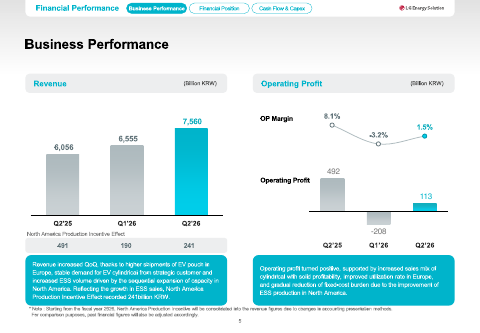
- KRW 7.6 trillion
- Operating profit · GAAP
- KRW 113.3 billion
- Operating margin · GAAP
- 1.5%
- Profit (loss) for the period · GAAP
- -328.6B
- Basic or diluted loss per share (KRW) · GAAP
- (1,613)
- Gross margin · GAAP
- 20.4%
15.3% increase quarter-on-quarter
| Segment or metric | Value | Change |
|---|---|---|
| ESS revenue growth, first half | 4.6x | year over year |
| ESS share of total revenue, first half | high-20% range | |
| New ESS orders, first half | exceeding KRW 3 trillion | |
| Cylindrical battery shipments incl. 46-Series, first half | 1.5x | year over year |
| Mid-to-low price share of EV pouch volume, first half | over mid-30% | |
| North America production incentive | KRW 241 billion | quarter-on-quarter increase driven by ESS shipments |
Where each number comes from
- Revenue: “LG Energy Solution posts KRW 7.6 trillion in consolidated revenue and KRW 113.3 billion in operating profit in Q2 2026”
- Operating profit: “The operating profit was KRW 113.3 billion, with the operating profit margin at 1.5%.”
- Operating margin: “The operating profit was KRW 113.3 billion, with the operating profit margin at 1.5%.”
- Profit (loss) for the period: “Profit (loss) for the period ₩ (328,644) ₩ (1,272,678) ₩ 90,605 ₩ 317,178”
- Basic or diluted loss per share (KRW): “Loss per share attributable to the equity holders 28 of the Parent Company (in Korean won) Basic or diluted loss per share (1,613) (4,502) (1,271) (1,894)”
- Gross margin: “Gross Profit 1,470 1,493 1,812 1,104 5,879 1,241 1,545 (%) 21.9% 24.6% 29.9% 17.0% 23.2% 18.9% 20.4%”
- ESS revenue growth, first half: “ESS business achieved 4.6x year-on-year revenue growth and secured new orders exceeding KRW 3 trillion.”
- ESS share of total revenue, first half: “with ESS accounting for the high-20% range of total revenue.”
- New ESS orders, first half: “ESS business achieved 4.6x year-on-year revenue growth and secured new orders exceeding KRW 3 trillion.”
- Cylindrical battery shipments incl. 46-Series, first half: “Cylindrical battery shipments including 46Series were boosted by 1.5x year-on-year.”
- Mid-to-low price share of EV pouch volume, first half: “Mid-to-low price solutions accounted for over mid-30% of total EV pouch battery sales volume in the first half.”
- North America production incentive: “The revenue includes the North America production incentive of KRW 241 billion, reflecting a quarter-on-quarter increase driven by ESS shipments.”
Copied from the press release ↗ and other documents in the company's results page ↗. A figure is published only if its sentence is in those documents.
Key takeaways
ESS has become a core growth engine
ESS revenue grew 4.6 times year on year in the first half and now sits in the high-20% range of total revenue. New ESS orders exceeded KRW 3 trillion, including AI data center projects.
North American ESS capacity widened to five sites
Ultium Cells (GM JV) Tennessee and L-H Battery (Honda JV) started producing ESS cells. The company calls itself North America's largest ESS manufacturer and is positioning to meet non-PFE requirements.
Data centers drive the ESS product line
Management cites AI infrastructure power demand, with UPS and BBU becoming critical data center parts. It is extending its lineup to BESS, UPS and BBU and building system integration to offer end-to-end solutions from cells to software.
46-Series cylindrical cells are the EV bet
Cylindrical shipments including 46-Series rose 1.5 times year on year, helped by tightening thermal safety rules and structural battery designs. The Arizona cylindrical line is being prepared, with equipment efficiency improved by 50%.
Affordable EV products and next-gen batteries advance
Mid-to-low price solutions exceeded mid-30% of EV pouch volume, improving utilization in Europe and Asia. The company also plans sodium-ion ESS sample shipments in 2027 and a dry-electrode all-solid-state pilot line.
Questions
What is driving LG Energy Solution's growth this quarter?
ESS is the main driver, with first-half ESS revenue up 4.6 times year on year and phased capacity expansion in North America. EV growth came from European pouch shipments and stable cylindrical demand from a strategic customer.
How is LG Energy Solution positioning for AI data center demand?
It is building a lineup of BESS, UPS and BBU products and system integration capabilities for turnkey hardware and software solutions. Its new ESS contracts of over KRW 3 trillion include AI data center projects.
What is the company's strategy for 46-Series cylindrical batteries?
It plans to supply locally produced 46-Series cells from its global sites, with a lineup from 4680 to 46120, 10-minute fast charging and improved pack designs. The Arizona cylindrical line is being prepared in the second half.
What are the second-half priorities for the ESS business?
Management plans to optimize North American operations to improve profitability and to pursue large renewable-linked ESS projects and data center infrastructure orders. It also plans pack and link capacity additions.
What next-generation battery work is under way?
The company plans full-scale mass production of high-power tabless 2170 cells, with uses such as BBU and robots. It is also preparing sodium-ion lines for ESS sample shipments in 2027 and a dry-electrode pilot line for all-solid-state batteries.