OpenNashEarnings
H78

Hongkong Land (H78) · Real Estate

Hongkong Land H1 2026 earnings call: transcript, summary & key numbers

Results filed 28 Jul 2026 · Quarter ended 30 Jun 2026 · Call 80 min · Michael Smith (CEO), Craig Beattie (CFO)

Read the transcriptSlides (54 pages)Press release ↗Investor relations ↗

Summaries and transcripts are machine-generated and can contain errors.

In brief

Hongkong Land launched its Singapore private fund SCPREF and is pivoting from capital recycling to growth, as Tomorrow's CENTRAL openings lifted LANDMARK tenant sales 11%.

The big shift this half was from reshaping the balance sheet to building a third-party capital platform. SCPREF, a Singapore private fund backed by Qatar Investment Authority and APG, launched in February. At LANDMARK, new flagships, including a Van Cleef & Arpels global flagship, and a Bespoke VIC lounge are pulling in ultra-high-net-worth shoppers. Westbund Central added a 27,000 sq. m. retail cluster and 337 rental apartments, and Hong Kong and Singapore offices kept leasing well.

Management now describes the focus as "growth, growth, growth". Capital is aimed at growing SCPREF, existing core assets and a measured look at new gateway cities, while four portfolio teams take over operations. The tension is that Hong Kong's recovery keeps the group concentrated there even as it tries to diversify. Mainland China conditions stay mixed, and deploying cash well takes time without taking on equity or losing its investment-grade rating.

Slides & documents

Open the slide deck (PDF, 54 pages) ↗

Hongkong Land H1 2026 slide deck, page 1Hongkong Land H1 2026 slide deck, page 2Hongkong Land H1 2026 slide deck, page 3Hongkong Land H1 2026 slide deck, page 4Hongkong Land H1 2026 slide deck, page 5Hongkong Land H1 2026 slide deck, page 6

Showing the first 6 of 54 pages.

Results documents

Key numbers

Underlying profit attributable to shareholders · non-GAAP
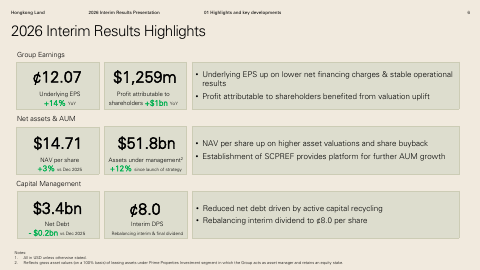
US$259 million

up 11%

Underlying earnings per share · non-GAAP
US¢12.07

up 14%

Profit attributable to shareholders · GAAP
US$1.3 billion

up 470%

Revenue · GAAP
632.7M

from 751.2 a year ago

Adjusted free cash flow · non-GAAP
$253 million

down 37%

Net asset value per share
US$14.71

up 3% from 31 December 2025

Segment or metricValueChange
Assets under management$51.8 billionup 12% since the launch of the new strategy
SCPREF AUM8.3 billion Singapore dollars
Hong Kong office committed occupancy94.2%
LANDMARK tenant sales11%year-to-date increase
Singapore office committed occupancy96.3%
China Integrated Properties contribution43%increase versus the same period last year
Where each number comes from
  • Underlying profit attributable to shareholders: “Underlying profit up 11% to US$259 million, with EPS up 14%”
  • Underlying earnings per share: “Underlying earnings per share were US¢12.07, up 14% compared to the same period last year.”
  • Profit attributable to shareholders: “Profit attributable to shareholders was US$1.3 billion and NAV per share up 3% from higher asset valuations”
  • Revenue: “Revenue (note 2) 522.3 110.4 632.7 511.6 239.6 751.2 1,048.3 400.0 1,448.3”
  • Adjusted free cash flow: “maintenance capital expenditure, and the net cash flows from the bill-to-sell segment amounted to $253 million in the first half of 2026.”
  • Net asset value per share: “Net asset value per share at 30 June 2026 was US$14.71, compared with US$14.30 at the end of 2025.”
  • Assets under management: “Assets under management reached $51.8 billion at the end of June, up 12 % since the launch of our new strategy.”
  • SCPREF AUM: “AUM increased to 8.3 billion Singapore dollars at the end of the mid-year as a result of higher property valuations.”
  • Hong Kong office committed occupancy: “Our portfolio continues to outperform the market, with committed occupancy being 94.2%.”
  • LANDMARK tenant sales: “Overall tenant sales year-to-date increased by 11%, with the watch & jewellery segment in particular continuing to drive growth.”
  • Singapore office committed occupancy: “In Singapore, the Group’s office portfolio continued to perform strongly, achieving committed occupancy of 96.3% at period-end.”
  • China Integrated Properties contribution: “Contributions increased by 43% compared to the same period last year, supported by a number of new openings over the past 12 months”

Copied from the press release ↗ and other documents in the company's results page ↗. A figure is published only if its sentence is in those documents.

Outlook

MetricPeriodOutlook
Full-year underlying profit growthfull year 2026broadly in line with growth achieved in the first half of 2026
Annualised cost savings run-ratefrom 2027 onwardsat least US$25 million
Remaining Tomorrow's CENTRAL investmentcompletion of Tomorrow's CENTRAL150 million US to 200 million US dollars
Cumulative capital recycledby the end of 2027at least US$4 billion

Key takeaways

  1. SCPREF gives Hongkong Land a third-party capital platform

    The Singapore private fund launched in February with Qatar Investment Authority and APG as founding investors and holds S$8.3 bn of AUM. Management targets at least S$15 billion within five years, which would add recurring fee income.

  2. Tomorrow's CENTRAL is drawing luxury flagships to LANDMARK

    Van Cleef & Arpels opened a global flagship, other Maisons reopened with new interiors, and a Bespoke VIC lounge opened. Bespoke VIC members rose 16% and tenant sales rose 11% despite about 40% of the area being under renovation.

  3. Management is moving from recycling capital to growth

    With US$3.7 billion recycled and gearing near 11%, the focus is acquisitions via SCPREF and core assets, with Sydney, Seoul and Tokyo explored without urgency. Management says it will keep its investment grade and not raise equity.

  4. Hong Kong and Singapore office demand is firming

    Hong Kong office vacancy fell to 5.8% on a committed basis against 9.2% for the core Central market, and reversions are expected to trend towards neutral. In Singapore, Amazon's space at Asia Square Tower 1 was backfilled by Shell with no downtime.

  5. Four portfolio teams replace the legacy structure

    Each portfolio gets its own leadership and KPIs such as rental growth, occupancy and AUM growth. Management expects at least US$25 million of annual savings from 2027, with about US$10 million already achieved.

What management said

Each quote matches the transcript word for word.

“Further elevating experiential retail for our VICs is critical to delivering on our strategy of not just retaining but increasing our share of the ultra high net worth spend in the city.”

It explains why LANDMARK is investing in the Bespoke VIC lounge and flagship experiences.

0:08:03 · Michael Smith (CEO)

“I think a year or so ago it was all about recycle capital, recycle capital, recycle capital, which is still incredibly important, but really now it's really focused on taking advantage of the market opportunities that we have to really drive growth”

It marks the strategic pivot from balance-sheet repair to growth.

0:30:13 · Michael Smith (CEO)

“The Singapore office market for a fund is a very good market, positive carry in terms of interest rates versus cap rates and definitely definitely growth in the underlying.”

It gives management's rationale for prioritising SCPREF acquisitions.

0:31:20 · Michael Smith (CEO)

“And so there is an earnings gap that we will need to look to fill through deployment of capital and investment into new opportunities.”

It shows organic recovery alone is not expected to deliver the 2035 ambitions.

1:00:06 · Craig Beattie (CFO)

“we made it very clear that we will do this with financial guardrails in place. We're not going to lose our investment grade and we're not going to go out and raise equity.”

It sets the limits on how aggressively the company will deploy capital.

0:41:49 · Craig Beattie (CFO)

Analyst Q&A

  1. 0:34:43 · Cindy, Citi · Capital deployment

    How aggressively will the company deploy capital, in which markets, and in what form?

    Growing SCPREF in Singapore and reinvesting in core assets come first, while Sydney, Seoul and Tokyo are explored without rush, with development and income-producing assets both considered. — Craig Beattie, Michael Smith

  2. 0:35:20 · Cindy, Citi · Tomorrow's CENTRAL

    How will Tomorrow's CENTRAL reopenings and retail valuations progress towards 2027?

    Valuers tightened cap rates after 10-year leases with major luxury brands, and about US$150 million to US$200 million of the US$400 million budget remains to be invested. — Craig Beattie

  3. 0:42:14 · Cindy, Citi · Portfolio restructuring

    What has the portfolio-based restructuring done and how will portfolio heads be measured?

    Four portfolios each have their own leadership with KPIs such as rental growth, occupancy, AUM growth and efficiency, and Hong Kong Central is run like a fund. — Michael Smith

  4. 0:46:10 · Carl Chen, J.P. Morgan · Earnings outlook

    Should 2027 earnings growth be similar to this year?

    Management expects further growth in 2027 as Hong Kong office, Tomorrow's CENTRAL, Singapore and China all contribute. — Craig Beattie

  5. 0:46:46 · Carl Chen, J.P. Morgan · Office reversions

    Will Hong Kong office reversions turn positive in 2028?

    Negative reversions are narrowing and management expects them to trend towards neutral in 2027, with growth following if that is achieved. — Craig Beattie, Michael Smith

  6. 0:49:03 · Raymond Liu, HSBC · Guidance change

    What drove the change in earnings guidance within a few months?

    Hong Kong retail outperformed, cost optimisation in China took hold, and interest on over US$2 billion of cash was stronger than expected. — Craig Beattie

  7. 0:50:08 · Raymond Liu, HSBC · Luxury demand

    Do capital flow regulation concerns threaten high-end tenant sales at LANDMARK?

    About 85% of LANDMARK customers are Hong Kong-based, and ultra-high-net-worth shoppers are described as resilient to geopolitics. — Michael Smith

  8. 0:52:54 · Raymond Liu, HSBC · Suntec REIT

    What is the strategy behind the Suntec REIT stake?

    It gives exposure to Singapore high-quality office and has a strategic element, but it is not a long-term hold. — Michael Smith

  9. 0:54:13 · Praveen, Morgan Stanley · Free cash flow

    Why is first-half adjusted free cash flow lower and will it cover the dividend?

    Less build-to-sell capital recycling drove the fall, partly on timing, and management expects second-half free cash flow to rise and cover the dividend. — Craig Beattie

  10. 0:56:28 · Karl · Redevelopment

    How is redevelopment of Central office buildings balanced against injecting assets into funds?

    Management keeps reviewing the ageing portfolio and would consider material redevelopment, but nothing is confirmed. — Michael Smith

  11. 0:56:28 · Karl · Cost savings

    How much of the US$25 million cost savings was realised in the first half?

    About US$10 million came through in the first half, with at least US$15 million more expected from 2027. — Craig Beattie

  12. 0:59:03 · Mark, Nubias · New investments

    Given strong organic recovery, is there less need for new investments to reach 2035 targets?

    Organic growth alone will not double profit or dividends, so an earnings gap must be filled by new investment, starting with expanding SCPREF. — Craig Beattie

  13. 1:00:42 · Mark, Nubias · Acquisition markets

    Why focus acquisitions on Singapore rather than Hong Kong?

    Hong Kong buildings are tightly held by families and rarely trade, while Singapore has institutional sellers, LP capital and positive carry. — Michael Smith, Craig Beattie

  14. 1:03:41 · Mark, Nubias · Cost savings

    Why did the cost-savings target drop from last year's figure?

    Last year's savings targeted the build-to-sell business, now reported as non-trading, while the US$25 million relates to prime properties. — Craig Beattie

  15. 1:05:36 · Rachel Tan, Macquarie · Share buyback

    Will the share buyback continue as more capital is recycled?

    Yes, up to 20% of recycled capital is allocated to buybacks, with pace depending on share price, market conditions and other investment opportunities. — Craig Beattie

  16. 1:06:04 · Zikuan Wang, CIBC · Debt issuance

    Are there bond issuance plans for the second half?

    There are no imminent plans, though the company will issue at some point to balance bonds and bank debt. — Craig Beattie

  17. 1:07:16 · Sarah Cooper, Bank of America · Dividends

    What is needed in the second half to hit the implied full-year dividend?

    Growing annual dividends by at least 5% means at least 26 cents versus 25 cents last year, with the board reviewing it at year-end. — Craig Beattie

  18. 1:08:16 · Sarah Cooper, Bank of America · Westbund capex

    How much capex remains for Westbund Central?

    About US$1.8 billion remains, with a 43% share funded by joint venture construction loans rather than the group's balance sheet. — Craig Beattie

  19. 1:08:47 · Sarah Cooper, Bank of America · Buyback accretion

    How much did the buyback add to NAV per share and EPS?

    The buyback explains the three-point gap between 11% profit growth and 14% EPS growth, with a smaller NAV impact of around 20 to 30 basis points. — Craig Beattie

  20. 1:09:42 · Patrick, Bloomberg · AI adoption

    Where has AI delivered surprising returns and how much IT budget goes to AI?

    AI use is experimental, built on building data across 12 Central buildings, and it is too early to quantify hard-dollar benefits. — Craig Beattie

  21. 1:11:05 · Simon, Goldman Sachs · Capital recycling

    Where will capital recycling come from after the US$4 billion target?

    Sources include about US$3 billion of build-to-sell inventory, about US$3.5 billion of equity in mainland China malls and other non-core assets. — Michael Smith, Craig Beattie

  22. 1:14:14 · Simon, Goldman Sachs · Recycling pace

    Will the pace of recycling slow after reaching the target?

    The pace over the next year or two will be slower than the first 18 months, while still targeting up to US$6 billion by the end of 2027. — Michael Smith, Craig Beattie

  23. 1:15:27 · Joe Hu, Rondell Investments · Diversification

    Does the target to cap any city at 40% of earnings still exist?

    It exists as a push for balance and a different valuation approach, though Hong Kong's rising values may keep concentration high. — Michael Smith, Craig Beattie

  24. 1:18:05 · Rachel Tan, Macquarie · Cap rates

    What are the cap rates and the Amazon space backfill reversion in Singapore?

    Hong Kong office cap rates are generally low threes and LANDMARK retail is trending towards 4%, and the Amazon backfill by Shell was around double digits with no downtime. — Craig Beattie, Michael Smith

  25. 1:19:08 · Rachel Tan, Macquarie · LANDMARK renovation

    Has peak LANDMARK renovation disruption passed?

    Peak disruption is about now, likely passing by mid-2027, with incremental rental growth to follow as the remaining Maisons open. — Craig Beattie


Questions

What is Hongkong Land's SCPREF fund and why does it matter?

SCPREF is a Singapore private real estate fund launched in February 2026 with Qatar Investment Authority and APG as founding investors. It holds S$8.3 bn of AUM, targets at least S$15 billion within five years, and is meant to add recurring fee income.

How is Tomorrow's CENTRAL performing at LANDMARK?

New flagships including Van Cleef & Arpels opened, tenant sales rose 11% and Bespoke VIC members rose 16%, even with about 40% of lettable space under renovation. Maison tenants signed long leases, lifting the weighted average lease expiry to 5.1 years.

Where does Hongkong Land plan to deploy capital after recycling US$3.7 billion?

Priorities are acquisitions through SCPREF in Singapore, reinvestment in existing core assets, and a measured look at Sydney, Seoul and Tokyo. Management says it will keep its investment grade and not raise equity.

What is the state of the Hong Kong and Singapore office markets for Hongkong Land?

Hong Kong committed occupancy was 94.2%, market vacancy fell to 9.2%, and reversions are expected to trend towards neutral. Singapore office was 96.3% occupied with positive reversions and limited new supply.

How is Westbund Central in Shanghai progressing?

A 27,000 sq. m. retail cluster launched in May with over 80% committed occupancy, and 337 more rental apartments opened in June. About 18% of the project's GFA is operational, and the Adidas Greater China headquarters is expected to complete by the fourth quarter.

Transcript

Listen to the official recording ↗

0:00:00
Michael Smith (CEO)

A warm welcome to those of you who are here with us at Centricity, as well as those of you joining online. I'm Michael Smith, the Group Chief Executive of Hong Kong Land, and with me is Craig Beattie, our CFO. Over the past six months, our focus was very much on sustaining the execution momentum we've built in the previous year. From delivering exciting openings from Tomorrow Central, to launching our inaugural private real estate fund in Singapore, to aligning our organizational structure to the goal set out in our strategic vision 2035.

0:00:31

We've all had a very busy first six months of 2026. Now let me talk you through some of the details of what I just outlined, as well as taking you through our interim financial results for 2026. We will have plenty of time for questions following the presentation. For those of you watching via the webcast, please send us your questions through the website, and we will include them in the Q &A session. Here's the structure for today's presentation unless otherwise stated all numbers quoted will be in US dollars so let's get started.

0:01:03

Turning to an overview of our 2026 interim results. The group's underlying earnings per share reached over 12 cents up 14 % from the prior period. Absolute underlying profit was $259 million up 11%. This was driven primarily by lower net financing charges and stable operating results from our portfolios. Profit attributable to shareholders was $1.3 billion, up from $221 million in the first half of 2025, primarily due to an increase in the independent valuations of our portfolios.

0:01:39

This increase in valuations, combined with our share buyback program, resulted in an NAV per share of $14.71 as at the end of June, up 3 % compared to the end of 2025. Assets under management reached $51.8 billion at the end of June, up 12 % since the launch of our new strategy. On capital management, consolidated net debt declined by $200 million to $3.4 billion as the group had meaningful cash inflows from capital recycling activities during the period.

0:02:11

Finally, the Board declared an interim dividend of $0.08 per share, reflecting a rebalancing of our annual dividend profile between interim and final dividend. For the last 15 years, our interim dividend has remained flat at $0.06 per share. Given our commitment to double dividends from $0.22 per share in 2023 to $0.44 per share in 2035, it was necessary to rebalance our dividend payments such that approximately 30 to 40 % will be paid as an interim with the remainder in our final.

0:02:45

This shift reflects the confidence we have in our underlying earnings. Turning over to key developments for the first half of the year, as many of you in Hong Kong will have seen, we welcomed a number of exciting new flagship openings. While the primary focus for Tomorrow's Central is to deliver a new shopping experience for our retail customers, we have not neglected our office tenants. their needs to connect with their clients and their business partners. At Landmark, we have refreshed the office lobbies of Edinburgh Tower and Gloucester Tower, so we've moved those lobbies from the third to the fourth floor, whilst also delivering new F &B offerings and office tenant amenities.

0:03:23

The Landmark Mandarin has also been reopened to customers on the 1st of June with a new arrival experienced and refreshed guest rooms. In Singapore, we successfully launched our first private fund SCPREF in February alongside our founding investors Qatar Investment Authority and APG. At Westbund in Shanghai the group unveiled The Terrace, a 27,000 square meter retail quarter with over 70 designer lifestyle brands and F &B outlets. We also launched an additional 337 rental apartment units increasing the scale of our service department operations to now close to 700 units.

0:04:02

At the China integrated properties portfolio much of our efforts in the first half were devoted to building operational momentum on the projects we launched in 2025. Our ongoing work on asset optimization is beginning to deliver real positive results. Finally many of you may recall from our 2025 annual results presentation that we've been working on an organizational redesign to implement a portfolio-led operating model, which I will provide an update on later. Overall, we are aiming to deliver annualized cost savings on existing operations of at least $25 million from 2027 onwards.

0:04:43

Turning to an update of our strategic vision, 2035. Back in 2024, we set a new direction for Hong Kong land, focus on what we would need to do to consistently deliver top quartile TSR over a sustained period. The simple answers were to deliver earnings growth and make more efficient use of our capital. While we may not achieve these ambitions overnight, we wanted to reposition the business towards achieving these targets over the mid to long term. On our desire to grow underlying PBI, we believe earnings bottomed in 2025.

0:05:16

We are now clearly focused on capturing growth across existing portfolios, delivering on pipeline projects as well as active pursuit of opportunities to deploy our capital. On doubling dividends per share to $0.44 by 2035, the group has delivered a 14 % increase in full-year DPS to $0.25 in 2025. Asset under management has grown by 12 % compared to when our new strategy was first announced, reaching $51.8 billion. We intend to further grow AUM via asset enhancements at existing portfolios over time and leveraging third-party capital to pursue growth investments.

0:05:57

And finally, on capital recycling, cumulative net proceeds generated amounted to $3.7 billion at the end of June. We're now at 93 % of our 2027 minimum target. The group continues to work on a number of opportunities at recycled capital and are confident of exceeding the $4 billion minimum target, we originally set ourselves by N27, but I think hopefully we can achieve that by end of this year. Turning now to provide more colour, literally, as you can see, on the latest happenings in the first half of the year across the group.

0:06:30

Hong Kong land's philosophy has always been about curating and strengthening our ecosystems. This goes back to our belief that experience to be truly central, the entire ecosystem is more valuable if it's experiential than the sum of the parts. While the Tomorrow's Central initiative is focused primarily on creating retail spaces for the future, we have not forgot about elevating the experience of our office tenant community. In the first half of the year, we launched the transformed office lobbies of both Edinburgh and Gloucester Tower.

0:07:00

The refresh spaces also feature an expanded array of F &B outlets and amenities catering to the needs of our office tenants. As the transformation continues, we expect more refreshed or new offerings to be introduced. Turning to our luxury retail operations. Since kicking off in the second half of 2024, the tomorrow's central transformation continues to exceed expectations. Initial phases of work are now beginning to bear fruit, with exciting openings in the first half of the year. A great example is Van Cleef opened its global FAG ship in June.

0:07:34

This is one of only five global maisons for this brand. Three other long-standing tenants, Bottega Veneta, Burberry and Berluti, we opened with all new interiors. For many of you who may be loyal customers of the landmark, you may have noticed that we launched the long-awaited bespoke VIC lounge at Gloucester House over the past week. The new space spans more than 8,000 square feet and reimagines the old-world elegance of Hong Kong's historic high society through a contemporary lens.

0:08:04

Further elevating experiential retail for our VICs is critical to delivering on our strategy of not just retaining but increasing our share of the ultra high net worth spend in the city. In Singapore the group officially established SCPREF, a core open-ended commercial real estate fund in February this year. AUM increased to 8.3 billion Singapore dollars at the end of the mid-year as a result of higher property valuations. Our ambition is to grow the scalable platform alongside like-minded third-party capital to an AUM of at least 15 billion Singapore dollars over the next five years and we hope to have some exciting announcements around that hopefully by the end of the year.

0:08:48

SCPREF has an investment mandate to acquire additional high quality income producing commercial assets in Singapore's central business district and Orchard Road, reinforcing Hong Kong Land's commitment to both Singapore and long-term value creation. Moving on to an update on Westbund Central, our flagship project under development in Shanghai. The Terraces, a new retail cluster of 27,000 square meters was launched in May this year. This retail cluster will bring together a diverse and unique mix of brands including a number of first in Asia stores such as the House of Ladirac, as well as several first in China stores such as Phoebe Philo, Recto Issey Miyake Full Collection flagship store and the Leica Gallery Academy and Cafe.

0:09:33

The offering will have over 70 designer and lifestyle brands when fully occupied by the fourth quarter of this year. Next on to organizational redesign. This is something the management team and I have spent a significant amount of our time on in recent months. While the launch of the Strategic Vision 2035 was endorsed by many of you in some room, as well as our board and our colleagues, we found some of the legacy organisational structures and culture did not optimally position the group in reaching our long-term ambitions.

0:10:05

We felt that a transformation was required to allow for clearer accountability, faster decision-making, as well as a stronger governance and collaboration across our operations. During the first half of the year, we undertook an extensive exercise to benchmark our organizational structure to best-in-class peers, not just across the region, but across the world. This resulted in a new structure which provides for dedicated leadership teams in each of our four portfolios. These teams are in turn given the strategic mandate and autonomy to execute on specific KPIs and business plans, and we're confident that this will evolve our culture to prioritize a performance mindset with greater accountability for commercial outcomes.

0:10:47

As part of this exercise, we've identified a number of opportunities to realize recurring operational efficiencies of at least $25 million in annualized run rate savings from 2027 onwards. Throughout the rest of the year, we will diligently work towards fully transitioning to the new organizational structure ahead of the 2027 financial year. Let me now pass on to Craig to go through our results and financials in a bit more detail.

0:11:14
Craig Beattie (CFO)

Thanks Michael and a pleasure to be here this morning.

0:11:18

So let's take a look at the key drivers for the movement of underlying profit in the first half of 2026 compared to the same period last year. So Hong Kong's central performance was broadly stable compared to the same period last year, with higher contributions from retail offset by lower office contributions, including the effects of the handover of some floors within one exchange square to the Hong Kong Stock Exchange. Singapore's central performance was strong, although on an absolute basis contributions were reduced by the disposal of Marina Bay Financial Centre Tower 3 upon the SCPREF fund formation at the end of last year.

0:12:00

Contributions from CIP increased substantially driven by a number of new openings over the past 12 months as well as further tenant mix optimization for assets that we've launched over the past few years. And net financing charges were lower on reduced net debt from the active capital recycling. Turning to an overview of the group's rental income and operational updates on our key segments. As you can see, rental income was up 3 % year on year, driven primarily by significant growth in the CIP portfolio and Hong Kong retail.

0:12:36

Total rental income from Singapore reduced by 9 % for our share due to the change in effective holdings of the underlying assets post-DSC-PREF formation. And in the Chinese mainland, where contributions have grown significantly, CIP in particular has been one of the key drivers in rental income growth, with contributions coming from the new retail mall openings that I previously mentioned. In line with the Group Strategic Vision 2035, the return of capital from the build-to-sell segment continues to be a key priority.

0:13:11

While profit contributions from this segment will continue to decline, the active recycling of capital continues to benefit the group's free cash flow. The adjusted free cash flow for the group, which includes the strong cash flows from the group's prime properties investment business, maintenance capital expenditure, and the net cash flows from the bill-to-sell segment amounted to $253 million in the first half of 2026. And this metric excludes net proceeds from major capital recycling initiatives, for example, the disposal of parts of one exchange square to the stock exchange and the sale of MCL land last year.

0:13:54

Net revaluation gate of 916 million in the first half of the year was primarily driven by three things. First of all, lower cap rates for the landmark retail in Hong Kong, which really reflects the advancement of Tomorrow Central. And as Michael showed earlier, now that we're starting to open a number of the retail stores and rents are going up, the valuers are attributing a higher valuation to that part of the portfolio. Two, there were higher open market rents for Hong Kong office, as the recovery for high quality buildings in Central District continues to take hold.

0:14:28

and three finally there were higher open market rents for West Bund Central as we look to build out that project of the coming years. The build to sell business generated 11 million of profit in the first half of the year and as I just mentioned for this segment we are focused on recycling capital and returning cash to the group overall. Other non-trading items including 84 million of net non-cash gains on disposal of our Singapore assets to SCPREF when it was established in February earlier this year.

0:15:02

This is primarily an accounting adjustment. Net asset value per share at 30th of June was $14.71 which was up 41 cents or 3 % compared to the end of 2025 driven primarily by the total valuation gains across the group's portfolio. We invested $150 million in share buybacks in the first half of the year, resulting in an accretive impact to net asset value per share, as well as our EPS, which we will have noticed went up by 14%, compared to 11 % growth for profits overall.

0:15:37

We also paid $407 million in dividends relating to the 2025 final dividend declared of $0.19 per share. Now let's turn to an update on dividends themselves as well as the share buyback. As Michael mentioned, the group has declared an interim dividend of 8 cents per share, an increase of 2 cents per share, and this reflects our intention to provide shareholders with a more rebalanced dividend profile throughout the year, which is reflective of the group's focus on growing our recurring high quality income.

0:16:11

This increase in interim does not change the group's intention to deliver a mid-single-digit percentage growth in annual dividends per share. Just to remind you, our aim is to take our dividends all the way up to 44 cents per share by 2035. During the first half of 2026, the group returned over 560 million to shareholders in the form of dividends in shared buybacks, which was an increase of 19 % compared to the first half of 2025.

0:16:42

In terms of the shared buyback program itself, a total of $650 million has been allocated to buybacks so far, with around $490 million deployed to date. Future buybacks continue to be subject to the returns that we generate from buybacks, which need to exceed our cost of equity and will depend on the availability of other investment opportunities as well as market conditions overall. But as we've demonstrated, we've consistently deployed into share buybacks in the past 12 plus months.

0:17:16

The maturity profile of the group's debt is shown on the left-hand side of the slide. As you can see, the debt maturities are staggered over a number of years and are well diversified between both banks and debt capital markets. The group remains really well financed with strong liquidity and no significant financing needs throughout the rest of this year. The average tenor of our drawn debt at the end of June was healthy at 5.3 years and the average interest cost declined slightly to 3.2 % down from 3.3 % at the end of 2025.

0:17:50

and 59 % of average gross debt was fixed and in fact 70 % of our Hong Kong borrowings was fixed overall too. At the end of June, the group had available liquidity of 3.2 billion compared to 3.5 billion at the end of 2025 and our credit ratings by S &P and Moody's remain unchanged at A and A3 respectively. So let me now pass back to Michael who will give us a bit more colour on the latest updates on our key business segments.

0:18:23
Michael Smith (CEO)

Thanks, Craig. Okay, so turning to a leasing and operational update for our Hong Kong office portfolio. Average net rents were $91 Hong Kong dollars per square foot per month. Vacancy on a committed basis declined to 5.8 % compared to 6 % at the end of 2025. This is a strong performance as our portfolio continues to outperform the core central grade A office market, which itself has seen significant improvement over the past 6 to 12 months.

0:18:52

For reference, the market vacancy for the core central grade A office market is 9.2 % versus our 5.8%. Our overall well stood at 3.3 years, whilst the well for our top 30 tenants, who together occupy close to half of our office space, was at 4.3 years. As at the end of June, 4 % of the portfolio was subject to expiration in 2026, so the team has done a great job over the first half to ensure that all that leasing risk is mitigated, with a vast majority of tenants staying within the portfolio.

0:19:24

In 2027, 30 % of the portfolio was either expiring or subject to rent reviews. With market rents on a clear growth trend, the portfolio is well positioned to return to growth. When we take a look at the Hong Kong office market overall, this chart shows that the rental change by district over the last three year period, clearly the recent recovery at office rents has been led almost entirely by Core Central. In addition to rents, Central has accounted for over 50 % of leasing activity in 2025.

0:19:58

In line with other financial hubs globally, flight to quality has resulted in a bifurcated office market, and in our view this trend will continue. The backbone of the core central office market has long been driven by demand from capital market participants. On this front, one of the key leading indicators is the health of the asset and wealth management sectors, which has been on a clear upward trajectory. total AUM for these sectors grew by 20 % from 2024 to 2025 to over 42 trillion Hong Kong dollars with over 50 % of funds originating from outside China mainland and Hong Kong so new funds coming into Hong Kong the number of type 9 or asset managed license firms grew by 7 %

0:20:47

year-on-year while new SFC institution license applications overall are up 18%. Individual licenses, and many of these individuals sit in offices in Central, show a similar positive trend, with type 9 licenses up 6 % and overall new applications up 15%. So in conclusion, we feel very, very comfortable about where both demand and supply are trending for prime core commercial office, which both indicate the start of a new trough-to-peak growth cycle. Turning to some of the numbers for Landmark, average retail rents increased by 2 % to HK $240 per square foot, which is an all-time historic high for us.

0:21:33

The last previous peak was pre-COVID. Excluding the 40 % of letable area that was out of action, the mall remained effectively fully let. Our well at the end of June was 5.1 years, up significantly from the 1.8 years from a year ago. This is reflective of the long-term commitments from our Maison tenants we had secured as part of Tomorrow Central, the implication being that the significant capex incurred by the brands to fit out their Maisons need to be amortized over long-term leases, which is why our well has extended.

0:22:08

Total tenant sales of Landmark were up 11 % compared to the first half of 2025. Considering the amount, and this is on a total amount of retail spend, so considering the amount of letable space under renovation is similar to last year, it's an incredibly remarkable performance in our mind. When we see these statistics, it's just quite mind-blowing. And further evidence of the strength of the ultra-high net worth segment and our ability to attract their spend at Landmark.

0:22:38

A few other observations worth noting on luxury retail spend. Absolute tenant sales, as I mentioned, grew by 11 % year-on-year, while spending from our bespoke VIC members increased by 17 % year-on-year. Also, the number of qualifying bespoke VIC members increased 16 % year-on-year, so we are getting more bespoke members who are all together spending more and more money, demonstrating our ability to capture an even greater proportion of this high-value customer segment with exceptional spending power and loyalty.

0:23:12

Landmark continues to maintain strength in high-value transactions, with sales of single transactions over HK $100,000 up 21 % year-on-year. So just little sound bites of how incredibly compelling the ultra-high net worth sector is and how loyal and attractive they are to Landmark. Another data point worth mentioning, which bodes well for Hong Kong over the medium term, is the growth in the number of ultra-high net worth individuals in this city has been unabated.

0:23:42

For those with a net worth of $30 million or more, Hong Kong continues to rank second globally, only behind New York City. But in terms of growth of that population, Hong Kong was the top performer amongst the top 10 cities in 2025, growing by an incredible 26 % year-on-year. 26 % more ultra-high net worth people living in Hong Kong than there was last year. Cross-border fund inflows and a robust equity market have contributed to this, as Hong Kong continues to serve as one of the key global hubs for private banking, family offices, and offshore wealth management.

0:24:20

Turning now to our Singapore office portfolio delivered steady growth driven by the same fundamentals as here, flight to quality and no new grade A office supply in the Marina Bay CBD. Average gross rents across our Singapore portfolio in the first half of 2026 was 11.9 Singapore dollars per square foot per month, representing a 3 % increase from the second half of 2025. Positive rental reversions were achieved during the period and committed occupancy was over 96 % at the end of June.

0:24:55

In terms of the Singapore office market as a whole, we continue to expect limited new supply in Singapore CBD and this scarcity has led to higher absorption rates in the first half compared to prior periods, meaning that available space is being taken up more quickly by prospective tenants. A good example in Asia Square One, Amazon relocated out of our building and was backfilled instantly by shell so it's quite a broad-based tenant demand there of finance and business technology oil services it's a very broad-based demand as a result vacancies across the market have decreased and will likely remain low for the foreseeable future we see a continuation of the strong demand for office space in the CBD which is

0:25:38

reflected in rental yields and the resilience of our Singapore office assets moving on to West Bund to date approximately 18 % of the project's total GFA is operational, which means there's still 82 % to come, which is quite amazing. And what is there at the moment is split between Waterside Square, which is our original phase one, and what we've now named the Terrace Quarter, which is phase two. First, providing an overview of the multi-family offerings on site.

0:26:06

So this is the 700 units which we now have in operation. Excluding the most recently launched, residential occupancy reached 90%, achieving rents in line with the high end of the market. Secondly, total retail committed occupancy across Waterside Square and the newly launched terraces reached 86%. For offices, three of four towers are now fully occupied. Both Lululemon and Sino Farm have moved in, while the new 32,000 square meter Adidas Greater China headquarters is currently being fitted out ahead of formal opening in the fourth quarter of this year.

0:26:43

Separately, we expect to announce further details on commitments to the final tower in the second half of this year. And then finally, on our China integrated properties portfolio, it really has seen significant progress over the past 12 months. As part of the previously mentioned organizational redesign exercise, the group's commercial assets and pipeline across the Chinese mainland, excluding Westbund Central, have been categorized as this CIP. Gross rental income from this portfolio increased 22 % year on year, supported by a number of new openings over the past 12 months, such as JLC Nanjing, the Ring Garden City Chongqing, and the Ring Live Galaxy Midtown Shanghai.

0:27:24

As a result of these new openings, our attributable net leaseable area increased by over 25 % compared to the end of June last year. In addition, a number of properties launched over the past few years, such as the Ring Chongqing, have yielded strong operating results from tenant repositioning and asset stabilisation efforts. Progress on other retail-led mixed-use projects in Suzhou and Chongqing remain on track with opening scheduled for 2027. These developments will further enhance the group's luxury retail presence in key Chinese mainland markets.

0:28:02

Turning now to our outlook for the remainder of 2026, Let me take a moment to go through our thoughts across our key markets. For Hong Kong offers, rental reversions will trend towards neutral. I think people need to remember that many of the negotiations that are now, the leases that are being renewed or extended right now were negotiated 8 to 12 months ago because our team doesn't wait until the lease expires. It will 8 to 12 months prior start those negotiations.

0:28:30

And when those negotiations were made for leases today, 12 months ago the market was not as strong as it is today. So the least negotiations that we're having now, the least discussions we're having now, gives us the strong view that will at least neutralize the reversions if not move into a positive territory. We're seeing a number of quality occupiers in the market evaluating expansion opportunities and upgrading opportunities. For luxury retail in Hong Kong the healthy sentiment is likely to continue through the remainder of the year.

0:28:59

The ultra high net worth segment is expected to outperform the broader luxury market. The opening of the new bespoke VIC lounge just last week is an excellent example of our conviction around this. In Singapore, the positive outlook resulting from robust demand and very tight supply and core CBD is unchanged. In Shanghai, our outlook on rental residences and lifestyle retail offering are constructive, performing very well. The office market, however, is clearly oversupplied, but similar to Occupy trends globally, state-of-the-art stock with a unique positioning tend to benefit most from the flight to quality.

0:29:39

For CIP, our China – remainder of China portfolio, trading conditions are likely to remain mixed and largely dependent on specific sub-markets and also sub-market factors, such as competitive dynamics within a certain catchment. Based on pre-leasing progress and discussions to date, we are seeing encouraging momentum for our luxury retail pipeline, which is principally Suzhou and Chongqing to be delivered next year. Going into the second half of the year, the executive team and I are firmly focused on driving growth.

0:30:13

Growth, growth, growth. I think a year or so ago it was all about recycle capital, recycle capital, recycle capital, which is still incredibly important, but really now it's really focused on taking advantage of the market opportunities that we have to really drive growth, as well as positioning Hong Kong land to deliver attractive compounding profits into 2027 and beyond. On organic growth, we now have an organisational structure that can leverage the strong supply-demand fundamentals to deliver rental growth across Hong Kong and Singapore.

0:30:42

On the Chinese mainland, where trading conditions diverge significantly between submarkets, the focus remains on tenant relationships and asset optimisation. to drive performance. Another significant component will be the execution of our committed pipeline of projects, most notably approximately 80 % of the GFA of Westbund Central has yet to be launched, while we continue to work hard to deliver on the opening of two more luxury flagships in Suzhou and Chongqing respectively in 2027. In terms of capital deployment, the focus areas are accretive acquisitions via SCPREF.

0:31:20

Myself, Michelle, the team are spending a lot of time focused on how we can continue to grow SCPREF. The Singapore office market for a fund is a very good market, positive carry in terms of interest rates versus cap rates and definitely definitely growth in the underlying. So having a mix of positive carry and growth makes that a very attractive market in its own right and to have a funding vehicle with third-party capital and opportunities presenting themselves in the marketplace it really is a focus of our attention is growing SCPREF.

0:31:49

Other potential opportunities in existing core markets and other gateway cities and continued reinvestment in our existing portfolios. We want to continue to ensure that we build the moat around particularly this portfolio and we reinvest in this portfolio to reinforce our core and drive growth. On capital management we continue to focus on recycling capital from our build to sell and also our non-core assets. You know our strategy is gateway cities we've been very clear If it's not in a gateway city, it's not going to be a long-term asset of ours.

0:32:21

So if you look through our balance sheet, we have lots of different assets across South Asia, across different markets that we can continue to monetize. And as you know, we have a $10 billion capital recycling ambition by 2035. We're only 3.7 through that. So we're very focused on recycling the build to sell, but there are, in our view, quite a few other opportunities for us to recycle capital. Secondly, our ambition to leverage third-party capital to fund growth and augment returns remains unchanged.

0:32:49

Subject to market conditions, we will continue exploring opportunities to further optimise the use of Hong Kong land-managed platforms, either in private or potentially public reform. Finally, our work on organisational redesign is expected to continue through to the end of 2026, which will see us fully transition to a portfolio-led model, which I think is quite unique amongst our peers. We have dedicated teams just focusing on ensuring that the assets are performing at the absolute peak.

0:33:19

That will realise operational efficiencies and help us build scale. The execution of our strategic vision 2035 has become the executive team's North Star. We all think about all of those bold ambitions that we set ourselves. That is our absolute focus of attention, reminding us that everything we do should contribute towards creating shareholder value and total shareholder return. When our discount to NAV was close to 80 % back in April 24, the light at the end of the MAV tunnel seem very, very distant.

0:33:52

Our work over the past two years and your strong support has resulted in our discount to MAV narrowing to 46%. I'm confident that as we continue to execute on our strategic vision 2035, we will further close this gap to MAV. I'm really, really proud and I'm really quite humbled by the fact that the market has supported us. I'm really glad that we have told you what we're gonna do and then we've gone ahead and done it.

0:34:18

It's great to see our China portfolio really growing its earnings as we said it would. It's great to see the Hong Kong office market and our tomorrow's central transformation. It's great to have the fund in Singapore with growth opportunities. So many of the things that we've laid out to you over recent years, it's very rewarding and very humbling to see all of these things now coming into play. So thank you very much for your time. I'd now like to open the floor to any questions you may have.

0:34:43

Thanks. We'll stand up. We've been sitting for long enough. Carl, I think he put his hand up quick. Sorry, Cindy, on you go.

0:34:53
Cindy (Citi)

Okay, thank you. This is Cindy from Citi. So three questions from me. The first is on your capital deployment. How aggressive will it be on pursuing the investment opportunities? Is it on the top of your priority now? What is your latest order of preference among the target markets? And is there a preference among acquiring material projects, pursuing new build or investing into existing assets?

0:35:20

And what is your expected pace of capital deployment? The second question is on your tomorrow central. So it's definitely a bright spot in the first half. How should we think about the timeline and the potential pace of reopening towards 2027? What is your outlook into the retail sales momentum? apart from jewelry what other categories are driving the growth and you mentioned the retail capric compression so shall we expect more valuation upside towards the completion of the project and the third question is on your portfolio based

0:35:56
Craig Beattie (CFO)

we'll do one at a time I think the first question is in the reserve on our capital deployment if I if I pick that up properly so your questions were around the size of

0:36:09

deployment, which markets are we prioritizing and maybe a little bit of how we intend to fund it. I don't know, Michael, do you want to?

0:36:17
Michael Smith (CEO)

I think as I mentioned at the end, SCPREF, we think, is a really interesting opportunity right now. And, you know, it plays to our core competencies. We've had a business in Singapore for over 30 years. We have a big team established there. We now have great LPs. I think we've got incredibly good assets.

0:36:33

I think we've got incredibly good LPs who, even though there is a lot of geopolitical uncertainty at the moment, and it's not as easy to raise new third-party capital, we've got still great conversations with great investors who I think will come into this fund over time. So given that backdrop, I think that's probably been the team's main focus, is how we can continue to look at SCPREF. We've also been quite fortuitous that opportunities have come to market.

0:36:57

So there are opportunities that we're pursuing off-market, but there are opportunities that fortuitously are just coming to market that we can explore. But we're in no rush. We have to be measured. We have to be thoughtful. We have return requirements that we need to achieve for LPs. This is very much of an institutional-grade fund, so we're not going to just be reckless and do silly things. It's going to be thoughtful. But I think in terms of where, that is really where our focus is.

0:37:21

And then the second point is our core assets, making sure that our core portfolio, the core business of Hong Kong land continues to thrive. All of the work that we've already factored into Tomorrow Central will continue to deploy the capital around other opportunities that we can see. There's a lot of interesting things that you'll see over the next six months that we'll be opening and exploring different hoardings and different activities, different sort of ways of ensuring that Hong Kong Central really is the centre of Hong Kong.

0:37:50

So that will continue looking at our office portfolio and seeing if there are ways to ensure that the office portfolio continues to be as fully occupied and generating the rentals that we wanted to generate. and to do that we have to continue to deploy capital to make sure that the experience is elevated so that's probably the two main areas the new markets we're still looking at you know since we announced our intention of looking at Sydney Seoul and Tokyo we've had quite a flood of opportunities presented to us but we're in no rush we don't have a presence in those markets I think that's going to be a lot more measured and thoughtful rather than just rushing in and taking

0:38:23

the first opportunity that we see I think we're much better to think about what we have in Hong Kong what we have in Singapore what we're doing in Shanghai to make sure the money that we're spending in these markets comes to fruition properly so we're busy in our core markets the new markets are definitely opportunities we have people on the ground now exploring them for us but there's no rush in those markets would have to be a pretty interesting opportunity really for us to go in there.

0:38:45
Craig Beattie (CFO)

Then on the capacity side you were asking about that I mean obviously the the reason that we focused on recycling capital, recycling capital, recycling capital was to bring down the group's debt not that there was anything wrong with it but we just wanted to create investment headroom so we've recycled 3.7 billion US dollars to date our net debt as you saw was 3.4 billion gearing below 11 % so Hong Kong land has a actually quite a lot of capacity to expand and so we've done a lot of work to get ourselves into where we are today now it's a case of selectively looking to deploy where we see opportunities and I think you were also asking about is

0:39:25

it just income producing assets or as a development assets and I think the answer is both. Hong Kong Land still wants to be a developer. I mean that's who we've always been. But as we work with third party capital and we have platforms like SCPREF, there are opportunities to buy existing income producing assets. And so from our perspective, we're trying to build a portfolio of assets that generate immediate income that benefits earnings and dividends, but also lays a foundation for future growth and earnings through development, as well as growth in AUM.

0:40:00

So you should expect us to look at both things. But development opportunities are harder to come by, I would say, just given the scarcity of land and other construction cost factors depending on the markets overall. I think on the retail point, you were asking about Tomorrow Central. I mean, as Michael said, it's been a huge success story overall. So the way that the valuers have thought about this is that when we announced the project, they obviously formed their own views on the forward rental profile from the project.

0:40:33

And at the time, they made quite conservative assumptions about the rents they thought that we would get. Since the project's been launched, we've consistently signed leases with quite significant fixed rental increases. And so at the end of 2025, we saw an increase in the value of the retail portfolio, which was on the back of the higher rental income coming through. In June, just now, what they've done is they've tightened the cap rate because they see the covenant strength.

0:41:04

We've signed 10-year leases with some of the world's biggest luxury brands. The strength of those businesses, the resilience of their income and the rents that we're generating is effectively continuing to reinforce the value and the scarcity premium of Landmark, and that's what you've seen coming through in the half-year results so rents came through rental growth came through last year this year cap rate in terms of further growth coming through obviously we still got some investment dollars to spend to finish the project about 150 million US to 200 million US dollars still to invest of our 400 once we invest that that will naturally flow through into the uplift in the valuation but I am expecting continual growth in

0:41:49

the value of the retail because we are also expecting good rental growth coming through in the years ahead.

0:41:54
Michael Smith (CEO)

Just on the capital redeployment, just as a reminder of everyone, we made it very clear that we will do this with financial guardrails in place. We're not going to lose our investment grade and we're not going to go out and raise equity. So just in terms of calming people's, no matter how good the opportunity there is, financial guardrails are.

0:42:14

You had a third question, right, Cindy?

0:42:16
Cindy (Citi)

I was going to ask about your portfolio based restructuring. What has been done basically and what to be due in the second half? What will be the KPS for the portfolio CEOs? Are they going to take in, like say, own profit and AUM targets? What are you going to assess them?

0:42:36
Michael Smith (CEO)

There are four portfolios and they're all very different. There is a bit of a North Star with the SCPREF group and the SCPREF assets.

0:42:45

that's a fund in formation, it's not in any development, that's just a fund. Then you've got Hong Kong which is similar but it's not in a fund format. With Graham sitting here now who is running that business, I wanted to make sure that he thinks and we both think that he's the GP and we're his LP. And he really thinks now of Hong Kong Central in a fund type format, so in terms of operational design, in terms of reporting, in terms of everything that's done.

0:43:12

and Graham's had a long, rich history of doing this type of stuff for 30 years. He knows what good is. So running Hong Kong Central like a fund, even if we do not do anything and there's no clear path that we do anything at all, I think we're going to get a lot more operational efficiencies out of running it as though it is a fund. In West Bund, that is halfway through its development phase. It won't be fully stabilised to the early 2030s, but there's an opportunity there one day with a $10 billion sort of asset to do something with that potentially.

0:43:40

And then there's the rest of the China business, which is very, very different. Some of it's sort of built to sell. There's some office. There's three luxury malls, including Beijing. That may have different opportunities to consider. We could do a China REIT. We could do a China fund. There's all sorts of different pockets in there. Some of it will just be divested. Obviously, the built to sell will just be divested. So they are all very different, but each of the portfolio Cs have KPIs around their particular business, and all they focus on is their business.

0:44:09

and they're accountable for the performance of their business. So it depends on what particular business – I mean, the KPIs for SCPREF for Payting is going to be different for Alvin, but they're all driven on performance. It's really bringing in that performance-based culture that you are now operating this group of assets. This is your KPIs. This is what you're going to get compensated on is your ability to achieve these budget projections or KPIs or things like that, which we haven't operated long in the past.

0:44:33

And I generally think that owning real estate in fund format is the most efficient way to own and operate real estate. So putting ourselves like that, whether it's in a fund or not, I do believe we're going to have a much more efficient organisation, which is why we've identified the 25 million at least sort of efficiency savings that we think we're going to generate from this. But there are, I mean, whilst each KPI is slightly different, there are some common ones.

0:44:56

So rental growth, occupancy, AUM growth, efficiency, I mean, that's sort of, you know, standard operating practice and that is embedded in each of the portfolio KPIs. The other thing that's very important is, as a group, we've got a 10-year vision to double our earnings. And so the portfolios have a huge role to play in that growth because a large part of the doubling is coming from what we already have today. So recovery in Hong Kong office, the completion of Tomorrow Central, the expansion of SCPREF platform, the opening of West Bund in China, and the continued opening and growth in CIP portfolio.

0:45:35

So one of the key reasons for creating the portfolio model is to drive the execution of the operational initiatives that we have in place. So there's a team and a big focus on deals and acquisitions and fund management. But you shouldn't forget that we're here to run businesses. And so that's why we have dedicated chief executives and leadership teams in each of the four portfolios. Carl, you're waiting very patiently.

0:46:07
Carl Chen (J.P. Morgan)

This is Carl Chen from J .P.

0:46:10

Morgan. So first of all, I think, Michael, you give us some very exciting slogan every year, right? Last year is recycling, recycling, recycling, and this year is growth, growth, growth, right? Which is exciting. And I think the market is also excited about the earnings growth guidance for the full year of this year, which will be broadly in line with what we are seeing in the first half so we assume it would roughly around 11 % right but then just curious say for next year 2027 should expected a growth momentum to be roughly similar to what we are seeing this year especially we are going to have quite a bit of cost savings from the optimization right so this is my

0:46:46

first question about the earnings growth and then the second question is on Hong Kong office rental reversion I think it's also exciting that next year we'll likely see a neutral reversion, right? Should we expect that we can see positive reversion in 2028? That would be my second question. Thank you.

0:47:03
Michael Smith (CEO)

Do you want to do the first one?

0:47:05
Craig Beattie (CFO)

Yeah, sure. So I think in terms of the reason Michael talks about growth, growth, growth is that we feel that we are now very much entering a growth phase.

0:47:16

And I say that, it's a bit riding on what I was saying to Cindy earlier. When you look at each of the four portfolios. Hong Kong office coming from a cyclical low starting to trend up. The completion of Tomorrow Central, there's growth, good compound growth just in that story by itself. Singapore, we've got steady returns coming through from a growing rental market, which we hope to augment by acquisition. And then the China businesses again coming out, you know, more of a completion story and then rental income coming through.

0:47:46

So as I look forward today into 2027, I am expecting further growth to kick through and that's needed right because obviously we've made a commitment to grow our dividend and so if we can grow our earnings then we'll continue to grow our dividend going through next year in terms of the office reversions for hong kong you'll have seen a narrowing of our negative reversions in the first half of the year and of course most of our renewals from the second half have already been negotiated so we we've got pretty good visibility as to where where the negative rental reversion size will be by the end of this year.

0:48:23

And it is trending down. So we are expecting, given where spot rents are in the market, we are expecting to trend towards a neutral rental reversion in 2027. And if that can be achieved, then 20 will show growth.

0:48:36
Michael Smith (CEO)

And the organisational sort of redesign that we've put in place now, with Graeme having that whole $20 billion plus portfolio, So everything within that is now going to be focused on driving growth. So not even just in the office, but the retail, what are we doing outside of activating the public spaces, just really working as one holistic sort of ecosystem to drive growth across the bar, which I think will then all feed into each other.

0:49:03

If the Tomorrow Central keeps opening and people are coming in and everybody, all these new F &B outlets and everything that we're doing, office tenants also get attracted to that as well. So it's all of that, creating that ecosystem, tomorrow's central is a real good example of that.

0:49:21
Raymond Liu (HSBC)

This is Raymond Liu from HSBC. I got three simple questions. The first question actually is something similar to the earnings guidance. Because back to March, the management guide investors about the earnings growth is going to be mild growth, which is also state in the first quarter operation statements and the sharings.

0:49:41

Right now we actually mentioned that we are the earnings growth expected to maintain a similar momentum like earnings growth like low teens figures. What are the biggest surprise that actually make us to change the earnings guidance is within like three to four months time so or are you guiding the investor very prudently that's why there's such a very big jump into earnings guidance. That's the first question and the second question is actually about a land map retail portfolio which is amazing.

0:50:08

We find 40 of the letable area closer and still deliver tenants. That is amazing, seriously. It surprised me when I saw it. So how do we see the current situation in terms of tenant sales performance? Because we also heard about the concern about the capital flow regulations, which could potentially impact the high end spending. Do you feel that something similar, or actually you see the tenant sales having very excellent for your high end shopping mall portfolios?

0:50:35

This is the second question.

0:50:36
Michael Smith (CEO)

I'll go on the second one. So I think some of the statistics we showed on the ultra high net worth. Yes. Now we're very much focused on that sort of segment. And the landmark mall, 85 % of our customers are Hong Kong. They've got an 852 number. So it's really building, you know, we spent a lot of money on this lounge. I welcome any of you to come and have a look at it.

0:50:57

It's amazing. And that's just available for bespoke customers. And you have to spend quite a lot of money in the mall to be able to be using that. So everything we're doing is to try and curate and foster relationships with that group of customers so that they don't go anywhere else. They just come here. So that provides the very high end, whether it's fashion or jewelry or watches, a lot of resilience because a lot of these people are not affected by sort of global politics or geopolitics or anything else.

0:51:24

So what's happening with capital flows? They have sufficient capital. They will either go and shop or they won't. And if they do go and shop, we want them to shop with us. So that's sort of the real focus of why we're doing what we're doing to make sure tomorrow is central, that there's nothing like that in Hong Kong.

0:51:40
Craig Beattie (CFO)

On the earnings guidance, always trying to manage the sort of, you know, with the optimism with the reality.

0:51:45

But I think what we've seen in the last few months is probably three things. First of all, the resilience of the retail in Hong Kong. so that has performed better than we expected despite the just temporary disruption from the renovation work right so we're exceeding our own forecasts in terms of rental income that's part of it to some of the cost optimization that that we've referred to in the presentation has already started to take hold so this is primarily in our China business where you know the top line market conditions remain challenging depending on which city you're in.

0:52:27

So we've been responding to that by managing our cost base, and we've seen some growth in profits. And the third thing I would say is interest rates. And so because we've recycled a lot of capital, we've got over $2 billion of cash on deposit, and deposit interest rates have been stronger than we anticipated, and I expect them to remain strong for the rest of the year. That was lucky timing, I think. to do what we did and then put on deposit.

0:52:54

I think there's a number of factors there. As we look forward beyond this year, I think it's going to be coming really from what do we see in Hong Kong office and then the sort of ongoing growth potentially through expansion of SEPREF.

0:53:11
Raymond Liu (HSBC)

For my last question, actually, it's about Suntec REIT investment. We're actually back to the parent group, investor date. One of the investment philosophy actually is preferring less public market equity investment. So can anyone share with us more about the idea or strategic goals about investment in this Suntec REIT and what should investors anticipate down the road and what's going to do transformation on those equity stake?

0:53:38
Michael Smith (CEO)

I think when we announced the acquisition of that stake, I think we were clear with the reasons why. I mean, we do believe in Singapore. we recycle a lot of capital out of Singapore we believe in the the change of management which has gone taken in place so you know there was a genuine belief that we wanted to continue to get exposure to the Singapore high quality office market and but we we are not building Treasury positions that's not an intention of the firm is to sort of go out and buy five or 10% of companies so there is also a strategic element to it which we continue to think about but this will not this is a not

0:54:13

a long-term investment for Hong Kong land It's a good investment, it's a very reliable owner. The change of management, I think the unit price has gone up quite a lot over recent months, so all of that has been positive, but it's not a long-term hold for Hong Kong land. Yeah, I agree. Praveen?

0:54:33
Praveen (Morgan Stanley)

Thank you for the great presentation. Praveen from Morgan Stanley. I have just one question. I'm not sure we can go to page 20 of the presentation by any chance.

0:54:45

Same with yours. No, okay. Yeah. So I'm just looking at the adjusted free cash flow and the dividend number. So two parts of the question. The first one is why is the first half lower year over year basis? What drove it? And if I were to multiply that by two, and one should not do it, but if you do it, then you won't cover the dividend. So just help us understand that.

0:55:15
Craig Beattie (CFO)

Yeah, sure. Good question. So the adjusted free cash flow comprises the income that we get from our prime property portfolio that we own 100 % of.

0:55:26

So it's mainly Hong Kong. And then we deduct from that maintenance CapEx to run the Hong Kong portfolio. And then the third thing that we include is the cash that we receive from the unwinding of our build to sell business, which as we said is a key focus, right? And so the reason, the key reason that there's been a fall is that there's been less capital recycling from the build to sell business. Broadly, the cash flows from the Hong Kong business were stable overall.

0:55:54

some of that built to sell reduction as a timing point because obviously we're selling residential inventory and so you know we can't perfectly manage that overall what I would say say Praveen though is that obviously the fact that we've increased the interim by two cents and the fact that we remain committed to growing a four-year dividend gives you some insight as to what we're expecting for the second half of the year because as we guided last year we are looking for our adjusted free cash flow per share to cover our dividend.

0:56:28

Based on what I'm seeing right now, I expect the free cash flow in the second half to go up. Karl? Karl.

0:56:36
Karl (Analyst)

Thanks. Two questions. First, I just want to ask about how do you think about the longer term redevelopment potential for some of your central office buildings? and how do you balance that versus injection of some of these assets into a fund and if you introduce their party capital it might the third-party capital may expect a steady recurring income so how do you balance the need between redevelopment versus steady income and second is just housekeeping question for the 25 million of savings that you expect could you give us some sense how much was already realized in the first

0:57:12

half numbers um

0:57:13
Michael Smith (CEO)

look the second question and I know where the direction of travel this is there has been a lot of you know speculation and things that we may be doing certain things with different buildings we continually look at our portfolio and we have a portfolio that has an average age I think of over 40 years right so it would as stewards of central which is what we think ourselves it's incumbent on us to really continually look at our office portfolio whether that means should we be doing something with the exchange square lobby you know it's a 40 year old lobby should we be doing what the exchange is now going through a massive sort of refurbishment of what

0:57:44

they're doing now they've bought their nine floors at the top of one exchange square so there's there's going to be a continual rejuvenation and reinvention of the portfolio if it's a material change and we think the market conditions allow it then we'll definitely consider it you know there's there's there's no reason why we would not think about taking the opportunity given the supply demand conditions that you've just seen given the fact that we do sit on a lot of land as a company we should be considering every opportunity that we have but there is nothing firm there's nothing absolutely confirmed as soon as there is and if there is then we will announce it but there's a lot of work

0:58:17

that's been going on and looking at all of our assets and where we see the best opportunity to deploy capital and create value. I mean it's our responsibility to grow the AUM of the estate in Hong Kong and so we will continue to invest so I mean right now we're very focused on tomorrow's central and the retail but the ecosystem needs continual investment so there are always things that we're looking at but you know multiple things need to line up around timing and funding and capacity to do things so I'm we're aware of the rumors in the market at various points but I think you know there's nothing confirmed at this stage and it's it's just under watching brief thank

0:59:03
Mark (Nubias)

you for taking my question this mark from Nubias first of all I have a questions more like on the strategic wise. I recorded that in our schedule review, we mentioned that maybe around 37 % in 2035, we'll be coming from new investments and end of management. That's the projected earnings breakdown. Well, given that the organic existing business recovery seems quite well, do you see that actually we have a less need to acquire new investments to fulfilling this target in maybe a few years of time?

0:59:41

I think that's the first question.

0:59:43
Craig Beattie (CFO)

Okay, this is a good question. In fact, at our board meeting yesterday, we went through something very similar in terms of just chatting around how we see the group doubling its earnings in the next 10 years. I think there's two key points to make. One, I've already made it, which is we have strong growth coming through from the existing four portfolios. and so that by itself would deliver pretty attractive growth.

1:00:06

But that by itself is not enough for us to double our profit over 10 years nor double our dividends over 10 years. And so there is an earnings gap that we will need to look to fill through deployment of capital and investment into new opportunities. So we remain committed to doing both. I think we've got the benefit of time in terms of finding the right opportunities. I think the lower hanging fruit, as Michael said, is to try and expand our SCPREF platform, which is newly established and raring to go.

1:00:42

But over time, we do need to continue to invest in other things. So it's a bit of both.

1:00:49
Mark (Nubias)

Maybe my second question will be, seems both of our core market, like Hong Kong and Singapore, are still having a pretty good recovering trend, right? Seems our strategy, we are still talking about acquisition in Singapore, right? Just wanted to ask why don't we maybe refocusing a bit in Hong Kong? How do you view on these two markets from the office recovery perspective?

1:01:15
Michael Smith (CEO)

I think, I mean, Hong Kong from trough to peak moves, as we all know. Unfortunately, peak to trough over the last six years has been quite painful. But from trough to peak, I don't think there's another office market in the world that can move so rapidly between two points. So, you know, as I said, I think we're on that journey now. I'm not sure exactly where we are, but we all collectively feel that we're moving from trough to peak.

1:01:35

And that has, in previous cycles, been very exciting. So from that regard, the Hong Kong office market is potentially a much – as, you know, we've had negative reversions for the last few years. When they turn positive, they turn really positive because they're coming off really low basis. So the opportunity to really get strong earning growth out of here versus Singapore, which is just a more steady market. The confusion that I've had as Singaporean is that normally the URA or the government would release more land in Marina Bay, and that's the real question mark that they haven't, and it doesn't appear up until the end of 2030 at least that they have any intention, and from what we understand even

1:02:11

beyond that, that is unusual for Singapore not to release land given the high occupancy. So I think we're in two sweet spots. We're here from the trough to a peak, which can be pretty exciting. No visible new supply, particularly in Hong Kong Central. and we're at the same type of conditions in Singapore. So this one is probably more exciting because we're coming from a lower base up, but Singapore definitely gives us that upward trajectory stability. We probably won't get the deltas that we'll get here in Singapore, but we'll just get that consistent growth.

1:02:40
Craig Beattie (CFO)

I think there's a fundamental difference also in the ownership of buildings in Singapore versus Hong Kong. So in Singapore, there's opportunities to acquire existing buildings because they're, they're held by institutions or financial capital and they want to recycle. In Hong Kong, it tends to be family-controlled groups who own the buildings adjacent to our portfolio. There is no price. There's basically a scarcity of opportunity point rather than any lack of desire to do more in Hong Kong.

1:03:08
Michael Smith (CEO)

An interesting observation, when we're looking at all these markets, Sydney, you can buy anything. It's a very purely institutional, as long as you want to pay whatever the price is, you can buy something. In Singapore, it's sort of half institutional, half family. It's probably more institutional with the REIT markets thing whereas here it's very very tightly held sort of family type and it's very very difficult to grow. Singapore the opportunity I think as Craig is saying we have the vehicle in place we have the LP capital behind us and we have opportunities to acquire so and we also have positive carry and growth so there's a whole bunch of positives down there.

1:03:41
Mark (Nubias)

My last question will be more like on the cost saving I look at the last year result I think we were guiding like about 50 million cost savings but seems now we have lower down the target a bit. Just want to check what was the rationale for the changes.

1:03:59
Craig Beattie (CFO)

Okay so last year the cost reduction initiatives were solely focused on our build to sell business and so in mainland China we had a big business that we built up over many many years and as we're unwinding that and selling the inventory we are managing our overhead costs by reducing that down so there's a lot of work was done last year to do that which is a continual process in the

1:04:25

years ahead the reason that we're not talking about that so much right now is because we decided last year to restate our build to sell business into non-trading and so we did that because it's no longer a strategic part of our business and we wanted to provide better insight to you the investor around the sort of quality of our earnings so those cost-saving initiatives mark are still ongoing they're just in the non-trading line what we're talking about today is in our prime properties business you know and and this is important because if we you know manager our cost base more more efficiently clearly their savings that we can be carried forward I think to the question that

1:05:08

was posed earlier there's probably about 10 million US of the 25 that came through in the first half. And so we're expecting that Delta 15 at least to come through in 2027 onwards. And this is quite broad based in terms of savings. You know, it's contractual. Should we be a bit more tougher on our contract negotiations? It's not just sort of head cut. And we are investing in people. Graham's joined us, Michelle. There's a whole bunch of people that we're investing in.

1:05:36

So it's really just ensuring that our whole business is just operating a lot more efficiency.

1:05:41
Michael Smith (CEO)

Can I take a few questions from online? Rachel Tan, Macquarie, a couple of questions. First of all, close to 90 % of the shared buyback has been invested. Should we expect more divestments and, as such, a continuation of the shared buyback program?

1:05:57
Craig Beattie (CFO)

In short, yes, because as we recycle more capital, up to 20 % of that will be allocated to buybacks.

1:06:04

Clearly, the pace of the buyback is driven by our shared price performance. market conditions and also investment opportunities but we remain committed to growing the buyback over time because we think it's an attractive use of our capital and creating long-term value for shareholders and then Rachel also the question about future investments and where they where those could be but I think Michael you've already covered those already question from Zikuan Wang from CICC any bond issuance plan in the second half of this year sounds like he's a credit investor

1:06:40

there are no imminent plans to issue a bond.

1:06:44

I think as I presented earlier, we remain in a very strong financial position from a Treasury point of view. We are sitting on quite a lot of cash, which we recycled, but the intention for that is to deploy into new investments. We do monitor the tenor of our debt and the mix between bonds and debt capital, bank and debt capital markets. and so we do try and strike a balance. So at some point we will do an issuance but that's not in our thinking at this time.

1:07:16
Michael Smith (CEO)

Sarah got some questions. Sarah's got a few questions. She's got a lot of questions. So Sarah Cooper, Bank of America. First of all about the dividends. She's saying, one, if the first half dividend is to be 30 % to 40 % of the full year dividend, that would imply as much as 26.7%, it's very precise, Sarah, for the full year. Can you comment further on what the deliverables in the second half would need to be to hit this level?

1:07:43
Craig Beattie (CFO)

First of all, we wouldn't pay 26.7. We'd pay either 26 or 27. But I think you're right, Sarah, in that if we are to meet our expectations of growing dividends by at least 5%, then there needs to be at least a one cent dividend. So we paid 25 last year. Needs to go up to at least 26. Given this sort of strong growth that we're seeing coming through, there's every chance that we may look to do a little bit more than 26 cents, but that's a matter for the board to review at the year end.

1:08:16

We are striving to try and maintain our final dividend. I think the construct, we've added two to the interim, it's unlikely we add two to the final item. It is a rebalancing.

1:08:28
Michael Smith (CEO)

True. There's a question here about Jardine Heist, but I think we've answered that already. and then follow one question from Sarah. How much CapEx remains for West Bond project?

1:08:38
Craig Beattie (CFO)

There's about 1.8 billion US dollars still to invest. In total, Hong Kong land share is 43 % of that, which is our equity ownership.

1:08:47

None of that comes from our balance sheet though because all of it's funded by construction loans at the joint venture level. Just to remind everybody, when we bought the land in 2020, we wrote the check with equity from Hong Kong land. So we've already invested everything we need to in that project. So there's no impact on our balance sheet overall.

1:09:08
Michael Smith (CEO)

And finally from Sarah, can you quantify the accretion from the share buyback to NEV per share and EPS?

1:09:14
Craig Beattie (CFO)

So in EPS, our underlying earnings were up by 11%. Earnings per share were up by 14%. So the delta of three percentage points was all due to the buyback. Since we launched the buyback, we've invested close to half a billion US dollars. We've cancelled about 4.5 % of our equity and issuance. The NEV impact is more modest because of the size of the balance sheet, but there's still some 20, 30 basis points there as well.

1:09:42
Michael Smith (CEO)

But EPS and DPS, it's quite... And it helps the dividend per share as well. Thank you, Michael. So yeah, it's good. I've got some more questions here if no one else. Okay, Patrick Bloomberg, this is a slightly different question. AI, in terms of AI adoption, Hong Kong Land launched the AI-powered intelligent facility management platform last year. He's talking about what we've been doing in our Hong Kong business. where has AI-related return on investment surprised you positively, such as driving new revenue opportunity or increasing cost efficiency?

1:10:19

And how much of your IT budget is going on AI tokens? Quite a specific question.

1:10:25
Craig Beattie (CFO)

I think on AI, like many companies, we are experimenting. We focused initially on the data that we have with our buildings in central, so 12 buildings all connected. we've been operating these for decades and decades and we've got data going back 10, 15 years on how we run the buildings. So I'm talking about the flow of people through the buildings, the energy consumption, the maintenance scheduling and everything and so we put that together into a big AI-driven platform and the objectives from that are to improve customer service by things like controlling the aircon when it comes off, when it goes on, manage our

1:11:05

cost to be more efficient and also to manage our maintenance and downtime, which again has a cost benefit to it. So these are some of the things that we've been trialing. I think it's too early to say, you know, what's been the sort of hard dollar benefits coming through. But I think it's something that we will continue to invest in, not just in Hong Kong, but elsewhere overall. Right now for AI, in terms of internally for colleagues, we're really trying to experiment and use platforms like many of you are to try and just be more efficient in how we operate, but we're doing it in a way that tries to manage risk for the company.

1:11:41

So that's it on AI.

1:11:43
Simon (Goldman Sachs)

Simon from Goldman Sachs. I just have one quick question. You mentioned that capital recycling, you already achieved 3.7 billion out of 4 billion. After reaching 4 billion, Where else would you be seeing capital recycling coming from?

1:11:59
Michael Smith (CEO)

The original, the overarching objective is $10 billion. So what we announced back in October 24 was a $10 billion US dollar capital recycling. That would be front-ended. So we made it very clear that we could see we had visibility over some things that we knew we could work quicker on.

1:12:21

And that's why at 3.0 we said $10 billion by 2035 and a minimum of $4 billion by 2027. We think that we will meet that minimum $4 billion through 26. It will be one year earlier and we will just continue to recycle. We have our build to sell inventory, which Craig, it's quite significant, not just in China but in other markets, that will naturally liquidate. In the case of Singapore, we managed to sell the whole business.

1:12:44

Across the rest of our build to sell, it will just liquidate. There may be some problems in certain markets in China and things that we had to provision last year and the year before, but the intention is just to get that cash back into the business so that we can deploy it into our Vision 2035, into our gateway city. So it really is not a business that we want to continue, but we definitely want the cash back as quickly as we can, and that will form a big chunk of that residual 6.3 that we still need to sell.

1:13:11
Craig Beattie (CFO)

I mean, we've still got close to $3 billion of built-to-sell inventory across our entire business that we're trying to unwind. So that in itself has put a lot of capital to come back, which will be phased over the coming years as we wind down the business. In addition, we've got about 3.5 billion US of equity invested in commercial retail malls in mainland China, which, as we said before, not all of those malls are core for us for the long term, and therefore there's opportunities potentially to recycle capital.

1:13:45

And then we've got other bits and pieces of things around the group. I mean, when we announced our intention to recycle capital 10, we were kind of blessed and we've got 36 billion US of balance sheet to kind of play with. So I think the opportunities to recycle capital remain. And it's still very important because as we look to deploy, we will be looking to manage the deployment impacts by, you know, recycling capital and helping to reduce net debt.

1:14:14
Simon (Goldman Sachs)

Do you have some timeline that you think about? because so far you're running ahead of yourself, right? After, let's say, reaching $4 billion by the end of this year, where else or how quickly do you think the pace? Because it feels like to me that your balance sheet improvement, that reduction has been much faster than you anticipated. Would you slow down that pace?

1:14:34
Michael Smith (CEO)

I think we've done a lot of recycling. We haven't done a lot of investing.

1:14:39

Just to demonstrate how measured we are, we have the SCPREF fund now, but that's a vehicle that we can grow in, but we haven't gone off and just sort of recklessly bought things. So I think the de-gearing has been a consequence of us doing a lot of recycling and de-gearing and not reinvesting. But I think, as Craig says, we've got a couple of $1 billion US of cash. So there's a real sort of war chest now that come the right opportunities, we are in that position to reinvest now.

1:15:03
Craig Beattie (CFO)

But in terms of the pace of further divestments, it's... So I mean, I think because we've done a number of large disposals, clearly it's been more front-end loaded. So I think it's fair to say that the pace in the next year or two will not be quite the same as what it's been in the first 18 months. But just to remind you, we did guide that we were trying to recycle at least four up to 6 billion by the end of 2027.

1:15:27

Clearly, we're almost at the four billion number, but we're still striving to get towards the six by the end of 2027. So we may not get as much as that, but just to give you a sense as to the range or magnitude that we're targeting, still quite significant. And then don't forget that 20 % of that will be used for buybacks. So that's the capital source that we'll be using to continue to fund buybacks.

1:15:53
Michael Smith (CEO)

Another question online from Joe Hu, Rondell Investments.

1:15:56

Hong Kong Land previously mentioned that there was a target for a city or region not to contribute more than 40 % of earnings. But based on the latest situation with a strong performance in Hong Kong, does this diversification target still exist? It does exist, but look, we can't help the market outperforming here. And as it does, as market rents go up, the valuations are going to go up as well, which will make that more challenging. But then we have this opportunity in Singapore.

1:16:22

We've said we started with 8 billion. We have a strong intention to go to 15 and beyond. It's an open-ended core fund. 15 is an aspiration, but we can go beyond that. So the more that we deploy in Singapore and grow that vehicle and do other things, the more the scale we have there, the proxy reduction here. But the question is right, Hong Kong, as I said, I think it's on a trough to peak type growth cycle.

1:16:44

Values will go up and therefore the concentration that we have in Hong Kong may be maintained simply because of that fact, no matter how much we invest elsewhere.

1:16:52
Craig Beattie (CFO)

Just to remind everybody, the reason that we came out with that statement was nothing to do with our views on Hong Kong. It was really more to close our NEV gap because we recognise that Hong Kong land, the share price of Hong Kong land, has been so heavily correlated to prime central Hong Kong office rents and we're looking to break that correlation and we really want our business to be valued on some of the parts.

1:17:16

And so when we looked and did a lot of analysis about the business, we felt that we needed to get the Hong Kong contribution down on a weighted basis to encourage many of you in the room to start to value us in a slightly different way. And so the 40 % is not so much a specific target that needs to be achieved, it's more about trying to get more balance in the portfolio and then for you to see the value in Austin to close that NEV gap.

1:17:41

So this is really a share price point rather than an earnings point, if that kind of makes sense.

1:17:47
Michael Smith (CEO)

Also the organizational design of the four portfolios, ideally we're going to be able to think about it, even internally now we think about those four portfolios, how they report, what they're doing, ideally that's how the market starts thinking about Hong Hong Kong land rather than just a proxy for Hong Kong office. We actually have four big portfolios of assets.

1:18:05

That's what you should be looking at, the individual performance and the valuation of those standalone portfolios. Okay, Rachel Tam, some more questions coming through. What's the cap rate for landmark and Hong Kong office portfolio?

1:18:19
Craig Beattie (CFO)

We do disclose the cap rate ranges in our annual account, so I don't think it's any particular secret. Hong Kong office portfolio is generally low threes. Landmark retail is trending towards 4%, which is tightened.

1:18:33
Michael Smith (CEO)

Secondly, she's asking what was, quite specifically, what was the office rental reversion for the backfilling of the Amazon space, Asia Square Tire One.

1:18:42

We don't talk about individual tenancies, but I think it was something like double digits. The speed in which that release was a great illustration of that marketplace. And the quality of the portfolio. There was no downtime at all for 100,000 square feet between Amazon and Shell. And Shell came outside of the core CBD to come into Marina Bay. More signalling than just the reversion, but just the signalling was positive. And then a final question for Rachel, Run Landmark.

1:19:08

Has the peak disruption passed on the upgrade? If not, when would that be?

1:19:12
Craig Beattie (CFO)

I think we're currently close to 40 % of the retail area is currently out of action for renovation. this is probably about the peak though although there's still quite a lot of work to be done throughout the course of 2027 but as we get through next year probably by the midpoint of next year I would say we've kind of passed the peak and so you should start to see incremental rental growth coming through from Hong Kong retail We still have a number of our maisons to open so through next year there'll be Katia, there'll be Tiffany there'll be basically the last ones will be Chanel and

1:19:48

Jamez so I think we've got three or four open now there's still five or six to come in terms of rental revenues and the turnover rents and things that are attributed to that it still we're quite optimistic about how that will look very good

1:20:03
Michael Smith (CEO)

we've answered all your questions thank you all for being here thank you much appreciated and we'll see you in six months thank you