0:46:27 · Carl Chen, JPMorgan · Dividend
How was the 9% dividend increase set given underlying profit fell, and should investors expect similar growth based on earnings or cash flow?
Management cited strong capital recycling and cash inflows, said each extra cent costs about US$21 million, and that near term adjusted free cash flow per share is the guide before reverting to roughly 80% of underlying earnings. — Craig Beattie
0:47:04 · Carl Chen, JPMorgan · NAV discount
What is the goal for the discount to net asset value, and should it be zero?
Management gave no price target but said net asset value alone is probably not enough, citing fund-management fees that are not in the net asset value. — Michael T. Smith
0:50:38 · Raymond Neal, HSBC · Hong Kong fund
Could Hongkong Land create a fund for its Hong Kong properties?
Management would not say yes or no, but said the Hong Kong portfolio will be run as platform ready so it could be placed in a fund if an opportunity arose. — Michael T. Smith
0:51:10 · Raymond Neal, HSBC · Fund management
What guidance is there on how the fund management business and assets under management will grow?
Management aims to double assets under management to US$100 billion, mostly through new investments with third-party capital, and could earn fees on existing assets as they are placed in funds. — Craig Beattie
0:54:16 · Cindy, Citi · Priorities
What has been added to the strategic priorities this year beyond capital recycling?
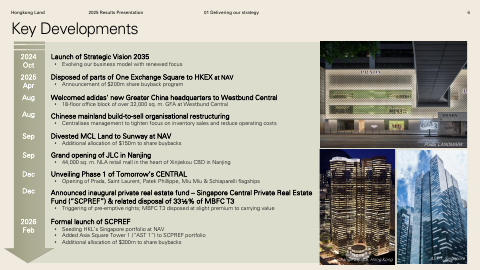
Deploying capital through growing SCPREF and other gateway cities is added, alongside delivering Tomorrow's CENTRAL and Westbund Central. — Michael T. Smith
0:54:44 · Cindy, Citi · Investment returns
What return is targeted on new investments as assets under management grow?
SCPREF targets about 8% for investors, and including fees the company expects returns of roughly 9% to 10%. — Craig Beattie
0:54:44 · Cindy, Citi · Tomorrow's CENTRAL
What more can be done at LANDMARK and what is the opening schedule for new flagships?
Two Maisons open each year, with two more due this year, and management expects rental income to grow 20% to 25% over pre-renovation levels, plus public-realm activations. — Michael T. Smith, Craig Beattie
0:59:45 · Carl Choi, Bank of America · Retail sales
How have Hong Kong retail tenant sales performed so far this year?
The trend has continued, with robust sales at LANDMARK during Chinese New Year and no change seen. — Craig Beattie
0:59:45 · Carl Choi, Bank of America · Office leasing
Is there any slowdown in corporate office leasing decisions given Middle East conflicts?
It is too early to tell, and management said its long-lease fixed-asset business is built for resilience. — Michael T. Smith
1:00:16 · Carl Choi, Bank of America · China retail yields
What are the yield on cost for new Chinese malls and the cap rates used for reclassified assets?
Nanjing is at low single digits and Suzhou is expected at upper single digits, while valuation cap rates on reclassified assets were about 5% to 6%. — Craig Beattie
1:03:08 · Mark Leung, UBS · Geopolitics
Will Middle East tensions benefit Singapore and Hong Kong offices?
Management expects both cities to be seen as safe havens and to benefit from some return of talent. — Michael T. Smith, Craig Beattie
1:03:08 · Mark Leung, UBS · Office rent cycle
When might Hong Kong office rents return to their peak, and what signposts would show funds returning?
Prime Central rents are down about 40% from peak, growth is expected but its pace is uncertain, and Hong Kong needs growth and lower interest rates before fund returns work. — Craig Beattie
1:07:35 · Simon, Goldman Sachs · New markets
Which other markets are targeted for fund management?
Tokyo, Seoul and Sydney, where the company has hired people, with announcements hoped for. — Michael T. Smith
1:08:06 · Simon, Goldman Sachs · Build-to-sell
How much build-to-sell inventory remains, and how large is the pool of medium-term lease assets?
Gross build-to-sell assets are US$2.9 billion with about US$1.4 billion net, and the medium-term lease assets are close to US$4 billion at the company's share. — Craig Beattie, Michael T. Smith
1:10:57 · Rachel Tan, Macquarie · Westbund Central
When will Westbund Central earnings materialise?
It will not be a big contributor until 2028 onwards, and more material from 2030 as the project matures. — Craig Beattie
1:12:28 · Rachel Tan, Macquarie · Impairments
Are more impairments expected in China?
Management believes it has done all it needs for now after repricing, though the market is not expected to improve in the next couple of years. — Craig Beattie
1:14:45 · Sarah · AI and office demand
Is AI or remote work changing what tenants want from 10-year office leases?
Work from home has not been a big issue in Hong Kong, AI tools may limit some tenants' space growth, and management still backs prime office in gateway cities. — Craig Beattie
1:17:42 · Nicholas, Credit Suisse · Debt
How much recycling proceeds will go to debt reduction?
Recycling was to create investment capacity rather than cut debt, with about US$3.5 billion of liquidity available for acquisitions. — Craig Beattie
1:19:49 · Joe Ho · China REITs
Is there progress on China real estate investment trusts?
It is too early because some assets are not yet stabilised, but management wants to be ready for a REIT or pre-IPO route. — Michael T. Smith
1:20:42 · Rachel Tan, Macquarie · Return on equity
Is there a return on equity target?
Improving returns is a focus, but the low-yield Hong Kong portfolio makes it hard to fix quickly, and moving to asset-light fund management should lift it. — Craig Beattie