“This directly addresses customers’ desire to consolidate vendors and receive integrated services.”
It explains the customer demand behind merging GlobalLogic and Hitachi Digital Services.

Hitachi (6501) · Industrials
Results filed 28 Oct 2026 · Quarter ended 30 Sep 2026 · Company's own call transcript · Tomomi Kato (CFO)
Read the transcriptSlides (42 pages)Official transcript (PDF) ↗Press release ↗Investor relations ↗
Summaries and transcripts are machine-generated and can contain errors.
Hitachi merged GlobalLogic and Hitachi Digital Services into one AI-focused digital unit and lifted its HMAX recurring-service target 70% year on year, as AI and data-center demand fed Energy orders.
Hitachi's growth this quarter came from demand for grid equipment, data centers and AI-related manufacturing. Energy orders were driven by large HVDC awards in Europe and data-center orders, and Connective Industries orders rose on semiconductor equipment. Domestic IT work for finance and public customers stayed strong. Hitachi also merged GlobalLogic and Hitachi Digital Services under new CEO Anand Birje, and completed the Clever Devices and Canduct Group acquisitions.
Management is steering toward Physical AI and recurring HMAX digital services. It is narrowing its focus to four service lines, seven verticals and its top 200 accounts. The main tension is execution. GlobalLogic's growth is limited and is being restructured. Energy backlog is stretching delivery lead times. Rare-earth constraints and cyber and geopolitical risks add uncertainty to a plan that leans heavily on large, long-running projects.
Open the slide deck (PDF, 42 pages) ↗
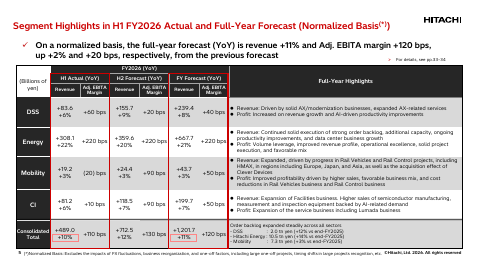
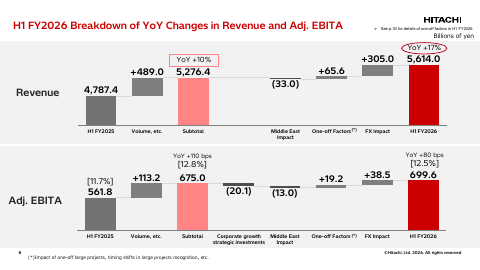
Showing the first 6 of 42 pages.
Results documents
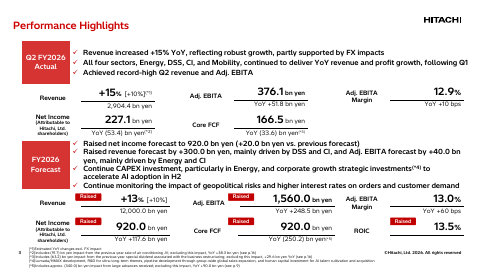
up 15% from a year ago
YoY +51.8 bn yen
YoY (53.4) bn yen
vs 103.55 a year earlier
vs 749,627 a year earlier
YoY (33.6) bn yen
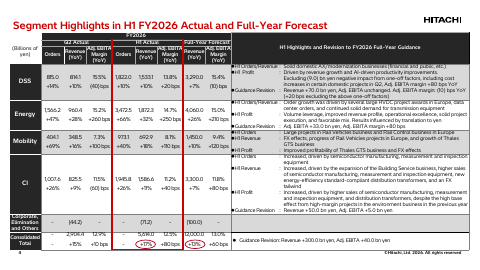
| Segment or metric | Value | Change |
|---|---|---|
| Energy Q2 revenue | 960.4B | +28% |
| Digital Systems & Services Q2 revenue | 814.1B | +10% |
| Connective Industries Q2 revenue | 825.5B | +9% |
| Mobility Q2 revenue | 348.5B | +16% |
| Hitachi Energy order backlog (tn yen) | 10.5 | +14% vs end-FY2025 |
Copied from the press release ↗ and other documents in the company's results page ↗. A figure is published only if its sentence is in those documents.
| Metric | Period | Outlook |
|---|---|---|
| Revenue forecast (bn yen) | fiscal 2026 | 12,000.0 |
| Adjusted EBITA forecast (bn yen) | fiscal 2026 | 1,560.0 |
| Net income forecast (bn yen) | fiscal 2026 | 920.0 |
The combined Hitachi Digital unit, led by Anand Birje, aims to offer end-to-end services across infrastructure, data, API and application layers. Management says this answers customers' wish to consolidate vendors and enables cross-selling.
HMAX requires data from Digitalized Assets, AI enhanced by domain knowledge, and recurring digital services. Management says much of the HMAX revenue should be seen as new business rather than relabelled existing revenue.
Data-center work is more than 10% of Hitachi Energy revenue and a low-teens share of orders. No delays or payment problems have been reported, and this year's orders should turn into revenue next fiscal year.
Hitachi reports about 10% productivity gains in SI by the end of fiscal 2025 and targets about 20% by the end of fiscal 2026 and about 30% in fiscal 2027. These gains are expected to improve margins gradually.
Orders are growing faster than production capacity, so the backlog should keep rising and substantially shorter delivery lead times are unlikely. Long contracts use price-index mechanisms to pass on inflation.
Each quote matches the transcript word for word.
“This directly addresses customers’ desire to consolidate vendors and receive integrated services.”
It explains the customer demand behind merging GlobalLogic and Hitachi Digital Services.
“We will not only grow with existing customers but also win competitors’ customers by providing end-to-end AI services across both the physical and digital domains.”
It states the competitive goal of the Hitachi Digital strategy.
“In the systems integration (SI) business, we achieved approximately 10% productivity improvement as of the end of fiscal 2025. We aim to achieve approximately 20% improvement by the end of fiscal 2026 and approximately 30% in fiscal 2027.”
It gives a concrete roadmap for AI-driven productivity gains in IT services.
“Data center-related business accounts for more than 10% of Hitachi Energy’s total revenue and a low-teens percentage of its orders, and is growing steadily.”
It sizes AI-infrastructure exposure within the Energy business.
“Its definition is stricter than that of Lumada, and only businesses meeting all three requirements qualify.”
It clarifies how narrowly HMAX is defined versus the broader Lumada brand.
Losses on certain domestic projects were resolved in Q2 with no further impact expected, and the outlook is not overly conservative. — Tomomi Kato
SI productivity improved about 10% by end of fiscal 2025, with about 20% targeted by end of fiscal 2026 and about 30% in fiscal 2027, lifting margins gradually. — Tomomi Kato
The integration enables end-to-end services and cross-selling, while AI governance, an agent registry and a Cyber CoE address security. — Anand Birje, Tomomi Kato
HMAX has a stricter definition than Lumada and management says much of its revenue should be regarded as new business. — Masashi Hatakeyama
Productivity gains and contained large-project losses were the main drivers, with backlog pricing still improving. — Tomomi Kato
He cited Hitachi's rare physical-plus-digital capabilities and its capacity for large AI and data investment. — Anand Birje
GlobalLogic is narrowing its vertical focus and undergoing restructuring, while Hitachi Digital Services keeps growing; fiscal 2026 is a year of reset and acceleration. — Tomomi Kato, Anand Birje
No delays or payment collection issues have been reported on secured orders, and this year's orders should convert to revenue next fiscal year. — Tomomi Kato, Shinichiro Tamai
Some lead times have lengthened, but strategic inventories and alternative sourcing keep the impact on production limited for now. — Tomomi Kato
Growth is expected to continue through 2035, with the rate moderating but absolute revenue increases maintained, without a specific next-year outlook. — Tomomi Kato
Geopolitics, AI-related volatility and cyberattacks, plus cost and schedule risks on large projects, mitigated by globally distributed sites. — Tomomi Kato
Security projects and inquiries from critical-infrastructure customers are rising, but the scale cannot yet be quantified and a 10% lift is unlikely soon. — Tomomi Kato, Shinichiro Tamai
No, orders are growing significantly, so the backlog should keep rising and a substantial shortening is unlikely. — Tomomi Kato
Contracts incorporate price-index mechanisms to reflect price increases, though temporary impacts may occur. — Tomomi Kato
They have been integrated into Hitachi Digital under CEO Anand Birje to offer end-to-end services and cross-sell. It will focus on four growth service lines, seven key verticals, its top 200 accounts and 11 ecosystem partners.
HMAX revenue was 238.0 bn yen in the first half, 47% of the raised full-year target of 510.0 bn yen, which implies about 70% year-on-year growth. It is a recurring digital service built on data from Digitalized Assets and AI.
Data-center business is more than 10% of Hitachi Energy revenue and a low-teens percentage of orders. Management reports no delays or payment issues on secured projects and expects this year's orders to become revenue next fiscal year.
Management pointed to geopolitical risk, AI-related volatility, cyberattacks, cost and schedule risks on large projects, and rare-earth supply constraints that have lengthened some lead times. It says the rare-earth impact is currently limited.
Yes. SI productivity improved about 10% by end of fiscal 2025, with about 20% targeted by end of fiscal 2026 and about 30% in fiscal 2027. Hitachi is also deploying forward-deployed engineers and expanding security and AI services.
Hitachi also publishes its official transcript (PDF) ↗.
Q&A Summary: Web Conference on Q2 FY2026 Earnings Date: Wednesday, October 28, 2026, 17:00–18:00 JST Speakers: Tomomi Kato Senior Vice President and Executive Officer, CFO Masashi Hatakeyama Vice President and Executive Officer, Deputy CFO Anand Birje CEO, Digital Engineering & AI Solutions Business Unit, Digital Systems & Services Sector Shinichiro Tamai Executive General Manager, Investor Relations Division Unless otherwise specified, all responses were provided by Mr. Kato.
Questioner 1 Q. What was the nature of the 9 billion yen in one-off costs in DSS, and what impact do you expect going forward? Also, is the full-year margin forecast of 18.8% for domestic IT services, excluding one-off factors, conservative?
A. Although losses were incurred on certain domestic projects, the situation was resolved in Q2, and we do not expect any additional impact going forward. The first-half margin excluding one-off factors was 17.2%. The full-year outlook appropriately reflects the expected project mix and is not overly conservative. We will continue to work to improve margins and business performance.
Q. When will AI-driven productivity improvements begin to contribute to margin improvement and enable you to capture projects that you previously could not accommodate despite strong domestic demand?
A. In the systems integration (SI) business, we achieved approximately 10% productivity improvement as of the end of fiscal 2025. We aim to achieve approximately 20% improvement by the end of fiscal 2026 and approximately 30% in fiscal 2027. We expect these improvements to translate into a gradual improvement in margins.
Q. What new capabilities will the integration of GlobalLogic and Hitachi Digital Services enable? Also, how are you addressing AI-related security risks, and what business opportunities do you see? A.
Mr. Birje: The benefits of integration include delivering end-to-end services that combine the strengths of both companies, cross-selling to existing customers, bringing together industry- specific domain knowledge and cross-industry capabilities, and unifying the management structure. GlobalLogic has strengths in products and platforms, applications, and data engineering, while Hitachi Digital Services specializes in enterprise platforms such as SAP and Oracle, as well as IT and cloud operations. By integrating the two companies, we can cover the infrastructure, data, API, and application layers and provide integrated services from development through operations and transformation. This directly addresses customers’ desire to consolidate vendors and receive integrated services. We will also pursue cross-selling by leveraging the long-standing customer relationships developed by both companies and trust in the Hitachi brand, while combining their domain knowledge across our seven key verticals. A unified CEO, CTO, and CMO structure and a single operating model will facilitate closer engagement with customers, partners, analysts, and employees. Over the next five years, as AI adoption moves from proof of concept (PoC) to full-scale deployment, risk management will be essential not only for security but also for governance and costs. We will fully leverage the proprietary expertise developed through AI deployment in our own operations across mission- critical industries to support customers. This includes an AI agent registry, security protocols covering OT and IT as well as physical and virtual environments, a governance framework, and foundations for AI, data, and cloud.
Mr. Kato: With DSS’s specialist Cyber CoE organization at the center, we are strengthening the protection of internal systems and our response to previously unknown vulnerabilities, while also actively supporting customers’ security measures. As inquiries from customers responsible for critical infrastructure increase, FDEs (forward-deployed engineers who work alongside customers) and specialist security teams collaborate closely to resolve issues. In addition, by working with global partners such as Anthropic and leveraging our own operations as Customer Zero, including OT environments, we are developing security initiatives that extend to Physical AI.
Questioner 2 Q. Following the increase in HMAX’s full-year target, how should we interpret the planned 70% 1/4
year-over-year growth in terms of reclassification of existing services versus growth from new businesses? Does the incremental portion also have the same high margin of 22% as HMAX overall? A.
Mr. Hatakeyama: HMAX has three requirements: (1) it uses data collected from Digitalized Assets; (2) it uses AI as an enabler and is enhanced by domain knowledge; and (3) it consists of recurring digital services. Its definition is stricter than that of Lumada, and only businesses meeting all three requirements qualify. Some existing businesses may already have met these requirements, but many have been customized to meet them, registered as HMAX, with the resulting revenue then recognized. Therefore, we would like you to regard much of this as new business.
Q. Growth in the Energy sector’s five-year medium-term outlook appears to be largely explained by a 2–2.5-fold increase in supply capacity, with limited assumptions for price increases above inflation. How much did higher prices at the time of order intake contribute to the recent 2.6- percentage-point margin improvement?
A. The two main drivers of the margin improvement were productivity gains and the containment of losses on large-scale projects. Expanded use of the previously introduced ERP system and greater use of AI contributed to productivity improvement. For large-scale projects, we set aside contingencies for unforeseen costs, and effective project management kept losses below our initial assumptions. Selling prices and the gross margin of the order backlog also continue to improve, leaving room for further improvement. However, these improvements had already been factored into the outlook as of Q1, and the latest upward revision is mainly attributable to factors such as productivity gains.
Questioner 3 Q. Why did Mr. Birje decide to join Hitachi, and how will he leverage his previous experience? A.
Mr. Birje: I began my career at Emerson Electric and have experience both in the physical and IoT domains of industry and in global systems integration and digital, data, and application engineering. I have worked in the digital field for approximately 20 years, including at Encora, a competitor of GlobalLogic. I bring approximately 30 years of experience gained in Silicon Valley and a global industry network. Hitachi is one of the few companies in the world with capabilities across the Physical and Digital tech stack, which it can combine to support transformation across both layers, and it has distinctive strengths, particularly in complex regulated industries. I was also attracted by its ability to make large-scale investments in AI, data, and digital transformation. A major reason for my decision to join was the opportunity to combine my experience across both the physical and digital domains and my global industry network with these strengths of Hitachi.
Q. While the full-year order outlook for engineering services is for 6% year-over-year growth, revenue growth is only 3%. Is this due to a strategic exit from non-priority businesses? What are Hitachi Digital’s non-priority businesses, what proportion of revenue do they account for, and what impact will they have this fiscal year and from next fiscal year onward?
A. Within Hitachi Digital, which integrates GlobalLogic and Hitachi Digital Services, Hitachi Digital Services continues to grow steadily, supported by manufacturing customers and synergies with the Hitachi Group. In contrast, GlobalLogic’s revenue growth remains limited, partly because it is strategically narrowing its vertical focus. We plan to advance structural reforms this fiscal year.
Mr. Birje: We regard this fiscal year as a year of “reset and acceleration” toward growth over the next five years. We will deliberately pursue both a vertical focus on priority sectors and a horizontal focus on growth areas (such as Data & Intelligence, Cloud, FinOps, operations (Ops), IoT, Physical AI, and Enterprise Platforms). We will not only grow with existing customers but also win competitors’ customers by providing end-to-end AI services across both the physical and digital domains. Specifically, we will concentrate management resources on four growth service lines (Cloud, Data, Physical AI, and Enterprise Platforms), seven key verticals, our top 200 accounts, and 11 ecosystem partners. Our top 200 accounts currently account for approximately 80% of revenue. Growth from these accounts has remained in the single digits from last fiscal year to this fiscal year. However, as vendor consolidation progresses among customers, we see significant room for further growth with them by leveraging the end-to-end capabilities realized through the integration of GlobalLogic and Hitachi Digital Services, as well as an opportunity to target higher, double-digit growth going forward. In addition, few companies in the world can cover both the Physical and Digital layers at scale in mission-critical industries, and this unique 2/4
strength of Hitachi also underpins our confidence in future growth. We are not disclosing specific numerical forecasts for next fiscal year at this time.
Questioner 4 Q. The Energy sector accounts for most of the upward revision to the outlook, and data center- related orders are also expanding. Have any data center projects been postponed, scaled back, or canceled amid credit concerns over AI infrastructure companies and rising financing costs? How do you view the risks and concerns going forward?
A. Data center-related business accounts for more than 10% of Hitachi Energy’s total revenue and a low-teens percentage of its orders, and is growing steadily. We have not received any reports of delays in projects for which orders have already been secured.
Mr. Tamai: We are not aware of any schedule delays or payment collection issues in ongoing projects. Although data center-related business contributed significantly to Q2 orders, there is a time lag before revenue recognition. On average, we expect orders received this fiscal year to contribute to revenue next fiscal year.
Q. Regarding China’s rare earth export restrictions, does the impact remain limited as the supply of elements such as dysprosium and yttrium to Japan becomes more constrained? Which elements and products are at risk, and how long can production be maintained using strategic inventories and already-secured supplies?
A. We procure magnets and motors containing rare earths mainly in the CI and Mobility sectors, and some delivery lead times have been extended. However, we are working with procurement partners to secure strategic inventories and explore alternative sources, and the impact on business performance and production is currently limited. We will continue to closely monitor strategic inventory levels. We refrain from disclosing a breakdown of individual impacts, as this relates to operational details.
Questioner 5 Q. Power Grids revised its outlook upward in Q2 following the Q1 revision, which I understand implies an annual profit increase of approximately 200 billion yen. Should we expect similar increases in revenue and profit from next fiscal year onward? Could growth accelerate further, and what downside concerns do you see?
A. Previously, we indicated that growth would continue through 2030, but since around last year we have explained that it would continue through 2035. As the absolute level of revenue increases, we expect the growth rate itself to gradually moderate. Meanwhile, the effects of capital investments made over the past two to three years will become apparent going forward, and we believe the absolute increase in revenue may be maintained at a certain level. That said, this is our current sense of direction, which includes a certain degree of expectation, and does not represent a specific revenue outlook for next fiscal year.
Q. What downside risks does Power Grids face?
A. Business performance could be affected by various factors, including geopolitical risks, AI-related volatility, and cyberattacks. That said, Hitachi Energy has built a highly resilient structure by distributing its production and development sites around the world. Even so, large-scale projects are continually exposed to risks such as cost increases and schedule delays, so we will ensure rigorous project and risk management.
Q. Will cybersecurity demand lead to an increase in orders from the second half of this fiscal year? Could you quantify the scale by industry and the impact on revenue? Also, will the overall impact toward next fiscal year be around 1–2%, or could it reach approximately 10%?
A. Security-related projects to protect customers’ assets and systems are increasing, but we are not yet in a position to quantify the scale or growth rate by field. It is unlikely that this would immediately lead to an increase of 10% or more in overall business performance. However, difficult-to-predict events are also occurring, so we will carefully assess future developments.
Mr. Tamai: Inquiries from customers responsible for critical infrastructure, including power, transportation, manufacturing, and finance, have increased significantly. However, we do not currently have specific figures to quantify the scale. 3/4
Questioner 6 Q. Will the expansion of Hitachi Energy’s production capacity shorten delivery lead times? What is your outlook?
A. Although we are systematically expanding production capacity and improving production efficiency, orders are also growing significantly, and we expect the order backlog to continue increasing for the time being. Therefore, a substantial shortening of delivery lead times is unlikely. In addition to shortening overall lead times, we are focusing on making timely deliveries in line with each customer’s requested schedule and are pursuing improvements accordingly.
Q. Do your long-term project contracts allow you to pass on inflation-related cost increases through selling prices?
A. We recognize inflation as a significant risk in long-term contracts. When entering into a contract, we always incorporate a mechanism that uses price indices to objectively reflect price increases in selling prices. Although temporary impacts may occur, this mechanism allows us to manage the risk appropriately.
end
4/4