“As AI-driven productivity improvements increase our capacity, we will be able to support more customers, which in turn will contribute to revenue growth.”
It links AI productivity to revenue growth in a market constrained by IT talent.

Hitachi (6501) · Industrials
Results filed 29 Jul 2026 · Quarter ended 30 Jun 2026 · Company's own call transcript · Tomomi Kato (CFO)
Read the transcriptSlides (38 pages)Official transcript (PDF) ↗Press release ↗Investor relations ↗
Summaries and transcripts are machine-generated and can contain errors.
Hitachi's Energy unit won several large HVDC awards in Europe and the company closed its Clever Devices rail acquisition. It also scaled AI-driven IT services and raised its full-year outlook.
Demand strengthened across Hitachi's four sectors. Hitachi Energy won several large HVDC grid projects in Europe, and orders for semiconductor manufacturing, measurement and inspection equipment rose. Domestic IT services kept winning AI-transformation and modernization work in finance, public sector and transport. The new high-end block storage product sold strongly, and Lumada digital business revenue rose 31%. Hitachi closed the Clever Devices acquisition on July 1, adding transit software to its rail business.
Management is steering toward AI-enabled services and grid and data-center infrastructure. It is raising capital spending, mainly in Energy's Power Grids business, and hiring forward-deployed engineers. It plans a power-to-rack data-center demonstration test in early 2027. The main tension is execution. Production capacity, talent and AI productivity gains must keep pace with a record order backlog, while the Middle East situation and weaker U.S. demand at GlobalLogic remain risks.
Open the slide deck (PDF, 38 pages) ↗
Showing the first 6 of 38 pages.
Results documents
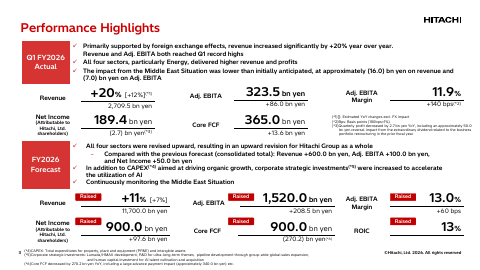
up 20% from a year ago
up 39% from a year ago
up 1% from a year ago
up 1% from a year ago
up from 442,091 a year ago
up from 367,699 a year ago
up 86.0 bn yen from a year ago
| Segment or metric | Value | Change |
|---|---|---|
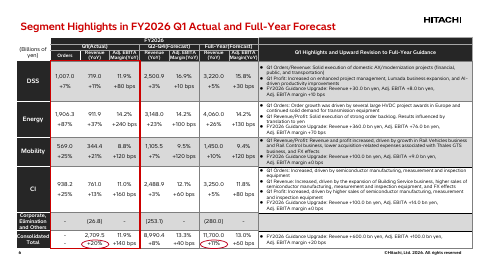
| Digital Systems & Services revenue | 719.1B | up 11% from a year ago |
| Energy revenue | 911.9B | up 37% from a year ago |
| Mobility revenue | 344.4B | up 21% from a year ago |
| Connective Industries revenue | 761.1B | up 13% from a year ago |
Copied from the press release ↗ and other documents in the company's results page ↗. A figure is published only if its sentence is in those documents.
| Metric | Period | Outlook |
|---|---|---|
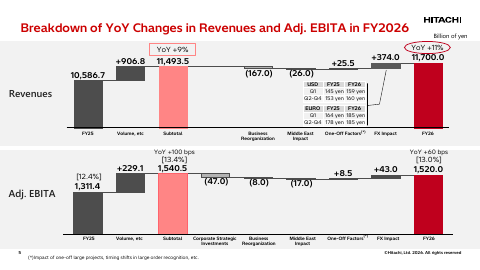
| Revenue forecast | fiscal 2026 | 11,700.0 bn yen |
| Adjusted EBITA forecast | fiscal 2026 | 1,520.0 bn yen |
| Adjusted EBITA margin forecast | fiscal 2026 | 13.0% |
| Capital expenditure forecast | fiscal 2026 | 670.0 bn yen |
Energy orders rose 87% on several large HVDC awards in Europe, and the Hitachi Energy backlog stands at 10.3 tn yen. Management now expects Hitachi Energy's full-year growth to reach 20% on a dollar basis, above its initial forecast.
Hitachi reports about 10% productivity gains at the end of fiscal 2025 and targets 30% by fiscal 2027. It will roll out an Agentic AI Integration Platform to large projects from September and expand domestic forward-deployed engineers from about 300 to about 1,000 by fiscal year-end. Management says more capacity lets it serve customers it cannot meet today because of Japan's IT talent shortage.
The two units began integrated operation in April and report cross-selling results, with a Google Cloud alliance and a thyssenkrupp partnership aimed at Physical AI. GlobalLogic's revenue and profit dipped slightly on a weak U.S. market and selective order-taking.
HMAX revenue was about 110 billion yen in Q1, led by Building Systems, Hitachi High-Tech diagnostics and Mobility, with margins above 20%. Management says all sectors should contribute to its growth.
Hitachi plans a demonstration of a system controlling everything from the power grid to the rack in early 2027. It expects 800V rack architecture to reach actual projects from around fiscal 2028, and says solid-state transformers will take longer to be widely adopted.
Each quote matches the transcript word for word.
“As AI-driven productivity improvements increase our capacity, we will be able to support more customers, which in turn will contribute to revenue growth.”
It links AI productivity to revenue growth in a market constrained by IT talent.
“We plan to begin a demonstration test of a system that integrally controls everything from the power grid to the rack in early 2027.”
It gives a concrete timeline for Hitachi's data-center power strategy.
“For large-scale projects such as HVDC, we are focusing on Engineering (E) and Procurement (P) within the EPC framework, while reducing our exposure to Construction (C).”
It shows Hitachi shifting its project mix to limit construction risk on large grid projects.
“Until last year, we explained that we expected growth through 2030, but at present there are large-system projects with delivery dates beyond 2030, and we recognize that growth will continue until around 2035.”
It extends management's view of the Hitachi Energy demand runway by about five years.
“By leveraging these businesses as Customer Zero and working closely with DSS to advance Physical AI initiatives, we are building a competitive advantage that is difficult to replicate.”
It explains why Hitachi thinks its mix of operational technology and IT gives it an edge in Physical AI.
Capacity additions, hiring and productivity gains drove it, with Q2-Q4 revenue growth broadly in line with Q1 and a full-year margin improvement of 140 bps expected. — Tomomi Kato
Connective Industries leads, through HMAX for Buildings and Hitachi High-Tech predictive diagnostics, followed by Mobility, with HMAX margins above 20%. — Tomomi Kato
Management points to AI productivity gains, with a 30% target by fiscal 2027, plus targeted inorganic investment. — Tomomi Kato
Japan's IT talent shortage leaves demand unmet, so extra AI-driven capacity lets Hitachi serve more customers. — Tomomi Kato
Management declined to give ratios but expects all sectors to grow, with Connective Industries currently slightly under half of HMAX revenue. — Tomomi Kato
Capacity investment, ERP rollout, a higher-margin backlog and tighter project management drove it, with AI and a lower exposure to construction on HVDC projects to follow. — Tomomi Kato
Long-term HVDC contracts of five to six years reflect cost increases in customer prices through indices. — Tomomi Kato
Storage passed on material costs and sold its new high-end block storage product strongly, while GlobalLogic dipped slightly but aims for full-year growth. — Tomomi Kato
Normalized Energy revenue growth was 24%, and Hitachi will run a power-grid-to-rack demonstration in early 2027 while treating solid-state transformers as a longer-term effort. — Tomomi Kato, Shinichiro Tamai
The two units support Lumada work in Energy and Mobility, and Anand Birje is expected to drive company-wide AI use and business expansion. — Masashi Hatakeyama, Tomomi Kato
It continues capital investment and hiring while shortening operating cycles through IT systems and AI. — Tomomi Kato
It uses order and track-record data short term, and framework agreements, capacity reservations and power demand forecasts long term, now seeing growth until around 2035. — Tomomi Kato
Framework agreements pre-set basic terms to speed individual contracts, and advance payments are received at contract signing. — Tomomi Kato
It cites its Energy, Mobility and Connective Industries businesses as Customer Zero and plans to keep using alliances with frontier AI companies. — Tomomi Kato
Several large HVDC awards in Europe lifted Energy orders 87%, and demand for transmission equipment stayed solid. The Hitachi Energy backlog is 10.3 tn yen, and management sees growth continuing until around 2035.
It is rolling out an Agentic AI Integration Platform to large projects from September and aims for 30% productivity improvement by fiscal 2027. It is also expanding domestic forward-deployed engineers from about 300 to about 1,000 by fiscal year-end.
Hitachi Rail closed its acquisition of Clever Devices, a U.S. provider of intelligent transportation systems for transit agencies, on July 1, 2026. The consideration was 302 million dollars.
It supports technical studies for 800V rack architecture, which it expects in actual projects from around fiscal 2028, and plans a power-grid-to-rack demonstration in early 2027. Its distribution transformers and UPS products also serve data centers.
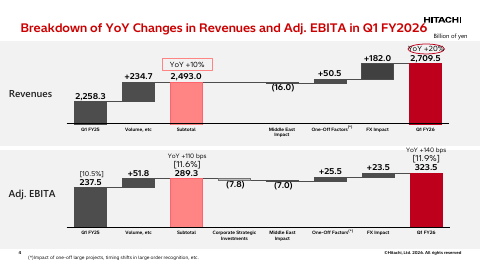
Management is monitoring the Middle East situation, which cost about 16.0 bn yen of revenue in Q1 and is reflected in Q2-Q4 forecasts. GlobalLogic's revenue and profit dipped slightly on a challenging market.
Hitachi also publishes its official transcript (PDF) ↗.
Q&A Summary: Web Conference on Q1 FY2026 Earnings
Date : Wednesday, July 29, 2026, 17:00-18:00 JST Speaker : Tomomi Kato Senior Vice President and Executive Officer, CFO Masashi Hatakeyama Vice President and Executive Officer, Deputy CFO Shinichiro Tamai Executive General Manager, Investor Relations Division Unless otherwise specified, all respondents were Mr. Kato
Questioner 1 Q. I assume that Hitachi Energy's Q1 profit margin exceeded the initial expectations. What were the factors and background behind this? Also, is there a possibility of further upside from Q2 onward?
A. Hitachi Energy's Q1 results exceeded the initial expectations. Revenue was above expectations not only due to foreign exchange effects but also on a dollar basis. Moreover, margin improvement was supported not only by increased production capacity through continuous capital investment and workforce expansion, but also by productivity improvement. IT investments made in recent years have also contributed to more efficient production. For this earnings presentation, we prepared explanatory slides on a normalized basis, excluding foreign exchange and one-off factors, on pages 7 and 31. While the revenue growth rate from Q2 onwards may appear lower than Q1, the cumulative year-over-year revenue increase from Q2 through Q4 is expected to be approximately three times the increase recorded in Q1. Accordingly, the year-over-year revenue increase in each quarter is expected to be broadly in line with Q1. As for the full-year profit margin, we expect an improvement of 140 basis points (bps). While this could fluctuate depending on the degree of production efficiency improvement, we basically expect performance to stay along this line. In addition, Q1 orders also exceeded the initial assumption.
Q. Regarding the full-year adjusted EBITA margin outlook of 22% for HMAX, which sub-segments or sectors are contributing to margin improvement?
A. Looking at the Q1 results, HMAX’s revenue composition was led by the CI (Connective Industries) sector, which includes the Building Systems business and Hitachi High-Tech (Measurement & Analysis Systems business), followed by the Mobility sector. In Building Systems, HMAX for Buildings; in Hitachi High-Tech, predictive diagnostics for medical analytical equipment; and in the Mobility sector, existing initiatives are each contributing to HMAX revenue. Profit margins are above 20%, making HMAX a driver of overall growth.
Questioner 2 Q. At the Investor Day, you explained that domestic IT services in DSS (Digital Systems & Services) aim to achieve revenue of 3-5 trillion yen in fiscal 2030. Going forward, is there a visible path to achieving double-digit growth through the expansion of AX (AI transformation) demand and reaching the 5 trillion-yen target? Also, how are you securing the resources for that?
A. The full year outlook for domestic IT services orders in fiscal 2026 is a 7% year-over-year increase. There are two elements that will drive the achievement of 5 trillion yen in revenue. The first is productivity improvement using AI. We achieved approximately 10% productivity improvement as of the end of fiscal 2025, and we have set an ambitious target to raise productivity improvement to 30% by fiscal 2027. The second is inorganic investment, which we will carry out in a timely manner in targeted areas. We believe that as these bear fruit, the scale of 5 trillion yen will come into view.
Q. Why does productivity improvement also lead to revenue growth?
A. Due to the continued shortage of IT talent in Japan, we have not been able to fully meet market demand. As AI-driven productivity improvements increase our capacity, we will be able to support more customers, which in turn will contribute to revenue growth.
1/3
Q. How will HMAX's sector revenue composition change from fiscal 2026 to fiscal 2027?
A. Of HMAX's Q1 revenue of approximately 110 billion yen, slightly less than half is from the CI sector, mainly the Building Systems business and Hitachi High-Tech, followed by the Mobility sector, the DSS sector, and the Energy sector. While we would like to refrain from stating specific ratios going forward, we basically expect all sectors to grow and contribute to medium-term growth.
Questioner 3 Q. What specific factors have driven the improvement in production efficiency at Hitachi Energy? In addition, how do you view the sustainability of profit growth as revenue continues to increase going forward?
A. The same factors applied in fiscal 2025. Revenue and profit growth were driven not only by expanded production capacity through capital investment, but also by improvements in production efficiency. The average gross margin of the order backlog has continued to improve, creating a structure in which profitability increases as the backlog is executed. The rollout of the ERP system across Hitachi Energy was completed in fiscal 2024, and the gradual improvement in operations translated into tangible results in fiscal 2025. Going forward, we will further enhance operational efficiency through the use of AI. For large-scale projects such as HVDC, we are focusing on Engineering (E) and Procurement (P) within the EPC framework, while reducing our exposure to Construction (C). Continued improvements in project management are also contributing to higher profitability.
Q. How is price pass-through progressing in response to rising procurement costs, and to what extent could it contribute to further profit growth going forward?
A. For long-term HVDC projects spanning from five to six years, we have a contract structure that reflects cost increases in the sales prices charged to customers using various indices. By enhancing the level of project management, including such contractual arrangements, we are contributing to the improvement and stabilization of profitability.
Q. How did soar DRAM and NAND prices affect the storage business, and what impact did the slowdown in the U.S. market have on GlobalLogic?
A. In the storage business, the new high-end block storage product launched this year has seen strong sales. Since we have basically been able to pass on the rising material costs to selling prices, both revenue and profit increased. From April, GlobalLogic and Hitachi Digital Services began integrated operation, and the results of cross-selling are emerging. Hitachi Digital Services achieved revenue and profit growth by acquiring new customers in areas such as industry, in addition to existing customers. On the other hand, GlobalLogic saw a slight decline in revenue and profit in Q1 due to the challenging market environment and the strategic selection of orders with a focus on profitability; however, we aim to achieve revenue and profit growth for the full year.
Questioner 4 Q. What was the Energy sector’s underlying Q1 performance excluding foreign exchange impacts and one-off factors? In addition, how do you assess progress against the medium- to long-term plan presented at Investor Day, and what initiatives are you pursuing regarding the 800V data center architecture and solid-state transformers?
A. The Energy sector's Q1 revenue increased 37% year-over-year, but revenue growth on a normalized basis excluding foreign exchange and one-off factors was 24%. Power Grids grew 35%, of which Hitachi Energy grew 22% on a dollar basis, an increase of approximately USD 1 billion year-over year. Full-year growth is now expected to exceed the initial forecast, reaching 20% on a dollar basis, and if this high level continues from next fiscal year onward, there could be upside to the medium- to long-term targets as well; however, we will carefully monitor future growth.
A. Mr. Tamai: Regarding the 800V rack architecture for data centers, we are providing support for technical studies, and industry forecasts anticipate that adoption in actual projects will progress from around fiscal 2028. First, we would like to accelerate partnerships in areas where delivery is fast, and we can leverage our existing technologies. We plan to begin a demonstration test of a system that integrally controls everything from the power grid to the rack in early 2027. Through this, we aim to contribute to simplification, efficiency improvement, and reduction of the installation footprint, thereby helping data centers ramp up quickly. As for solid-state 2/3
transformers, we are advancing preparations by integrating Hitachi Energy's strengths in control, power electronics, and transformation technology; however, since widespread adoption will take a long time, we will first contribute through control systems that support early ramp-up.
Q. I would like to ask about the synergy revenue of GlobalLogic and Hitachi Digital Services (booked by other BUs & Group companies). For example, is there any margin improvement from bringing system development in the Energy and Mobility sectors in-house by leveraging GlobalLogic and Hitachi Digital Services? Also, what are your expectations for Mr. Anand Birje, who was appointed CEO of DSS's Digital Engineering & AI Solutions Business Unit (DEAI BU)?
A. Mr. Hatakeyama: GlobalLogic and Hitachi Digital Services play a key role in supporting the Lumada business in the Energy and Mobility sectors through their digital capabilities. In fiscal 2026, the Lumada business is expected to deliver strong profitability, with margins of 20% in Digital Services and 14% in Digitalized Assets. As these revenues are recorded within the respective sectors, synergy revenue continues to expand.
A. Mr. Kato: The DEAI BU under DSS is the core organization that drives the digital business, including GlobalLogic, Hitachi Digital Services, and Hitachi Vantara. To capture the tailwind of AI utilization and to drive business transformation and operational efficiency across HMAX and the entire group, we welcomed Mr. Anand Birje, who has extensive global experience, as BU CEO. We expect him to drive company-wide AI utilization and business expansion through strong leadership.
Questioner 5 Q. What initiatives are you taking to accelerate the conversion of Hitachi Energy's strong orders into revenue?
A. We continue to advance capital investment and talent hiring as planned, while also shortening the operational cycle through IT system investments and AI adoption. By further enhancing operational efficiency with AI, we aim to accelerate the conversion of orders into revenue.
Questioner 6 Q. What indicators do you emphasize in the short term and in the medium to long term when assessing the outlook for Hitachi Energy's market environment?
A. For the short-term outlook, we conduct our analysis based on our abundant order activity and track-record data as the industry's top player. For the medium to long term, in addition to concluding framework agreements and capacity reservation agreements with customers, we conduct our analysis by utilizing various data such as economic forecasts and power demand forecasts. Until last year, we explained that we expected growth through 2030, but at present there are large-system projects with delivery dates beyond 2030, and we recognize that growth will continue until around 2035.
Q. What efforts are you making in negotiations with customers regarding capacity securing and advance payments?
A. By predetermining the basic terms through framework agreements, we simplify and expedite the subsequent individual contracting procedures. Since the initial engineering also involves costs, we operate by receiving advance payments at the time of contract conclusion.
Q. From what perspective do you measure the global benchmark for Physical AI? Also, could you elaborate on your future initiatives?
A. While I will refrain from naming specific benchmark companies, our greatest strength is that, in addition to OT and products, we have businesses such as Energy, Mobility, and CI within the Hitachi Group. By leveraging these businesses as Customer Zero and working closely with DSS to advance Physical AI initiatives, we are building a competitive advantage that is difficult to replicate. For advanced language models, we will continue to leverage alliances with leading frontier AI companies and move forward with speed and agility.
end
3/3