“Today, 78 % of small business submissions are bindable straight through.”
It quantifies the digital capability management credits for small business growth running at twice industry levels.

The Hartford (HIG) · Insurance
Results filed 26 Oct 2026 · Quarter ended 30 Sep 2026 · Call 63 min · Chris Swift (CEO), Beth Costello (CFO)
Read the transcriptSlides (14 pages)Official transcript (PDF) ↗Press release ↗Investor relations ↗
Summaries and transcripts are machine-generated and can contain errors.
The Hartford closed its Equitable employee benefits acquisition to push into small and mid-sized employers, while competition tightened in small commercial and personal auto.
The Hartford's small business unit kept growing through digital speed: 78% of submissions can be bound straight through, and E&S binding is on pace to reach $500 million by year end. Homeowners agency rollout lifted new business, while personal auto stayed under pressure from intense competition. Employee Benefits grew with strong persistency, and the Equitable employee benefits business closed in October.
Management is steering toward a more connected enterprise: AI-enabled underwriting, claims and service, plus bringing small-business ease to benefits. The tension is a market getting more competitive. Small business new business stopped growing for the first time in roughly 20 quarters, middle and global specialty are being selectively underwritten, and workers' compensation and disability claim frequency are rising. A CEO handover to Mo Tooker is set for March 1.
Open the slide deck (PDF, 14 pages) ↗

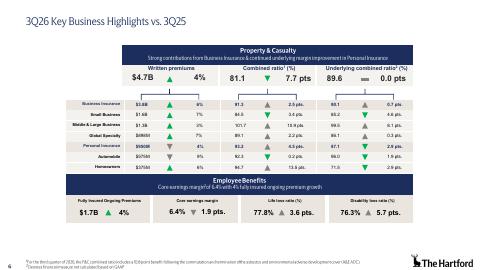
Showing the first 6 of 14 pages.
From The Hartford investor relations
SEC filing
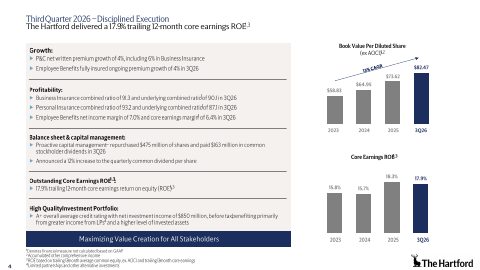
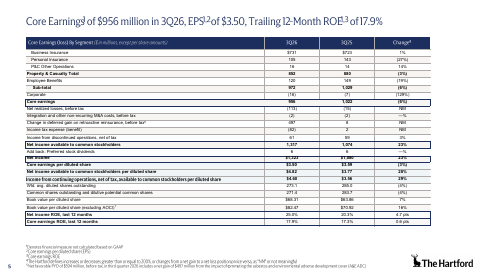
up 23% from $1.1 billion a year ago
up from $3.77 a year ago
down from $3.59 a year ago
down 6% from $1,022 million
| Segment or metric | Value | Change |
|---|---|---|
| Business Insurance written premiums | $3.8 billion | up 6% |
| Personal Insurance written premiums | $950 million | down from $987 million |
| Employee Benefits fully insured ongoing premium growth | 4% | up 4% from third quarter 2025 |
| Business Insurance underlying combined ratio | 90.1 | |
| Personal Insurance underlying combined ratio | 87.1 |
Copied from the press release ↗ and other documents in the SEC filing ↗. A figure is published only if its sentence is in those documents.
| From the filing | Q3 2026 | vs year ago | vs last quarter |
|---|---|---|---|
| Revenue | $7.2B | +3.9% | −0.6% |
| Net income | $1.3B | +22.5% | +1.9% |
| Diluted EPS | $4.82 | +27.9% | +3.0% |
Calculated by code from XBRL, not by the model.
| Metric | Period | Outlook |
|---|---|---|
| Employee Benefits core earnings margin range | long-term | 6 % to 7 % |
| Annual intangible asset amortization from Equitable acquisition | annual, from acquisition | $30 million |
78% of small business submissions are now bindable straight through, which management estimates is 5 to 10 points better than its leading competitor. Agents and brokers ranked The Hartford first for small business digital experience for the eighth year in a row.
The closed acquisition adds approximately $500 million in annual premium and brings dental and vision. Management plans to bring small-business-style speed and ease to benefits, with modest core earnings dilution expected in 2027.
Small business new business was non-positive for the first time in probably 20-something quarters, and middle and global specialty are also more competitive. Management says it is picking its spots and protecting renewals rather than chasing growth.
A new homeowners product in the agency channel drove 20% new business growth, while auto new business faced intense competition and elevated shopping. Management says it will grow in a disciplined way rather than manufacture a growth crossover.
Management sees a broad-based frequency increase across industries, geographies and risk sizes, which it links to health care costs and expired ACA subsidies. It is responding with segmentation, new business pricing and 2027 rate filings, and calls 2026 a one-time step change.
Fourth quarter worked out from the annual figure.
| Q4 2024 | $6.9B * |
| Q1 2025 | $6.8B |
| Q2 2025 | $6.7B |
| Q3 2025 | $6.9B |
| Q4 2025 | $8.2B * |
| Q1 2026 | $7.2B |
| Q2 2026 | $7.3B |
| Q3 2026 | $7.2B |
| Q1 2025 | $2.15 |
| Q2 2025 | $3.44 |
| Q3 2025 | $3.77 |
| Q1 2026 | $3.04 |
| Q2 2026 | $4.68 |
| Q3 2026 | $4.82 |
Fourth-quarter EPS appears once the press release is read; filings report it only for the full year.
| Q4 2024 | $1.9B |
| Q1 2025 | $947.0M |
| Q2 2025 | $1.3B |
| Q3 2025 | $1.8B |
| Q4 2025 | $1.8B |
| Q1 2026 | $1.0B |
| Q2 2026 | $1.3B |
Operating cash flow minus capital expenditure, from cash flow statements.
Each quote matches the transcript word for word.
“Today, 78 % of small business submissions are bindable straight through.”
It quantifies the digital capability management credits for small business growth running at twice industry levels.
“there was an incremental step change in the competitiveness in small in the quarter. You'll see our new business went negative or non-positive for the first time in probably in 20-something quarters.”
It shows that competition has reached even The Hartford's strongest franchise.
“We are excited about the modern integrated technology that we are acquiring, making it easier for employers and brokers to do business with us in the small and mid-sized employer market.”
It explains the strategic rationale for the Equitable acquisition beyond adding premium.
“We're actually really optimistic in a world of AI-enabled businesses that actually it's going to be a small business revival in some ways”
It shows how management expects AI to expand its small business market rather than threaten it.
“3% of our small business book is direct today. That number has been fairly static for years now, and again, we don't see a change there.”
It indicates agentic AI has not yet shifted how small business customers buy insurance.
Workers' comp and non-cat property each added a little under four points in middle and large; non-cat property is seen as normal volatility, while comp frequency is broad-based and being met with underwriting, segmentation and 2027 price filings. — Chris Swift, Beth Costello, Mo Tooker
Behavioral health claims and higher-wage claimants are still elevated, paid family leave is modestly better but still elevated year to date, and mid double-digit rate increases are going into that book. — Mike
The reserve review did not change booked reserves and management feels good going forward. — Beth Costello
Small business has performed strongly for years, this quarter was helped by favorable non-cat property, and management points to its digital capabilities as a lasting differentiator. — Beth Costello, Chris Swift, Mo Tooker
Not necessarily; the quarter included a true-up, and the nine-month impact is about half a point, with management viewing 2026 as a step change. — Chris Swift, Beth Costello
Yes, management still sees 6% to 7% long term, with integration costs excluded from core, about $30 million of annual amortization included, and modest dilution in 2027. — Chris Swift
Management will not guide 2027 but still sees a 6% to 7% business, with the acquisition taking time to scale. — Chris Swift
Management is confident in similar small business growth but noted new business was non-positive for the first time in over 20 quarters and middle and global are more competitive. — Chris Swift, Mo Tooker
Management expects stability and does not anticipate significant change. — Mo Tooker
Auto remains intense with elevated shopping, retention is improving, agency homeowners is scaling, and growth will be disciplined. — Chris Swift, Melinda
It is very broad-based, and management expects AI-enabled business formation to support small business growth. — Mo Tooker
It is broad-based efficiency, with lower cost per head, as management expected for the back half of 2026. — Chris Swift
Small business is constrained by filings but frequency is within loss picks, while middle and large relies on segmentation and mix rather than price. — Chris Swift, Mo Tooker
Mix is about 0.3 to 0.4 points in total Business Insurance and will continue as national accounts premium earns in, with the rest being many small items tied to pricing. — Beth Costello
No; medical severity still starts from the 5% assumption. — Beth Costello
It is early days with no real shift; 3% of small business is direct, and the technology is ready if the market moves. — Mo Tooker
Management sees disability as mean reverting and priceable, and believes comp is a one-time 2026 step change tied to health care, not another year of elevated frequency. — Chris Swift
No common pattern was cited beyond health care cost disruption; management will keep using data, analytics and AI to investigate. — Chris Swift
It has made small business quick to buy, with 78% of submissions bindable straight through and a first-place digital experience ranking for the eighth year. Growth is running at twice industry levels, though new business growth stalled this quarter.
The deal adds approximately $500 million in annual premium and dental and vision products, and brings modern technology aimed at small and mid-sized employers. Management expects modest core earnings dilution in 2027.
Management says the market is incrementally more competitive: small business new business stopped growing, middle and global specialty are being selectively underwritten, and personal auto new business remains intense.
Auto premium fell on competitive pressure, while homeowners new business grew 20% after a new product rollout in the agency channel. Management is prioritizing margins and disciplined growth over chasing volume.
Management sees a broad-based frequency increase it ties to health care costs and expired ACA subsidies, and is responding with segmentation and 2027 filings. It currently views 2026 as a one-time step change and does not expect another year of elevated frequency in 2027.
Call recording on YouTube ↗. Official replay ↗. Timestamps jump to the moment.
The Hartford also publishes its official transcript (PDF) ↗.
Hello everyone. Thank you for joining us and welcome to the Hartford Third Quarter 2026 Financial Results webcast. After today's prepared remarks, we will host a question and answer session. If you would like to ask a question, please press star 1 to raise your hand. To withdraw your question, press star 1 again. I will now hand the conference over to Kate Jorens, Senior Vice President, Treasurer, and Head of Investor Relations. Kate, please go ahead.
Good morning, and thank you for joining us today for the Hartford Third Quarter 2026 Earnings Call and Webcast.
Yesterday, we reported results and posted all earnings-related materials on our website. Before we begin, please note that our presentation includes forward-looking statements, which are not guaranteed or future performance and may differ materially from actual results. We do not assume any obligation to update these statements. Investors should consider the risks and uncertainties detailed in our recent SEC filings, news release, and financial supplement, which are available on the Investor Relations section of the Hartford .com. Our commentary includes non-GAAP financial measures with explanations and GAAP reconciliations available in our recent SEC filings, news release, and financial supplement.
Now, I'd like to introduce our speakers, Chris Swift, Chairman and Chief Executive Officer, and Beth Costello, Chief Financial Officer. After their remarks, we will take your questions, assisted by several members of our management team. And now, I'll turn the call over to Chris. Chris Swift, Chairman and Chief Executive Officer, and Beth Costello, Chief Financial After their remarks, we will take your questions, assisted by several members of our management team. And now, I'll turn the call over to Chris.
I'd like to say a few words about the leadership transition we announced last month. It has been an honor to serve this iconic company, first as CFO and then as CEO for nearly 13 years. Over that time, what the team has accomplished together reflects the talent and commitment of our employees and the trust that we have built with our agents, brokers, and customers. I have tremendous confidence in Mo's leadership. Since joining the Hartford in 2015, he has strengthened our underwriting and has expanded our products and risk appetite.
More recently, as president, he has successfully led business performance, strategy, and enterprise-wide execution. Mo is the right leader for the Hartford's next chapter. This was a thoughtful planned succession and the Hartford strategy, priorities and commitment to disciplined execution are unchanged. I remain fully engaged as CEO and look forward to supporting Mo and the entire team to ensure a seamless transition. As I reflect on the last 13 years, Hartford broadened its capabilities by investing in transformative technology while expanding product offerings and geographic footprint.
Growth and innovation have been central to the Hartford's transformation. Over this time, we modernized core platforms, moved applications and data to the cloud, and built the foundation that now allows us to embed AI in underwriting, claims, and service across the businesses. It is no coincidence that over the same period, the Hartford has become a company that consistently delivers outstanding returns. We have the scale to keep investing with a significant share of our spend directed to strategic initiatives.
Small business is where that work is most visible. Agents and customers want speed and simplicity, and our digital capabilities continue to outpace competitors by a wide margin. Today, 78 % of small business submissions are bindable straight through. In addition, Quinova recently shared with us that the Hartford ranked first for small business digital experience for the eighth year in a row with a 20-point lead over the next carrier. This is translating into performance, with small business growth at twice industry levels, combined with excellent margins.
We have extended those same strengths across the enterprise, making it easier for agents, brokers, and employers to do business with us. Customers' buying habits will continue to evolve, and we are ready, combining the speed of technology with the underwriting expertise and advice customers value. We are well positioned to compete, grow, and deliver attractive returns as the market changes. With that, let me share a few details from the quarter. Business insurance delivered strong written premium growth of 6 % with an underlying combined ratio of 90.1.
In personal insurance, the underlying combined ratio improved 2.9 points year over year, with growth impacted by a competitive market. Employee benefits had another quarter of strong premium growth, with a core earnings margin of 6.4%. The investment portfolio generated excellent net investment income, and earnings in capital generation supported a 12 % increase in the common quarterly dividend effective January 2027. All these factors contributed to core earnings of 956 million and an outstanding core earnings ROE of 17.9 % over the trailing 12 months.
Let's take a closer look at third quarter performance. Business insurance delivered a solid quarter. In small business, written premium grew 7 % with an exceptional underlying combined ratio of 85.2, which outperformed our long-term average. Growth was led by package, our largest product line, and E &S binding, which is on pace to reached $500 million by year end, up from less than $100 1,000,005 years ago. Deep underwriting expertise combined with market-leading service capabilities positioned small business to continue generating profitable growth.
Moving to middle and large, written premium growth was 3%, driven by solid growth in middle market, partially offset by lower written premium in national accounts. The underlying combined ratio of 99.5 reflected higher non-cap property and workers' compensation loss ratios. The team is actively managing the book in a competitive market with thoughtful risk selection and pricing. Turning to global specialty, results remain strong with written premium growth of 7 % driven by global RE and an underlying combined ratio in the mid-80s.
The diversity of the global specialty products and underwriting capabilities enables us to capitalize on business opportunities and pursue profitable growth across the portfolio in changing market conditions. Turning to pricing, business insurance renewal written pricing, excluding workers' compensation declined by 40 basis points to 5.3 % in the quarter. Pricing in commercial auto remained strong and above loss trend. General liability including primary, umbrella, and excess continued to generate some of the highest price increases across the portfolio, although down from the prior quarter and slightly below loss trend.
In property, aggregate pricing and small business package and middle market general industries remained relatively stable in the mid single-digit range in price decreases in large property and ENS binding eased modestly. All-in, business insurance renewal written pricing declined 40 basis points to 4%, with workers compensation pricing improving slightly and remaining positive. Shifting to personal insurance, the underlying combined ratio was excellent at 87.1, reflecting earned pricing that continues to exceed loss trend in both auto and homeowners.
The team remains focused on matching price with risk and maintaining target margins. Competition for new business in auto remain intense and impacted overall premium growth. In homeowners, new business growth of 20 % reflects the positive reaction to the rollout of our new product to the agency channel. Agency is an important lever for profitable growth and we are building on deep relationships developed over many years across the enterprise. Before moving on to employee benefits, I'd like to briefly touch upon the Council of Insurance Agents and Brokers Insurance Leadership Forum earlier this month.
Overall, feedback continued to emphasize the importance of our investments in digital and AI enabled capabilities and highlighted the strength of the Hartford's position as the market continues to evolve. In addition, conversations increasingly expanded beyond PNC to include employee benefits and broader enterprise capabilities, reinforcing the value of a more connected enterprise approach. Turning to employee benefits, the core earnings margin was 6.4 % within our long-term range of 6 % to 7 % as underlying business trends revert to historical levels.
Fully insured premiums grew 4%, supported by strong year-to-date sales growth and broke persistency in excess of 90%, all while maintaining pricing and underwriting discipline. At the same time, continued investments in technology and service are strengthening the business, allowing us to meet evolving customer needs. Earlier this month, we closed the acquisition of Equitable's employee benefits business, which complements our already leading franchise and accelerates growth in the small and midsize employer segment, which represents a significant portion of the overall employee benefits market.
The acquired business brings approximately $500 million in annual premium and expands the product portfolio to include dental and vision. We are excited about the modern integrated technology that we are acquiring, making it easier for employers and brokers to do business with us in the small and mid-sized employer market. Over time, we see opportunities to bring more of the Hartford to these customers. In terms of capital management, yesterday we announced a 12 % increase in the common quarterly dividend, continuing a track record of annual dividend increases supported by earnings power and strong capital generation.
In closing, third quarter results demonstrate the continued momentum and execution of our strategy. In business insurance, a diversified portfolio, strong distribution relationships, disciplined underwriting, and technology-enabled execution continue to drive profitable growth at attractive returns. In personal insurance, the focus remains on thoughtful expansion in the mature market, supported by the continued rollout of our modern platform in the agency channel. Employee Benefits remains a high-quality, accretive business enabled by differentiated technology and a leadership position in the absence and leave marketplace.
These strengths position us well at the large end of the market, while the recent acquisition expands our ability to serve small and mid-sized customers. Investment income continues to be supported by a diversified and durable portfolio and higher reinvestment rates will benefit net investment income going forward. With another strong quarter, I am confident in the Hartford's ability to continue delivering outstanding ROEs and attractive returns for shareholders. Now I'll turn the call over to Beth to provide more detailed commentary on the quarter.
Thank you, Chris. Before I begin, I want to thank Chris for his leadership and partnership. The company we are today reflects his vision and discipline, and I look forward to continuing our work together through the transition and supporting Mo as we begin our next chapter. Third quarter core earnings were $956 million, or $3.50 per diluted share, with a trailing 12-month core earnings ROE of 17.9%. Book value per share, excluding AOCI of $82.47, increased 12 % from year end and 16 % from a year ago, reflecting the earnings power of our businesses and disciplined approach to capital management.
In addition, the trailing 12-month net income ROE was 25%, which includes earnings from Hartford Funds. As it relates to the sale of Hartford funds, we are progressing towards closing, which could occur as early as December 1st, subject to standard regulatory and fund approvals. And as a reminder, once we close, distributions from Hartford funds will occur quarterly and will be recorded in realized gains within net income. Moving to results, in business insurance, core earnings were $731 million with written premium growth of 6 % and an underlying combined ratio of 90.1.
Small business continues to deliver excellent results with written premium growth of 7 % and an underlying combined ratio of 85.2. The underlying combined ratio improved 4.6 points from the prior year, primarily due to lower non-cap property losses and a lower expense ratio. Middle and large business delivered written premium growth of 3%, including 5 % in middle market, with an underlying combined ratio of 99.5. The underlying combined ratio increase from prior year equally impacted by higher loss ratios from non-cap property and workers' compensation.
Non-cap property losses reflect normal volatility with a few large fire and non-weather water losses this quarter. The increase in workers' compensation relates to a broad-based uptick in claim frequency, which we have been observing and reacting to throughout the course of the year. Global Specialties third quarter was strong with written premium growth of 7 % and an underlying combined ratio of 86.1, which is relatively consistent with the prior year. The business insurance expense ratio of 30 improved 1.1 points from the prior year driven by the impact of earned premium growth and lower staffing costs partially offset by higher technology costs.
In personal insurance, core earnings were 105 million with an underlying combined ratio of 87.1. Written premium declined 4 % with a 9 % decline in auto and 6 % growth in home. The underlying combined ratio improved 2.9 points in the quarter, driven by earned pricing increases outpacing lost cost trends in both auto and home. The personal insurance expense ratio of 26 was relatively flat compared with 25.8 in third quarter 2025. Turning to reserves, favorable prior year development of $594 million before tax included a $497 million benefit from the impact of commuting the A &E adverse development cover.
This benefit is not included in core earnings. Core favorable prior development was $97 million, driven by reserve reductions in workers' compensation, commercial property, and personal insurance. With respect to catastrophes, P &C current accident year losses were $198 million before tax, or 4.2 points, primarily from tornado, wind, and hail events. This compares with 70 million or 1.6 points in the third quarter of 2025, which was a historically light catastrophe quarter. Moving to employee benefits, core earnings of 120 million and a core earnings margin of 6.4 percent reflect higher group life and disability loss ratios, partially offset by an improved expense ratio and higher net investment income.
Fully insured ongoing premium grew 4%, reflecting strong new business sales, increased exposure on existing accounts, and book persistency above 90%. The group life loss ratio of 77.8 increased 3.6 points as compared to an unusually favorable prior year period. The group disability loss ratio of 76.3 increased 5.7 points driven by higher claim incidence across short and long-term disability and less favorable long-term disability recoveries. Long-term disability loss ratios, while elevated on a year-over-year basis, remained within expectations while short-term disability loss ratios were slightly above expectations.
The employee benefits expense ratio of 25.4 improved 1.3 points driven by lower staffing costs and the impact of earned premium growth partially offset by higher technology costs. As Chris mentioned, we closed the acquisition of Equitable's employee benefits business earlier this month and and expect $500 million in annual premium across group life, disability, and other supplemental products including dental and vision. Consistent with the smaller end of employee benefits, we expect loss ratios for this business to be lower than our existing book, though offset by a higher expense ratio due in part to approximately $30 million of annual intangible asset amortization.
Excluding the amortization, we expect the core earnings impacts of the acquisition to be modestly diluted in 2027 and to improve each year as the business integrates and scales. Turning to investments, our diversified portfolio delivered strong results in the third quarter. Net invested income was $850 million, up $95 million or 13 % from the third quarter of 2025, driven by higher income from limited partnerships and other alternative investments, and a higher level of invested assets. Excluding limited partnerships, the annualized portfolio yield was 4.6 % before tax.
annualized limited partnership returns were 10.2 percent before tax and 7.8 percent year-to-date results benefited from particularly strong performance in infrastructure and energy transition funds turning to capital management holding company resources totaled 1.5 billion at end. As Chris mentioned, we increased our common quarterly dividend by 12 % to 67 cents per share, payable on January 5th, 2027. Over the past decade, our annual dividend increases have averaged approximately 11%, demonstrating our confidence in the sustained earnings power and capital generation of the organization.
During the quarter, we repurchased 3.4 million shares under our Share Repurchase Program for $475 million. As of September 30th, we had $4.37 billion remaining on our Share Repurchase authorizations. In summary, we are very pleased with our strong performance for the third quarter and believe we are well positioned to continue to enhance value for our stakeholders. I will now turn the call back to Kate.
Thank you, Beth. We will now take your questions. Operator, please repeat the instructions for asking a question.
We will now begin the question and answer session. Please limit yourself to one question and one follow-up. If you would like to ask a question, please press star 1 to raise your hand. To withdraw your question, press star 1 again. We ask that you pick up your handset when asking a question to allow for optimum sound quality. If you are muted locally, please remember to unmute your device. Please stand by while we compile the Q &A roster.
Your first question comes from the line of Brian Meredith with UBS. Your line is open. Please go ahead.
Yes, thank you. I guess first question, I was hoping to unpack the underlying combined ratio a little bit on the middle market, and particularly what was the impact of the unusual losses on an underlying loss ratio in the quarter for the total business insurance? And then maybe talk a little bit about what you're doing with comp in order to kind of fix some of this increased frequency and underwriting that you're doing there.
Brian, thanks for joining us. I might ask Beth to sort of break down and give an attribution of the combined ratios for, you know, the two items that we called out, right? I mean, non-cat weather was, you know, a little elevated. I could give you the, you know, quarterly impacts and the year-to-date impacts after she's done. But I think that, you know, the comp, we've been watching very closely, you know, here in 26, as far as, you know, the emerging trend of higher frequency.
So, Beth, would you break down those components?
Yeah, I will. And Brian, I'm going to take some time and just go through the various components as it relates to MLC and then the impact just when we think of total BI. But as I said in my prepared remarks, when we look at the underlying combined ratio for MLC for the quarter, we definitely saw a little bit of improvement in expense. So think of that about a point kind of consistent with what we're seeing in small commercial.
And then the rest relates to loss ratio movements. And so the two items that we called out, comp and non-cat property, I would say both contributed a little less than four points to the change from the prior year. And again, all my comments are related to the prior year. In addition, similar to what we've seen during the course of the year, although we didn't call it out because it was not as large as those two items, we continue to see a little less than a point related to MIX.
And I think we've talked about that before as some of the growth that we saw in national accounts has earned into the book. And then like a lot of other things that make up the difference there. Going back to the two items, comp and non-cap property. On non-cap property, what I would say, and I said this in my remarks, is as we look at the results there, we see this as normal volatility. It is another quarter of seeing an uptick there.
But if you go back and look over several quarters, we've had more quarters where non-cap property has been favorable in ML than unfavorable. So we do see that as normal volatility. And then on the comp side, as I said, we've been seeing an increase in frequency during the course of the year. Increases in frequency, you know, quarter to quarter can happen, so you don't necessarily react to that. But as we evaluated where we were year to date, felt that was appropriate to increase the loss ratio there.
So a component of just under four points of underlying combined loss ratio points this quarter, a little bit of that does relate to prior quarters, just to put that in context. So then when you go to the all-in business insurance and what the impact of all of that is, I would say a non-cap property, it's really not a driver. We had favorability in small and that offset and the unfavorability that we saw in middle.
And then the comp piece pulling that through to the all-in BI loss ratio is a little over a point. And then again, we have some small sort of items as it relates to mix and other things. And then more importantly, if I look at things on a year-to-date basis, we're probably a little under a point off to where we were year to date last year for all in BI. The comp piece that I reference is a little less than half a point and then you know the remainder of the items are things like mix and some of the other things that I discussed.
So when I step back from all of it, you know looking at where middle came out, how small performed, the contribution to the total, where we are year to date, I feel really good about the overall performance in business insurance as we continue to perform, I think, in a competitive marketplace. But I can stop there. Brian, if you have any questions, then I was going to turn it to Mo to talk about some of the actions that we've been taking.
Yeah. Okay. Yeah, Brian, just to build on where Beth was, I think as we've looked at the frequency throughout the year, I think it's really important to understand we see it across the book in all segments. It's not specific to any industry. It's not specific to any geography. It's not specific to size or risk. Not specific to injury type. So really what we're seeing we think is a broad-based move in frequency that's not unique to our book.
And when we look at the contributing factors, we are looking at the increase in health care costs in this country, the expiration of the ACA subsidies, and broadly just thinking about the affordability challenge for many workers across this country. And we feel like some of those losses that might have been in the health care costs are coming back into the workers' compensation system, which is why we feel it's so broad-based. And to your point on underwriting, as Beth talked about on the property side, we really don't think there's anything going on in our book.
As Beth said, eight of the past 10 quarters, we've been better than expected on property losses in middle of March. So we really feel like this is just a second quarter of adverse results relative to expectations. And on the workers' compensation side, we've been working on it all year. We've been making sure the quality of the new business is strong, the new business pricing. We're pulling the levers that we can in terms of segmentation. And certainly we're working to get price increases into our filings in for 27.
So just think of a broad-based underwriting reaction to all that we just described.
Great. That's really helpful. Very thorough. I appreciate it. And then maybe just my next question, switching over to the disability loss ratio. Thanks for some description. But I know Mike last quarter mentioned a couple of things going on with long and short-term disability. I'm wondering if those are continuing, i .e., maybe the Family Medical Leave Act, you know, maybe some mental health claims you're seeing coming through.
Yeah. Well, I'll ask Mike to add his color.
Yeah, so Brian, I think similar to what I discussed last quarter, both those items you pointed out, so we're seeing a bit of elevation in behavioral health. We're seeing that both in short and long-term disability products. In addition to sort of that from a diagnosis perspective, we're also seeing some higher claims with higher wage earners. So I think the individuals who are going out on claim we're seeing in terms of a little bit on the higher end of the salary level.
So I'd say those are a couple of underlying trends within the short and long-term disability lines. Paid family leave in the quarter was moderately improved, I should say modestly improved, relative to 3Q of 25, but on a year-to-day basis still elevated. And I'd say I'd just end by saying we continue to put rate into the paid family and medical leave product line. we've been successful through the year. So think mid double digit rate increases we're putting into that book.
We are seeing utilization continue to trend up. So again, as long as that utilization level continues to rise, we'll put rate increases in that product line.
Terrific. Thank you.
Your next question comes from the line of Andrew Kleiderman with TD Cowan. Your line is open. Please go ahead.
Hey, thanks a lot. Mo, congratulations on the well-deserved new role. And Chris, spare me 30 seconds. I've covered this company throughout your tenure. So before my question, I just want to say congratulations on an exceptional run.
You made some bold, unpopular calls from acquiring Aetna benefits and navigators to reportedly rejecting a $65 offer in 2021, and your conviction proved right. Underwriting has excelled. The stock has nearly quadrupled since you became CEO, and most importantly, you restored the Hartford to its place as an iconic industry leader, only better. That's an incredible legacy, Chris, and I just want to congratulate you on that. And now I'll shift into my questions. First one, Beth, you didn't call out anything on general liability and commercial auto in the reserve adjustments.
So I just, you know, I went through the queue. I didn't see anything in there. I just want to make sure I understand that right or if there were some big moves in prior accident years. And generally, just, you know, how are you thinking about the reserves going forward for commercial auto and GL?
Yeah, Andrew, so your review is correct. We did conduct our reserve review during the quarter, and we did not adjust our booked reserves as we looked at the activity.
It was, you know, consistent with the actions that we had previously taken. So we did not make any adjustments there.
And you're feeling good going forward?
Yes, we are feeling good going forward. You know, obviously we do our reserve review every quarter and if we felt that we needed to increase our reserves, we would have. Again, our reserve review substantiated where we stood relative to our book reserves.
Yeah, and on small business, the 85.2 underlying was quite exceptional and certainly materially stronger than your other business insurance segments.
So I just want to get a sense, historically, have you always done much better in small business? And, you know, how do you feel about the sustainability of that combined ratio amidst pricing pressures?
Yeah, I'll start, and if Mo or Chris want to add anything, you know, I think we've consistently talked about the strong performance in small business, which has been there, you know, quarter after quarter and year after year. You know, obviously this quarter, you know, printing the combined ratio that we did was impacted by favorable non-cat property, as we called out.
And so obviously that can move around from period to period. But, you know, when we look at the underlying performance, you know, feel very good. So, you know, the question may be where would we expect fourth quarter to be. It's a little bit of kind of what happens with non-cat property. But again, I think the performance of small business stands on its own.
Andrew, I would just add, you know, we're very proud, obviously, as I called out in our prepared commentary that, you know, is recognized as, again, for the eighth consecutive year of leading with digital capabilities.
And I think that just reflects our mindset of continuing to invest in small commercial to be easier to interface with, faster, make lives easier for our agents and brokers and customers. So, yeah, we're going to continue investing in this franchise to differentiate it as the world changes going forward. But, Mo, what would you add?
Maybe just one more anecdote, Andrew. the 78 % straight through on the entire portfolio that Chris called out. That's an all-time high for us, and we think it's probably 5 to 10 points better than our leading competitor, let alone our average competitor.
So we expect that 78 % with all the technology investments we're making, including AI, to continue to improve, and that just creates a better experience for our agents and brokers.
Thanks a lot.
Your next question comes from the line of Elise Greenspan with Wells Fargo. Your line is open. Please go ahead.
Hi, thanks. Good morning. My first question is going back to the discussion on workers' comp. So I think you said you guys, you know, gave a lot of color on the impact of middle and large, but then said, right, it was around a point, right on overall BI in the quarter.
So just given it sounds like you can, you know, you expect perhaps this elevated frequency to persist, should we continue to think about like an ongoing, you know, one point drag from comp on BI for, you know, at least in the near term?
Yeah, I would say not necessarily, and Beth can add her, you know, point of view. You know, obviously we're focused on 2026 trends and finishing the year strong. Obviously we'll talk about 2027 at the right time and give you any additional, you know, color.
But again, I think this is a step change, you know, given some of the activities that we talked about, particularly, you know, healthcare. care and we'll see how it's going to play out beyond this year end. But I think this is a year of sort of, as I said, a step change and hopefully then things at least calm down a little bit. But Beth, what would you say?
Yeah, the only thing I would point out, Elise, is when we talked about the impact on comp for the quarter being little over a point, that is for the quarter, which included a a bit of a true up for first and second quarter.
So when I think more of the run rate, and I kind of look at the nine months, kind of where we are year to date, the impact on comp from that perspective is about a half a point. So again, just I don't want you to lose sight of the fact that there is a bit of a true up that happens in the quarter if you just look at the quarterly number.
Thanks. And then my second question is on employee benefits.
You guys gave some guidance on just bringing on the equitable deal. Also, it sounds like maybe some normalization and disability should persist. So as we think about those two forces, bringing on equitable, which at least you said will be dilutive in 27, can you guys, do you still expect to be within the 6 % to 7 % margin guide for benefits with all those factors taken into consideration?
Yeah, it's a great question. I would say yes.
We still think in terms of this business as 6 % to 7%, but I would point out there's three moving parts here that you inherently know. One, obviously we've got to integrate, and we're going to spend some money on integrating probably in the 30 million ish range maybe 40 that those costs will be sort of below the line on core so it's excluded from core like we've done all our all our deals we also called out that there's probably $30 million of annual intangible amortization that will be part of you know core you know earnings so and then we're going to obviously continue to be as efficient as possible and continue to invest in the business but when you
put it you know all together we still see this business as a as the six to seven we called out that you know there's going to be a modest dilution in 27 particularly as we scale i mean this is you know the technology required is really actually very very good and industry leading in our judgment but it's going to take some time to sort of scale and and get all the things you know moving forward but when we get to that that point uh and if you really um you know think about you know the moving parts six to seven is still uh our long-term view thank you
Your next question comes from the line of Alex Scott with
Barclays. Your line is open. Please go ahead.
Hey, good morning. I wanted to see if you could give us a better sense of what to expect out of the core margin and group benefits. No, you probably don't want to give guidance for 27 and that kind of thing, but just given there's some more moving parts there around the acquisition and disability and maybe even paid family medical leave. I just wanted to see if you'd help us out with thinking through that.
Yeah, you're right. We're not going to give you guidance on 27. That's what I tried to do a little bit just on the prior question of just, you know, the acquisition, you know, impacts. I still think this is a six to seven business for us. It's going to, you know, take maybe just a little bit of time to scale and sort of earn into the activities that we spec. But $500 million a premium, and if we could grow that at a healthy rate, we'll get to where we want to be.
And that's why I said in my prepared remarks, Alex, that this is still a highly accretive business for us, particularly when you look at it on a tangible return on equity basis. You know that's it's in the 15 16 percent return on tangible If you look at margin on a nine-month basis, I think it's 6.9 compared to the 6.4 for the quarter, so it's contributing, you know, meaningfully and as we alluded to Particularly particularly with their technology, you know bringing more of the Hartford to that small the mid-sized customer base in benefits would be a a strategic objective I know Mo and the team have.
That's all helpful. Thanks. Second question I had is on growth and BI. As we look at small commercial, could you talk a bit about the competitive landscape you're seeing there? Do you expect to be able to sustain these levels of growth even as the market continues to get more competitive and are you seeing any of your competitors that are maybe more geared towards the larger market influencing things in the small
I'm gonna let you know mo that's sorry Alex I stepped on you I'm gonna let mo you know add but again I think all our businesses fit together well that we constructed the portfolio here of you know small middle large specialty international, EB, personal lines.
So it's actually a diversified portfolio that all the businesses are contributing to our overall results, both from a growth side and a profitability side. But Mo, what would you add?
Yeah, let me just make a layer below that for you. So I think the messaging is going to be fairly consistent with what we've talked about in prior quarters. In small, we're very confident about our abilities to grow at a similar pace. I think what we're bringing to the marketplace, the digital and technology capabilities continue to make a real impact for our agents and brokers.
I think I cited the 78 % straight through, which is nowhere near our competitors. And obviously, Chris talked about Keynova. That being said, there was an incremental step change in the competitiveness in small in the quarter. You'll see our new business went negative or non-positive for the first time in probably in 20-something quarters. It's the first time we didn't grow our new business so there is a competitiveness that team is staying very disciplined and making good choices in middle and global again we've talked about it that is increment incrementally more competitive as well and we're really trying to pick our spots and I talked about it last quarter about having an increasingly divergent view from some of our
competitors who are talking about stability we're not necessarily feeling stability we're feeling it incrementally more competitive and that's coming through in the new business numbers that we show in the supplement and both middle and global. So on those businesses, we are going to continue to make choices that are really dependent on what the market's doing from a rate perspective. We are protecting our renewals. You can see that in a retention number. So our growth in middle and global, as we talked about last quarter, will be very dependent on how market conditions evolve, especially in the general liability and workers' compensation space.
your next question comes from the line of gregory peters with raymond james your line is open please go ahead
well good morning everyone um and congrats chris and uh congrats to you mo as well um um can we considering the the uh strong levels of profitability inside business insurance. Can you speak for a second on the impact of, you know, on contingent commissions on your expense ratio? I'm just curious, you know, as we look forward, you know, it seems like the outlook for your business remains really strong.
So it seems like there could be the potential for some elevated pressure that are going forward just on contingents alone, but maybe you could talk about a little bit about policy acquisition costs.
Yeah, Greg, it's Mo. We expect a lot of stability there. We've worked really hard with our partners to make sure that we've got equitable deals, i .e. deals that are equitable on both the benefits and the PNC side. As we look forward, we don't anticipate any significant change there.
Okay. I guess since it hasn't come up yet, at least in the Q &A, I'll pivot to the personal insurance business. you know where your results have recovered quite nicely um but growth is becoming an issue um so i'm just curious how you think about your price competitiveness both in auto and home and then both in agency and direct you know as we think about the potential for growth um going forward
Yeah, I would ask Melinda to add her color, but I'm overall pleased where we're at.
Obviously, in this business, we've worked hard to restore margins and profitability, both in auto and home. We're keeping up with the trend. We're growing home, particularly in our agency. agency. But yeah, the auto market is, as I said in my prepared comments, intense. And I think it will continue to be that way with still elevated shopping. But Melinda, what would you add?
Yeah, I would say our growth trajectory has been improving as retention benefits from lower rate and through the customer experience efforts that we have been deploying in market.
You can see that clearly in our retention up year over year and sequentially. Agency, as Chris mentioned, is scaling, which is also supporting top line. And other than that, I would just say, Greg, we're going to be disciplined. We're not trying to manufacture a growth crossover as much as we are trying to be thoughtful about making sure that we are, you know, in the market, growing in a disciplined and appropriate way.
Got it. Thanks for the detail.
Your next question comes from the line of Rob Cox with Goldman Sachs. Your line is open. Please go ahead.
Hey, thanks. Good morning. Yeah, thanks for the comments on small commercial. You know, noting that you said it's getting a little bit more competitive there. But we just noticed, you know, continues to be strong policy additions in small commercial. and just curious if there's any particularly parts of the economy or geographically where you're seeing the growth there, or is it pretty broad-based?
Robert, Mo, I would say very broad-based. When we look across industries, the small business formations, when you look at the government data, it's still very strong. We're actually really optimistic in a world of AI-enabled businesses that actually it's going to be a small business revival in some ways, and we think that more and more entrepreneurs will be equipped and able to start up companies with AI than more of those so in the past. So we actually think the capabilities in a technology perspective are coming towards us in a small business, and it's one of the reasons we're so excited about the equitable transaction because we're going to bring the same speed, ease of transaction that we've got in
the P &C side to the benefit side, and we just feel like we are the full service firm for every small business in this country.
Thank you. Just a follow-up on the expense ratio. You guys highlighted a decrease in staffing costs across the business. Maybe you could just help us unpack really what's going on there and where you're driving some of those efficiencies.
Yeah, I would say, Rob, it's sort of broad-based. I mean, obviously we're continuing to invest in our franchise but we do have expectations on your returns and efficiency you know gains there and continuous improvement so it's just not one thing I think it's everything it's sort of working in in concert and you know as
we talked about at the beginning of the year we thought the back half of 26 here we would start to demonstrate you know the efficiencies And, yeah, we called out, you know, in essence, salaries and overall total compensation. But that is that's what it means. It's just our overall, I'll call it cost per head is is coming down.
Your next question comes from the line of David Motamaden with Evercore. Your line is open. Please go ahead.
Hey, thanks. Good morning. I was hoping, Chris and Mo, you guys could maybe elaborate a little bit more on pricing in the workers' comp book. I heard you guys say that it improved a little bit this quarter and remained positive, but I'm wondering how you're thinking about putting price through the book now, just given the frequency increase that you guys are now assuming in your loss picks.
Yeah, I know we'll add his color. I would say there is a California dynamic and then a other 49 state dynamic where the other 49, as much as we're saying it's positive, it's slightly positive.
So I wouldn't say there's a step change in the economics that's emerging yet in our book. and then California has its own ecosystem, Mo. So maybe you add your overall point of view.
Yeah, please. Yeah, David, I would say a couple things. One, we are constrained by the marketplace. That comes through more in the small business space where we just see the filings as a more important part of the pricing process. But just know that in the small business, we feel like the frequency improvement, we've the frequency change we've seen is within our law spec and we feel like we can cater for what we're seeing within the the pricing parameters we have today in small business when you get
to middle and large we have much more flexibility in terms of the day-to-day decisions from our underwriters so think about segmentation think about book mix shifts and we've been working on that all year so the team is working really hard to pull all the levers from an underwriting perspective think less about pricing and more in underwriting to make sure that we can shape the book in response to the frequency changes we're seeing in middle and large.
Got it. Okay. Thanks. That makes sense. And then maybe just for Beth, so it's just on the underlying loss ratio in business insurance, the roughly 200 basis points deterioration year on year, 100 of that coming from the workers' comp changes, but then 100 basis points from mix and a few other small items. I guess, could you sort of unpack those mix and other small items that contributed to, I guess, 100 basis points of the 200 basis points deterioration?
And should we think about those? I would think that the mix dynamic would just continue as written premium earns in, but I'm interested in how we should think about that going forward.
Yeah, so one thing just to correct in what you said is that if we're talking about total business insurance, the mix piece would be, you know, less than five-tenths of a point. The point roughly less than a point was what I meant with middle and large.
So again, if you are in the total BI piece, I'd say it's more in the 0.3, 0.4 range. And then the other items that make up the difference really is just a lot of little tens of points here and there kind of across the various lines, which I think is more just reflective of a little bit of the pricing environment. So, you know, you feel a little bit in financial lines, which we talked about in the past.
and some of the other things. So not any one large item that I would point to. And I'm sorry, the last question you had on mix. I would expect some of that mix to continue as we continue to see that the higher written premiums that we saw in national accounts continue to earn into the book.
Got it. And that's at 30 to 40 basis points just on all-in underlying loss ratio. and BI. All in, yes.
Great, thank you.
Your next question comes from the line of Katie Sekes with Autonomous Research. Your line is open. Please go ahead.
Thanks, good morning. I wanted to ask one more question on the workers' comp book. We've talked a lot about the change you have observed in claims frequency, I wanted to sort of ask about claim severity. I think earlier this year, you guys described that as trending around 33.5 % and still within your 5 % pricing and reserving assumption.
Has that changed as the year has progressed? And is there any impact from a shift and claim severity embedded in your changed loss picks this quarter?
Yeah, so our starting point still as we think about severity and I think you're referring to the medical severity still starts with that 5 % and that still continues to be our starting point and no real change I would highlight relative to kind of what we've been observing You know, obviously, as frequency changes, you know, that obviously can have some impact on just how it pulls through.
But the starting point of the 5 % has not changed.
Okay. Thank you, Beth. And then perhaps shifting over to the small commercial business, we saw a lot of hubbub from the launch of Meta's Muse product in September. I guess more broadly, how are you guys thinking about the impact of agentic AI on your small commercial business and wondering if you could update us on your views about the way that you source risks there as agentic AI becomes more commonplace?
Yeah, Katie, it's Mo. I would say it's very early days. We're monitoring adoption, privacy, security. I mean, there's lots of issues that go on with this technology that we're monitoring closely. And we haven't seen any real changes, a real note. And we see continued strong customer engagement through our existing channels. So we're just not seeing the shift at the moment. That being said, our technology agenda, we're prepared for wherever the market goes. As a reminder, we've talked about it publicly.
3% of our small business book is direct today. That number has been fairly static for years now, and again, we don't see a change there. We still find that our small business customers really value an agent in the transaction that they don't spend a lot of time on throughout the course of the year, so the advice and trusted advisor continues to be a really important feedback when we go to small business owners and ask them for their feedback.
So we're ready. The technology is on the shelf. We're ready to go. But we just haven't seen any real adoption coming through today.
Thanks for the color mail.
Your next question comes from the line of Ryan Tunis with Cantor. Your line is open. Please go ahead.
Thanks. So you guys shared your assessment, I guess your early assessment on the incidence tick is kind of a stop function. I guess my concern is, so coming from the perspective, and correct me if I'm wrong, we're at pretty low absolute frequency levels in both group disability and workers comp.
I guess my concern would be just from an absolute perspective, there could be quite a bit harder for that to mean reverse. So just, I guess, you know, just interested in your thoughts on that and you know where we are in absolute terms on that frequency variable in both businesses
yeah and you know I would I would say on both comp and disability you know we've particularly in disability you know we've enjoyed you know some strong results going back four or five years so I think it's in my language it's mean reverting now you know our customer base is very sophisticated so they know how their book is is performed we've we've basically kept pricing flat to maybe slightly negative
over the last you know a couple years so I still think it is a profitable book there are some dynamics particularly related to mental health related to paid family leave you know where utilization it tends to be higher so all those the things that we could eventually price for and you know get back to you know the profitability I think on the comp side it's a little different right it's less you know mental health you know maybe more as we said the environment related to health care ACA you know that's that's driving I do think it is a right now our belief is it's a one-time step change here in 2026 and we'll have to see how things play
out in in 2027 but we're not expecting sort of another year of elevated frequency and 27 as we sit here today but that's what I would say Ryan so hopefully I scratched your itch
yeah that's helpful and I'm just curious obviously the when we've had it's a incidence of frequency increases in the past it could be somewhat economically correlated it sounds like there might bit of that. I think Mo mentioned more white-collar knowledge economy type claims.
Are you seeing anything rhyming between the increase in incidence and disability and frequency and workers' comp? Is there anything rhyming in terms of the type of claims that are coming in? Thanks.
No. And I don't think Mo mentioned white-collar at all. So maybe that was another call you're multitasking on. But yeah, I think the only thing, I will say it again, is there is a premise on healthcare related activities, the cost, high deductible plans, and you've seen when we've seen spikes in frequency in the past, it tended to be economic shocks more than anything.
Maybe Maybe you could say that the healthcare system is a minor adjustment or a minor disruptor that's creating some of the frequency issues. Time will tell, but we'll continue to use all our data and analytics and AI power to really try to uncover what is exactly happening in our 50 states.
We have reached the end of the question and answer session. I will now turn the call back to Kate Jorens for closing remarks.
Thanks for joining us today.
As always, feel free to follow up with any additional questions and have a nice day.
This concludes today's call. Thank you for attending. You may now disconnect.