“but we see it as a $10 billion deposit opportunity by 2030, in addition to other avenues for revenue growth.”
Sizes the new Innovation Banking business as a long-term deposit source.

Fifth Third (FITB) · Banking
Results filed 19 Oct 2026 · Quarter ended 30 Sep 2026 · Call 84 min · Tim Spence (CEO), Brian Preston (CFO)
Read the transcriptSlides (44 pages)Press release ↗Investor relations ↗
Summaries and transcripts are machine-generated and can contain errors.
Fifth Third completed the Comerica systems conversion over Labor Day weekend and has turned to organic growth, led by retail deposit gains in Texas and the Southwest.
Fifth Third finished converting Comerica's systems over Labor Day weekend, moving about 600,000 accounts with strong client and banker retention. Growth now comes from both footprints. Commercial loan production doubled from a year ago, retail deposit campaigns are working in the Southwest, and Fifth Third Innovation Banking launched for startups and the investors who back them.
Management plans to spend the next year on organic share gains: 150 new Texas branches over three years, a push into startup banking, and continued AI investment. The main tension is deposit competition. Promotional pricing is rising, with new-money consumer offers now around Fed funds plus 50, and management says it must keep gathering low-cost deposits to fund growth.
Open the slide deck (PDF, 44 pages) ↗

Showing the first 6 of 44 pages.
From Fifth Third investor relations
SEC filing
up from $763 million in the prior quarter and $608 million a year ago
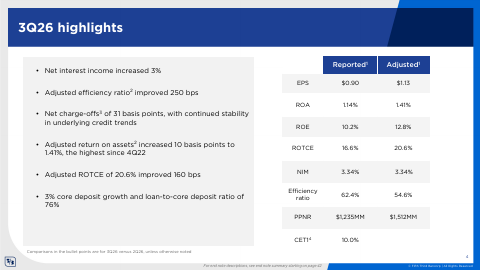
up from $0.83 in the prior quarter; $0.91 a year ago
excludes $0.23 of certain items
up 3% sequentially
improved 160 bps sequentially
| Segment or metric | Value | Change |
|---|---|---|
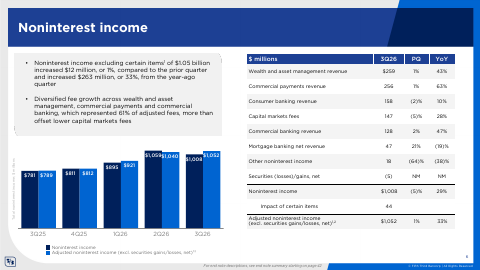
| Wealth and asset management revenue | $259 million | up 1% sequentially |
| Commercial payments revenue | $256 million | up 1% sequentially |
| Capital markets fees | $147 million | down 5% sequentially |
| Average active digital users | 3.49 million | up from 3.27 million in 2Q26 |
| Southwest share of consumer deposits | 10.4 % | up from 7.6 % at the end of the first quarter |
Copied from the press release ↗ and other documents in the SEC filing ↗. A figure is published only if its sentence is in those documents.
| From the filing | Q3 2026 | vs year ago | vs last quarter |
|---|---|---|---|
| Net income | $866.0M | +33.4% | +8.1% |
| Diluted EPS | $0.90 | −1.1% | +8.4% |
| Free cash flow | $651.0M | −26.5% | −75.2% |
Calculated by code from XBRL, not by the model.
| Metric | Period | Outlook |
|---|---|---|
| Average loans and leases growth, sequential | fourth quarter of 2026 | 1 % to 2 % |
| Net interest income growth, sequential | fourth quarter of 2026 | up 2.5 % to 3.5 % |
| Adjusted noninterest income growth, sequential | fourth quarter of 2026 | up 2 % to 4% |
| Adjusted noninterest expense change, sequential | fourth quarter of 2026 | down 2 % to 3% |
| Net charge-off ratio | fourth quarter of 2026 | 30 to 35 basis points |
| Effective tax rate | fourth quarter of 2026 | 22.5% |
| Share repurchases | fourth quarter of 2026 | $200 to $300 million |
| Total merger-related charges | total Comerica merger-related charges | approximately $1.3 billion |
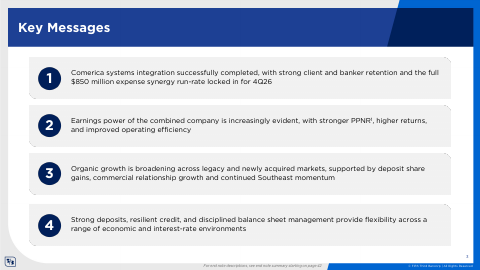
Fifth Third onboarded approximately 600,000 accounts and 293 banking centers over Labor Day weekend and decommissioned 82 others. The full $850 million expense synergy run-rate is locked in for 4Q26, so attention shifts to organic growth.
Consumer deposits in the Southwest rose to 10.4 % of the total from 7.6 %, and household growth was 8 % with no checking marketing. Texas branch construction starts next year, with 150 de novo branches planned over three years.
The new business pairs Comerica's tech and life sciences vertical with Fifth Third's payments, digital, investment banking and wealth capabilities. Management sees at least a $10 billion deposit opportunity by 2030.
Commercial loan production was double the year-ago quarter and pipelines are at record levels. Texas added 80 to 85 middle market relationships this year, which management says is about twice the pace per banker Comerica achieved.
Fifth Third estimates $2.5 billion of its deposits are sorted every month and it retains about 80 %. It argues operational, relationship-based deposits are less exposed, and it plans to build similar features into its own app.
| Q1 2025 | $0.71 |
| Q2 2025 | $0.88 |
| Q3 2025 | $0.91 |
| Q1 2026 | $0.15 |
| Q2 2026 | $0.83 |
| Q3 2026 | $0.90 |
Fourth-quarter EPS appears once the press release is read; filings report it only for the full year.
| Q4 2024 | -$246.0M |
| Q1 2025 | $1.1B |
| Q2 2025 | $1.2B |
| Q3 2025 | $886.0M |
| Q4 2025 | $765.0M |
| Q1 2026 | -$1.3B |
| Q2 2026 | $2.6B |
| Q3 2026 | $651.0M |
Operating cash flow minus capital expenditure, from cash flow statements.
Each quote matches the transcript word for word.
“but we see it as a $10 billion deposit opportunity by 2030, in addition to other avenues for revenue growth.”
Sizes the new Innovation Banking business as a long-term deposit source.
“what history has shown us over and over again is that the groups that are most exposed to this sort of change are the ones that have nothing but pricing defining their value propositions”
Frames management's view of which banks face AI-driven deposit optimization risk.
“So our estimate is that something on the order of $2.5 billion of deposits on our platform are sorted every month”
Quantifies deposit churn that automated cash-management tools could target.
“four out of the five largest banks by market share in Dallas, as an example, do not offer a totally free checking product, right?”
Explains why management believes its free-checking model can win share in Texas.
“that is the reason that we have essentially sat out the, you know, data center construction lending for the data center sponsors.”
Shows how the credit philosophy keeps Fifth Third out of unproven high-growth lending categories.
The main change is the higher-rate environment, which lifts earnings for an asset-sensitive balance sheet; gross synergies came in in the low $900 millions, some reinvested, and 53% efficiency remains the long-term target with room to beat it near term. — Brian Preston, Tim Spence
About 45% of the quarter's growth was moving Comerica sweep balances onto the balance sheet; future growth should come from Southeast and Texas build-outs, small business and payments operating accounts, and Innovation Banking. — Tim Spence
Structural levers like commercial lending capacity come first, then cross-selling products, then branch-dependent gains; wealth is already showing about $100 million of new AUM from private banking clients and $100 million of institutional mandates. — Tim Spence
Earnings add more than $1 billion a quarter, about 45 basis points of capital, leaving roughly $300 to $500 million a quarter for repurchases after dividends and growth. — Brian Preston
Management says online-only and sweep-heavy platforms that compete only on price are most exposed, while operational, relationship-based deposits are sticky, and Fifth Third will build similar tools into its app. — Tim Spence
Clients are still investing and another 50 to 100 basis points would not change plans, while the bank watches consumer discretionary and rate-sensitive areas and keeps leveraged lending small. — Brian Preston
AI efficiency is a longer-term opportunity needing near-term compute investment, and management prefers sustaining peer-leading returns and tangible book value growth over squeezing out more efficiency. — Brian Preston, Tim Spence
No; management wants to stay focused on organic opportunities and finish what it has started before taking on anything else. — Tim Spence
The mix should move toward roughly 50-50 over coming years as long as the liquidity rules hold no surprises. — Brian Preston
Both: early-warning monitoring and behavioral data have improved underwriting, but the bank stays cautious on unproven asset classes and has sat out data center construction lending. — Tim Spence
The Midwest has the oldest, highest-margin book but is most competitive at the margin, the Southeast carries more promotions, and the Southwest has the most promotions and the lowest margins for now. — Brian Preston, Tim Spence
The new platform launched in the second quarter with all participating agencies issuing cards on it, and the legacy program converts starting this winter into next spring. — Tim Spence
Texas ROAs should rise from here as branches and talent are added; the growth statistics cited are year-over-year pro forma, and Texas added 80 to 85 middle market relationships this year. — Tim Spence
They have more ways to start relationships, such as leasing, hedging and payments, and the larger balance sheet lets them lend more aggressively. — Tim Spence
Easier, because asset sensitivity produces profit faster than multi-year hiring and branch investments can be deployed. — Brian Preston
All else equal the rate environment is beneficial and fixed-rate asset repricing is improving, with deposit competition as the wild card; full 2027 guidance comes in January. — Brian Preston
A mid-50s beta for a hike or two, which could drift up with persistent hikes; consumer new-money pricing has moved from Fed funds plus 15 to about plus 50. — Brian Preston
Not really; consumer discretionary, commodity-exposed and real estate areas are watched closely, but there is little stress showing in them. — Tim Spence
It finished the systems conversion over Labor Day weekend, onboarding approximately 600,000 accounts and 293 banking centers and decommissioning 82 others, with strong client and banker retention. The full $850 million expense synergy run-rate is locked in for 4Q26.
Retail deposit campaigns lifted the Southwest to 10.4 % of consumer deposits and drove 8 % household growth, and Texas added 80 to 85 middle market relationships. The first of 150 planned Texas de novo branches opens in the third quarter next year.
It is a newly launched business serving startups and growth-stage companies, their founders and investors, combining Comerica's tech and life sciences vertical with Fifth Third's payments, digital, investment banking and wealth capabilities. Management sees a $10 billion deposit opportunity by 2030.
Management says rate-only models such as online-only banks and sweep platforms are most exposed. Fifth Third estimates $2.5 billion of its deposits are sorted each month, retains about 80 %, and plans to build savings and budgeting tools into its own app.
It limits leveraged lending to about 2 % of loans, has non-bank financial institution exposure of 8 % of loans, and has sat out data center construction lending. Management says it watches consumer discretionary and rate-sensitive borrowers but sees little stress so far.
Call recording on YouTube ↗. Official replay ↗. Timestamps jump to the moment.
Hello everyone. Thank you for joining us and welcome to the Fifth Third's Third Quarter Earnings Conference Call. After today's prepared remarks, we will host a question and answer session. If you would like to ask a question, please press star 1 to raise your hand. To withdraw your question, press star 1 again. I will now hand the conference over to Matt Curoe, Director of Investor Relations. Please go ahead.
Good morning, everyone. Welcome to 5th, 3rd, 3rd quarter, 2026 earnings call.
This morning, our Chairman, CEO, and President Tim Spence and CFO Brian Preston will provide an overview of our 3rd quarter results in Outlook. Please review the cautionary statements in our materials, which can be found in our earnings release and presentation. These materials contain information regarding the use of non-GAAP measures and reconciliations to the GAAP results, as well as forward-looking statements about Fifth Third's performance. These statements speak only as of October 19, 2026, and Fifth Third undertakes no obligation to update them.
Following prepared remarks by Tim and Brian, we will open up the call for questions. With that, let me turn it over to Tim.
Hello, everyone, and thank you for joining us. It is me accustomed to start these calls with a comment on great banks and navigating uncertainty. But today, I want to start with something else that distinguishes great banks, their people. This quarter was a defining moment in the history of our company. I am humbled by and exceptionally grateful for the commitment our people showed to our clients, our shareholders, and the one another.
We announced the acquisition of Comerica one year and 13 days ago, and throughout that time, all our people hustled and collaborated to complete the largest and most complicated conversion in our 168-year history. Following Legal Day 1, you welcomed new colleagues onto your teams and introduced Fifth Third to new communities. You made the tough decisions necessary to achieve our expense commitments and worked together to identify and pursue revenue opportunities. You invested more than 4 million hours in preparation for conversion, and you gave new meaning to the word labor in Labor Day weekend when you onboarded approximately 600,000 accounts and 293 banking centers while decommissioning 82 others.
Since then, you have continued to work tirelessly to welcome new customers to the bank, to get their accounts configured the way they want them, and to ensure customers experience the benefits of banking with our combined company. Your advice is what improves our clients' personal lives and their businesses. Your creativity is what wins awards for innovation, and your commitment to excellence is what produces pure leading financial results. Thank you for keeping our customers at the center of everything you do.
This morning we reported earnings per share of $0.90 or $1.13, excluding certain items outlined on page 2 of the release. Adjusted PPNR grew 8 % over the second quarter, as adjusted revenue grew 2%, while adjusted expenses fell 2%. In an increasingly competitive environment, core deposits grew 3 % sequentially and loans grew 1%. Net charge-offs remained stable at 31 basis points. Despite the conversion occurring a full 10 weeks into the quarter, we've already exceeded two of the three 2027 profitability targets spelled out in our deal announcement.
Adjusted return on tangible common equity was 20.6%. Our adjusted return on assets was 1.41%, and our adjusted efficiency ratio was 54.6%. Even with the largest acquisition in our company's history and the 10-year treasury increasing 114 basis points in the past year, our tangible book value per share grew 2 % year-over-year, and our TCE ratio was flat. With technical conversion and the work on expense synergies now behind us, our primary task going forward is to leverage the power of our combined company to drive organic growth and market share.
The FDIC Summary of Deposits Dataset is one mechanism we use to measure progress, and the 2026 release became available in September. Using the CAP branch deposit methodology to focus on retail deposits, I am pleased that Fifth Third ranked number one in our retail footprint and number three nationally in year-over-year retail deposit growth. In Texas, we came straight out of the chute in February. Retail deposits in Dallas and Houston grew more than 20 % over the prior year, and we gained more than 40 basis points of market share.
We now rank number seven and number eight in Dallas and Houston, respectively, and that is prior to opening any of our 150 De Novo branches in Texas over the next three years, starting with the first one in the third quarter next year. In our southeast footprint, we again ranked number six in retail market share. Retail deposits continue to grow at a rate more than five times the rate of the Southeast overall, and they have grown at 11% compound annual rate over the past five years.
Our Southeast Enobo program continued to be a big part of the growth story, but it is not all of it. We rank number two in total new branches built and number two in average deposits per branch after three years, but we are also number two in same branch deposit growth for legacy branches over the same period. Our total cost of Southeast consumer deposits remains 207 basis points below Fed funds. We've already opened 35 additional branches in the Southeast in 2026 and remain on track to open the full 55 that we committed for the full year.
One other strategic item I would like to note from the quarter is the formal launch of Fifth Third Innovation Banking, a business focused on startup and growth stage companies, their founders, and the investors who back them. Innovation Banking pairs Comerica's 34-year-old tech and life sciences vertical with Bithard's payments, digital, investment banking, and wealth management capabilities. It will be built around hub cities where venture capital flows are concentrated and the industry verticals where we can bring unique expertise, starting with our recently launched FinTech vertical.
We will spend more time to mentioning this business for you in the coming months, but we see it as a $10 billion deposit opportunity by 2030, in addition to other avenues for revenue growth. Now let me close where I usually begin. At Fifth Third, we believe great banks distinguish themselves not by how they perform in benign environments, but by how they navigate on certain ones. While our clients tell us the underlying economy remains strong, this is of fluid operating environment, as evidenced by the recent sharp spike in interest rates.
When things change, the factors that dictate success change along with them. Discipline and optionality become very important. In this environment, our priorities are to be strongly differentiated in core deposit growth, broadly diversified in loans and other earning assets, with limited exposure to unproven high-growth categories and the interest rate-sensitive borrowers, balanced across recurring fee businesses and less exposed to market-sensitive revenue streams, and to have the profitability to sustain the long-term investments in growth and AI without compromising return targets.
While we will always have opportunities to get 1 % better, I feel great about how Fifth Third is positioned and in our ability to deliver an even better 2027. After all, you can't spell flexibility without F, I, T, and B. With that, I'll hand it over to Brian to provide more detail on the quarter and on our outlook for the remainder of the year.
Thanks, Tim, and good morning. Our third quarter results show the profitability of the combined company, even with the expense energy not yet fully in the run rate.
The conversion over Labor Day weekend was the last major step of the technical integration, and the remaining expense energies will follow. Additionally, the rate environment tested the balance sheet. Rates moved sharply higher in the quarter. That weighed on capital markets fees and on AFCI, but it will drive NII growth and provide attractive entry points to reduce the increased asset sensitivity we've carried since closing the acquisition. Through the conversion and the rate volatility, the businesses kept growing in both the Fifth Third and Comerica footprints, and credit performance remained stable.
As Tim mentioned, adjusted PPNR grew 8 % to $1.5 billion. Of the $113 million sequential increase, over half came from revenue, with net interest income up 3 % and fees up 1%. The realization of expense synergies was the primary driver of the $45 million decrease in adjusted expenses. Page two of our release details the certain items excluded from these adjusted figures. The PPNR growth drove the approximately 160 basis point improvement in our adjusted ROCCE and the 250 basis point improvement in our adjusted efficiency ratio.
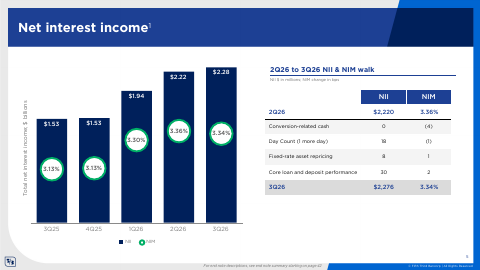
The step-up in profitability is sustainable. In the fourth quarter, the expense base comes down further as the remaining expense energies are realized and revenue continues to grow organically. With the systems conversion complete and the expense base where it will be, the fourth quarter gives you the first full view of the combined company's profitability and the baseline from which we will grow. Net interest income was $2.28 billion, up $56 million from the second quarter. The increase was driven by organic loan growth, investment portfolio activity, and continued fixed-rate asset repricing, partially offset by higher deposit costs and tighter spreads in C &I and auto.
Net interest margin was 3.34%, down two basis points. In order to simplify certain conversion-related activities, We intentionally migrated Comerica off-balance sheet investment suite products onto the balance sheet into deposit products, which resulted in elevated cash. As a result, average short-term investments rose $3.1 billion and reduced net interest margin by approximately four basis points, but had no material impact on NII. Excluding this cash build, the margin would have expanded about two basis points over the prior quarter.
The higher market rates during the quarter provided attractive entry points to begin reducing our asset sensitivity. We added $2.5 billion to the held-to-maturity portfolio at an average yield of 4.9%, and we added $7 billion of received fixed cash flow hedges. The third quarter taxable securities yield increased 13 basis points to 3.68%. As a result of the investment portfolio actions, period and short-term investments declined to $2.8 billion. Even with these actions, we remain asset-sensitive and expect to benefit from further potential rate hikes.
Loan growth in the quarter was commercial-led, with production diversified across the combined footprints and verticals. Total commercial loan production in the third quarter was double the production generated in the year-ago quarter. Among regions, Chicago, Indiana, and Michigan continue to generate meaningful activity in the Midwest, while the Carolinas and Florida were the standout regions in the southeast. While vertical production was also very broad based, consumer retail, healthcare, energy and renewables, media and entertainment, FIG, and dealer finance all delivered strong production growth both sequentially and year over year.
Our growth production pipelines remain at record levels as we enter the fourth quarter. Average portfolio loans increased 1 % sequentially to $179 billion, and period end loans were also up 1 % to $180 billion. Average commercial loan growth of approximately $1.5 billion was concentrated in CNI and construction. commercial line utilization was 38 % down 50 basis points from the prior quarter, partially offsetting the production. Average consumer loans were stable as home equity grew 3 % and regular mortgage grew 1%, offsetting runoff in solar and modestly lower auto balances.
The mix remains consistent with our strategy. relationship-based commercial growth, and consumer categories where we have long underwriting experience and attractive risk-adjusted returns. Core deposits funded the quarter's long growth and continued to replace wholesale borrowings. Average core deposits increased 3 % sequentially to $236 billion, led by retail deposit campaigns and payments-linked operational deposit growth. The previously mentioned migration of Comerica investment suites onto the balance sheet added $3 billion in deposits. Additionally, we simplified some of Comerica's legacy deposit products into more modern interest-checking product structures, resulting in a shift from commercial savings and money market into interest-checking, which grew 6%.
Money markets still grew 5 % thanks to the success of our retail deposit campaigns, while savings and retail CDs each declined 2%. Consumer deposit growth was 5 % sequentially in the southeast and 23 % in the southwest. At the end of the first quarter, the southwest represented 7.6 % of our consumer deposits. At September 30th, that increased to 10.4 % of our consumer deposits. When we announced the merger last year, we believe our consumer deposit growth strategies would be replicable in new markets.
Our early campaign performance continues to support our beliefs in this $10 billion-plus growth opportunity in the Southwest. Average non-interest-bearing deposits were up slightly sequentially and represent 27 % of core deposits. Total deposit costs rose nine basis points sequentially to 1.64%, reflecting promotional pricing from the successful retail campaigns and the impact of the Comerica investment sweep migration to the balance sheet. Excluding the investment sweep impact, deposit costs rose seven basis points. The deposit growth allowed us to reduce average wholesale funding 10%, including a $1.3 billion reduction in long-term debt and a $1.1 billion reduction in FHLB advances.
With that mid-shift, the rate on total interest-faring liabilities rose six basis points and only four basis points, excluding the Comerica Investment Sweep's impact. Our loan-to-core deposit ratio was 76%, down 1 % from the prior quarter. Our approach has not changed. Granular deposit funding, meaningful liquidity buffers, and active management of overall funding costs. Shifting the fees, adjusted non-interest income, excluding the items listed on page 4 of the release, was $1.05 billion, up 1 % sequentially and 33 % from the prior year.
Sequential growth in wealth, commercial banking, and mortgage more than offset a $7 million decline in capital markets fees. The late quarter rate move pushed out some expected capital markets activity, as well as having a negative impact on mortgage fees. Wealth and asset management revenue was $259 million, up 1 % sequentially, reflecting higher institutional trust and personal asset management revenue. Total assets under management were $125 billion a quarter end. Retail brokerage revenue was $60 million in the quarter, up 7 % from a year ago.
Commercial payments revenue was $256 million, up 1 % sequentially, with growth in deposit fees partially offset by higher earnings credits. Capital market fees were $147 million, down 5 % as lower M &A advisory and loan syndication activity more than offset higher corporate bond fees. Commercial banking revenue rose 2 % to $128 million on higher lease remarketing and syndication revenue, and mortgage banking revenue was $47 million, up $8 million as the prior quarter loss on net servicing valuation did not repeat in the third quarter.
Consumer banking revenue was $158 million, down 2%. With five fee categories, each generating more than $500 million in annual run rate revenue, and each representing at least 10 % of our total fees, our diversified fee engines kept total fees growing despite the 5 % decrease in capital markets. Now to expenses, where the integration progress shows most clearly. Adjusted non-interest expense was $1.82 billion, down 2 % sequentially, driven by lower compensation and benefits expense as synergies were realized.
Adjusted expenses exclude certain items listed on page 2 of our release and the non-qualified deferred compensation mark to market. The adjusted efficiency ratio improved 250 basis points, and we generated approximately 450 basis points of sequential positive operating leverage. Remaining synergies will be realized from the system decommissioning, stacking changes, and branch consolidations that followed conversion weekend, including the 82 banking centers consolidated and will take effect in the fourth quarter. Merger-related charges recognized in non-interest expense were $215 million in the quarter, primarily associated with the system's conversion, and total approximately $1.1 billion year-to-date, consistent with our integration timeline.
We continue to expect total merger-related charges of approximately $1.3 billion, with substantially all remaining charges anticipated in the fourth quarter. On credit, performance remained in line with our expectations. Net charge-offs were $139 million, or 31 basis points, up one basis point sequentially, and at the low end of our 30 to 35 basis point range we guided to in July. Commercial net charge-offs were 22 basis points, up one basis point, while consumer net charge-offs improved one basis point to 52 basis points.
The NPL ratio increased one basis point to 59 basis points. The NPL ratio increased four basis points to 64 basis points, reflecting the impact of a $58 million increase in branch and other corporate real estate that were consolidated as part of the integration. Excluding this merger-related real estate impact, the NPL ratio was up one basis point. Early-stage delinquencies improved with the 30 - to 89-day balances down $21 million sequentially to 30 basis points, driven by improvement in the commercial loan portfolio.
The allowance for credit losses was $3.1 billion, or 1.74 % of portfolio loans, down two basis points sequentially, reflecting stable loss performance and improvement in the commercial portfolio risk profile. The allowance covered non-performing loans, 294%, and non-performing assets, 271%. Provision expense was $122 million, compared with $129 million in the second quarter. We made no changes to our macroeconomic scenario ratings during the quarter. Our baseline and downside cases assume unemployment reaching 4.7 % and 8.3 % respectively in 2027.
The credit results are consistent with the disciplined and diversified portfolio construction Tim described. We are focused on limiting exposures most sensitive to higher rates and continue to grow in categories where we have long underwriting histories and structural protections. Our exposure to non-depository financial institutions was 8 % of total loans at quarter end, concentrated in subscription and capital call facilities, corporate facilities to traditional financial institutions, and secured lending to mortgage-related entities, with private credit exposures representing less than 1 % of total loans.
Moving to capital, CET1 ended the quarter at 10%, up nine basis points, as earnings more than offset risk-weighted asset growth of 1 % and the impact of $211 million of after-tax charges related to the integration and other items. That places us within our 10 to 10.5 % operating range. The increase in longer-term interest rates impacted AOCI by $1.6 billion during the quarter. Given the bullet locked-out structure in the investment portfolio, which represents approximately 57 % of fixed-rate securities and available for sale, We have a high degree of certainty into the timing of the AOCI accretion back into capital, given the scheduled nature of the principal cash flows.
Using the forward curve at the start of October, we project AOCI accretion to generate 27 basis points of marked CET1 and 4 % growth in tangible book value per share by year-end 2027, before considering any future earnings contributions to capital. We estimate our fully phased-in, bodily-free capital ratio to be 9.2%. Given the speed and magnitude of rate increases during the quarter, we deferred restarting our share repurchase program, which delayed a small repurchase plan for September.
Future share repurchase activity will be based on capital needed to support organic loan growth and overall industry capital levels. In September, we raised the quarterly common dividend 5 % to $0.42 per share. Our capital return priorities are unchanged. Pay a strong dividend, support organic growth to deliver the best long-term returns for our shareholders, and then share repurchases. Moving to our outlook, Tim highlighted we grew across the combined footprint and delivered returns ahead of the targets we set for 2027 in the third quarter.
Those trends should continue in the fourth. We expect average loan growth of 1 % to 2 % sequentially, led by continued commercial loan growth, primarily in CNI and CRE. We expect net interest income to be up 2.5 % to 3.5 % sequentially, driven by higher yields on floating rate loans, a full-quarter impact of the securities deployment, and continued fixed-rate asset repricing, partially offset by higher deposit costs. This outlook reflects the forward curve at the start of October, which assumes a 25 basis point rate hike in December.
With the current rate outlook, we see fourth-quarter net interest margin at or above the 340 level. Adjusted non-interest income is expected to be up 2 % to 4%, reflecting seasonally strong capital markets activity and continued growth in wealth and commercial payments. We expect the remaining synergy realization to take adjusted non-interest expense down 2 % to 3%, partially offset by compensation associated with seasonal fee strength and occupancy expense growth associated with fourth quarter branch openings.
In total, our guide implies adjusted PPNR to grow 9 % to 10 % from the third quarter. It also places net interest income and the implied PPNR for the full year to be at the high end of the range we provided back in January for the combined company. The fourth quarter is typically our best quarter for ROTCE and the efficiency ratio. Even after adjusting for normal seasonal strength, our guide delivers the 2026 exit rate profitability at or better than the 19 % ROTCE and 53 % efficiency ratio we set at the deal announcement and on the timeline we committed to in January.
As is our custom, we will provide our full 2027 outlook in January on the fourth quarter earnings call. For credit, we expect net charge-offs of 30 to 35 basis points in the fourth quarter. On capital, we expect CET1 to remain within our 10 to 10.5 % operating range, and we expect to repurchase $200 to $300 million of stock in the fourth quarter, dependent on the strength of our organic loan growth. The third quarter showed the profitability of the combined company, with the synergies not yet fully realized.
The fourth quarter brings the rest of the synergies into a business that is already growing. We exit 2026 as one bank, with the value of the Comeric accommodation no longer a projection, but a run rate, and with the organic growth momentum that carries it from here. With that, let me turn the call over to Matt to open it up for Q &A.
Thanks, Brian. Before we start Q &A, given the time we have this morning, we ask that you limit yourself to one question and one follow-up, and then return to the queue if you have additional questions.
Operator, please open the call for Q &A.
We will now begin the question and answer session. Please do limit yourself to one question and one follow-up. If you would like to ask a question, please press star 1 to raise your hand. To withdraw your question, press star 1 again. We ask that you pick up your handset when asking a question to allow for optimum sound quality. If you are muted locally, please remember to unmute your device.
Please stand by while we compile the Q &A roster. Your first question comes from the line of Ryan Nash with Goldman Sachs. Ryan, your line is now open. Please hold. Your line is now open. Please go ahead.
Hey, good morning, guys.
Hey, America's new number one J .J. McCarthy fan, Ryan Natch.
I'm ready. Thankfully, the NBA season kicks off tomorrow. Maybe just to kick off where Brian had left off regarding, you know, the 20-27 expectations of 53 efficiency in 19, Rossi.
Obviously, a lot of things have moved around. I know that we'll get an update in January, but maybe just broad strokes on how you're thinking about some of the key drivers, what's really changed since the initial guide came out, and also just how we think about, you know, reinvestment in the business versus letting maybe some of the upside hit the bottom line. Thanks, guys.
Yeah, I mean, I think the adage in my household, Ryan, is good things come to those who wait.
So we're not going to talk about 2027 guidance today, but Brian walked through a few of the moving parts in his script, and I'm going to let him talk a little bit about just the framework we're using to think through as we see revenue growth based on sources and otherwise what it means for efficiency and reinvestment.
Yeah, thanks, John. Hey, Ryan. The main thing I would tell you that has changed since the deal model is just the rate environment.
Obviously, we've had carried an asset-sensitive balance sheet that's benefiting quite a bit from the changing rate outlook. No one was anticipating 100-plus pages planted heights over the 24-month horizon post the deal and the close the deal. So certainly that has been a big difference that's created a lot of earnings power for us as a company, which we feel very good about from a positioning perspective. We've been able to deliver on the $850 million synergy target.
We've actually outperformed that a bit from a gross perspective. That number's really low 900s from a gross perspective, but we've used some to reinvest back in the business, whether it's marketing expense to grow households or even just continuing to accelerate sales force hiring in the newly expanded markets. Those are the main areas that we're looking at from a reinvestment perspective. From a longer term perspective, 53 % efficiency is where we want to run the company. We think that is a good prudent place and it's going to allow us to deliver those 19 % ROTC's that we've been talking about.
But we also recognize that we do want to continue to invest in growth and we're going to do that in a very, very prudent way. But when you see the kind of great environment changes we've seen, there's never – we're not going to have the ability to invest as quickly as you may like with those changing rate environment changes. So there is an opportunity for us to outperform that 53 % in the near term.
Gotcha. And then Tim.
No, I just was saying agreed on everything, Brenton.
Gotcha. You guys have really successful deposit growth this quarter. Maybe just unpack some of the growth. how much is due to the campaigns you've been running across the Southwest markets. And now that the conversion is behind you, how do you think this changes the curve in terms of deposit gathering?
Yeah, good one. It's fun right now to spend time thinking about the deposit franchise. The old adage here at Fifth Third was loans are for show, deposits are for dough, right?
We went through a period where both in terms of the shape of the curve and absolute levels of interest rates, loans were showando. But we're back to a place where I think the ability to grow high-quality, low-cost deposits is going to be, like, the determinant of your ability to generate really strong returns in an environment where, you know, as the economy continues to clip along at, you know, 6-7 % nominal GDP, we should have pretty good loan growth across the board.
The composition of deposits at Fifth Third is so radically different today than what it was previously. If you look at the breakdown now, deposit balances are like 50 % Midwest, 25 % coming from the high growth Southeast and Southwest markets, markets, and then 25 % national, whether that's, you know, corporate banking or deposits were able to source via our fintech platforms provide and otherwise. As Brian referenced in his remarks, about 45 % of the deposit growth in the quarter was the decision we made to move Comerica sweep deposits back on balance sheet.
I do expect that some of those deposits may go back into, you know, other forms of liquidity now that we're through the conversion and things are stable. But we also had some more modern hybrid account structures that I think will be appealing to some of those clients. The unique thing now is going to be where the growth comes from going forward, right? and we have seen in the last couple of quarters, folks have varying degrees of success in driving deposit growth.
And our view is if you're going to get low-cost deposits, it has to come from some structural investment that accumulates over time. And whether that is the continued power of the build-out of the southeast, you know, which we've talked about as an excess of a $10 billion dollar incremental opportunity or the $10 billion opportunity we think exists in Texas to anything I think we're probably more emboldened on given the early success that we've had here or the success that we continue to have driving operating accounts in small business and from commercial payments.
And then now the innovation banking platform, you know, which is at a minimum a $10 billion dollar opportunity in the next handful of years. Those are going to be the places that we go to find the incremental growth.
Thanks and send my best text to Lawrence. You got it.
Your next question comes from the line of Scott Ciphers with TD Cohen securities. Scott your line is now open please go ahead. Welcome back.
Hey thank you I appreciate that thank you very much.
So I guess you know now that the cost savings look increasingly like a lock I think the the market's focus sort of begins to shift more visibly to the revenue side you know you've had I guess the benefit of even more time since the the closing and conversion maybe if you could speak sort of broadly about how you're feeling about the revenue synergies you guys have articulated in the past and as you sort of think about you know timing and magnitude which of these at this point feel like sort of the easiest pickings which could take more time to marinate or require more investment etc
yeah Brian I think we're commenting this morning Scott that one of the fun things
about this acquisition is pretty much everywhere where we thought there was opportunity, we're finding opportunities. So, what I think we have said from the outset was the revenue synergies that we could get at with structural levers were going to be the ones that would materialize the fastest. The stuff that involved either teaching people new products and services or building new connectivity inside the company would be the sort of intermediate and then the stuff that required, you know, at the investment physical plants, like the branches would be what took us the longest.
That's more or less how it's playing out. Like, you know, obviously the success we had with the deposit campaigns in the second quarter and carrying over to the beginning of the third quarter is evidence of the ability for us to deploy the tactics that we have utilized to drive consumer deposit growth through Comerica's southwestern markets. And I only anticipate that will get better as we get now checking account marketing online with the technology conversion behind us.
So quite excited about our ability to even grow faster than the 8 % household growth that we generated in the southeast in the third quarter. I'm sorry, southeast and the southwest in the third quarter. I expect structural level was just down to sheet capacities we talked about for commercial lending. So when we announced the acquisition, the big question we got, you know, was would we be able to maintain fifth-thirds prior pace of growth? I think CMI growth last year annualized out for something on the order, I'm sorry, the third quarter last year, Like 4, 4.5 % for Fifth Third, 4.7 % in the third quarter this year.
So, asked and answered in terms of our ability to get Comerica's specialty verticals and markets running at the pace of growth that Fifth Third Legacy was doing. And I think there should be more upside from there, you know, as we have bankers. We actually have more bankers in Texas today than we did in February 1 when the deal closed, just as an example. And that's just now – we're just now scratching the surface on our ability to utilize the ADL products, the leasing products, some of the other things Fifth Third had in the specialty lending categories through Comerica's markets.
Lastly, then, I think wealth, really nice early progress there. We expected wealth to materialize a little more slowly because we have to repaper all of those clients, and typically you've got to get through a conversion before you can do a lot of deepening. We have already seen about $100 million in new AUM added from Primerica private banking clients and $100 million in mandates for our institutional business from commercial clients who are moving retirement plans and pensions over onto these new platforms.
So, very excited about the energy that, you know, now that we're through conversion and that we can focus on new business and not just taking care of existing client relationships about what we're going to be able to do.
Perfect. Thank you for that. And then, Brian, you know, appreciate the fourth quarter repurchase commentary. And I know how you think about capital management sort of thematically from your remarks. But, you know, as I think about things, there's just going to be so much capital creation over, you know, especially the coming year.
Even if you, as or as you reinvest, there should still be a lot of excess developed over time. Any thoughts for me to help kind of narrow the tone of potential magnitude as we look out a few quarters?
Thanks, Scott. I think you're right. The profitability of the company is driving a lot of capital creation every quarter. I mean, rough math, it's north of $1 billion a quarter just from earnings contribution to the company, about 45 basis points on average.
Think about a third of that goes into the dividend. So that's still 30 basis points of capital every quarter then to support growth or for share repurchases. You think of normal growth rate, we talk a lot about high single-digit, normal GDP plus a point or two from a growth perspective. That's only, you know, $250, $400, $500 million capital from a retention perspective, which leaves, you know, $300 to $500 million a quarter available for shared purchases if we were wanting to execute that.
So there is a lot of optionality on that. And even with the higher rates, yes, the higher rates has an impact on ASEI. but it also helps us generate more income and more profitability over that same horizon. So we've got a lot of capital flexibility from here as we continue to navigate this environment.
Yeah, perfect. All right, thank you for that call. I appreciate it. Thanks, Scott.
Your next question comes from the line of Manon Gossalia from Morgan Stanley.
Manon, your line is now open. Please go ahead. Hey, Manon. Good morning, all.
Hey, good morning. Tim, a lot of conversation and debate through the quarter on the potential risk to deposit from AI-driven cash optimization tools. I was wondering if you can give your perspective on what that could mean for the banking industry and how Fifth Third might choose to respond over time.
Yeah, sure. We maybe make a broad comment. and I'll just give you some data on what we see because I think there's more sorting that goes on in the banking sector today than, you know, people maybe broadly appreciate.
My own view on this one is that this is the right question to ask. Like every time you have a new technology platform that either reduces friction or increases transparency, you should be asking the question about what that means for margins. I just think that you're asking it about the wrong companies. Like, what history has shown us over and over again is that the groups that are most exposed to this sort of change are the ones that have nothing but pricing defining their value propositions, which I think in our world, in the case of deposits, would mean the online-only banks who have to lead with rate or who don't have any distribution and therefore have to buy liquidity through
aggregators or the wealth platforms that are, you know, pricing sweet deposits at inferior yields to market rates, you know, where there are equivalents. And not the folks who have either distribution or product advantages or relationship advantages, as I certainly believe, you know, that we do, because those are the things that justify incremental margins. You know, it's just the sweet deposits of the world, the online-only deposits are going to go from being low-margin products to even lower-margin products.
And I think for the rest of us, there's enough interplay here, whether it's proprietary distribution, like we have been building across the southeast and the southwest through the direct marketing capabilities we have. And then the unique value that's embedded in the products themselves are in broader relationship pricing on both the consumer and the commercial side of the equation. So our estimate is that something on the order of $2.5 billion of deposits on our platform are sorted every month, Okay, meaning they either move from a, you know, a paycheck that comes into a deposit account or out of the equities markets into cash or come off of promotional pricing or in an MNDA or move out of a CD product
and then move somewhere else. In our case, we have been successful in retaining about 80 % of those deposits. 90 % of that tends to go back into a deposit. About 10 % of it hits a liquidity portal, either on the consumer or the commercial side of the equation, or goes into an investment account. So the mechanisms that need to be in place to ensure that money that's there for investment and at rest versus money that is in motion, like basically money that's on a layover in a checking account because it came in through a paycheck and then it's going to move out in the next two to four weeks in the form of some sort of expenses, settles in
the accounts, you know, where it should settle. The advantage banks like us who have these branch networks and a checking-led proposition on the consumer side of the equation, and then a heavily operational commercial deposit base led by all the stuff that we do in commercial payments is that the money is operational. It needs to be here. The median checking account at a third is like $3,100, right? So there's just not a lot of value, you know, there.
I think the last point I just want to make sure that, you know, I make is like every time you have a new platform like this, the battle for a market comes down to whether incumbents get the innovation faster than the insurgents get distribution. I think that's an old Andreessen Horowitz line. It's definitely the line. But we're going to take every valuable service that you can get done on news, whether that's looking at subscriptions and finding opportunities to generate savings or budgeting or otherwise, and we're all going to build them into our apps.
And the benefit you'll get then is, you know, investment-grade or bank-grade information security as a perimeter and no blending, you know, between the information that exists in your financial graph, you know, with the information that exists in your social graph, which today is monetized by basically selling you to third parties for ad purposes and otherwise. And I just think that incumbents have a lot of leverage here, provided that we respond.
That's great, Carla. I really appreciate your response.
Brian, maybe to switch over to the other side, I think you noted that loan pipelines are at record levels right now. Are you seeing any impact from high rates at all? Is that part of the conversations? Are there any projects the clients are pulling back on in the high-rate environment? Or, you know, on the flip side, are you reducing your appetite to lend in any specific industries or for any projects?
Yeah, I mean, clients are still very, very productive in their conversations right now.
You know, certainly as people talk about high rates, it influences how they think about the world. But I think in general the feedback that we're hearing overwhelmingly is that it is still a growing economy. And high rates are not the meaningful driver of decision-making from here. It's like they need investment because they're worried about continued inflation and input costs and things where they know they need to make this investment. They want to go ahead and get it done.
Another 50 to 100 basis points on rates does not impact their view. They do worry about demand from here if there were a broader slowdown because of rates. But in general, most of our clients are saying that they are going to continue to move forward with investment. The things that we're focused on right now, clearly consumer discretionary is a category that we're paying a lot of attention to between the combination of the rate environment and continued inflation.
in anything that we think is interest rate sensitive. We are paying particular attention to. We've continued to be very disciplined on leverage lending. Our leverage portfolio continues to be a very small portion of our balance sheet at about 2%. That's not an area that we've been looking to grow. And we just think that there's areas where the unproven asset classes are continuing to be very cautious around. So, in general, most of the core middle market banking that we've been doing and the industry specialties where we have real expertise, we're seeing a lot of opportunity in, and that's the spot where we're going to continue to lean into.
Okay.
Your next question comes from the line of Ibrahim Poonawalla with Bank of America. Your line is now open. Please go ahead.
So maybe first question, Brian, just wanted to hit him. Just wanted to circle back. I think you mentioned the efficiency ratio, long term still 53 % seems like a number you like with the balance between investments and efficiency is kind of what management is targeting could be lower in the near term. But one, just want to make sure I heard that right.
But maybe bigger picture, just about areas of investment spend. And when we think about AI, you're adding scale and density, should we expect the bank to be incrementally more efficient? Either you look at it unit cost economics or medium term efficiency ratio, could that be headed towards the 50 % or is that just unreasonable given the investment spend that you have ahead? Thanks.
Yeah, I think, you know, certainly there is going to be opportunity to leverage AI to get the company more efficient over time.
That is something that I think is a little bit longer term out. And, you know, obviously that is the, you know, the big question as we're sitting here talking about use and the impact on deposit costs. If AI is so effective that it actually gives you the ability from a cost-effective perspective to optimize low-balanced deposit accounts, it's going to create a lot of opportunity for us to get efficiency in how we operate as a company.
So those are all the tradeoffs we're thinking about from a longer-term perspective. And as cost structures change and those opportunities come, we'll take advantage of it. But it does take near-term investment to get there. near-term investment in compute capacity and infrastructure associated with deployment of AI. I would tell you that from a near-term perspective, when we talk about investing, it is a continuation of the strategies that you have heard us talk about for a long time.
It's investment in retail distribution and marketing to grow households. It's investment in middle market bankers and product partners and capital markets and treasury management and wealth. and its investment in product, and product from a consumer banking perspective, continuing to advance our momentum banking consumer product, as well as continuing to invest in our payments business. That's such an incredible portion driver of future growth for us, both from a deposit and operational deposit perspective as well as fees.
And so those are the near-term places that we're looking at that keep us in that kind of 53 % range, but certainly as technology and other structural investments change, it does give us an opportunity to continue to evolve our expense base.
Yeah, if I can just put a point on a couple of things there. You touched on it, and admittedly, I haven't done this analysis in a while, but historically, average deposits per branch were basically the one metric that positively correlated with the efficiency ratio.
I remember it was never scale, you know, again, controlling at least to some extent for some of the oddities that are out there in terms of business mix. So as we get more dense, you should expect the existing business to continue to improve its efficiency. The question is just always where you get the leverage on the marginal dollar. Like, are we better off where we're positioned at this level of profitability trying to grind out a little bit more in the way of return?
Are we better off trying to compound tangible book value per share? And we have done that math recently, and we just are of the belief that sustaining peer-leading returns and driving up TVB per share growth is a more powerful lever for long-term investors than trying to go from peer-leading returns to even more peer-leading position
got it and maybe just sticking with sort of density deposits for branch so America seems to have gone relatively smoothly you have a playbook on bank M &A like as you think about the next six 12 months like how do you think about potential opportunities that could accelerate some of what you plan to achieve through the new branch openings via an
acquisition?
Yeah, I thought we might get that one, so I spent some time staring at the data that comes out of my aura ring this morning, and it says I'm still operating with a moderately high sleep deficit. So I think from Fifth Third's perspective, We've got to get back into balance, you know, on sleep deficit and otherwise, you know, before we would look at anything else. We have a lot of opportunity in front of us organically.
I think the playbook has worked well. But part of the reason that the playbook's worked well is because we have discipline in terms of what we elected to do. And then we committed ourselves to getting it done entirely. before we got distracted with the next thing and you know that ethos is just an ethos here whether it's organic investment or inorganic investment.
The accuracy of de-ordering is suspect. You might be sleeping better than you think.
Well, I still want to see a crown before I get too excited about anything. All good.
Your next question comes from the line of Jared Cassidy with RBC Capital Markets. Your line is now open. Please go ahead.
Hi, Tim. Hi, Brian. Good, Gerard. Morning. Morning. Question for you both. On the investment portfolio, you folks have about 70 % in available for sale and 30 % in health maturity. And when we think about Basel III endgame, when it's finalized, we all know about the AOCI being included in CET1.
Can you guys give us some thoughts on how you might change that mix over the next couple of years to manage the AOCI volatility?
Yeah. Hey, Jared. Thanks. Great question. There is no doubt as the capital rules are finalized, we will be using more HTM as part of our investment portfolio. The thing that we have been cautious around is has honestly been waiting for the final liquidity rules because we wanted to make sure that we weren't making this decision without understanding if there were going to be some limits on the amount of HTM securities that would qualify as liquidity.
But I think it's fair to say that as long as there's nothing meaningfully unexpected in those rules, that we're probably going to be operating at a closer to 50-50 split between ASS and HCM going forward. So we do think as we continue to invest cash flows over the next couple years, you're going to see that mix continue to head into the HCM direction. And what, from a broader balance sheet perspective, then what will happen is the ASS portfolio will manage with a slightly lower duration than the HTM portfolio, and that in general our balance sheet has needed a security portfolio with a four - to five-year duration.
And so we'll try to blend that with a little bit longer duration stuff in HTM to help manage that capital volatility risk.
Very good. Thank you, Brian. Tim, I might regret asking this question, especially for somebody like me. Credit quality for you folks and your peers is very good. It's been very resilient, maybe surprisingly so, for all of us to see. And here's maybe the regrettable question. Has the credit picture for the industry and you guys specifically changed in the sense that either you're better underwriters or more conservative underwriters, we know what's happened post-financial crisis with the de-risking of the industry, or is it just the economic environment is much better than we all thought and don't get
over your skis to think that, you know, the banking industry is smarter now on credit?
I think that's the first time I've ever gotten a question where the asker expressed regret twice. Oh, my God. We got to the end of it. And listen, I think there are a few things that are going on here. There's no question that coming out of the financial crisis, there was a huge investment made inside the banking sector to get smarter on credit.
And in particular, I think to get smarter on early warning signals. Certainly, that's the case here at Fifth Third. There's a apparatus around early learning that supports continuous monitoring that we do in commercial. There's a lot more behavioral data utilized in the underwriting process in consumer and then in small business and otherwise, which has proven to be, you know, very useful as a complement to, you know, conventional scored underwriting. So, I think we've gotten better. Clearly, some of the risk has migrated out of the banking system, just given the growth in the NDFI world.
Now, that obviously has come back in through back leverage and otherwise, but with enhancements that didn't exist previously. So I do think that the higher leverage points, the more rate-sensitive borrowers and otherwise are, you know, more prominently supported by non-banks today than certainly they were in the past. So those things are good. That said, like, you know this better than I do. The history is that the big credit cycles are not driven by the sort of normal economic cycle in mature industries.
They're driven by relatively not well understood high growth asset classes or new channels that turn out to drive negative select, you know, or otherwise. So, while I think we're better at the stuff we've always known, as you know, we tend to be a little bit more reticent to dip our toe into areas of the credit markets that are, you know, not proven or where it's hard for us to see that they're being accurately priced. Like, that is the reason that we have essentially sat out the, you know, data center construction lending for the data center sponsors.
It is the reason that, you know, we have the lowest exposure combined with our combined balance sheet to private credit and BDCs, you know, relative to the others. It may well be that we were, you know, wrong there to be worried about credit and right to be worried about just being priced appropriately. But in my mind, those are two sides of the same coin. So, yes, I think we're better, and new risks will continue to materialize as long as human beings are continuing to find, you know, new ways to take risks.
Very good. Well said. Thank you, Tim.
Your next question comes from the line of Chris McCrady with KBW. Your line is now open. Please go ahead.
Oh, great. Good morning, everyone. Kim, in the past, you've talked about the Midwest being one of the more competitive markets, whereas I think some of your peers have talked about the Southeast. You gave an interesting stat in your prepared remarks. I think it was the Southeast was, I think, a little over 200 basis points.
The pricing was a little bit below the Fed funds. Do you have those same stats by market? Like I guess what I'm after is deposit, incremental deposit costs by your three big markets. Thanks.
Yeah. Hey, Chris, it's Brian. You know, what I would tell you on that front is you have to be careful when you look at those numbers because the seasoning of the book matters as well. And so what you're going to see is that the Midwest market is our highest margin market because it has the oldest book.
And part of that is the legacy checking accounts in particular are just higher balance on average. The Southeast has a higher percentage of promotional offers then as a percentage of the deposit book. And even with that, you still have 200 basis points of spread relative to the Fed funds rate. And then the Southwest book will have the absolute highest rate of promotional offers as a percentage of their book. So it will have the lowest margins right now relative to Fed funds.
In general, I don't have the exact numbers in front of me for the Midwest and the Southeast, but I would expect that the Midwest at this point is probably about 50 basis points better than the southeast, and the southwest is going to be probably 50 to 100 basis points worse. But it is just a function of the percentage of promo offers as a percent of the aggregate deposit base.
Yeah, and then the measure of competition in my mind is not sort of what is the price on the season portfolio, it's what does it cost to grow the marginal deposit in each of those.
markets. So when we talk about the Midwest being more competitive, it's at the margin if you wanted to grow another dollar of deposits. It is tougher to do it just when you look at the promotional offers that are in the market in the Midwest than it is in the Southeast today. I think the other dynamic that's worth mentioning is that more consolidated market structures tend to be less competitive in terms of the bleeding edge offer, the less consolidated market structures.
And the southeast and the southwest have both historically been more consolidated market structures than you see in the Midwest, which is part of the other reason, you know, that we're, I think, quite optimistic about our ability to continue to gain share in both of those places. and to, you know, frankly, that the tactics that have worked so well over the past several years in the southeast are portable to the southwest. And just one simple statistic, four out of the five largest banks by market share in Dallas, as an example, do not offer a totally free checking product, right?
And that is, I think, four out of the five, the largest banks by market share in literally every Midwest market would have a totally free checking product.
Okay, that's interesting. Thank you for that. And then maybe a comment or an update on Direct Express post-conversion. Thanks.
Yeah, thank you. Good progress there. As you'll remember, we launched our new platform at the beginning of the second quarter. Every one of the participating agencies inside the federal government is issuing cards on that platform.
And we got through the period of hypercare that we always run when we launch a new product, and we're very pleased with the outcomes. You can see it just in the – whether it's the digital channel usage or direct express customers taking advantage of some of the functionality that's built into the mobile app. to support things like paying rent and otherwise. We also have made some changes to policies, whether it was at ATM or in the branches, to enable direct express customers to do things more easily than they were able to do at Comerica, and then that is a huge benefit associated with just having a, you know, a broader branch network in terms of the way that we service
those folks. We anticipate initiating the full conversion of the legacy program this winter moving into next spring. So there's lots of work underway to ensure that that is a seamless transition. This is, just by definition, a population that tends to need a little bit more hand-holding, and therefore we have been very concerned about executing the conversion in a way that produces the least disruption for our clients. But the fiscal inside the U .S. Treasury has been, you know, a wonderful partner here.
We're very excited about the platform that Fifth Third and Fiserv offer. to be able to, you know, turn this program really from a funds disbursement model for the federal government into a tool for financial health for the population that it serves. So, business continues to plug away. We continue to see it, you know, as a nice growth engine for the company.
Great. Thank you very much.
Your next question comes from the line of Mike Mayle with Wells Fargo Securities.
Your line is now open. Please go ahead.
Hi, my general question is simply for more granularity on what's taking place in Texas. You said you've added bankers, but deposit costs are 50 to 100 basis points more. So it seems like some cross currents there. So my long-shot question is it seems like your return on assets firm-wide, it's 1.4%. It's probably a lot less for the Southwest. What is it in the Southwest or Texas and what sort of gap is there?
And I'm not expecting an answer, but I thought I'd try since you're a line of business company. So an easier question, you can't answer that. What time frame were you referring to? You said Southwest deposits are up 23%, households are up 8%, Dallas-Houston and Austin deposits are up over 20%. Is that a year over year? And if you can just give some of those types of metrics for loans, businesses, and anything else. Thank you.
Yeah, sure. Let me start on that, Mike, and I'll try to answer both of your questions. And then we'll transition. So the auto ways in the business are best in markets where we have a really strong middle market commercial banking franchise that is essentially self-funded or or even a net liquidity provider back to the bank with low-cost sort of checking anchored consumer deposits. So we have a very nice middle market business in Texas through the combination of the sort of legacy Comerica, which was a very strong, you know, sort of top five market position in core middle market in its Texas markets.
and then the expansion market that Fifth Third had built there. What we don't have yet is the retail deposit funding base that we will have as we build out the branch network. So, you know, the branches in Texas, like the average branch deposits for a consumer small business, are I think a little bit less than half what we would have in our Midwest markets, just as a point of comparison. and about in line with what we have in the southeast, despite all the branches in Texas being seasoned already, and very few of the branches in the southeast as a percentage of the total being seasoned and still seasoning on their own.
So we expect the ROAs in Texas to go up from here, not to go down as we're doing the construction and as we continue to add talent in the markets. So as it pertains to the statistics that I provided on retail small business, it's year-over-year pro forma. So we added Fifth Third and Comerica together, which in retail in Texas was Comerica something, Fifth Third nothing a year ago. and then the combined company today, and then we cap the individual branches at $250 million to get the headquarter and wholesale deposits out.
And the 20%, the greater than 20% growth rates across the four MSAs that you mentioned are year over year. They would also be greater than 20% if you cap the branches at $500 million. So no gate playing there. It's just you have to draw the line somewhere. So we did. The 8 % household growth is year-over-year. Households, so it was Comerica households a year ago. It's Comerica plus the new households we've been able to generate across the Southwest this year.
And I anticipate that the growth rate there should be double digits because that is what we have demonstrated repeatedly. We're able to do in markets where we're adding to the branch footprint, where we're adding direct marketing. We got 8 % with no checking marketing, you know, across the Southwest in terms of where we're going. Now, I think the one other stat that you didn't reference but that I will give you is we've added, I think, something on the order of 80 or 85 middle market relationships in Texas this year from Fed 1 forward.
That's a pretty good clip for us down there, and it is a faster clip. It's about at 2x the pace per middle market banker that Clomerico was adding them in the last few years. So you can see the acceleration there from both the impact of the combined teams and the additional balance sheet capacity in the new solutions that we're bringing to the market.
And that 80 to 85 middle market is off of what sort of base?
Is that kind of small or is that meaningful?
It's meaningful growth. I don't have the total number off the top of my head here, but we'll be happy to share that.
And then just when you say they two times faster per banker in that footprint. I mean, how does that happen? I mean, because you have more balance sheet, because you told them to work harder, because you have more accountability. I mean, it's hard to just flip the switch and make that happen.
So what are you doing differently that's helping them?
Yeah. I mean, what you hear when you talk to the bankers is they have more attachment points. So when you are in the markets and you talk to Comerica, like very seasoned Comerica bankers, as we were actually across the southwest over the course of the last couple of months. The anchor products Comerica had to lead with were C &I lending or maybe a personal loan through the private bank to the owner of the business historically.
The average C &I loan tenure at most banks is like 18 or 19 years, just when you look at the average length of a relationship. You've to wait a long time if that's the only attachment point you have, whereas at the third, as we have talked about in the past, CNI remains the primary attachment point in the middle market. But our folks lead with lease lines through the equipment leasing platform. They lead with hedges, like commodity hedges, you know, or currencies through our capital markets platform.
And then they have the commercial payments business, which is, I think we have shared repeatedly, adds almost one new relationship that's payment-led for every relationship that it adds that's attached to a new CNI facility on an annual basis. So what you hear from the bankers is they just have more arrows in the quiver. And if they can't move, you know, the working capital line, that there's a lot of other things that they can do to initiate new relationships.
The clients, so that's part of it. I think the other big part of it, as we've talked about it in the past, is Comerica was going out of its way to ensure that the liquidity and the capital that were available to support lending principally supported the growth of existing relationships, which is absolutely the right thing to do if that's a constraint. In our case, we have a larger balance sheet. We, as we instinctively, the sequential growth during the quarter, even when you strip out the, you know, incremental deposits that came from moving Comerica Suite product on balance sheet, we have ample liquidity to support more lending activity.
And therefore, it's allowed them to be more front-footed in terms of what they can add to growth. All right.
Your next question comes from the line of Erica Najarian with UBS. Your line is now open. Please go ahead.
Good morning. Just wanted to clarify, Brian, your response to Ryan's question like an hour ago. Did you say when the rate environment changed a lot since the deal, that you don't have the ability to invest as quickly?
Did you say it gives you a better chance to outperform the 53 % efficiency or it's tougher to outperform the 53 %? I just wanted to make sure we got that right.
Yeah, yeah. It gives you a better chance to outperform because the idea is with the asset sensitivity, it generates profitability at a clip when rate changes happen at a pace faster than we typically plan and deploy investments. You think about the sales hiring and the branch bills.
Like, those are multi-year strategies that we're executing. So, from a near-term perspective, it's going to give us an opportunity to outperform the deal targets.
Got it. I'm glad I clarified that. And just to follow up, you know, obviously, especially after Comerica, your balance sheet is more short rate sensitive. But there's also movements in the, you know, in the portfolio. You talked about, you know, taking down sub. You know, you also, you know, brought on a bunch of off-balance sheet deposits that may come back off.
As we think about the forward curve and we think about maybe the 10-year not going, you know, hopefully not testing 5-3, you know, anymore, how should we think about the net interest margin trajectory from that 3-4 plus exit rate in 4Q, assuming the forward curve?
Yeah, I mean, it's a, you know, obviously we're positioned to be benefiting from continued rate increases, but there's a lot of big questions further out just in terms of what the loan environment and the deposit environment looks like in 27.
And we'll give you more clarity on that at the beginning of next year when we get full guidance. But statically, it sounds like it should be a net positive, assuming no changes in net. and modest growth? Yeah, I mean, all else being equal, the rate environment is beneficial. And we've obviously continued to generate fixed rate asset repricing. The opportunity on that $4 or $5 billion and a quarter of the pricing that occurs has actually gotten better again, closer to 100 basis points.
We are sensitive to the front end, so the higher rate outlook is beneficial to us. The wild card on all these things is just where there's deposit competition over time, but certainly a very productive environment with what we're seeing right now.
Okay, great. Thank you so much.
Our next question is from the line of Ben Gerlinger who has disconnected. Please hold. We will now take the question. Our next question from John Pencari with Evercore. John, your line should now be open.
Yes, your line is now open. Please go ahead.
Hey, John. I'll try to be quick. Just on the last question, maybe just another way to go at it with the deposit side. I mean, can you just help us with the trajectory of your expected trend in deposit costs here into the fourth quarter and into 2027. And what beta are you assuming in the up-rate environment? Could that differ from the down rate beta or previous up-rate betas that you've seen now that you've got the Comerica balance sheet on board?
Thanks.
Yeah. You know, the beta assumption right now from a near-term perspective is a mid-50s beta for just a hike or two. Certainly that if you were to see more persistent hikes, that could start to drift up a little bit. And you see this in, as Tim was referencing earlier, the overall deposit cost, new money cost in the consumer business. That used to be a FedFunds plus 15-ish from a promo perspective. That has, over the last couple quarters, shifted out closer to a FedFunds plus 50.
Now, part of that is just the outlook from a rate expectation perspective. And when we talk about the relative competitiveness of markets, it's that Fed Funds plus 50 number that we're focused on when we say the Midwest is more competitive. But you're typically in a plus or minus 10 or 15 basis point range across markets on that new money pricing. If we were to see a lower expectation of hikes, if we were only to get one or two more, I think you're going to see that start to rationalize again because certainly people are acting in front of rates.
With that, if new money continues to come on on that rate, I think you would see a continued deposit cost migration that looks similar to our migration that you saw from 2Q to 3Q, excluding the impact of the off-balance sheet sweeps that we brought on balance sheet. Because we do intend to continue to keep growing deposits, but we'll also be able to do some things to reprice some of the prior vintages of ProMones to offset some of that cost.
It's that same strategy that we use continuously on reinvesting interest expense, recycling it in different areas to allow us to continue to grow. And even with that, where we price things down, we're still keeping in the range of 80 % of balances. somehow within the framework of our company, either between deposit book or in some of our off-balance sheet investment products. So we do retain a fair amount of dollars even after we price those balances down.
Got it. Okay, thanks, Brian. And lastly, on the credit side, I know you stated certain areas that you're watching work closely, consumer discretionary average lending. Are there any areas that you are seeing stress start to evolve? We've had a couple of the banks this quarter have a couple of lumps. And so are you seeing anything on that front of end? The ACL ratio declined a bit this quarter, a couple of bits. How should we think about the reserve level?
Thanks.
Yeah. Not really in terms of any areas. You know, as you mentioned, the areas of the economy where there have been transition, consumer discretionary is one, and you just – you see the value position brands and the luxury brands doing better than the sort of the, you know, middle market brands in consumer discretionary at the moment. In terms of what's going on, we were watching commodity price exposed categories really closely. But the margin compression this last quarter was like 1.4 % in terms of their operating margins in our portfolios as we got new financials in.
So, they've done a very nice job of positioning themselves either to be less sensitive to the movement in commodities prices or to be able to push price along to their own customers. Rate-sensitive borrowers, in particular, other ones that are, you know, region or refinance. Wall or all these places that we look, that tends to be real estate and leveraged lending. There's just not a lot in our leveraged loan book, so there's not a lot to watch in that particular case, although we always watch it closely.
And then on the real estate front, I mean, you can see it in our performance this quarter, and you get the stratification there. I think we feel pretty good about what's going on on that front. But those are going to continue to be the areas that we watch, like is there a factor that could drive a shift in demand? Is there volatility in input costs? Or do you have a scenario where debt service costs become challenging for clients?
Those are the things that anticipate credit stress in the portfolio. There's just not a lot of that going on, really anywhere in the industry as you referenced.
Great. Thanks, Tim.
There are no further questions at this time. I will now turn the call back to Matt Puro for closing remarks.
Thank you, Alexandra, and thanks everyone for your interest in Fifth Third. Please contact the Investor Relations Department if you have any follow-up questions. Alexandra, you may now disconnect the call.
This concludes today's call. Thank you for attending. You may now disconnect.