
CIMB Group (1023) · Banking
CIMB Group Q2 2026 earnings: summary, key numbers & outlook
Results filed 28 Aug 2026 · Quarter ended 30 Jun 2026
Slides (43 pages)Press release ↗Investor relations ↗
Summaries and transcripts are machine-generated and can contain errors.
In brief
CIMB completed Malaysia's first tokenised deposit pilot, using it to subscribe a tokenised sukuk, while doubling down on its universal bank and TNG Group digital combination.
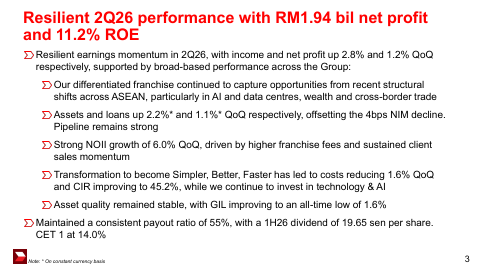
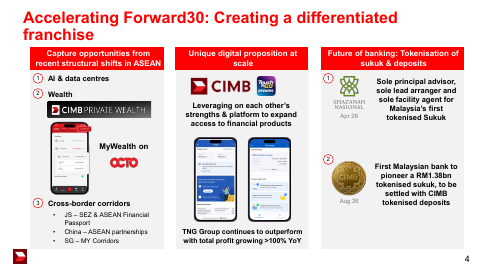
CIMB showed progress on its Forward30 plan. It completed Malaysia's first pilot of tokenised deposits to subscribe a tokenised sukuk, raising RM1.38 billion from 12 institutional investors. TNG Group's total profit more than doubled year-on-year, and TNG's payment volumes grew 68.8% year-on-year. Deposits grew 2.5% on a constant-currency basis, led by wholesale banking, and Singapore wealth and consumer lending were strong. Thailand consumer lending shrank.
Management wants to capture ASEAN shifts in AI and data centres, wealth and cross-border trade, while pairing the bank with TNG's platform and reallocating capital from weaker businesses, such as the exit from the Thailand auto business. The tension is that margins are still falling, so the plan relies on Indonesian loan repricing and cheaper deposits, while transformation costs and provisions weigh on Group Funding and Indonesia.
No call transcript for this quarter, so this summary also draws on: The Star ↗.
Slides & documents
Open the slide deck (PDF, 43 pages) ↗

Showing the first 6 of 43 pages.
Results documents
Key numbers
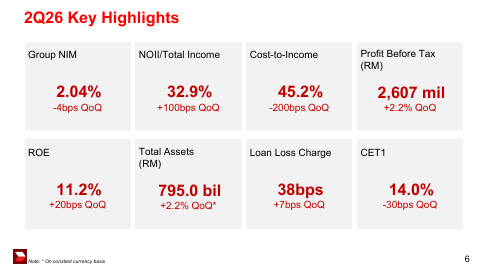
- Net profit attributable to owners · GAAP
- RM1.94 billion
- Diluted EPS · GAAP
- 17.92
- Total income
- RM5.56 billion
- Annualised ROE
- 11.2%
- Cost-to-income ratio
- 45.2%
- CET1 ratio
- 14.0%
up 1.2% quarter-on-quarter
vs 17.55 sen a year ago
up 2.8% quarter-on-quarter
up 20bps quarter-on-quarter
improved 200bps quarter-on-quarter
| Segment or metric | Value | Change |
|---|---|---|
| Consumer Banking PBT | RM1,255 mil | 1H26, down 16.0% year on year |
| Commercial Banking PBT | RM1,037 mil | 1H26, up 12.6% year on year |
| TNG Group total payment value growth | +68.8% YoY | |
| Group net interest margin | 2.04% | down 4bps quarter-on-quarter |
Where each number comes from
- Net profit attributable to owners: “net profit up 1.2% quarter-on-quarter (“QoQ”) to RM1.94 billion from the first quarter ended 31 March 2026 (“1Q26”)”
- Diluted EPS: “Earnings per share attributable to ordinary equity holders of the Parent (sen): - Basic B7(a) 17.94 17.57 35.69 35.96 - Diluted B7(b) 17.92 17.55 35.63 35.85”
- Total income: “Total income grew 2.8% QoQ to RM5.56 billion, with growth in both net interest income (“NII”) and non-interest income (“NOII”).”
- Annualised ROE: “The Group delivered an annualised return on average equity (“ROE”) of 11.2%, an improvement of 20bps QoQ”
- Cost-to-income ratio: “contributing to a 200bps improvement in cost-to-income ratio (“CIR”) to 45.2% for the quarter.”
- CET1 ratio: “Common Equity Tier 1 (“CET1”) ratio at 14.0%, providing sufficient capacity to absorb potential headwinds and support future growth.”
- Consumer Banking PBT: “Consumer Commercial 24% 20% Banking Banking PBT QoQ YoY PBT QoQ YoY RM1,255 mil ▲ 7.4% ▼ 16.0%”
- Commercial Banking PBT: “RM1,255 mil ▲ 7.4% ▼ 16.0% RM1,037 mil ▼ 28.3% ▲ 12.6%”
- TNG Group total payment value growth: “TNGD (RM ’mil) 2Q26 QoQ 1H26 YoY Total Payment Value (RM ‘bil) +68.8% YoY”
- Group net interest margin: “Group NIM NOII/Total Income Cost-to-Income Profit Before Tax (RM) 2.04% 32.9% 45.2% 2,607 mil -4bps QoQ”
Copied from the press release ↗ and other documents in the company's results page ↗. A figure is published only if its sentence is in those documents.
Outlook
| Metric | Period | Outlook |
|---|---|---|
| Asset growth (constant currency) | FY26 | 5 – 7% |
| Cost-to-income ratio | FY26 | < 47% |
| Loan loss charge | FY26 | 25 – 35 bps |
| CET1 ratio (CIMB Group) | FY26 | ≥ 14.0% |
Key takeaways
Tokenised deposits funded Malaysia's first tokenised sukuk pilot
The pilot raised RM1.38 billion from 12 institutional investors as part of a RM1.68 billion sukuk issuance. CIMB was sole principal advisor, sole lead arranger and sole facility agent, positioning it early in digital-asset infrastructure.
TNG Group is becoming the digital growth engine
TNG Group's total profit grew more than 100% year-on-year in 1H26, and payment value rose 68.8% year-on-year. CIMB is combining its universal bank with TNG's platform, including gold investment services on the TNG app.
Management is targeting AI, wealth and cross-border corridors
The stated opportunities are AI and data centres, wealth, and cross-border trade, including the JS-SEZ, ASEAN Financial Passport, China-ASEAN partnerships and a Singapore ASEAN Corporate Hub. Transaction Banking is a focus, backed by the regional roll-out of the CIMB OCTO Biz app.
Capital is being moved out of weaker businesses
CIMB exited CIMB Thailand's auto business, and Thailand consumer loans fell 7.2% year-on-year. Freed capital is meant to go to higher-return ASEAN segments.
Wholesale and Singapore wealth offset weak consumer markets
Wholesale deposits grew 15.5% year-on-year and Wholesale PBT rose 31.3% quarter-on-quarter on Treasury & Markets and recoveries. Singapore wealth grew 20.3% year-on-year, while Thailand and Indonesia consumer lending stayed weak.
Questions
What did CIMB launch in digital assets this quarter?
CIMB completed Malaysia's first pilot of tokenised deposits to subscribe a tokenised sukuk, raising RM1.38 billion from 12 institutional investors within a RM1.68 billion issuance.
How is TNG Group performing and why does it matter?
TNG Group's total profit grew more than 100% year-on-year in 1H26 and its payment value rose 68.8% year-on-year. Management is combining it with the universal bank to build a differentiated digital proposition at scale.
Where does CIMB see growth in ASEAN?
It points to AI and data centres, wealth, and cross-border trade, including the JS-SEZ, ASEAN Financial Passport, China-ASEAN partnerships and a Singapore ASEAN Corporate Hub.
What strategic portfolio changes did CIMB make?
It exited CIMB Thailand's auto business and is reallocating capital from underperforming businesses toward higher-return ASEAN segments. CIMB Thai is also restructuring to support its return on equity.
How is CIMB tackling pressure on its margins?
Management expects margin pressure to ease progressively, helped by loan repricing in Indonesia and growth in lower-cost deposits across key markets. Group margin still fell 4bps quarter-on-quarter to 2.04%.