OpenNashEarnings

Al Rajhi Bank (1120) · Banking

Al Rajhi Bank Q3 2026 earnings call: transcript, summary & key numbers

Results filed 21 Oct 2026 · Quarter ended 30 Sep 2026 · Company's own call transcript · Waleed Al-Mogbel (CEO), Abdulrahman Al-Fadda (CFO)

Read the transcriptSlides (31 pages)Press release ↗Investor relations ↗

Summaries and transcripts are machine-generated and can contain errors.

In brief

Al Rajhi Bank is shifting growth toward SME and corporate lending, with SME financing up 32.2%, while securitization and a housing slowdown shrink its retail mortgage book.

Al Rajhi Bank's growth this year came from businesses rather than households. Corporate financing rose 9.3% year on year, led by a 32.2% jump in SME lending, while retail financing fell 1.3%. Mortgages shrank because the bank sold SAR 5 billion of them in the third quarter and about SAR 10 billion for the year. Mortgage origination also slowed after a white land tax was introduced. Fee growth came from payments, trade and cash management.

Management is finishing its three-year "Harmonize the Group" strategy and will present the next one after a Board vote in December. It says it will favor pricing discipline over volume and will securitize more mortgages only when the economics work. The main tension is that SME lending is the growth engine but is also where non-retail bad loans are rising. Rate hikes and tighter funding add pressure.

Slides & documents

Open the slide deck (PDF, 31 pages) ↗

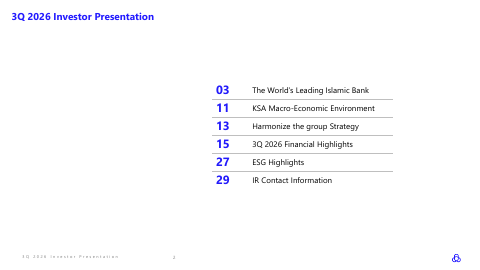
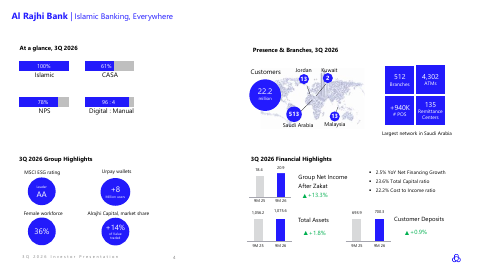
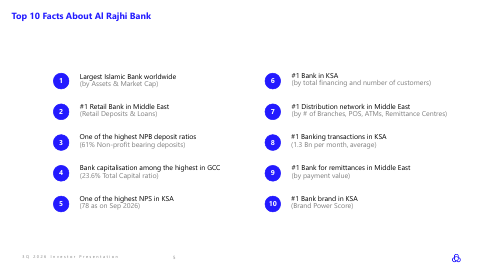
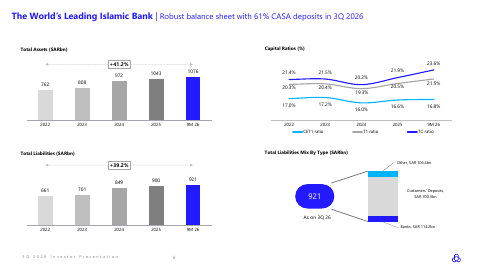
Al Rajhi Bank Q3 2026 slide deck, page 1Al Rajhi Bank Q3 2026 slide deck, page 2Al Rajhi Bank Q3 2026 slide deck, page 3Al Rajhi Bank Q3 2026 slide deck, page 4Al Rajhi Bank Q3 2026 slide deck, page 5Al Rajhi Bank Q3 2026 slide deck, page 6

Showing the first 6 of 31 pages.

Results documents

Key numbers

Total operating income (9M 2026)
32.5B

up 13.4% from a year ago

Net income after Zakat (9M 2026)
20.9B

up 13.3% from a year ago

Earnings per share (9M 2026, SAR)
3.27

up 12.79% from a year ago

Return on equity (9M 2026)
23.3%

Net financing and investment margin (9M 2026)
3.51%

up 42 bps from a year ago

Cost to income ratio (9M 2026)
22.2%

improved from 22.5%

Segment or metricValueChange
Net financing775 billionup 2.5% year on year
SME financing growth32.2%year on year
Corporate financing growth9.3%year on year
Retail financing-1.3%year on year
CASA share of deposits61%
Where each number comes from
  • Total operating income (9M 2026): “Total operating income increased by 13.4% to 32,528 million in the first nine months of 2026, compared with 28,685 in the same period last year.”
  • Net income after Zakat (9M 2026): “During the first nine months of 2026, Al Rajhi Bank reported net income of 20,870 million, up 13.3% year-on-year.”
  • Earnings per share (9M 2026, SAR): “while earnings per share reached 3.27 for the period”
  • Return on equity (9M 2026): “outstanding profitability, with ROE and ROA at 23.3% and 2.7%, respectively.”
  • Net financing and investment margin (9M 2026): “Lastly, our NPM expanded to 3.51%, higher by 42 bps year-on-year, and that's driven by ongoing effort to improve the yield and optimize the cost of fund”
  • Cost to income ratio (9M 2026): “Operating efficiency with a market leading C/I of 22.2%”
  • Net financing: “Net financing grew by 2.5% YoY, reaching 775 billion”
  • SME financing growth: “corporate financing grew by 9.3% year-on-year, driven by a 32.2% expansion in the SME book, while the retail book declined by 1.3%.”
  • Corporate financing growth: “corporate financing grew by 9.3% year-on-year, driven by a 32.2% expansion in the SME book, while the retail book declined by 1.3%.”
  • Retail financing: “corporate financing grew by 9.3% year-on-year, driven by a 32.2% expansion in the SME book, while the retail book declined by 1.3%.”
  • CASA share of deposits: “The funding profile remained diversified, with CASA representing 61% of total deposits as of 30 September 2026.”

Copied from the press release ↗ and other documents in the company's results page ↗. A figure is published only if its sentence is in those documents.

Key takeaways

  1. Three-year Harmonize the Group strategy is ending

    Management says most KPIs are already met or will be by year-end. The next three-year strategy goes to the Board in December and will be presented next year.

  2. SME lending is now the growth engine

    SME financing grew 32.2% year on year and corporate financing 9.3%, while retail financing declined 1.3%. The mix is shifting toward business customers.

  3. Mortgage securitization is a balance-sheet tool

    The bank securitized SAR 5 billion of mortgages in Q3 (SAR 10 billion for the year) and SAR 1.9 billion of consumer loans. It will do more only if the economics are positive, and it also lowers rate sensitivity.

  4. White land tax slowed mortgage origination

    Average monthly mortgage origination was close to SAR 5.6 billion, below last year, which management ties to the white land tax. It expects the effect to be short term and stays positive on mortgages.

  5. Rising SME bad loans and deposit mix are watch points

    Non-retail NPLs rose to 1.44%, driven by SMEs, which management still calls attractive on a risk-adjusted basis. CASA fell from 64% to 61% as customers preferred interest-bearing deposits.

What management said

Each quote matches the transcript word for word.

“This is due to the management initiative to reprice, take into consideration the management communication over the last few earnings calls that the management focus is on value rather than volume.”

It shows the bank prioritizes pricing over growth in volume.

Transcript · Abdulrahman Al-Fadda (CFO)

“As long as the economics work for us, whereby, the delta between the new origination of mortgage minus the rate of the securitized book is positive, this is something that will have a NIM positive impact over the medium term.”

It sets the condition for further mortgage securitization.

Transcript · Abdulrahman Al-Fadda (CFO)

“And we've been saying that we believe that the impact is going to be short term, but the medium to longer-term outlook, we're still positive about the mortgage growth story.”

It frames the white land tax slowdown as temporary and keeps mortgages central to the outlook.

Transcript · Abdulrahman Al-Fadda (CFO)

“As I mentioned before, we are working now on the next 3 years strategy, which will be presented, inshallah, next year once it gets approved by the Board in December.”

It says when the next strategy will be set.

Transcript · Waleed Al-Mogbel (CEO)

“higher yields have increased customer preference for interest-bearing deposits. We're responding through stronger transactional relationships, cash management solution or disciplined pricing,”

It explains how the bank plans to defend its low-cost deposit base.

Transcript · Abdulrahman Al-Ajaji (Executive)

Analyst Q&A

  1. Transcript · Abdullah Al Buraidi, Emirates NBD · NIM guidance

    How does the NIM guidance square with the widening SAIBOR-SOFR spread and renewed competition for funding?

    Treasury sees the October widening as temporary and the spread easing; the CFO expects sequential NIM pressure but full-year NIM expansion. — Abdulrahman Al-Ajaji, Abdulrahman Al-Fadda

  2. Transcript · Abdullah Al Buraidi, Emirates NBD · Funding spread

    What spread is assumed in the guidance?

    Treasury expects the spread to stay flattish to current levels until year-end. — Abdulrahman Al-Ajaji

  3. Transcript · Shabir Malik, Morgan Stanley · Asset quality

    What drove the Stage 2 increase, how will cost of risk trend with more SME lending, and is there more room for repricing?

    Stage 2 rose on some stage migration that is not worrying, the long-run cost of risk averages 50 to 55 bps versus about 41 bps now, and repricing will continue with a value-over-volume focus. — Abdulrahman Al-Fadda

  4. Transcript · Jon Peace, UBS · Loan growth

    Will loan growth pick up next year, and was the treasury mark-to-market about SAR 200 million?

    The CEO said next year's outlook is hard to give, and the CFO said the mark-to-market figure is not disclosed but partly reversed in October. — Waleed Al-Mogbel, Abdulrahman Al-Fadda

  5. Transcript · Tryfonas Spyrou, Roemer Capital · Securitization

    Can the economics of securitizations be tracked, will more follow, and how large were the overlays?

    The bank has securitized about SAR 31 billion since starting, will do more if economics work, and said overlays are adequate without quantifying them. — Abdulrahman Al-Fadda

  6. Transcript · Aybek Islamov, HSBC · CASA and corporate

    What is the CASA floor, is there prepayment risk or dollar lending demand in corporate, and what limits securitization volume?

    The bank is comfortable at about 61% CASA, sees no material prepayment risk, prefers SAR lending, and will securitize whenever it improves NIM and ROE. — Abdulrahman Al-Ajaji, Abdulrahman Al-Fadda

  7. Transcript · Naresh Bilandani, Jefferies · Liquidity, NIM sensitivity

    What is easing system liquidity, and is the bank reducing its NIM sensitivity to rate hikes?

    Treasury cited resilient system deposits and SAMA's standard repo tools, and the CFO said securitization, floating-rate lending and hedges cut sensitivity from 7 to 6 bps per 25 bps. — Abdulrahman Al-Ajaji, Abdulrahman Al-Fadda

  8. Transcript · Naresh Bilandani, Jefferies · SAMA liquidity

    Does this mean SAMA has been intervening in the market?

    No, SAMA has not intervened; it has long offered repo and term repo tools. — Abdulrahman Al-Ajaji

  9. Transcript · Naresh Bilandani, Jefferies · Liquidity

    What metrics show liquidity has calmed?

    A transitory deposit outflow in Q3 has been returning, and the SAIBOR-SOFR spread has fallen from a 180 bps peak to about 113 bps. — Abdulrahman Al-Ajaji

  10. Transcript · Waruna Kumarage, SICO Bank · SME NPLs

    Is the rise in non-retail NPLs related to SMEs, and what is being done about it?

    Yes, it is the SME book, which management still sees as attractive on a risk-adjusted basis while investing in collections and recovery. — Abdulrahman Al-Fadda

  11. Transcript · Rahul Rajan, BofA · Fees and mortgages

    Will geopolitical tension hit fees in Q4, what drove corporate loan growth, and how will mortgage growth look?

    No fee impact is expected, mortgage origination is lower on the white land tax with a short-term effect, and the medium-term mortgage outlook remains positive. — Abdulrahman Al-Fadda

  12. Transcript · Hussein Safieddine, Arqaam Capital · Securitization, funding cost

    Has investor appetite for securitization fallen, and did funding cost pressure continue in October?

    The bank sees no change in investor appetite and expects funding costs to keep rising in Q4, with tools to reflect the liquidity premium in new lending. — Abdulrahman Al-Fadda

  13. Transcript · Talal Alradan, ACap · Investment book

    How much of the investment book is repo-funded or swapped to floating?

    About 75% is fixed and 25% floating before hedges, and repo funding is not material. — Abdulrahman Al-Fadda


Questions

Where is Al Rajhi Bank's lending growth coming from?

From business customers: corporate financing grew 9.3% year on year, led by a 32.2% jump in SME financing, while retail financing fell 1.3%.

Why did the mortgage book shrink?

The bank securitized about SAR 10 billion of mortgages this year, and origination slowed to about SAR 5.6 billion a month after the white land tax. Management expects the slowdown to be short term.

What is Al Rajhi Bank's next strategy?

Its three-year "Harmonize the Group" strategy is in its final quarter, and a new three-year strategy goes to the Board in December and will be presented next year.

What is driving fee income growth?

Fee income rose 14.9% in nine months, driven by cards, payments, trade, cash management and brokerage and investment banking. Management says tension in the region is not hurting fees.

What are the main risks management flagged?

Rising SME non-performing loans, a lower share of CASA deposits (61% versus 64% in Q2), and margin pressure from rate hikes and higher funding costs, with sequential NIM pressure expected.

Transcript

Official transcript (PDF) ↗

Speaker

3Q26 FINANCIAL RESULTS EARNINGS CALL TRANSCRIPT

October 27, 2026

Charlie (Operator)

Welcome, everyone, to the Al Rajhi Bank Q3 2026 Earnings Call. My name is Charlie, and I'll be the coordinator today. If you'd like to ask a question and have joined the call via the Webex, please press the raise hand icon on your toolbar. I'd now like to hand the call over to Dr. Sultan Altowaim, Head of Research at Al Rajhi Bank to begin. Dr. Sultan, please go ahead.

Sultan Altowaim (Head of Research, Alrajhi Capital)

Sultan Altowaim (Executive)

Good afternoon, everyone. This is Sultan from Al Rajhi Capital. We are pleased to host Al Rajhi Bank Q3 2026 Earnings Call. Welcome, everyone, to this event. Please note that this call is open for analysts, investors and shareholders only. Media, including social media outlets are requested to disconnect at this point. Without any further delay, I will hand it to Mr. Mohammed Alqahtani from Investor Relations to introduce the management team.

Mohammed Alqahtani (Senior Investor Relations Manager)

Mohammed Alqahtani (Investor Relations)

Thank you, Dr. Sultan. Good day, everyone, and thank you for joining the call. With us on the call today, are our MD and CEO, Mr. Waleed Al-Mogbel; our Group CFO, Mr. Abdulrahman Al-Fadda; and our Group Treasurer, Mr. Abdulrahman Al-Ajaji.

As always, our CEO will start with the results highlights and strategy performance. Then our CFO will cover the financial performance in more detail. And finally, we will open the floor for your questions. Also, I would like to remind everyone to refer to Page 2 of the earnings presentation for the disclaimer notice. And now, I will hand over to Mr. Waleed.

Waleed Al-Mogbel (Managing Director and Chief Executive Officer)

Waleed Al-Mogbel (CEO)

Thank you, Mohammed. Welcome, everyone, and thank you for attending our earnings call for the third quarter of 2026. As always, I will start by taking you through our performance highlights, followed by an overview of our performance and our strategy, Harmonize the Group. Then I will hand the floor to our CFO, to cover the financial performance in more detail. If we move to the next slide.

In the last quarter, the bank delivered an excellent performance supported by the progress in our strategy execution and the healthy economy. This resulted in an outstanding net income of almost SAR 21 billion alongside healthy balance sheet growth. The balance sheet remains solid. Total assets reached SAR 1.076 billion, higher by 2% year-on-year and 3% year-to-date, while total liabilities stand at SAR 921 billion, reflecting a 2% year-to-date increase with a healthy LDR of 83.6%.

Moving to the profitability. Net income reached now, as I mentioned, almost SAR 21 billion for the first 9 months of 2026, which is higher by 13% compared to the same period in 2025. Net yield income grew by

17%, while non-yield income increased by 3% year-on-year. As a result, total operating income grew by 13%, reaching SAR 32 billion.

Regarding credit quality, we continue to maintain high asset quality with a cost of risk of 41 bps. Additionally, NPL stands now at 76 bps, supported by a coverage ratio of 152%. Moving to the last part, the key ratios. The bank maintained strong operating efficiency with a cost-to-income ratio standing at 22.2%. Also, our total capital ratio reached 23.6%, well above the regulatory minimum, reflecting the bank's healthy financial position.

Lastly, our NPM expanded to 3.51%, higher by 42 bps year-on-year, and that's driven by ongoing effort to improve the yield and optimize the cost of fund in the current rate environment. Regarding the progress of the strategy, as we are now in the last year and last quarter of the three-year strategy, Harmonize the Group, I'll just give it a very high level.

All the ratios now are in the progress and most of the ratios either achieved already the KPIs or will be achieved by the end of this quarter. As I mentioned before, we are working now on the next 3 years strategy, which will be presented, inshallah, next year once it gets approved by the Board in December. Now I will hand over to Abdulrahman to provide a detailed update of our financial performance, and thank you.

Abdulrahman Al-Fadda (CFO)

Thank you, Waleed. Good day, ladies and gentlemen. It is my pleasure to welcome you again to our Q3 earnings call. I will go over the financial performance slides very quickly so that you can have further time during the Q&A session. Starting with the balance sheet. Our total balance sheet stands at SAR 1,076 billion, almost 2% growth year-on-year and 2% on a sequential basis.

Our balance sheet has grown by almost 3% year-to-date, as you can see on the bottom left-hand side of the chart, mainly driven by the financing book, which has grown by almost 3%, and I will cover that in further detail in the following slide. The SAR 32 billion increase in our total assets, mainly funded by the customer deposits, while we've taken an opportunity to shed off some of the expensive interbank as well as Sukuk and others.

Zooming further into the main driver of our balance sheet movement, our financing book stands at SAR 775 billion, 2% growth year-on-year and 2% on a sequential basis. To analyze the 3% growth year-to- date, as you can see on the top right-hand side of the chart, our mortgage book has contracted by almost SAR 5 billion. It's worth to highlight that we have securitized a total year-to-date of almost SAR 10 billion.

Hence, our mortgage gross growth was only SAR 5 billion contraction. Ex mortgage and retail, we have seen a healthy growth mainly on the third quarter, where we have seen a 2% growth year-to-date. Corporate and SME have shown a healthy growth of almost 5% and 20%, respectively.

Our total mortgage book stands at SAR 271 billion, out of which represent 56% of the retail book and 34.5% of our overall financing book. Retail book as a percentage of the overall stands at a healthy level of 62%, while non-retail, 38%. Our total customer deposits stand at SAR 700 billion, 1% growth year-on- year and almost 2% growth on a sequential basis.

On a year-to-date basis, as you can see on the bottom right-hand side of the chart, our total customer deposit has increased by almost 5%, mainly driven by time, while CASA have contracted by SAR 6.5 billion due to transitory deposit movement to TD. On the investment side, our total investment book stands relatively stable at almost SAR 178 billion, out of which 87% are Sukuk and Murabaha, 75% fixed rate and finally, 82% within KSA.

If we move to the profitability section, our net income for the third quarter was almost SAR 7.1 billion, 12% growth year-on-year and 1% on a sequential basis.

To analyze the sequential movement, as you can see on the bottom left-hand side of the slide, NII have increased by almost 3.7%. Non-yield income contracted by almost 3%, mainly driven by the treasury investment book, which is classified as a fair value through P&L.

OpEx were lower by SAR 38 million, which would bring the pre-provision profit to be 3.2% higher on a sequential basis. Our net income for the period was SAR 20.9 billion, 13.3% higher year-on-year, mainly driven by the yield income of almost 16.7%, non-yield income by 3%, while OpEx were higher by 11.8%, which brings the pre-provision profit to be 14% higher year-on-year.

To further zoom in into the net income driver, I'll start with the operating income. Operating income for the third quarter, a healthy level of SAR 11.1 billion, 12% higher year-on-year and 2% on a sequential basis. Our operating income for the period stands at SAR 32.5 billion, 13.4% higher year-on-year. The driver, as you can see in the top right-hand side of the chart, our NII went higher by 17%.

Although our average earning assets have increased by only 3%, however, we have a 42 basis point NIM expansion, which drives that healthy growth in our NII. Fees have further improved by 15% year-on- year, mainly driven by payments, the GDP, which we've seen a very good improvement in our acquiring profitability, trade, cash management and finally, the subsidiary contribution to the overall fee income growth.

Exchange income have shown a 12% year-on-year increase, while other income have shown a contraction of SAR 564 million, which is in line of my previous comment that due to the treasury mark-

to-market movement, given the higher interest rate environment. Our NIM for the 9 months were 3.51%, 42 basis point expansion.

And the driver of that 42 basis point expansion, as you can see on the bottom right-hand side of the chart, around 25 basis points were coming from the gross yield improvement. This is due to the management initiative to reprice our assets, also the asset mix, all of that have contributed to almost 25 basis point increase in our gross yield to reach at 6.10%.

That is coupled with 17 basis point improvement in our cost of fund, given that the average SIBOR year- on-year as of the first 9 months compared to the first 9 months of 2025, were lower by almost 57 basis points. OpEx for the Q3 were almost at SAR 2.4 billion, 6.3% higher year-on-year and 2% lower on a sequential basis.

Our OpEx for the period were close to SAR 7.2 billion, 11.8% higher year-on-year, mainly driven by staff costs as well as the G&A. As Waleed mentioned earlier, to execute the harmonize the group strategy to further improve the ROE of the shareholders. Given that we have a very healthy operating income increase of 13.4%, while OpEx were increased by only 11.8%, that 160 basis point positive jaws helped us to reduce further the cost-to-income ratio from 22.5% to almost 22.2%.

On the asset quality, our impairment charge for the third quarter was SAR 852 million, close to 50% higher year-on-year and 3% lower on a sequential basis. Our cost of risk, at 41 basis points compared to 31 basis points at the same period last year. The movement on our NCL chart, as you can see on the bottom left-hand side of the chart, gross charge were higher by SAR 815 million. This is attributed to 3 main factors.

Number one, the portfolio growth; number two, the management has taken overlay, taking into consideration the current environment. Thirdly, we keep updating our ECL model, taking into consideration the recent macro outlook changes. As you can see on the bottom right-hand side of the chart, the majority of that growth into the NCL will top up our non-retail book.

Our NPL stand at SAR 6 billion, where we have seen a 5% increase year-on-year, mainly driven by the non-retail book write-off. We have written off close to around SAR 4.4 billion and while net inflow is close to SAR 4.7 billion. Our NPL ratio stands at almost stable at 76 basis points, although it's worth to highlight that we have seen a further improvement in our retail NPL, given the natural write-off, coupled with the portfolio growth where we have seen the retail NPL dip to 35 basis points.

While non-retail book, we have seen growth in the NPL specifically on the SME sector. We haven't seen any one-off that has taken us to increase the non-retail book NPL to 1.44%. NPL coverage still healthy at 152%. Our ECL stock stands at SAR 9.1 billion, mainly driven by topping up our non-retail provision book.

Stage 1 still represent the majority, 96.6% of the portfolio. No material movement compared to the previous quarter. Stage coverage, again, remained stable, Stage 1 at 37 basis points compared to 38 basis points in the second quarter, Stage 2 at 10.7% compared to 11%. And finally, Stage 3 flat compared to the second quarter at 54%.

Liquidity position remained healthy and within the regulatory requirement. Although our headline LDR at 110.7%, our unweighted LDR, which includes Sukuk and other syndicated loan stand at 96.9%. Regulatory LDR at 83.6%. LCR and NSFR, at a comfortable ratio and above the minimum requirement. Our total RWA stands at SAR 693 billion, 3.4% increase year-on-year, mainly driven by a 3.4% increase in our credit RWA.

It's worth to highlight that our RWA density at 64.4% compared to 64.3% in the second quarter. Our capital ratio stands as follows: CET1 at 16.8%, lower by 50 basis points compared to the second quarter. This is due to the first half dividend distribution, which has been paid in the third quarter. Tier 1 at 21.5% and finally, our total capital at 23.6%.

Year-to-date, we've seen our total Tier 1 capital have increased by almost 100 basis points. Although that our balance sheet growth, coupled with the dividend distribution have contributed to almost 290 basis points of capital drop. However, that has been offset by the same amount due to the internal capital generation, given that we have a very healthy RWA density.

Returns metrics are healthy and above the industry average. Our RORWA stands at 4.07%, ROE at almost 23.3% and finally, our ROA at 2.65%. Before we jump into 2026 guidance, maybe a couple of minutes to discuss or to highlight our general outlook. As far as the GDP forecast, IMF have revised the Saudi GDP forecast for 2026 to be 3.3% contraction, mainly driven by oil activity, while the core non-oil GDP is showing 2.6% expansion.

Outlook for 2027, still healthy to grow at almost 8%. Consumer spending outlook is still healthy, where we have seen in the first 8 months, the consumer spending have increased by almost 8%. On the interest rate environment, the Fed have delivered one hike in September. Our base case forecast, there will be additional hike in this quarter, which might have a negative impact into the NIM.

However, the management initiatives are still undergoing to further improve the asset yield and optimize the cost of fund in order to improve and manage the NIM accordingly. Having said that, taking into consideration all of the above, our outlook is still unchanged compared to what we have communicated in the second quarter, financing book to be low single-digit growth. NIM 30 to 40 basis point expansion, cost income below 23% ROE is above 23.5%. And finally, cost of risk in the range between 35% to 45%. Waleed, back to you.

Waleed Al-Mogbel (Chief Executive Officer and Managing Director)

Waleed Al-Mogbel (CEO)

Thank you, Abdulrahman for the Financial highlights. We are so proud of our outstanding performance and the progress made across all the KPIs of our Harmonize the Group strategy. Now we will open the floor for Q&A. Operator, back to you.

Charlie (Operator)

Thank you. As a reminder, if you'd like to ask a question, please use the raise hand feature on your Webex toolbar. We'll allow for all the questions to be registered. Our first question comes from Abdullah Al Buraidi of Emirates NBD. Abdullah, please unmute yourself locally and proceed with your question.

Abdullah Al Buraidi (Analyst, Emirates NBD)

Abdullah Al Buraidi (Emirates NBD)

Congrats for the wonderful results. I have a question regarding the NIM guidance. While we've undergone a hike and we're expecting another hike to be in the remainder of the year, I think the focus on the liquidity stance is, at least during October, is the SIBOR SOFR spread, which expanded massively.

And we've seen through other banks financial disclosures that deposit has declined and the competition for funding has come back again. And based on that guidance, it is that either we're expecting a flat NIM quarter-over-quarter or a slight increase. We know that Al Rajhi is geared for rate cuts or lower cost of funding. How do we pencil that with the increased SIBOR SOFR spread? Thank you very much.

Abdulrahman Al-Ajaji (Executive)

Okay. Just to cover the SAIBOR SOFR spread. If you look at the average for the third quarter, the spread stood at 107 basis points comparing to 109 back in the second quarter. Yes, in October, we have seen some widening in that spread, and that is mainly due to short-term liquidity fluctuations.

However, from our end, we view this as a temporary movement rather than a structural change in the funding conditions. Since then, by the way, spread have dropped from a peak of 180 basis points to approximately 124 basis points. And if I'm correct, today's spread was 130 basis points as market conditions, in our opinion, have started to stabilize.

Abdulrahman Al-Fadda (CFO)

As far as the NIM, first of all, I didn't mention that the NIM will be flat to positive compared to the third quarter. On a sequential basis, we are expecting probably there will be pressure. However, on a full year compared to full year, 2026 compared to 2025, the NIM still continue to expand. That's number one.

Secondly, if you recall, slide 10 in our presentation, where we have highlighted the NIM movement out of the 42 basis points after that, there has been a 25 basis point improvement in our gross yield despite that the SAIBOR were lower in the same period by almost 57 basis points. This is due to the management initiative to reprice, take into consideration the management communication over the last few earnings calls that the management focus is on value rather than volume.

Abdullah Al Buraidi (Analyst, Emirates NBD)

Abdullah Al Buraidi (Emirates NBD)

Okay. That's pretty informative. What's the spread that you are expecting in driving that guidance, SAIBOR SOFT spread?

Abdulrahman Al-Ajaji (Executive)

I believe from now until the year-end, we will be flattish to what levels we are in right now.

Shabir Malik (Analyst, Morgan Stanley)

Shabir Malik (Morgan Stanley)

Thank you very much. I just have a couple of questions around asset quality. So, in your Stage 2 ratio seems to have increased quarter-on-quarter. So, I just wanted to get your thoughts on what's driving that increase. And maybe if you can touch on the cost of risk trends over the medium term.

So, I think you've indicated that there were certain changes like, for example, changes in the macroeconomic variables and certain overlays, which have driven provisioning a bit higher. But over the medium term, given that you're leaning more towards SME and corporate, how does the cost of risk shape up over the medium term?

And my second question is around margins. So, this quarter, you indicated that there was some benefit of loan repricing. Can you indicate if there is room for more repricing going into the fourth quarter and into 2027? And is this more towards the corporate side? Or is it more towards the retail side? Thank you.

Abdulrahman Al-Fadda (CFO)

Actually, Shabir, 3 questions, not 2 questions. Number one, Stage 2 exposure, 2.4%, you're absolutely correct. This is due to some stage migration, but I don't think this is something that we are worrying as we speak. And our credit team has invested quite a lot over the last few years to further improve recovery and the stage migration, and this is something that they will continue. So, I don't think that is something worrying as we speak for the time being.

The second question related to the cost of risk medium-term outlook. The cost of risk average is anywhere between 50 to 55 basis points over the cycle that we have seen, over the last probably 10 years.

Currently, we are at around 41 basis points. Despite that probably the SME as a percentage of our financing book have increased to almost 9.4%. Nevertheless, I think similar to our collection team, where we have seen improvement in the retail business to improve further the recovery and the collection, I think they are investing now to further enhance the capability on the SME side.

The third question related to the NIM. Yes, I think the NIM, I think the management has been taking lots of initiatives over the last few years to reprice the assets. We'll continue to focus in a value rather than a volume. We'll continue to focus to make sure liquidity premium is reflected properly into the asset origination.

I think it will take some time. And I think all what you have seen, the 25 basis point increase into the gross yield that we have delivered year-on-year, it wasn't happened only this year. It was that several initiative has been taken over the last couple of years delivered that 25 basis points. We will continue to do so and to further improve the NIM over the medium term.

Jon Peace (Analyst, UBS)

Jon Peace (UBS)

Hi. Thanks for taking the question. So firstly, please, would you expect loan growth to pick up a little bit next year if the capital pressures are eased and the mix is continuing to shift towards corporate and SME sort of back to the mid-single-digit range? And the second question, please, is you referenced treasury mark-to-market within the other income. It looks like that might have been around the SAR 200 million sort of level. Just wondered if you might be able to confirm that. Thank you.

Waleed Al-Mogbel (Managing Director and Chief Executive Officer)

Waleed Al-Mogbel (CEO)

Yes, hi. It is very difficult now considering the current situation to give you an outlook for the next year. However, as you know us from the last 2 strategy, we're always trying to find ways to improve our profitability and enhance our benchmark compared to other competitors.

Abdulrahman Al-Fadda (CFO)

On the second question, that is not disclosed, Jon. That will be usually an annual disclosure. Nevertheless, despite the movement in the interest rate, our treasury team are doing an active management of our balance sheet as well as the investment book. I think in the first 3 weeks of October, we've seen a further reversal of that negative mark-to-market year-to-date. And our treasury team is actively managing that exposure to further improve the other income line.

Tryfonas Spyrou (Analyst, Roemer Capital)

Tryfonas Spyrou (Roemer Capital)

2 questions, most of them have been answered, but I've got 2. The first one is on securitizations. Is there any way for us to track the kind of accretion or economics of these transactions? And do you expect more of them to come, given the current interest rate environment? The second one is on cost of risk. I think you mentioned some overlays that you took in Q3. I was wondering whether you can help us quantify those. Thank you.

Abdulrahman Al-Fadda (CFO)

On the securitization, as I mentioned, we securitized SAR 10 billion this year on mortgage. Since we started the journey with securitization, we securitized close to around SAR 31 billion. And if you look at our capital liquidity ratio, we are at a very comfortable level. So we are not looking to do any fire sale.

As long as the economics work for us, whereby, the delta between the new origination of mortgage minus the rate of the securitized book is positive, this is something that will have a NIM positive impact over the medium term. The management is looking in a very continuous dialogue and looking at securitization. If the economics work, we will definitely look into securitization. As far as the second question, the overlays, rest assured that the management is conservative.

Look at the current environment. If we need to take any charges to be conservative, we will be more than happy. Overall, we have taken an adequate overlays as we speak. This is a regular review that has been done by the internal management team. However, our cost of risk guidance is still intact of 35 to 45 basis points.

Aybek Islamov (Analyst, HSBC)

Aybek Islamov (HSBC)

Thank you very much for the conference call. Three questions from me, please, first is on your CASA deposit ratio. What do you think is an absolute floor for your CASA deposit ratio, especially given that your assets continue to grow in low single digits and obviously, you have captive current accounts, which back your mortgage book and point-of-sale loans, for example? That's my first question.

And secondly, on the corporate loan book, do you see a risk of like rising prepayments given high interest rates at the moment? And also, are you observing any pickup in demand for dollar lending versus Saudi real lending among the corporates? That's a second question.

And I think thirdly, at what sort of like rate hikes do you think you may need to securitize mortgages more aggressively? And given the capacity within the market, could you tell us about the maximum kind of securitization volume per quarter that you can digest, right? I mean, assuming economics is attractive, as you pointed earlier.

Abdulrahman Al-Ajaji (Executive)

For the first question, I mean, higher yields have increased customer preference for interest-bearing deposits. We're responding through stronger transactional relationships, cash management solution or disciplined pricing, even though our CASA from the second quarter to the third quarter dropped from 64% to almost 61%, which is fair given that we've had some transitory outflows that took place in the third quarter, and we started getting that inflow back again in the fourth quarter. So we're comfortable with the levels that we are in right now.

Abdulrahman Al-Fadda (CFO)

On the second question, Aybek, about the impact of rising interest rate environment, whether that will have an impact in the corporate repayments, probably the best benchmark is to go back to the history. If you look at 2022 when the Fed started hiking the rate, in 2022, our corporate book has managed to increase by almost SAR 24 billion. In 2023, our corporate book has increased by almost SAR 40 billion.

So yes, there could be some repayment pressure. However, overall, there has been a growth overall on a net absolute basis. So, I don't see that is a material risk. Then funding versus Saudi riyal, again, from our perspective, the management still continue to focus into the SAR lending given that the majority of our customer time deposits in SAR. From our perspective, the management preference is SAR.

Finally, on the mortgage securitization. Again, we are looking from our perspective if the economics work, as you mentioned. Even during the low interest rate environment, if you remember back in 2022 when we started the mortgage securitization, rates were much lower than the current level.

So it's depending on multiple factors, depending on capital, depending on funding, depending on the growth outlook. From our perspective, as long as the economics work and there is an opportunity to further improve the NIM and the ROE, we'll definitely take that call.

Naresh Bilandani (Jefferies)

Thank you. It's Naresh from Jefferies. Two questions, please. In an earlier comment from the management in the call, there was a view shared that the liquidity pressures that had elevated in the past few weeks are now stabilizing. Can you please share what supportive actions, if any, from the authorities are helping the liquidity situation?

I think the system-wide pressure on liquidity was being led by the government deposits decline. Are you seeing these reverse at the system level or are you seeing some other indicators, if you can please share, that you feel are now bringing this liquidity situation a lot better as compared to what we have seen in the past couple of weeks? So that's the first question.

My second question is on the NIM sensitivity. I'm just keen to hear if in light of the heightened volatility and the risk of a hawkish Fed going into the next year, if you have taken or are planning to take any steps to bring your inverse sensitivity lower via interest rate swaps or any other measures? Thank you

Abdulrahman Al-Ajaji (Executive)

Okay. So despite the ongoing geopolitical tension, the Saudi banking sector has continued to demonstrate a strong resilience to maintain a robust liquidity position with no significant adverse impact observed on the overall banking system. We, at the bank maintain a diversified Saudi and USD funding sources supported by a prudent liquidity buffers and disciplined balance sheet management.

I mean by just looking at the SAMA bulletin, the latest, which was published in August, total deposits have posted SAR 3.079 trillion, which is up about 5.2% year-to-date. Even though if you've seen the reverse repo on a quarter-over-quarter basis, we dropped from SAR 59 billion to SAR 48 billion in this quarter, which is still remains at a stable level.

Now you've mentioned something for -- from a regulatory point of view from SAMA. SAMA continuously support the quality of the banking regulatory environment and also closely monitoring the liquidity situation. There are a number of funding tools that are used by the regulator to manage system liquidity. For short term, SAMA offers bank repo on an overnight basis and term basis. However, banks in the Kingdom uses SAMA as the lender of last resort.

Abdulrahman Al-Fadda (CFO)

Naresh, as far as the NIM sensitivity, taking into consideration the inflationary pressure that we have seen probably from the first quarter, if you recall my earlier comment, we've securitized close to SAR 10 billion of our mortgage book, which reduced to some extent, the long-term fixed asset.

Also, you have seen our corporate book have increased by almost 5% year-to-date. Those measures have been taken by the management to reduce the NIM sensitivity, coupled with ongoing activities that our treasury team is looking in light of the ALCO discussion to reduce the NIM sensitivity.

Earlier in the year, our NIM sensitivity were close to 7 basis points for every 25 basis points. However, due to the management initiative that has been taken, either securitization or focusing in the floating rate or some of the hedges that has been put in place, the NIM sensitivity dropped from 7 to 6 basis points.

Naresh Bilandani (Jefferies)

Understood. If I can just get back a clarification on the previous reply, please. Am I to infer from these comments that have been shared that SAMA has been intervening in the market to bring the liquidity situation in control or alternatively in the next set of reading...

Abdulrahman Al-Ajaji (Executive)

No, let me correct you. SAMA, they did not intervene. SAMA has the tools, which has been there since I've known the banking sector on a short-term basis, which is the reverse -- the repo and the term repo. So I have not mentioned any intervention.

Naresh Bilandani (Jefferies)

Understood. But you said that we are seeing sort of like a stabilization in the liquidity situation. And pardon me if I'm getting too argumentative on this one, but I'm just keen to understand the metrics that you are seeing that you feel now is bringing the liquidity situation a lot calmer as compared to what we've seen in the past couple of weeks.

Abdulrahman Al-Ajaji (Executive)

I've mentioned earlier that we've had one transitory deposit that left in the second quarter -- sorry, in the third quarter, which as of the beginning of the fourth quarter, we're seeing inflows in the same way and in the same amount, which can be tracked if you look at the SAIBOR SOFR spread, where in October, we've seen a peak of, I believe, 180 basis points, and that was about 10, 11 days ago. And now we're back into 113, which is around the same levels that we've seen in the second and the third quarter.

Waruna Kumarage (Analyst, SICO Bank)

Waruna Kumarage (SICO Bank)

Thank you very much. I have one question related to the NPLs, specifically on the NPLs in the non-retail segment. Am I correct in assuming that this uptick that we have seen in third quarter, that it is related to MSMEs in particular? I just want to understand if there are any trends that you're seeing and any mitigation measures that you're taking.

Abdulrahman Al-Fadda (CFO)

Waruna, yes, this is exactly what I have mentioned during the NPL slide, which was on Page 13 of the presentation. We have highlighted that this is the SME book start to the season. Nevertheless, as I mentioned, although that probably that uptick in the NPL from a risk-adjusted return still is an attractive value proposition, giving the yield attractive. It's efficient from a credit RWA perspective.

Also, it provides further improvement in the fee income. And even adjusted for the cost of risk is still an attractive business. Nevertheless, I would also reiterate my earlier comment, our credit and collection team have been investing quite a lot to improve further the SME collection and recovery to be able to manage the cost of risk to further improve the profitability for the organization.

Rahul Rajan (Analyst, BofA)

Rahul Rajan (BofA)

Hello. Good evening. A couple of questions from my side, please. First is in October specifically or from the impact of the heightened geopolitical tensions that we are seeing in Saudi, is -- should we see some impact on the quarterly fee generation trends in 4Q or even the general nonfunded income? That's number one.

And secondly is from a loan growth perspective, if you can probably shed some color as to what are the drivers for loan growth in the corporate space, specifically in 3Q? And even otherwise, typically, 4Q or 1Q has been seasonally strong quarters for mortgages. So should we see mortgage growth -- or how should we see mortgage growth this year versus last year? Thank you.

Abdulrahman Al-Fadda (CFO)

To be honest, Rahul, I don't think that there will be any impact on the fee income. And I think the majority of the fee income, given that we are a retail bank, we are serving close to 20 million retail customer. We have a very good dominance in the bank market share in the issuing or the market side, probably might be on a positive side.

And I think given that most of the spend rather than done internationally will be done locally, which will provide a further improvement into the acquiring profitability. Nevertheless, if you recall my earlier comment related to the 15% growth in the fee income year-on-year were attributed to multiple initiatives.

We have seen a good pickup in our trade cash management despite the current tension that we started seeing end of February. Nevertheless, we have seen a further improvement into the fee. The second question, Rahul, if I get you correctly, you're asking specifically on to the mortgage from the origination in the fourth quarter, whether that will have an impact or not, correct?

Rahul Rajan (Analyst, BofA)

Rahul Rajan (BofA)

Yes, absolutely. One is from the mortgages, typically, we have seen fourth quarter and 1 quarter to be stronger quarters from a mortgage origination perspective.

Abdulrahman Al-Fadda (CFO)

Definitely. That is usually because of the Cityscape conference that which usually happen in the fourth quarter. As far as I know, I'm not aware of any changes could happen to the event, maybe rescheduled. That is not up to our knowledge for the time being.

Nevertheless, and I think the mortgage slowdown we have seen this year, which has been communicated to you guys, we've seen the mortgage average origination were close to SAR 5.6 billion per month, which is lower than the same period last year.

That is expected due to the white land tax introduction that has happened earlier this year. And we've been saying that we believe that the impact is going to be short term, but the medium to longer-term outlook, we're still positive about the mortgage growth story.

Hussein Safieddine (Analyst, Arqaam Capital)

Hussein Safieddine (Arqaam Capital)

Hello. Congratulations on these results. my first question is, have you seen any decline in investor appetite for securitization in the current market? And my next question is for the cost of fund. Is the cost of fund pressure persisted in October or intensified? And do you expect the regulators to introduce any measures to ease funding conditions? Thank you.

Abdulrahman Al-Fadda (CFO)

We are not aware of any changes into the investor appetite on the mortgage securitization. It's an open dialogue. We'll continue to look for opportunity. If the math is suitable for us, we'll take the call. As far as the second question, I think my colleague, Abdulrahman, our Group Treasurer, has answered that question accordingly related to the overall liquidity situation.

As I mentioned earlier, I believe that overall, the cost of fund is expected to continue to rise in the fourth quarter compared to the third quarter. However, as a management, we have multiple tools to be able to make sure that liquidity premium reflected into the asset origination

Talal Alradan (Analyst, ACap)

Talal Alradan (ACap)

Thank you, management for the presentation and congrats on the set of results. I have only one question. How much of the investment book is repo funded or swapped to floating, if you can share during the third quarter.

Abdulrahman Al-Fadda (CFO)

Talal, first of all, our investment book, if you recall, when it comes to the investment book slide that I presented earlier, that was in Slide #8. Overall, the fixed rate component of our investment book is close to 75%, and 25% is floating. That is not taking into consideration the hedges that has been put in place. As far as repos, this is not a material book. And again, this could be as an opportunity for us to manage our cost of fund efficiently.

Charlie (Operator)

Thank you, Talal. This is all the questions we have time for today, so I'll hand back over to the management team for any further or final closing comments.

Waleed Al-Mogbel (Chief Executive Officer and Managing Director)

Waleed Al-Mogbel (CEO)

Thank you, everyone, for dialing in and for your trust in us. We are very proud of our results for the third quarter of 2026, and we will continue to achieve our strategic goal this year and beyond. We look forward to meeting you in the next quarter earnings call. Inshallah. Thank you.

Charlie (Operator)

Ladies and gentlemen, this concludes today's webinar. Thank you for joining. You may now disconnect your lines.