OpenNashEarnings

Al Rajhi Bank (1120) · Banking

Al Rajhi Bank Q2 2026 earnings call: transcript, summary & key numbers

Results filed 21 Jul 2026 · Quarter ended 30 Jun 2026 · Company's own call transcript · Waleed Al-Mogbel (CEO), Abdulrahman Al-Fadda (CFO)

Read the transcriptSlides (31 pages)Press release ↗Investor relations ↗

Summaries and transcripts are machine-generated and can contain errors.

In brief

Al Rajhi Bank is shifting from loan volume to value, securitizing retail loans while SME lending grows 46.7%, and is preparing its next three-year strategy.

Al Rajhi Bank leaned into corporate and SME lending while its retail book shrank, because it sold down mortgages and consumer loans through securitization. SME financing grew 47% year on year. Fee growth came from payments, trade, cash management, investment banking and asset management. The bank's digital-to-manual ratio reached 96:4, and every application is now cloud-ready.

Management is finishing its three-year Harmonize the Group strategy and expects the board to approve the next one by December. The stated approach is value over volume. Financing guidance was lowered to low single digits, with more securitization and funding diversification planned. The tension is a cautious stance on credit, a lower IMF Saudi growth forecast, rising rate pressure on funding costs, and a first-half dividend that is still undecided.

Slides & documents

Open the slide deck (PDF, 31 pages) ↗

Al Rajhi Bank Q2 2026 slide deck, page 1Al Rajhi Bank Q2 2026 slide deck, page 2Al Rajhi Bank Q2 2026 slide deck, page 3Al Rajhi Bank Q2 2026 slide deck, page 4Al Rajhi Bank Q2 2026 slide deck, page 5Al Rajhi Bank Q2 2026 slide deck, page 6

Showing the first 6 of 31 pages.

Results documents

Key numbers

Net income after Zakat (first half 2026)
13,764 million

up 14.2% from a year ago

Total operating income (first half 2026)
21,413 million

up 13.9% from a year ago

Earnings per share (first half 2026)
2.17

up 13.71% from a year ago

Segment or metricValueChange
Net financing762 billionup 2.7% year on year
SME financing growth46.7%year on year
Retail financing growth2.6% declineyear on year
CASA share of deposits64.2%
Real estate loan market share38%
Where each number comes from
  • Net income after Zakat (first half 2026): “During the first half of 2026, Al Rajhi Bank reported net income of 13,764 million, growing by 14.2% year-on-year. This strong performance was driven by a 13.9% increase in operating income,”
  • Total operating income (first half 2026): “Total operating income increased by 13.9% to 21,413 million in the first half of 2026, compared with 18,803 in the first half 2025.”
  • Earnings per share (first half 2026): “ROE and ROA stood at 23.3% and 2.6%, respectively, while earnings per share reached 2.17 for the period”
  • Net financing: “Net financing grew by 2.7% YoY to 762 billion, supported by growth in the non-retail book, where large corporate and SME increased by 5.9% and 46.7%, respectively.”
  • SME financing growth: “Within the financing portfolio, corporate financing grew by 13.2% year-on- year, driven by a 46.7% increase in the SME book, while the retail book declined by 2.6%.”
  • Retail financing growth: “Within the financing portfolio, corporate financing grew by 13.2% year-on- year, driven by a 46.7% increase in the SME book, while the retail book declined by 2.6%.”
  • CASA share of deposits: “The funding profile remained diversified, with CASA representing 64.2% of total deposits as of 30 June 2026.”
  • Real estate loan market share: “maintaining the largest market share in real estate loans at 38%, and sustaining leadership in payments business with nearly one million point-of-sale (PoS) devices.”

Copied from the press release ↗ and other documents in the company's results page ↗. A figure is published only if its sentence is in those documents.

Key takeaways

  1. SME lending is becoming a core growth engine

    SME financing grew 47% year on year and now represents 24% of the non-retail book and 9% of the financing book. Management says the aim is to become the main bank for corporates, with a corporate portfolio of around SAR 285 billion.

  2. Retail book shrinks as securitization accelerates

    Gross retail lending grew SAR 3.2 billion, but about SAR 8 billion of consumer and mortgage loans were securitized, so the retail book contracted. Management says securitization is NIM-accretive when new origination rates exceed the securitized book, and it lowered financing guidance to low single digits.

  3. Cross-sell and fee products outpace lending

    Products per customer reached 44%, and sales from target customer segments are up above 400% since 2023. Fee growth was driven by payments, trade, cash management, investment banking and asset management.

  4. Digital and cloud programs hit key milestones

    All applications are now cloud-ready, 66% of processes are automated and the digital-to-manual ratio is 96%. Revenue from data-driven marketing is up above 570% since 2023, with AI and event-driven activities cited as gaining momentum.

  5. Next three-year strategy due by December

    Harmonize the Group ends this year, and a successor strategy is being prepared for board approval by December and presentation next year. The first-half dividend decision is still pending, as management weighs payouts against preserving capital for growth.

What management said

Each quote matches the transcript word for word.

“The management feedback is focusing on our value rather than our volume. We believe that the liquidity has a premium, and we want to make sure that liquidity premium is being reflected properly into the asset origination.”

It explains why loan growth is deliberately restrained in favor of pricing discipline.

Transcript · Abdulrahman Al-Fadda (CFO)

“as long as the new origination rate is higher than the securitized book, that's a NIM accretive over time.”

It gives the CFO's rule for when selling down loans is worthwhile.

Transcript · Abdulrahman Al-Fadda (CFO)

“We look at our corporate lending franchise on an overall 360. It's not only a balance sheet lending, we're looking also in terms of liquidity, we also look into the fee auxiliary business that come with that relationship,”

It shows corporate relationships are judged on fees and liquidity as well as lending returns.

Transcript · Abdulrahman Al-Fadda (CFO)

“we are in the process of preparing our next 3-year strategy. Once we finish it, we will approve it by the Board by December.”

It sets the timeline for the successor to Harmonize the Group.

Transcript · Waleed Al-Mogbel (CEO)

“We're not shying away from investing as long as that will help us to further improve the customer experience, improve the customer stickiness, which will have a positive impact into increasing our operating income.”

It signals continued investment in customer experience despite cost-efficiency targets.

Transcript · Abdulrahman Al-Fadda (CFO)

Analyst Q&A

  1. Transcript · Mohammed Al-Rasheed, Hassana · Asset yield

    What drove the sequential drop in asset yield: securitization mix or repricing of the back book?

    The retail back book is still repricing and mix did not change materially; the drop reflects average SAIBOR easing from 4.85% to 4.75%, mainly affecting corporate exposure. — Abdulrahman Al-Fadda

  2. Transcript · Mohammed Al-Rasheed, Hassana · Provisions

    Are the higher gross provisions tied to reprioritized giga-projects, and did stage classifications change?

    None of the names relate to giga-projects; they are in other sectors and were topped up as a precaution. — Abdulrahman Al-Fadda

  3. Transcript · Naresh Bilandani, Jefferies · Loan growth

    Will muted credit growth continue into next year, or could it pick up?

    Strategy remains value over volume, with growth guidance under regular review and more securitization and funding diversification planned. — Abdulrahman Al-Fadda

  4. Transcript · Naresh Bilandani, Jefferies · Net margin

    Is peak NIM behind the bank given a more hawkish rate outlook and higher funding costs?

    A rate hike could weigh on NIM given the bank's gearing to lower rates, but repricing, mix and funding optimization are levers to improve NIM over the medium term. — Abdulrahman Al-Fadda

  5. Transcript · Naresh Bilandani, Jefferies · Securitization

    How much was securitized in the first and second quarters?

    About SAR 1.5 billion in the first quarter and SAR 6.5 billion in the second, or SAR 8 billion year to date. — Abdulrahman Al-Fadda

  6. Transcript · Shabbir Malik, Morgan Stanley · Tax rate

    Will the effective Zakat and tax rate stay around 10% for the full year?

    The default rate is close to 10.3%, but management initiatives have lowered the effective rate this year and more optimization is being assessed. — Abdulrahman Al-Fadda

  7. Transcript · Shabbir Malik, Morgan Stanley · Costs

    Why did operating expenses moderate, and is the positive jaws strategy intact?

    The positive jaws strategy is unchanged, the second-quarter cost-to-income ratio was around 22%, and the bank will keep investing in customer experience. — Abdulrahman Al-Fadda

  8. Transcript · Shabbir Malik, Morgan Stanley · Loan guidance

    Is the trimmed loan growth guidance due to prioritizing profitability over growth?

    Yes, it reflects the focus on value over volume and NIM, plus funding diversification through securitization. — Abdulrahman Al-Fadda

  9. Transcript · Shabbir Malik, Morgan Stanley · Dividend

    What is the dividend philosophy, and will it resemble the second half of last year?

    Management weighs dividends against preserving capital for growth; the first-half dividend is still being evaluated and will be announced in due course. — Waleed Al-Mogbel

  10. Transcript · Chiro Ghosh, SICO · Fee income

    What drove strong fee income despite muted loan growth, and is it sustainable?

    Cross-sell, new products and customer acquisition drove it, and management aims to grow fees faster than the financing book. — Abdulrahman Al-Fadda

  11. Transcript · Chiro Ghosh, SICO · Corporate mix

    How do risk-adjusted returns on corporate lending compare with retail, and will the mix affect ROE?

    Corporate relationships are assessed on lending, liquidity and fees from trade, cash management and investment banking, and ROE improved year on year. — Abdulrahman Al-Fadda

  12. Transcript · Mehmet Sevin, JPMorgan · Cost of risk

    Which exposures drove the cost of risk, and might provisions rise further?

    Drivers were an ECL model update for lower IMF growth and overlays for sectors that could be affected; management is comfortable with coverage as of quarter end. — Abdulrahman Al-Fadda

  13. Transcript · Mehmet Sevin, JPMorgan · Costs

    Should a seasonal rise in costs be expected at year end as last year?

    No further seasonality is anticipated, and no cost guidance was given beyond the cost-to-income and ROE targets. — Abdulrahman Al-Fadda

  14. Transcript · Karim Kekhia, Arqaam Capital · CASA deposits

    Will the SAR 17.5 billion of CASA that left return, and what should be assumed for CASA ratio and funding costs?

    Growing CASA remains a priority, and CASA is up almost SAR 10 billion year to date despite the seasonal outflow. — Abdulrahman Al-Fadda

  15. Transcript · Karim Kekhia, Arqaam Capital · New strategy

    Will a new strategy with medium-term targets follow Harmonize the Group?

    A new three-year strategy is being prepared for board approval by December and presentation next year. — Waleed Al-Mogbel

  16. Transcript · Aybek Islamov, HSBC · Securitization

    Why securitize more assets, and is it linked to the delayed first-half dividend?

    Securitization is a funding tool that is NIM-accretive when new origination rates exceed the securitized book, avoiding costly deposit-raising or higher leverage. — Abdulrahman Al-Fadda

  17. Transcript · Aybek Islamov, HSBC · Asset quality

    Can cost of risk stay below about 40 basis points over the next 12 to 18 months?

    Management is comfortable with the 35 to 45 basis point guidance and sees no material risk to it for the rest of the year. — Abdulrahman Al-Fadda

  18. Transcript · Edmund Christou · Asset yield

    Is there upside to asset yields going into 2027?

    There is still room to improve asset yields if rates rise, though repricing is unlikely to repeat this year's pace given the large financing book. — Abdulrahman Al-Fadda

  19. Transcript · Edmund Christou · Funding costs

    Can optimizing wholesale and dollar funding lower the cost of funds?

    Yes, further funding optimization is possible and treasury, corporate and retail teams are working on it. — Abdulrahman Al-Fadda

  20. Transcript · Edmund Christou · Overlay

    Is the overlay significant, and could more top-ups follow if sectors like petrochemicals come under pressure?

    Management disagrees that the overlay is immaterial but declined to disclose its size, noting stage migrations and write-offs are not visible in the ratios. — Abdulrahman Al-Fadda

Questions

What is Al Rajhi Bank's main strategic shift this quarter?

It is prioritizing value over volume: financing guidance was lowered to low single digits, retail loans are being securitized, and corporate and SME lending is expanding.

How fast is SME lending growing?

SME financing grew 46.7% year on year, and management says it now represents 24% of the non-retail book and 9% of the financing book.

Why did the retail book shrink?

About SAR 8 billion of consumer and mortgage loans were securitized, outweighing SAR 3.2 billion of gross retail growth, leaving a net contraction of SAR 4.8 billion.

What happens to the Harmonize the Group strategy next?

It ends this year; a new three-year strategy is being prepared for board approval by December and presentation next year.

What digital progress did the bank report?

All applications are cloud-ready, 66% of processes are automated, the digital-to-manual ratio is 96%, and data-driven marketing revenue is up above 570% since 2023.

Transcript

Official transcript (PDF) ↗

Speaker

2Q26 FINANCIAL RESULTS EARNINGS CALL TRANSCRIPT

July 28, 2026

Adam (Operator)

Good morning or good afternoon, all, and welcome to today's Al Rajhi Bank Q2 2026 Results Call. My name is Adam, and I'll be your operator for today. If you would like to ask a question at the Q&A portion of today's call, please use the raise hand icon at the bottom of your Webex window. I will now hand the floor to Dr. Sultan Altowaim to begin.

Sultan Altowaim (Executive)

Sultan Altowaim (Head of Research, Alrajhi Capital)

Good afternoon, everyone. This is Sultan Altowaim from Al Rajhi Capital. We are pleased to host Al Rajhi Bank Q2 2026 Earnings Call. Welcome, everyone, to this event. Without further ado, I will hand it to Mr. Sulaiman Alquraishi, the Head of Investor Relations, to introduce the management team.

Sulaiman Alquraishi (Investor Relations)

Sulaiman Alquraishi (Head of Investor Relations)

Thank you, Mr. Sultan. Good day, everyone, and thank you for joining the call. With us on the call today are our Managing Director and CEO, Mr. Waleed Al-Mogbel, and our CFO, Mr. Abdulrahman Al-Fadda. As always, our CEO will start with the results highlights and strategy performance. Then CFO will cover the financial performance in more details. And finally, we will open the floor for your questions. And now I'll hand over to Mr. Waleed.

Waleed Al-Mogbel (CEO)

Thank you, Sulaiman. Welcome, everyone, and thank you for attending our earnings call for the second quarter of 2026. As always, I will start by taking you through our performance highlights and then follow with an overview of our performance on our strategy Harmonize the Group. Then I will hand the floor to our CFO to cover the financial performance in more details.

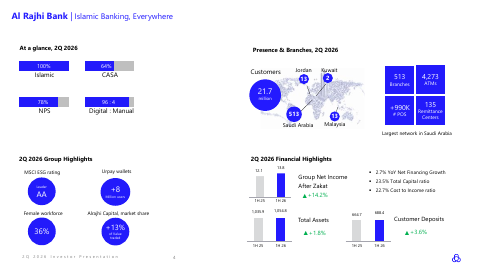
And now, if you allow me, let's take a closer look to our Q2 2026 performance. If we go to the Slide #3. In the last quarter, the bank delivered an excellent performance supported by the progress in our strategy execution and a healthy economy. This results in an outstanding semiannual net income of SAR 13.8 billion alongside with a healthy balance sheet growth.

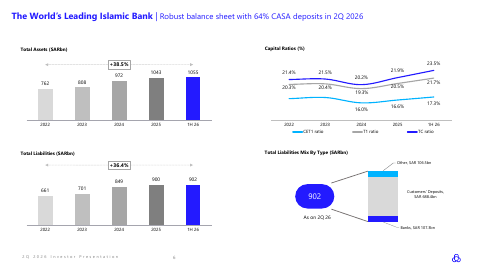
The balance sheet remains solid. The total assets reached now SAR 1,055 billion, higher 2% year-on-year and 1% year-to-date, while the total liabilities were flat at SAR 902 billion during the second quarter of 2026, with a healthy LDR 82.8%.

Moving to the profitability. Net income now reached SAR 13.8 billion, as I mentioned, for the first half of 2026, higher by 14% compared to the same period in 2025. The net yield income grew by 16%, while the

non-yield income increased by 7% year-on-year. As a result, the total operating income grew by 14%, reaching SAR 21.4 billion.

Regarding the credit quality, we continue to maintain a high asset quality with cost of risk of 39 bps. Additionally, NPLs also stand at 74 bps, supported by a coverage ratio of 153%. Moving into the key ratios. The bank maintained strong operating efficiency with a cost-to-income ratio stands at 22.7%.

Also, our total capital ratio reached 23.5%, well above the regulatory minimum, reflecting the bank's healthy financial position. Lastly, our net profit margin expanded to 3.5%, higher by 36 bps year-on-year, and that's driven by ongoing efforts to improve yield and optimize the cost of funds in the current rate environment.

If we move to Slide 4, we highlight the progress of our strategy execution. As you know, we are in the third and final year of our 2026 strategy “Harmonize the Group” and the bank has outperformed across all their KPIs.

Now allow me to walk you through the pillars of our strategy, starting with the first one, B2C business- to-consumer. Our focus on retail cross selling remains as a key goal. The product per customer ratio stands at 44%, higher by 6% since we introduced our strategy. Additionally, our sales from our target customer portfolio have witnessed a growth of above 400% since 2023, and that's backed by our efforts to expand our customer base across both existing and new segments.

Our universal offering and financial solutions have made us the bank of choice for approximately 22 million customers across the Kingdom. We also maintain high customer satisfaction, reflected in a leading net NPS of 78.

If we move now to the second pillar, B2B, business-to-business, our corporate portfolio continued to grow, reaching around SAR 285 billion, which is higher year-on-year by 13%. This growth was driven by our ongoing effort to expand wholesale lending and focus more on SME, which has grown massively by 47% year-on-year and now representing 24% of our non-retail book and 9% of our financing book.

Our focus on developing the investment banking business is a key part of our strategy to enhance non- yield income with revenue from investment banking activities grow by 328% since 2023. Looking at third pillar, Support Business, we continue to invest in technology and automation across the group to drive innovation and operational excellence.

As of the second quarter of this year, the percentage of process automated reached 66%, supporting our ambition of becoming a cloud-ready bank and increased scale and agility via cloud. We are so proud to share that the percentage of applications that are cloud-ready has officially now reached 100%. This milestone reinforces our commitment to achieving our strategic goals across all pillars.

On the Digital & Data side, the digital-to-manual ratio stands at 96% by end of second quarter 2026, highlighting solid progress in our digital transformation. In addition, AI and event-driven activities are gaining momentum in generating revenue through data-driven marketing, which increased by above 570% since 2023.

By that, if you allow me, I will hand over to Mr. Abdulrahman, our CFO, to provide more detailed update of our financial performance. Thank you.

Abdulrahman Al-Fadda (CFO)

Thank you, Waleed. Good day, ladies and gentlemen. It is my pleasure to welcome you again in our Q2 earnings call. I will try to go over the financial performance very quickly so that you can have further time during the Q&A session.

We start on our balance sheet. Our total balance sheet stands at SAR 1.06 trillion, almost 2% growth year-on-year and flat on a sequential basis. On a year-to-date basis, the growth in our total balance sheet stands at almost SAR 12 billion. The majority of that are coming from our financing book, and we'll cover that in further detail in the following slide.

As far as the funding side, the bank continue to diversify our funding profile. We've seen a healthy growth in our customer deposits, where we've grown by almost 3.2% year-to-date. Zooming further into the main drivers of our balance sheet, our total financing book stands at SAR 762 billion, 3% growth year-on-year and 1% on a sequential basis.

To further analyze the 1% growth in year-to-date growth in our financing book, as you can see on the top right-hand side of the chart, our retail book has contracted by almost SAR 4.8 billion, i.e., 1%, but that is a net basis. On a gross basis, the retail book has grown by SAR 3.2 billion, while we've securitized almost SAR 8 billion.

We've securitized over the last six months, almost SAR 3 billion of consumer loans and SAR 5 billion of our mortgage book. Corporate and SME shows a healthy growth of 2% and 16%, respectively. It's worth to highlight that our retail book stands at 63% of our financing book, mortgage at SAR 273 billion, which represents 57.2% of our retail book and almost 35.4% of our financing book.

Our total customer deposits stand at SAR 688 billion, almost 3.6% growth year-on-year and 1.4% on a sequential basis. CASA, as a percentage of the overall customer deposit, stands at 64.2%. To analyze the 3.2% growth in our customer deposits, as you can see on the bottom right-hand side of the chart, CASA have grown by SAR 10 billion year-to-date.

It's worth to highlight in the second quarter, you've seen some of the seasonal transitory CASA has left by almost SAR 17.5 billion. However, that has been compensated by almost SAR 12 billion growth in our customer time deposit year-to-date. Our investment book almost flat, SAR 175 billion as of Q2, whereby 87% of the book are Sukuk, 75% are fixed rate and finally, 83% of the book are within the Kingdom.

If we move to the profitability section. Our net income for the second quarter is above SAR 7 billion, which shows almost 14% growth year-on-year and 4% on a sequential basis. To analyze the 4% sequential movement, as you can see at the bottom left-hand side of the chart, we had a small dip of 1% on our NII, while that has been compensated by a healthy growth on our non-yield income.

Expenses were lower by almost 3%, which will bring the pre-provision profit to be 5.2% sequential growth. We top up our impairment charge by SAR 250 million in the second quarter. Our net income for the period stands at almost SAR 13.8 billion, 14% growth year-on-year and the driver, as you can see on the bottom right-hand side of the chart.

NII have grown by almost 16%, non-yield income by almost 7%, while OpEx has increased by 14.7%, which will bring the pre-provision profit to be 13.7% higher year-on-year, while impairment charge was higher by almost SAR 387 million compared to the same period last year.

To zoom in further into the net income driver, I'll start with the operating income. Our operating income for the second quarter were almost SAR 10.9 billion, 13% higher year-on-year and 3% higher on a sequential basis.

Our operating income for the period standing at SAR 21.4 billion, around 14% increase year-on-year and the driver, as you can see on the top right-hand side of the chart, NII were higher by 16%. The driver given our average earning assets has increased by 4%. That is coupled with 36 basis point expansion in our NIM.

On our fees, we had a very healthy growth of almost 17% year-on-year. This is despite some of the regulatory changes that happened in the second half of last year, coupled with some also further changes in the beginning of the year. And the driver of that growth are payments, trade, cash management and also a good contribution from investment banking and assets under management.

Exchange income was higher by 21% year-on-year. Other income was lower by 33% and the driver for that is lower mark-to-market -- sorry, higher negative mark-to-market for this year given that the credit spread as well as the interest rates were higher. Also, the lower capital gain. Nevertheless, Q2 other income showed a very healthy growth compared to Q1.

Our NIM stands at 3.5%. This is due to higher cost of funds, given that we've seen some of those transitory seasonal CASA have left, which increased the proportion of the paid time deposits, which had a negative impact on our cost of fund.

The 36 basis point NIM expansion year-on-year as you can see into the bottom right-hand side of the chart, attributed to 22 basis points on the gross yield. This is due to the management initiative to reprice the retail asset, coupled also on repricing of the corporate. Also, we had a further improvement of 14 basis points in our cost of fund year-to-year basis.

OpEx at SAR 2.4 billion for Q2, 11.7% higher year-on-year, nevertheless, were lower by almost 3% on a sequential basis. OpEx for the period were at almost SAR 4.8 billion, 14.7% higher year-on-year, mainly driven by the G&A, given that the bank continued to invest in executing Harmonize the Group strategy, coupled with a further investment to modernize our IT infrastructure.

Our cost-to-income ratio for the first half will stand at 22.7%, higher by 20 basis points compared to the same period last year. Nevertheless, cost-to-income ratio for the second quarter were 22%, which gives us a very good momentum to further improvement in the second half of this year. Impairment charge stood at SAR 880 million for the second quarter, almost 47% higher year-on-year. Cost of risk were at 39 basis points.

As you can see on the bottom left-hand side of the chart, we top up further our gross charge by SAR 658 million. It attributed to the following factors. Number one is updating our ECL model, taking into consideration that IMF revised the GDP growth for Saudi from 4.5% to 1.7%, coupled with a few names that are under stress, and we increased our coverage accordingly. However, that SAR 658 million increase in our gross charge have been negated by SAR 270 million improvement in our recovery.

On the bottom right-hand side of the chart, most of that top-up were happening on to the non-retail book. Our NPL for the second quarter stands at SAR 5.7 billion. No material change compared to Q1. In fact, it's around SAR 35 million and NPL ratio stands at 74 basis points, retail at 45 and finally, on the corporate side, around 1.23%. Finally, the NPL coverage stands at a healthy level of 153%.

Our ECL stock stands at around SAR 8.8 billion and the majority, as we mentioned earlier, were provided into the non-retail book. As you can see on the bottom left-hand side of the chart, Stage 1 exposure represents almost 96.8% of the overall financing, no material movement compared to the year-end, nor on a sequential basis.

Stage coverage still at the healthy level and no material change, Stage 1 at 38 basis points, Stage 2 at 11% and finally, Stage 3 at 54%. Although our headline LDR at 110.7%, nevertheless, the unweighted LDR by taking into consideration Sukuk and other syndicate loan, it will bring down the LDR to 95.5%.

Finally, relative LDR at 82.8%. LCR and NSFR at a comfortable level and above the regulatory requirement.

Moving on to the capital side. Our total RWA stand at SAR 679 billion, 2% higher year-on-year, mainly driven by 3.4% growth in our credit RWA. It's worth to highlight that our RWA density stands at a healthy level of 64.3%. Our capital ratio, CET1 at 17.3%, Tier 1 at 21.7% and finally, our total capital at 23.5%.

If you can see on the bottom right-hand side of the chart, we had 125 basis points improvement in our Tier 1 capital ratio. This is attributed to the 60 basis points due to the Sukuk issuance that we've done in the first half coupled with 190 basis points of internal capital generation. However, that negated by almost 123 basis points due to the balance sheet growth as well as the dividend distribution for the second half of 2025.

Return metrics are at the healthy level and above the industry standard. We've seen a further improvement on our RoRWA to stand at 4.07%. Our ROE for the first half were 23.3%. Q2 ROE were at 23.7%, ROA at 2.63%, while the Q2 ROA stands at 2.68%.

Before we move on to the guidance, we talked about the revision on the GDP forecast for this year. Nevertheless, the IMF has upgraded 2027 GDP growth to be 5.5%, mainly driven by non-oil GDP in line of the transformation agenda. Consumer spending is still at a healthy level, where we have seen the growth of almost 8.4% year-on-year.

On the rate outlook, our base case forecast is still no change to a one-rate hike in the second half, but we don't think that will have a material impact in the NIM for 2026. Mortgages rate still stand at almost 7.5%.

Having said that, we have updated our guidance for the financing book, previously, we were guided by low to mid-single digits. However, we take into consideration some of the securitization that we have done and potential, based on the opportunity for the second half, we have lowered our guidance to be in the low single digits.

Our cost of risk, we have updated our guidance to be 35 to 45 basis points, only 5 basis points higher compared to the previous guidance. Apart from that, no other changes into the guidance that we have communicated to you guys in the previous quarter. Waleed, back to you.

Waleed Al-Mogbel (CEO)

Thank you, Abdulrahman for the Financial highlights. We are so proud of our outstanding performance and the progress made across all the KPIs of our Harmonize the Group strategy. Now I will open the floor for Q&A. Operator, back to you.

Adam (Operator)

Thank you. We’ll now begin today’s Q&A session. So as a reminder, if you’d like to ask a question on today’s call, please use the raise hand icon at the bottom of your window and please state your affiliation before asking your question. Thank you. And our first question comes from Mohammed Al- Rasheed. Mohammed, please go ahead, unmute and ask your question.

Mohammed Al-Rasheed (Hassana)

Mohammed Al-Rasheed (Analyst, Hassana)

Thank you, gentlemen, for the presentation and congratulations. Strong set of results. I have two questions. My first question is regarding the sequential drop in the asset yield. What drove this? Was it due to change in mix given the securitization? Or was it driven by the repricing of the back book or the loans that were originated during 2023 and 2024 for the retail segment in particular?

And my second question is regarding the increase in the gross provisions. You mentioned that it's related to some corporate exposure that are witnessing some challenges. My question is, are these exposures related to some of the giga-projects that were reprioritized? And if so, has there been a significant change in their stage’s classification? Has it been moved from Stage 1 to Stage 2 or Stage 3?

Abdulrahman Al-Fadda (CFO)

I'll start with the last question. The names that we have topped up the provision in the second quarter, none of them are related to the giga projects. These are related to other sectors, and given the current situation, I would say that we are precautious, we have top up our provision to be precautious.

As far as the first question, Mohammed, on the sequential drop into the gross yield in the second quarter compared to Q1. In terms of the retail book, the back book still has been repricing nicely. We haven't lowered our pricing in the second quarter.

But again, and I think you need to take into consideration that probably the average SAIBOR in the first quarter were 4.85%. The average SAIBOR in the second quarter were 4.75%. That 10 basis points, to some extent, is impacting the corporate exposure. And we haven't seen any material change in mix that led to that drop into the gross yield.

Mohammed Al-Rasheed (Hassana)

Mohammed Al-Rasheed (Analyst, Hassana)

Thank you.

Adam (Operator)

The next question comes from Naresh Bilandani. Naresh, please go ahead, unmute and ask your

Naresh Bilandani (Jefferies)

Yes. Hi. Thank you very much. It's Naresh Bilandani from Jefferies. Thank you for the presentation. Two questions, please. First, it would be very helpful if you could kindly offer some insight into the muted credit growth that the bank has been reporting, which partially also seems to be led by the conscious strategy of the bank for NIM conservation. Will this continue into the next year? Or could we see some uplift in the credit growth?

I mean I realize that 2027 planning would still be further out, but just keen to get some visibility at this stage on how should we model the credit origination because it's important for us to sort of like have some visibility there for the valuation of the stock into the future years. So that's first.

And my second question is on the -- given the fact that the rate outlook now has turned more hawkish in the recent months, and we've also seen some pressure on the cost of funds in the second quarter, which unfortunately may not ease in the near term, given how the outlook is panning out, could you reconfirm if it's fair to think that the peak NIM for the franchise for the current cycle is behind us? Or do you have levers to deliver improvement on the NIM line going into the second half of this year? So, any insight on these two questions would be super helpful. Thanks a lot.

Abdulrahman Al-Fadda (CFO)

On the loan growth outlook, Naresh, our strategy has been consistent over the last couple of years. The management feedback is focusing on our value rather than our volume. We believe that the liquidity has a premium, and we want to make sure that liquidity premium is being reflected properly into the asset origination.

Overall, as we believe the current operating environment, although that we take positively that the growth in the customer deposits for the first half is outpaced the growth into the customer loan, nevertheless, we wanted to wait for a couple of quarters to see if that's going to be a sustainable trend.

Nevertheless, as a management, we will continue to look to diversify our funding profile vis-a-vis debt capital market issuance or tapping in different markets or different instruments, look at further

securitization to further improve the NIM over the medium term. From our perspective, we are agile. We assess the operating environment on a regular basis, and we will take a call.

Based on the current environment, low to mid-single digit, probably it might be intact. But this is something that we evaluate on a regular basis.

As far as the NIM, we acknowledge that probably there might be some inflationary pressure, which might lead the Fed to increase the rates. As we mentioned earlier before we highlight the guidance, we believe that there could be no change to probably one-rate hike that might have a negative impact into the NIM, given that our gearing to lower rate environment.

But overall, we will continue to look at improving the mix on the assets as well as the liability. Having said that, if you look at our gross yield for the Q2 last year, it used to be at 5.84%. During Q2 2025, the average SAIBOR was 5.41. This year, average SAIBOR for the second quarter were 4.75%.

So, we have almost 60 basis point drop into the SAIBOR. Nevertheless, with the management initiatives to reprice the retail as well as repricing our corporate, and changing the mix by increasing our SME, that have helped the gross yield to increase from 5.84% to almost 6.05%.

And if you recall, when we discussed about the NIM trajectory, year-on-year, NIM for the corporate book has increased by 4 basis points compared to 60 basis points drop into the SAIBOR. So long story short, are we probably think that could be the peak? we are trying our best to further improve the NIM over the medium term.

Naresh Bilandani (Jefferies)

Got it. Thank you very much for the insights Just one very small technical follow-up. Would you kindly be able to clarify what has been the level of securitizations that you've undertaken in the first quarter and the second quarter of this year?

Abdulrahman Al-Fadda (CFO)

In the first quarter, we've done close to SAR 1.5 billion. Second quarter, we've done the delta, close to around SAR 6.5 billion. So year-to-date, we've done SAR 8 billion of securitization versus the retail contraction of SAR 4.8 billion, which gives you an indication that the gross increase on our retail lending were SAR 3.2 billion.

Naresh Bilandani (Jefferies)

Excellent. Thank you so much for your insights.

Adam (Operator)

Now we return to the line of Shabbir Malik. Shabbir, please go ahead and unmute and ask your

Shabbir Malik (Morgan Stanley)

Thank you, my first question is around the tax rate, Zakat rate, which is a bit lower than what it has been historically. Just wanted to get a sense that for the full year, the effective tax rate is going to be 10% or thereabouts. That's my first question. Secondly, in terms of your OpEx, the trend this quarter seems to have moderated compared to the first quarter. So, if you can give some color on that?

And generally speaking, on jaws, is it -- is the 100 to 150 basis points positive jaws strategy still intact? And finally, on loan growth, you've trimmed the guidance for this year. This is primarily because of the approach of profitability over growth. Is that what's driving this downgrade? Thank you.

Abdulrahman Al-Fadda (CFO)

On the loan growth, the that management focus into value rather than volume, focusing on NIM, coupled with diversifying our funding profile by virtue of securitization. So, this is mainly because of those reasons.

As far as the OpEx, we haven't changed our strategy in terms of delivering a positive jaws. If you look into the cost-to-income ratio year-on-year were higher by 20 basis points. If you look at Q2 stand-alone, we are around 22% below the 22.7%, which is the cost to income for the first half.

We're not shying away from investing as long as that will help us to further improve the customer experience, improve the customer stickiness, which will have a positive impact into increasing our operating income. We haven't changed our focus.

As far as the tax rate, you're absolutely correct. The default tax rate in the Kingdom is close to 10.3% However, there is a lot of initiatives that we, as a management, have been taking. And this is what I believe from our perspective differentiate us, we are thinking outside the box, looking at an opportunity how we can maximize the shareholder value for our investors.

And there have been lots of initiatives that we have been taking that have reduced the effective tax rate for this year. However, the default, as I mentioned, is close to 10.31%, and we will look to assess for a better initiative to optimize our tax rate over the medium term.

Shabbir Malik (Morgan Stanley)

Got it. If I may, one more thing, one more question, please. In terms of capital, you seem to be in very good shape. Any comments on dividend or on the dividend philosophy? Is it going to be similar to what we saw in the second half of last year?

Waleed Al-Mogbel (CEO)

Yes. If you allow me, Abdulrahman, to answer this question. It's very clear, like what we did in last year, the management decision when it comes to dividend distribution is to weigh in between dividend distribution and preserving capital to support the growth. As far as for the first half of this year dividend, we are still evaluating, and we will recommend to our Board taking into consideration the current operating environment where we should announce the decision in due course.

Shabbir Malik (Morgan Stanley)

Thank you very much.

Adam (Operator)

The next question comes from Chiro Ghosh. Chiro, please go ahead and unmute.

Chiro Ghosh (SICO)

Chiro Ghosh (Analyst, SICO)

Hi. This is Chiro Ghosh from SICO Bahrain. So, the first question is related again to the fee income side of it. So, the fee income has been quite strong if we look at it in the context of that the loan growth was relatively muted. So, what were the prime drivers if you can again just highlight those points? So -- and more importantly, how sustainable would this be? So that's my first question.

And the second one, look, I get a sense that you might be also growing a little bit on the corporate side of the corporate loans, basically. So, your retail franchise is quite strong. So, in that context, I want to get a sense how would be the profitability that is risk-adjusted return, which you would be making on your corporate portfolio versus your retail portfolio. So, going ahead, would it have an impact on your ROEs? So that would be my two questions.

Abdulrahman Al-Fadda (CFO)

In terms of the first question related to the fee income growth. And again, I'm sure you've been watching us for quite some time, and we've mentioned that one of the main KPIs of our Harmonize the Group strategy is how we can increase the fee income contribution by focusing on the cross-sell, focusing in introducing new products and services, customer acquisition.

All of those factors have helped us to further improve the fee income. And we've delivered close to 17% fee income growth for the first half. Now, as far as the guidance, and we've been highlighting that the management is looking to grow the fee income more than the growth into our financing book. We've grown our fee income 17% year-on-year and the financing growth were higher by 3%.

As far as the second question related to the mix on the non-retail versus retail on the overall in terms of the profitability, whether that will have an impact into the ROE or not. We look at our corporate lending franchise on an overall 360. It's not only a balance sheet lending, we're looking also in terms of liquidity, we also look into the fee auxiliary business that come with that relationship, fees that is coming from trade, cash management, and investment banking activities. And if you recall my presentation when I mentioned that on the main driver of the fee income growth were coming from trade, cash management, investment banking activities. So overall, from that perspective, despite that probably the retail mix dipped compared to the same period last year. However, if you look at an ROE, we have improved the ROE year-on-year.

Chiro Ghosh (SICO)

Chiro Ghosh (Analyst, SICO)

Very clear. Thank you. Thank you very much.

Adam (Operator)

The next question comes from Mehmet Sevin. Mehmet, please go ahead and ask your question.

Mehmet Sevin (JPMorgan)

Mehmet Sevin (Analyst)

Hi. Good evening. Apologies. I hope you can hear me now. I have just two remaining questions and thank you for the presentation and taking the time. One on the cost of risk, as you highlighted earlier, thanks for the comments. I was wondering if you can give a little bit of more color on the exposures there specifically.

Was there any specific sector exposure given the ongoing situation? Or were there just corporates where you thought you would like to be prudent? And would you see a scenario where you need to increase the provisions on these loans going forward as well? Or with what we know today, do you feel comfortable on that front?

And the second question was on costs. Just looking at the seasonal impact in the fourth quarter of last year, there was a visible increase to end the year. I know things have eased a little bit and you don't tend to guide for costs. But I was wondering if you can maybe give color whether we should expect any seasonal impact this year towards the end of the year as well, similar to last year. Thank you.

Abdulrahman Al-Fadda (CFO)

Mehmet, let me try to clarify. The increase into the cost of risk for the first half, our cost of risk were 39 basis points. I've mentioned that the reason for the increase in the cost of risk were attributed to the following factors: A, updating our ECL model, taking into consideration the IMF revision to the Saudi GDP from 4.5% to 1.7%. That will have impact definitely on the ECL for our models. Second reason, there are, again, some of the sector that we believe that could be impacted due to the current situation. We have taken overlays to make sure that we are covered in the right, I would say, balance. As we speak, we are comfortable with the coverage as we speak. We will continue to assess the ongoing situation. And if there is any requirement that we need to take a further or reduce, we will take that accordingly. But as we speak, as of the closing of the second quarter, we are comfortable with the current provision that we have.

As far as the cost, we don't anticipate any further seasonality. Although that I don't provide any guidance into the OpEx, but I hope the guidance that I provide on the cost income ratio and on the ROE will help you to take a directional view how is the profitability move.

Mehmet Sevin (JPMorgan)

Mehmet Sevin (Analyst, JP Morgan)

Okay, that’s very helpful. Thanks very much.

Adam (Operator)

The next question comes from Karim Kekhia. Karim, please go ahead, unmute and ask your question.

Karim Kekhia (Arqaam Capital)

Thank you so much and congratulations on a strong first half. Two quick questions from my side. I want ask about the SAR 17.5 billion of CASA deposits that left in the second quarter, which I presume weighed on the margin. Have they to come back in July? And what should we assume for the CASA ratio and cost of funds for the second half? And I think you answered this question in Q1, if you want, but I just want to make sure. So, this is the last year of Harmonize the Group strategy. So, would you be issuing a new strategy next year? And would it come with new medium-term targets as well?

Waleed Al-Mogbel (CEO)

If you allow me, Abdulrahman, to answer the last question, please. In terms of strategy, as we mentioned before, yes, you're right, this is the last year of our strategy, and we are in the process of preparing our next 3-year strategy. Once we finish it, we will approve it by the Board by December. And then next year, we will present it to you guys in our usual meeting.

Karim Kekhia (Arqaam Capital)

Great. Thank you so much.

Abdulrahman Al-Fadda (CFO)

As far as the first question related to the CASA, one of the focus areas for the organization is to grow CASA despite that transitory/seasonal CASA has left. But if you look at the growth in our CASA for this year is almost SAR 10 billion. We will continue to focus in growing our CASA in order to manage our cost of fund efficiently.

Karim Kekhia (Arqaam Capital)

Thank you so much, Abdulrahman, and congratulations once again.

Adam (Operator)

The next question comes from Aybek Islamov. Aybek, please go ahead, unmute and ask your question.

Aybek Islamov (HSBC)

Aybek Islamov (Analyst, HSBC)

Yes, thank you very much for the conference call. I'd like to ask two questions, please, right? First one is what's really driving the decision to securitize more assets? I believe these are retail loans. And is this decision somehow connected to your delayed dividend announcement, right? So, you haven't announced your first half dividend.

So, these two questions. And I think the third one is on asset quality. Given the slowdown in loan growth you anticipate and assuming things don't change materially in 2027, how confident are you can keep your cost of risk below, let's say, 40 basis points, right, over the next 12 to 18 months?

Abdulrahman Al-Fadda (CFO)

Our CEO, have highlighted or elaborated further into the dividend discussion. As far as the securitization, I think you've been participating in our earnings calls over the last -- since I became a CFO. When we started the securitization journey back in 2022, we've been highlighting that if you look at our capital ratio, if you look at our liquidity ratio, we don't need to do any fire sale.

And when we wanted to do a securitization, it has to make sense for our balance sheet structure as well as from a liquidity and a capital perspective. But given that the operating environment since 2022 has changed in terms of the liquidity start having a premium, we've looked into securitization as avenue of our funding profile.

And for us as a management, the way that we look at securitization, as long as the new origination rate is higher than the securitized book, that's a NIM accretive over time. None of the securitizations that we have done over the last 3 to 4 years have a negative trend on the NIM. In fact, they have a positive.

We've done a securitization in the early part of the Q2 and look at where are the rates now. If you look at the 10 years treasuries, I've seen it at 4.62% compared to where it used to be. I think our range was 4.25%, 4.30%, and we're expecting a mortgage origination to be higher. And this is what we monitor on a regular basis.

We monitor the new origination rate minus the securitized book. And what I can assure you, it is NIM- accretive, which should help improve the NIM and the profitability over the medium term rather than increasing the leverage and start paying expensive into raising deposits to manage the funding profile.

Second question related to the asset quality. As we speak, we are comfortable with the guidance that we have provided. You said whether it's below 40. And again, the guidance that we believe it is around 35 to 45 basis points. As we speak, we don't see any material risk to change our guidance over the remaining of the year.

Aybek Islamov (HSBC)

Aybek Islamov (Analyst, HSBC)

Thank you.

Adam (Operator)

The next question comes from Edmund Christou. Edmund, please go ahead, unmute and ask your

Edmund Christou (Analyst)

Thanks for the call and the insight. Just two questions. The first one on the margin. So, I will start with this one. Just want to understand -- I understand the bank is geared towards lower interest rate in terms of outperforming peer than higher interest rate. But you are doing repricing of the books and clearly partially has offset the decline in the SAIBOR. So, this is good news.

You are securitizing loans and freeing liquidity, so you are able to grow into -- or you are growing already into the corporate, which is float. So, you will capture higher rates with the Fed increase. So, I just want to understand from you, do you see upside in the asset yield or more or less flattish asset yield going into next year and next year 2027?

And for the same question is the same concept on the cost of funding. Your cost of funding has been increasing given the market situation. However, we've seen an optimization happening with the banks where they are optimizing their wholesale funding because domestic time deposit could be cheaper.

And you do have a large wholesale funding and reliance on dollar funding. Do you see optimization that could help you on the cost of funding despite CASA coming down, your cost of funding will improve. So that could be a positive story for the margin. So, this is on the margin side. Should I ask the second question or wait for you to answer the first?

Abdulrahman Al-Fadda (CFO)

I will try to answer because it was a very long question. Nevertheless, I'll try to be brief. Yes, there is still an opportunity to further improve our asset yields if the rates start going higher. And if you look at an earlier example, we've seen asset yields have increased by almost 20 basis points year-on-year despite SAIBOR were dropping from 5.40 to 4.75, i.e., talking about 60 basis points.

We -- as a management, we will continue to reprice, we'll continue. But I doubt that we'll have that close given that we have a very large financing book, SAR 672 billion. I don't think it's going to be similar to what we've done, but we will continue. As far as funding, answer is yes, there could be a further optimization, and we are working very closely with our colleagues in the treasury, corporate and retail, looking at an opportunity to optimize. Second question, please?

Edmund Christou (Analyst)

Second question on the overlay. Usually overlay when it happened, it improved the Stage 1 and maybe Stage 2. And I can see that you have taken overlay, which has improved slightly the Stage 1 to 38 from 37 basis points. and improved the Stage 2 to 11% from 10.6%. So, it doesn't seem to me a significant overlay has been taken here.

So, if you are not able to tell me how much that overlay is, is it -- do you agree with me it's not significant? And if it's not significant, do you expect some top-up if we see some pressure happening in petrochemical or other sector that could be impacted? Thank you.

Abdulrahman Al-Fadda (CFO)

I disagree that it is not material in your perspective. And I agree with you that I will not be able to disclose because you are not taking into consideration if there is any stage -- if there is a one name moved from a stage to another stage and you write off that exposure, that is not in your calculation.

Edmund Christou (Analyst)

Okay. Yes, true. Sounds good. Thank you. Good luck. Thank you.

Adam (Operator)

This will conclude today's Q&A session. So, I'll now hand the call back to MD and CEO, Mr. Waleed Al- Mogbel, for closing remarks.

Waleed Al-Mogbel (CEO)

Thank you, everyone, for dialing in and for your trust in us. We are very proud of our first half of 2026 results, and we will continue to achieve our strategic goals this year and beyond. We look forward to meeting you in the next quarter earnings call. Thank you.

Adam (Operator)

This concludes today's call. Thank you very much for your attendance. You may now disconnect your lines.