0:25:08 · Glen Shore, Evercore ISI · NII outlook
What does the full-year outlook imply for fourth-quarter net interest income given an asset-sensitive balance sheet?
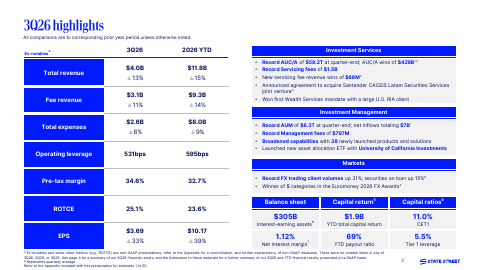
Management expects net interest income to grow sequentially again in the fourth quarter, likely toward the upper end of the range delivered so far. — John Woods
0:27:05 · Glen Shore, Evercore ISI · Wealth services
Why re-enter RIA custody in a competitive market, and does it explain the lower payout ratio?
Wealth management is shifting toward customization and new distribution channels, and the first win validates the strategy, while payout approaching 80% still follows organic investment and the dividend. — Ron O'Hanley, John Woods
0:32:13 · Alice Floskin, Goldman Sachs · Servicing sales
Why are servicing sales running below the level discussed in the past, and what is the organic growth outlook?
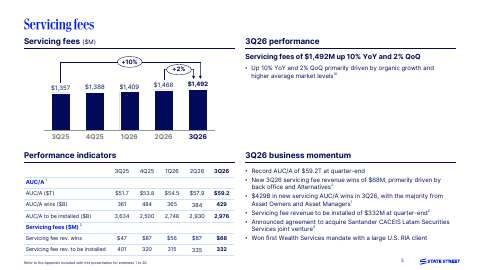
Management expects a back-end-loaded fourth quarter, a fourth straight year above $300 million in sales, and mid single digit servicing fee growth over the medium term even without market gains. — Ron O'Hanley, John Woods
0:35:25 · Alice Floskin, Goldman Sachs · Capital sensitivity
How sensitive is capital to higher rates, and could it affect buybacks?
A 25 basis point rate rise would unmitigated cost roughly 10 basis points of capital, but management has levers and still plans the buyback ramp. — John Woods
0:37:42 · Abraham Poonawalla, Bank of America · NII drivers
How should asset repricing, deposit growth and deposit mix affect net interest income over the next 12 to 18 months?
Securities turnover and rate hikes are tailwinds, non-interest-bearing deposits should stay near 10% of the mix, and management will manage deposit betas. — John Woods
0:40:43 · Abraham Poonawalla, Bank of America · Digital assets
Does the shift to digital assets and tokenization threaten medium-term revenue or margins?
Management sees traditional and digital finance coexisting for a long period, expects State Street to provide the on-ramp and off-ramp, and does not plan for medium-term revenue loss. — Ron O'Hanley
0:42:45 · Mike Mayo, Wells Fargo · FX trading
Why did FX trading revenue fall 14% sequentially, and will it rebound?
Second-quarter volatility was exceptionally high, especially in Asia-Pacific, so moderation was expected, and management expects fourth-quarter growth from the third quarter. — John Woods, Ron O'Hanley
0:44:57 · Mike Mayo, Wells Fargo · Servicing wins
What is the 2026 servicing wins target, and how does it reconcile with strong organic growth?
About $200 million of wins year to date and more than $100 million expected in the fourth quarter, with organic servicing fee growth of 7% supported by flows and client activity. — John Woods
0:47:12 · Kenneth Houston, Autonomous · Deposits
Is the fourth quarter on track to average the deposit level needed for the full-year outlook?
Management expects fourth-quarter average deposits of $275 billion to $280 billion, putting the year very slightly below $270 billion. — John Woods
0:47:47 · Kenneth Houston, Autonomous · Net interest margin
How much sequential benefit will terminated swaps provide for net interest margin?
About a basis point of benefit from terminated hedges, plus some rate benefit from Fed and ECB moves in the third quarter. — John Woods
0:48:59 · Kenneth Houston, Autonomous · Fee revenue
Did anything go wrong in servicing fee capture or other fee revenue that might reverse?
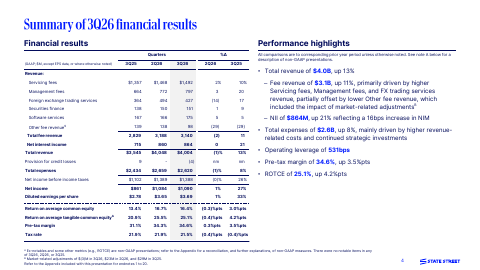
The other fee decline reflects year-ago gains and late-quarter mark-to-market items, with stability expected there and growth expected in servicing, management fees and FX trading. — John Woods
0:50:35 · David Smith, True Security · Buybacks
Is a fourth-quarter buyback near $650 million the lower bound for approaching 80% payout?
Fourth-quarter buybacks should be north of that figure, probably closer to $700 million, plus or minus. — John Woods
0:51:11 · David Smith, True Security · Medium-term targets
Are there real headwinds that would stop steady progress beyond the medium-term targets?
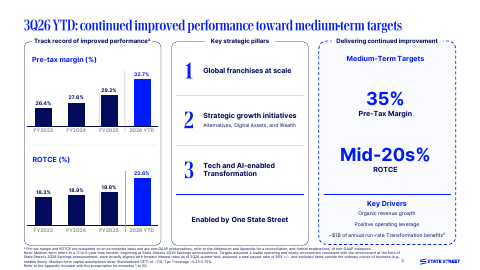
Management says the raised outlook lifts the implied baseline toward 33% pre-tax margin and wants to deliver on a full-year basis and ensure sustainability before considering future improvement. — John Woods
0:54:00 · Manan Gosalia, Morgan Stanley · Deposit mix
Why did average non-interest-bearing deposits fall, and how will they behave as rates rise?
Early-year surges moderated and the share is down slightly but still around 10%, which management sees as a good planning assumption. — John Woods
0:55:19 · Manan Gosalia, Morgan Stanley · Liquidity rules
Would proposed liquidity rules giving credit for discount window collateral change balance sheet mix?
Management expects little impact, citing an extremely liquid balance sheet, and will review the proposal when it arrives. — John Woods
0:57:28 · Brennan Hawken, BMO Capital Markets · Loans
Why did loan growth slow, and what is the outlook?
Less relationship-driven loan books are running off, while subscription finance, AAA CLOs and fund finance should grow, with growth resuming around 2027. — John Woods
0:59:33 · Scott Seavers, TD Cowen · Fee momentum
How did third-quarter fee income compare with expectations and what is the momentum going forward?
Late-September mark-to-market adjustments hit other fees, fees would have grown about 12% without them, and growth is expected in servicing, management fees and FX trading in the fourth quarter. — John Woods, Ron O'Hanley
1:02:26 · Gerard Cassidy, RBC · NIM repricing
How much of the margin gain came from securities repricing, and what happens if rates rise further?
About five basis points of the 16 basis point gain came from securities turnover, and a 25 basis point hike is worth about one basis point in the euro area and half a basis point for the Fed. — John Woods
1:05:34 · Gerard Cassidy, RBC · Deposit growth
How much of the deposit growth comes from new business versus market conditions?
Most comes from new custody business, with market conditions, client cash behavior and money supply growth as additional drivers. — Ron O'Hanley, John Woods
1:08:12 · Ben Gerlinger, Citi · Expenses
Is higher expense growth mostly revenue-related, or are 2027 investments being pulled forward?
Five of the eight points of expense growth were revenue-related, with the remaining roughly three points reflecting strategic investment net of productivity. — John Woods
1:09:18 · Ben Gerlinger, Citi · Strategic investment
Does that mean near-term investment spending could be lower because it was pulled forward?
Management said it sees an exciting portfolio of strategic opportunities and, as productivity ramps, can keep growing strategic investment while maintaining its margin trajectory. — John Woods