Transcript · Joseph Dickerson, Jefferies · Capital and deposits
Is a 300-400bps CET1 buffer over MDA still the right target, and why have CASA mixes fallen in CIB and WRB?
Management will operate across the 13-14% CET1 range, not manage to an MDA buffer, and will update at full year; CASA mix reflects term-deposit competition and the FCNR inflows, with CIB outflows partly reversing. — Bill Winters, Manus Costello
Transcript · Jason Napier, UBS · Costs and NII
What is the cost trajectory into 2027 and how will NII contribute to 2027 income growth?
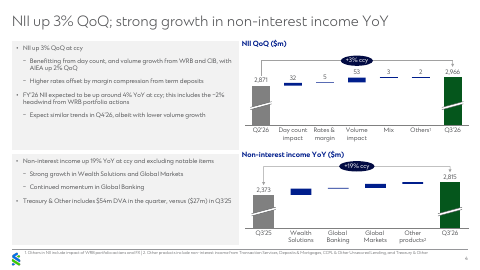
Management committed only to positive jaws each year and continued investment, and will give 2027 NII and rate guidance in February. — Bill Winters, Manus Costello
Transcript · Perlie Mong, Bank of America · NII and deposits
Why should volume growth not drive more NII in Q4, and where is deposit competition strongest?
Competition is mainly in Hong Kong and Singapore and is baked into guidance, while loan growth is expected to moderate after a strong Q3. — Manus Costello, Bill Winters
Transcript · Perlie Mong, Bank of America · Loan-to-deposit ratio
Are you happy to keep lending growing ahead of deposits?
Management says the loan-to-deposit ratio is an output and it will deploy liquidity only where returns are right. — Manus Costello
Transcript · Guy Stebbings, BNP Paribas · RoTE and credit
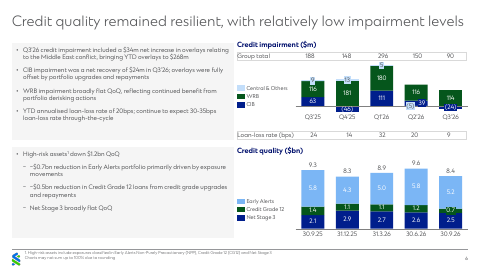
Is there anything to caution on RoTE into 2027, and might the through-the-cycle loan-loss assumption be revisited?
Caution comes from macro uncertainty, and management says revisiting the 30-35bps loan-loss assumption is premature. — Bill Winters, Manus Costello
Transcript · Ed Firth, KBW · Costs
Where is the higher implied cost guidance going, and does Q4 step off into 2027?
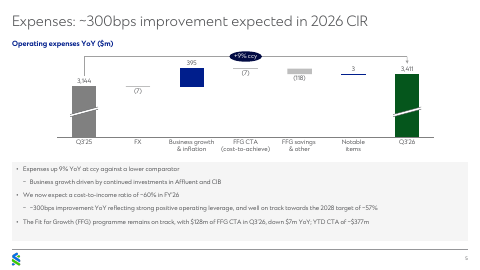
The cost-to-income guidance is unchanged from Q2 and funds relationship managers, wealth centres and platform investment. — Manus Costello
Transcript · Ed Firth, KBW · Q4 trends
How is Q4 revenue shaping up so far?
Q4 is shaping up fine, with underlying trends in wealth, markets and banking unchanged apart from normal seasonality. — Bill Winters
Transcript · Nick Lord, Morgan Stanley · Wealth and unsecured
What drove the move from AUM to AUC, how are wealth clients behaving, and why is unsecured lending falling?
AUM-to-AUC shifts are routine, clients are drifting toward lower-risk products, and unsecured lending is falling because of portfolio exits. — Bill Winters, Manus Costello
Transcript · Nick Lord, Morgan Stanley · Wealth margins
Do lower-risk products carry different margins?
Margins differ mainly by liquidity, but the shift is gradual so wealth income has held up. — Bill Winters
Transcript · Kendra Yan, CIBC · 2030 target
What macro assumptions underpin the 2030 RoTE target, and which products are winning market share?
Structural trends in wealth and fragmentation support the target absent a major disruption, and markets share gains come from better products and deeper client relationships. — Bill Winters, Manus Costello
Transcript · James Invine, Rothschild & Co Redburn · Flow income and tax
Where is flow income growing geographically, and what is the tax rate outlook?
Flow growth is broad-based with strength in China and emerging markets, and the 2026 tax rate guidance is around 26%. — Bill Winters, Manus Costello
Transcript · Alastair Warr, Autonomous Research · Wealth jaws
Can wealth keep contributing to operating leverage toward the 57% cost-income target?
Yes, as relationship manager productivity and new wealth centres mature, and AI should add quality and efficiency. — Manus Costello, Bill Winters
Transcript · Robert Noble, Deutsche Bank · 2028 cost target
Under what scenario would the 2028 cost-income ratio go below 57%?
The 57% target is part of a package with income growth, loan losses and RoTE, so it depends on revenue outcomes. — Manus Costello
Transcript · Aman Rakkar, Barclays · Reinvestment and NII
How are revenue windfalls split between reinvestment and profit, and what are the 2027 NII moving parts?
Rate-driven outperformance would drop to the bottom line, and 2027 NII guidance will come in February. — Bill Winters, Manus Costello
Transcript · Katherine Lei, J.P. Morgan · Portfolio and wealth yield
How is the FVOCI bond portfolio managed, are you targeting a lower loan-to-deposit ratio, and how should Q4 return on AUM be modelled?
The FVOCI book is short tenor with a 9bps CET1 impact, the loan-to-deposit ratio is an output, and Q4 return on AUM is seasonally lower. — Manus Costello
Transcript · Katherine Lei, J.P. Morgan · Wealth yield
Should Q4 2025 be the benchmark for Q4 2026 return on AUM?
No, use the full-year run rate, as Q4 is always seasonally lower and the strong first half ran above the long-term range. — Manus Costello