
Spotify (SPOT) · Media & Streaming
Spotify Q2 2026 earnings: summary, key numbers & outlook
Results filed 4 Aug 2026 · Quarter ended 30 Jun 2026
Slides (35 pages)Press release ↗Investor relations ↗
Summaries and transcripts are machine-generated and can contain errors.
In brief
Spotify reached 300 million Premium subscribers while expanding AI-powered listening, concert-ticket access and audiobook tiers across its platform.
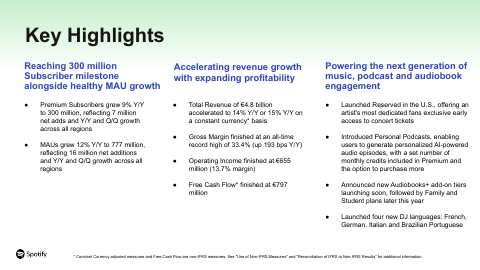
Spotify's Premium base grew 9% year on year to 300 million, helped by strong promotional intake and a 20th-anniversary in-app experience that nearly 100 million users engaged with in its first six days. Product launches spanned music, podcasts and audiobooks: Reserved (early concert-ticket access) in the U.S., Personal Podcasts with AI-generated episodes, Narrated Articles, and DJ in four new languages. Ad-Supported revenue grew only modestly, with automated channels the largest contributor.
Management is steering toward more personalized, AI-driven audio and higher-priced tiers, including Audiobooks+ add-ons, then Family and Student plans later this year. The company is also investing temporarily in marketing and cloud/AI spend. The tension is that this reinvestment and the push into new formats must keep converting free users to paid while advertising pricing remains soft and subscriber additions are guided to slow in Q3.
No call transcript for this quarter, so this summary also draws on: The Motley Fool ↗, PPC Land ↗.
Slides & documents
Open the slide deck (PDF, 35 pages) ↗


Showing the first 6 of 35 pages.
From Spotify investor relations
- Prepared RemarksCFO commentary ↗
- Earnings WebcastWebcast replay ↗
- Financial StatementsFinancial tables ↗
SEC filing
Key numbers
- Revenue · GAAP
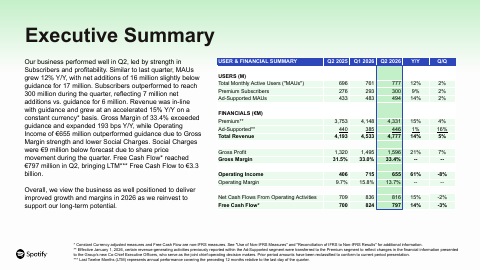
- 4.8B
- Net income · GAAP
- 545.0M
- Diluted EPS · GAAP
- 2.61
- Free cash flow · non-GAAP
- €797 million
up 14% from a year ago
vs. a net loss of 86 a year ago
vs. (0.42) a year ago
up 14% from a year ago
| Segment or metric | Value | Change |
|---|---|---|
| Premium revenue | €4,331 million | up 15% from a year ago |
| Premium ARPU | €4.89 | up 7% from a year ago |
Where each number comes from
- Revenue: “Revenue 4,777 4,533 4,193 Cost of revenue 3,181 3,038 2,873 Gross profit 1,596 1,495 1,320 Research and development 403 331 415”
- Net income: “Net income/(loss) attributable to owners of the parent 545 721 (86) Earnings/(loss) per share attributable to owners of the parent”
- Diluted EPS: “Earnings/(loss) per share attributable to owners of the parent Basic 2.65 3.50 (0.42) Diluted 2.61 3.45 (0.42) Weighted-average ordinary shares outstanding”
- Free cash flow: “Free Cash Flow* was €797 million in Q2, a record high Q2 as a result of higher Net Income adjusted for non-cash items”
- Premium revenue: “Premium Revenue* grew 15% Y/Y to €4,331 million (or 16% Y/Y constant currency**), reflecting 9% Y/Y Subscriber growth”
- Premium ARPU: “Premium Average Revenue per User (ARPU) of €4.89, up 7% Y/Y (or 7.4% Y/Y constant currency**)”
Copied from the press release ↗ and other documents in the SEC filing ↗. A figure is published only if its sentence is in those documents.
Outlook
| Metric | Period | Outlook |
|---|---|---|
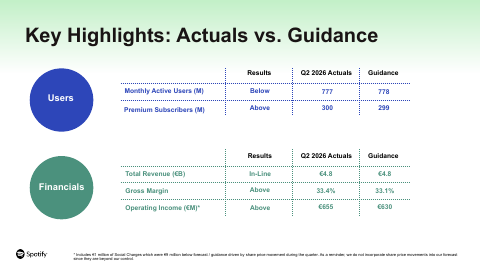
| Total MAUs | Q3 2026 | 788 million |
| Total Premium Subscribers | Q3 2026 | 305 million |
| Gross margin | Q3 2026 | 32.9% |
| Operating income | Q3 2026 | €670 million |
Key takeaways
Spotify hit 300 million Premium subscribers
Subscribers grew 9% year on year, with 7 million net additions and growth in every region. Strong global promotional campaign intake contributed, and Spotify's biggest single day of subscriber intake ever followed the 20th-anniversary experience.
AI audio products expanded across formats
Personal Podcasts lets Premium users generate personalized AI-powered episodes using monthly credits, with more available for purchase. DJ added French, German, Italian and Brazilian Portuguese and now reaches nearly 100 million Premium users.
Reserved links superfans to concert tickets
Launched in the U.S., it gives an artist's most dedicated fans early ticket access, and nearly 100,000 tickets have been reserved since the Live Nation launch. It extends Spotify from listening into live-event fandom.
Audiobooks+ tiers and Family plans widen packaging
New higher-hour Audiobooks+ add-on tiers launch soon, followed by Audiobooks+ Family and Student plans later this year. Narrated Articles from publishers like Rolling Stone and The Atlantic are included in the monthly audiobook allowance.
Advertising shifts toward automated sales channels
Ad-Supported revenue grew 1% year on year, with music impressions sold up but pricing soft. Automated channels were the largest contributor to ad growth and, per the research, represented nearly 40% of ad-supported revenue.
Questions
What were Spotify's main product launches in Q2 2026?
Spotify launched Reserved in the U.S., Personal Podcasts, Narrated Articles and Studio by Spotify Labs, and expanded DJ to four new languages. It also announced Audiobooks+ add-on tiers and extended Prompted Playlist to audiobooks.
How is Spotify using AI in its products?
AI features include DJ, which has reached nearly 100 million Premium users, and Personal Podcasts, which generates personalized audio episodes with monthly credits included in Premium. Spotify also says it launched plug-ins and MCPs for Claude, ChatGPT and Gemini.
What is Spotify doing with audiobooks and pricing packages?
New Audiobooks+ add-on tiers with more listening hours launch soon, and Family and Student versions follow later this year. Premium ARPU growth was driven by price increases, partly offset by product and market mix.
How is Spotify's advertising business changing?
Ad-Supported revenue grew 1%, with music growth from more impressions sold offset by softer pricing, and podcast growth led by sponsorships in Owned & Licensed content. Automated sales channels were the largest growth contributor.
What is Spotify's outlook for user growth next quarter?
Spotify guides to 788 million MAUs and 305 million Premium subscribers in Q3, implying about 11 million and 5 million net additions. Management says it is reinvesting in marketing and cloud/AI spend to support long-term growth.