
Singtel (Z74) · Telecom
Singtel H1 FY2027 earnings: summary, key numbers & outlook
Results filed 13 Nov 2026 · Quarter ended 30 Sep 2026
Slides (21 pages)Press release ↗Investor relations ↗
Summaries and transcripts are machine-generated and can contain errors.
In brief
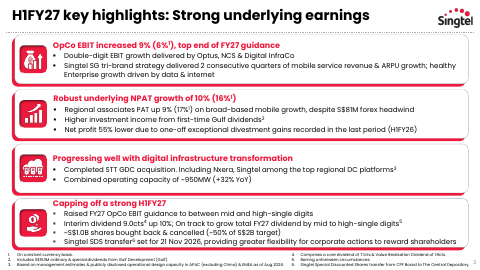
Singtel completed the STT GDC acquisition with KKR, creating a data centre platform of about 950MW operating capacity, while its sovereign AI cloud RE:AI scales on fully contracted demand.
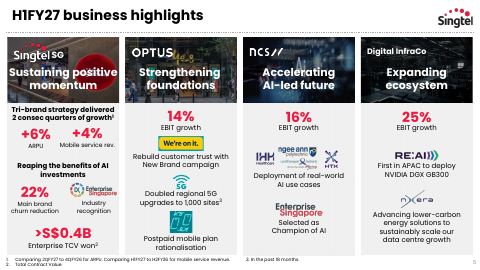
Singtel closed its STT GDC deal in August, combining it with Nxera for roughly 950MW of operating capacity. Singapore data centre capacity is fully contracted, and RE:AI became the first in APAC to deploy NVIDIA DGX GB300. NCS booked S$1.6 billion of work, with growing demand for AI and digital resilience. Optus raised mobile prices and simplified its plans, while Singtel Singapore's tri-brand mobile strategy produced two straight quarters of growth.
Management wants to shift the group toward digital infrastructure and AI services, which now make up about 18% of EBITDA, while keeping consumer mobile steady. The main tension is that data centre and AI capacity requires heavy capital, tied to new data centre rules in several countries, while Singapore mobile faces intense price competition and Optus lost mobile customers (235,000) as it prioritises rebuilding trust and service quality.
No call transcript for this quarter, so this summary also draws on: Light Reading ↗, Longbridge (Business Times syndication) ↗.
Slides & documents
Open the slide deck (PDF, 21 pages) ↗
Showing the first 6 of 21 pages.
Results documents
Key numbers
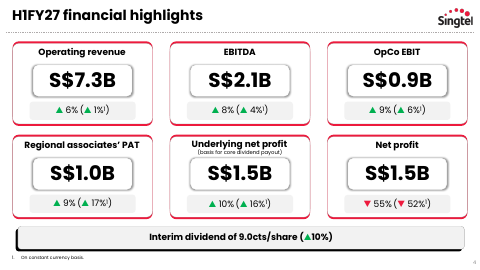
- Operating revenue · GAAP
- S$7.29 billion
- OpCo EBIT · non-GAAP
- S$0.90 billion
- Net profit · GAAP
- S$1.54 billion
- Underlying net profit · non-GAAP
- S$1.49 billion
- Diluted EPS · GAAP
- 9.41¢
- Free cash flow · non-GAAP
- S$2.25 billion
- Net cash from operating activities · GAAP
- 3.4B
up 6% from a year ago
up 9% from a year ago
down 55% from a year ago
up 10% from a year ago
from 20.44¢ a year ago
up 56% from a year ago
from 2,724.1 a year ago
| Segment or metric | Value | Change |
|---|---|---|
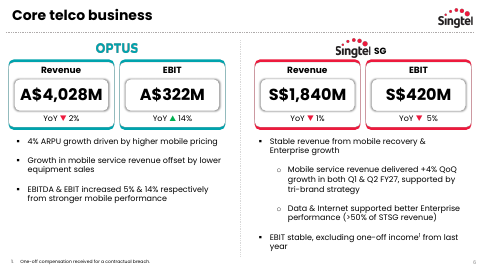
| Optus mobile service revenue | 2.9% | blended mobile ARPU up 3.9% |
| Singtel Singapore mobile service revenue (sequential quarter) | 4% | second consecutive quarter of growth |
| NCS bookings | S$1.6 billion | NCS revenue up 10% |
| Digital InfraCo revenue | 22% | EBIT up 25% |
| Combined data centre operating capacity (STT GDC and Nxera) | 950MW | |
| Regional associates' post-tax profit | S$0.99 billion | up 9% |
Where each number comes from
- Operating revenue: “Operating revenue rose 6% to S$7.29 billion while EBITDA and OpCo EBIT increased 8% and 9% to S$2.15 billion and S$0.90 billion respectively”
- OpCo EBIT: “Operating revenue rose 6% to S$7.29 billion while EBITDA and OpCo EBIT increased 8% and 9% to S$2.15 billion and S$0.90 billion respectively”
- Net profit: “Net profit was 55% lower at S$1.54 billion mainly due to S$2.21 billion in net exceptional gains from the partial stake sale in Airtel”
- Underlying net profit: “Singtel Group’s underlying net profit grew 10% to S$1.49 billion for the first half of the year with higher EBIT contributions from NCS”
- Diluted EPS: “Earnings per share attributable to shareholders of the Company - basic 10 9.43¢ 20.62¢ - diluted 10 9.41¢ 20.44¢”
- Free cash flow: “Free cash flow grew 56% to S$2.25 billion. The increase was mainly due to higher operating cash flow resulting from improved operational performance”
- Net cash from operating activities: “Dividends received from associates and joint ventures 1,774.1 1,139.7 Income tax and withholding tax paid (244.0) (211.0) Net cash generated from operating activities 3,376.3 2,724.1”
- Optus mobile service revenue: “Mobile service revenue increased 2.9%, while blended Mobile ARPU increased 3.9%.”
- Singtel Singapore mobile service revenue (sequential quarter): “Singtel Singapore’s mobile service revenue grew for the second consecutive quarter, up 4%, supported by the progress of its tri-brand strategy”
- NCS bookings: “NCS’ revenue grew 10%, led by the homeland security business under its Strategic Growth portfolio. Coupled with higher delivery margins, EBIT grew 16%. Bookings remained healthy at S$1.6 billion”
- Digital InfraCo revenue: “Digital InfraCo’s revenue and EBIT increased 22% and 25% respectively on the back of Nxera and RE:AI’s continued growth momentum.”
- Combined data centre operating capacity (STT GDC and Nxera): “becoming one of the region’s top data centre platforms with a combined 950MW of operating capacity between STT GDC and Nxera”
- Regional associates' post-tax profit: “The regional associates’ post-tax profit contributions increased 9% to S$0.99 billion due to broad- based mobile growth.”
Copied from the press release ↗ and other documents in the company's results page ↗. A figure is published only if its sentence is in those documents.
Outlook
| Metric | Period | Outlook |
|---|---|---|
| Capex (Core S$1.8B, Growth S$1.2B), likely lower than current guidance | FY27 | S$3.0B |
Key takeaways
STT GDC deal makes Singtel a top regional data centre player
Completed in August with KKR, the deal gives Singtel about 25% of STT GDC and, with Nxera, combined operating capacity of about 950MW. Contracted capacity across the two is about 1.2GW.
RE:AI sovereign cloud is scaling on contracted demand
RE:AI was first in APAC to deploy NVIDIA DGX GB300 and launched Token-as-a-Service and expanded Model-as-a-Service offerings. About 4MW began contributing in September, and 6MW by year-end is fully contracted for the next three to five years.
Singtel Singapore mobile stabilises under tri-brand strategy
Mobile service revenue grew sequentially in both quarters across Singtel, Gomo and Hi!, even as roaming fell on bundling and travel eSIMs. Enterprise, over 50% of revenue, offsets consumer price competition.
Optus trades customer count for pricing and simplicity
Optus raised postpaid prices, cut consumer postpaid plans from 511 to 239 and brought 137 stores in-house. The mobile base fell by 235,000, mainly from a lost wholesale postpaid contract and fewer connected devices.
New data centre regulation shapes Nxera's expansion
Singapore's Digital Infrastructure Bill, Malaysia's 30% renewable requirement and Thailand's new oversight policy add requirements. Management says existing projects are not expected to be affected, and DC Tuas is designed for 1.25 PUE.
Questions
What did Singtel complete in data centres this quarter?
It completed the STT GDC acquisition with KKR on 31 August 2026, taking an effective stake of about 25%. Together with Nxera, Singtel has about 950MW of operating capacity.
How is demand for Singtel's AI cloud RE:AI?
Capacity is deployed only against customer demand: about 4MW started contributing in September and 6MW by year-end is fully contracted for three to five years. It was first in APAC to deploy NVIDIA DGX GB300.
Is Singtel's Singapore consumer mobile business recovering?
Mobile service revenue grew for a second consecutive quarter, helped by the Singtel, Gomo and Hi! tri-brand strategy. Over the half year it was still down 1.6% on intense price competition and lower roaming.
What is Optus doing to improve its business?
It is simplifying plans, bringing network operations and incident management back to Australia, and moving to company-owned stores. It also hit 1,000 upgraded regional 5G sites, with over 1,500 planned by end of 2028.
What risks does Singtel's data centre expansion face?
New energy efficiency, renewable and oversight rules in Singapore, Malaysia and Thailand add requirements, though management says current projects should not be affected. Pipeline capacity is uncommitted until demand is secured.