
Singapore Airlines (C6L) · Transportation
Singapore Airlines Q1 FY2027 earnings: summary, key numbers & outlook
Results filed 28 Jul 2026 · Quarter ended 30 Jun 2026
Slides (20 pages)Press release ↗Investor relations ↗
Summaries and transcripts are machine-generated and can contain errors.
In brief
Singapore Airlines Group pushed ahead with network expansion and joint-venture partnerships, including Air China and Malaysia Airlines, while a Middle East conflict forced route suspensions and deferrals.
Demand stayed strong: the Group carried a record 10.9 million passengers and passenger yields rose 12.0%. Cargo yields rose 28.1% on resilient demand, with semiconductor and data centre-related movements providing support. SIA started daily Hangzhou flights and Scoot opened Belitung and Pontianak, while fares and cargo rates were raised to offset costs.
Management plans to keep adding capacity in Europe and Australia, unveil a new in-flight product later in 2026, and bring in Starlink broadband from 2027. It is also deepening partnerships with Air India, Malaysia Airlines and Air China. The main tension is jet fuel: price increases do not fully offset it, and the Middle East conflict is suspending routes and adding uncertainty.
No call transcript for this quarter, so this summary also draws on: Asian Aviation ↗, Travel Weekly ↗, 100 Knots ↗.
Slides & documents
Open the slide deck (PDF, 20 pages) ↗

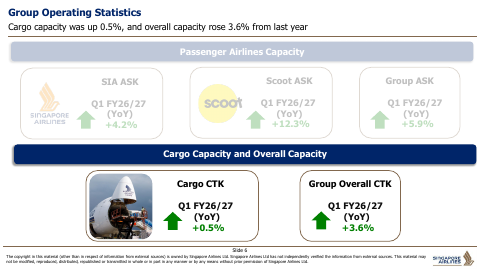
Showing the first 6 of 20 pages.
Results documents
Key numbers
- Total revenue
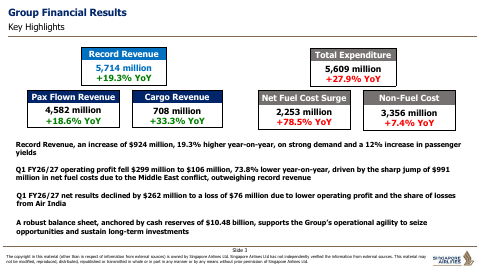
- S$5,714 million
- Operating profit
- S$106 million
- Net loss
- S$76 million
- Diluted loss per share
- (2.4)
- EBITDA margin
- 12.3
up 19.3% from a year ago
down 73.8% from a year ago
a deterioration of $262 million from a year ago
from earnings of 6.1 cents a year ago
from 21.2 a year ago
| Segment or metric | Value | Change |
|---|---|---|
| Passenger revenue | S$4,582 million | up 18.6% |
| Cargo revenue | S$708 million | up 33.5% |
| Passengers carried | 10.9 million | up 6.3% |
| Group passenger load factor | 87.1% | down 0.5 percentage points |
| Passenger yield | 11.2 cents per revenue passenger-kilometre | up 12.0% |
| Cargo load factor | 58.8% | up 1.9 percentage points |
Where each number comes from
- Total revenue: “The SIA Group achieved a record revenue of $5,714 million during the first quarter of FY2026/27, an increase of $924 million (+19.3%) year-on-year.”
- Operating profit: “the Group recorded an operating profit of $106 million, down $299 million (-73.8%) from a year ago.”
- Net loss: “the Group reported a net loss of $76 million, a deterioration of $262 million year-on-year, due to the drop in operating profit”
- Diluted loss per share: “(Loss)/Earnings per share (cents) - Basic R1 (2.4) 6.3 - Diluted R2 (2.4) 6.1”
- EBITDA margin: “EBITDA ($ million) R3 702.4 1,015.1 EBITDA margin (%) R4 12.3 21.2”
- Passenger revenue: “with passenger revenue up 18.6% to $4,582 million.”
- Cargo revenue: “Cargo revenue grew $178 million (+33.5%) to $708 million”
- Passengers carried: “SIA and Scoot carried a record 10.9 million passengers, up 6.3% from a year ago.”
- Group passenger load factor: “Group passenger load factor (PLF) stood at 87.1%, 0.5 percentage points lower year-on-year”
- Passenger yield: “Passenger yields rose 12.0% to 11.2 cents per revenue passenger-kilometre.”
- Cargo load factor: “a 1.9-percentage point increase in cargo load factor (CLF) to 58.8%.”
Copied from the press release ↗ and other documents in the company's results page ↗. A figure is published only if its sentence is in those documents.
Key takeaways
Partnership web widens with Air China MoU
SIA and Air China signed a Memorandum of Understanding on 29 June 2026 to establish a commercial joint venture. Subject to regulatory approvals, it could include expanded codeshare, coordinated schedules, joint fares and revenue-sharing.
Malaysia Airlines joint business now selling fares
After final regulatory approval in January 2026, the two airlines introduced joint fare products between Singapore and Kuala Lumpur in June 2026. Reciprocal lounge access and coordinated schedules are to follow.
Europe and Australia get the capacity
SIA is moving London Gatwick to twice-daily at peak, going daily to Manchester, and adding Madrid via Barcelona from 26 October 2026. It will also fly daily to Western Sydney International Airport from November 2026, bringing Sydney to five-times daily.
Middle East conflict disrupts Gulf routes
Scoot resumed Jeddah on 22 June 2026 but suspended it again from 14 July 2026. SIA's Dubai service remains suspended and the Riyadh launch has been deferred to December 2026.
Premium product refresh and Starlink coming
A new First Class SilverKris Lounge opened at Changi Terminal 2. SIA will unveil next-generation long-haul cabins and a refreshed KrisWorld later in 2026, and add Starlink broadband progressively from 2027.
Questions
What partnerships did SIA advance this quarter?
SIA signed an MoU with Air China on 29 June 2026 for a commercial joint venture and launched joint fares with Malaysia Airlines. It also agreed with Air India to expand codeshare, network connectivity and loyalty collaboration.
How is the Middle East conflict affecting SIA's network?
Scoot suspended Jeddah flights from 14 July 2026, SIA's Dubai service remains suspended, and the Riyadh launch is deferred to December 2026. Jet fuel prices are also elevated, and fare and cargo rate increases do not fully offset them.
Where is SIA adding capacity?
SIA is adding frequencies to London Gatwick, Manchester and Amsterdam, plus Madrid via Barcelona from 26 October 2026. It is also adding Adelaide frequencies and daily Western Sydney service from November 2026.
What customer-experience upgrades is SIA planning?
SIA will unveil next-generation long-haul cabins, a refreshed KrisWorld entertainment system, new dining and amenity kits later in 2026. Starlink satellite broadband will be introduced progressively from 2027.
How is cargo demand holding up?
Cargo demand is resilient across most key verticals, with semiconductor and data centre-related movements providing support. Cargo yields rose 28.1% and load factor reached 58.8%.