Summaries and transcripts are machine-generated and can contain errors.
In brief
Sea plans a standalone listing for Monee within one to three years and has launched Sea Cloud, an AI services startup, while Shopee scales instant delivery and ShopeeVIP.
Shopee kept widening its edge in delivery and membership. Instant delivery now reaches buyers in as little as one hour, and ShopeeVIP passed 21 million members. Monee extended credit beyond Shopee through standalone apps and a card usable wherever Mastercard is accepted, while tightening underwriting for softer segments. Garena relied on Free Fire and a 10th-anniversary push for Arena of Valor.
Management wants Monee to become independent, targeting a listing in one to three years. It has also set up Sea Cloud as a startup selling AI infrastructure, models and agents. The tension is capital and risk. Sea Cloud has no enterprise contracts yet and will only pursue committed, high-return deals. Monee's growth must be balanced against rising credit stress in Thailand and Brazil.
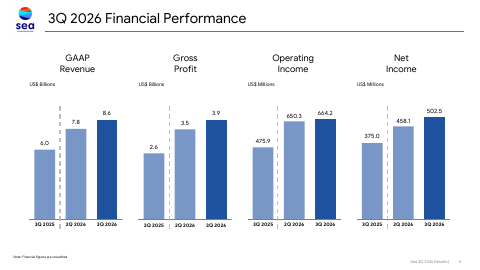
Revenue: “In the third quarter of 2026, Sea’s GAAP revenue was US$8.6 billion, up 43.4% year-on-year.”
Net income: “The Company also achieved gross profit of US$3.9 billion, up 51.4% year-on-year, and net income of US$502.5 million, up 34.0% year-on-year.”
Diluted EPS: “Diluted earnings per share attributable to Sea Limited’s ordinary shareholders was US$0.78 in the third quarter of 2026, compared to diluted earnings per share attributable to Sea Limited’s ordinary shareholders of US$0.59”
Gross profit: “The Company also achieved gross profit of US$3.9 billion, up 51.4% year-on-year, and net income of US$502.5 million, up 34.0% year-on-year.”
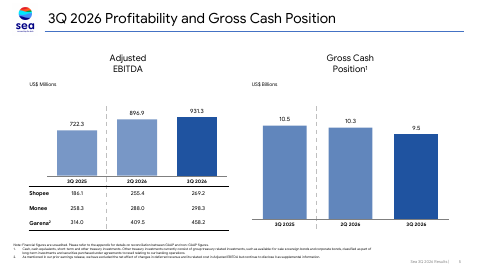
Adjusted EBITDA: “Adjusted EBITDA1 increased by 28.9% year-on-year to reach US$931.3 million.”
Shopee GMV: “GMV was US$39.7 billion for the quarter, increasing by 23.3% year-on-year.”
Shopee gross orders: “Gross orders totaled 4.5 billion for the quarter, increasing by 25.5% year-on-year.”
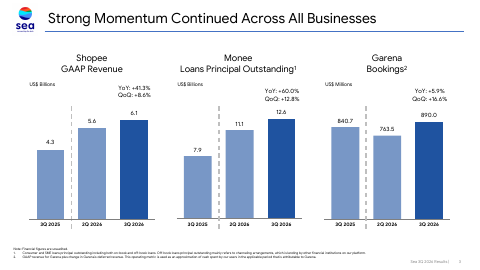
Shopee revenue: “GAAP revenue was US$6.1 billion, up 41.3% year-on-year.”
Monee loans principal outstanding: “consumer and SME loans principal outstanding was US$12.6 billion, up 60.0% year-on-year.”
Monee revenue: “GAAP revenue was US$1.6 billion, up 63.9% year-on-year.”
Garena bookings: “Bookings3 were US$890.0 million, up 5.9% year-on-year.”
Garena quarterly active users: “Quarterly active users were 671.7 million, as compared to 670.8 million for the third quarter of 2025.”
Garena quarterly paying users: “Quarterly paying users were 68.6 million, up 4.1% year-on-year.”
Management said Monee has the scale to sustain itself and aims to list it in the next one to three years. Monee and Shopee will keep working closely as payment and credit partner and platform.
Sea Cloud launches with no customers yet
Sea is setting up Sea Cloud as a startup to sell infrastructure, model and agent capabilities it built for its own businesses. It has no enterprise contracts, and will only pursue deals with clear customer commitments and attractive returns.
Instant delivery can reach buyers in as little as one hour, and in Indonesia those orders more than doubled year-on-year with cost per order falling. More than 12,000 offline stores are on the platform.
ShopeeVIP is becoming a core retention lever
Members exceeded 21 million, contributed close to 25% of GMV, and show about 80% monthly retention. A higher ShopeeVIP+ tier with a Netflix subscription launched in Indonesia, Thailand and the Philippines.
Monee grows off-Shopee while tightening risk
Off-Shopee SPayLater more than doubled to nearly 25% of the SPayLater portfolio, and nearly 6 million first-time borrowers were added. NPL 90+ rose to 1.3%, so Monee recalibrated underwriting in selected segments, especially in Thailand and Brazil.
What management said
Each quote matches the transcript word for word.
“Our instant delivery service can now deliver as quickly as one hour. This has suspended our addressable market by unlocking new spending scenarios where speed matters most.”
Shows how faster delivery is opening high-frequency categories such as groceries and pharmacy.
“Where customers need dedicated computing capacity, we will only pursue opportunities with clear customer commitments and attractive returns. We will mainly look to partners and customer prepayments to fund the physical infrastructure.”
“Given that we built our platform around long-tail products and also the pricing in our platform is a lot more competitive compared to other platforms online or compared to the alternative offline as well”
Explains why management sees Shopee as resilient to macro pressure and competition.
What return profile and demand drivers should investors expect from Sea Cloud investments?
Forrest Li said Sea Cloud is at a very early stage, built on in-house AI know-how, with strict financial discipline on every project and no clear return figures yet. — Forrest Li
What milestones does Monee need to become a standalone platform, and how does independence compare with staying integrated?
Forrest Li said Monee has reached sustainable scale, a standalone listing gives it room to grow beyond Sea's ecosystem, and Shopee collaboration continues, on a one-to-three-year timeline. — Forrest Li
0:42:17 · Divya Cothillo, Morgan Stanley · Shopee profitability
When will Shopee's monetization gains flow through to profitability, and what is absorbing them?
Management said better ad monetization will partly flow to EBITDA and partly be reinvested in growth, with full-year EBITDA above $1 billion reaffirmed and content now contribution-margin positive. — Management
0:42:50 · Divya Cothillo, Morgan Stanley · Agentic AI
How would agentic AI discovery such as Meta's Muse change Shopee's order economics and customer ownership?
Management said checkout stays within Shopee, it sees no meaningful near-term economic impact, and it already works with YouTube and Meta as affiliate partners. — Management
When will peak investment in ShopeeVIP, instant delivery and fulfillment pass, and is content now profitable?
Management said timing varies by country, EBITDA should keep improving year over year despite investment, content has a positive contribution margin, and fulfillment costs are falling. — Management
Has Sea Cloud secured enterprise contracts, and will Sea invest in data centers and GPUs?
Forrest Li said there are no enterprise contracts yet, GPUs will be bought for internal use regardless, and data centers are not a general interest but may be built for uses like Monee data residency. — Forrest Li
0:56:09 · Thomas Chong, Jefferies · Sea Cloud outlook
How significant could Sea Cloud become to the business and profit mix in three to five years?
Forrest Li said he is very bullish but cannot give a timeline, and the aim is a permanent, sustainable business that only proceeds if returns are attractive. — Forrest Li
0:56:56 · Thomas Chong, Jefferies · Shopee GMV outlook
Given macro uncertainty such as fuel prices, should Shopee's GMV growth be expected to slow?
Management said it sees no big slowdown, with similar growth to last quarter excluding forex, more value-seeking behavior, and resilient demand given low e-commerce penetration. — Management
Questions
What is Sea's plan for Monee?
Sea intends to pursue a standalone listing of Monee within the next one to three years, taking market conditions and regulation into account. Monee will remain a key payment and credit partner for Shopee.
What is Sea Cloud and how much will Sea invest in it?
Sea Cloud is a new startup offering infrastructure, model and agent capabilities that Sea built for its own businesses. It has no enterprise contracts yet, will pursue only deals with clear customer commitments and returns, and is not expected to affect financials significantly for now.
How is Shopee improving delivery and customer retention?
Shopee expanded instant delivery to as little as one hour, plus low-cost options and fulfillment, and ShopeeVIP passed 21 million members with about 80% monthly retention. Members contributed close to 25% of GMV.
How is Monee managing credit risk while growing?
Monee recalibrated underwriting and credit limits for selected segments after early signs of softness, mainly in Thailand and Brazil. Its NPL 90+ ratio was 1.3%, up from 1.1% a year earlier.
What is driving Garena's performance?
Garena was anchored by Free Fire, including a returning NARUTO SHIPPUDEN collaboration, and Arena of Valor's 10th anniversary events. Bookings grew 5.9% year-on-year and quarterly paying users rose 4.1%.
Good morning and good evening to all and welcome to the Sea Limited third quarter 2026 results conference call. All lines have been placed on mute to prevent any background noise. After the speaker's remarks, there will be a question and answer session. If you would like to ask a question during this time, simply press star followed by the number one on your telephone keypad. If you would like to withdraw your question, press the star 1 again. For operator assistance throughout the call, please press star 0.
And finally, I would like to advise all participants that this call is being recorded. Thank you. I'd now like to welcome Mr. Elson Choi to begin the conference. Please go ahead.
Hello, everyone, and welcome to Sea's 2026 Third Quarter Earnings Conference Call. I'm Elson from Sea Investor Relations Team. On this call, we may make forward-looking statements which are apparently subject to risk and uncertainties and may not be realized in the future for various reasons as stated in our press release.
Also, this call includes the discussion of certain non-GAAP financial measures such as adjusted EBITDA. We believe these measures can enhance our investors' understanding of the actual cash flows of our major businesses when used as a complement to our gap disclosures. For a discussion of the use of non-gap financial measures and reconciliation with the closest gap measures, please refer to the section on non-gap financial measures in our press release. I have with me C's Chairman and Chief Executive Officer, Forrest Li, President Chris Bung, and Chief Financial Officer Tony Ho.
Our management will share strategy and business updates, operating highlights, and financial performance for the third quarter of 2026. This will be followed by a Q &A session in which we welcome any questions you have. With that, let me turn the call over to Forrest.
Hello, everyone, and thank you for joining today's call. Our strong momentum from the first half of the year has continued into the third quarter. C achieved a new record high of $8.6 billion in revenue, up 43 % year-on-year, and over $930 million in adjusted EBITDA, up 29 % year-on-year.
We are pleased with this solid performance and will continue to focus on executing our priorities with the discipline. With that, let me take you through each business's performance. Starting with Shopee. Shopee delivered another strong quarter, again achieving new record highs in both top and bottom line metrics. GMV rose 23%, and gross orders rose 26 % year on year. Revenues reached a new high, and adjusted EBITDA reached $269 million, making this our most profitable quarter ever. The acceleration in new user growth we saw in the second quarter has continued into the third.
We engaged and re-engaged a broad range of users through both online and offline campaigns, brought our content to more social and video platforms, and widened our service options, especially in delivery, to serve different user needs. With these efforts, new average monthly active buyers grew more than 50%, and the total average monthly active buyers increased by 20 % year-on-year. Monetization has also continued to do well. Driven by ads, sellers are responding well to the greater value they see in our AI-driven ad solutions.
At paying sellers, it was more than 35%, while average ad spend per seller increased around 13 % year on year. And revenue grew more than 55%, and our ad tick rate improved by over 80 basis points year on year. Our operational priorities to enhance service quality, price competitiveness, and discoveries remain consistent and continue to be driven by our efforts in logistics, Shopee VIP, and our content ecosystem. It made good progress this quarter. First, logistics. We expanded our delivery options to serve a wider range of buyer needs, from instant and same-day delivery to low-cost services.
Our instant delivery service can now deliver as quickly as one hour. This has suspended our addressable market by unlocking new spending scenarios where speed matters most. These tend to be high frequency categories, such as the groceries and the pharmaceutical items, boosting our overall purchase frequency. In Indonesia, orders using these services more than doubled year-on-year, with cost per order declining year-on-year. Retailers there have embraced the service. We now have more than 12,000 offline stores on our Eastern platform and growing.
Adoption is also growing in Thailand, where Eastern and same-day delivery now accounts for nearly 15 % of orders in Greater Bangkok. We will continue to grow this service in areas where demand is high and the unique economic extent. At the same time, we have continued to expand lower cost delivery services to ensure that all users continue to have affordable, convenient options on Shopee. In the third quarter, fire self-collection order penetration reached more than 30 % in Singapore and more than 15 % in Malaysia.
In Indonesia, our economical shipping option has gained strong adoption and now accounts for more than half of total orders. Its cost per order is more than 20 % lower than the platform average in the market. This initiative allows us to offer free shipping at a lower minimum spend, giving our buyers the flexibility to choose between cost and speed, and letting us serve a broader range of buyers' needs. We have also continued to scale fulfillment quickly. Sellers have responded well to our fulfillment offerings as we help them take on the complexity of storing, packing, and shipping.
This represents significant efficiency gains for them, especially during peak campaign periods where orders may be several times higher than normal. With our services, sellers can and build their businesses more easily without having to increase their own warehouse space for staff size. In the third quarter, fulfilled order volumes accelerated to around 25 % quarter on quarter. Unit economics for our fulfilled by Shopee service improved sequentially in Asia and we see further room to gain efficiency through higher warehouse utilization and automation.
Fulfillment also drives synergies with delivery, enabling us to deliver more packages more quickly. The number of parcels delivered by the next day for Sonar grew over 60 % year-on-year, more than twice as fast as our overall order growth. Second, Shopee VIP is growing fast. Membership across markets exceeded 21 million at the end of September, of more than 40 % quarter on quarter, and the members contributed close to 25 % of Shopee's overall GMV. The program is demonstrating stickiness, with monthly retention around 80%.
Members show a consistent double-digit percentage uplift in spend, on average, after subscribing, and with more sellers and partners investing alongside us in membership benefits. The program's unique economics improved sequentially. We have also continued to enhance the program's value proposition through new subscription tiers with more benefits. In September, we introduced the Shopee VIP Plus in Indonesia, Thailand, and the Philippines, a higher subscription tier that combines core member benefits with the Netflix subscription. Third, our content ecosystem continues to make discovery more engaging.
Auditors from live streaming and short-term video grew more than 45 % year-on-year and accounted for more than 25 % of physical goods orders in Southeast Asia. Unit economics also improved sequentially. Beyond our ads, our affiliate program remains an effective and growing channel to bring new buyers to Shopee from other platforms. In the third quarter, orders driven by YouTube content more than doubled year-on-year, and the Shopee affiliate order generated by Facebook-linked creators grew more than 90 % sequentially.
On Instagram, more than 4 million reels have been tagged with Shopee products since we launched the partnership in April, with the number growing more than four times quarter-on-quarter. Shopee is also one of the early connector partners for Meta's MUSE AI personal assistant that has just launched in Singapore. Users will be able to research and compare products on Shopee through MUSE, helping them make purchase decisions tailored to their preferences. The partnership is still at an early stage, but we see potential for it to become a solid additional channel for buyer acquisition and incremental gmv growth over time Brazil remained our fastest growing market and we again grew faster than the broader market in the third quarter logistics improvements underpinned
these growth we continued to widen the range of faster delivery options we offer across the country with average buyer waiting time improving 12 % year-on-year. We have branched into air delivery, cutting delivery times to the north and the northeast regions significantly. In greater Sao Paulo, around 40% of pustos now arrive by the next day and nearly 60% within two days. Our new instant delivery servicier, Shopee Turbo, already delivers in under four hours from more than 7,000 partner stores.
Stronger delivery capabilities have enabled us to onboard more sellers to fulfillment. For example, we rolled out an in-house delivery service for bulky items such as large appliances and furniture. Combined with our strong service reputation and reliable cross-nation coverage, this has made more large item sellers willing to fulfill with us. across the country, fulfillment order volume more than doubled year on year. These service quality improvements have helped drive stronger growth in higher value categories. More upmarket buyers are joining Shopee and existing buyers are shopping across more categories with us.
Automotive and home improvement categories were more than 80 % year on year, and more brand sellers have come on board. TfB from Shopee Moore sellers was up nearly two and a half times from a year ago, and Shopee Moore orders carried an average basket size almost three times the platform average. Looking ahead, we see a lot of ahead room to grow in this exciting market. In summary, Shopee delivered another quarter of strong growth while generating the highest quarterly profit we have ever achieved.
Our strategies have proven effective at strengthening our fundamentals, giving us a growing buyer base, stronger monetization, and improving unit economics. We still see a long runway of opportunity ahead, and we will keep executing with the discipline to capture it. We remain on track to deliver GMV growth of around 25 % and an adjusted EBITDA of $1 $1 billion for the full year of 2026. next moving to Monee Monee has grown well beyond its origins as a payment infrastructure serving our internal business needs today it has evolved into a financial services business across mobile wallet credit digital banking and more Monee has shown consistent strong growth and has been profitable for the last three physical years we believe Monee has reached
the scale and the maturity to sustain itself and would benefit from becoming more independent today Monee is already one of the largest unsaturated consumer lending companies in southeast asia serving nearly 44 million active credit users with a loan book of over $12 billion. Increasingly, Monee's growth is coming from beyond shopping, and it is building direct relationships with users through standalone apps across Southeast Asia and Brazil. Personal cash loans and off-shopee loans made up around 50 % of our loan books at the end of September.
An average monthly transacting users on these apps more than doubled year-on-year in the third quarter. Our ambition is to keep growing Monee into a full financial ecosystem with inclusion at its heart, serving users across their life cycle needs from unsecured loans to secured lending, insurance, wealth management, and more. We believe a standalone listing would give Monee the dedicated capital base it needs to build this ecosystem and let it invest for growth while managing risk with discipline.
I want to be clear about what does not change. Monee and the Shopee will continue to work closely together as they do today. Monee will remain a key payment and credit partner for Shopee, and the Shopee will remain a key platform for Monee to reach users. Insights from our businesses will continue to empower Monee's growth. We hope to leave the Monee at the right time in the next one to three years, taking into consideration factors such as market conditions, microenvironment, and regulatory requirements.
We will approach this carefully, working closely with our stakeholders in each market. Throughout, we aim to deliver value for our shareholders. I'm very excited about what lies ahead. With that, let me take you through Monee's performance this quarter. Let me deliver another quarter of healthy growth. Our notebook grew around 60 % year-on-year to $12.6 billion at the end of September. Unique economics are healthy, and we continue to invest where we see a clear path to attractive long-term returns.
We continue to expand our credit business on three fronts, acquiring new users, deepening our relationship with existing users, and expanding our credit use cases. Our user base continues to grow heavily in the third quarter. We added nearly 6 million first-time borrowers, bringing active credit users to nearly 44 million, up around 28 % year-on-year. As the borrower builds longer credit histories with us, we can progressively offer them higher limits, longer tenures, and more products.
Average loan outstanding per user through 23 % in the third quarter year on year, and over 40 % of our active credit users were using two or more of our credit products at the end of September. S-Pay Later is becoming an everyday way to pay both online and offline in many of our markets. Our off-Shopee S-Pay Later portfolio more than doubled year-on-year to nearly 25 % of our entire SPLator portfolio at the end of September.
In Malaysia, its share is nearly 40%. In Thailand, the Shopee Pay Unlimited card allows SPLator users to accept their approved SPLator credit limit wherever MasterCard is accepted. Monthly transacting users of the card in September grew more than 50 % compared to a quarter ago. We are rolling the card out at a pace set by risk performance, and we plan to bring it to Malaysia later this year. Risk management remains our top priority as we continue to grow our loan book.
Our 90-day NPL ratio was 1.3 % at the end of September. The modest uptick primarily reflects an evolving credit environment, especially in Thailand and Brazil. as well as market and product mix, including faster growth in Brazil and offshore escalator. Our underwriting is highly responsive to market conditions. We proactively adjusted our underwriting criteria and credit limit management for selected customer segments at early signs of softness. To maintain disciplined growth and optimize risk-adjusted returns, We are staying close to the data and will keep adjusting as needed, so our notebook growth stays healthy and sustainable.
In summary, Monee delivers healthy growth while staying disciplined in how we manage risk and how we invest. Our credit playbook remains consistent. Start small, proved economic, that's still. We are reaching more users, keeping new relationships with existing ones, and extending credit into to more everyday spending scenarios, both on and off Shopee. Many of our initiatives are still in the early stages, and we are making good progress capturing the large, underserved opportunity across our markets. Next, turning to Garena.
Garena delivers a solid third quarter, with bookings continuing to grow from the high base set last year. Profitability also improved. Free Fire anchored this performance with strong booking scrolls, and the Ring of Valor continued its strong momentum from its 10th year anniversary celebrations. In January last year, we released our Smash Heat IMP collaboration, Naruto Shipsen Chapter 1. This year, by popular demand, we brought it back with upgraded gameplay and fresh rewards rebuilt around top fan requested content.
Our players loved original campaign's most iconic moment, when the anime's giant nine-tailed forks descended on the battlefield as a threat that everyone had to survive. To build on it, we brought in one of the most important powers from the Naruto universe, the shurrigan. This iconic ability the anime's most powerful characters used to control the nine-tailed folks. Here we could use it to make the giant creature attack their opponents, bringing the excitement of the moment to a new level.
We also expanded the map with places fans had asked to explore, like the ninja school where the main character first trained. We continued to pay close attention to detail, including small but important elements like the screen where a young Naruto sat alone in the original enemy that gave players an an extra boost for the rest of the game. Our careful authenticity has resonated with the players and the industry alike. Content around our Naruto Shepton collaboration has generated more than 6.5 billion views on social media today.
This quarter, we were also honored that our Naruto Shepton Chapter 2 collaboration won the award for best use of IP or license at the 2026 Pocket Gamer Mobile Games Awards. Beyond free fire, the Ring of Valor is celebrating its 10th anniversary this year. It's the end of one single event. We are making the entire year a celebration with a series of in-game content releases and our biggest ever real-world events. We hosted AOB's biggest ever offline celebrations with a concert at Taiwan's largest indoor venue, the Taipei Dawn, the first ever gaming event to be held there.
Around 30,000 fans came to see K-pop and local artists, many of whom had previously collaborated with us on music for AOV. We also transformed the parts of Taipei into an AOV-themed city, collaborating with the metro stations and 7-Elevens, putting us anniversary exhibitions and holding a light show at the iconic Taipei 101. The campaign went viral, becoming the number one trending topic on social media in Taiwan. 10 years in, AOA is still winning over new generations of players, and the deepening is bound with the long-time fans.
With this strong engagement, we believe that, just like Free Fire, AOA will continue to be an evergreen game. In summary, the greatest performance this quarter showcases our ability to keep successful games fresh, listen closely to our players, and build lasting relationships with them, we will remain focused on delivering engaging experiences and strengthening our franchises for the long term. In addition to our three existing business segments, we have always been exploring and experimenting with new businesses. The most recent of these is the C Cloud, as we announced recently.
As AI has taken off, we have built up meaningful capabilities over the past two years across the infrastructure, model, and agentic application layers, and our own businesses have benefited significantly from them. C Cloud looks to bring these capabilities to other organizations across all three layers. Today, there is a lot of focus on compute prices and the cyclical margins, and having enough compute certainly matters, but we believe the ultimate price lies elsewhere. The cost of tokens is falling rapidly and structurally, and as it does, AI becomes affordable for far more organizations and far more use cases.
The real opportunity is to build a significant business around the long-term decline in token and prices, helping organizations to have much broader AI adoption. We see much of the lasting value in the layers above bare metal capacity. When it's running AI efficiently, it gets more out of every GPU through vector utilization, faster deployment, and the linear operations, which we have mastered for our own businesses. The other, and the more important over time, is the agents, software, and orchestration that soft organizations put AI to work, running models reliably and securely, adapting them to their own data and languages, keeping that data close to home, and moving to newer and more cost-efficient models, including open models, as they emerge without
having to rebuild each time. Many organizations grow up this, but few have to specialize the teams to build it themselves. That is where we intend to focus, and it is not theoretical for us. It is what we have had to do for our own businesses running AI at scale in areas such as fraud detection, customer service, and content generation under real commercial pressure, and in Monday's case, in highly regulated environments. We see this as an opportunity to turn our AI capabilities today across the center of receive into a perfect center.
We are already making these investments for our own businesses. By serving external customers on top of that existing base, we can spread our fixed costs across more users and earn attractive incremental returns on capital. This is consistent with how we have entered new businesses throughout our history, like Monee beginning as a payment instructor, serving our own platforms before going into a business serving customers well beyond them. We are setting up eCloud as a full-goal startup so that it can stay nimble and respond quickly to market demand.
Our focus is the software and customer relationships, not only large amounts of physical capacity. Where customers need dedicated computing capacity, we will only pursue opportunities with clear customer commitments and attractive returns. We will mainly look to partners and customer prepayments to fund the physical infrastructure. As a result, we do not expect CCloud to have a significant impact on our financials for now. It is still early, and we will update investors on any meaningful developments. We also want to give an update on our share repurchase program.
As of today, we have almost fully completed our $1 billion share repurchase program announced a year ago. We are pleased to announce that we plan to buy back an additional $1 billion worth of shares. In conclusion, we have delivered another strong quarter. Our three businesses have all expanded their addressable opportunity and strengthened their competitive position. unit economics continue to improve across many of our initiatives. A testament to our financial discipline and operational efficiency. Our public momentum across the first three quarters give us greater confidence for the rest of the year.
Thank you, Forrest, and thanks to everyone for joining the call. For C, overall, total get revenue increased 23 % year-on-year to $8.6 billion in the third quarter of 2026. This was primarily driven by growth in Shopee and Monee. Our total adjusted EBITDA was up by 29 % year-on-year to $931 million in the third quarter of 2026.
Our short key, growth orders increased 26 % year-on-year to $4.5 billion in the third quarter of 2026, and GMV increased by 23 % year-on-year to $39.7 billion in the third quarter of 2026. Our third quarter GAAP revenue of $6.1 billion included GAAP marketplace revenue of $5.3 $1 billion up 41% year-on-year and get product revenue of 0.7 $1 billion within get marketplace revenue core marketplace revenue mainly consisting of transaction-based fees and advertising revenues was 4.6 $1 billion up 51% year-on-year value-added services revenue mainly consisting of revenues related to logistic services was $0.7 billion.
Shopee adjusted EBITDA was up by 45 % year-on-year to $269 million in the third quarter of 2026. Monee gap revenue was up by 64 % year-on-year to $1.6 billion in the third quarter of 2026. Adjusted EBITDA was up by 15 % year-on-year to $298 million in the third quarter of 2026. As of the end of September, our consumer and SME loans principal outstanding reached $12.6 billion, up 60 % year-on-year.
This consists of $11.2 billion on book and $1.3 billion off book loans principal outstanding. Done-performing loans passed due by more than 90 days as a percentage of total consumer and SME loans was 1.3 % at the end of the quarter. Garena Bookings grew 6 % year-on-year to $890 million. Gap revenue was up by 29 % year-on-year to $840 million. The growth was primarily due to the increase in our active user base and deeper paying user penetration.
Garena adjusted EBITDA was up by 46 % year-on-year to $458 million. Returning to our consolidated numbers, we recognize a net non-operating income of $123 million in the third quarter of 2026 compared to a net non-operating income of $61 $1 million in the third quarter of 2025. We had a net income tax expense of $280 million in the third quarter of 2026 compared to net income tax expense of $161 million in the third quarter of 2025.
We will now begin the question and answer session. If you would like to ask a question during this time, simply press star followed by the number one on your telephone keypad. If you would like to withdraw your question, press the star 1 again. In the interest of time, we will take a maximum of two questions at a time from each caller.
If you wish to ask more questions, please request to join the question queue again after your first questions have been addressed. At this time, we will pause momentarily to assemble our roster. Your first question comes from the line of Alicia Yap with Citigroup. Your line is open. Please go ahead.
Good evening, management. Congrats on the solid set of results. Thanks for the email questions. Two questions. First, I wanted to ask on C-Cloud. So I see plans to invest in cloud and AI infrastructure.
how should investors think about the expected return profile for these investments? What are the key use cases or demand drivers that give you confidence that vCloud can become a meaningful business over time? Second question, Monee. Monee has reached a meaningful scale with over 12 billion in loans, outstanding 44 million active credit user, and also an increasingly diversify business beyond the shopping ecosystem. As you look ahead, what milestones do you believe are still needed before Monee can be viewed as a standalone financial platform?
And strategically, how do you think about the benefits of keeping Monee integrated within C versus creating a more independent segment over time? Thank you.
Thank you, Alicia. For the C Cloud business, as I just mentioned in my remark, this is a very pretty new initiative and this is at a very, very early stage. So, I'm always thinking what is the potential new business opportunities we may have opportunities during the AI era And continually and increasingly, we believe eventually because of this new technology, both the consumers and organizations across the whole world, and especially in our region as well, will go through the AI transformation.
and every organization seems to build up certain AI capabilities, right? This is including across all the layers, including the compute capacity and including the models and also how to use the model, how to deploy the model in an affordable way, in an efficient way, in a secure way. And also on top of that, what is the software can be used and what is the agent can be built, right? And this is going to make a meaningful impact.
And I think actually it's not an easy process. And this will take time. And so it will take quite some effort for that transformation. In the past few years, we have gone through this for our own business. It's firsthand. Although this is a very, very challenge, we put a lot of effort. We're also very excited about the impact it can be made. right and so you might remark and mention the specifically several cases like fraud detection customer service content generation so like this is a benefit our business significantly on a daily basis and we have a strong conviction and what this capability we have to build this is the know-how and the knowledge we have learned through our own
use case experience will be valuable to other organizations as well and also like for if not any other organization has the same technical capability and the uses as we have today in-house allow us to build such capability capability from the like from the scratch that's why we think is a the aspiration is a really extra externalize what we already have and build and as the internal capabilities and resources but like become a standard kind of like a new businesses to serve external customers and we also believe like adoption and acceleration will be accelerated because of the model is getting better and better and the agent can do more and more things and also the the token cost will be
continually go down so this is so make a uh make the entire kind of this ai demand more affordable and and and the more accessible and in a seller in accelerated pace so that is a kind of the the uh big picture where we are looking we are looking at and we think the demand will be huge and this is just at very very early stage So we want to get into this business early. There's a lot of things we don't know yet.
And again, this is very early. This is a kind of a startup. So there's a lot of things we need to figure out. For example, what exactly the segment we should focus on, what exactly type of customers we should focus on, and what is the best business model we should use. We think we'll get a better picture when we really get into the get our own feet into the game and we start to get the first time experience I hope I'm also I'm sure the learning will be very very quick right and we really have a kind of a real business working on that so we feel in the past although this is very early like in the past few
months we have gained a lot of insight and the learning about the potential opportunities we have i think we're going to keep investors updated and at the same time because of this is very new and it is a very dynamic situation and opportunity we want to make sure i will be very very frugal in terms of the in terms of the capital expenditure in terms of the cash flow spending i think whatever the opportunity we are looking at the top down we just shared we believe in the big potential ahead of us but like a bottom-up when we look at each potential each project each customer uh each potential deal uh will very much uh kind of a discipline
in terms of what is the like a return we're looking at what is the what is the mean to us financially um i don't think at this moment we have a very very clear as order as a business is what will be the return on investment will look like. We believe this will be very, very good. But again, so we also want to stay humble. There's a lot of things we don't know what we don't know.
But autumn up for each project, we'll keep the financial discipline very, very seriously. We want to make sure every project we work on will be generated attractive return for us and minimize our potential financial risk if there's any. So I think that is the overall thinking we have for the C Cloud businesses. It's still at the formation stage. It's a very, very different profile compared to the three existing businesses we have. It took us a decade to build up the three existing business to date the stage.
And I think the C Cloud will be really, really a long term bet, right? And this is one of the bets we have in the AI times. We are very excited about it and we'll keep our investors and shareholders updated if there's any major development on that front. And for your question about the Monee IPO, again, this is a very, very exciting project. It always has been our aspiration to build Monee into a standalone financial services business.
And we believe, and the Monee has the potential to be one of the best in the world, in the fintech businesses. I think we're on the red track now. And now we feel comfortable. I think it's reached a stage. It can reach the stage and skill can be sustainable itself. I think being listing standalone will give more room and more flexibility for Monee to continually grow. In the past, Monee has been benefited hugely being part of the C and being integrated, being part of integrated system.
I think that is a very, very critical success factor for Monee in the past. But I think moving forward, we expect the Monee will continually grow and it's not only rely on the sea ecosystem but really have the courage and have the flexibility and have the room to grow out of it. And meanwhile please don't get it wrong, I think whatever the, as I shared in my remark, whatever the benefit and the being like together with the sea and with the shocking the past will be still there right and as I mentioned there will be still very very integrated tight collaborations uh between shopee and Monee right and there's a huge synergy we're definitely not uh give it away and
also at the same time i think like whatever the from the seed perfect perspective that the capability we built during the ai era we've continually the technical uh support an enabler for Monee's growth um so i think that is That is kind of like our thinking for now. Again, so we are not in any rush. And I think this is, we just want to share this directional move with the investors, shareholders as early as possible. And we are looking at one to three year timeline.
And there's a lot of things when we start to take off the process, there will be a lot of learnings and that there will be, we'll weigh the different ways of doing that and the pros and the cons. I think at the same time, we're going to keep all the shareholders and investors updated along the journey as well.
My first question is on Shopee and really when does the monetization actually start flowing through profitability? So we saw that despite the strong growth in take rates and advertising, margins are still flat quarter and quarter at about 68 basis points. Could you elaborate what absorbed these monetization gains specifically and which investments should start delivering some sort of operating leverage next year? If you could also comment on the profitability runway difference between ASEAN and Brazil, as well as between content or ecosystem versus Shell.
So that's my first question on Shopee profitability. My second question is just on agentic AI in Shopee. You are an early connector partner for Mews, as you mentioned. If product discovery moves to an internal agent, how do the economics of a Shopee order change, particularly the advertising revenue and the contribution profit? Do you actually retain the customer relationship and data? And if you could also comment on how Migu is performing on adoption and conversion, and how do you see its role in Shopee as the agentic AI going forward?
On the Shopee side, for the monetization that you mentioned, we do see better monetization over the quarter. As you point out, our EBITDA also remains relatively stable from the quarter to quarter. I think overall, the thinking we have is that we still see that it's quite a lot of growth potential in both South Asia and Brazil market. In fact, if you look at our growth rate, we grow 23 % this quarter. If you look at the growth without the forex impact, we grow more than 26%, close to 26.5%.
So we do see a lot of potential in our market. And we would like to grow e-commerce penetration further in both South Asia and Brazil markets. At the same time, as far as mentioned in the opening remarks, that we commit to have our EBITDA more than one billion this year. I think we still hold that as our standard. We expect going forward, our administration will also be better, primarily from the ad side, less from the fixed emission side.
And part of that will flow to the bottom line EBITDA improvement over time. And part of that might go to the investment to grow our market further as well. Between Brazil and South Asia, I don't think there's a particular difference in terms a trend between the two regions. I think both Brazil and South Asia are relatively stable if you look at from quarter to quarter perspective. For content sites, content for us comprise of let's say both the videos and live streams.
Our content ecosystem has been growing year year to year and quarter to quarter. At the same time, our profitability also grows better for content as well. If you look at contribution margin perspective, our content part of business has been profitable already for this quarter, which is a very good milestone for us to achieve. Coming to the second question on the agentic AI, we actually partner with a range of partners. starting from Chachy BT and now as you mentioned the news at this part time all the checkouts and seller initiatives and buy initiatives happens within the shopping platform and we didn't see a meaningful impact to our economics for the near future.
At the same time, I would like to point out that we work with many platforms as affiliate partners as well. For example, we have been working very closely with both YouTube and Meta for Facebook and and Instagram as affiliate partners, which works similar to the fashion we work with platform like Muse. And affiliate partner, we've been generating a sizable new user to our platform, generating a sizable traffic to our platform, and it's been part of our economics in the past years.
Hi. Thanks a lot and congratulations on a good set of numbers. Two questions. Firstly, on Shopee, when do you think the peak investments would pass, considering the ongoing investment in Shopee VIP, instant delivery, fulfillment. And did I hear correctly that content ecosystem is now EBITDA positive?
Or if not, then how much is the drag on profitability? And can you also share what's the progress on fulfillment both in Asia and Brazil? Second question on CCloud, you have explained in detail your aspirations. But can I check if you have secured any enterprise contracts already And just to clarify, would you invest in data center and GPUs or would it be Capex Lite where you will leave these assets and any guardrails if you have put on maximum capital investment over the next two to three years in this segment would be great?
Yeah. I think we're investing in the shopping therapy and procurement and also the other initiatives like the instant delivery, et cetera, across our countries. It's a bit hard to argue when you say pick investments as we roll out this program in different countries, different markets, at different time frames. So if you look at our early countries that we started, let's say, some of programs, it does pass the pick investments, but there are some other countries company later.
So the mix of country and the taste of it has a lot of impact in terms of the face of investment. But in any case, as I shared earlier in the previous answers, we do see the bottom line, essentially the EBITDA will continue to improve year over year which includes all the investment to this program. So we manage it within sort of how much takeaway we can take and how much investment we can make while growing the ecosystem and the user base.
For content ecosystem which includes video livestream, I think it's a bit hard to split a particular segment to the EBITDA levels because there are many shared costs below that. I think for us we look at sort of variable cost or contribution margins to our platform. The content platform does have the positive contribution margin. Essentially what we're saying is if we grow content a business more in our platforms we'll have more profit rather than you know has less profit for our businesses.
The fulfillment penetration, I think the overall fulfillment has been growing quite a lot year over year. We started this in South Asia earlier than Brazil, so in reality is the penetration in South Asia will have a slightly higher percentage as overall platform than Brazil. But we do believe that the penetration will further grow in both Brazil and South Asia. The other thing that we spend our time on is to optimize the cost of the fuel, which is very important for us.
We're saying meaningful reduction in both South Asia and Brazil for our cost to fulfill for our fulfillment businesses. The part of that contributes by the scale that we've been built over time, part of that contribution by a better automation which is very important tools for us to reduce the cost of spills compared to many of our sellers. Part of that also comes from how to optimize the way we work with the sellers, the way we inbound the product selection we have, how long do we keep the products in our fulfillment centers, et cetera.
Kirish, for CCloud, for your question, as you know, this is just at the very, very beginning of the business. At this moment, we haven't secured any enterprise contracts. And for the investment in the data center and the GPUs, let me put it this way. We definitely probably will invest in the GPUs and the primary for our own use. So regardless if there is a C cloud business or not, like how the business of progress down the road, we are going to invest into GPUs and the primary for all the internal use cases.
And in the data centers, so we will see how the opportunity look like. In general, we are not interested to invest in the data centers, but we may spend the Monee to build data centers for our own use cases, primarily for our uses. For example, for our financial services business for Monee, right? And based on regulations, a lot of data need to stay in Singapore. So for those cases, it could be we'll evaluate the options in terms of build up our own data centers.
And because this is a very, very clear usage and a very, very clear use case versus leasing the data center capacity. right? And so I would say we're going to be open-minded on that part. But again, I would say this has nothing to do with the C cloud business. It's in general from C perspective, we'll keep those options open. And in terms of the guardrail on capital investment here, as I mentioned, we'll be very cautious, right?
And the good thing is like it's different from the consumer business like you have to have a have a spend a huge amount of a investment upfront and then along the way like to reach the critical mass and start to because of the the density because of the because of the volume and you start to see the unique economics from negative to positive like we have we have a come through several round of that we know that part very very well But the business nature is a bit different from the C cloud.
I think it will be very much deal by deal driven, at least at the beginning stage, and with very, very specific target in terms of the customers, in terms of the projection of the revenue, and what is the timeline for that, and what is the potential investment we put in. So I think we are going to have a guardrail. We want to, as I mentioned in the remark, we're only pursuing opportunity with a clear customer commitment and a clear return profile.
And we're going to make the case by case of judgment if that return is good enough for us or not. We don't have to pursue the opportunities if we don't like the return profile. and at the same time we're going to try all the ways to minimize the impact on our own financials and especially the cash flow the balance sheet I think there's a lot of ways to work with the potential partners and a lot of things can be worked with through the customer prepayment but the spirit we're going to minimize our own financial impact.
Hi. Good evening. Thanks, management, for taking my question. I also have two questions. The first question is also on the CQR business. Given that we have talked about it's a project-by-project basis and we also look into the return profile. I just want to get some color from management strategic perspective. If we look at three years or five years down the road, in terms of our business mix or our profit mix, how significant is C-Cloud to our overall business?
Would that become another very meaningful business, like three to five years down the road? That's my first question. And then my second question is back to Shopee business outlook. Given that we are seeing the macro is very dynamic, fuel price and other macro uncertainties, how should we think about our GMV outlook or growth rate going down the road? and and are we actually expecting like a meaningful slowdown or a gradual slowdown given all these headwinds thank you
thank you Thomas yeah for for C cloud and strategically and in the big picture we are very very bullish we are very optimistic as the as I shared and And so number one, we believe AI, this is a fantastic technology.
This will make huge impact for every single organization, every single business. Every organization, every single business will need to right away, but need to figure out their own strategy and the action plan executions, how to make that the transformation and how to make them relevant in the AI era. So if you look from that perspective, the demand is huge. And the second thing we bet on is the AI adoption across all the industries will be accelerated and it's mainly because the model is getting better and the agent can do more things.
and can really make impact in the workflow and in the day-to-day use cases. And at the same time, the token cost and the token price is going down rapidly. So this is the things we, this will give us the conviction and that the opportunity could be huge. And by the other days, this will happen in three years or five years. As you said, it depends. I don't have a very, very clear view and things go very, very fast in this industry, right?
And so to be honest, I don't have the exact kind of perspective on that specific timeline. But I mean, we build this business is not only for three years or five years. We want to build it like become a sustainable business, become a part of our businesses permanently. So that's the aspiration. And of course, we only do this if we do believe this will generate a very, very meaningful, a very, very insightful revenue and perfect for us down the road.
On the shopping growth, first of all, we don't see a big shopping growth rate slow down As we shared earlier in Q3, we do see a meaningful growth, similar growth rate compared to last quarter from a year-to-year perspective if we take away the year's forex impact. You are right that there are many macro factors like fuel price, et cetera, impacting the consumption. The overall we see that although we have noticed some more value seeking behaviors in our market due to all this macro environment, but the general overall demand has relatively resistant.
But again, I would like to reiterate that our competitive advantage will differentiate us from the peers. even in the macro situation that we are in right now. Given that we built our platform around long-tail products and also the pricing in our platform is a lot more competitive compared to other platforms online or compared to the alternative offline as well on top of that many of our much a large part of our platforms GMV are driven by the people have the needs to purchase rather than people as an impulse buying all All those put us in a more resistant position on the growth for our e-commerce in our market.
I think we will continue to monitor our market very closely for any changes, but again, giving all the things we mentioned above and also the e-commerce penetration are still relatively low compared to many other markets. We still believe that that is a big runway for us to grow our e-commerce in the regions.