OpenNashEarnings

Royal Bank of Canada (RY) · Banking

Royal Bank of Canada Q3 FY2026 earnings call: transcript, summary & key numbers

Results filed 27 Aug 2026 · Quarter ended 31 Jul 2026 · Call 57 min · Dave McKay (CEO), Catherine Gibson (CFO)

Read the transcriptSlides (88 pages)Press release ↗Investor relations ↗

Summaries and transcripts are machine-generated and can contain errors.

In brief

RBC is combining its cash management and treasury businesses into a global transaction bank while anchoring AI-build-out lending with cross-sell into deposits, investment banking and wealth.

Client activity was broad. Canadian mortgage growth picked up as switch volumes and retention improved. RBC launched new cashback cards and a Hopper travel partnership. Commercial deposits grew 9% year over year. Capital Markets gained investment banking market share, with equity financing volumes up 40%. Wealth Management saw stronger direct investing trading and a healthy advisor-hiring pipeline, and HSBC Canada client retention is tracking at or ahead of plan.

Management is steering toward a unified global transaction banking business, AI productivity gains targeting $700 million to $1 billion of enterprise value by fiscal 2027, and organic U.S. growth through City National, with acquisitions secondary. The tension is balance sheet and competition. Heavy corporate lending must be monetized through cross-sell, Canadian margins face mortgage and term-deposit competition, and impaired loans rose in real estate.

Slides & documents

Open the slide deck (PDF, 88 pages) ↗

Royal Bank of Canada Q3 FY2026 slide deck, page 1Royal Bank of Canada Q3 FY2026 slide deck, page 2Royal Bank of Canada Q3 FY2026 slide deck, page 3Royal Bank of Canada Q3 FY2026 slide deck, page 4Royal Bank of Canada Q3 FY2026 slide deck, page 5Royal Bank of Canada Q3 FY2026 slide deck, page 6

Showing the first 6 of 88 pages.

SEC filing

Key numbers

Total revenue · GAAP
C$18.5B

up 9% year-over-year

Net income · GAAP
C$6.0 billion

up $610 million or 11% from the prior year

Diluted EPS · GAAP
C$4.23

up 13% over the same period

Adjusted diluted EPS · non-GAAP
C$4.28

up 11% from the prior year

Return on equity (ROE)
17.9%

up from 17.3% a year ago

Pre-provision, pre-tax earnings · non-GAAP
C$8.7 billion

up $1.0 billion or 13% from a year ago

CET1 ratio
13.5%

flat QoQ

Segment or metricValueChange
Personal Banking net incomeC$1,923 milliondecreased $15 million or 1% from a year ago
Commercial Banking net incomeC$936 millionincreased $100 million or 12% from a year ago
Wealth Management net incomeC$1,442 millionincreased $346 million or 32% from a year ago
Insurance net incomeC$197 milliondecreased $50 million or 20% from a year ago
Capital Markets net incomeC$1,544 millionincreased $216 million or 16% from a year ago
Assets under management (AUM)1.7T
Assets under administration (AUA)6.2T
Where each number comes from
  • Total revenue: “Total revenue | $18,538 | $17,453 | $16,985 | $53,951 | $49,396 PCL | 1,000 | 912 | 881 | 3,002 | 3,355”
  • Net income: “today reported record net income of $6.0 billion for the quarter ended July 31, 2026, up $610 million or 11% from the prior year.”
  • Diluted EPS: “Diluted EPS was $4.23, up 13% over the same period, reflecting higher results in Wealth Management, Capital Markets and Commercial Banking.”
  • Adjusted diluted EPS: “Adjusted net income2 and adjusted diluted EPS2 of $6.1 billion and $4.28 were up 10% and 11%, respectively, from the prior year.”
  • Return on equity (ROE): “Diluted EPS of $4.23 was up $0.48 or 13% and ROE of 17.9% was up from 17.3% a year ago.”
  • Pre-provision, pre-tax earnings: “Record pre-provision, pre-tax earnings2 of $8.7 billion were up $1.0 billion or 13% from a year ago, mainly due to higher fee-based revenue in Wealth Management”
  • CET1 ratio: “Common Equity Tier 1 (CET1) ratio | 13.5% | 13.5% | 13.2% | 13.5% | 13.2% Tier 1 capital ratio | 14.9% | 15.0% | 14.8% | 14.9% | 14.8%”
  • Personal Banking net income: “Net income of $1,923 million decreased $15 million or 1% from a year ago.”
  • Commercial Banking net income: “Net income of $936 million increased $100 million or 12% from a year ago, primarily driven by higher net interest income”
  • Wealth Management net income: “Net income of $1,442 million increased $346 million or 32% from a year ago, mainly due to higher fee-based client assets”
  • Insurance net income: “Net income of $197 million decreased $50 million or 20% from a year ago, primarily due to lower insurance service result”
  • Capital Markets net income: “Net income of $1,544 million increased $216 million or 16% from a year ago, primarily driven by higher revenue in Corporate & Investment Banking”
  • Assets under management (AUM): “Assets under management (AUM) (2) | 1,705,500 | 1,630,300 | 1,469,800 | 1,705,500 | 1,469,800”
  • Assets under administration (AUA): “Assets under administration (AUA) (2), (5) | 6,187,900 | 5,865,500 | 5,213,500 | 6,187,900 | 5,213,500”

Copied from the press release ↗ and other documents in the SEC filing ↗. A figure is published only if its sentence is in those documents.

Outlook

MetricPeriodOutlook
Non-TEB effective tax rate guided rangecoming quarters21 % to 23 %
CET1 ratio rangeover time12.5 % to 13.5 %
Dividend payout ratio objectivemedium term40 % to 50%
Enterprise value from AIby the end of fiscal 2027$700 million to $1 billion
Operating leverage in Canadian bankingfiscal 20261 % to 2 %
Expected after-tax gain on Moneris saleclosing by end of first quarter of 2027approximately $475 million

Key takeaways

  1. RBC is unifying its payments businesses into global transaction banking

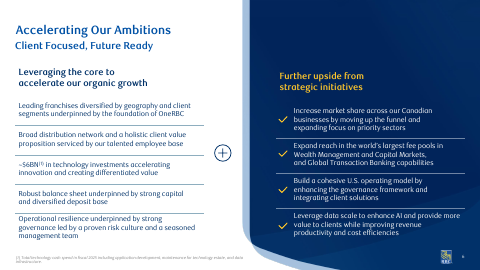
    Technology platforms across commercial banking, RBC Clear in Capital Markets and City National will sit under one leader, with organizational changes over the next 60 to 90 days. Management cites cross-border trade flows and modernizing payments through tokenization and stablecoin, and says it will publish KPIs later.

  2. AI build-out lending is meant to anchor cross-sell

    Capital Markets frames financing for data centers, power and critical minerals as a first step that pulls in cash management deposits, debt and equity origination, trading and wealth. Management says it expects this opportunity to be sustainable.

  3. AI spend is targeted at advisor and back-office productivity

    Wealth Management says its AI use cases, from advisor productivity to back-office streamlining and investment signals, are funded within its existing envelope with no required step-up. The bank-wide goal is $700 million to $1 billion in AI enterprise value by the end of fiscal 2027.

  4. Retail momentum and HSBC Canada integration are on track

    Mortgage growth rose to 1.8% sequentially on higher switch volumes and retention, and RBC launched cashback products and a Hopper travel partnership. HSBC Canada client attrition is well below modeled levels, and clients are deepening relationships.

  5. Organic growth comes first; U.S. tuck-ins stay optional

    Management prioritizes organic lending growth, buybacks and City National expansion into new markets, while holding the door open to U.S. commercial or wealth scale. It says it will act only if the deal creates meaningful shareholder value, with CET1 trending toward the middle of a lower range.

What management said

Each quote matches the transcript word for word.

“we felt that we wanted to integrate that technology platform and bring it under one common leader to to not only create efficiencies, but enable a more focused go-to-market strategy with our clients globally as we segment.”

It explains why the transaction banking businesses are being combined and what management expects to gain.

0:30:37 · Dave McKay (CEO)

“Clearly, as we're growing our loan book, we are connecting the dots with our cash management business and growing deposits as part of that.”

It shows the lending-to-deposits cross-sell logic behind the corporate growth strategy.

0:30:01 · Derek Nelner (Executive)

“So within all of that, that's all within our existing funding envelope, and we do not see any required step-up.”

It signals Wealth Management expects scale and AI to lift margins without extra investment spend.

0:37:01 · Neal McLaughlin (Executive)

“We're keeping capital for growth, and we're also keeping capital because there's a little bit of instability in the geopolitics world right now”

It clarifies that excess capital is not a signal of an imminent acquisition.

0:44:54 · Dave McKay (CEO)

“we expect Canadian banking margins to be relatively stable, with structural tailwinds offset by increased competition for mortgages and term deposits.”

It names competition in mortgages and term deposits as a constraint on Canadian margins.

0:21:39 · Catherine Gibson (CFO)

“we are well below our targeted, you know, attrition rates that we would have modeled during the due diligence.”

It is direct evidence that HSBC Canada commercial clients are staying.

0:50:33 · Paul Holden (CIBC)

Analyst Q&A

  1. 0:27:37 · Ibrahim Panawala, Bank of America · AI capex, transaction banking

    How does the AI capex cycle benefit RBC beyond one-off deals, and where does RBC have a right to win in global transaction banking?

    Management said AI build-out lending anchors cross-sell into deposits, investment banking, trading and wealth, and that RBC's technology, deposit base and corporate relationships give it a right to win in global transaction banking. — Derek Nelner, Dave McKay, Shana Madaguchi

  2. 0:34:40 · John Aiken, Jefferies · Wealth margins

    Will Wealth Management need a step-up in investment, or will scale keep lifting pre-tax margins?

    Management said scale benefits are growing and that technology and AI investment sits within the existing funding envelope with no required step-up. — Neal McLaughlin

  3. 0:37:34 · Stephen Boland, Raymond James · Transaction banking KPIs

    How will the global transaction banking initiative be implemented and measured?

    Organizational changes will take 60 to 90 days, the businesses will keep reporting in existing segments, and new KPIs will be published later. — Derek Nelner

  4. 0:39:24 · Gabriel DeShane, National Bank Financial · Capital Markets ROE

    When will balance sheet intensity in Capital Markets ease so that ROE improves?

    Management said Capital Markets ROE is well ahead of its 14% by 2027 target, that revenue to RWA is improving, and that some balance sheet deployment is building medium-term client franchises. — Derek Nelner

  5. 0:42:18 · Gabriel DeShane, National Bank Financial · M&A

    How does RBC define a tuck-in acquisition and what would it take to do something larger?

    The CEO said organic growth, buybacks and capital for growth come first, and acquisitions would happen only if they create meaningful shareholder value. — Dave McKay

  6. 0:45:30 · Mario Mandunka, BofA Securities · Net interest margin

    Why isn't RBC's deposit franchise driving stronger net interest margin and NII growth relative to peers?

    The CFO pointed to Capital Markets items and the earn-through of HSBC Canada purchase price adjustments, said underlying NII is growing 7%, and expects a stable margin into the fourth quarter. — Catherine Gibson

  7. 0:48:06 · Paul Holden, CIBC · Commercial loans

    Why is commercial loan growth less strong than some peers, and what are the competitive dynamics?

    Commercial loan growth of 1.2% doubled from last quarter, July was the strongest month in a year, and pipelines are strong in agriculture, healthcare, public sector and real estate. — Shana Madaguchi

  8. 0:50:33 · Paul Holden, CIBC · HSBC Canada retention

    Is HSBC Canada client retention in line with or better than expected?

    Commercial attrition is well below modeled levels and retail retention is at or slightly ahead of plan, with relationship depth still building. — Shana Madaguchi, Erica Nielsen

  9. 0:52:21 · Mike Resvenovich, Scotiabank · Capital ratio

    Could RBC's CET1 ratio fall toward about 12% over two to three years after the buffer change?

    The CEO said RBC is being prudent given geopolitical uncertainty but expects to bring CET1 down toward the 12.5% to 13.5% range, potentially lower, through organic growth and buybacks. — Dave McKay

  10. 0:53:41 · Mike Resvenovich, Scotiabank · City National

    Is City National's next leg of growth organic or will RBC add capabilities through acquisitions?

    Management said it is pursuing organic growth through new teams and products, but would add scale in the U.S. if there is a confident playbook that takes out costs. — Dave McKay

Questions

What is RBC's global transaction banking strategy?

RBC is combining the technology and cash management businesses across commercial banking, RBC Clear in Capital Markets and City National under one leader. The goal is a more focused go-to-market for cross-border clients, with organizational changes over 60 to 90 days and new KPIs to follow.

How is RBC positioning for the AI investment cycle?

Capital Markets sees AI-related financing in data centers, power, energy and critical minerals as a way to anchor lending relationships and cross-sell cash management, investment banking, trading and wealth. Separately, the bank targets $700 million to $1 billion of enterprise value from its own AI efforts by the end of fiscal 2027.

How are RBC's Canadian retail and HSBC Canada integration progressing?

Mortgage growth picked up to 1.8% sequentially on higher switch volumes and retention, and RBC launched cashback products and a Hopper travel partnership. HSBC Canada client attrition is well below the levels modeled in due diligence.

Is RBC planning acquisitions?

Management says organic growth and buybacks come first, and it would pursue U.S. commercial or wealth scale only if it creates meaningful shareholder value. It is also selling its half of Moneris with BMO to Francisco Partners, with new exclusive referral arrangements.

What competitive and credit risks did management flag?

Canadian banking margins are expected to be stable as structural tailwinds are offset by competition for mortgages and term deposits. Impaired loans rose in Capital Markets real estate and in City National utilities, and new U.S. Section 338 tariffs add sector-specific pressure.

Transcript

Call recording on YouTube ↗. Official replay ↗. Timestamps jump to the moment.

0:00:00
Operator

Good morning ladies and gentlemen. Welcome to the RBC's 2026 Third Quarter Results Conference Call. Please be advised that this call is being recorded. All lines have been placed on mute to prevent any background noise. After the speaker's remarks, there will be a question and answer session. If you would like to ask a question during this time, simply press star followed by the number one on your telephone keypad. If you would like to withdraw your question, press star one again.

0:00:28

I would now like to turn the meeting over to Asim Imran. Please go ahead.

0:00:34
Asim Imran (Investor Relations)

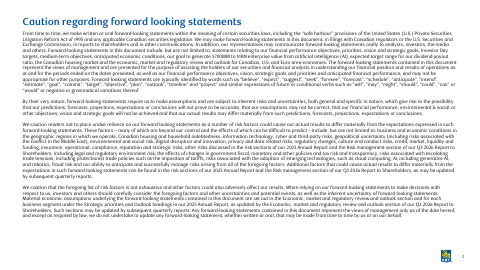
Thank you and good morning everyone. Speaking today will be Dave McKay, President and Chief Executive Officer, Catherine Gibson, Chief Financial Officer, and Graham Hepworth, Chief Risk Officer. Also joining us today for your questions, Erica Nielsen, Group Head Personal Banking, Shana Madaguchi, Group Head Commercial Banking, Neal McLaughlin, Group Head Wealth Management and Insurance, and Derek Nelner, Group Head Capital Markets. As noted on slide two, our comments may contain forward-looking statements, which involve assumptions and have inherent risks and uncertainties.

0:01:06

Actual results could differ materially. I would also remind listeners that the bank assesses its performance on a reported and adjusted basis and considers both to be useful in assessing underlying business performance. To give everyone a chance to ask questions, we ask that you limit your questions and then re-queue. With that, I'll turn it over to Dave.

0:01:26
Dave McKay (CEO)

Thank you, Austin. Good morning, everyone, and thank you for joining us. Today, we reported very strong results, including record earnings of $6 billion off 11 % year-over-year.

0:01:38

Revenues grew by 9 % year-over-year as we further increased our revenue productivity while also deploying our balance sheet for client-driven growth. Furthermore, our relatively equal weightings between non-interest revenue and net interest income income provides us with an attractive business mix. We also improved our cost efficiency, generating an adjusted operating leverage of 2.4 % and adjusted efficiency ratio of 52%. These results reflect three forces working together, diversified business model, strong client activity, and a favorable market backdrop.

0:02:17

This was enabled by a disciplined execution of well-articulated strategies, investments in talent and technology, and deployment of our balance sheet. Our performance this quarter delivered a premium return on equity of nearly 18 % and broad-based growth while maintaining a robust 13.5 % common equity tier one ratio. This combination continues to generate sustainable long-term shareholder value, and this was evidence by the 10 % year-over-year growth in book value per share and 80 basis points of internal capital generation this quarter, or three percentage points over the last 12 months.

0:02:55

We deployed 85 basis points of capital in the quarter to grow our business, pay dividends, and buy back our stock. As always, we continue to prioritize the deployment of our balance sheet towards client-driven organic growth. As we mentioned earlier this year, we are looking to continue building for bank of the future. That means growing market share and laying the foundation for new growth verticals and relationships to diversify the business and create future value. These create a flywheel of multiplier effect for driving durable ancillary revenue streams.

0:03:31

Our integrated platform, client trust and market leadership helps us earn the recognition as both Canada's and North America's Best Bank and Euro Money's 2026 Awards for Excellence. We also continue to return capital to our shareholders. Our total payout ratio increased to 69 % this quarter as we grow our dividends towards the midpoint of our medium-term dividend payout ratio objective of 40 % to 50%. We're also buying back our stock in a disciplined manner as we look to optimize ROE, EPS growth, and compound book value for share growth in a multi-tiered operating environment.

0:04:08

Taking a step back to look at the global landscape, market conditions have remained largely constructive, with megatrends continuing to shape critical sectors, including natural resources, power infrastructure, strategic defense, healthcare, and the AI ecosystem. These trends support increased client activity for our capital markets and wealth management segments. On the left, elevated bond yields across many large economies are creating fiscal challenges and refinancing risks for both governments and corporations. Now a few comments on the outlook for Canada.

0:04:43

The Canadian economy and labour market have performed well, having already absorbed multiple shocks over the past 18 months. Our clients have also continued to spend and delinquencies remain well controlled. Looking forward, the implementation of the recently announced Section 338 tariffs could impact approximately 40 basis points of Canadian GDP, with a larger impact on certain sectors and provinces. While Canada and the U .S. have yet to come to a longer-term solution, we note the average effective tariff rate remains low at approximately 6%, with over 80 % of exports remaining duty-free.

0:05:19

Furthermore, the government has announced substantial support packages leveraging Canada's significant financial flexibility. The median-term opportunity remains more meaningful. We look forward to working with all stakeholders on the development of major nation-building projects and we are pleased to see advancements, support of Montreal expansion and shift-building contracts. Increased foreign direct investment and new trade relationships add to our optimism. We believe we are well positioned to navigate near-term uncertainty while supporting our clients growth aspirations given the strength of a balance sheet and diversified business model with this context I will now speak to the drivers behind our strong segment results with a focus on four key factors first our leading award-winning franchises that are laser focused on client

0:06:05

needs second our strategies that position us to benefit from our significant data scale structural growth opportunities and client activity third the targeted connectivity of balance sheet scale client acquisition and deepening client relationships and for operating scale that underpins our premium risk adjusted profitability moving to slide 5 personal banking Canada reported record revenue this quarter and remains the preeminent franchise in the country with leading market share and personal lending total deposits and investments it's encouraging to see higher switch volumes and strong retention driving a significant uptick in sequential mortgage growth to 1.8 percent the highest in their acquisition of HSBC Bank of Canada, for Bank Canada.

0:06:50

Credit card balances increased 7 % from last year. The quarter, we're having rewards at a record number of new accounts acquired. We also launched new cashback products as well as our partnership with Hopper, which will bring a world-class travel booking platform and innovative travel offerings to the Canadian market. Also, the aggregate of average retail deposits and mutual fund AUA increased 8%, or $47 $1 billion year-over-year with net money inflows positive for the quarter.

0:07:20

Ultimately, this repositioning primarily out-of-term deposits to fee-based investments benefits both the client and the bank. Commercial banking is leading market share in both loans and deposits across client categories. This segment generated record net income this quarter, underpinning an ROE of 18.6 % in an environment of trade uncertainty and geopolitical risks, weighing on business activity and client sentiment, particularly in real estate, supply chain, and consumer sectors within Ontario and British Columbia. However, this quarter showed an uptick in sequential loan growth to 1.2%, partly due to growth pockets in agriculture, healthcare, and the public sector, as well as HST rebates in the real estate sector.

0:08:07

Deposit growth was very strong at 9 % year over year, benefiting from increased client coverage and improved sales productivity. There was also ancillary fee-based benefits to this volume growth as client activity drove double-digit transaction banking revenue growth across FX and cash management fees. RBC Capital Markets is the leading franchise in our home market, a top 10 global investment bank, and was recently named Canada's best investment bank by Euromoney. This segment reported record revenue in net income this quarter, while generating an ROE of 14.5%.

0:08:41

Investment banking revenue increased 23 % from last year, and our market share over the last 12 months grew to 2.1%, benefiting from higher origination and M &A activity across most regions. Strong lending growth in corporate banking was largely driven by higher investment-grade loans and securitization finance in support of our clients' growth aspirations. This drove increased opportunities to cross-sell into advisory origination and sales and trading and intermediation activities. Our average investment banking fee per client and average fee per senior banker continue to increase, demonstrating our monetization, expanded client connectivity, as well as continued talent investments and balance sheet productivity overall, driving stronger returns.

0:09:29

Global market revenue was up 11 % from last year, underpinned by growing momentum in our equities franchise, where we reported strong market share gains in equity derivatives. As we noted, at our investor day, growing our equity financing capabilities is a strategic imperative. We grew these volumes 40 % compared to last year. We continue to leverage our strong balance sheet, credit rating, and brand to drive these strategies which have robust returns on equity. Looking ahead, our pipeline remains healthy in a constructive environment and our ongoing growth initiatives support our client-focused strategies.

0:10:03

Wealth Management also reported record revenue in its net income this quarter, benefiting from its diversified revenue streams as clients came to us for trusted advice, service and solutions in an evolving environment. Starting with our wealth advisory businesses, RBC Dominion Securities, which is the largest Canadian wealth management franchise, was recently recognized by its advisors as the highest rated bank owned investment dealer in Canada and investment executive's brokerage report card for the 20th consecutive year. Our U .S.

0:10:33

wealth advisory business, the sixth largest U .S. wealth advisory firm, recently ranked fourth in J .D. Power's advisory satisfaction ranking. Canadian Wealth Management and U .S. Wealth Management, AUA, increased 20 % and 14 % respectively, benefiting from both market appreciation as well as net new assets this quarter. NRVC Direct Investing, our self-directed platform, benefited from nearly a 40 % year-over-year increase in trading volumes partly due to successful launch of GoSmart earlier this year.

0:11:04

Our wealth management platforms also benefited from higher deposits in our Canadian business and an 18 % year-over-year growth in credit and lending balances in our U .S. wealth advisory franchise. Our new advisor hiring pipeline continues to be strong, positioning us well for future revenue growth. As the largest Canadian retail mutual funds franchise, RBC Global Asset Management increased assets under management by 13 % year-over-year through constructive markets and leading mutual fund net sales.

0:11:34

In addition, the RBCI Shares Alliance led the industry with respect to long-term ETF net sales of $10 billion for calendar Q2 2026, while currently announcing the expansion of its lineup of fixed-income solutions as we continue to expand into private markets. I'll now cover a few of the key initiatives that will underpin our next leg of profitable growth with a more detailed update to come in Q4. We have an ambition to build a global transaction banking business with an end-to-end offering that allows us to service our business and wholesale clients as they operate seamlessly across borders in a world of evolving trade connections.

0:12:13

Secondly, our U .S. region efficiency ratio has improved to 75 % year-to-date, moving us closer towards our target in the low 70s. As part of this success, City National Bank's net income increased to US $184 million this quarter, benefiting from 8 % loan growth and 5 % deposit growth, as we continue to add teams and execute well for our clients. And third, we're also accelerating at the execution around our AI ambitions, as we build towards generating $700 million to $1 billion in enterprise value by the end of fiscal 2027.

0:12:47

We are leveraging our advantages in data scale, client relationships, execution capabilities, and nearly a decade of investments in our Borealis Research Institute. And with that, Catherine, over to you.

0:13:00
Catherine Gibson (CFO)

Thanks, Dave, and good morning, everyone. Starting with slide seven, we delivered record results this quarter. We diluted earnings per share of $4.23. Adjusted diluted earnings per share of $4.28 was up 11 % from last year, reflecting record revenues across most of our segments and all bank operating leverage of 3%.

0:13:21

Turning to capital on slide eight, our CT1 ratios remain flat at 13.5%. We generated ROE of 17.9%, underpinning strong capital generation of 80 basis points this quarter. After dividends and strong client-driven growth, primarily in corporate lending, credit cards, and residential mortgages, complemented by higher market-related exposures in capital market, we generated 16 basis points of net capital. This is largely absorbed by the repurchase of 5.6 million shares for approximately $1.6 billion.

0:13:59

Lastly, the previously announced oil of Moneris is expected to contribute approximately 10 basis points to CT1 in the first quarter of 2027, while the run rate earnings impact is not expected to be significant. Moving to slide 9, all bank net interest income grew 5 % from last year. Excluding trading net interest income, all bank net interest income was up 7%. Further excluding the impact of certain transactions in capital markets that carry related offsets and other non-interest income, as well as excluding lower purchase price adjacent adjustments or PPA related to the acquisition of HSBC Canada, our all-bank net interest income was up 11%.

0:14:47

This reflected solid volume growth across our largest segment, including personal banking, commercial banking, and wealth management. We also continue to benefit from our deposit tracker strategy. The sequential decline of four basis points in all bank NIM, excluding trading, was largely due to capital markets, including the aforementioned transactions, as well as lower loan book spreads, including a shift towards investment-grade loans. Trading on interest income was down $178 million, or 27%, from last year, driven by higher financing volumes in capital markets, as Dave noted earlier.

0:15:29

This was more than offset in trading non-interest income. Total non-interest income was up 13%, driven largely by higher fee-based revenues and wealth management in capital markets. Moving to slide 10, recorded non-interest income was up 6 % from last year and up 7 % on an adjusted basis. Higher variable compensation, consistent with higher revenues, drove more than half of the growth. Higher salaries was the second largest driver of the growth as we continue to invest in our talent, including in capital markets, wealth management, and personal banking.

0:16:09

The remainder of the increase reflected technology-related spend, including safety and soundness initiatives and digital tools, as well as higher marketing investments, including new brand partnerships. Moving to taxes, the adjusted non-TED effective tax rate increased by one percentage point to 22.3%, reflecting changes in earnings mix. I'll now turn to our Q3 statement results, which begin on slide 11. Personal banking generated $1.9 billion of earnings this quarter. Personal banking Canada net income was down 1 % from last year.

0:16:47

Revenue was a record, up 4 % from last year. Net interest income was up 5 % as we earned through the impacts of lower HSBC Canada-related PPA. Excluding this, our net interest income was up 8 % from last year, driven by 4 % loan growth and higher margins. Non-interest income was up 3%, driven by growth and mutual fund distribution fees, underpinned by higher fee-based assets. This is partly offset by lower service charges, largely reflecting the impact of regulatory changes that we guided to previously.

0:17:24

Expenses were up 9%, including higher stock-related costs and the timing of investments in technology and marketing. This included digital and AI initiatives, as well as client acquisition and engagement campaigns. Turning to slide 12, commercial banking net income was a record $936 million, up 12 % from last year, underpinned by record pre-provision, pre-tax earnings of $1.5 billion. Revenue was up 5%, primarily reflecting higher net interest income growth, driven by higher volumes and margins.

0:18:02

Commercial banking loan-to-deposit ratio improved three percentage points from last year to 58%. Our deposits grew 9 % from last year and 6 % sequentially, reflecting growth in non-maturity deposits. Loans were up 4 % from last year and 1 % sequentially, as growth accelerated among our larger clients and in certain sectors. I'll now make a few comments on our combined Canadian banking segment. Non-interest income was up 5 % from last year or up 7%, excluding the impacts of lower HSBC Canada-related PPA.

0:18:39

NIM was down three basis points from last quarter. This is primarily reflecting the seasonally higher lending spreads we noted in the prior quarter. Lastly, our combined Canadian banking segments generated a leading efficiency ratio of 37%. This quarter's negative operating leverage of 3 % largely reflected lower HSBC Canada-related PPA, the impact of regulatory changes, and the timing investments in personal banking. Our year-to-date operating leverage remained strong at 2%. Turning to wealth management on slide 13, net income of $1.4 billion was up 32 % from last year, reflecting record revenue and a strong pre-tax margin of 29.3%, which was up 8 percentage points from last year.

0:19:31

Non-interest income was up 16%, underpinned by market appreciation, positive net sales, and net new assets across most regions. Higher transactional revenue also contributed to the increase, with increased activity in Canadian wealth management, including our direct investing business. Net interest income was up 16 % from last year, benefiting from deposit growth in Canadian wealth management and higher spreads in loan volumes in U .S. wealth management, including city national banks. Turning to capital markets on slide 14, record net income of $1.5 billion was up 16 % from last year.

0:20:13

Pre-provision pre-tax earnings of $2 billion was also record, driven by strong revenue momentum across all businesses and efficiency ratio improvement of three percentage points. Global markets performance remained strong with revenue up 11 % from last year, reflecting continued momentum in equity trading and strength in our non-trading and financing portfolios. This is partly offset by headwinds in rates trading amid muted client activity. Corporate and investment banking revenue was a record, up 16 % from last year, with investment banking revenue up 23 % from last year, reflecting record levels of activity.

0:20:58

Lending and transaction banking revenue was up 10%, driven partly by strong growth in loans and in deposits. Turning to slide 15, insurance net income of $197 million was down 20 % from last year, largely due to lower insurance service results. This is primarily a result of favorable longevity reinsurance adjustments and recaptures in the prior year. A premium of deposits grew up 9 % from last year, reflecting higher segregated funds and through the new scale. To conclude, we reiterate our full year target while remaining mindful of the evolving macro environment.

0:21:39

All based net interest income, excluding trading, is up 7 % year-to-date and on track to deliver against our mid-single-digit range guidance. Looking ahead to next quarter, we expect Canadian banking margins to be relatively stable, with structural tailwinds offset by increased competition for mortgages and term deposits. Expense growth of 5 % year-to-date remains consistent with our mid-single-digit range guidance, We continue to expect positive all-bank operating leverage for the full year, including 1 % to 2 % in Canadian banking.

0:22:16

As a reminder, we continue to expect the non-TED effective tax rate to move towards the higher end of our 21 % to 23 % guided range over the coming quarters. Lastly, following the recent change in the domestic stability buffer, we now expect the CT1 ratio to trend towards a midpoint of a 12.5 % to 13.5 % range over time, as we look to drive organic growth, increase our dividends, and execute share buybacks at a similar cadence to the last couple of quarters.

0:22:49

With that, I'll now turn it over to Graham.

0:22:52
Graham Hepworth (Executive)

Thank you, Catherine, and good morning, everyone. I'll now discuss our allowances in the context of the current macroeconomic environment, continued geopolitical tensions and ongoing trade developments. As Jane noted earlier, the Canadian economy has proven to be resilient. With the improvements in employment and GDP seen in Q2, we maintain a cautiously optimistic outlook that the economy will continue to expand. Likewise, the U .S. economy has demonstrated strong productivity growth and lower employment rates.

0:23:20

The geopolitical risks remain as significant sources of economic and credit uncertainty. This stems from two key areas. First, the impact of evolving and uncertain trade policy, and second, the inflationary pressures arising from the ongoing conflicts in the Middle East. On the trade front, improvement moving to an annual review cycle has left tariff exemptions intact for goods and services covenant act. Nevertheless, last week we saw the implementation of new section 3-3 tariffs on fee and exports to the U .S.

0:23:47

As it applies to a narrow base of Canadian products, these tariffs alone are not expected to meaningfully change our overall economic forecast. The economic impact ultimately depends on how long the new tariffs remain in place, any potential retaliatory tariffs, and potential government support measures provided to affected workers and businesses. Against its backdrop, we continue to lean on our robust credit underwriting and provisioning processes. For allowances, we have prudently retained elevated weighting toward downside scenarios, including our trade disruption scenario, which contemplates a North American recession driven by an escalating global trade war and rising geopolitical risks.

0:24:23

During the slide 17, we took a total of 21 million, or one basis point of provision, on performing loans this quarter. This was predominantly driven by portfolio growth in personal banking and capital markets, partially offset by favorable changes in our macroeconomic forecasts, largely in the U .S. region. Moving to slide 18, gross impaired loans were up 353 million, or one basis point from last quarter, primarily driven by capital markets and wealth management, and offset by low impaired loans in commercial banking.

0:24:51

In capital markets, gross impaired loans increased by $466 million, largely due to impaired loans in the real estate and related sector. These borrowers are part of a subset of our commercial real estate portfolio, which we expect will face continued impact from ongoing sector headwinds in the near term. The facility's impact are structured to minimize losses and therefore were not a key driver of PCL this quarter. And while management impaired loans, predominantly City National Bank, increased $114 million, primarily driven by the utilities sector.

0:25:21

In commercial banking, impaired loans are down $241 million over the quarter, so we are seeing lower impairments in the real estate and related and consumer discretionary sectors. As a reminder, impairments in our wholesale portfolios are inherently more difficult to protect and can be episodic. However, while risk continues to be elevated, we are seeing modest improvements in credit quality across the wholesale portfolio. Turning to slide 19, PCL and impaired loans have 35 basis points, with up one basis point, or 80 million quarter-over-quarter, and remains in line with our expectations.

0:25:54

In capital markets, provisions were up 148 billion quarter-over-quarter. The largest graduate provisions this quarter relate to a former investment trade borer in the other services sector, more specifically in the utility space, and we were originally impaired in the first quarter of 2025. Recent changes in the political environment have significantly increased on surge around the path to resolution on this file. Accordingly, we are prudently taking an additional $120 million provisions while recognizing that the ultimate outcome remains uncertain.

0:26:22

In the commercial portfolio, while PCL and impaired loans remains elevated compared to historical levels, we have seen improving loss trends over the last three quarters. Additionally, retail credit indicators are showing signs of stabilization. Proviniencies in unsecured products, particularly credit cards, remain elevated that have leveled off from last quarter. In our home equity finance portfolio, while we continue to manage near-term renewal risks, we are encouraged by recent improvements in impairment formations. To conclude, despite various geopolitical and trade headwinds over the last few quarters, Canada's economy has shown signs of stabilization, driven by resilient household spending, recovering business investment, and expanding their trade.

0:27:04

Although sector is directly targeted by U .S. tariffs to date have faced headwinds, The impacts have remained contained and have not spread to the overall economy. Internally, as noted previously, credit indicators have generally been stable or improving. We are pleased with the performance of our loan portfolio this quarter. We expect our overall full-year 2026 provisions on employee loans to remain within the range we previously guided to. And now back to Dave.

0:27:32
Dave McKay (CEO)

Okay. We can take Q &A now.

0:27:37
Operator

At this time, I would like to remind everyone, in order to ask a question, press star, then the number one on your telephone keypad. And your first question comes from the line of Ibrahim Panawala with Bank of America. Please go ahead.

0:27:53
Ibrahim Panawala (Bank of America)

Hey, good morning. I had a two-part question since you want to limit questions, but both with the angle of trying to understand where Royal can outperform peers on growth. So maybe for Dave or Derek, one, talk to us in terms of what the AI CapEx cycle means for Royal.

0:28:13

Yes, you were on some of these IPOs, debt issuance, but is there something more lasting when we think about lending, deposits, wealth management that this AI cycle can create? And we just heard NVIDIA last night talk about growth into the next couple of years. So trying to understand if we should view Royal on the revenue side as a beneficiary of what's going on with the AI CapEx build-out. And second, you made a big splash of the global transaction banking.

0:28:41

Just to summarize for us where you think Royal has the right to win in an area that is intensely competitive.

0:28:50
Derek Nelner (Executive)

Sure. Thanks, Adrian. It's Derek. I'll maybe take your first question on the AI CapEx cycle. I think certainly it's an area that's obviously driving tremendous growth, and we do think it will be a unique growth opportunity for us where we are positioned to drive differentiated performance. So if I step back from that or unpack that a little bit, obviously the AI build-out is impacting a variety of sectors from technology to data centers to power, to energy, to critical minerals.

0:29:24

Those are all areas where we feel we have strengths today, areas we've been investing over time and areas where we're bringing together our collective expertise very well in our view. When we then look at those areas of opportunity and how they connect to our businesses, obviously there's a lot of financing required for the build-out. Given our size and scale and AA balance sheet, It's an opportunity for us to support clients initially with lending, and you've seen that come through in some very strong loan growth for us year over year, but importantly then, you know, anchoring that lending and those relationships into other businesses.

0:30:01

You mentioned GTV. Clearly, as we're growing our loan book, we are connecting the dots with our cash management business and growing deposits as part of that. We're obviously tying that to investment banking activity where we had very good results this corridor, both across DCM, ECM, Project Finance, and advisory. And then that obviously has ancillary benefits into our trading businesses and also into our wealth franchise. So in totality, there's a very big opportunity, and we think we're positioned well to capitalize on it, and we do think it will be sustainable.

0:30:37
Dave McKay (CEO)

Here on this, Dave, maybe I'll give some of the rationale behind creating this global transaction banking business and integrating it across platforms and I'll hand it to Sean and Derek for more specific comments about the competitive rationale but we do have aspirations to compete globally we have invested heavily in technology platforms across commercial banking obviously RBC clear and capital markets that Derek just spoke to and our city national franchise and we felt that we wanted to integrate that technology platform and bring it under one common leader to to not only create efficiencies, but enable a more focused go-to-market strategy with our clients globally as we segment.

0:31:20

So this allows us to be more efficient and bring our technology to our customers across the market more efficiently, and our aspiration is to really serve a more globally connected bank, globally connected customer from RBC. And we see the world moving to create more global trade relationships and more global cross-border flow, and also enabling the group to look at modernizing payments through tokenization and stablecoin. So that's the strategy behind it. We are very optimistic about it.

0:31:50

We think we have and we believe we have the right to win. We're a significant creditor to a very large corporate loan book and commercial loan book and City National is growing their corporate and commercial loan book, and therefore we're part of syndicates. We have relationships with these customers, and we feel we have, with modern technology, the right to ask for the cross-sell into the global transaction banking capability. So with that, maybe Sean and then Derek some comments about specific competition.

0:32:20
Shana Madaguchi (Executive)

Yeah, thanks, David. Sean speaking. So we've assessed the opportunity here. We started by looking at where are we today, and ultimately we've got an exceptionally strong foundation across Canada and increasingly in the U .S. as Dave mentioned. As you saw in our results, approaching $340 billion in Canadian deposits across all segments of the business and wholesale landscape. We've invested heavily, as Dave has mentioned, to build leading cash management platforms here and in the U .S. with Edge and Clear.

0:32:53

We now have the most comprehensive product suite across the cash management, treasury, and trade landscape. And then when we start thinking about our clients and client needs across all segments, the clients are expecting more connected and integrated experiences. They also want less friction when they're dealing with us across borders. And clients of all sizes across all sectors and segments increasingly are operating internationally. And this is about supporting client needs and accelerating, I'd say, our growth ambitions across the transaction banking landscape.

0:33:30

across regions and ultimately this leads to you know some of our long-standing focuses of our organization deposit strength funding advantage and growing kind of fee resilient businesses and ROE expansion for the enterprise

0:33:43
Derek Nelner (Executive)

I would just briefly add in terms of a Competitive market but where we feel we have a right to win You know beyond building on Sean's comments on the very strong foundation. We obviously enjoying Canada And I think we've seen very good success in our build-up of RBC Clear, and we look forward to providing a more detailed update at Q4, but needless to say, we're tracking ahead of our plans.

0:34:10

We're seeing very good results in terms of new client onboarding, the growth of deposits and the profitability that's coming with that. And so, you know, that track record now of two years entering a new market in the transaction banking business and the success we're seeing to date gives us confidence we can continue to build off that, not just in North America, but over time in other regions. Excuse me, comprehensive.

0:34:35
Operator

Thank you. Your next question comes from the line of John Aiken with Jeffries.

0:34:40

Please go ahead.

0:34:41
John Aiken (Jefferies)

Morning. I wanted to talk about the wealth management pre-tax margins. Now, I know the court benefited from the reserve release, but basically what we've seen over the last two years, as Dave highlighted in his comments, very significant growth in AUA, AUM, that's leading to operating leverage and benefiting the segment. Where I'm going with this is, you know, with this growth, are we going to see a necessary step of investment in the segment to perpetuate this, or are we at a level now where we're actually going to see the scale benefiting and potentially see that margin continue to increase?

0:35:19
Neal McLaughlin (Executive)

Yeah, thanks for the question. So, look, overall, in terms of pre-tax margin, what you're seeing, you know, maybe just start with our World Canada franchise. We heard Dave's comments. I mean, this is the number one platform, you know, in Canada. We're actually larger than our number two and three competitors put together. So, we do have a scale advantage there, and that continues to grow in terms of just a fixed cost base in terms of, you know, as we're competing and having these assets continue to grow, you know, We're getting some real scale benefit in our Canadian business.

0:35:52

You also heard in some of the comments a very updraft direct investing franchise, both in terms of adding new clients but also seeing much steeper client activity in terms of trades per day. So these are all very positive, I'd say, you know, revenue and top line, you know, benefits in terms of the pre-tax margin. In terms of, you know, do we expect to see a step up as investment? Right now, we have been investing fairly consistently across our wealth franchises in terms of technology.

0:36:26

We do not expect to have a required sort of step-up in non-investment. And then even within that envelope, we are funding our AI use cases, probably first and foremost, to make better productivity for those same advisors so they can go out and spend more time connecting with clients, continue to grow those individual portfolios, do better for the client, and obviously better for the enterprise. And then also in our back office, being able to streamline our processes, think end-to-end, take costs down, increase our service levels.

0:37:01

And then the last portion is our AI for Alpha and making sure that our global asset management business is getting the best signal they can and embedding that into the 30-plus customized investment processes to generate alpha. So within all of that, that's all within our existing funding envelope, and we do not see any required step-up.

0:37:24
John Aiken (Jefferies)

Great. Thanks for the call.

0:37:26
Operator

Your next question comes from the line of Stephen Boland with Raymond James. Please go ahead.

0:37:34
Stephen Boland (Raymond James)

Good morning. I'm going to follow up on the GTB announcement. I think that was a good, comprehensive answer. I'm just wondering about implementation, timing of this, and how do we measure success in this initiative? Is it just going to be kind of buried in the loan growth numbers, maybe the deposit numbers? What metrics are you looking for to show that this initiative is actually taking traction? I'm not sure who wants to take that. Sure, Steve. It's Derek.

0:38:04

I'll start, and Sean can add. Very good question. In terms of implementation, so we have, you know, well-established businesses today that individually are all doing very well. And so we've got great momentum. We see an even bigger prize over time that we can get after, but we're very pleased at how all the businesses are doing right now, and we're going to try to ensure we don't disrupt that strong momentum in any way. So we'll be bringing the businesses together.

0:38:34

it will be some organizational changes around that we'll be working through that over the next 60 to 90 days and we think it'll be a fairly seamless transition to take those existing businesses into a unified offering importantly for our clients and as well for our teams we've obviously done a lot of work looking at what we think the opportunity is in North America and beyond as we bring this business together we will be crystallizing those targets and over time we'll look to come out with different KPIs to address your exact point so I'd say stay tuned but definitely you know there will well this will continue to be reported in the existing segments today we will be coming out with

0:39:24
Derek Nelner (Executive)

KPIs to track how the broader GTP initiative is proceeding

0:39:28
Operator

Your next question comes from the line of Gabriel DeShane with National Bank Financial. Please go ahead.

0:39:35
Gabriel DeShane (National Bank Financial)

Hey, good morning. I'm not, you know, the 18 % ROE is great, so it's a little bit odd to, you know, maybe poke holes into it. And what I mean by that is the capital markets business is, unlike other banks, has not really been enhancing the ROE to the same degree.

0:39:56

That's because of the capital intensity of that business we've seen over the past year or two, more corporate lending, balance sheet expansion. I understand the motivation behind that strategy. I'm just wondering when do you expect the inflection point, the balance sheet intensity to maybe calm down a little bit and then the lower capital intensity revenue items moving higher and the ROE following that.

0:40:25
Derek Nelner (Executive)

Sure. Thanks, David. It's Derek. I'll address that. First, just a couple of sort of comments I would make.

0:40:34

One, as you're probably aware, different banks have different approaches to capital allocation to the businesses. So it's a little bit apples and oranges when you compare the capital markets ROEs across piers. I think to your point, though, it's very important to look over time at how has that been progressing. If you look back, and again, we've had our own changes to capital attribution in recent years. If you look back and you normalize that, we've seen very significant expansion of the capital markets, are we really going back to 2019-2020?

0:41:08

As you'll recall, at Investor Day, we put out a target of 14 % by 2027. We're operating well ahead of that this year, so we feel very pleased about how we've been able to continue on that trajectory. And even year-to-date, you know, we've obviously seen a good lift in ROE, but when we look at our revenue to RWA, again, very good progression in those metrics. The strategy obviously is to continue to improve that. We feel very confident in our ability to do it.

0:41:39

Part of that comes from the mix of non-lending versus lending. I would just highlight that, again, if you come back to the very strong balance sheet growth we've seen year-to-date, some of that gets monetized in the very near term because there's a direct linkage between the capital you provide and and and so very business but some of that is building for the long term and that's where we see very good opportunities where some of the balance sheet deployment right now is really building our medium term client franchises and we feel very confident that you know as we've seen in the last number of years we'll continue to see that monetization ratio comes through and strengthen our franchises

0:42:18

over time

0:42:19
Gabriel DeShane (National Bank Financial)

I guess it's different than a different approach. You learned from the past, a long time ago, admittedly, but we saw the corporate loan book growing by a lot, and then there was some reversal of that eventually. It's different this time, I suppose. My next question for Dave, M &A is an obvious area of discussion here, given where bank stock valuations are. You know, how do you define a tuck-in acquisition these days? And what would it take for you to do something more than a tuck-in, I guess?

0:42:58
Dave McKay (CEO)

I would say first and foremost, Gabriel, we're focused on organic growth. You've seen the momentum quarter over quarter in year over year in our corporate loan book, in our commercial loan book, in City National. You look at the mega projects coming. We're expecting to see our WA growth and lending growth and revenue growth and I growth from those sectors so there's going to be significant opportunity and growing opportunity to deploy capital into organic growth and we're quite excited about it and you saw you know the very strong client activities that across all our lending including mortgages so so I think that's where we're going to put capital first and foremost we've always said that and I'm very excited about the

0:43:43

growth and opportunities around that super cycle generated from AI that was previously asked so I think that's foremost as we think about then to your question second we're going to buy back our shares as and continue and buy back shares at the rate we've done in the last number of quarters and accelerate where we're possible so I think we've got significant capital we generated a significant amount of capital for our profitability so I think second third if I think about that it's always important to state those first two because that's our priority and that's how we're going to create significant shareholder value we're always mindful of franchises that can create value for us whether it's you know creating scale and

0:44:24

commercial banking in the United States creating scale and wealth management in the United States has always been our focus we have an ability because of RBC scale to allow city national to grow we don't need to do something to be competitive. We have cash management products, we have treasury management, we have commercial and consumer lending capability. We're cross-selling those effectively now. So it's not that we need it to close the capability gap. We'll do it if it can create shareholder value.

0:44:54

And while our stocks are strong, so are the potential targets. And therefore, it's all about creating a playbook that creates medium-term shareholder value. So nothing's changed. We're not keeping capital because we think we're going to do something imminently. We're keeping capital for growth, and we're also keeping capital because there's a little bit of instability in the geopolitics world right now, but we're not keeping capital because we feel we have to do something. We're only going to do something if it creates meaningful shareholder value because management time's best placed in growing the franchise client by client, and we have huge opportunity to do that.

0:45:30
Operator

All right. Thanks, Dave and Derek. The next question comes from line of Mario Mandunka with TD Securities. Please go ahead.

0:45:37
Mario Mandunka (BofA Securities)

Good morning. I was looking at Royals' pre-tax perversion of profit growth this quarter, and frankly over the last couple of quarters. It's in line with some, but it's certainly weaker than others. And as I drill down and think about it, it's certainly not your fee income. Clearly that's very strong. And while there could be some lagging on the trading, I understand that because of Royals' focus on your peers.

0:46:01

But where it does stand out is on the NIM, essentially. And I appreciate the bank's target is to grow NII, but your NII growth is lagging several of your peers. The reason I'm coming at it from this direction is I would not have expected that given Royals' deposit profile. And you tout that profile and the funding advantages regularly, as you should. why is that not driving better margin performance relative to your peers, given the funding profile and the level of rates that we have in the market today?

0:46:35
Catherine Gibson (CFO)

Good morning, Mario. Thank you for the question. It's Catherine. As you noted, our all-bank NIM is impacted at the top of the house by some capital market items. As you pull those out and you look at the overall kind of underlying growth, So one thing that I would take you to is on the net interest income side, we have been earning through our purchase price equation. So that is the headwind that we've been earning through.

0:47:03

So if you take that aside as a reference in my remarks, we are growing our net interest income at 7%, and that is underpinned by strong volume growth that we've seen in both our commercial as well as in our personal banks. So both on the loan side as well as the deposits in the commercial banking. So overall, we're feeling good about that trajectory going forward as we think about our NAM. And as I said in my comments, I feel like we've got a stable NAM as we enter into the fourth quarter.

0:47:33
Mario Mandunka (BofA Securities)

Let's talk about what the effect of the wind down of the PPA. Is that taking out three points of growth, four points of growth? What would you put that at? And when would you expect the bank to last that headwind?

0:47:47
Catherine Gibson (CFO)

So the TPA is about $100 million headwind per quarter, and that translates into about a four basis point headwind. And so we will last that when we head to the Q2 next year.

0:48:00
Mario Mandunka (BofA Securities)

Okay. Thank you. That's all I've got.

0:48:06
Operator

Your next question comes from the line of Paul Holden with CIBC. Please go ahead.

0:48:11
Paul Holden (CIBC)

Thank you. Good morning. Sort of questioning along the same vein, specifically, I guess, for Sean, just looking at the NII growth and, I guess, loan growth specifically, we have seen some of the peers show accelerated commercial loan growth over the last couple of quarters, not seeing that as much as for Royal, but obviously it's still really good deposit growth. So just wondering if you can talk about that and what's going on in terms of the competitive dynamics there.

0:48:41
Shana Madaguchi (Executive)

Sure. Thanks, Paul. Thanks for the question. So our loan growth for the quarter was 1.2%, as Catherine highlighted. That was actually double the growth rate from our previous quarter with really strong exit momentum. July actually was our highest growth month that we've experienced in a year. And so looking ahead, we expect to track and to continue to build on that momentum. Our pipelines are really strong. We've obviously seen some variability across regions and sectors, especially those impacted by the tariffs.

0:49:17

But we're also seeing some really good green shoots that's driving that momentum, especially in those sectors that are less impacted by tariffs or some of the uncertainty, whether it's in agriculture, in healthcare, in public sector. And some emerging green shoots also in real estate, especially in Ontario, as developers have shifted to single family homes and purposeful rentals driven by the HSD rebate. Our pipelines are really strong, as I mentioned. We continue to see quality improvements across the portfolio, whether it's declining watch lists, impaired rates, and special loan volumes.

0:49:56

And as Dave mentioned, we've got some, you know, obviously optimism that the government and infrastructure programs will start to take effect. In fact, we're pretty well balanced and steady through the cycle lenders, Paul, and have, you know, coming off of a 12 of 13 consecutive quarters of outsized growth relative to the market. So, you know, we're happy with our growth, especially at this part of the cycle, and, you know, we have a lot of focus on continuing the momentum we have recently and continuing to invest in the business on both sides of the balance sheet.

0:50:33
Paul Holden (CIBC)

Okay, that's helpful. So it sounds like building momentum. Just one quick follow-up, just HSTC client retention that's being strong in line with or better than your expectations?

0:50:45
Shana Madaguchi (Executive)

Yeah, absolutely. I'll start. Maybe I can follow as well. On the client side, we are well below our targeted, you know, attrition rates that we would have modeled during the due diligence. We've had extremely strong retention and growing with the client bases now that we've fully integrated, completed the TSA, and also are picking up strength in some of the areas that HSBC had outsized positions in, for example, in hotels and seniors housing.

0:51:17

And the upper end of the market in our corporate client group where we really embedded a lot of the learnings from HSBC's model to drive growth in that segment. So absolutely, we're really pleased with the retention and importantly the recent growth of that portfolio.

0:51:32
Erica Nielsen (Executive)

And then on the retail side, it's Erica. I would say similar themes to what Sean just expressed. At the aggregate client retention level, feel very good about the performance of that trending at or slightly ahead of where we would have expected it when we went into the deal.

0:51:48

And then we continue to see the opportunity for depth of relationship across that client franchise take hold And so month over month, we are continuing to deepen those client relationships. That HSBC client came to us with less depth than the RBC client, and so we see ourselves on track exactly as we would expect relative to that depth of relationship. So feeling good that those clients are being well served by us.

0:52:16
Paul Holden (CIBC)

Thanks for taking my questions. Appreciate it.

0:52:21
Operator

Your next question comes from the line of Mike Resvenovich with Scotiabank. Please go ahead.

0:52:26
Mike Resvenovich (Scotiabank)

Hey, good morning. I had a question for Dave just on the capital ratio. Just wondering, it seems like there's a bit of a hesitation to fully incorporate the 100 basis point DSB range reduction into where you sort of want to be on the CQ1 ratio. And I understand in the current environment perfectly why. But if you're thinking more longer term, let's say two to three years out, is there a possibility that maybe we go back to that previous historical dynamic where the banks, well, Royal, would be somewhere in that 50 to 100 basis point buffer above the high end of where the DSB could land

0:53:03

at, meaning that right now the max that OSPI could be at at the CT1 requirement would be 11. So can you get to sort of ballpark 12 % flat on CT1 in, say, two to three years?

0:53:17
Dave McKay (CEO)

Yeah, great question. So we are being careful and prudent given some of the uncertainty in the geopolitical environment. But we do, as Catherine mentioned, foresee bringing that 13.5 down towards initially the mid-over range, 12.5 to 13.5, because we're at the high end now, and then potentially even lower, to your point, because we have that ability to do so, whether it's organic growth or continuing share buyback.

0:53:41

So I would say yes, we would not have an adverse reaction to bringing it down consistently through the employment of capital to somewhere near those ranges, given the recent DSP pullback by office.

0:53:53
Mike Resvenovich (Scotiabank)

Okay, that's helpful. And then a quick one for Neil. Just wanted to ask about C &B. Obviously, the number of the score looks really strong, and you've had a pretty strong rebound here. When you think about C &B and the next leg of growth, is this something that is just going to largely be an organic story, or are you potentially looking to add to your capabilities with inorganic?

0:54:20
Dave McKay (CEO)

Maybe I'll address that as I work very closely with Greg Carmichael, the head of C &D and our U .S. operations. So, yes, first and foremost, we have a very significant opportunity to grow organically. We are adding teams across different markets now into the southeast, looking potentially to go into Texas. We're adding product capability to cross-selling to our wealth clients. In Neil's business, whether it's mortgages, core banking product, credit cards coming off the C &B platform, we're moving into mid-corporate global transaction banking with new capabilities there.

0:54:59

So there is a significant organic push that the team is very focused on. If there is an opportunity to add to commercial scale, We do talk about that and the synergies. We're increasingly building a capability to have a robust, as he said, as we've gone through all those change and investment in our platforming, our risk platforms, our tech platforms. Increasingly, we're building a capability to roll another bank onto those platforms. We have a number of very significant opportunities to integrate the U .S.

0:55:29

already within RBC, whether it's our Georgia bank and others. So there's synergies there that we're focused on. So the U .S. has enormous opportunity for us. You saw very significant growth in C &B, and we think there's more exciting growth coming as we continue to reduce costs from our remediation efforts, and we continue to grow organic air footprint. And, yes, we're always thinking and talking about how can we add to that scale with a confident playbook that we had with HSBC where we take out costs as a predominant driver of shareholder returns and then look to grow our footprint in the region.

0:56:04

So it's both. Honestly, it's a great question, and we're very excited about the opportunities in the United States.

0:56:11
Operator

Thanks, McCullers. This concludes the question and answer session. I'll now turn the call back over to Dave McKay for closing remarks.

0:56:19
Dave McKay (CEO)

Thank you for your questions today. We're really happy with the results. I think there's some areas where certainly we're looking to improve our operations, but I think the underlying thematic that we tried to convey today is we're seeing very strong client activity.

0:56:35

We're winning market share, not always at the margin we wanted, but we're winning market share across our corporate banking, investment banking activities, commercial banking, deposits in particular, consumer banking, mortgages, competing well. We're competing really well for AUA and AUM. So you're seeing a franchise that's really invested and continues to invest in building a sustainable foundation for growth on our balance sheet, off our balance sheet. I think that's the characteristic of our franchise. It's a sustainable growth built through clients with great products, great systems, great capabilities, and we're going to continue to do that with a really healthy mix between NII and non-interest income.

0:57:16

So thank you very much for your questions. We look forward to our ongoing dialogue and to see you next quarter.

0:57:23
Operator

Ladies and gentlemen, that concludes today's call. Thank you all for joining. You may now disconnect.