Summaries and transcripts are machine-generated and can contain errors.
In brief
Rolls-Royce says it has effectively eliminated aircraft on ground in Civil Aerospace while data-centre demand lifts its Power Systems growth target to 25% a year to 2030.
Rolls-Royce says it has effectively eliminated aircraft on ground in Civil Aerospace, helped by higher engine overhaul output and upgraded Trent 1000 engines. The Trent 1000 XE has now been selected by three airlines. In Power Systems, hyperscalers are driving orders for backup engines and for gas engines used as prime power. Defence is gaining from UK and NATO spending and from autonomous propulsion, and Rolls-Royce SMR was selected for three units in Sweden.
Management is steering toward more Power Systems capacity, a next-generation data-centre engine due in 2028, and a second phase of efficiency work that uses AI and a digital thread. It is also looking for a strategic narrowbody engine partner. The tension is timing: only 25% of the cash value from improved long-term service contracts arrives by the end of 2028, and the gas-engine opportunity is expected to sit almost entirely in the US.
Underlying revenue: “Underlying revenue of £11.3bn was 26% higher than the prior period, reflecting strong growth across all divisions.”
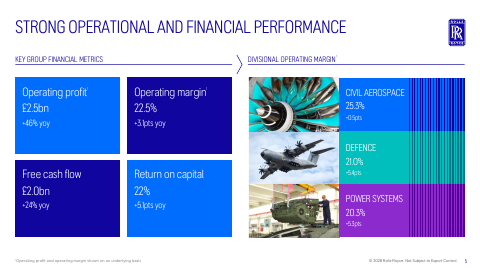
Underlying operating profit: “Underlying operating profit rose by 46% to £2.5bn; underlying operating margin of 22.5% with higher profitability in all divisions reflecting the impact of our strategic initiatives and operational improvements”
Underlying operating margin: “Underlying operating profit rose by 46% to £2.5bn; underlying operating margin of 22.5% with higher profitability in all divisions reflecting the impact of our strategic initiatives and operational improvements”
Power Systems underlying revenue: “Defence 2,484 17% 522 57% 21.0% 5.4pt Power Systems 2,604 28% 528 72% 20.3% 5.3pt All Other Businesses”
Civil Aerospace OE deliveries (engines): “Total OE deliveries of 279 engines were 18% higher than the prior period (H1 2025: 237)”
Large engine order book: “our large engine order book stood at 2,266 engines at the end of June 2026 (H1 2025: 2,056)”
Defence order backlog: “Order backlog now stands at £17.5bn, equivalent to more than three years of revenue, with order cover approaching 90% for the remainder of 2026.”
Power Systems order intake: “Order intake was £4.6bn, more than a 50% increase compared to the prior period, with a book-to-bill ratio of 1.8x.”
Aerospace supply chain cash impact within free cash flow
full year 2026
£150-200m
Large engine flying hours (% of 2019 levels)
full year 2026
115%-120%
Total OE deliveries
full year 2026
550-600
Total shop visits
full year 2026
1,480-1,550
Cash tax increase year on year
full year 2026
GBP 300 million higher
Power generation OE revenue growth per year
to 2030
25% per year growth
Key takeaways
Aircraft-on-ground problems effectively eliminated in Civil
Management calls this best-in-class for the industry and a differentiator against competitors. It follows 13% higher large engine MRO output, 35% more large engine refurbishments and turnaround times on first refurbs that are three weeks faster.
Durability upgrades are winning Trent 1000 XE orders
The Trent 1000 XE has been selected by three airlines, including LATAM, with more campaigns under way. Almost 50% of the eligible Trent 1000 fleet now has the upgraded HPT blades, and the time on wing programme targets more than a 100% durability increase.
Data centres lift Power Systems growth ambitions
Power generation OE revenue is now expected to grow 25% per year to 2030, up from a 20% target to 2028. Prime power is still under 10% of the business, but hyperscaler framework agreements with penalties and a next-generation engine due in 2028 support the plan.
Defence leans on UK funding and autonomous propulsion
The UK Defence Investment Plan allocated £5bn to autonomous systems. Rolls-Royce engines powered the first flight of the U.S. Navy's MQ-25A Stingray, and the company is under contract in Germany to design a scalable core engine for medium CCA-class platforms.
Rolls-Royce SMR builds a European contract lead
SMR was selected in Sweden for three units, and its UK and Czech contracts are now in execution and generating revenue. Management aims to scale to two SMRs commissioned per year in the mid-2030s, rising to eight at maturity.
What management said
Each quote matches the transcript word for word.
“effectively eliminating AOGs in Civil Aerospace for the first time in a decade, a best-in-class for the industry which provides a significant operational benefit to our customers.”
It is the clearest statement of the operational improvement management says differentiates it from competitors.
“Prime power today represents less than 10% of our power generation business. But this percentage will rise because we expect a significantly faster growth in prime power sales compared to backup.”
It shows how management expects the data-centre mix to shift toward prime power.
“a gas engine which obviously runs all the time versus a diesel like backup engine, aftermarket profit is exponentially higher, exponentially. And it comes in three years.”
It explains why prime-power gas engines could add aftermarket revenue sooner than backup engines.
“So we are already taking orders for data centres for '28. And with hyperscalers, actually, our - - we have framework agreements with penalties. They go all the way to 2030, okay?”
It describes how contract structure gives multi-year visibility into data-centre demand.
“Improved durability and our good aftermarket service offering have resulted in positive commercial momentum. Trent 1000 XE has now been selected by three airlines including LATAM, who we are welcoming back as a Trent 1000 XE customer.”
It links the engine durability upgrades to winning customers.
Transcript · Ian Douglas-Pennant, UBS · Civil demand, catch-ups
Are airlines changing behaviour because of higher fuel prices, and why were contract catch-ups larger than expected?
Fuel-related cancellations are mostly narrowbody, retirements show no sign of rising, and the larger catch-ups reflect genuine business improvements such as optimised lease engines and Business Aviation customer upgrades. — Tufan Erginbilgic
Transcript · Samuel Burgess, Goldman Sachs · Supply chain, data centres
How confident is management that the supply chain cash headwind will fall in 2027, and could data-centre power become a holistic offering with SMR?
Management expects the charge to fall in 2027 and be gone by 2028, mainly because Trent 1000 upgrades remove its particular issue, and says SMR and Power Systems already meet hyperscalers together. — Helen McCabe, Tufan Erginbilgic
Transcript · Ross Law, Morgan Stanley · Prime power, A350, narrowbody
How large could prime power become, what would an A350 rate increase require, and what kind of narrowbody partner is needed?
Prime power is expected to reach 15% to 20% of power generation by 2030, Airbus must decide on the A350 first, and a narrowbody partner must bring a strategic dimension rather than purely financial backing. — Tufan Erginbilgic
Transcript · Ben Heelan, Bank of America · A350-2000, narrowbody
Could Rolls-Royce supply an XWB derivative for an A350-2000, and would it give an airframer a stake in a narrowbody programme?
Airbus has to make the A350-2000 choice first, and on narrowbody management is talking to multiple partners but will not name them and has ruled out financial players. — Tufan Erginbilgic
Transcript · Colin Moody, RBC Capital Markets · Power overcapacity
Is there a risk of overcapacity in power generation, and might prime-power gas engines revert to backup roles?
Management points to an £8 billion order book and hyperscaler framework agreements with penalties to 2030, sees gas-engine visibility to 2030, and says some engines can switch to backup power. — Tufan Erginbilgic
How sustainable is the 21% Defence margin for 2026 and the mid-term?
Part of the half-year margin reflects aftermarket mix that will not repeat, but management expects Defence margins to settle above the earlier level, not at 21%, because the aftermarket cost improvements are sustainable. — Tufan Erginbilgic
Questions
What is the biggest operational change at Rolls-Royce's Civil Aerospace business this half?
Management says it has effectively eliminated aircraft on ground for the first time in a decade, supported by higher MRO output, more engine refurbishments and upgraded Trent 1000 engines.
How is Rolls-Royce positioned in data-centre power?
It now expects 25% per year growth in power generation OE revenues to 2030, with demand for backup engines and Series 4000 gas engines for prime power, hyperscaler framework agreements, added capacity and a next-generation engine due in 2028.
Is the Trent 1000 XE finding customers?
Yes. It has been selected by three airlines, including LATAM, with further sales campaigns under way, and almost 50% of the eligible Trent 1000 fleet has the upgraded HPT blades.
What is happening with Rolls-Royce SMR?
It was selected by Videberg Kraft to supply three SMRs in Sweden, and its UK and Czech Republic contracts are now in execution and generating revenue. Management targets two SMRs commissioned per year in the mid-2030s, rising to eight at maturity.
What are the main risks to the plan?
Supply chain cost inflation continues, with a £150-200m cash impact expected this year, and management expects a lower contribution from Civil contract improvements in the second half. Most cash benefits from LTSA improvements arrive after 2028.
Participants: Ian Douglas-Pennant UBS; Analyst Samuel Burgess Goldman Sachs; Analyst Ross Law Morgan Stanley; Analyst Colin Moody RBC Capital Markets; Analyst
So, the full results materials can be downloaded from our website. And before our present -- sorry, in today's presentation, we will cover, firstly, our strategic and financial progress in the first half, the financial details of the results in detail and our guidance for 2026.
In the first half of this year, we delivered significant operational and strategic progress including effectively eliminating AOGs in Civil Aerospace for the first time in a decade, a best-in-class for the industry which provides a significant operational benefit to our customers.
Rolls-Royce SMR was selected in Sweden, underscoring our position as a global leader in SMRs. We also finalised our SMR contracts into the UK and the Czech Republic.
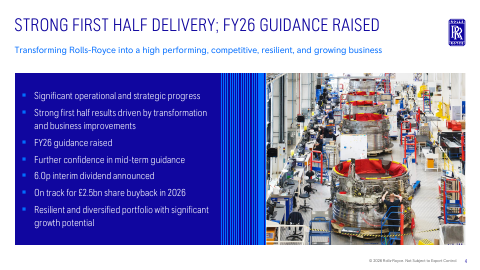
We delivered strong first half results, driven by our strategic initiatives with commercial optimisation and simplification across the group. Significant business improvements led to higher operating margins across all three divisions as we drive higher quality earnings and cash flows. We achieved this despite an uncertain external environment.
Our strong first half results give us confidence to raise our guidance for 2026, and also builds further confidence in mid-term targets we set out in February.
We are continuing to invest for the future growth and reward our shareholders. Today, we announced an interim dividend of 6p, and we remain on track to buy back GBP 2.5 billion of shares in 2026.
We are creating a highly competitive and resilient Rolls-Royce with a diversified portfolio, strong balance sheet, and a best-in-class total cash cost to gross margin ratio. And we have significant growth opportunities in both our existing and new businesses.
We have delivered significantly improved operational and financial performance in the first half of this year. Operating profit of GBP 2.5 billion was 46% higher than last year, and Group operating margin was 22.5% compared to 19.1% last year as a result of the business improvements that we are doing.
In a challenging environment, we reacted quickly and decisively to the situation in the Middle East, fully mitigating the direct impact to the business. Together with our strong progress in the first half, this has allowed us to raise our guidance for the full year.
We have higher operating margins in all three divisions. Civil Aerospace operating margin was 25.3%, reflecting three main factors: stronger aftermarket performance mainly driven by higher LTSA margins and increased shop visit volumes.
A significant contribution from contract catch-ups, reflecting the sustainable improvements to the business we are making through commercial improvements and efficiencies alongside continued onerous provision release and increased time and materials profit.
Defence operating margin was 21%, reflecting a stronger aftermarket performance across transport and combat, supported by lower shop visit costs and manufacturing efficiencies, alongside a strong contribution from profitable international sales and an increase in flying hours.
In power generation, stronger performance was driven by data centres as we captured volume growth with an improved mix and commercial optimisation benefits.
And across the Group, our cost efficiency programme continues to deliver. Free cash flow of GBP 2 billion was 24% higher than last year, primarily driven by higher operating profit. And our return on capital rose by 5.1 percentage points to a best-in-class 22%, again, driven by higher operating profit.
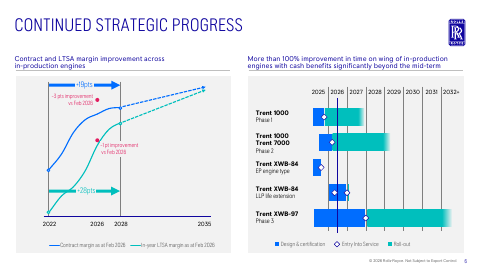
This slide focuses on how we are driving higher Civil Aerospace LTSA margins, a key driver of performance improvement to the mid-term and beyond. The left-hand chart shows that we are driving higher contract and LTSA margins over time across our in-production engines.
As a reminder, the top line is the average margin across all signed contracts even if the engines are not yet delivered. This is a leading indicator for the second line which is the LTSA margin booked in our income statement.
Our actions to deliver commercial and operational improvements across our aftermarket contracts are driving significant year-on-year growth in both contract and LTSA margins.
In February, we told you that we expected a 19-percentage point increase in our contract margin and a 28-percentage point increase in our LTSA margin between 2022 and 2028.
We are continuing to deliver on this. And in addition, we are improving these contracts further as shown by the red dots on the chart. Compared to what we set out in February, we are driving a 3-percentage point improvement to our contract margins and a 1-percentage point improvement to our income statement margins in 2026.
The 3-percentage point improvement in contract margins is mainly driven by new contracts coming in with better profitability. The 1-percentage point improvement in LTSA margin is driven by contract improvements which are mainly operationally driven.
It is worth remembering that even by 2028, only half of our in-production LTSA contracts will be on new commercial terms which means there will be a sustained benefit beyond 2028 as more contracts come in with higher margins.
As well as improving the margins of our in-production engines, we are also driving higher margins across our mature engine portfolio and business aviation.
The right-hand chart focuses on time on wing, a key driver of LTSA margin improvements and stronger cash flows over time. Our time on wing programme is progressing well and we continue to target more than a 100% increase in durability across our in-production engines which offers a significant operational benefit to our customers.
At the end of the first half, the majority of this improvement target has already been achieved. All our time on wing improvements will be complete by the end of 2027 which will leave us with a highly competitive engine portfolio.
I will now talk to our time on wing programme progress by engine. The phase 1 and 2 HP turbine blade modifications for the Trent 1000 XE were certified last year. Phase 1 will deliver more than 100% increase in time on wing with an additional 30% increase from phase 2. Depending on the operation, these packages can deliver up to a 3x improvement in time on wing. Almost 50% of the eligible fleet has now been upgraded with the new HPT blades, bringing them to the new Trent 1000 XE standard.
The Trent 7000 also benefits from the same HPT blade improvements. We have now largely upgraded the fleet and accumulated almost 3 million engine flying hours with the new blades.
The phase 1 improvements have been performing very well in service for over three years, delivering up to a 3x increase in time on wing. This gives us further confidence in the Trent 1000 XE upgrades.
On to XWB-84. We have split the improvement programme to accelerate its delivery. We pulled forward the planned life extensions for critical LLPs and remain on track to certify the remaining LLP life extensions by the year-end.
The XWB-84 EP builds on the performance of the world's most efficient large engine in service today. The first EP engine entered service last year with Delta Air Lines. The EP delivers a fuel burn improvement of 1.8% compared to the baseline XWB-84, far above the planned 1% improvement as well as building on its industry-leading time on wing.
For an airline, this fuel burn improvement represents an annual saving of USD 450,000 per aircraft. Actually, in the current environment, it is going to be higher than USD 450,000.
Our improvement programme remains on track with the enhanced engine to enter service in 2028. These improvements have been subject to a rigorous testing programme with more than 20 rig tests completed alongside evidence analysed from more than 300 shop visits of the current in-service engines.
Key pieces of technology, such as the combustor and the ceramic matrix composite seal segment have been proven through testing. This was the TRL 6 stage.
We are now proving out the durability of the whole engine including a durability test representative of the harsh and sandy operations that it will face. Following this ground test programme, we will flight test and certify the engine next year ahead of a 2028 entry into service.
We are continuing to evolve the XWB-97 engine including for Project Sunrise. Our partnership with Airbus and Qantas, where our engines will power ultra long-range services with the A350. The first nonstop Project Sunrise test flight from Australia to Europe landed earlier this week.
In total, only 25% of the cash value that we created through improving our LTSA contracts and only 30% of the cash value of our OE renegotiations will be realised by the end of 2028. Most of the cash flow will come after that.
We continue to deliver strong disciplined progress across our four strategic pillars. I have already talked about how we are driving higher LTSA margins. I will now cover some of our other key achievements.
In power generation, we are seeing increasing demand for both backup engines and gas engines for use as a prime power source for data centres. As a result, we now expect 25% per year growth in power generation OE revenues to 2030 compared to our previous target of 20% growth to 2028. This reflects strong backup growth alongside growing demand for our gas engines for prime power use.
Prime power today represents less than 10% of our power generation business. But this percentage will rise because we expect a significantly faster growth in prime power sales compared to backup. This is supported by our continued investment in capacity expansion. These gas engines for prime power will generate significantly more aftermarket revenues over the course of their life than an engine that is used for backup power. This will support strong aftermarket growth beyond the mid-term.
We are continuing to invest in our next-generation engine to replace Series 4000 that targets the data centre market with increased power density. This remains on track to launch in 2028.
In governmental, we now expect growth of 20% per year to 2030 compared with our previous target of 20% growth to 2028, supported by continued strong order inflow.
In Civil Aerospace, we effectively eliminated AOGs which provides a significant operational benefit to us and to our customers. Here, we are setting a new standard for the industry and differentiating ourselves from competition. This has been supported by improved operational performance across our MRO network, where we are driving towards best-in-class performance.
In the first half, we increased large engine MRO output by 13% with a 35% year-on-year increase in refurbs. We have restructured our aftermarket operations to build greater
operational resilience for our customers and optimise costs through network efficiencies. We are expanding our repair portfolio to reduce cost of ownership and improve turnaround times.
Third, Trent 1000 XE. Here, our time on wing investment is already starting to deliver clear commercial benefits. Improved durability and our good aftermarket service offering have resulted in positive commercial momentum. Trent 1000 XE has now been selected by three airlines including LATAM, who we are welcoming back as a Trent 1000 XE customer.
Fourth, in Defence, where we are a clear beneficiary from the recent UK Defence Investment Plan. We are cementing our position as a global leader in autonomous propulsion, a market with significant growth potential. The UK Defence Investment Plan which includes a GBP 9 billion multiyear commitment to GCAP, gives us strong visibility of GCAP's funding to 2030. It also further underpins the outlook for AUKUS.
In autonomous, there were a number of important milestones in the period. The U.S. Navy conducted the successful first flight of the MQ-25A Stingray, unmanned aerial refueler vehicle powered by our AE engines. And in the UK, the Defence Investment Plan included a commitment to spend GBP 5 billion on autonomous platforms over the next four years.
We are also under contract in Germany to design a scalable core engine concept capable to be adapted for multiple autonomous platforms in medium CCA class which we aim to complete towards the end of the year.
Fifth, efficiency and simplification. The first phase of our efficiency and simplification delivered GBP 600 million of benefits between 2023 and 2025. We are now underway with the second phase of the programme. This includes more than 20 work streams.
We are accelerating the rollout of group business service centres and progressing our transformation of sales, inventory and operational planning, alongside going further in lean manufacturing to drive higher productivity.
Work streams are also focused on other multiple different cost lines including logistics and increased efficiencies from further digitising our business.
In addition to driving cost efficiencies using digital and AI, we are also building a digital thread across Rolls-Royce from engineering and MRO through to the supply chain.
We are gathering dispersed engineering data into a strategic asset for better, faster decision-making and deploying tools to improve our operational execution.
Finally, Rolls-Royce SMR was selected in Sweden for three units. We have been successful in every competitive tender in Europe and are uniquely positioned to become a global leader in SMR.
In the UK and Czech Republic, we have now signed the contracts and entered the execution phase. In July, we signed an MoU with CEZ and the Czech government to enable the preparation of two further sites. We see significant demand from other countries including the US. This supports our ambition to scale up to commissioning two SMRs per year in the mid-2030s, rising to eight per year at maturity.
Rolls-Royce SMR has more firm contractual commitments and a clearer order pipeline than any of its listed or unlisted competitors and is already starting to generate revenues and profits.
We've had a very strong start to the year across all three of our businesses, and they have responded to the dynamic environment with agility and pace.
We have continued to execute on strategic initiatives, continued to improve operational performance and continue to drive rigorous performance management, a clear demonstration that we are sustainably transforming Rolls-Royce into a high-performing, competitive, resilient and growing business.
Double-digit profit and cash growth across every division with all three delivering strong margin expansion. The balance sheet is resilient, and we continue to reward our shareholders with growing distributions.
Operating margin grew by over 3-percentage points to 22.5%. And free cash flow, it grew by close to GBP 400 million to GBP 2 billion, with cash delivery primarily driven by higher operating profit.
Strong cash flow in the period meant that we closed the half year with a net cash position of just over GBP 2 billion. That's a resilient position to operate from given the current macroeconomic environment.
Then return on capital, it was 22%, a best-in-class performance. And the strength of these results has enabled us to declare an interim dividend of 6p per share as we follow through in our capital frame commitments.
Now let's go to the detail by division, starting with Civil Aerospace. Civil delivered the largest year-on-year improvement in operating profit and cash. And as you can see on the bottom right of the slide, all key operating metrics grew as we continue to focus on operational execution.
OE deliveries of 279 were 18% higher as we further improved supply chain resilience and supported our OEM partners as they ramped up production. End market demand also remained strong. These deliveries included 157 large engines, almost 30% higher than last year and 122 in business aviation, 6% higher than last year which were all Pearl as we ramped up new platforms.
Large engine flying hours or EFH, they grew to 113% of 2019 levels, a 4% increase year-on- year despite some disruption from the Middle East conflict. And in the first half, our fleet has continued to grow faster than the widebody market, an important driver of future EFH growth.
Shop visits. They grew to 712. Of these, 294 were large engine refurbs. That's 35% higher than last year. Higher shop visits were supported by our actions to further strengthen the supply chain and our MRO network improved, where we drove improved operational performance and benefited from our investments to expand capacity, all of which supported a three-week improvement in turnaround times for first refurbs in our main overhaul bases compared to last year.
First, strong large engine aftermarket profits, where service revenues grew by more than 30%. Profit growth was driven by a higher average LTSA margin, a higher number of large engine shop visits which included substantially more refurbs and higher time and material profits.
It's worth pausing for a moment on the benefits of our total service model and how it gives us strong visibility and control over shop visits. Under this model, we have discretion over when engines come into the shop and the work scope to be done. This gives us flexibility to optimise MRO schedules and adapt to different scenarios, all of which we do working closely with our customers to keep their fleet serviced and flying.
The second driver of profit growth was net contractual margin improvements. They were GBP 497 million. That compares to GBP 288 million in the first half of '25. The GBP 497 million comprised a net benefit of GBP 125 million in onerous contracts and GBP 372 million from catch-ups.
We made good progress renegotiating onerous aftermarket contracts, allowing us to release provisions in the period. And as we drove commercial and operational improvements across both widebody and business aviation, we benefited from contract catch-ups.
All of this contributed to a gross benefit of GBP 574 million in the period. This was partially offset by an additional charge of GBP 77 million which was taken across both onerous and catch-ups due to supply chain-related product cost inflation. And just to be clear, we don't expect such a high level of contractual margin improvements in the second half.
It's worth a moment on the supply chain. Product availability is continuing to improve, but product cost inflation remains an industry-wide challenge, especially in areas such as rare earths and elementals.
We continue to proactively strengthen our supply chain. For example, we have forward bought to build buffer stocks, and we are also opening alternative sources of supply for specific products and materials.
And finally, the third driver of profit growth was Business Aviation with higher aftermarket profitability driven by a stronger mix of shop visits and higher time and material profits.
Moving to cash. Civil delivered a trading cash flow of GBP 1.5 billion. That compares to GBP 1.1 billion in the prior period, a very strong performance in the current environment.
Increased cash flow was primarily driven by higher operating profit. Working capital was well managed and the LTSA balance growth was lower than last year which I will come back to in a moment.
Order intake in the period stood at close to GBP 2.5 billion with a book-to-bill ratio of one and order backlog was GBP 17.5 billion, equivalent to over three years of revenue with order cover for the remainder of the year approaching 90%
Strong order backlog alongside recent commitments made in the UK, US and Europe give us confidence over future demand for our existing portfolio of profitable products including the EJ200 and AE engine family, alongside the new ramp-up of platforms such as the growing opportunity from autonomous that Tufan spoke to earlier.
Three factors drove that increase in operating profit. First, strong aftermarket performance across both transport and combat, supported by our actions to reduce shop visit costs and drive manufacturing efficiencies, a stronger contribution from profitable international sales and a benefit from higher flying hours.
Second, the benefits of continued self-help including sustainable cost efficiencies as we drove improved productivity and tighter operating cost control.
Cash flow. It stood at GBP 615 million. That compares to GBP 327 million in the prior period. Higher cash flow was driven by operating profit growth as well as some benefit from customer advances.
Now Power Systems. Another very strong performance in the first half as we continue to drive profitable growth across both power generation and governmental.
Our differentiated products and services are enabling us to capture strong market demand. Order intake of GBP 4.6 billion was more than 50% higher than last year with a book-to-bill ratio of 1.8x. Power gen order growth was even higher, driven by data centres which included growing demand for gas engines for prime power use.
Looking at our order book for the remainder of the year, we are fully covered, with a growing firm order cover for 2027 and '28. And with power gen's multiyear framework deal structure, we have increasing visibility on growing orders up to 2030.
Operating profit grew to GBP 528 million. That's a 72% increase year-on-year with operating margins growing to 20.3%. That 72% increase was driven by an excellent performance in power gen, where we continue to capture strong volumes with growing revenues of 41%. And within this, data centre revenue grew even faster.
We are capturing this growth with higher profitability due to continued commercial optimisation and an improved product and customer mix. Indeed, we are seeing stronger growth from hyperscalers who want our higher power density engines with additional systems across multiple regions. And with our global account management approach, it means we are well positioned to be their partner of choice.
Next, a strong performance in governmental, where we are on key NATO platforms and continue to capture growing European defence spending. Governmental revenues grew by 25%, driven by both OE and aftermarket growth.
Then cash flow. It grew to GBP 507 million, around GBP 100 million higher than last year, driven by higher operating profit alongside higher investments and working capital as we supported disciplined business growth.
We delivered GBP 2 billion of free cash flow in the period. That's almost GBP 400 million higher than last year. The principal driver of increased free cash flow was operating profit which grew by GBP 800 million.
Other factors included net investments, they were over GBP 100 million higher than last year. Investments in Power Systems in engine development and capacity expansion are just some of the areas where we continue to invest to underpin future growth.
Then the Civil net LTSA balance. It grew by just under GBP 100 million. That compares to nearly GBP 500 million in the prior period. There are a number of moving parts that drove that lower LTSA balance growth, a higher number of engine flying hours and growth in the normalised engine flying hour rate which were largely offset by a higher number of shop visits which included a higher number of refurbs, a higher LTSA margin which led to higher realisations in the P&L. And finally, a high level of catch-ups in the period as we drove sustainable operational and commercial improvements across aftermarket contracts.
It's important to remember that positive catch-ups reduce the LTSA balance and that those improvements ultimately drive higher LTSA margins and sustainable cash generation.
Then turning to working capital. It was broadly similar to last year with inventory and receivable days both improving year-on-year, a strong performance in the current environment and as we continue to build supply chain resilience forward buy key products and support revenue growth.
Cash tax, it increased to GBP 525 million, GBP 270 million higher than the prior period, reflecting higher profits and the timing of payments. And we have now worked through the last of the remaining over-hedge position which was a minimal outflow in the period.
We expect the 2026 net LTSA balance growth to be below the 2025 level. This reflects large engine flying hours towards the lower end of the 115% to 120% range of 2019 levels, a higher normalised engine flying hour rate, the impact of a higher number of shop visits growing to
Other cash items to note. Year-on-year, we expect a higher level of net investments with them more weighted to the second half as we continue to invest for growth including additional capacity in power gen given the stronger outlook we now see. An outflow in provisions as we continue to progress commercial renegotiations and with higher profits, we now expect higher cash tax costs, for them to be around GBP 300 million higher for the year.
Capital frame. Our approach to capital frame remains unchanged. We continue to strike a balance between preserving a strong balance sheet, delivering competitive returns to shareholders and retaining financial flexibility for investment opportunities.
In the period, we repaid GBP 1.1 billion of bonds. We also issued EUR 1 billion of new bonds, allowing us to extend maturities and maintain a presence in the bond market.
We were delighted by the level of support for our first bond issuance since 2020 which was significantly oversubscribed. A thanks to all who participated.
The credit rating agencies continue to recognise our progress with Moody's and Fitch both upgrading us to A3 and A-, respectively, in March and with S&P recently reaffirming our BBB+ rating and moving us to a positive outlook.
Then distributions. We're announcing an interim dividend of 6p per share, representing a distribution to shareholders of approximately GBP 0.5 billion. And as of today, we are more than halfway through our GBP 2.5 billion share buyback for 2026, the remainder of which will be executed across the balance of the year.
Taken together, the dividend paid to shareholders in June and the interim dividend that we're announcing today, along with the 2026 share buyback, represents a return to shareholders of GBP 3.4 billion. That's a distribution of almost 90% of our 2026 free cash flow, all of which we are delivering as we continue to increase net investments across the group.
To close, first half results have been strong across all divisions and all key metrics. Our strategy is delivering, and the teams are doing an outstanding job. I would like to thank them for all their hard work and commitment.
And there is still much more to do as we realise our full potential and continue transforming Rolls-Royce into a high-performing, competitive, resilient and growing business.
A strong first half delivery across all divisions gives us confidence to raise our guidance for 2026. We now expect underlying operating profit of GBP 4.7 billion to GBP 4.9 billion with a year-on-year improvement across all three divisions. The increase in guidance is driven by, first, higher LTSA margins and increased level of contract catch-ups driven by the commercial and operational improvements that we are making across Civil Aerospace, then stronger power generation profitability and higher Defence aftermarket growth.
We expect free cash flow of GBP 3.8 billion to GBP 4 billion. This includes a GBP 150 million to GBP 200 million supply chain headwind which will be lower in 2027 and will be gone by the mid-term.
We are creating a resilient, competitive and diversified business with significant growth potential. This is being driven by transforming Rolls-Royce operationally, financially and strategically and embedding a distinctive performance culture.
Operationally, we are creating a business with best-in-class safety and operational effectiveness. We are improving our products and technologies to their best in a relatively short period of time and therefore delivering the best customer service.
We have effectively eliminated AOGs and are meeting the needs of our airline and airframer customers and improving products and operational focus. This differentiates us from our competitors and delivers value to Rolls-Royce.
Next, financially, we are building a highly competitive, resilient and diversified business with a high quality of earnings across all our businesses, if you look at our operating margins of our businesses.
In the first half of 2026, we delivered significant underlying performance improvement. This has resulted in increased operating margins across the group alongside a higher return on capital and has been delivered despite a challenging external environment. These results and our raised guidance for 2026 gives us increased confidence in the delivery of our midterm targets.
So first of all, it is very clear that all three businesses are delivering underlying performance improvement. When I say underlying, that means sustainable. That is happening.
Second, though, we have some contract improvements in Civil Aerospace, and you need to actually differentiate them. If you are comparing year-on-year onerous ones, actually, this year, onerous is lower than last year. But onerous comes with zero revenue, therefore it has a big leverage on operating margin.
We told you, I think, onerous contracts, I expect some more next year but not in mid-term. Catch-ups on the other hand which was the majority this time as long as we continue to improve the business, and I believe we will, catch-ups at least at some level will continue to be there, right? Hold it that way.
But I also said it many times, I don't know how much it is sinking in. If you are looking at what we do, ignore how we run the business, you will never understand our results. How do you actually exceed these things?
So we run -- we changed the way we run the business. We -- teams are not running after a budget. They are tasked, they are incentivised, to deliver strategic progress year-on-year. That means improve the business every day. Proxy to that is year-on-year profit improvement, obviously, right, if you are doing that, all underlying though, right?
With this context is important in the sense of what we are doing. But given the progress we made in the first half, and therefore we actually increased the guidance, we may revisit our mid-term targets. That's how I would like you to hold it.
Finally, strategically, we have delivered significant strategic progress this year. For example, the selection of Rolls-Royce SMR in Sweden and two contracts already signed in the UK and Czech Republic, underscores our position as a global leader in SMRs.
Our transformation has created a business with significant growth potential in the mid-term and beyond. I really believe we have unmatched potential for growth for the following reasons: we have positioned Rolls-Royce to benefit from key global trends including world GDP growth, higher defence spending, digitalisation and AI, and energy transition including a nuclear renaissance.
To further support this agenda, two more things I will mention. We are now underway with the second phase of efficiencies and the implementation of a digital thread across the group including generative and agentic AI to unlock significant value as the business grows.
Are you -- look, thinking about the Civil market, are you seeing any indication of behavioural changes at the customers at the airlines in response to the higher fuel price? And given the way, as you say, you've structured the business slightly differently to the contracts slightly differently to other engine makers, what would be the early indicators that you would look at internally to give you an idea of what might be coming next year?
And secondly, on the catch-ups, so these are somewhat larger than I think you expected. Why is that? And maybe you could, Helen, give us an outline of the process by which you
Okay. So I think sort of Civil improvements. I think your first question is sort of how do I see the fuel business? Is that -- is that -- I think fuel cancellations frankly, once Middle East happened and fuel prices went up, et cetera, we actually -- I get twice a week report. It tells me everything going on in the world. So how many fuel cancellations in what geography, obviously ours, market. So I have a pretty good idea sort of on an ongoing basis, what is going on.
We said it in trading update, and that continues to be true. Vast majority of fuel price cancellations actually narrowbody. Yes, there was a smaller percentage, much smaller percentage also widebody.
But our -- if you -- if I take it to Rolls-Royce, our big impact was more some of the Middle East players, and you know which airlines, obviously especially March, April, then there was a recovery period after that.
So given I look at weekly report, I look at yesterday, Middle Eastern players mostly recovered, okay? So therefore I think fuel cancellations, yes, it impacts us but not as much as narrowbody impact.
So I think when you say, okay, what do you think about next year? Obviously, we are in an uncertain world. So depending on scenario, my answer may change.
For example, we said it in trading update. We don't expect any shop visit schedule change because of Middle East. But we now actually stabilise the business. We optimise the business. We will continue to optimise.
I actually chair an optimisation meeting every two weeks that optimise the whole system. I don't mean we are in constant sort of shop visits, but we optimise it. And because you actually stabilise the business because so far, our -- admittedly, our only focus was on customers. Let's eliminate AOGs. When you stabilise the business, you actually optimise it for profit and cash as well better.
So when I -- what are the early signs sort of -- as I said, I mean it's not even weekly. Every other day, I get this. And we look at it holistically. I look at even the fuel price and so on given my history, all that, how is the aviation fuels market is going, all that stuff.
But we look at multiple things. Obviously, we will look at retirement. So far, there is no hint of it. And I have a view that you extrapolate retirements from the early experience, I think you will end up in the wrong place because economics of retiring a plane right now is very different than what it was because in supply chain constrained environment, economics is very different than non-constrained environment. Therefore I don't actually expect retirements and their level is very low.
Fuel cancellations, we continue to look at. But frankly, that is a factor, but I don't worry about it. If I was running narrowbody, probably I would worry about it a lot more.
Catch-ups, I think -- yes, it was -- they were actually more than we expected, but we expected them. So let me give you an example, and I'm not going to go into accounting because actually, this is business proposition rather than accounting. I really believe that.
These are genuine business improvements. I'll give you an example. Because you stabilise the system, now you can optimise your lease engines, you had to allocate previously to eliminate an AOG, now you don't have to. That improves that contract. Yes. Did I expect that? No, because that's sort of dynamic optimisation you go into, right?
I'll give you another example. Yes, you see only onerous contracts, but I said it in one of the presentations, we have low-margin negotiations that team actually does. Some of that come through, okay, i.e., commercial improvements in the contract. Some -- when they come, they sort of create catch-up, not onerous.
Third thing, Business Aviation is a big part of catch-ups this half. We had this programme that we put in place to upgrade our customers to the next corporate level, and that came more than we expected. When you high-grade, your margins improve, your contract improve, obviously you give them better service and more service, et cetera.
But those are some of the -- so therefore going forward, how should I think about catch-ups? You should think that we will continue to have catch-ups. I cannot tell you they are going to be at this level, at that level because it is -- when you are continuing to optimise the business with value stream framework, I said it last time we run the business very differently. You intervene in the business constantly, constantly.
So some people think, Tufan, this is long-cycle business, how do you actually -- yes, it's not, long cycle if you design engine and so on, it's not long cycle in this optimisation. It's actually every 15 days. It is there. So that's how I would actually answer that.
Firstly, can you just give us an update on supply chain, what you're seeing and the level of confidence that GBP 150 million to GBP 200 million cash headwind will reduce in 2027?
And then the second question, you've got an increasingly broad and strong portfolio now in the data centre power market. And you've just spoken to the growing opportunity in prime power. How important could this market become to Rolls-Royce? And is the long-term plan to evolve a really holistic offering that incorporates SMR?
I think short answer is absolutely. We are already -- when we actually meet with hyperscalers today, even SMR and Power System team shows up together. Yes, SMR still has some mileage to go in terms of execution. But definitely, it will -- because when we started, frankly, SMRs are 470 megawatts. I thought this is actually grid.
But what happened during the process, still -- I mean what we are doing in the UK will go to grid. But what happened in the process is data centres got bigger and bigger and bigger. Right now, they are even -- they are building 500-megawatt data centres. So they are now between 200 to 500.
In that kind of setup, yes, you can actually put an SMR, then you not only have continuous power, but it is also net zero, obviously. So it will definitely play that role.
In fact, I was think AMRs may play that role, but AMR is smaller. They will actually more focused on space, defence and industrial setup if you have an industrial complex and so on.
So yes, answering that, but gas engines is very interesting for us because anything Helen presented, we don't actually benefit from that, because I said it less than 10%, but that's non- data centre. And it has been actually off-grid applications.
Now we see enormous demand coming, enormous. Good news is we actually have some capacity in our plan. Without investment, we can scale up, then we need to invest, obviously for that.
But that gives us -- and also, we really very strong service, almost 50% of our profit comes from services in Power Systems. And this will increase that because a gas engine which obviously runs all the time versus a diesel like backup engine, aftermarket profit is exponentially higher, exponentially. And it comes in three years. So it's not like 15 years. Three years, you need to -- because they run so, so much.
So Sam, on supply chain, so we definitely see an improvement in that, and we have put a lot of effort into it. As I said, product availability has improved. We've invested with our suppliers. We've sent hundreds of people in there to strengthen their supply chain. We've opened up additional sources. We've put in new tooling, machinery, second source supply.
So we are seeing the benefit of that come through as a result of our actions. You can see that in some of your stats, large engine OE deliveries up 30% year-on-year, turnaround time in our main bases; three weeks quicker. That's a lot compared to this time last year.
Where we're still seeing some of the crunch points is particularly in product cost inflation. The Middle East environment hasn't helped with that if you think of how much product, particularly some of those rare earth elements and elementals that I spoke to that transit through the straits. But we have got a set of actions, and they are both tactical to deal with here and now and strategic to sustainably build up resilience.
So we've got good visibility into it. We've got confidence that as the environment stands at the moment, that charge will reduce in 2027 and be gone by 2028 based on the current environment.
Supply chain has some generic issues. And then every company has some specific issues, right? I won't give company names, but if you think about it, you will figure it out.
Our issue has been, therefore we are confident that's going to disappear, GBP 150 million to GBP 200 million. Our big issue was Trent 1000. When the engines supply -- think about parts availability and issue, engines come back every 9 to 12 months in that environment, that creates all sorts of issue including customer disruptions and the implications of that financially, right?
So by upgrading those engines, therefore we are actually confident that -- I mean that was a big part of how we are eliminating AOGs. So that's why our particular issue disappears. That's why we are talking with confidence that that's what's going to happen.
One quick follow-up to Sam's question on power gen. And I think you said primary power was kind of 10% contributor to sales. What do you think that could be medium-term?
Secondly, on the A350 and the potential rate increase that Airbus has flagged. And what CapEx would be required there? And is that included in your outlook?
And lastly, on narrowbody and the potential partner, and does that partner need to be an operational partner that actually brings technical expertise to the table? Or can it be simply a financial partner?
Okay. I think less than 10% if I start with gas engines, less than 10%, yes, given the visibility of orders right now. Here's how you should think about our growth. We said 25%, but within that, you think about backup engines still growing and gas engines are growing even more. Therefore, both of them are growing, but even more. And as a result, we expect by 2030, that number will be 15% to 20%, but both of them growing. So therefore it will more than double by definition, right?
So -- and the good news is really because OE margin profile very similar, but you have very big aftermarket coming. Therefore I said in my presentation, after mid-term, they will come because it's normally three years, okay? So that's first question.
A350, frankly, first, Airbus needs to decide. And I don't want to elaborate or sort of comment on what they will do, what they will not do. It's a good question for them.
I think -- but we are very closely working with them. And I would like to highlight our great success with A350, right? I mean 84, XWB-84 is the best engine durability, fuel efficiency in the whole market right now and 97 has 99.9% -- more than 99.9% actually dispatch reliability. And it is the most utilised engine in widebody.
So obviously we will bring that understanding and expertise to that. But first, they need to decide, a, are they going to do it; b, what kind of thing they will do.
Narrowbody, I think pure financial, I'm not really interested in. So I think there needs to be a sort of strategic dimension of the partnership. And all the parties we are talking to, and there are multiple parties, I can assure you, has that profile.
Thanks, Tufan. So I've got some online questions here including from Ben Heelan at Bank of America. A couple of his questions have been answered, but one to sort of focus on here is A350-2000. Would you think about could you provide an engine that's a derivative of an existing XWB? And what sort of investment would that require is the first one.
And the second one is a follow-on or an additional question on narrowbody which is would you be willing to sort of pair up with an airframer in term -- for that programme in return for giving them a stake in the programme?
I think -2000, I'm afraid, Ben. I'm going to give the same answer I gave. So I think on -2000, first, Airbus needs to make the choice, then obviously we are working with them to help make that decision, then we can talk about it.
I think on narrowbody, as I said, we are talking to multiple partners. At this point, it's not appropriate to talk about this kind of player, that kind of player. I already answered that it's not financial players. So I would like to leave it at that because -- is there any other? In the room at the back.
Colin Moody from RBC here. Just maybe another one or two on the Power Systems and power generation opportunity. You talked about potential to expand more capacity yourself. Clearly, there's a lot of capacity coming online from your two other main competitors as well as a slew of others. How do you think about the risk of overcapacity in the industry?
And then maybe just another question. Clearly, you gave a view on what a primary power generation opportunity could go to in the mid-term. Do you think it's a duration -- kind of a limited duration to that potentially? When you look at the comments from the larger gas turbine manufacturers, a lot of them have a view that as they get their capacity up, engines will kind of retire again to sort of being backup power solutions. So how do you view that risk?
So it's a great question. I think -- so here's what I don't actually see on the first part of your question, I'll come to the second part of your question in a minute.
But I don't actually see that risk because here's a couple of data points for you. We already said in our presentation that actually order intake increased 50%. That was total Power Systems. Actually, if you look at data centres and power gen, it is more than 50%.
So number one, this GBP 8 billion order book is very unusual in this industry. If you are aerospace analyst with all the respect, you may not appreciate it saying, okay, what is this? But for this industry, it is unbelievable.
So we are already taking orders for data centres for '28. And with hyperscalers, actually, our - - we have framework agreements with penalties. They go all the way to 2030, okay? So I think this data is important.
And I know yesterday, today, AI growth this and that, the whole world is sort of obsessed by that. And every other day, they changed their mind, by the way, it's interesting.
But today is the down day, I guess. But so -- but I have a perspective on that, frankly. Sometimes we miss -- we confuse companies' valuation which I'm not going to comment on, they are all great companies on technology space. Companies' valuation, are they higher valued, lower valued versus would digital transformation in the world will continue, okay?
I'm not going to comment on the first one. I'm going to comment on the second one. Second one tells me actually the following because we are -- I just talked about digital thread. We are actually going big time. Think about companies like us, right?
Digital transformation in the world will continue because it enables effectiveness, it enables efficiency. There is no doubt. Therefore would digital infrastructure to support that will continue. It will have to continue because world needs it.
That's very different than x companies value is too much. I'm not going to even comment on it. But sometimes people confuse the two and make conclusions from that, is it a bubble? I don't think digital transformation is a bubble, right?
And we look at -- we talk to our customers, hyperscalers. But if you look at NVIDIA product roadmap, their chips are requiring more and more power. Why? Because AI models are getting more and more complex. Just look at their product roadmap.
So therefore we still don't want to -- we actually signed a framework agreement. I can assure you, early next week, in investment committee, we are going to sign another big hyperscaler sort of deal, we will, in the investment committee authorise, hopefully. So -- and that gives you a framework agreement with penalties.
It gives you multiyear sort of visibility. Then we actually go and invest, right? And we optimise our operations a lot more like two years ago versus now, we are optimising a lot more because volume allows you to do that.
Your gas engines, I think you are right. There is a good visibility for gas engines to 2030. And our investments target that as opposed to how about 2050, this will happen and let's have speculative investment, et cetera.
But it will be very interesting. Frankly, I was actually reflecting on this. It will be very interesting because most -- almost exclusively all of these gas engines will go to US because of the off-grid -- grid situation in the US. So therefore US market is actually the market to talk about here.
You are right. At some point, grid may come. It will be interesting once you paid for these engines, given how cheap gas is in the US, would some companies rather than grid will continue with this because maybe operating costs may be lower. I'm not going to speculate on it, but I wouldn't totally rule that out either, right? So you need to think about it that way as well.
Focusing on the Defence performance which is really standout at a 21% margin. Obviously that compares to the mid-term guidance of 14% to 16%. So how should we be thinking about Defence margins going forward for both 2026 and the mid-term? And how much of that improvement is sustainable?
David, as usual, great question. But with one correction, if I may, stand out not only Defence, all other two divisions also stand out, just small correction.
But -- so -- but I would say, let me characterise that for you because there may be a background conversation, Middle East is that. I think what we did, this value stream framework, we first applied the way to run the business in Civil. Then we went to other divisions.
Now we actually run it that way. And Power Systems were sort of there. And as part of that, there was an aftermarket project. And as a result of that, we look at aftermarket, I talked about six levers for Civil. I didn't talk about it today, but you know what they are. Same six levers actually there as well, different dynamics, same six levers. A big aftermarket profitability improvement was driven by lower shop visit costs. They are sustainable.
So therefore, David, the way to think about it, yes, I think 21%, you know David, this really well six months is six months, right? In that six months, there was this aftermarket versus OE percentage which will not be there in full year. Therefore some of it is like aftermarket.
I always say our targets are sustainable operating margin targets. Therefore one quarter -- sometimes people come to me, this competitor delivered this margin in three months. I mean it's three months. You are not -- lots of dynamics drive that. If I don't deliver any OE, lots of aftermarket, I may deliver 40% margin.
So I think you need to sort of think about it. There is that in Defence first half. But there is also this underlying performance improvement in aftermarket coming, as I explained. Therefore you should expect not 21%, but relative to where we were, you should expect increased underlying operating margin improvement in this.
And also, we said actually combat and transportation aftermarket and the international sales. If there is a background conversation in the first half, how about Middle East impact, Middle East, most of it was underlying and there was some Middle East profit impact, okay? So that's how you should actually hold it.
I think we are making great. What am I delighted about these results? Lots of underlying performance improvement came from every division. That's why I'm delighted because I'm not worrying about this six months, I'm actually worrying about moving the bar and building on it and capture the ground, build on it. And in that sense, all three divisions did exactly that and created, therefore continuous underlying performance improvement which is actually sustainable.
So therefore we are making great progress in that. And as I said, we created -- if you think about it, whether it is portfolio mix of high-performing three divisions and how they are actually lined up to major growth trends and our underlying performance improvement
coming, that diversified portfolio and the agility in the company and frankly, how much we lowered cash breakeven of the company, this is a very resilient company.
Sometimes resilience come at the expense of growth. We have actually unmatched growth potential, but at the same time, a lot more resilient than our competitors. If you think five minutes, you will find the answer.
So I think that mix is a brilliant sweet spot actually for Rolls-Royce that we will continue to build on it and deliver. Thanks for listening. Have a great day.