0:16:38 · John Pancari, Evercore ISI · Net interest margin
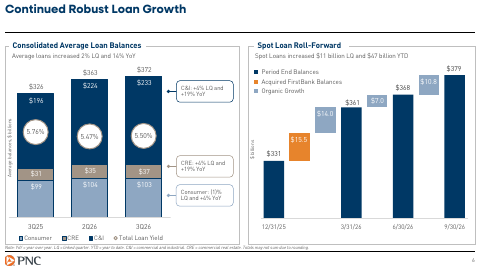
How confident are you in a margin of 3% or higher in the fourth quarter given deposit costs and low-spread loan growth, and what does it mean for 2027?
Management said half of the loan growth came in the last two weeks, spreads fell about three basis points, and fixed-rate securities repricing will lift the margin. — Bill Demchak, Rob Reilly
0:19:55 · John Pancari, Evercore ISI · Loan mix
What type of lending is driving the lower-spread growth, and what credit loss assumptions apply to it?
Growth is in high-quality corporate finance, such as trade receivables and asset-backed lending, with very low expected credit losses and fees that offset the lower spread. — Bill Demchak, Rob Reilly
0:21:44 · Scott Seepers, TD Cowen · Client sentiment
How is client sentiment holding up under higher rates, and is there a tipping point for growth?
Management sees no slowdown yet, pipelines remain strong, and it expects higher rates to crimp capital spending eventually. — Bill Demchak
0:23:48 · Scott Seepers, TD Cowen · Capital markets
How do you see the capital markets trajectory, particularly at Harris Williams?
Management feels good about pipelines and expects capital markets fees to be up almost 15% in the fourth quarter. — Rob Reilly
0:25:08 · Erica Najarian, UBS · Expenses
Is the fourth-quarter expense step-up tied to capital markets and so not a run rate for 2027?
Yes, the CFO confirmed the increase relates to capital markets activity rather than a pull-through into 2027 expense growth. — Rob Reilly
0:25:08 · Erica Najarian, UBS · 2027 NII
Should the rate of NII growth slow in 2027 given new-market momentum?
Management declined formal guidance but said fixed-rate asset repricing adds certainty and it would agree with growth of roughly $1 billion above 2026. — Rob Reilly
0:27:38 · Anand Gosalia, Morgan Stanley · Deposit betas
What deposit beta should we expect as the Fed tightens?
Management expects a cumulative beta in the mid-50s, with higher betas on corporate and wealth deposits and less on consumer. — Bill Demchak, Rob Reilly
0:29:46 · Anand Gosalia, Morgan Stanley · Loan growth timing
What drove half of the loan growth arriving in the last two weeks of the quarter, and is it sustainable?
Management said the deals were already in the pipeline and that lending does not respond to a single economic factor within two weeks. — Bill Demchak
0:30:49 · Ken Usen, Autonomous Research · Fees and expenses
Is the fourth-quarter expense step-up pulling investments forward, and what are the fee lines?
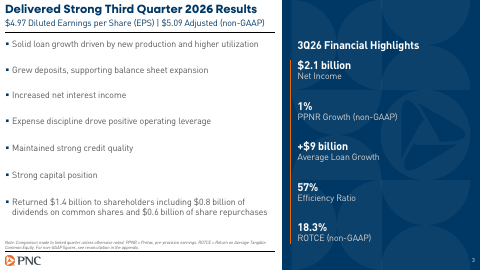
Capital markets fees are up about 15% and mortgage is down, with other fee lines stable, and expenses reflect revenue-driven costs and seasonality. — Rob Reilly
0:32:29 · Ken Usen, Autonomous Research · Capital
What is CET1 including AOCI, and how should we think about buybacks going forward?
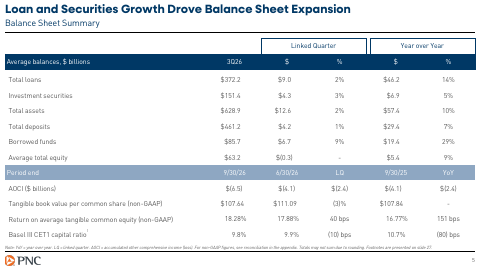
Including AOCI the ratio would drop to the low nines, and PNC expects fourth-quarter repurchases similar to the third quarter. — Rob Reilly
0:34:09 · Ibrahim Purnawala, Bank of America · Client conversion
Should low-cost deposits measure whether the new-client strategy is working?
Yes, deposit growth is the goal, and PNC is adding the same kinds of clients as before in new markets, with credit card offers to come to deepen relationships. — Bill Demchak, Rob Reilly
0:36:48 · Ibrahim Purnawala, Bank of America · AI spending
Will AI cost drag or productivity gains matter more over the next 12 to 24 months?
AI costs already show in the run rate, and the next phase of reengineering with AI is meant to lower technology costs and then support revenue. — Bill Demchak
0:40:36 · Gerard Cassidy, RBC Capital Markets · Deposit competition
Will AI agents moving deposits around push deposit costs up for the industry?
Deposit movement will get easier and more competitive over time, but agents transacting in accounts would need liability laws and secure authentication first. — Bill Demchak
0:43:16 · Gerard Cassidy, RBC Capital Markets · Growth drivers
What is driving client momentum beyond new business, and is it sustainable into 2027?
Clients have adapted to an uncertain world in a strong economy, and expansion-market share gains add to the industry tailwind. — Bill Demchak, Rob Reilly
0:45:23 · Gerard Cassidy, RBC Capital Markets · Client acquisition
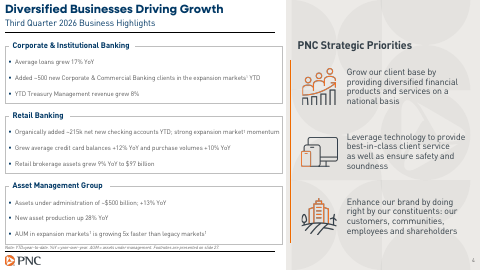
Are the 500 new client relationships replacing other banks or complementing existing ones?
Both: larger corporates are typically multi-bank deals, while smaller middle-market clients are sometimes new to PNC as their primary bank. — Rob Reilly, Bill Demchak
0:45:57 · Mike Milo, Wells Fargo · Commercial loans
How much commercial loan growth is industry versus share, AI capex versus other, and new markets?
Management said excess growth in new markets is pure share, that AI capex impact is hard to size, and that expansion markets are growing two to three times faster. — Bill Demchak, Rob Reilly
0:48:27 · Mike Milo, Wells Fargo · Expansion markets
How fast is Texas and the Southwest growing?
It is growing at the two-to-three-times rate, with California and Florida also growing. — Bill Demchak
0:49:03 · Mike Milo, Wells Fargo · Growth durability
Is this commercial growth a one-quarter event or a multi-year change?
Management thinks it has legs for now with strong pipelines, but said many things could knock it off course. — Bill Demchak
0:50:04 · David Cavarini, Jefferies · Rate sensitivity
What is PNC's sensitivity to rates and balance sheet positioning?
PNC is roughly neutral to short-term rates and benefits from a steeper yield curve through fixed-rate asset repricing. — Rob Reilly
0:50:40 · David Cavarini, Jefferies · Credit quality
What drove the NPL increase and what is the credit outlook?
It came from previously reserved CRE office loans and one service-provider credit with cash flow issues, and credit is otherwise good. — Rob Reilly
0:51:49 · David Cavarini, Jefferies · M&A
What are your latest thoughts on M&A appetite?
Management said it prefers organic growth and the AI transformation over large M&A, which could slow that work, though small deals are not ruled out. — Bill Demchak
0:53:55 · Chris McGrady, KBW · Risk appetite
Has PNC's or its clients' risk tolerance changed with the macro and rate backdrop?
No, PNC keeps to its basic structures and client types and grows by adding clients rather than moving into riskier buckets. — Bill Demchak