“Brazos adds substantial contracted growth and value chain opportunities across our system, increasing our momentum toward the higher end of that target.”
Management links the Brazos deal to the upper end of its long-term growth target.

ONEOK (OKE) · Energy
Results filed 27 Oct 2026 · Quarter ended 30 Sep 2026 · Call 62 min · Pierce Norton (CEO), Walt Holt (CFO)
Read the transcriptSlides (17 pages)Press release ↗Investor relations ↗
Summaries and transcripts are machine-generated and can contain errors.
ONEOK closed its Brazos Midland acquisition and a $9 billion minority equity investment, expanding its Permian footprint as record volumes and data-center gas demand shape growth.
ONEOK completed its Brazos Midstream Permian Midland acquisition in October and finished the Denver refined products pipeline expansion. Record Permian volumes lifted NGL and gas processing activity. Producers are adding rigs in the Bakken, Mid-Continent and Powder River basins. Export demand for refined products and crude stayed strong, and new gas pipeline contracts for power plants were announced.
Management plans to fill new Permian processing plants and the Medford fractionator, add Delaware NGL takeaway, and pursue more gas contracts for power and data centers. It will give 2027 guidance in February. The main tension is capital and timing: spending is expected to stay near $3 billion in 2027 under a lower leverage target, and a big NGL inventory build depends on Medford starting on schedule.
Open the slide deck (PDF, 17 pages) ↗
Showing the first 6 of 17 pages.
SEC filing
up from 8,634 in the third quarter of 2025
up from $940 million a year ago
up from $1.49 a year ago
up 6%
up from 1,558 a year ago
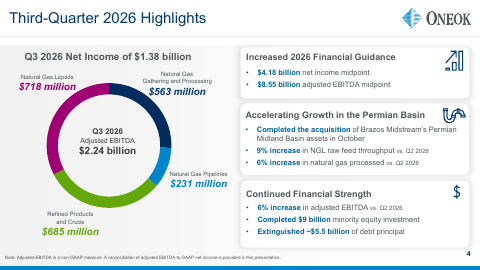
| Segment or metric | Value | Change |
|---|---|---|
| Natural Gas Liquids adjusted EBITDA | 718.0M | down from 748 a year ago |
| Refined Products and Crude adjusted EBITDA | 685.0M | up from 582 a year ago |
| Natural Gas Gathering and Processing adjusted EBITDA | 563.0M | down from 566 a year ago |
| Natural Gas Pipelines adjusted EBITDA | 231.0M | up from 200 a year ago |
| NGL raw feed throughput (MBbl/d) | 1,661 | up 6% from a year ago |
| Refined products volume shipped (MBbl/d) | 1,615 | up 6% from a year ago |
| Crude oil volume shipped (MBbl/d) | 1,693 | down from 1,813 a year ago |
| Natural gas processed (MMcf/d) | 5,866 | up from 5,852 a year ago |
Copied from the press release ↗ and other documents in the SEC filing ↗. A figure is published only if its sentence is in those documents.
| From the filing | Q3 2026 | vs year ago | vs last quarter |
|---|---|---|---|
| Revenue | $12.5B | +44.3% | +3.4% |
| Operating income | $1.6B | +0.6% | −1.6% |
| Net income | $1.4B | +43.8% | +39.8% |
| Diluted EPS | $2.13 | +43.0% | +39.2% |
| Free cash flow | $442.0M | −46.1% | −69.3% |
| Operating margin | 12.6% | −5.4 pts | −0.6 pts |
Calculated by code from XBRL, not by the model.
| Metric | Period | Outlook |
|---|---|---|
| Net income | 2026 | $4.09 billion to $4.27 billion |
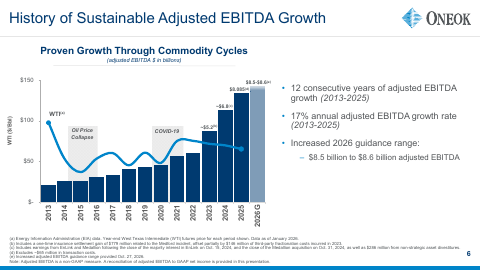
| Adjusted EBITDA | 2026 | $8.5 billion to $8.6 billion |
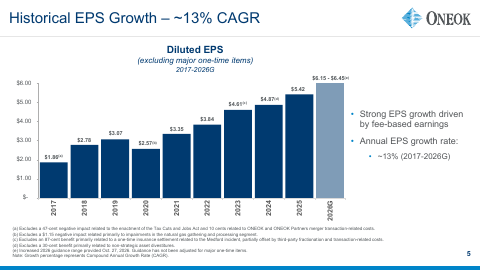
| Diluted EPS | 2026 | $6.15 - $6.45 |
| Capital expenditures | 2026 | approximately $3.5 billion |
| Book income tax rate | 2026 | 16% |
| Capital expenditures | 2027 | $3 billion-ish |
| Debt to EBITDA target | going forward | approximately 3.25 times or lower |
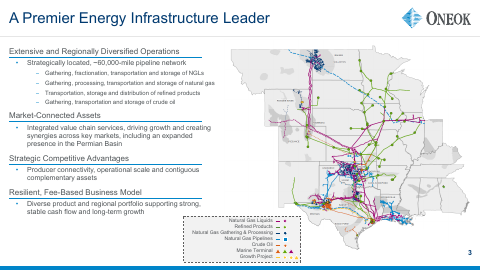
ONEOK closed the Brazos Midstream Permian Midland acquisition in October. Management says the plants are full and volumes are above expectations, with about 14 rigs expected on the acreage in 2027. The Cassidy 1 plant is due at year end, and tying the system into ONEOK's legacy network saves capital.
Gulf Coast/Permian NGL volumes rose 16% year over year. Fractionators are highly utilized, so ONEOK is building unfractionated inventory until Medford Phase I starts in mid-December. Management expects the associated earnings to be recognized mainly in the first quarter of 2027.
ONEOK announced a 10-year firm transportation agreement for 250 million cubic feet per day for a 1 gigawatt power plant, plus 110 million cubic feet per day for a 500 megawatt expansion starting May 2028. It is engaged with more than 40 data center and power counterparties.
The 35,000 bpd Denver-area refined products expansion is complete and fully contracted, and customers are discussing a scalable next phase. Refined products exports rose about 15% and Seabrook crude exports remain fully contracted.
ONEOK now targets debt to EBITDA of approximately 3.25 times or lower, down from about 3.5 times, after the $9 billion minority equity investment. This gives it room to fund more organic projects and keep capital spending near $3 billion in 2027.
Fourth quarter worked out from the annual figure.
| Q4 2024 | $7.0B * |
| Q1 2025 | $8.0B |
| Q2 2025 | $7.9B |
| Q3 2025 | $8.6B |
| Q4 2025 | $9.1B * |
| Q1 2026 | $9.6B |
| Q2 2026 | $12.0B |
| Q3 2026 | $12.5B |
| Q1 2025 | $1.04 |
| Q2 2025 | $1.34 |
| Q3 2025 | $1.49 |
| Q1 2026 | $1.23 |
| Q2 2026 | $1.53 |
| Q3 2026 | $2.13 |
Fourth-quarter EPS appears once the press release is read; filings report it only for the full year.
| Q4 2024 | 22.4% |
| Q1 2025 | 15.2% |
| Q2 2025 | 18.1% |
| Q3 2025 | 18.0% |
| Q4 2025 | 16.9% |
| Q1 2026 | 14.8% |
| Q2 2026 | 13.2% |
| Q3 2026 | 12.6% |
| Q4 2024 | $1.0B |
| Q1 2025 | $275.0M |
| Q2 2025 | $776.0M |
| Q3 2025 | $820.0M |
| Q4 2025 | $576.0M |
| Q1 2026 | $70.0M |
| Q2 2026 | $1.4B |
| Q3 2026 | $442.0M |
Operating cash flow minus capital expenditure, from cash flow statements.
Each quote matches the transcript word for word.
“Brazos adds substantial contracted growth and value chain opportunities across our system, increasing our momentum toward the higher end of that target.”
Management links the Brazos deal to the upper end of its long-term growth target.
“We intend to operate the company with lower leverage than our previous target of approximately 3.5 times.”
It signals a lasting change in balance sheet policy that supports funding more growth projects.
“we've seen a big pull of export volume that's changing the dynamics on our system.”
Export demand is reshaping refined products flows and creating new expansion opportunities.
“This project includes a 10-year firm transportation agreement for 250 million cubic feet per day of natural gas and is expected to be in service in late 2030.”
It shows power-plant and data-center demand turning into long-term contracted pipeline business.
“But because Brazos overbuilt this system, we're immediately able to access that capacity and save that capital.”
It points to an early capital synergy from integrating the acquired assets.
Growth capital will span all segments, led by Permian gathering and processing, with opportunities in the Mid-Continent, refined products and data-center gas pipelines. — Sheridan Swords, Pierce Norton
The dip was ethane rejection while propane-plus volumes grew, and Medford will start full as it works through stored raw feed. — Sheridan Swords
Management said it stayed cautious on geopolitics and expects a tailwind into the fourth quarter and 2027 if conditions hold. — Walt Holt
ONEOK has some spare capacity at Medford and a permitted additional fractionator, and will build it when timing is right.
Volumes are above expectations, and Brazos's oversized pipelines let ONEOK avoid expanding one of its own lines. — Pierce Norton
The upsized pipeline opens northern Delaware and New Mexico to compete for third-party processing and NGL volumes, backed by contracted producers and processors.
Yes, rigs are returning, including from multi-basin producers new to ONEOK's footprint, some drilling core acreage.
Private equity owners see a strong market window, and ONEOK prefers assets where it can capture NGLs and touch the molecule across its integrated chain. — Walt Holt
About $3 billion in 2027, then $2.5 to $3 billion a year, still leaving free cash flow for shareholder returns.
Both producers and third-party processors signed up, and it is almost entirely full value chain transportation and fractionation.
Management cited flexibility through commodity cycles and shareholder interest in lower leverage, not any single factor or a rating target.
It would be a modest, scalable expansion that needs customers to commit to capacity, and those conversations are underway.
Cassidy 1 adds capacity to plants that are full today, the Brazos and legacy systems will be tied together, and Cassidy 2 should ramp quickly. — Sheridan Swords, Walt Holt
Yes, producers are getting more comfortable with the Barnett and could add rigs, though current plans point to the base case. — Sheridan Swords
The decline was in the low-margin Houston distribution system, while higher-margin Permian gathering volumes rose 7% and Permian crude should grow. — Sheridan Swords, Pierce Norton
Management declined to guide but said 2027 is setting up well, with activity picking up across the Permian, Mid-Continent, Bakken and Powder River.
ONEOK was about 75% hedged for 2026 and has accelerated 2027 hedges at wide margins, but the growth target is based on the base business. — Sheridan Swords
ONEOK did not quantify the inventory, but Medford should run full through the first quarter, with fee-based earnings recognized when barrels are fractionated.
No; wide margins, lower logistics costs from synergy projects, an RVP-related timing shift and higher gasoline volumes all helped, and fourth-quarter margins are still good.
It closed the Brazos Midstream Permian Midland acquisition in October, after completing the $9 billion minority equity investment. Brazos plants are full, volumes are above expectations, and Cassidy 1 is due at year end.
ONEOK has a 10-year firm transportation agreement for 250 million cubic feet per day for a 1 gigawatt plant and 110 million cubic feet per day for a 500 megawatt expansion. It is engaged with more than 40 counterparties representing more than 5 Bcf/d of potential demand.
Fractionators are highly utilized and unfractionated NGL inventory is building until Medford Phase I starts in mid-December. Management expects associated earnings mainly in the first quarter of 2027.
Refined products volumes rose 6%, gasoline grew 10%, and the Denver-area pipeline expansion is complete and fully contracted. Export volumes rose about 15% and Seabrook crude exports remain fully contracted.
It now targets debt to EBITDA of approximately 3.25 times or lower, down from about 3.5 times. It expects capital spending near $3 billion in 2027 and will issue 2027 guidance in February.
Call recording on YouTube ↗. Official replay ↗. Timestamps jump to the moment.
Good morning and welcome to One Oaks third quarter 2026 earnings call. As a reminder, this call is being recorded. If you would like to participate in the question and answer session following the speaker's opening remarks, simply press star one on your telephone keypad. At this time, I'd like to turn the conference over to Megan Patterson, Vice President, Investor Relations. Megan, please go ahead.
Thank you, Anna. Welcome to 1 Oaks' third quarter 2026 earnings call. Our earnings release and presentation were issued after market close yesterday and are available on our website.
On our call today are Pierce Norton, President and Chief Executive Officer, Walt Holt, Chief Financial Officer, Randy Lentz, Chief Operating Officer, and Sheridan Swords, Chief Commercial Officer. Following our prepared remarks, management will be available to take your questions. Statements made during this call that might include one of expectations or predictions should be considered forward-looking statements and are covered by the Safe Harbor provision of the Securities Acts of 1933 and 1934. Actual results could differ materially from those projected in forward-looking statements.
For discussion of factors that could cause actual results to differ, please refer to our SCC filings. With that, I'll turn the call over to Pierce Norton.
Thank you, Megan. And good morning, everyone, and thank you for joining us today. Yesterday we reported strong third quarter results supported by our record Permian Basin volumes and continued growth across our integrated system. And we increased our 2026 financial guidance for the third time this year. Also completed several strategic milestones.
During the quarter, we closed a $9 billion minority equity investment, extinguished nearly $5.5 billion of debt, and received credit rating upgrades from both S &P and Fitch. Earlier this month, we closed the acquisition of Brazos Midstream's Permian Midland Basin assets. Together, these actions give One Oak greater skill, greater financial flexibility, and and clearer visibility into the future earnings growth. Our confidence in One Oaks Outlook continues to gain momentum, supported by the assets that we own, the customers that we serve, growth projects already underway, and the innovation of our people.
We're not providing 2027 guidance today, but we expect to do so after our fourth quarter results in February. but the underlying drivers are increasingly clear. Constructive producer development plans and continued drilling and completion efficiencies, recently completed projects that will contribute to a full year's earnings in 2027, additional projects nearing completion, and a full year of ownership of the Brazos assets. Importantly, that visibility extends across our integrated system and isn't dependent on a single commodity or project or basement.
We see opportunities across natural gas, HGLs, refined products and crude, and supported by domestic and international demand and the connectivity that we built across our value chain. That diversification gives us a multiple of avenues to grow and capture value as the market conditions evolve. The broader backdrop reinforces the opportunity. Global energy markets remain dynamic, but growing natural gas demand for power generation, industrial loads, and liquefied natural gas exports to feed the international demand all point to the same need.
Reliable access to essential energy when and where it is needed. The international buyers are increasingly seeking long-term access to U .S. supply for its reliability and resiliency. And trend we're seeing through the strong export demand across our system. These drivers also reinforce our confidence in our mid to high single-digit adjusted EBITDA growth target for the next five to seven years from our 2025 base. Brazos adds substantial contracted growth and value chain opportunities across our system, increasing our momentum toward the higher end of that target.
One Oak has the assets, the financial strength, the discipline, and the people to capture the growing energy demand and to deliver sustainable long-term value for our investors. With that, I'll turn the call over to to Walt for a financial update.
Thank you, Pierce. Third quarter net income attributable to One Oak totaled $1.35 billion for $2.13 per diluted share and adjusted EBITDA totaled $2.24 billion, a 6 % increase compared with the third quarter of 2025.
Net income and EPS included a $336 1,000,001-time non-cash income tax benefit related to the corporate reorganization completed in connection with the minority equity transaction. Adjusted EBITDA included a $53 million net benefit from the transactions, primarily related to gains on the extinguishment of debt. As Pierce mentioned, we increased our 2026 financial guidance again, reflecting strong year-to-date performance, visibility into the remainder of the year, and the addition of the Brazos Midland assets. We now expect a 2026 net income midpoint of $4.18 billion and adjusted EBITDA midpoint of approximately $8.55 billion.
This represents a $200 million increase in our adjusted EBIT job midpoint compared with the guidance we provided last quarter and a $450 million increase compared with our original February guidance. Of this quarter's $200 million increase, approximately $50 million reflects transaction-related benefits I just described. Approximately 75 million reflects the expected 2026 contribution from the Brazos assets, which is offset then by $25 million of transaction costs, and the remaining $100 million reflects stronger performance across our base businesses.
This year we've been somewhat conservative with guidance due to the geopolitical volatility. If commodity conditions remain consistent with where they are today, we will have a very good tailwind in the fourth quarter and into 2027. That takes me to our hedging program. As the back end of the commodity forward curve has risen throughout the year, we've increased our hedging position into 2027 at a greater percentage and at higher prices than 2026. We continue to programmatically hedge commodity exposures.
On capital expenditures, we stated on the second quarter earnings call, we expected to approach the high end of our guidance range over $3.2 billion. We now expect 2026 capital expenditures to total approximately $3.5 billion, due primarily to $200 million of capital associated with the Brazos acquisition, along with added growth projects such as the Cutter 2 plant, our Delaware NGL expansion, and compression pulled into 26 from 27 due to Bakken and Mid-Continent activity levels.
From a balance sheet perspective, we extinguished nearly $5.5 billion of debt in September, FOLLOWING COMPLETION OF THE $9 BILLION APOLLO MINORITY EQUITY INVESTMENT. BOTH S &P GLOBAL RATINGS AND FITCH RATINGS UPGRADED OUR CREDIT RATINGS TO BBBPLUS WITH A STABLE OUTLOOK FOLLOWING THESE TRANSACTIONS. WITH THESE ACTIONS COMPLETE, WE ARE OPERATING WITH A STRONGER BALANCE SHEET. AND NOW I WANT TO SPEND A MOMENT ON OUR LEVERAGE FRAMEWORK BECAUSE IT'S AN AREA WE 'VE RECEIVED A NUMBER OF QUESTIONS.
Our debt to EBIT target going forward is approximately 3.25 times or lower, and the overall lower matters. This is not guidance. It reflects a change in philosophy. We intend to operate the company with lower leverage than our previous target of approximately 3.5 times. As modeled today, we would expect to go below three times within the next few years. However, our commercial team continues to find highly attractive projects which we expect will increase our capital expenditures over the next few years.
We now have the financial flexibility to execute on those capital expenditures and still maintain a strong balance sheet. We now view 3.5 times as the upper end of our targeted leverage range. The gap between where we expect to operate and that ceiling is intentional. It gives us meaningful flexibility through business and commodity cycles and the capacity to act if a compelling opportunity comes along that clearly meets our return thresholds. That's optionality, not a plan. Our base case remains disciplined and leveraging while we continue to fund attractive growth and return capital projects and capital return to shareholders.
That includes our dividend and the capacity for share repurchases. From a cash tax perspective, the Brazos Midland acquisition is expected to extend our runway by another year, deferring meaningful cash tax payments until 2032 from previously 2031. I'll now turn it over to Randy for an operational and project update.
Thank you, Walt. Our teams continued to execute safely and reliably during the third quarter while advancing growth projects across the system. During the quarter, we completed our Denver Area Refined Products Pipeline expansion, adding 35,000 barrels per day of capacity.
Demand has been encouraging, and we're beginning to evaluate further expansion opportunities. We also completed 110 million cubic feet per day of processing expansions in the Delaware Basin and are already seeing incremental volume with a continued ramp up to capacity in early 2027. In the fourth quarter, Medford Phase 1, Cutter 1, and Cassidy 1 are all expected to enter service providing additional fractionation and processing capacity across the Mid-Continent, Powder River and Permian. Then in 2027, Bighorn adds 400 million cubic feet per day of processing capacity in the Delaware.
Cassidy 2 adds another approximately 330 million cubic feet per day of capacity in Midland. And our Delaware NGL expansion adds 245,000 barrels per day of takeaway capacity. That expansion added this year supports growing Delaware volumes and connectivity with our West Texas NGO pipeline. The acquisition of Brazos Midland assets also expands our opportunity set considerably. We're already advancing connections between Brazos and our legacy One Oak system, which we expect will improve capital efficiency and commercial flexibility as we continue Midland Basin growth.
Beyond what we've announced, we continue to see a growing set of opportunities across across multiple products and regions, providing several pathways for continued organic growth. With that, I'll turn the call over to Sheridan for a commercial update.
Thank you, Randy. Third quarter commercial activity was strong, driven by customer demand and volume growth across key portions of our system. Starting with the natural gas liquid segment, total raw feed throughput increased 6 % year-over-year to nearly 1.70 million barrels per day.
Our largest volume growth was in the Gulf Coast Permian region, where volumes increased 16 % year-over-year and 9 % compared with the second quarter, with nearly all of the increase from West Texas. Volumes continued to benefit from increasing producer activity, recently connected third-party plants, and additional natural gas egress out of the basin. Copane Plus volumes increased both year-over-year and sequentially across all of our operating regions, driven by continued producer activity. Ethane recovery remained attractive across most of our system, supported by strong domestic and international petropanical demand.
We saw a modestly higher rejection in the Rockies and mid-continent falling strong recovery levels in the second quarter, while Permian economics continue to favor full recovery. Our fractionators are highly utilized as we work toward the completion of Medford Phase I, which we expect in mid-December. Until then, we're continuing to build the inventory of unfractured NGLs, which defer the timing of the associated earnings from these NGLs. As Medford comes online, we will begin working through that inventory and recognize the associated earnings, primarily in the first quarter of 2027.
We expect this to give us a built-in earnings benefit early next year. Turning to the refined products and crude segment. Refined products volumes increased 6 % year over year, including 10 % growth in gasoline and 2 % in disciplines, supported by solid demand and high refiner utilization across our footprint. Based on our year-to-date performance, we expect refined products volumes to finish the year near the top end of our original guidance range. Our connectivity and marketing capabilities also let us capture regional opportunities as wide mid-continent to Gulf Coast basis differentials and low inventories created price volatility.
Mid-year tariff adjustments added a further benefit. Liquid blending also performed well. Increased gasoline throughput and the completion of synergy projects contributed to higher blending volumes during the quarter. We entered the fall season with approximately 75 % hedged and unhedged September spot margins provided additional upside. Historically, widespread has allowed us to lock in favorable blending margins throughout 2027, further out than we typically would. Export demand has also remained strong, with refined products volumes that clean up approximately 15 % year-over-year.
Crude oil exports at Seabrook remain fully contracted with third quarter throughput approximately doubling the prior year period. In our higher margin crude gathering business, we expect full year volumes to increase approximately 7%, supported by midland producer activity averaging nearly 40 rigs on our dedicated acre. Moving to the natural gas gathering and processing segment, Volumes increased all three regions compared with the second quarter, led by record volumes in the Permian Basin. Volumes are higher across both the Midland and Delaware basins in the Permian, led by growth in the Delaware following completions of our processing expansions.
Across our dedicated Permian acreage, we have approximately 21 rigs, including 17 in the Midland Basin and 4 in the Delaware. The addition of the Brazos assets substantially expands our Midland opportunity with a long runway of high-quality drilling inventory and greater connectivity across the combined system. Importantly, what we've seen since announcing the transactions continue to support our acquisition assumptions. Based on current producer plans, we expect an average of approximately 14 rigs on the Brazos Midland Dedicated Acres during 2027.
Producers are also encouraged by early Barnett results, including well performance and drilling and completion efficiencies, which are supporting increased development activity and a higher volume outlet. As we said today, the current Brazos Sundan plants are full and volumes on the Brazos's assets are above our expectations for this point in the year. We expect the continued volume ramp will be enough to fill Cassidy 1, which comes online, at year end. The larger combined system gives us flexibility to optimize the timing and location of that next expansion.
Outside the Permian, Rocky's processing volumes increased 3 % from the second quarter and were encouraged by activity in the area. Since March, Williston basin rigs are up approximately 50 % and rigs on our dedicated acreage have doubled to 16, approaching 2024 and early 2025 levels. The higher activity reinforces a stable, durable volume base, and with our infrastructure already in place, incremental volumes translate directly into very attractive cash flow. In the Permian River Basin, initial well performance around the Cutter Plant has exceeded producer expectations, and we expect volume to ramp with planned completions in the fourth quarter and throughout 2027.
In the mid-comp, growth continues across our Oklahoma system, driven by activity in both the Cherokee and stack formations. And several gathering expansions are underway to support further growth into 2027. There are currently 17 regs on our dedicated acres. Overall, producers remain disciplined, but current 2027 plans reflect increased activity and our conversations remain constructive. I'll close with the natural gas pipelines, where third quarter adjusted EBITDA was $231 million, up from $200 million a year ago, benefiting from higher optimization and marketing activity and higher firm transportation revenues.
As expected, the Waha to Katy opportunity moderated sequentially as additional Permian Egress entered service and price differentials narrowed. We expect a further reduction in the fourth quarter, which is already reflected in our guidance. Longer term natural gas demand continues to provide significant opportunities. Last quarter, we announced we had been awarded a supply grant for a 1 gigawatt of power plant demand. This project includes a 10-year firm transportation agreement for 250 million cubic feet per day of natural gas and is expected to be in service in late 2030.
Additionally, we've been awarded another agreement to supply 110 million cubic feet per day for a 500 megawatt power plant expansion, which will go into effect in May 2028. these attractive return projects are good examples of the opportunities we are pursuing across our pipeline network and we expect to announce additional projects as this discussions advanced appears that concludes my remarks
uh thank you uh walt and randy and sheridan for that uh those updates uh as i look back at the first nine months of this year the progress that we have made is significant we've increased guidance three times significantly strengthened the balance sheet expanded our position in scale in the permian basin completed significant organic projects with additional projects approaching startup
and we're seeing constructive volume trends and producer activity across our footprint Most importantly, though, those accomplishments, along with constructive producer plans and our hedging program, give us momentum and visibility as we enter 2027. At the same time, the broader need for reliable U .S. energy infrastructure continues to grow. The energy landscape will remain dynamic. Our goal isn't to predict every geopolitical event or commodity price movement. is to position One Oak to perform through them. And we believe our scale, asset connectivity, financial flexibility, and customer relationships give us the ability to do just that.
We believe One Oak will enter 2027 from a position of strength with a clear inventory of growth opportunities and the infrastructure required to help connect essential U .S. energy resources with the growing demand. And as always, none of this happens without our employees. I want to thank them for their continued commitment to safety, reliability, innovation, and to serve customers. Operator, we're now ready to take questions.
Thank you. And if you would like to ask a question, please signal by pressing star 1 on your telephone keypad.
If you are using a speakerphone, please make sure your mute function is turned off to allow your signal to reach our equipment. We do ask that you limit yourself to one question and a follow-up to fit in as many of you as possible. Again press star 1 to ask a question. We'll pause for just a moment to allow everyone an opportunity to signal for questions. And we'll now take our first question from Spiro Dunas with Citi.
Operator, good morning team. I want to start off with new projects. Well, you mentioned commercial teams working on some new opportunities here. Curious if you can expand and maybe give us a sense of what regions or commodities you're seeing the most activity and where that capital is likely to get allocated. And just to add on, Pierce, I noticed you added some commentary on the natural gas side. Sheridan seemed to support that with some of these data center projects.
So curious, you know, if we can expect gas to maybe get a higher allocation than has historically been the case, and if 3 billion plus is a good run rate to use from here on CapEx.
Yeah, this is Sheridan. I would say as we start thinking about where we're going to see, you know, growth in CapEx or growth across our system is obviously we'll start in the Permian where volumes are strong, growing strong. We already have quite a bit of processing capacity come online.
We see the runway that we will be adding more processing capacity in the future, so that's going to create more opportunity for the NGL business as well. So we think we'll see a lot in the gathering and processing segment in the Permian. We're also seeing some opportunities in the MidCon. We continue to see that grow. Volumes are up strong. We could have some allocation of capital into the MidCon area. As you start thinking about refined products, you know, we've seen a big pull of export volume that's changing the dynamics on our system.
We could see some optimization opportunities or being able to increase our capacity between the Gulf Coast and the Mid-Continent be an opportunity. We're also looking to expand the Denver pipeline that, you know, came up this year, completely fully contracted. Commercial teams are working with other people to see about the opportunity to expand that systems we continue to go forward and then obviously the data centers we continue to be in discussions with a large number of data centers a lot of them continue to advance you know last quarter we announced one this quarter we're announcing another one the teams are on the edge on a couple other really nice projects as well so we will see some area from from
power demand going forward on the natural gas pipe so really when we think about capital and the capital we're looking about across our footprint, it's in all the segments as we go forward. It's not really concentrated in one area or the other.
Spiral, this is Pierce. One thing I'd add to that is, you know, much of the gas that we move is going to be feeding LNG facilities as well as the electric generation, either for utilities or for AI data centers.
It comes with liquids. And so the gas demand that we see also will increase the gathering and the processing opportunities that we have, along with moving the liquids associated with those gathering and processing plants and the fractionation facilities. And it gives us more blending opportunities with those products into our RPC business. So it touches all phases of our business.
Got it. It's helpful, Collar. Second question, moving to NGL volumes, tracking to be above the high end of your guidance this year, but you did see some volumes come in quarter over quarter in the Rockies and MidCon.
Sheridan, I suspect that was really a function of ethane rejection, but maybe you would appreciate more color there and how you're seeing the rest of the year shape up. And if you could, maybe just talk through what changes when Medford comes online. Is there an easy way to sort of quantify the impact of storing all these NGLs and how quickly you'd expect Medford to fill up?
Yeah, I think, Superior, you're exactly right. The little bit of fall off we saw in the Rocky Mountains and Midcontinent where the NGLs was all ethane.
As I said in my remarks, the C3 plus volume is actually up. So the underlying growth is strong there. It's a little bit more ethane projection. Some of that is on our own chose coming out of the Bakken that we dialed back our incentivized ethane a little bit just due to the market conditions we're seeing right now. As we continue to move forward on NGLs, we continue to see growth. And a lot of that growth is going to come out of the permeance, but we'll see a significant amount of that growth going forward as we continue to ramp up our natural gas gathering and processing assets out there in the area.
So we see, well I'm going forward, now when Medford comes up, the impact of Medford is because we do have raw feed that is in storage today, obviously we have more raw feed coming to our system than our current fractionators can handle. Medford will come up completely full for a period of time as we work off that raw feed and inventory. So both phase one and phase two will be full for a period of time going forward.
But then we'll be able to leverage that into growth after that's worked down, that growth coming out of Permian that we see as we bring on, you know, the Brazos plants, continue to fill our legacy one oak plants out there is going forward. As Randy said, we've already, we are in the process of tying Brazos and the legacy one oak midland systems together, which we will be able to remove volume that we're doing on third parties today, we have offloads in our GNP Midland system today, third parties will be able to bring that into our own plants and create more NGLs, which will be able to fractionate through Medford going towards them.
When we put Medford, when we actually came out with Medford, we had said that we had not subscribed 100 % of that capacity because it was a lower cost fractionator. If it was a brownfield fractionator, we didn't need to scribe all the capacity so that we We had additional operating leverage that we could continue to contract. Commercial team has continued to contract as we've gone through this build phase. We still have capacity that is uncontracted today, but that is a lot less than we had before.
And we think that gives us a lot of leverage to be able to contract even more third-party volumes, as we have done with our Delaware expansion.
Great. I'll leave it there. Thank you, gentlemen.
We'll now take our next question from Jeremy Tenet with JPMorgan.
Hi. Good morning. Good morning, Jeremy. Just want to, you know, touch on the guide for 26 if I could a bit. And if we're looking at it right, it seems like it implies 4Q doesn't really move up versus 3Q in any meaningful fashion.
And that would even be with the Brazos contribution. So just wondering if you could talk a bit more gives and takes in the fourth quarter. Think of it as maybe seasonally a bit stronger as well. Is that conservatism or are there other elements at play here?
Jeremy, this is Walt. As I said in our remarks, we have remained cautious throughout the year, just given the whole geopolitical situation. If everything stays like we are today, we are probably on the conservative side and you could expect a nice tailwind.
Then we'll be in the fourth quarter and with the reactivity that we're seeing now really continue into 2027 pretty strong.
Got it. Thank you for that. And then maybe just moving over towards the fractionation side, picking up a bit more in the comments, he said, seems like Medford would bring, you know, a lot of optimization opportunities or flexibility to the system. But then even if I look at the NGL raw supply that you guys have versus fractionation capacity, it still seems maybe the system is a little bit short and could need some more fractionation build out, particularly when you're thinking about all the processing plant additions and, you know, the dock and export coming up here.
just wondering you know how you think about that growth opportunity
yeah or mine yeah we watch that very closely Jeremy to understand where it is now remember not all the volume you see that we report we fractionate some of that we just transport on that but what I would say we do have a little bit extra capacity in Medford and we do have in B7 that's already permitted and then we're just trying to understand when the right time is that we can't I do that to be able to make sure we have fractionation capacity for our growing gas processing plants.
Got it. Understood. I'll leave it there. Thank you.
Our next question will come from Manav Gupta with UBS.
Good morning. I actually just wanted to go back to Brazos and ask you about now that you've had some look at these assets, are they actually meeting your expectations? Where are the areas where you think actually there could be some upside here? If you could give us an update on how you're thinking about the synergies now that you have had some chance to look at these assets at a closer look.
That's my first question.
Yeah, what I would say is that we are very, very satisfied with what we've seen with RALZOS. I mean, as I mentioned in my remarks, that volumes are above our expectations at this time of the year, at this time in the process. And nothing tells us that they're not going to continue to be of our expectations as we move into 2027. The assets in general, we have found them, we've been very pleased with the assets in general.
They put some very big pipelines in their area. They didn't just build enough what they had. They do a lot of things like we did, they upside their pipelines, and that's given us a lot of capital synergies immediately. We actually were going to have to expand one of our main lines on our system, on our Legacy 1-0 gathering and processing system. But because Brazos overbuilt this system, we're immediately able to access that capacity and save that capital.
And that continues to happen going forward as we get to look at it. as we get these plants up, we're very pleased at how well they built the plants, the redundancy they put in there. They built them like we would. They built them to last. As we continue, as I talked about in the volumes, we continue to talk to producers. Producers get more and more excited about this barnet and what it means, the efficiencies, and as they get better at it, the volumes exceeding their expectations per well.
So right now, Brazos is probably hitting on all cylinders of what we expect it to. We're very pleased with what we've seen so far.
And this is Pierce. I can't emphasize enough, you know, sharing his last comments about the quality of the way these assets have been built. You know, Randy and I have both backgrounds in, you know, the construction of these kind of things. And I can walk around that plan and tell that they've addressed a lot of the things that I've seen as problems in the past, with other companies and other assets.
And I think they built them for reliability, resiliency. So I'm very, very pleased with the quality of the assets that we picked up.
Perfect. My very quick follow-up here is we noticed in the slide deck that Delaware NGL expansion of 245. And we also know you have the processing plant at Big Horn coming around like 400,000 somewhere in 2Q. And this new expansion is 3Q. So can you talk about these two projects in some form complementary to each other?
They are a little bit, but really this expansion that we're doing, we're really laying a pipeline from our Texas, Delaware, up to the northern Delaware and New Mexico. So we're up in a new area. We did upsize this expansion more than we needed, like we've done other ones. We have a lot of growth there. It's backed by third-party processors and producers that have contracted for this space. And with that extra capacity, we really are excited about being able to access a different part of the Delaware Basin, that northern New Mexico, Delaware, where there's a lot of opportunity for us to compete for third-party processing plants in that third-party NGL volume.
Thank you so much.
Well, now I'll take our next question from Jean Anne Filsbury with Bank of America.
Hi, good morning. Bakken rigs have gone up markedly in the last month or two. Have you heard from producers that they're adding activity in the Bakken at these oil prices?
Yeah, we have. They are. Obviously, they're adding activity. We have more rigs coming online. And what's interesting about that is we're seeing more rigs come in or rigs come back from producers that are multi-basin producers that have other opportunities across the whole North America and they are bringing regs back back.
So we are very, we're excited about what we're seeing and in some of these areas they're drilling in the core of the core, which is great, great for us and that volume is all coming to us as well. So yeah, we are seeing more activity in the Bakken with this rig count and from a different type of producer that we haven't seen before, which is very encouraging.
And there's obviously been a lot of Permian M &A in recent months, specifically of GMP M &A.
What do you attribute this uptick in activity to? A lot of these GMPs had kind of been out there for a long time. And then I guess relatedly, what are the key criteria when One Oak assesses these for fit within your portfolio? Is the ability to direct NGLs a must-have component when you're screening these things?
Jan, this is Walt. You know, I think that, you know, you ask why there are so many of these transactions.
Clearly with commodity prices where they are, the private equity backers are looking at this as a window and opportunity to sell when the market's as strong as it has been. So they're all testing the market. Many of these assets have tested the market before, but at these levels, you're seeing some activity. And the other thing is that there are fewer and fewer of those opportunities out there. So, you know, as people look at trying to round out, you know, they've decided to act, and many of them have de-risked quite a bit.
But in previous years when they've tried to come to market, they had a lot of space, but maybe not a lot of volume. Many of them have been able to do a good job filling those up. So I think it's just the maturity of the basin with the backdrop of a great commodity price that's bringing people to the market.
Thanks. And I guess what are the key criteria for One Oak when you're screening them? Oh, I mean, NGLs, I apologize, I forgot that for the question.
That's right. NGLs is clearly something that would be important to us and something that we look at. It's one piece to the overall picture, but to the extent that we can use our integrated system and continue to touch that molecule throughout the chain, that is what our strategy So, if we can capture those NGLs, that definitely would screen better on our radar, for sure.
Great. Thank you, Walt.
Walt mentioned that this was, you know, a part of the criteria, but the areas of dedication, the locations of those areas of dedication in and around the existing assets, both from a legacy standpoint and the assets that you'd pick up, the quality of the producer that's drilling those areas.
There's a multitude of things that we look at all to basically de-risk what it is that we're looking at and where we spend our capital.
Great. I'll leave it there. Thank you for the answer.
We'll now take a question from John McKay with Goldman Sachs.
Hey team, thank you for the time. You touched on this a couple times, I think in the context of the incremental balance sheet capacity, but just as you guys are out there looking to add new organic growth projects, could you touch a little bit about where you think kind of run rate annual growth capex could get to and maybe any sort of range you want to put around that keeping the leverage target in
mind. Thank you.
Sure. Well, you know, as we've said, 27 will look somewhat like 26. We expect a lower level than 26, but we still have some reasonably big projects finishing up with Medford wrapping up in 2027. You know, processing a large processing plant, several plants actually, and then the the dock. So you should think around that $3 billion-ish, give or take, for $27. And then we would expect it to range between that $2.5 to $3 billion going forward, which will still leave us with quite a bit of free cash flow to return capital to shareholders.
I appreciate that. Thank you. And just a second one for me. On the Northern Delaware NGL expansion. Anything you can comment in terms of mix of third-party counterparties there, either producers or is it all midstream? And then would you expect that to be kind of like full chain margin including frack all the way to Bellevue from the Northern Delaware or is it just a portion? Thanks.
Yeah, so the first thing, it is both. We have multiple third-party processors that have signed up for this capacity and producers on that.
So it's a very nice mix between there. It will be almost entirely is a full value chain, transportation and fractionation. There is a little bit that will be just transport only, but it is highly all transportation down to Mont Belview and fractionation into Mont Belview. And we think that ramping will be what we, the volume that has underwrote this will be coming up fairly quickly once it's put into service. And that will be into the third quarter of 27 when it comes up in service.
All right. Interesting. Thanks for the color. Appreciate it.
We'll now take our next question from Teresa Chen with Barclays.
Good morning. Well, would you further elucidate the shift in your leverage philosophy, operating with lower leverage on a run rate basis? Is this rating agency led? Is it that you're seeing more commodity volatility across your base business versus previously, or is it more driven towards showing up dried powder in the event of attractive inorganic opportunities complementing your organic ones?
I would say that it's no one particular thing. As we've gone through these transactions of live-through commodity cycles, we think maintaining the flexibility to look at opportunities and not stress the balance sheet is important. We have seen a lot of interest from large shareholders and seen a lower leverage in the business. So, we're in the view that we did not do it just to get a triple A plus, that's for sure, but we're very pleased that the rating agencies have recognized that we intend to operate the business with a lower level of leverage.
So it's a little bit more conservative we've seen some pretty significant commodity cycles over the last 10 years and there will be another one at some point.
Thank you and as you evaluate further expansion of your Denver pipeline um how could the next phase differ from the initial project now that that's online both in terms of scale and product capabilities. Would it be fair to assume that the next phase would handle products beyond jet fuel? What would you need to see to move forward towards an FID?
And what are you seeing in terms of demand in that market as well?
Yeah, I mean, really, we set this up very nicely that the next expansion of Denver is not going to be a huge capital expansion. And so really what we're looking for is talking to customers of them wanting to sign up for that capacity. And they're looking at not only what's going on in the front range, but overall what's going on in Pad4, what they're looking at, and how they continue to move that out, or other inner movements within Pad4, how that would affect the front range.
So really to FID that project, we just need to get to the customers and have them ready to sign up for the space, is really where we're at. And we're having those conversations today. But obviously, that pipeline just came online. We're moving more volume. People want to see how the markets react to this additional volume. We are seeing increased jet fuel demand across our whole system. And Denver is no exception. But obviously, this new capacity is meeting that demand today.
But I will say we are having quite a few conversations with customers about the next expansion of Denver. And the thing that's unique about it is if they come in and want a little bit, we can give it or they want a lot. We can scale our expansion to what the customers want to sign up for. That's the beauty of us putting this operating leverage in the pipe when we leave it for the first time.
We'll now take our next question from Praneet Satish with Wells Fargo.
Thanks. Good morning. Just on Brazos, I was wondering if you could help bridge the – so in Q4, looking at the contribution, I think if you annualize it, it's about $315 million of EBITDA. The 2027 target that you provided when you made the acquisition was $590. I know you have Cassidy 1 and 2, so that's probably part of it. But maybe, like, what are the other key drivers? And then how much visibility is there into filling up those two plants and getting to that 590 target for 27?
Well, this is Sheridan. What I would say is, you know, obviously, CASD1, as I said, is coming up here at the end of this year. It will fill relatively quickly on that. So you're going to get another $330 million a day of processing capacity. We're processing, you know, right now we have 550 million. So we're increasing by over 50%. Then also as we tie that system into our system, we'll be able to access our processing capacity as well.
And then you get the downstream effect of the NGLs that are coming off this increased processing capacity to us as well. So it's kind of a twofold that we're getting on as we continue to go forward. So, and then Cassidy 2, when it comes up, we will have to have used our legacy system when Cassidy 2 comes up. So, everything is pointing to that Cassidy 2 will ramp up fairly quickly. As I said in my remarks, we are actually ahead, volume is ahead of where we thought we would be at this time.
and projections are showing that that's going to continue well into 2027, especially with our conversations with the producers out there that are getting excited about this barnet and what they're saying. They're seeing better results than they had anticipated from a volume standpoint on the gas. So we think that's how we're going to get to that higher number.
And, Pernice, this is Walt. I think the important part today is that the $550 million that is there is full, and we're doing offloads at this point.
So if we had the capacity, we would be at a higher number. But until we bring in that Cassidy 1 plant, we will take a stair step up as we go into 2027.
Got it. That's helpful. And maybe just staying on Brazos. So Sheridan, I think you noted that you expect 14 rigs on the Brazos acreage in 2027. I guess with commodity prices moving higher and some of these results here that the producers are seeing from the Barnett, is there any interest from producers on the Brazos system to add rigs?
Do you think there's a possibility that that rig count moves above 14 rigs in 2027 based on the discussions you're having with your customers?
Yeah, I do think there's an opportunity for it to move up. We do have some customers that are continuing to look at that, continue to see where they want to deploy these rigs. As they get more and more comfortable with the Barnett, what's going on, they're probably going to be moving more into that area.
So, yeah, we think it could definitely move up. We're just saying our discussions right now is they're saying this is where it is. Right now they know they're going to have this many rigs on there, and there could be more coming. We just need to see how we get into a little bit more to 27.
Got it. Thank you.
Our next question will come from Brandon Bingham with, I'm sorry, Brandon Bingham with Scotiabank. Hey, good morning.
Thanks for taking the questions. I wanted to maybe get a little more clarity around the crude volumes during the quarter. Looked a little bit light. Just what can you say about some of the dynamics around the crude piece? And then maybe how should we think about the forward trajectory of Permian crude, especially in light of all of the gas that is forecasted to come online? through the end of the decade?
So, this is Sheridan. What I would tell you is that the crude number we give you is a total system number.
That includes both the gathering volumes, volumes that travel down our long-haul pipelines, and also volumes that we move through our Houston distribution system. Each one of those have very different rates on there. And Houston distribution system, which is where a lot of the volume moves, is at the lowest rate. That's why in our remarks we talked about the high margin volumes are our gathering system out there in the Permian and that is up 7 % and that's why we're trying to give you that number because we know there's other pieces of course that move around in there because we've only given you one number and there's another effect of how we kind of count for numbers depending on where
they go and what systems they go through how many times they get counted. So overall we like where our volumes are they're growing they're growing where they need to grow that means they're growing in the gathering system. We continue to see that grow as we have 40 rigs on our acreage right now drilling. We continue to expand our acreage dedication that we're getting from people continue to grow that volume, continue to make connectivity between our systems, continue to make connectivity between our gathering systems and our long-haul pipelines.
Our long-haul pipelines are predominantly full right now at this time they're moving at rates. So I know it's a little bit hard because we show a little bit of drop in volumes that that is around our Houston distribution system where that is which is by far the lowest margin but our gathering volumes are up nicely at 7%
and Brandon if you're going to continue to see the LNG growth in the Gulf Coast there another 12 BC up today you know it's our belief that a lot of that gas is going to come out of the permeate basin so there's two things that's kind of moved there either either the volume of crude has to go up therefore lifting
the gas or the gor has to grow up if the volume of crude stays flat our opinion is they probably both will move up so there's going to be more crude i think to move out there in the future
I agree very helpful and then maybe one quick follow-up I know you said you were going to wait for 4Q to kind of get into specifics but is there anything maybe more qualitative or high level you could discuss maybe for the non-Brazos piece of the business as Brazos feels kind of pretty well understood at this point I think you're getting on I think you're getting on what's the guidance for 27
I do want to re-emphasize that we're
not going to give guidance today for 2027 but I can tell you from where I sit I really like where 2027 is setting up for us.
I do think that what's important add to that is you really have to see we've talked a lot about the Permian today given the Mid-Continent it's due because the Mid-Continent activity has picked up significantly And we're not only seeing it on the western side of the state, we're now starting to see the stack come back a little bit, too.
So we're excited about the Mid-Continent. The powder's been doing great. So across each of the basins, we've talked about the rigs and the bakken. So we're seeing it across all the basins.
Very helpful. Appreciate it.
Our next question will come from Julian Demolian-Smith with Jeffrey.
Yeah, you've actually got Patrick this morning, but thank you for taking our questions. On the first one, I was wondering if you could add a bit more colour around the hedging.
I know you said you don't want to do 27 guidance, but how does this fit into your mid to high single digits long-term growth trajectory? I mean, I think you said 75 % hedged into 2027 at these prices. Can you just add some color about how that relates to your longer term earnings guidance if you expect that to be kind of sustained or if that would drop off pretty sharply assuming geopolitical normalization?
Yeah, this is Sheridan.
First thing is, yeah, we did not say we're 75 % through 2027. We were 75 % coming into the fourth quarter of or into the third quarter of 2026. And that other 25 % gave us quite a bit of uplift. But as we talked about, as hedging going into 2027, with these wide margins, we are seeing opportunity to hedge more than we typically do. We have a very programmatic hedging that we are in a cadence when we hedge.
We're not really trying to call the market. When we see times like this, we do have the ability to accelerate that hedging. And we've done that into 2027, more so in the first part of the year because of the backwardation in the market. And obviously, that backwardation is a sign of strength. So we really think the market will kind of come up as we get out in 27. But we are more heads now than we typically are at this time of the year, these wide margins.
Obviously, that has just come up late. When I really think about this, you know, medium to high single digit growth rate, that's really going off the base business and more what we typically see in our margins going forward. So commodity price could be a nice little tailwind.
Okay, thanks for that. And I think a second bit, maybe a minor question was, do you tell us how much inventory is building for NGLs that Medford would need to process?
Could you say that again?
volume. Do you tell us how much inventory is building up for Medford to process?
Sorry, I apologize. We haven't come out and said exactly how much inventory we have but we have quite a bit of inventory right now that we've been building since the second quarter anticipating of Medford coming on as we've been successful in being able to contract more volume and growth across our system. So Medford's going to run for definitely the first quarter and probably into part of the second quarter when it comes up.
And that will earn it the product prices at that point in time where you've hedged the prices that it will get as it processes all that inventory back?
So there's two things that happen is because the way of accounting we cannot we can account for our fee-based earnings that we received from those that volume that we put into the well so when we fractionate that volume we will get the fee-based earnings associated with those volumes in the well our marketing team has already heads those out into the future to take out the commodity price on it so the earnings you'll see next year coming from this will be from of the fee-based portion that is we cannot
record until we fractionate the barrel.
We'll now take a question from Keith Stanley with Wolf Research.
Hi. Good morning. I wanted to follow up on the Delaware NGL extension pipe. Should we think of the 245,000 barrels a day as mostly spoken for with new long-term contracts, or is this creating a lot of white space for you in New Mexico? And then related to that, any update on how full you are now on the, I think it's 750,000 barrels a day of West Texas LPG capacity all the way to the Gulf Coast?
Yeah, so on the Dell hardware expansion, we think it's a very strategic pipeline. We think it goes to an area that there's a lot of opportunity to pick up third-party NGL volume. And so we did go in there and upsize that pipeline for that. So there is quite a bit of white space that we have there to be able to leverage and to be able to increase the volume on that system. And then overall, we still have around, you know, a little over between two and three hundred thousand barrels a day of space on the West Texas and Geo pipeline going forward.
Obviously, whether our expectations for Brazos, Brazos is going to fill up quite a bit of that. And then a growth across our other base business will help us give a substantial amount of that pool.
Great. Thanks for that. Quick one, second question on the refined products optimization. So you were up Q over Q in the third quarter on higher blending results. You know, the slides often talk about Q2 and Q4 as the big blending quarters. Should we assume some of the blending sales were pulled forward from Q4 into Q3, or is there anything else you'd point to on Q3 being very strong?
Yeah, Q3 was strong. obviously we had some very wide margins in there that made it really good volumes were good which was kind of a culmination of a lot of our synergy projects that we've been being able to put into place we've actually we talked about this Magellan when we bought it they were spinning around about 20 cents per gallon for their normal butane to get to the right place and to be able to blend because they are moving a good portion on trucks the synergy projects that we've been able to put together have moved almost all that onto pipeline and we've been able to cut you know 10 cents a gallon out of that so what we're blending now
even though we had we had wide margins and then we had lower logistic costs to get there and those logistic costs will be there every year i mean that's that's permanent i'm continuing to go forward so that and then and then a little you know we had some there was a little bit of waiver help you know they in In September, they moved from the first September 15th to the first of 15th since the RVP changed.
That gave us some more volume to be able to blend into. And frankly, we're just getting better and better at it. You're right. The other thing was good is we are seeing increased gasoline volume across our system. The more gasoline volume across our systems, the more opportunity we have to blend. So there's three or four things that have really attracted to that. And as we go into the fourth quarter, you know, we're still seeing good margins.
Obviously, logistic costs are still there, and volumes across our system are strong compared to where they are in store.
That concludes our question and answer session for today. I would now like to turn the call back over to Megan Patterson for closing remarks.
Thanks, Anna. Our quiet period for the fourth period begins when we close our books early next year and extends until we release earnings in late February. Our IR team is available throughout the day for any follow-ups.
Thank you for joining us and have a great day.
Thank you. That concludes today's call. You may now disconnect your lines at this time and have a wonderful day.