Summaries and transcripts are machine-generated and can contain errors.
In brief
Nintendo Switch 2 passed 25 million units as new first-party hits and a Zelda anniversary edition set up the holiday season, even as hardware price increases and rising component costs loom.
Switch 2 hardware sales fell from last year's launch-driven pace, but software and digital grew. Splatoon Raiders, Star Fox and Fire Emblem: Fortune's Weave drove Switch 2 software, while Tomodachi Life: Living the Dream and Rhythm Heaven Groove carried the original Switch. The Super Mario Galaxy Movie lifted IP-related income, and digital reached 60.7% of platform software sales. Hardware prices were raised in Japan in May and elsewhere in September.
Management is steering toward the holiday season with a Zelda 40th Anniversary Edition console, Ocarina of Time and Pokémon Winds and Waves in 2027. It also plans continued investment in films, starting with a live-action Zelda film. The main tension is cost: memory and component prices are rising and will weigh more heavily from the third quarter, while the full-year hardware target depends on how price-revised hardware sells in the coming weeks.
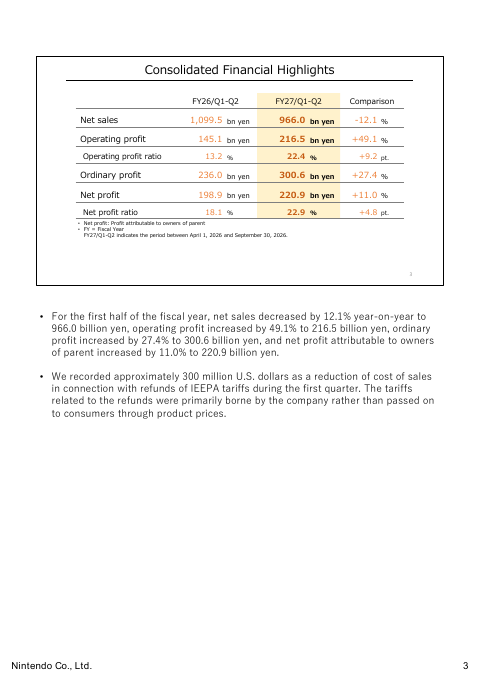
Profit attributable to owners of parent (six months)
220.9 billion yen
up 11.0% year-on-year
Segment or metric
Value
Change
Nintendo Switch 2 hardware
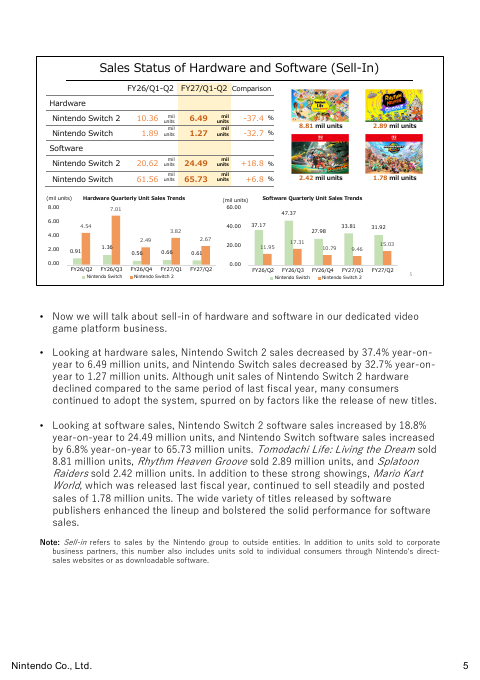
6.49 million units
down 37.4% year-on-year
Nintendo Switch 2 software
24.49 million units
up 18.8% year-on-year
Nintendo Switch hardware
1.27 million units
down 32.7% year-on-year
Nintendo Switch software
65.73 million units
up 6.8% year-on-year
Digital sales
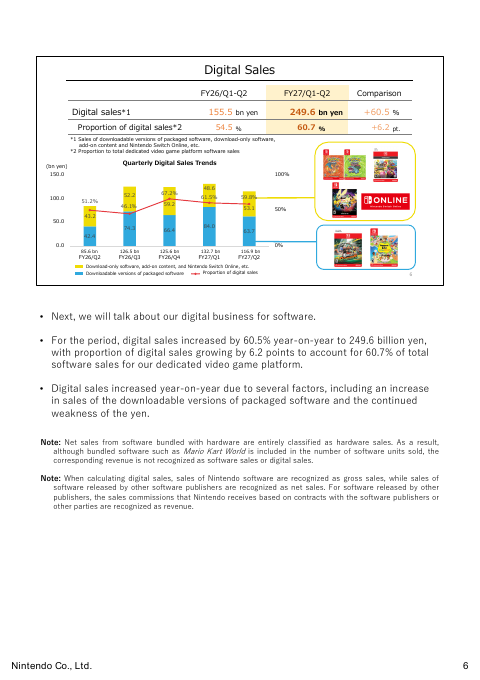
249.6 billion yen
up 60.5% year-on-year
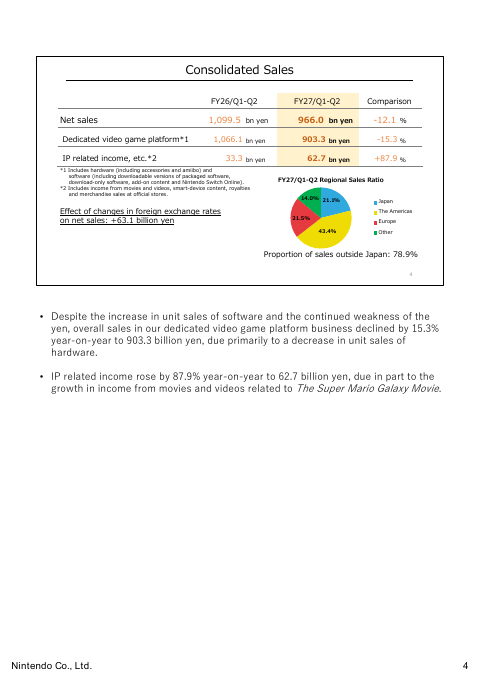
IP related income, etc.
62.7 billion yen
up 87.9% year-on-year
Where each number comes from
Net sales (six months): “The end result is that overall sales totaled 966.0 billion yen (with sales outside of Japan of 762.4 billion yen accounting for 78.9% of the total).”
Operating profit (six months): “operating profit increased by 49.1% year-on-year to 216.5 billion yen, and the operating profit ratio increased by 9.2 points to 22.4%.”
Operating profit ratio (six months): “operating profit increased by 49.1% year-on-year to 216.5 billion yen, and the operating profit ratio increased by 9.2 points to 22.4%.”
Gross profit ratio (six months): “The gross profit ratio increased 14.2 points to 50.4%, reflecting solid software sales and the resulting increase in the proportion of software in net sales”
Profit attributable to owners of parent (six months): “Profit attributable to owners of parent increased 11.0% year-on-year to 220.9 billion yen due to the increase in ordinary profit.”
Nintendo Switch 2 hardware: “Nintendo Switch 2 sales decreased by 37.4% year-on- year to 6.49 million units, and Nintendo Switch sales decreased by 32.7% year-on- year to 1.27 million units.”
Nintendo Switch 2 software: “Nintendo Switch 2 software sales increased by 18.8% year-on-year to 24.49 million units, and Nintendo Switch software sales increased by 6.8% year-on-year to 65.73 million units.”
Nintendo Switch hardware: “Nintendo Switch 2 sales decreased by 37.4% year-on- year to 6.49 million units, and Nintendo Switch sales decreased by 32.7% year-on- year to 1.27 million units.”
Nintendo Switch software: “Nintendo Switch 2 software sales increased by 18.8% year-on-year to 24.49 million units, and Nintendo Switch software sales increased by 6.8% year-on-year to 65.73 million units.”
Digital sales: “digital sales increased by 60.5% year-on-year to 249.6 billion yen, with proportion of digital sales growing by 6.2 points to account for 60.7% of total software sales”
IP related income, etc.: “IP related income rose by 87.9% year-on-year to 62.7 billion yen, due in part to the growth in income from movies and videos related to The Super Mario Galaxy Movie.”
Management said adoption has progressed smoothly roughly a year and a half after launch, helped by Pokémon Pokopia in March. In Japan the installed base grew faster than any past Nintendo platform, though demand spiked before the May price revision and then settled.
New first-party titles are driving software momentum
Splatoon Raiders sold 2.42 million units, Fire Emblem: Fortune's Weave 1.34 million and Star Fox 1.17 million. On the original Switch, Tomodachi Life: Living the Dream reached 8.81 million, and Switch software still sells because Switch 2 plays it.
Digital now more than 60% of software sales
Digital reached 60.7% of platform software sales, driven by downloadable versions of packaged games. Nintendo also notes that sales of other publishers' software are recognized net of commissions.
Movies are becoming a sustained strategic investment
After The Super Mario Galaxy Movie lifted IP income, management said it will keep producing films and video content, including a live-action Zelda film next year and investment in and beyond 2028. It frames film as a way to bring characters to new audiences and build reusable digital assets.
Component costs and price revisions are the main risk
Management said rising memory and component costs will hit hardware profitability more from the third quarter and that it would consider price revisions if it cannot absorb costs. Hardware prices were already raised in May in Japan and in September elsewhere, so holiday sell-through is key to the unit target.
What management said
Each quote matches the transcript word for word.
“the movie and visual content business is not simply an addition to Nintendo's existing business, but a business that can create synergies with multiplier effects, making it a strategically worthwhile investment.”
Shows film is being treated as a core, reinvested growth pillar rather than a side project.
“From the third quarter onward, the proportion of raw materials purchased at higher prices will increase compared to the first half, so we anticipate that the impact of rising component prices will be greater than in the first half.”
Signals cost pressure on hardware will intensify in the second half.
“we think it is essential that we not only release individual software titles, but also continuously offer products and services that make consumers want to play more.”
Indicates a shift from one-off packaged games toward ongoing engagement around its IP.
How will Nintendo balance its emphasis on software quality, which lengthens development, with business management over the medium term?
Beppu said development is the engine of competitiveness and the company will stay committed to thorough internal deliberation to satisfy consumers, using internal and external resources to widen choice. — Yusuke Beppu
Did Switch 2 sell-through slow after the price revision, and can Nintendo reach its 16.5 million unit target?
Furukawa said the installed base exceeds 25 million, Japan settled after a pre-revision spike, and the next several weeks of holiday sales are key to the target. — Shuntaro Furukawa
How does Nintendo think about hardware and software pricing given rising component costs and inflation?
Furukawa said it will try to absorb moderate cost increases but would consider price revisions if profitability cannot be maintained, and prices software title by title. — Shuntaro Furukawa, Ko Shiota, Shinya Takahashi, Yusuke Beppu
What are Nintendo's plans for movies and video content beyond the live-action Zelda film?
Furukawa said more films and video are planned, and Beppu said Nintendo will keep investing in and beyond 2028 as a strategically worthwhile business. — Shuntaro Furukawa, Yusuke Beppu
Why did inventories rise to 814.5 billion yen, and what does it mean for hardware profitability?
Furukawa cited seasonal finished-goods build, higher memory and raw-material prices and planned procurement, and said cost impact will be greater from the third quarter. — Shuntaro Furukawa
How does Nintendo view Pokémon Winds and Waves and the Pokémon movie for the Switch 2 business?
Furukawa said Pokémon titles have been major installed-base drivers, and Winds and Waves are very important titles as Switch 2 enters its third year. — Shuntaro Furukawa
Has developing new ways to play, like the Wii Remote, become less of a priority?
Furukawa said it has not, and Takahashi and Shiota said integrated hardware-software teams keep experimenting with new forms of play. — Shuntaro Furukawa, Shinya Takahashi, Ko Shiota
Questions
What drove Nintendo's software performance this quarter?
Splatoon Raiders (2.42 million units), Star Fox, Fire Emblem: Fortune's Weave, and on the original Switch Tomodachi Life: Living the Dream (8.81 million) and Rhythm Heaven Groove, plus steady Mario Kart World sales.
How is Switch 2 adoption trending after the price increases?
The installed base exceeds 25 million units. Hardware units fell 37.4% in the half, and management says the next several weeks of holiday sales are key to the 16.5 million unit full-year guidance.
What is Nintendo doing with movies and video content?
The Super Mario Galaxy Movie lifted IP income, a live-action Zelda film is due next year, and management plans to keep investing in film in and beyond 2028.
How are rising component costs affecting Nintendo?
Memory and component prices are rising, forecast cost of sales already includes about 100.0 billion yen of impact from components and tariffs, and management expects a bigger effect from the third quarter and would consider price revisions if costs cannot be absorbed.
What is on Nintendo's upcoming release slate?
Switch Sports Resort and Zelda: Ocarina of Time are out in the holiday period, with Metroid Ravenous on 1/28/2027, and Kirby and the World Beyond, Pokémon Winds and Waves and Xenoblade Genesis scheduled for 2027. A Zelda 40th Anniversary Edition Switch 2 launched in October.
Date: Friday, November 6, 2026 Attendees: Shuntaro Furukawa (President and Representative Director, Member of the Board) Shinya Takahashi (Senior Managing Executive Officer and Corporate Director, Member of the Board) Satoru Shibata (Managing Executive Officer and Corporate Director, Member of the Board) Ko Shiota (Senior Executive Officer and Corporate Director, Member of the Board) Yusuke Beppu (Senior Executive Officer and Corporate Director, Member of the Board) Hajime Murakami (Executive Officer) • The following are the main questions and answers from the briefing. Please note that portions of this content have been edited or revised for readability. • If you quote from this Q&A, please include a citation or link to this file. • Shigeru Miyamoto (Executive Fellow and Representative Director, Member of the Board) was unable to attend as he was feeling unwell. He is expected to recover within a few days to a week.
Q1 Nintendo emphasizes software quality, but this emphasis seems to be lengthening the development period for each title. Nintendo's strength lies in its development capabilities, but from a corporate planning perspective, how do you plan to balance creativity and business management over the medium term?
A1 Yusuke Beppu (Senior Executive Officer and Corporate Director, Member of the Board): Development is the engine of Nintendo's competitiveness and value. Creating new and unique products is our top priority. Despite having four decades of experience in game development, balancing creativity and business is always challenging. Ultimately, unless we satisfy consumers, our efforts will not lead us to good business results. For this reason, we believe it is important to stay committed to our basic operation of creating products and services that satisfy consumers by engaging in thorough internal deliberation. The business environment is changing significantly for the entire entertainment industry, not just games. Technologies like the internet and AI have dramatically increased the amount of digital content available to the world. There are now many forms of entertainment that can be enjoyed for free, so we are conducting business in an environment that is different from the past. Given this situation, it is important to offer unique entertainment experiences that are very Nintendo, so that consumers will choose Nintendo. We also believe it is very important to leverage both internal and external resources to maximize our offerings so that we provide a wide variety of choices to consumers.
Q2 Sell-through momentum for Nintendo Switch 2 seems to have slowed a bit following the price revision. What is your analysis? Also, based on recent sales trends in major regions, do you
A2 Shuntaro Furukawa (President and Representative Director, Member of the Board): Adoption has progressed smoothly over the roughly one and a half years since Nintendo Switch 2 launched last June, and the installed base now exceeds 25 million units. At the end of last year's holiday season, we explained that there were regional differences in how well our expectations were met. But the March release of Pokémon Pokopia acted as a driver of global hardware sales, and we entered the new fiscal year with good momentum. We subsequently revised our hardware prices in May in Japan, and in September in other regions. In Japan, the Nintendo Switch 2 installed base has shown faster growth than any of our past dedicated video game platforms, and given that there was also a spike in demand ahead of the price revision, sell-through settled down after that. In regions outside of Japan, there was ample time between the announcement of the price revision and when it took effect. There were also hardware and software bundles offered during this period. Because of these factors, the sales trends before and after the price revision do not differ as much as we saw in Japan. As for the current situation, the response to the release last week of Nintendo Switch 2 – The Legend of Zelda – 40th Anniversary Edition as a specially designed edition of the system was very positive and has contributed to strong sales in various regions. The Legend of Zelda: Ocarina of Time was just released, so it is too early to comment on specific numbers, but the title is off to a great start, and we are in good shape for the coming holiday season. Holiday season sales significantly impact the number of units shipped annually for our dedicated video game platform business. Given the hardware price revisions, we think the sales trends over the next several weeks will be key to achieving our sales guidance.
Q3 I'd like to hear your thinking on hardware and software pricing. Given the rising price of hardware components, how do you factor cost into your development process? Also, for software, what is your approach to pricing and development in light of inflation? Finally, under what circumstances would you consider revising the prices of existing products, also taking into account your long-term sales strategy?
A3 Furukawa: As far as pricing is concerned, our approach toward hardware and software is different. Hardware is manufactured using various components supplied by numerous business partners, so manufacturing costs are susceptible to the external environment. Currently, manufacturing costs are trending upward due to various external factors. Our basic thinking is that if costs rise by a moderate amount, we will work to keep sales prices unchanged through measures like improving production efficiency to absorb those increased costs, and by bearing the remaining costs ourselves, to the extent possible. However, considering the overall profitability of the business, if the impact over the mid-to-long term is such that we cannot absorb the costs through our own efforts, and we determine that it would be difficult to maintain a healthy profit
structure, we will need to consider price revisions. Packaged software also uses memory in game cards, so rising component prices are affecting them as well. Although the impact is more limited than for hardware, the situation is not necessarily favorable either. Our basic policy for software is to set prices that reflect the value of each title. Instead of setting a uniform price, we consider and determine the price on an individual basis, taking the content of each software product into account.
Ko Shiota (Senior Executive Officer and Corporate Director, Member of the Board): In Nintendo's approach to product creation, it is less about using the newest and most advanced technologies and more about the kinds of entertainment experiences we can deliver to our consumers. We will invest in the areas necessary to enable these experiences, and we may limit features or scale back performance specifications in other areas. These types of decision-making are key aspects of Nintendo's approach to hardware design. When thinking about hardware specifications, it is also important to consider how to run software in engaging ways on the hardware. That is why hardware and software developers work together, discussing and deciding on the specifications. This has been Nintendo's basic approach to product creation for many years, and we intend to continue with that approach going forward.
Shinya Takahashi (Senior Managing Executive Officer and Corporate Director, Member of the Board): In software development, it is important to create unique products that deliver value beyond their price. We believe that getting these kinds of products into the hands of many people who will enjoy playing them for years to come ultimately leads to stable revenues. The role of software developers is to consider how to leverage the unique characteristics of the hardware to offer new kinds of fun.
Beppu: Nintendo's basic approach is to assess the value of a product or service, combine various types of added value and services, and then set the price. Our long-term goal is to enhance the value of our products and services and determine prices that reflect such value but also maximize the number of people who choose them. As the variety of entertainment options increases, I feel that people are becoming more selective in their choices than ever before. For people to choose our products, it is important that we present distinctive and unique products that are very Nintendo in our lineup. For the past four decades or so, our software business has revolved around the sales of packaged games. Going forward, to further enhance the value of our IP, we think it is essential that we not only release individual software titles, but also continuously offer products and services that make consumers want to play more. Although this is unrelated to pricing, I want to mention that when we surveyed the satisfaction levels of people who watched The Super Mario Galaxy Movie, we found that these levels were higher when people watched in groups of two instead of alone, and higher still when watched in groups of four instead of groups of two. As illustrated by the four controller
ports on Nintendo 64 in the past, Nintendo has long placed value on the idea of everyone playing together. The fact that people can play together can be one of the reasons consumers choose our products, and from there the circle of players widens. I think this also has an indirect influence on pricing, but creating reasons and opportunities for people to play together is important for enhancing Nintendo's value.
Q4 In today's presentation, it was indicated that Nintendo plans to continue producing movies and video content beyond the live-action movie of The Legend of Zelda. Could you tell us your future production and release plans, as well as your thoughts on the movie business?
A4 Furukawa: Although I cannot talk about specifics at this time, we do intend to continue delivering new movies and video content beyond the live-action movie of The Legend of Zelda, which is set to premiere next year. We have been saying for the past few years that we want to actively pursue movies and videos because of their strong affinity with our dedicated video game platform business. In addition to theatrical releases, increasing the opportunities for consumers to encounter Nintendo's characters and game worlds through other forms of video content, such as those produced by our subsidiary Nintendo Pictures, plays an important part in achieving our goal of mid-to-long-term growth of our overall business.
Beppu: I feel that the initiative to release films globally is an excellent fit for Nintendo's dedicated video game platform business. They allow us to convey the appeal of Nintendo's uniqueness and characters in a concentrated 90- or 120-minute experience, and the digital assets we accrue during production will become valuable resources we can utilize in the future. Each of these projects has deep involvement from our developers at Nintendo, including producers and directors, with Miyamoto (Shigeru Miyamoto, Executive Fellow and Representative Director) at the helm. The experience of creating a more linear viewing experience in movies and videos, which differs from interactive forms of entertainment such as video games, is an excellent opportunity for our developers to obtain new skills. From a business perspective, we have set up a framework that can generate revenues through theatrical releases and secondary initiatives, so if we handle this appropriately, we can make solid profits and reinvest those profits into our business. In this way, the movie and visual content business is not simply an addition to Nintendo's existing business, but a business that can create synergies with multiplier effects, making it a strategically worthwhile investment. For this reason, we will continue investing in the production of movies and video content in and beyond 2028. There will be other opportunities to explain specific details at later dates.
Q5 Your inventories increased from 539.8 billion yen at the end of the previous fiscal year to 814.5 billion yen at the end of September. What are the main reasons for this increase? Memory prices are rising, so if procurement of memory and raw materials is behind the increased amount, what impact will this have on the profitability of hardware?
A5 Furukawa: The increase in inventory amount compared to the previous fiscal year-end is chiefly due to the increase in finished goods and raw materials. Typically, the end of the second quarter is a time when finished goods inventory increases, as hardware production peaks and software and accessories are ready for shipment ahead of the holiday season. The rising prices of memory components and other raw materials and the planned procurement to maintain stable production also contributed to the increase in inventory. The fact that the unit price of Nintendo Switch 2 hardware is higher than past Nintendo hardware is another factor driving up overall inventory amount. However, even if component procurement prices increase, that does not immediately impact the cost of sales. The impact on hardware profitability will gradually appear according to inventory levels and sales trends. Component procurement prices have risen this fiscal year compared to when Nintendo Switch 2 first launched, and the effects are gradually becoming apparent. From the third quarter onward, the proportion of raw materials purchased at higher prices will increase compared to the first half, so we anticipate that the impact of rising component prices will be greater than in the first half. We have taken these effects into consideration when we initially set our financial forecasts for the current fiscal year.
Q6 The Pokémon Company has announced that, in addition to the release of Pokémon Winds and Pokémon Waves, the movie Pokémon: Wild Card is scheduled for release in 2027. How are you viewing the development of the Pokémon initiatives in conjunction with the movie and the impact it will have on the Nintendo Switch 2 business?
A6 Furukawa: The business development of Pokémon is handled by The Pokémon Company, an equity- method affiliate of Nintendo, so I will refrain from giving any specific explanation, but titles related to Pokémon have played a significant role in the growth of the installed base of Nintendo's dedicated video game systems. Pokémon Pokopia, which was released this year in March, is a significant driver of Nintendo Switch 2 sales. This year marks the 30th anniversary of the release of Pokémon Red and Pokémon Green [in Japan], and The Pokémon Company is generating substantial interest through various initiatives including the trading card game. We recognize that Pokémon Winds and Pokémon Waves, brand new entries in the Pokémon series scheduled for release next year for Nintendo
Q7 I understand that Nintendo's strength is in how it comes up with new gameplay experiences through integrated hardware-software development. However, it feels like we recently haven't seen any proposals for new approaches to gameplay that can rival the Wii Remote controller. Has developing new ways to play become less of a priority?
A7 Furukawa: Creating new ways to play through integrated hardware-software development has in no way become less of a management priority. We believe that providing unique forms of entertainment as only Nintendo can is vital for us. We are confident that we've achieved that over these past four decades precisely because of our development of integrated hardware and software. In the future, we may offer unique entertainment in a different form from what we currently offer, but right now we believe that integrated hardware and software entertainment is where we can best leverage our strengths. We will continue to place a high priority on unique entertainment experiences that only Nintendo can offer.
Takahashi: Our hardware and software development teams come together as one to develop new ways of playing games that leverage the performance and features of new hardware. In doing so, the use of new features is not the goal in and of itself. Rather, our basic approach is to first come up with fun ways to play, consider what hardware features would be necessary to realize those ways to play, and then make the most of those features. With Nintendo Switch 2 as well, we are continuing to experiment and refine new ways to play. We hope you'll look forward to when we are able to share more.
Shiota: Hardware and software developers coming together as one, sharing ideas, and repeatedly going through trial and error to come up with new forms of entertainment can be seen as a long-standing part of Nintendo's development culture. I myself have been involved in development for many years since joining Nintendo. Even though the technology we work with and the form of the products have changed, I feel that this way of thinking as a developer has not. Only a handful of ideas become actual products after much trial and error, but we believe it's crucial for management to invest in activities that lead to new forms of enjoyment, and all of us on the management team here continue to support those efforts. We hope you'll be excited about the unique new forms of entertainment yet to come.