“All this is already starting to pay off, with around 10% organic growth in emerging markets Petcare so far this year, doubling from a year ago.”
It shows the emerging-market Petcare growth platform is already producing results.

Nestlé (NESN) · Consumer Brands
Results filed 22 Oct 2026 · Quarter ended 30 Sep 2026 · Company's own call transcript · Philipp Navratil (CEO), Anna Manz (CFO)
Read the transcriptSlides (35 pages)Press release ↗Investor relations ↗
Summaries and transcripts are machine-generated and can contain errors.
Nestlé's focus on growth platforms and execution lifted volumes in every zone, while it agreed to sell its mainstream vitamins business for USD 1.0 billion and lost control of Russia.
Demand improved broadly. Volume growth was positive in every zone and globally managed business. Emerging markets led, with India at 20% organic growth. In North America, Petcare sell-in matched sell-out and US coffee recovered after earlier price rises. Waters and premium beverages grew double digits on international brands and a hot European summer. Nutrition was the weak spot, held back by the infant formula recall and uneven adult nutrition.
Management is putting extra investment, funded by efficiencies, behind growth platforms such as emerging-market Petcare, noodles, medical nutrition and out-of-home coffee, while fixing core brands like Milo. It is also pruning the portfolio, selling mainstream vitamins and no longer consolidating Russia. The main tension is pricing: input costs are rising again after a year of falling coffee and cocoa prices, and management wants to raise prices without hurting consumer penetration or volumes.
Open the slide deck (PDF, 35 pages) ↗
Showing the first 6 of 35 pages.
Results documents
reported sales grew 5.2%
| Segment or metric | Value | Change |
|---|---|---|
| Zone Americas | 10.0M | organic growth 3.3%, RIG 2.4% |
| Zone Asia, Oceania and Africa | 5.0M | organic growth 6.4%, RIG 5.0% |
| Zone Europe | 4.0M | organic growth 1.2%, RIG 1.0% |
| Nespresso | 1.0M | organic growth 2.5%, RIG 1.1% |
| Nestlé Waters & Premium Beverages | 1.0M | organic growth 12.3%, RIG 7.3% |
| Petcare | 4.0M | organic growth 5.3%, RIG 4.3% |
| Food & Snacks | 6.0M | organic growth 5.0%, RIG 5.4% |
| Nutrition | 4.0M | organic growth 0.3%, RIG -1.1% |
Copied from the press release ↗ and other documents in the company's results page ↗. A figure is published only if its sentence is in those documents.
| Metric | Period | Outlook |
|---|---|---|
| Organic growth | 2026 | 3% to 4% |
| Underlying trading operating profit margin | 2026 | improve versus 2025 |
| Gross profit margin | 2026 | Improving versus 2025 |
| Free cash flow | 2026 | above CHF 9 billion |
| Underlying tax rate | 2026 | Approx. 22% |
| Foreign exchange effect on sales | 2026 | Approx. -2% |
| Incremental 'Fuel for growth' savings | 2026 | CHF 0.9 billion |
RIG was positive in all zones and globally managed businesses, and management said most of it came from volume rather than mix. Temporary Q2 problems, including US pricing reactions and European de-listings, were resolved.
Management cited around 10% organic growth in emerging-market Petcare so far this year, doubling from a year ago. It plans to use its distribution footprint and higher marketing spend to build the category.
Noodles are growing at about twice the rate of food, and World Cuisine twice as fast again. Korean and Ramen ranges are being launched across all three Zones.
Nestlé agreed to sell Nature's Bounty and six other mainstream vitamin brands to Yellow Wood Partners for USD 1.0 billion. Russia was deconsolidated after being placed under temporary external administration.
Pricing moderated as coffee and cocoa costs fell and last year's increases rolled off, but management expects more pricing in 2027. It says it will price only where consumer penetration holds, and Europe remains the most competitive market.
Each quote matches the transcript word for word.
“All this is already starting to pay off, with around 10% organic growth in emerging markets Petcare so far this year, doubling from a year ago.”
It shows the emerging-market Petcare growth platform is already producing results.
“Noodles are growing at around twice the rate of Food, and World Cuisine is growing twice as fast again.”
It explains why noodles and World Cuisine get expansion investment beyond Asia.
“From being an underperformer, Milo is back to delivering double- digit growth and gaining market share, with increasing household penetration and growing servings.”
It is management's proof that its core-brand playbook can turn around a laggard.
“our approach won’t change: We’ll take pricing to the extent we can without damaging medium term consumer penetration.”
It sets the pricing rule as input costs start rising again.
“we have built new capacity, fresh capacity to have more availability of cat food, wet cat food.”
It links the US Petcare recovery to new wet cat food capacity, which allows innovation and better customer service.
“those consumers are growing again in Europe, that is the first time we see that growing since many years now.”
It is an early sign that Nespresso's European business may be stabilizing.
Anna Manz said not to extrapolate the 5.5% Food & Snacks RIG because early Christmas orders helped, though offsetting phasing hurt Nutrition; Philipp Navratil credited emerging-market execution, growth platforms and share gains, and said resilient supply chains are the response to El Niño. — Philipp Navratil, Anna Manz
Anna Manz said pricing is rolling off last year's increases but emerging markets will take more price in Q4 and 2027 is likely to see more pricing, and she declined to guide North American RIG, noting a tougher Petcare comparison in Q4. — Anna Manz
Philipp Navratil said new wet cat capacity allows innovation and better service, with sell-in and sell-out normalizing and dog slightly improving; Anna Manz said it is too early to guide 2027 margin and more detail will come in February. — Philipp Navratil, Anna Manz
Philipp Navratil said growth platforms remain at high single digit and the core improved slightly, funded separately by efficiencies; infant formula is nearly back to pre-crisis level in AOA but slower in Europe, with no impairment. — Philipp Navratil, Anna Manz
Philipp Navratil said the pillars simplify many underlying metrics, such as taste testing and distribution tracking, and Anna Manz said all big SKUs are now taste-tested, with the biggest brands and countries rolled out first. — Philipp Navratil, Anna Manz
Philipp Navratil said coffee growth is driven by volume and innovation rather than new pricing, and that frozen food improved through better innovation, execution and customer service; Anna Manz would not quantify the quarterly change. — Philipp Navratil, Anna Manz
Anna Manz said coffee RIG looks stable on a two-year basis and US momentum is returning after price increases; Philipp Navratil said Starbucks and Natural Bliss creamers are strong while Coffee mate still has factory work to finish. — Anna Manz, Philipp Navratil
Anna Manz said most stranded costs are covered by supply agreements and the rest are being removed, and that freight inflation is a headwind for all players and one reason for a little more pricing in Q4. — Anna Manz
Philipp Navratil said out-of-home grows faster than retail and is being invested in, and that Nespresso is gaining US share and has growing active consumers in Europe for the first time in many years. — Philipp Navratil
Anna Manz said Russian interest was not material and that she would give margin implications of the M&A at full-year results, once closing timelines are clearer. — Anna Manz
Emerging markets delivered 6.8% organic growth in Q3, with RIG of 4.3%, driven by innovation, protected price points, broad distribution and platforms such as soluble coffee and pet food. India grew 20%, and 10 emerging markets have annualized sales of at least CHF 1 billion.
Petcare organic growth was 5.3% in Q3, led by wet cat food, therapeutics and Pro Plan, ONE and Felix, with new wet cat capacity letting US sell-in match sell-out. Emerging-market Petcare is a new growth platform, at around 10% organic growth so far this year.
It agreed to sell its mainstream vitamins, minerals and supplements business, including Nature's Bounty, to Yellow Wood Partners for USD 1.0 billion, with closing expected by the first half of 2027. It also stopped consolidating its Russian business after it was placed under temporary external administration.
Pricing eased to 1.1% as 2025 increases rolled off and coffee and cocoa costs fell. Management expects more pricing in 2027 and in emerging markets in Q4, applied only where consumer penetration holds.
Nutrition organic growth was only 0.3%, with the infant formula recall still weighing on Europe and adult nutrition uneven. Europe is competitive with moderating pricing, Greater China remains challenging, and Nespresso is under pressure in Europe.
NESTLÉ S.A.
2026 THIRD-QUARTER AND NINE-MONTH RESULTS PREPARED REMARKS AND Q&ATRANSCRIPT
22 October 2026
Speakers:
This transcript may have been edited for clarity, and the spoken version is the valid record. This document is subject to the same terms and conditions found at http://www.nestle.com/info/tc
Good morning, and welcome to Nestlé’s third quarter and nine-month 2026 results. I am David Hancock, Head of Investor Relations and I am joined today by Philipp Navratil, CEO and Anna Manz, CFO.
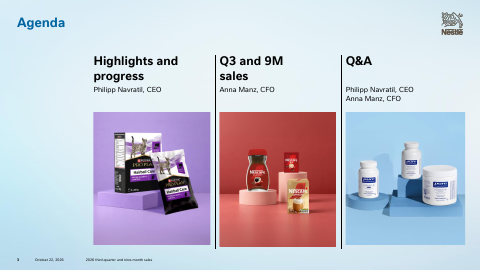
Before we get started, please take a moment to review the disclaimer on slide 2. Let me quickly take you through our agenda. Philipp will start with some highlights of our progress made in the quarter, before Anna reviews the numbers in more detail. We will then open up the lines for Q&A. With that, I’ll hand over to Philipp.
Thank you, David. Good morning, everyone, and thank you for joining us. Let me start with the key messages.
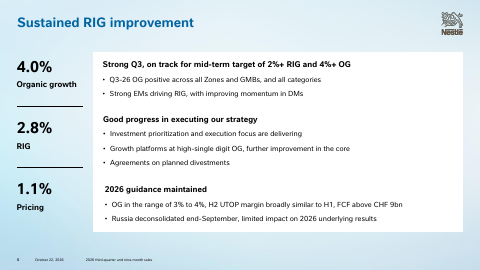
We delivered a strong quarter of growth. Organic growth was 4.0%, with RIG of 2.8% and pricing of 1.1%. We are on track towards our mid-term ambition.
Organic growth was positive across all Zones and globally managed businesses. And it was positive across all categories.
Emerging markets continued to grow strongly, while we saw improving momentum in developed markets. On strategy, we keep executing. We are prioritizing incremental investment behind our growth platforms, which again delivered high single digit growth, and the performance in the core is improving further. In September, we reached an agreement to sell our mainstream VMS business, following the partnership for Waters we announced in July. As we already announced, our operations in Russia have been placed under temporary external management. Anna will pick this up in more detail. Last but not least, we are maintaining our full-year guidance.
It is now a year since I first stood before you as CEO of Nestlé. We have made good progress in the last 4 quarters. That has come from focus: setting clear priorities and embedding them in the organization. We are starting to see improvement — in the way the organization is changing and in our financial results. This gives me confidence that we are on the right path.
I am pleased with our progress. But I am not satisfied. There is much more for us to do to deliver the potential of the business. We need to continue this journey, execute relentlessly, and deliver consistently.
Before sharing some examples of our progress driving growth, let me briefly return to our growth model. We target sustained organic growth of 4% plus, led by RIG of at least 2%.
Nestlé 2026 third-quarter and nine-month sales Thursday, 22nd October 2026
We are combining growth platforms that compound over time at a higher rate with improving performance in the core. Our growth platforms receive incremental investment, funded through efficiencies. This puts more resources behind the opportunities with the greatest potential to drive growth. Let me share some examples of what this looks like in practice.
This slide shows four of our growth platforms, with one example from each of our categories.
Each is different but the approach is consistent. Structural growth opportunities, differentiated consumer proposition, a science or technology advantage, strong brands and execution models that can travel across markets. Let me go into more detail on two of them.
First, emerging-market Petcare. This is a significant opportunity. Pet population growth in emerging markets is far outpacing developed markets, growing mid- to high- single digits annually since pre-pandemic. Consumers increasingly want higher-quality nutrition, driving increased calorific coverage and premiumization. We are perfectly positioned to capture this opportunity.
From our leading Petcare business in developed markets, we already know that our propositions work– we have the product expertise and the brands. Our focus is therefore on investing behind awareness, and building the category.
And across the emerging markets, Nestlé has an unparalleled distribution footprint. We are leveraging this to bring our exciting pet food propositions to more consumers in Asia and Latin America.
All this is already starting to pay off, with around 10% organic growth in emerging markets Petcare so far this year, doubling from a year ago.
Turning next to Noodles. On the last slide, we talked about taking Petcare know-how from developed to emerging markets. With noodles, it’s a bit the other way around. We have a well- established base in Zone AOA, especially India, Malaysia and Singapore. And we have lots of headroom to grow here – driving further category penetration and market share. We are also excited about opportunities beyond Asia. We have ambitious expansion plans in Europe and the Americas, built on clear consumer insights. Noodles is an attractive category, as consumers increasingly move between traditional meals and smaller, convenient eating occasions.
At the same time, consumers — particularly younger consumers — are looking to World Cuisine for bolder flavors and more exciting meal experiences. Noodles are growing at around twice the rate of Food, and World Cuisine is growing twice as fast again.
We are capturing this opportunity through Korean and Ramen ranges – taking us from convenient everyday meals to bolder, more adventurous taste experiences. This innovation is supported by culturally relevant partnerships and digital activation across channels.
These propositions are already being rolled out across more than 25 markets covering all three Zones.
This is our growth platform approach in action. It’s simple and repeatable. Structural opportunities with differentiated consumer propositions, putting additional resources behind them to scale fast and deep across markets.
This focus on simple, repeatable execution discipline also applies in our core which brings me to Milo. Milo is a billionaire brand with deep roots across Asia, Oceania and Africa. But heritage alone does not deliver growth. Two years ago, Milo was one of our underperformers. So we went back to the fundamentals: Product superiority, value, visibility and communication.
Product superiority starts with taste. And for Milo, this wasn’t good enough. So, we worked systematically across Milo’s products to get back to winning taste preference.
We also made Milo’s nutritional proposition more tangible, and relevant in each local market. It is based on a “Triple Advantage”: growth from milk protein and calcium, focus from iron and zinc, vitality from B-vitamins.
We also developed product innovations and extensions for specific nutritional and consumption needs. For example, Milo Pro ready-to-drink gives older teens permission to keep enjoying a taste they love when they outgrow the drink of their childhood.
Second, value. Cocoa inflation placed significant pressure on costs. We protected the key price points and funded this through efficiencies.
Third, visibility. We expanded distribution so that Milo is consistently visible and available wherever consumers shop.
Fourth, communication. Across Nestlé, we are focusing our brand investments - fewer campaigns, bigger impact. This is what we are doing at Milo.
Milo’s proposition has always been about encouraging a more active lifestyle through sport and physical activity. The Milo Marathon has been held in the Philippines since 1974.
And we are building on that positioning. From January, Milo will be part of a three-year partnership with the NBA across 21 countries. The ambition is to help an additional 2.5 million young people become more active over three years.
Our approach is working. From being an underperformer, Milo is back to delivering double- digit growth and gaining market share, with increasing household penetration and growing servings.
It takes time, but it shows we can turn a core brand into a growth story. Milo is one example, and we have many more opportunities across Nestlé.
With that, let me hand over to Anna, who will take you through the numbers in more detail.
Thanks Philipp and good morning.
We delivered 4% organic sales growth in Q3, with RIG of 2.8% and pricing of 1.1%. Reported sales grew 5.2%. And for the first time since I joined Nestlé, I am able to say that our sales growth benefited from a positive FX impact in the quarter. Assuming current spot rates, the currency headwind for the full year is now around 2%.
Looking at our performance in a bit more detail. We delivered another good quarter of RIG-led growth. And within RIG, the majority comes from volume rather than mix, meaning that consumers are eating and drinking our products more.
With now 5 quarters of better OG and RIG, we are building good growth momentum. As Philipp said, this comes from putting incremental investment against our biggest opportunities and improving execution. Progress is never linear and Q3 RIG was particularly strong, but we are confident that we are moving towards our guidance sustainably in the medium term.
Before I focus on RIG, a few comments on pricing. Pricing has been moderating through 2026 and that’s mainly due to input cost dynamics. Last year we took significant pricing in coffee and confectionery due to rising input costs. This year we have been lapping those increases, with limited further price increases, as coffee and cocoa prices fell.
Looking forward, there is now again some upward pressure again on input costs. And through this volatility, our approach won’t change: We’ll take pricing to the extent we can without damaging medium term consumer penetration. As you’ve seen over the last 18 months, when we take price there can be a short-term RIG reaction as consumers adjust but it comes back quickly where the consumer proposition is strong.
Smart Price Pack Architecture and innovation is how we build those strong consumer propositions. And of course we will continue driving cost savings within our own business. And this is why we are confident we can continue to deliver RIG-led growth and pricing.
Nestlé 2026 third-quarter and nine-month sales Thursday, 22nd October 2026
Now let’s get into RIG. Across our Zones, the improvement in RIG was broad-based. We saw positive volume growth in every Zone. This reflects both the strength of our execution and the resolution of the temporary impactors we saw in Q2. I’ll talk more about the improving performance of Coffee and Petcare in the US on the next slide.
In Europe, the delisting issue we had towards the end of Q2 was resolved during Q3, although the environment remains competitive. And in Nutrition, recovery from the infant formula recall continues to progress, particularly in AOA. The strong RIG in the quarter reflects our underlying business performance.
Turning to North America. We delivered good improvement in the quarter, with OG accelerating to 2.6% and RIG recovered from negative in Q2, to 1.8% in Q3. Progress was driven by 3 categories.
In Coffee, we took significant price increases in Starbucks and Nescafé earlier in the year, impacting RIG in Q2. Momentum has been recovering progressively through Q3 and growth also benefited from a modest improvement in Coffee mate.
In PetCare, the category continues to strengthen, particularly in wet cat. We have had some lumpiness in organic growth in recent quarters, but in Q3, sell-in was in-line with sell-out. Looking forward to Q4, keep in mind that we are lapping a tough comp.
Food & Snacks delivered strong growth, with an improvement in Confectionery and in Frozen. Our actions are driving share gains in both categories, and we also had some benefit from the timing of customer orders. So, progress across 3 of our 4 categories.
The fourth is Nutrition, where in Q3 we underperformed our potential. Medical nutrition is performing well, accelerating for the sixth consecutive quarter. Gerber is soft, but stabilizing. And in Adult, growth is uneven, partly impacted by the phasing of innovation and we’ve got work to do on the consistency of execution.
Stepping back, at the edge, the US consumer is increasingly challenged, but our results show that our execution is improving and we are delivering performance despite a tough market.
Next, emerging markets, which continued to drive growth. One of the things that make Nestlé special is the breadth and scale of our EM footprint across Latin America, Asia, and Africa. We have 10 markets with annualized sales of at least 1 billion Swiss francs, and we are seeing good growth across our entire footprint.
Turning to the Zones, I’ll be brief as we've already covered a lot of the moving parts. Within AMS, I’ve talked about North America. Latin America delivered another strong quarter, broad based across markets and categories.
Momentum in AOA continued. India delivered 20% OG, and we had double digit growth in Middle East & North Africa, Japan, Malaysia and Singapore.
In Greater China, the headline growth reflects underlying progress and also the base effect of inventory adjustments last year. The market environment remains challenging.
And in Europe, growth has been moderating this year, largely driven by tougher comps. With consumer caution and pricing pressure across the zone, we are focused on providing attractive value propositions to our consumers through innovation. And this is driving improved market share.
Turning to the globally managed businesses. Nespresso delivered solid performance against a strong prior year comp. Growth has moderated as we lap last year’s pricing, along with some market softness in the US, where we continue to gain share. Encouragingly, capsule volumes are positive, as we drive recruitment and consumption.
Finally, Nestlé Waters. Waters delivered exceptional RIG-led growth in the quarter, across all of our markets. Performance benefited from a hot summer in Europe and continued strong demand for our international brands.
Moving to our categories. Coffee continues to perform well, with the slowing growth rate largely a function of the prior year comps. Nescafé continues to drive RIG pretty much everywhere, as we provide the right product experience and price point for every need in every market.
To give you an example, in Mexico our offering spans from the entry-level Nescafé Classico, through Tasters Choice, up to Nescafé Reserva. That coupled with our actions on price pack architecture, means we are relevant to all consumers, whatever their budget, allowing us to gain share.
I’ve already talked about Petcare in North America, but the category strength is really a global story. OG and RIG were mid-single digit or better in Europe, LATAM, and AOA, as well as North America.
The Nutrition story for the group is also similar to what I described for North America: Medical strong, Infant improving, and Kids & All family and Adult uneven. We view Nutrition as one of our biggest areas of opportunity. The integration of Nestlé Nutrition and Nestlé Health Science clarifies our brands and strengthens our global leadership positions. We now need to step up execution.
Finally, Food & Snacks delivered strong growth. This was primarily driven by our largest brands, including Maggi, KitKat, and Milo.
Turning to Russia. Following the presidential decree issued in September, our business in Russia has been placed under temporary external management. As a result, we will stop
consolidating it into our financials effective end of September. There is no impact to OG, RIG and pricing, as Russia has been excluded from organic growth since 2022. But the deconsolidation does impact reported Sales, UTOP and free cash flow, starting in Q4 this year.
In addition, the net assets of the business have also been derecognized. In total, this is expected to negatively impact group net debt by approximately 900 million Swiss francs for the full year 2026. The situation remains fluid, and we will continue to provide updates as appropriate.
Turning to 2026 guidance. We continue to expect: Organic growth in the range of 3 to 4 percent, with RIG accelerating versus 2025 and UTOP margin improving versus last year.
Our underlying UTOP margin expectations are unchanged from July. The deconsolidation of Russia will have a limited impact on the full year, so we still expect second half margin to be broadly similar to the first. This margin guidance excludes any tariff refund benefits in the second half.
And finally, no change on free cash flow, which we expect to be above 9bn for the full year.
So, to conclude, we are strengthening how we work: prioritizing our investment and getting more consistent on execution. The strong Q3 results are evidence of our progress, and with much more still to do. And with that, I hand over to David to start the Q&A.
Thank you, Anna. We'll now move to the Q&A session. As usual, please limit yourself to a maximum of two questions to give everyone a chance to ask their questions.
The first question comes from Guillaume Delmas from UBS. Please go ahead, Guillaume.
Guillaume Delmas, UBS Thank you, David, and good morning, Anna and Philipp. Two questions for me, please. The first one on Food and Snacks and then on emerging markets.
So, Food and Snacks. I mean, RIG particularly strong in the quarter. It seems a broad-based improvement across three zones. You also Anna, did mention some favorable seasonal order phasing. So, my question is, can you maybe help us unpack this strong RIG performance?
I mean, particularly on a product category basis or whether there were some one-offs flattering a bit this performance and looking ahead, what would you see as a sustainable run rate for
food and snacks RIG? I mean, should we get used to mid-single digit RIG, or should we expect a rapid return to a more lower single digit, 0 to 2% range, for this business?
And then my second question is on emerging markets. I mean, you were facing tougher comps in the quarter and yet RIG barely decelerated. So still well over 4% whether we include China or not. And so, my question here is what is driving this particularly strong RIG for now two, maybe a bit more, consecutive quarters? Is it down to category volume growth, is it some changes in consumer behavior or it's mostly down to your broad-based market share gains? So, any color on that would be helpful.
And also, I don't know if you've got some early thoughts on what El Nino could do or impact the consumer environment in some of these geographies? Thank you very much.
Good, thanks Guillaume. I'll start with your emerging market question, and I'll give you a bit of a comment on Food and Snacks, and I'll pass then over to Anna to talk you through the specifics.
On emerging markets, indeed the performance was strong, driven by RIG and pricing and also market share gains which is really good to see. And if you look at our emerging markets, what really comes to life there is our execution muscle that we have. So, really, you have that at its best in terms of how the teams there execute our strategy. That's across Asia and Latin America and Africa as well. It's all about driving innovation and renovation at speed. Also hitting the right price point and protecting those right price points. Strong distribution muscle, so we're really available everywhere where people shop. And also, I have highlighted that in my remarks in terms of growth platforms, we have a few growth platforms that go across emerging markets like soluble coffee, like pet food, etc. that are driving strong growth. Also receiving additional investments from our efficiency programs, while also performing well on the core. One example was the one that I called out on Milo, but you also have others under Maggi, doing really well. So, really pleased with what emerging markets are delivering today.
Then, just on Food and Snacks, and I'll give you, as I said, some general comments. We saw some good performance in terms of share across our frozen business in the US, which was good to see also there, innovation, executing the business better. Generally, a good performance across confectionery and consistent strength again across emerging markets here. India is a call out on both Maggi and KitKat, and as you see, this is driven by our billionaire brands that again receive focused investment there. Maggi, KitKat but also Milo are performing really well in the food and snacks category.
And I'll pass over to Anna to give you a bit more specifics on your forward-looking questions. I'll come back on a comment on El Nino afterwards.
Yes, so your question is, should you extrapolate 5.5% RIG? And 5.5% RIG is obviously a strong performance in the quarter, and I wouldn't extrapolate that. And it is helped by some seasonal order timing, so Christmas orders coming a little bit early and that type of thing. But it's not material enough of a tailwind to call out at a group level. And actually, what we saw across the board was fundamental strength and share gain. And I would, you know, while you're looking at the one off in Food and Snacks, I'd also say to you, we've had some phasing of orders the other way that have hurt us a little bit in Nutrition in the quarter. So, when you step back and look at it all as a whole, I would say it's a wash.
And then very quickly, on your third question, on El Nino. Generally, what we have been working on since many years, and you saw also an update on our sustainability strategy and objectives on our website, is working across our supply chain to make it more resilient. And obviously El Nino will have some effect. It's early to say what exactly it will look like. And we're relying on resilient supply chains and making sure we protect costs as much as we can, working with farmers across our most important commodities across the globe.
Guillaume Delmas, UBS
Thanks, Guillaume.
Thank you. Our next questions come from Celine Pannuti at JP Morgan. Go ahead, Celine.
Celine Pannuti, JP Morgan Thank you. Good morning, everyone. So, my first question is on pricing and the balance of pricing and volume. You mentioned that pricing, you faced a tough comp, but as well, I think there were some competitive environments in some developed markets. So, could you give us a bit of a steer on the path of pricing as we look into the remainder of the year? I mean, is there further step up in comp or are we expecting an inflection as you look to raise prices on what I believe is a COGS inflation inflecting? And maybe if you look into the balance of volume and pricing and into 2027, what is your expectation of being able to maintain that RIG momentum in the face of what could be effectively pricing, not just from your perspective, but as well, I think in emerging markets, you will have, or even in developed markets, pricing across different categories. So, just try to understand a bit how you see that shaping up into 2027.
And then on North America, we see that your RIG has progressed, but as well a total organic growth. What do you think, is a sustainable RIG performance in the North American market, given the portfolio you have? Obviously, now we've seen a big acceleration in cat on the back of your supply chain, improving. But, I mean, to which extent that this is a bit of a one off and then there will be some form of normalization. So, if you could help us understand whether a one and a half, 2% RIG in North America is a sustainable number given the portfolio you have.
Thanks, Celine. I'll pass those to Anna to give you more color.
Great. So let me start with pricing and maybe start with pricing in Q3. So, the way to think about pricing in Q3 is we had a lot of input cost inflation last year, and we took a lot of price and that input cost inflation in 2026 has actually turned into deflation on coffee and cocoa. So, we haven't been taking very much incremental price in 2026. And so, what you've seen as we've moved through the year is that we had the benefit of the rollover pricing from 2025 helping the beginning of `26. And that benefit has decreased as we've gone through the year. So, this isn't about us taking prices down. For the most part, it's about us just seeing their less year-on-year pricing. The most competitive area of our portfolio is Europe, where you've got the buying groups, which makes it the toughest pricing environment. And I would say within that, Confectionery is the one area where there is some price pressure. But for the most part,
really what you're seeing on pricing is, is the expected roll-off of last year. And if you look forward to Q4, there's two factors impacting pricing in Q4. One is that further roll-off of prior year pricing, which obviously is a negative or reduced pricing. And then in the emerging markets, you're seeing a starting to take some more price, which is a positive on pricing in the context of the inflation we're seeing in input costs.
Maybe just to step back though a bit, how do we think about pricing and this is maybe a bit your 2027 question. We take price to the extent that we can, whilst at the same time ensuring that we maintain that consumer penetration. And that's kind of the guiding principle that we use. And the way we think about it, it's not that we think about, you know, let's take price on coffee. We're thinking about in Germany, what pricing can we take on Maggi recipe solutions versus Maggi soups or in Mexico, where are we around that consumer proposition for sachets of Nescafé Clasico vis a vis a 300-gram pack of Taster's choice. So, our pricing decisions are all about our consumer proposition and really specific to the market environment that we're in. And there are always opportunities for us to take price, you know, where we've got that proposition, right. And you've seen that us do that over the last 18 months. We've had a lot of practice at really getting the consumer proposition right through a combination of price pack architecture and innovation into the right price points, so you'll see us do more of that.
So, you know, as we look forward to 2027, it is an inflationary environment. It's likely we'll see more pricing. And while there may be a short-term consumer reaction because there occasionally is in the quarter that you take the price, we're confident that over the medium term we can sustain both RIG and price.
And your other question, North America, sorry – yes, RIG has progressed nicely as we've seen a normalization in PetCare and we are seeing some nice share gain and improvement in the US. So fundamentally, all the things that you heard Philipp describe around our improving execution are supporting our performance in the US despite a challenging market. I'm not going to give you specific guidance on RIG. I would just call out that as we move into Q4, of course, we've got a tougher comp with respect to PetCare because we had the pre-price increase buy-in and some inventory requirement associated with bringing our new plants online in Q4 a year ago, which just gives us a slightly tougher comp. But other than that, the actions that we're taking are improving our momentum.
Celine Pannuti, JP Morgan
Thank you, Celine. The next questions come from David Hayes at Jefferies. Your line is open, David.
David Hayes, Jefferies Hello, thanks, David. Two for me, one on pet food, one on next year's margin, if I can be a bit cheeky. So, on the pet food side, just to follow up, I guess. So just to confirm: sell in, sell out across the division basically equated to each other? Just to confirm that. And then within that performance, that inflection we've seen - can you just talk a little bit more about the dog trends in the last few months, what's going on in that category and is that changing? And then on the cat capacity, can you just talk about whether this is more about mix in some ways than volume? Is it more about innovation, flexibility, the capacity rather than you just couldn't meet orders? It seems a sense I'm getting is that it's more around that and whether you can talk to that.
And then the cheeky margin question for next year, I suspect you'll say too early to say, but given the headwinds, you talked about 20-30 bps and given the input costs versus pricing dynamics, margins still up next year, you think with confidence?
Thank you so much, thanks, David. I'll answer Pet, and I'll give the margin question to Anna. Look, in Pet we have seen good growth across Cat, Wet cat and also Therapeutics, specifically in the US but also in Europe, and Dog is improving slightly. What you’re right on, you called it out, we have built new capacity, fresh capacity to have more availability of cat food, wet cat food. And what that does, it allows us to obviously innovate into the space, and that's what we have done, and also, if necessary, drive promotions. And hence, you have seen in the third quarter a normalization in terms of sell-in and sell out. In fact, we're driving the category growth now as we're gaining share in the cat space, and that is due to our capacity actually not only to innovate and promote better, but also service our customers, and hence our consumers, better in that space. And then again, underlying, the trends in cat are very favorable, cat adoption is still up, while dog remains flattish but is slightly improving, as I said, going forward. So, we're looking forward for some good momentum in Pet across the globe, and in addition, opportunity in emerging markets, as I called out in my remarks earlier.
And on your margin question, I'll pass that one to Anna. Thank you, David.
Sure. So, on margin, you'll be unsurprised when I say it's too early to guide, but I can give you a bit of a sense of the moving parts, perhaps. So, you're right, Russia will be a slight headwind next year, because you'll have three quarters of that impact and obviously, we're in a substantially more inflationary environment than we were. That said, you'll see us continue to drive cost savings hard. Obviously, we will be pricing and we've got the benefit of the volume that we're driving, giving us leverage. And we get a slight benefit also, because we won't have the infant formula recall challenge. So, in short, a number of moving parts, we will give you more in February on what that means for our margin as a whole, but we're focused on rebuilding our margins, whilst at the same time making sure that we maintain that consumer penetration that I was just talking about.
Thank you, David. The next questions come from Warren Ackerman at Barclays. Go ahead, Warren.
Yes, good morning, it's Warren Ackerman, here at Barclays. Could we maybe firstly go back to the core versus the high growth platforms? Philipp, you obviously gave some examples on the high growth platforms - can you maybe update us on how you're thinking about the core performance? It sounds like it's slightly improving. If there's any metrics you can give us, maybe are you able to split the RIG and price between the core and the high growth platforms and are you confident that the kind of skewing of investments into the high growth platforms is not leaving any vulnerabilities on the core? I would just be interested to sort of understand, you know, progress, what's working, what's not working, what's ahead, what's behind trend? Anything on market shares on the core would be useful.
And then secondly, I guess the other category we haven't spoken much about is Nutrition, in detail. Can you maybe update us where we are on infant nutrition? It sounds like it's still quite challenging in places. Is it kind of a bit behind your expectations and sort of how should we think about, you know, the recovery? Has there been any kind of impairments because of the cereulide recall at the beginning of the year? So yeah, that would be great.
Thanks Warren. In terms of high growth platforms and the core, we still see strength across the growth platforms, so this is working - really investing behind those growth platforms where we have higher structural growth, but then also higher capabilities to deliver against our strategy and really execute with brilliance. That is still working, that growth remains strong, and we said we want to have that growth [high] single digit 1, and that is still intact in Q3. Going strong, and you saw two examples that I called out in the remarks before, but then there are others that are still doing good, so it is working.
And as you know, those additional investments that we put behind the growth platforms, they are coming out of our efficiency programs, they're not coming out of the core. The core is well funded and actually the same brands that are spanning across the growth platforms are also relevant for the core. If you look at Maggi, for example, Maggi noodles, that is a growth platform, but then Maggi has a large business in the core as well. The core has improved as well, so improved further.
When I say there is more work to be done, there is more work to be done to bring the core up to, you know, cruising speed of the company. But we're going in the right direction, and if you look at the playbook and I pointed that out when I talked about Milo before, the playbook is the same playbook. We focus the investment more, we drive innovation, we drive the right price points, and we just execute brilliantly. And then that will bring the core into the right direction as well. More work to be done but going into the right direction in terms of growth, which is both RIG led and organic growth or pricing led as well. So, strategy in action and we're executing this better, and you saw that reflected in the results in Q3.
In terms of Nutrition, we see infant formula sequentially improving. We see good improvement in AOA where we get back to almost pre-crisis level, driven by higher investments, innovation and just bringing consumers back to the franchise of infant formula. So, good progress across AOA and it's more complicated and more difficult and a bit slower in Europe, where we now see a pickup of our stage one formulas, which is good news. That means the brand is still intact, but obviously we have lost the cohort and we still see some gaps in stage two formulas, which obviously we will have to work through that time and those consumers that we have not picked up during the recall. So, a little bit slower in Europe, but really good traction in AOA as this is sequentially improving on infant formula.
Corrected to high-single digit in follow-up answer
And just to comment on some of the numeric bits - no impairment, so nothing there on Nutrition and on core and growth, we're maintaining our momentum on the growth platforms versus where we were in H1 with core, with a slight improvement.
Thank you both.
And then just quickly, Warren, I misspoke, the growth platform is not mid-single digit, it's high single digit, so just to have that right.
Yes, thanks.
Thank you. Warren.
The next questions come from Callum Elliott at Bernstein. Go ahead Callum.
Callum Elliott, Bernstein Hi, good morning, thank you. You've spoken, Philipp, quite a bit over the past two quarters about execution across your four pillars of the value proposition. And we've had quite a few companies across staples talk about this kind of execution superiority focus through turnarounds over the past 10, 15 years or so. But it strikes me that most of your peers want to track significantly more than just four kinds of vectors. I think one of your big European peers talks, for example, about 23 metrics that they're systematically tracking. And so, my question is - is good execution at Nestle really as simple as your four pillars or are you maybe just simplifying this in your communication for our benefits and hoping you can maybe bring to life these pillars a little bit for us in terms of how you're using them in practice? And then my follow
up is related - you gave obviously, Philipp the example this morning of Milo, I think Anna gave the example at half year about Felix in terms of the execution around these pillars - what I'd like to understand is where are you in the journey of sort of more systematically tracking these vectors across the business as a whole and executing this strategy more broadly? Thank you.
Yes, thanks for the question. So, look, obviously when we talk about the four U’s or the four metrics that we look at, it's a simplification. There's obviously much more behind it, but if you look at when we talk about taste preference, obviously there's lots behind that in gaining taste preference, while also improving the ingredients we put in our products. So, obviously we do extensive testing across the portfolio and that is a work that is not a global work, it's done country by country, category by category, our products against competitor products and we track that across growth platforms, but also the core, and we just want to make sure that out of 100 consumers that taste any product of Nestlé, at least 60 prefer our product versus any competitor product. And that means that then this is an investment case, because if we then invest behind those products, consumers will come back for more if the taste obviously delights them. So, we track that across the portfolio extensively also on the second pillar, when we talk about value and Anna talked a little bit about this, this obviously has to do with pricing, but it has to do with the whole value proposition that we bring to consumers. So, it includes, you know, how does packaging look, what is the brand metric behind it, so how strong is our brand, what is the pricing, what is the elasticity. So, there is plenty of metrics behind the value equation that we also track. Also same on distribution when we say we want to have our products everywhere where people shop, obviously this includes numeric and weighted distribution, but also includes how do we service our customers and how do our products look like on shelf online and offline. So here again, it's a simplification where we say, you know, it's important to be visible and distributed, there is also plenty of metrics behind that. We have the data and we use to actually measure execution and the same on communication when we say we want to invest better and stronger and be a reference when it comes to marketing, also there we measure extensively our return on investment, on media investment, but also more and more retailer media investment and this is also tracked extensively by the teams. I don't know if we have 23 metrics, the important is that it comes together in stronger execution. And we probably have more than 23 metrics there. What's important is that we see share gains coming through, we see volume growth coming through, and this is ultimately the show that actually works. And again, and we have mentioned that before, when we have all of those four pillars, so taste, value, distribution, visibility and communication going well we gain share and we grow the business, and this is true for growth platforms, but also the core.
And that leads to your second question on Milo, so when I talk about Milo, you see, it's the same execution playbook that we have across growth platforms and the core, and that done well drives results into the right direction. So, we track this, it's automatized, and our teams have the metrics and they know exactly what needs to be improved, if something needs to be improved.
And maybe just one point of, one example in that actually getting the metric framework rolled out was not the hardest bit, it's really getting it embedded by brand. But when we did the Capital Markets Day a couple of years ago, at that point, the number of products that had been tested for taste preference in the prior three years was pretty low. And so, now, where we sit today, everything is, all our big SKUs are tested. We know exactly where we are and we know exactly what's left to be improved. So, it's more the embedding of the whole and you see us give examples based on some of our focuses on our biggest category, country combinations. First, rather than rolling every single metric out globally top to bottom, it's really important that we get our biggest category country, our biggest brands and our biggest countries right first. And that's what's driving the acceleration.
Thank you. We'll take our next question from Nicolas Ceron at Bank of America. Go ahead Nicolas.
Nicolas Ceron, Bank of America Thanks, David and morning, Anna, morning, Philipp. Two questions please, the first one is we've seen one of your Swiss competitors in chocolate, that showed that a fall in input cost can lead to a big slowdown in organic growth. And so, I'm wondering whether you expect organic growth in coffee to also slow down materially as input costs are falling? And my second question is on the US frozen food improvement - maybe you could help us understanding that, could you quantify the acceleration in Q3 versus Q2 and explain why the RIG has improved? Is it primarily because one of your key competitors has raised prices and you did not follow?
Yes, thanks, Nicolas. I'll give a few general comments on both of those questions. Obviously as Anna said, when we price, we look at input costs and then when we need to price, we do price, but we take consumers along and so obviously that's the balance between, you know, volume growth and then pricing led growth. And you have seen coffee coming down in terms of new pricing, so we have not had new pricing on coffee. But coffee is still a very attractive category that is driven by innovation and our strong execution across the three best brands in the coffee industry. And so, we see organic growth driven by volume growth and more people picking up Nestlé coffees across the globe. In terms of US as well, you see that reflected in Q3 and Anna will give you the moving parts between Q2 and Q3, but it is really about better execution and obviously, if you see us gaining share, it is having the right products in the right place, at the right price points, with the right innovation. And the category you're referring to, I guess, is Frozen. But it's good to see our frozen brands picking up some share and having consumer excited about the innovation in there and also on execution on that category specifically. Also, we have been able to service our customers and consumers in a more consistent and better way, which is also, being part of the increased performance in the US. So, it's really down to executing our strategy and our capabilities in the market well. But over to you, Anna.
Yes, nothing to add really. I'm not going to get into Q2 versus Q3 on Frozen, as you say, broad based sustained improvement in execution.
Nicolas Ceron, Bank of America
Thank you. The next question comes from Olivier Nicolai at Goldman Sachs. Go ahead, Olivier.
Olivier Nicolai, Goldman Sachs Good morning, Philipp, Anna and David, just two questions, please. Going back on coffee. Could you give us more details on the coffee RIG, which was a bit subdued in Q3 despite limited additional pricing? And how should we think about Q4 and next year, especially in the
context of green coffee prices remaining high? And would you expect large growth difference between Europe, US and EM? And just a quick follow up on creamers in the US, you talk about a modest improvement, I remember you had some production issues previously- is it all back to normal now? Thank you.
I'll pass coffee to Anna, and I'll pick up the creamers afterwards, thanks, Olivier.
Yes, the only thing here - it's worth looking at the coffee RIG comps over a couple of years, because if you look at the sort of two-year comp stack, what you see is coffee is pretty stable. We've just got, you know, we're lapping some much bigger comps. So, RIG performance, volume growth in coffee is good. The one place where it's slowed a bit in Q2 and is now coming back was the US where we took price across Starbucks and Nescafé, but we're seeing that momentum come back now. So, you know, good momentum as we go into next year and price versus RIG will obviously depend on what happens with commodity costs. But our focus, which you know, is a focus across the portfolio is driving that healthy, volume led, consumer led consumption, because that's what drives both RIG, but also gives you the brand power to continue to take price depending on where the inflation costs go. Are you going to cover creamers?
Yes, absolutely, I'll do the creamers part there as well. So, look, in terms of creamers, we have three main brands, two of them are really doing well. So, we have the Starbucks Creamers and the Natural Bliss creamers, they're doing well and they're driving high growth. So, they're doing well, the challenges have been Coffee Mate, and that's the one you're alluding to and indeed supply issues have been one of the factors, but we're making progress on the factory there and resolving them. But there is still more to do to bring that business back to higher growth, and the team is on it with urgency. And we see that as an attractive category that accompanies, obviously, the growing trends in coffee that we see, in driving coffee shop based coffees at home and Coffee Mate, Starbucks and also Natural Bliss Creamers have been a partner to do exactly that at home, for consumers and across the US.
Olivier Nicolai, Goldman Sachs
Thank you. The next question comes from Sarah Simon at Morgan Stanley. Go ahead, Sarah.
Sarah Simon, Morgan Stanley Yes, thank you. I have two questions: the first one is, obviously with the disposals, those ought to be margin accretive because you're selling lower margin operations, I'm just wondering if there will be any stranded costs that we need to think about, in the context of those disposals? And then the second one was on US freight, because all of the US CPGs have been calling that higher freight costs. I'm wondering if A, you're seeing that yet or maybe you have longer procurement times, and B, if you can just give us an indication of how much domestic freight is, for your US business in terms of percent of revenues or percent of COGS or something.
Yes, thank you very much, Sarah. I'll pass those on to Anna.
Yes, so firstly, on stranded costs. The majority of the stranded costs that we have will be covered through a level of supply agreement that we have as we separate the businesses, and where it is not covered, we are working hard to take out those stranded costs. So, as you think about your model, it's not a big factor because in an inflationary environment, we are very focused on making sure that we don't have stranded costs. And then with respect to US freight, I mean, look, oil prices where they are, we've got inflationary pressures on freight and distribution across the portfolio. And that's, you know, one of the reasons you heard me say that we'll be taking a little bit more price in some places in the fourth quarter. It's a factor for everybody, I'm not going to quantify it, but you know, how do we think about it? Well, firstly, our scale puts us in quite a good position in terms of buying and managing. And then as you know, we're very focused on cost efficiencies as we simplify our business, which also helps in terms of the management of margin. But yes, I mean it's a headwind for all players.
Sarah Simon, Morgan Stanley Okay, thanks.
Thank you, Sarah. The next question comes from Jeremy Fialko at HSBC. Go ahead, Jeremy, your line should be open.
Jeremy Fialko, HSBC Hi there, a couple of questions from me, on the coffee side. The first one is, could you give a bit more color on the out-of-home business? There was a little bit in one of the slides, but it would be interesting for you to size it, give us an indication of how quickly it's growing and what are some of the main opportunities that you are prioritizing at the moment? And then secondly, maybe we could talk a bit more about Nespresso. Obviously, the growth has come down over successive quarters, but then again, you had this quite high comp in Q3. So perhaps talk a bit more about how you view that business performing in a kind of underlying sense, and whether you think that there can be some sort of a pickup over the balance of the year. And one other thing related to Nespresso is I know that it was historically viewed as an underperformer, particularly because of the lack of availability in Europe, given some of the changes in distribution, so how do you feel you are addressing some of those issues? Thank you.
Good, thank you Jeremy. Look, on out-of-home, you have seen that also in the release, out- of-home in general for Nestlé is growing faster than the retail business, so it's the growth accelerator in out-of-home. And coffee remains a big opportunity, we're actually a rather large player in out-of-home coffee, as you know, we drive Nescafé coffee options across all geographies in many places where we have convenient offerings through machines, but then also in Asia, through out of home coffee stalls, more and more under the Nescafé brand, where people can pick up coffee on the go. Then out of home, also in coffee is important because out-of-home, sometimes you think about a machine and a coffee stall, but also all of our ready to drink coffee offerings, those you can consider out of home in a sense as well, they're on the go and those are driving that trend as well. And then, as you know, we also have the license
for We Proudly Serve Starbucks® that is also being driven across the globe, where we have the Starbucks license. And most of those offerings are in the US, and this is still growing, and we drive that in universities, in offices and inside places where people pick up a delicious cup of Starbucks coffee. So, this is a growing business, with still opportunities to roll out further and to deliver great tasting coffee shop experiences on the go and in offices. It's one we're investing behind and we see further growth going into that.
On Nespresso specifically, there's two comments to that. We're obviously lapping a very high quarter last year of over 8% organic growth, that was pricing driven. Now pricing has come off somewhat and the category in the US, the portion coffee category is decreasing. We are gaining share and growing in the US, so we are picking up household penetration and market share in the US on the back of a great quality coffee execution. And we see further consumers coming into Nespresso buying machines and then obviously showing interest of buying our capsules. Definitely pricing has come off and the category has slowed down somewhat, but we're making progress in the US and in Europe as well. Europe is a very competitive environment in portioned coffee, as you know, but Nespresso there as well. We have active consumers, these are consumers that own a machine but also actively buy capsules, those consumers are growing again in Europe, that is the first time we see that growing since many years now. That means we're picking up somewhat velocity there, and we see the brand being more relevant as well, as we invest into the brand in terms of communication, but also innovation and making the brand stand out. So, it's not necessarily availability driven, but it's brand strength driven, execution driven as consumers pick up machines and then also consume, further capsules. And so, this is encouraging to see and as I said, still a huge opportunity, specifically in the US to drive further household penetration. If we compare Nespresso penetration to the categories' penetration, there is still a big avenue of growth that the team is executing against.
Jeremy Fialko, HSBC Thanks.
Thanks, Jeremy.
Thank you. We'll squeeze in our last question from Jeff Stent from BNP Paribas. Go ahead Jeff.
Jeff Stent, BNP Paribas Okay, thank you, David, for squeezing me in. One housekeeping question and one sort of regular question. Maybe housekeeping first, on the 900 million of financial assets in Russia, if you could just give some guidance as to the sort of interest rate that you are receiving on that. And then to my question, coming back to margins, not looking for guidance on 27, but if we take the Waters exit, mainstream VMS, Russia, the IMF recall, can you just give a feel for what an aggregate would be, the annualized impact on margins from those moves? Thanks.
Thanks, Jeff. I'll pass both of those to Anna.
Yes, and I'm afraid this is a sales call, so we're not going to get into lots of detail on margins. With respect to Russia, I think the interest wasn't material, and I really don't want to get into the Russian balance sheet more. We'll have a lot more detail on that at the full year, as we work our way through it. But in terms of your model, it's not going to have a material impact on how you're thinking about interest, as you forecast forward. And in terms of the implications from M&A, we'll give you quite clear guidance at the end of the year because we'll have more clarity as to exactly when the transactions are closing, and of course, that has an impact on the margin implications. So, I don't want to give you a number now and then there'll be a shift in closing timeline and it will change again, but at the full year we will give you all of that.
Jeff Stent, BNP Paribas
So, thank you all, that concludes the Q&A session. I will hand over to Philipp for some closing remarks.
Thank you, David, and let me leave you with a few closing comments from my side. We delivered a strong Q3, continuing the performance improvement of our recent quarters. Our focus on clear priorities and also disciplined execution is delivering clear results. There is much more to do to realize the full potential of the business. Our direction is clear and we will stay focused on delivering consistently. Thank you again for all of your questions and your continued interest in Nestlé.
END OF TRANSCRIPT