
Mitsubishi Heavy Industries (7011) · Industrials
Mitsubishi Heavy Industries Q2 FY2026 earnings: summary, key numbers & outlook
Results filed 6 Nov 2026 · Quarter ended 30 Sep 2026
Slides (8 pages)Press release ↗Investor relations ↗
Summaries and transcripts are machine-generated and can contain errors.
In brief
MHI raised its full-year outlook as gas turbine combined-cycle demand stayed strong, backed by about ¥6 trillion of GTCC backlog and a push to double new-unit capacity.
Gas turbine combined-cycle (GTCC) orders were strong, particularly in North America and Asia. Nuclear power and metals machinery orders also grew, and a major Middle East engineering order was booked. Utilities and independent power producers made up 94% of gas turbine orders in 2024 and 2025, and management reports no cancellations in the past one to two years. Defense work progressed steadily, and commercial aircraft deliveries rose. In data centers, MHI booked UPS orders in North America and obtained regional certification for its large centrifugal chillers.
Management plans to invest about ¥500 billion in GTCC growth, mainly hot parts capacity at Takasago, plus further spending on defense, nuclear, ships and engines ahead of the 2027 medium-term plan. A buyback of up to ¥300 billion is also planned. The main tension is mix. New gas turbines carry lower margins than after-sales service, so management says a 25% Energy Systems margin would not be easy. Data-center-driven demand and a one-time IGCC plant provision add uncertainty.
Slides & documents
Open the slide deck (PDF, 8 pages) ↗
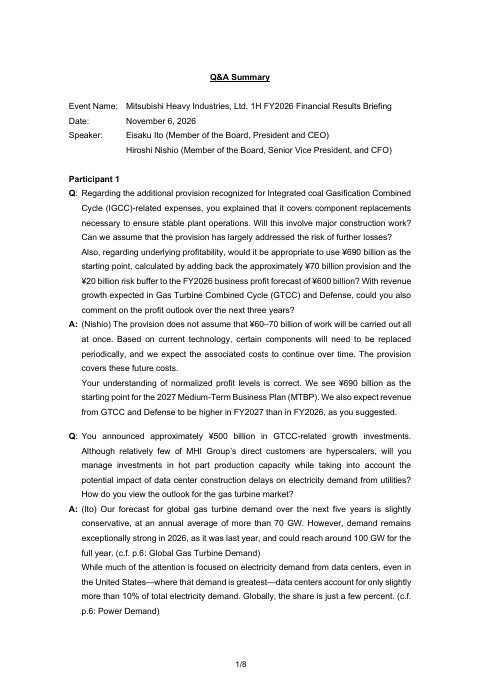
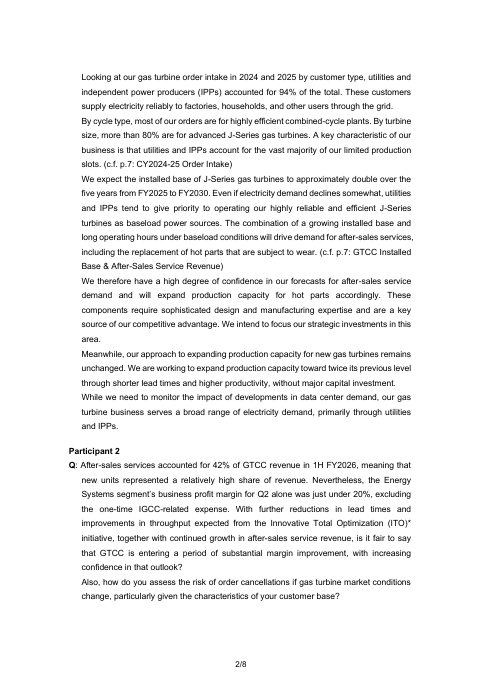
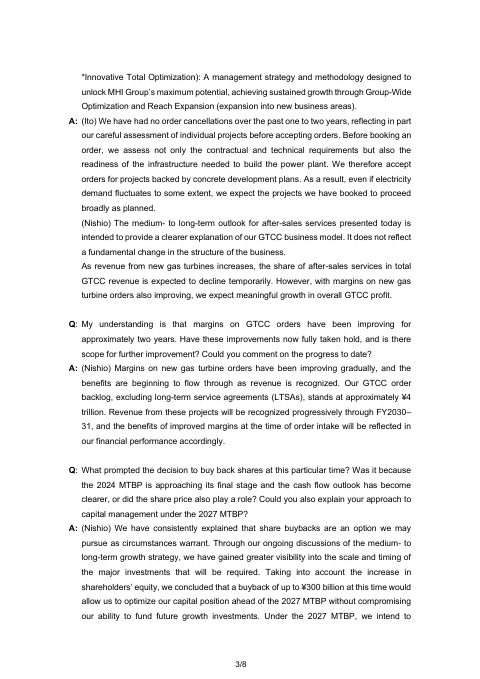
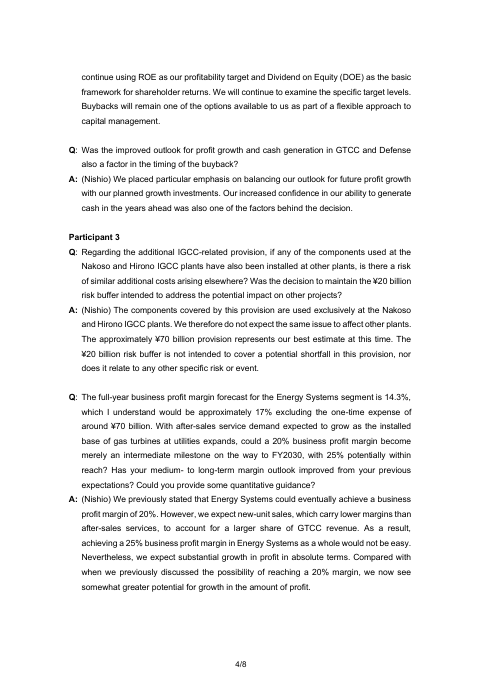
Showing the first 6 of 8 pages.
Results documents
- MHI Announces Outline of FY2026 First 6 Months Financial Results Ended September 30, 2026 (Consolidated)RELEASE ↗
- Summary of Q&A at PresentationCOMMENTARY ↗
- 1H FY2026 (2Q) Financial ResultsFINANCIALS ↗
- Presentation MaterialsPRESENTATION ↗
- Presentation Materials with SummaryPRESENTATION ↗
- Results pageCompany site ↗
Key numbers
- Revenue (first half)
- ¥2,523.2 billion
- Business profit (profit from business activities)
- ¥249.3 billion
- Business profit margin
- 9.9%
- Net income attributable to owners of the parent
- ¥203.2 billion
- Diluted EPS (yen)
- 60.47
- Operating cash flow
- ¥394.5 billion
- Free cash flow
- ¥468.3 billion
- Order backlog
- ¥14,225.6 bn
up 19% from a year ago
up 45% from a year ago
up 1.8 pts from a year ago
up 77% from a year ago
from 34.20 yen a year ago
up ¥988.0 bn from the end of FY2025
| Segment or metric | Value | Change |
|---|---|---|
| Energy Systems revenue | ¥1,122.5 billion | up 29% |
| Energy Systems order intake | ¥2,304.2 billion | up 16% |
| Plants & Infrastructure Systems order intake | ¥689.5 billion | up 41% |
| Industrial Solutions order intake | ¥375.6 billion | up 15% |
| Aircraft, Defense & Space revenue | ¥633.4 billion | up 18% |
Where each number comes from
- Revenue (first half): “Revenue increased 19% YoY to ¥2,523.2 billion. Business profit grew 45% YoY to ¥249.3 billion.”
- Business profit (profit from business activities): “Revenue increased 19% YoY to ¥2,523.2 billion. Business profit grew 45% YoY to ¥249.3 billion.”
- Business profit margin: “Profit from 171.5 249.3 +77.7 (+45.3%) Business Activities (8.1%) (9.9%) (+1.8 pts)”
- Net income attributable to owners of the parent: “Net income rose by 77% to ¥203.2 billion, supported not only by higher business profit but also foreign exchange gains and finance income.”
- Diluted EPS (yen): “Diluted earnings (loss) per share 34.20 60.47 Continuing operations 37.57 59.22 Discontinued operations (3.37) 1.25”
- Operating cash flow: “Operating cash flow reached positive ¥394.5 billion, driven mainly by strong profit generation and continued booking of large advances received”
- Free cash flow: “The lower rows provide a breakdown of free cash flow, which was ¥468.3 billion.”
- Order backlog: “Order backlog increased by ¥988.0 bn from end of FY2025 to ¥14,225.6 bn.”
- Energy Systems revenue: “Revenue increased 29% to ¥1,122.5 billion, and business profit rose 80% to ¥145.1 billion.”
- Energy Systems order intake: “total segment order intake rising 16% YoY to ¥2,304.2 billion.”
- Plants & Infrastructure Systems order intake: “order intake increased in Engineering, Metals Machinery, and Commercial Ships, rising 41% YoY to ¥689.5 billion.”
- Industrial Solutions order intake: “total segment order intake increasing by 15% YoY to ¥375.6 billion.”
- Aircraft, Defense & Space revenue: “drove revenue up 18% YoY to ¥633.4 billion. Business profit rose 27% YoY to ¥76.3 billion.”
Copied from the press release ↗ and other documents in the company's results page ↗. A figure is published only if its sentence is in those documents.
Outlook
| Metric | Period | Outlook |
|---|---|---|
| Revenue (¥ billion) | FY2026 (ending March 31, 2027) | 6,000.0 |
| Business profit forecast | FY2026 (ending March 31, 2027) | ¥600 billion |
| Basic EPS forecast (yen) | FY2026 (ending March 31, 2027) | 130.91 |
| Free cash flow forecast | FY2026 (ending March 31, 2027) | ¥800 billion |
| Share repurchase (maximum) | November 9, 2026 to November 8, 2027 | 300 billion yen |
Key takeaways
GTCC demand stays strong, led by utilities
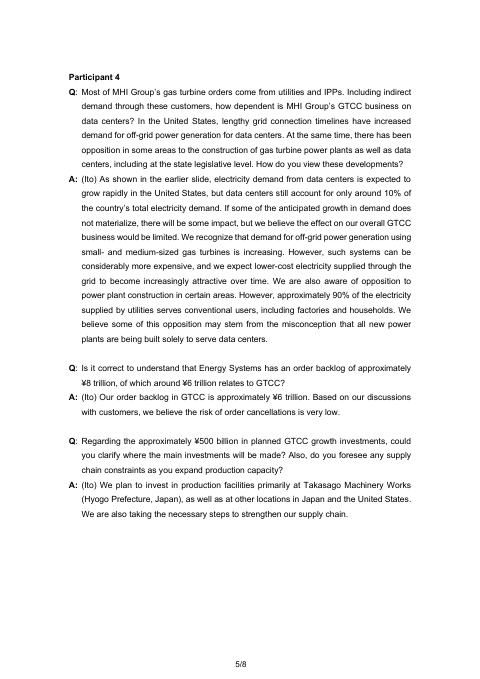
GTCC orders were particularly strong in North America and Asia, and utilities and IPPs made up 94% of gas turbine orders in 2024 and 2025. That customer mix is why management expects limited exposure to any slowdown in data center demand.
MHI plans about ¥500 billion for GTCC growth
Spending centers on hot parts production capacity, mainly at Takasago Machinery Works plus other sites in Japan and the United States. Management expects a growing J-Series installed base to drive after-sales demand.
New-unit capacity to double without major capex
Under the Innovative Total Optimization (ITO) initiative, MHI aims to roughly double GTCC new-unit production capacity by FY2030 versus FY2024 through process improvements and automation. This lets it add capacity while saving capital for hot parts.
Data center push and AI partnership under way
MHI booked UPS orders in North America, obtained regional certification for large centrifugal chillers, and formed a capital and business alliance with Preferred Networks on AI for mission-critical uses. Data center & energy management now sits in Industrial Solutions.
IGCC provision and portfolio pruning shape the plan
A roughly ¥70 billion one-time provision covers periodic component replacement at the Nakoso and Hirono IGCC plants, which management says use components found at no other plant. MHI also completed the Logisnext divestment and agreed to sell its Bombardier business jet Tier 1 business.
Questions
How dependent is MHI's gas turbine business on data centers?
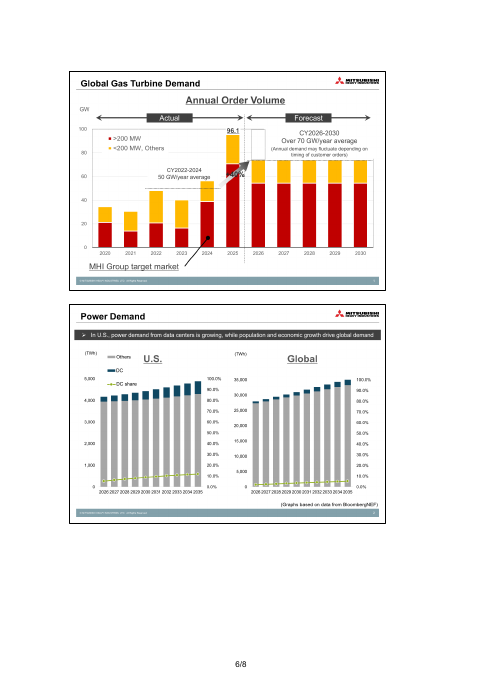
Management says utilities and IPPs accounted for 94% of gas turbine orders in 2024 and 2025, and that data centers are only slightly over 10% of US electricity demand. It expects limited impact on overall GTCC if some data center demand fails to materialize.
Where is MHI investing to expand GTCC capacity?
About ¥500 billion is planned for GTCC growth, including hot parts production capacity, primarily at Takasago Machinery Works plus other sites in Japan and the United States. New-unit capacity is meant to roughly double by FY2030 through process improvements and automation, without major investment.
How safe is MHI's gas turbine order backlog?
GTCC backlog is about ¥6 trillion, and management reports no order cancellations over the past one to two years. It says it accepts orders only for projects with concrete development plans and ready infrastructure.
What is MHI doing in data center and AI businesses?
It booked UPS orders for data centers in North America and obtained regional certification for its large centrifugal chillers. It also formed a capital and business alliance with Preferred Networks to develop AI for mission-critical applications.
What changed in MHI's portfolio and capital plans?
MHI completed the divestment of Logisnext, agreed to sell its Bombardier business jet Tier 1 business, and approved a share buyback of up to ¥300 billion. It plans to keep ROE as its profitability target and Dividend on Equity as its shareholder-return framework under the 2027 medium-term plan.