Summaries and transcripts are machine-generated and can contain errors.
In brief
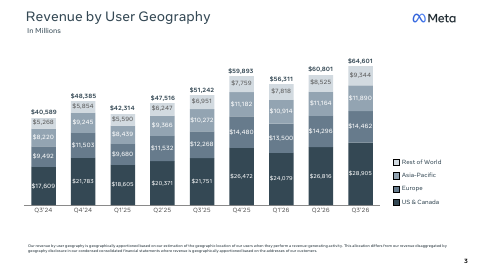
Meta reported Q3 2026 revenue of $64.60 billion, an increase of 26% year-over-year, and diluted EPS of $3.83, which includes a $9.89 billion charge related to the agreement with U.S. State Attorneys General.
Meta's third quarter revenue was $64.60 billion, up 26%, driven by 10% more ad impressions and a 14% higher average price per ad. Profit fell sharply because of a $9.89 billion charge to settle teen mental health litigation with 52 attorneys general. Operating margin was 20% versus 40% a year earlier. Capital expenditures were $34.91 billion, and free cash flow turned negative at $2.12 billion. Meta also launched its Muse personal agent and announced a new non-voting Class C stock.
For the fourth quarter, Meta expects revenue of $73-76 billion and a tax rate of 15-17%. Full-year 2026 total expenses are now forecast at $175-179 billion and capital expenditures at $135-145 billion. Management says it will keep investing aggressively in AI and expects strong revenue growth throughout 2027. The main tension is cost: Muse is expensive to run, spending is rising, free cash flow has turned negative, and more youth-related trials are scheduled in the U.S.
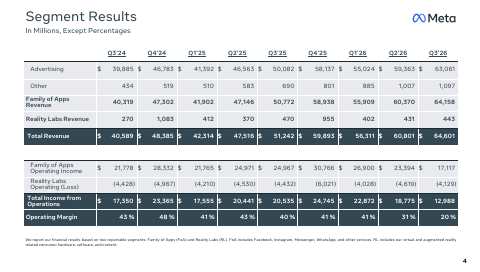
Family of Apps income from operations: “Income (loss) from operations: Family of Apps | $17,117 | $24,967 | $67,410 | $71,702 Reality Labs | (4,129) | (4,432) | (12,775) | (13,171)”
Reality Labs operating loss: “Income (loss) from operations: Family of Apps | $17,117 | $24,967 | $67,410 | $71,702 Reality Labs | (4,129) | (4,432) | (12,775) | (13,171)”
Reality Labs revenue: “within our reality lab segment q3 revenue was $443 million, down 6 % due to lower Quest headset sales, which were partially offset by continued strong growth in AI Glasses revenue.”
Family daily active people (DAP): “DAP was 3.64 billion on average for September 2026, an increase of 3% year-over-year.”
Ad impressions: “Ad impressions delivered across our Family of Apps increased by 10% year-over-year.”
Average price per ad: “Average price per ad increased by 14% year-over-year.”
Compared with the company's own guidance, not analyst estimates, and only where the outlook and the reported figure are the same measure on the same basis. Ranges are worked out by code from the company's wording. How this works.
Outlook
Metric
Period
Outlook
Total revenue
fourth quarter 2026
$73-76 billion
Foreign currency impact on year-over-year revenue growth
fourth quarter 2026
approximately 1%
Tax rate
fourth quarter 2026
between 15-17%
Total expenses
full year 2026
$175-179 billion
Capital expenditures, including principal payments on finance leases
2026
$135-145 billion
Reality Labs losses
2026
$18-19 billion
Reality Labs losses
2027
around $15 billion
Key takeaways
Legal charge drove profit decline
A $9.89 billion charge for the agreement with 52 attorneys general cut Q3 income from operations to $12.99 billion. Excluding it, income from operations would have been $22.88 billion and diluted EPS $7.40.
Ad growth driven by volume and price
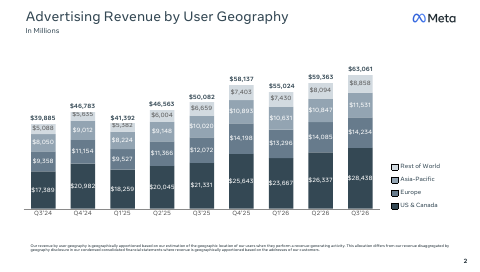
Ad impressions rose 10% and average price per ad rose 14%, producing revenue growth of 26%. Advertising revenue was $63,061 million in the quarter.
Spending pushed free cash flow negative
Capital expenditures were $34.91 billion against operating cash flow of $32.79 billion, leaving free cash flow at negative $2.12 billion. Full-year 2026 capex is guided to $135-145 billion.
Muse launch is early but strong
Management said more than 10 million people in the U.S. and Canada have set up Muse, and it expects to improve compute cost efficiency by more than 10x in the next year. Shopping is the most common use case.
New non-voting Class C stock announced
The Board approved a Class C common stock effective January 19, 2027, with a one-time dividend of one share per existing share, effectively a two-for-one split. Management said it has no specific financing plans to announce.
Charts
Revenue$64.6B+26.1% y/yQ3 2026
Fourth quarter worked out from the annual figure.
Data
Q4 2024
$48.4B *
Q1 2025
$42.3B
Q2 2025
$47.5B
Q3 2025
$51.2B
Q4 2025
$59.9B *
Q1 2026
$56.3B
Q2 2026
$60.8B
Q3 2026
$64.6B
Diluted EPS (GAAP)$3.83+264.8% y/yQ3 2026Data
Q1 2025
$6.43
Q2 2025
$7.14
Q3 2025
$1.05
Q1 2026
$10.44
Q2 2026
$6.18
Q3 2026
$3.83
Fourth-quarter EPS appears once the press release is read; filings report it only for the full year.
Operating margin20.1%−20.0 pts y/yQ3 2026Data
Q4 2024
48.3%
Q1 2025
41.5%
Q2 2025
43.0%
Q3 2025
40.1%
Q4 2025
41.3%
Q1 2026
40.6%
Q2 2026
30.9%
Q3 2026
20.1%
Free cash flow-$1.2BQ3 2026Data
Q4 2024
$13.6B
Q1 2025
$11.1B
Q2 2025
$9.0B
Q3 2025
$11.2B
Q4 2025
$14.8B
Q1 2026
$13.2B
Q2 2026
$1.7B
Q3 2026
-$1.2B
Operating cash flow minus capital expenditure, from cash flow statements.
What management said
Each quote matches the transcript word for word.
“In the near term, Muse is very compute intensive to run, but we expect to improve its cost efficiency by more than 10x in the next year, which will enable it to be profitable once the revenue lines are at scale.”
It states the cost problem and the efficiency target on which Muse's economics depend.
“So with these factors combined, we expect that the P &L of Reality Labs to improve from here, with operating loss coming down to around $15 billion next year and trending towards profitability from there.”
It gives the 2027 Reality Labs loss target as spending shifts toward AI.
“We don't have any specific financing plans to announce at this time, but we thought it was prudent to establish the appropriate capital structure framework to ensure that we have access to a diverse pool of funding sources.”
It clarifies that the Class C stock is a flexibility tool, not a signal of an imminent raise.
0:30:15 · Brian Nowak, Morgan Stanley · Muse growth
What are the main constraints on the pace of Muse user growth?
Mark Zuckerberg said Muse has not launched globally because it is compute intensive, so compute efficiency, business buildout and better models are the limiting factors over the next year. — Mark Zuckerberg
0:30:39 · Brian Nowak, Morgan Stanley · Enterprise offering
What is the vision for the Meta enterprise offering and its key value drivers?
Near-term offerings are the model API, Muse Code and business agents, with a longer-term Muse network, and Susan said the company will scale investment behind demonstrated customer demand. — Mark Zuckerberg, Susan
0:36:49 · Eric Sheridan, Goldman Sachs · Agentic commerce
How will Meta handle friction when aggregators or suppliers resist agents interacting with their platforms?
Management said most businesses are eager to participate and expects a shift toward permissioned, structured agent interactions using standards such as the personal agent protocol. — Mark Zuckerberg, Susan
0:37:36 · Eric Sheridan, Goldman Sachs · Capital structure
How does the new share class change the thinking on capital sources and structure?
Susan said the non-voting stock can be used for capital raising, employee compensation and acquisitions while preserving voting power, with no specific financing plans announced. — Susan
How does the experience change as more businesses adopt agents and move to permission-based agent-to-agent transactions?
Susan said adoption will be uneven but business agents handling interactions and proactive consumer and business agents should enable more transactions. — Susan
How much room is there to improve the ad business as the new model is deployed internally?
Susan outlined three themes, ongoing machine learning improvements, new LLM-based research bets and expanding generative AI ad tools, giving meaningful runway through 2027. — Susan
0:46:02 · Justin Post, Bank of America · 2027 revenue
Does strong 2027 revenue growth come from advertising or also incremental AI revenue?
Susan said it comes from core ads and engagement plus new AI businesses that can begin contributing incremental revenue in 2027 but matter more over time. — Susan
0:49:54 · Mark Shmulek, Bernstein · Company strategy
Is the company reorienting around Muse, and how have business mandates changed?
Mark Zuckerberg said personal superintelligence has been the North Star for over a year and the company is making long-term bets on end-to-end models, agents and hardware. — Mark Zuckerberg
0:50:20 · Mark Shmulek, Bernstein · Small business
What work is required to serve and scale offerings for small businesses?
Susan said Muse for small business is a set of skills and connectors inside the Muse app, and Meta is watching use cases while using its 500 million self-identified small businesses as a channel. — Susan
What is the per-user cost structure of Muse today and how will the cost curve come down?
Susan gave no numbers but cited off-peak capacity, smaller models, inference efficiency and higher GPU utilization as near-term levers. — Susan
0:57:07 · Mark Mahaney, Evercore ISI · Monetization timing
Will Muse follow the usual playbook of growing users before monetizing, or must monetization come faster?
Susan said monetization will come somewhat sooner than usual given the cost and commerce focus, and Mark Zuckerberg added that efficiency gains and revenue must both scale. — Susan, Mark Zuckerberg
0:57:30 · Mark Mahaney, Evercore ISI · Commerce data
Does the commerce data point include travel purchases or only retail?
Susan said the commerce figure does include travel, which is also one of the top use cases. — Susan
Questions
What were Meta's Q3 2026 revenue and earnings?
Revenue was $64.60 billion, up 26% year-over-year, and net income was $9,860 million with diluted EPS of $3.83. Results include a $9.89 billion charge for the state attorneys general agreement.
Why did operating margin fall to 20%?
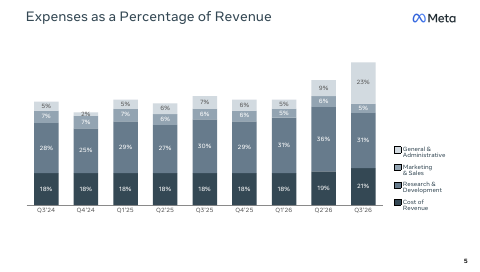
Total costs and expenses rose 68%, including the $9.89 billion legal charge and higher infrastructure and AI token costs. Excluding the charge, income from operations would have been $22.88 billion.
What is Meta's guidance for Q4 2026?
Meta expects Q4 revenue of $73-76 billion, with foreign currency an approximately 1% headwind, and a tax rate between 15-17%. Full-year 2026 total expenses are expected at $175-179 billion.
How much is Meta spending on capex and what happened to free cash flow?
Q3 capital expenditures including finance lease principal payments were $34.91 billion, and free cash flow was negative $2.12 billion. 2026 capex is now expected at $135-145 billion, narrowed from $130-145 billion.
What is the new Class C stock?
It is a non-voting, publicly listed class effective January 19, 2027, distributed via a one-time dividend of one share per existing Class A or Class B share. Meta expects Class A's price to reflect a two-for-one split, and voting power does not change.
Thanks for joining today. This has been a busy and exciting few months. Our family of apps is now used by 3.64 billion people each day and we are seeing all-time highs in engagement on both Facebook and Instagram driven by strong growth in video. Threads has now overtaken X in monthly actives and continues to grow quickly. WhatsApp is hitting all-time highs in messaging and is becoming an increasingly important platform for agents as well. In the last few months, we have had several major milestones towards our goal of delivering personal superintelligence to everyone.
We had one of our most successful launches ever with the Muse personal agent. We shipped Muse Wonder as our first frontier model, and we shipped several new glasses and gadgets with Muse integration, including coming soon to our new audio glasses. We've been discussing our vision for personal superintelligence for more than a year now. We want to help every person have an extremely capable personal agent that understands your goals and can help you achieve them and improve your life in whatever ways you want, whether that's improving your relationships, helping you save time, save money, build a business, create new things, or anything else that you can dream of.
Muse is the product form of this vision. So now we have the foundational technology in place to deliver this. There is still a lot of work ahead, but our initial position is very strong. In just a month and a half, more than 10 million people in the U .S. and Canada have set up Muse personal agents. Growth continues to be strong, and we have been number one in the App Store almost every day. Engagement and retention are also off to a strong start.
About 25 % of people who have set up Muse use it on any given day. For our earliest adopters, the longer that they use Muse, the better that retention seems to get. So to put this in perspective, this is more than twice the level that Thread started at, or where we believe that other AI apps started at as well. The most common use case for Muse is shopping, with more than a quarter of people who are using Muse engaging in this with an average purchase size of over $200.
Plaid told us that they hadn't seen activity like they're seeing with their connector on any other service before. And in the first week, we had to work with Stripe to raise credit limits since the volumes were above what any of us expected. Beyond shopping, the most common connectors are for personal productivity and connecting Muse to your other services like email and calendar. Now, this shows the importance of the Muse Secure VM that we've built to provide state-of-the-art privacy and security, and we are looking forward to following up soon with the Muse Confidential VM, which will make it so that even Meta cannot see your content.
We've also seen that Muse Wonder improves quality, engagement, and retention further, which suggests that as we continue to improve intelligence, Muse will perform better and better over time. Now that Muse has clear product market fit, we are entering a new phase and a more operational phase that is focused on scaling it. The goals for this next phase play to many of Meta's strengths. We need to do three things, scale the product, grow revenue, and optimize compute costs.
We expect to grow Muse to serve billions of people. This is both our mission and our strategy. It's our mission in that we believe in putting the power of personal superintelligence in everyone's hands. We believe that that is the path to ensuring a positive future for everyone with individual empowerment as the source of prosperity and balance of power as the foundation for safety. On a values level, we believe that delivering this capability widely is the best thing that we can be doing.
This is also our strategy because we think that billions of muses in a network at scale will be able to get more done for people and businesses by working together. So we'd like to create a large-scale Muse network as quickly as possible. From a business perspective, the average revenue per American user for our existing Muse users is, sorry, for our existing family of apps users is several hundreds of dollars annually. And we expect that Muse will reach an even higher level over time due to the amount of commerce that we already see taking place.
This will take some time, but we're starting to work on this now. Our business model will have a few components. For most people, the product should be free, and we will build commerce tools, so we get paid a fee based on the transactions that we help facilitate. We expect this will be paid for by businesses. For people who want the most advanced models or to use extra tokens, they subscribe directly and pay. For business owners who want additional features to use Muse to grow their businesses or for companies that want people to use Muse for work, they will be able to subscribe directly and pay as well.
And for those who want Muse to help improve the personalization and quality of their content and ads across Meta, they will be able to connect to those experiences as well. Just to clarify, the average revenue that I was talking about before is the family of apps revenue for our existing Muse users. On the compute side, we are building out the capacity to serve more than a billion people over the next few years. In the near term, Muse is very compute intensive to run, but we expect to improve its cost efficiency by more than 10x in the next year, which will enable it to be profitable once the revenue lines are at scale.
If compute efficiency continues improving quickly for another few years, which we think is highly likely, then Muse will be highly profitable over multiple years. In the near term, the strength of our core business enables us to scale the Muse network before then, and we believe that we are the best positioned company to pursue this strategy. One other note on compute economics is that since training is a large fixed cost, now that we have leading models, we want to serve as much high margin inference demand as possible.
That is why we are building the meta enterprise platform led by CJ Desai. Muse Wonder and even more advanced models that we're training can serve additional high margin services beyond the Muse network, including our API, Muse Code, and other enterprise services. A fundamental feature of our business is that we have many good uses for this compute. It is difficult to forecast the exact growth rates for the Muse network, for our enterprise platform, and for how Muse Wonder and beyond will accelerate our core business.
But through building up multiple ways to deploy these advanced models, we increase the chances that one or more of them significantly outperforms our expectations. Beyond serving other businesses, we have not yet found the limit of how effectively we can apply compute to accelerating our own core business. We have implemented an eval with Muse Wonder to improve how effectively it can autonomously improve our recommendations and ad systems. And as our upcoming models get even more advanced, I expect that we're going to see an increasing rate of improvement in these systems.
All right, let's talk about the models now. Muse Wonder is state-of-the-art across many dimensions that matter for personal superintelligence. This validates the importance of training models ourselves to deliver the best experience. In addition to Muse, we have also seen that engagement per person in Meta AI has more than doubled since April when we started rolling out our new models. While Muse Wonder has been our most important release, I've been very pleased with our pace of execution here.
In the last few months we've shipped MuseSpark 1.2 and 1.3, MuseCode, two open weights models with MuseGlimmer and MuseSpark open, and also MuseVoice. Going forward with the field advancing quickly, we plan to focus on both pushing the frontier of intelligence and distilling those models into much smaller and more efficient product models that will be optimized for personal agents. My view is that we will be able to build superintelligence through scaling, so we are methodically working our way up the ladder there.
We are already working on larger models after Muse Wonder, and they're going to be very impressive and capable. We are also working on new smaller models that are coming out soon that will deliver Muse Wonder-level intelligence more efficiently. Moving on, our work on personal superintelligence is now also the focus of Reality Labs. MUSE is coming to MetaGlasses starting next month, and that will be an important step towards this. People already love many features of the glasses already, music, calling, capturing moments, hearing assistance, and more.
But over time, we expect MUSE and having your personal superintelligence with you throughout the day will be the most important part of the experience. MUSE is also central to the business model for the glasses. Again, our mission and strategy are to serve everyone here. We believe in putting the power of this technology in everyone's hands. So we have priced our devices not to make a large profit on the hardware, but to build a large software and super intelligence business on top of them over time.
Glasses sales continue to grow rapidly. And now with Muse, we expect that paid subscriptions will increase and that this business will begin improving meaningfully from here. I also shared at Connect that we are changing our approach to virtual reality to only ship new devices when we have major breakthroughs like we had with the meta VR glasses this year, which of course are the first VR experience ever in a pair of glasses. I continue to believe that the path to delivering holographic experience, of bringing together the physical and digital worlds and everyday glasses will come through VR first, but we will pace this aspect of our investment more to focus on delivering personal super intelligence first.
So with these factors combined, we expect that the P &L of Reality Labs to improve from here, with operating loss coming down to around $15 billion next year and trending towards profitability from there. Before we conclude, I want to spend a moment on the sheer velocity that we are seeing. An important part of our approach has always been to move fast so we can learn quickly and serve people better at scale. But recently things have accelerated.
In the last year, we shipped edits, and it has already passed 50 million actives. New apps like Forum and Seller were built by small teams and are scaling quickly to serve power users. Muse went from an idea on a whiteboard to a successful product in just about eight months. And we're about to ship Muse Charm, which will have gone from concept to a hardware device in people's pockets in less than a year. I am proud of what we are building.
people have all kinds of different opinions about the future but at Meta we believe that the future is for everyone and that putting power in people's hands is how we get there I think that this matters there needs to be a company out there that represents these ideas but this isn't just about ideas it's also about execution so I am grateful for everyone who is working so hard to deliver all of this to billions of people around the world and as always thank you to everyone who on this journey with us and now here's Susan.
Thanks Mark and good afternoon everyone. Let's begin with our segment results. All comparisons are on a year-over-year basis unless otherwise noted. Q3 total family of apps revenue was $64.2 billion up 26%. Q3 family of apps ad revenue was 63.1 $1 million up 26 on both a reported and constant currency basis in q3 the total number of ad impressions served across our services increased 10 impression growth was healthy across all regions driven by growth and engagement and users as well as ad load optimizations the global average price per ad increased 14 year over year driven by ad performance gains and improvements in macro conditions relative to q3 of last year this was partially offset by strong
impression growth particularly from lower monetizing surfaces and regions family of apps other revenue was 1.1 $1 billion and grew 59 driven primarily by whatsapp paid messaging and subscriptions revenue within our reality lab segment q3 revenue was $443 million, down 6 % due to lower Quest headset sales, which were partially offset by continued strong growth in AI Glasses revenue. Moving now to our consolidated results. Q3 total revenue was $64.6 billion, up 26 % on both a reported and constant currency basis.
Q3 total expenses were 51.6 $1 billion up 68 compared to last year and included a 9.9 billion dollar charge related to the august 2026 multi-state attorneys general agreement year-over-year growth was primarily driven by legal related costs infrastructure costs and third-party ai token costs the growth in infrastructure costs was driven by higher third-party cloud spend demand, depreciation, and data center operating costs. We ended Q3 with over 66 ,000 employees, down 12 % from Q2 following the May 2026 headcount reduction.
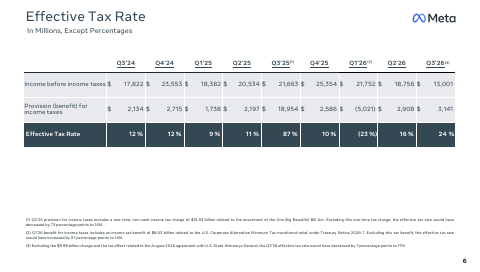
Third quarter gap operating income was $13 billion, representing a 37 % decline year-over-year and a 20 % operating margin. Excluding the Q3 legal charges related to the aforementioned legal settlement, our third quarter operating income would have increased 11% year-over-year. Our tax rate for the quarter was 24%, above our outlook range, primarily driven by the non-deductible portion of legal expenses. Net income was $9.9 billion, or $3.83 per share.
Capital expenditures, including principal payments on finance leases, were $34.9 billion, driven by investments in servers data centers and network infrastructure free cash flow was negative 2.1 $1 billion we ended the quarter with 82.4 $1 billion in cash and marketable securities and 83.7 $1 billion in debt turning now to the business performance there are two primary factors that drive our revenue performance our ability to deliver engaging experiences for our community and our effectiveness at monetizing that engagement over time on the first we continue to see significant gains from our content recommendation initiatives on instagram global time spent per user reached an all-time high and grew double digits year over year in q3 with strength across both
reels and feed on facebook reels time spent reached all-time highs both globally and in the u .s with both growing double digits year over year threads also continue to scale with time spent per user growing over 20% year over year engagement gains across our services continue to be driven by improvements we're making to the relevance personalization and timeliness of the content we recommend investments into our recommendations engine across retrieval and ranking have continued to yield positive results on instagram and facebook for instance on instagram reels our relevance launches in q3 increased real time spent by over 4% driven in part by our upgraded model architecture that ranks sequences of reels at a time instead of evaluating each
reel independently as well as improvements we made to add richer watch time signals on facebook feed and reels we completed the global launch of a new generative retrieval architecture which inspired by llms labels pieces of content with semantic representations and generates potential recommendations, helping our systems surface relevant new posts before they've accumulated significant engagement. This new architecture is now rolled out to roughly one quarter of unconnected feed views and half of Reels views and increased Reels watch time by 1%.
Our recommendations work is also helping us deliver fresher and more personalized content. Nearly 45 % of recommended Instagram Reels are now less than one day old, up more than 11 percentage points from Q2. On Facebook Reels, we doubled the amount of history our ranking model can consider, driving a 1 % increase in Reels watch time in the US. LLMs are also helping us understand content more deeply. We continue to process public Instagram posts each day through LLM-based content understanding systems these signals have improved the engagement with instagram search results by 1% through the end of this quarter this quarter we also began moving our content understanding models onto our first party muse model family in offline evaluations these
models are outperforming our prior production models and are reducing per unit content processing costs by more than 80 % across Instagram threads, Facebook, and ads. Beyond improving quality, owning more of this stack gives us greater flexibility to develop models around the signals that matter the most for personalization. Turning to the second driver of our revenue performance, increasing monetization efficiency. We see significant opportunity to continue improving performance for the businesses who use our services. Within our ad systems, we are continuing to drive performance gains as we deploy more predictive models that understand users more deeply and deliver ad experiences better aligned with their unique preferences while also making our infrastructure more efficient.
Last quarter, we introduced Meta Generative Recommender, which uses LLMs to reason across ad content and user preferences to predict the best ad for each person. In Q3, we launched this approach to generative retrieval on Facebook feed, driving a nearly 2 % increase in conversions across targeted segments. In addition, we expanded our GEM model for ads ranking to additional surfaces, driving a 1.7 % increase in conversions for off-site conversion campaigns and a 9.6 % increase in app ad conversions.
And we continue to scale our retrieval systems efficiently. In Q3, improvements to Andromeda, such as scaling model complexity and throughput, increased conversions by 1.4 % on Facebook. We're also leveraging AI to make it easier for businesses to manage campaigns, develop creative, and act on performance opportunities. Meta AI Business Assistant is becoming a more proactive and capable partner for advertisers. We estimate that advertisers who adopted its recommendations drove almost 5 % more conversions at the same cost per conversion and increased their advertising investment by 9 % compared with similar non-adopters.
We are rolling out additional capabilities, including creative insights, stronger business context, and more agentic actions. campaigns. These features will allow marketers to plan, create, and optimize campaigns, as well as schedule tasks and alerts through a conversational experience with approvals and previews that keep them in control. I'll share one example of how Meta AI Business Assistant is empowering our advertisers. Simply Organic Maple, a family-run maple syrup producer in Vermont, used Meta AI Business Assistant to improve its campaign messaging.
After the Business Assistant recommended testing longer, more descriptive advertising copy, the business saw a 57 % increase in purchases and a 36 % reduction in cost per purchase. Its strongest revised ad delivered a 3x return on ad spend, a 52 % improvement from the original. Adoption of our generative AI ad creative tools also continues to scale. In Q3, nearly 10 million advertisers used at least one of these tools. Advertiser adoption of our video generation features grew 25 % quarter over quarter, driven in part by ready-made videos that reduced generation time to just a few seconds from a single image upload.
We're also expanding the opportunity at the intersection of creators and advertising. Partnership ads, which allow advertisers to run ads with creators, brands, and other businesses, continued to scale rapidly in Q3. Our partnership ads product grew over 97 % year-over-year and surpassed $15 billion in annual revenue run rate. In Q3, we also completed the global rollout of Creator Marketing Hub to all advertisers, bringing creator discovery, content organization, and partnership ad activation into one place with more than 10 million creators now discoverable.
We are integrating Meta AI Business Assistant into the hub so advertisers can conversationally search for creators, identify content to use in partnership ads, and get guidance across their creator marketing workflows. Outside of ads, we are also building out additional ways to monetize engagement across our ecosystem in september we announced the global expansion of meta one our unified subscription service for consumers creators and businesses meta one is rolling out gradually with more than 50 features across instagram facebook and whatsapp including meta business agent and meta ai and has surpassed 15 million subscriptions and trials to date the core experience across our apps and meta ai will remain free while subscriptions offer more specialized capabilities and expanded ai usage And beyond monetizing
engagement across our existing services, we are building new experiences and revenue streams around consumer agents. Mark highlighted the impressive early momentum with Muse. Users have found many reasons to use Muse, with the top three categories being shopping, personal productivity, and creativity. We're encouraged by the breadth of use cases, with shopping in particular being used by over 25 % of Muse weekly actives. While our near-term priority is to grow adoption and expand Muse's reach, we see multiple paths to monetization beginning with subscriptions.
We also see a significant opportunity to extend Muse to small businesses. Based on a recent user survey, we estimate that at least 500 million self-identified small businesses use Meta's family of apps to reach customers and generate revenue. Muse could help these businesses acquire customers and operate more efficiently while helping people complete transactions. Over time, consumer and business agents could connect and transact directly, creating opportunities around paid usage, commerce, and business services. Alongside growth, we are focused on building sustainable unit economics.
Muse's compute intensity means that expanding its user base will require significant investment, and we expect total serving costs to rise. At the same time, we expect to improve compute cost efficiency by more than tenfold over the next year, driven by better utilization of off-peak capacity, more efficient models, and inference optimization. As revenue scales, these efficiency gains give us confidence in our ability to build a highly profitable business over time. Moving now to our financial outlook.
We expect fourth quarter 2026 total revenue to be in the range of 73 to $76 billion our guidance assumes foreign currency is an approximately 1% headwind to year-over-year total revenue growth based on current exchange rates turning to the expense and capex outlooks we are raising our expense outlook to incorporate the 9.9 billion dollar charge related to legal proceedings recognized in q3 we now expect full year 2026 total expenses to be in the range of 175 to $179 billion excluding the q3 legal charge we continue to expect 2026 operating income to be above 2025 operating income at a segment level we now expect reality labs losses to decline compared to 2025 to a range of
18 to $19 billion we anticipate 2026 capital expenditures including principal payments on finance leases to be in the range of 135 to $145 billion narrowed from our prior outlook of 130 to $145 billion absent any changes to our tax landscape we expect our fourth quarter 2026 tax rate to be between 15 and 17 percent additionally we continue to monitor active legal and regulatory matters that could significantly impact our business and financial results for example we continue to see scrutiny on youth related issues in several markets and have a number of youth related trials scheduled in the coming months in the united states looking beyond 2026 we are still developing our budget and capacity plans for next year
but we expect to continue investing aggressively to support both our core business and emerging AI initiatives. Our current capacity and what is scheduled to come online gives us the flexibility to allocate resources across model training, core business growth, and the development and support of new products. Our AI investments are already delivering substantial incremental advertising revenue through stronger engagement, better recommendations, and more efficient monetization. Building on this progress, our MSL investments are creating the technology and infrastructure needed to unlock significant new revenue opportunities and strengthen capabilities across the business.
While these investments will take longer to generate returns than those in our core business, the breadth of monetization opportunities and internal efficiencies gives us confidence in their long-term potential. Looking ahead, although we are not providing a full-year 2027 revenue outlook the benefits our ai investments are delivering to the core business combined with emerging opportunities from model advances and product launches position us to sustain strong overall revenue growth throughout 2027. separately we remain focused on improving reality labs profitability as mark mentioned we expect losses to narrow next year to around $15 billion as we reallocate investment towards other priority areas primarily ai finally today we announce plans to create a new class of non-voting capital stock which
will be distributed to all existing shareholders through a stock dividend for each existing share held stockholders will receive one share of the new non-voting stock effectively resulting in a two for one stock split we expect trading to begin in late january 2027. in closing our business momentum continued in q3 with strong execution across our core ads and engagement initiatives and we're also excited by our progress towards bringing personal super intelligence to everyone with that krista let's open up the call for questions Thank you.
We will now open the lines for question and answer session. To ask a question, please press star 1 on your touchtone phone. To withdraw your question, you may press star 1 again. Please limit yourself to one question. Please pick up your handset before asking your question to ensure clarity. If you are streaming today's call, please mute your computer speakers. And your first question comes from the line of Brian Nowak with Morgan Stanley. Please go ahead.
I have two, one on Muse, one on Enterprise. Maybe that person congrats on the success of Muse. But as you analyze the user behavior in the product, can you talk with us a little bit about any of the constraints to the slope of forward user growth that you're most focused on addressing, whether it's capabilities, model efficiency, capacity, et cetera, just so we understand what are the limiting factors to forward user growth that you want to address?
And the second one is on Enterprise. Mark, can you just sort of walk us through your vision for the meta enterprise product offering and the key value drivers you hope to provide for the enterprise adopting the service?
Yeah, I think I can talk about both of those, and then Susan can jump in with anything else. All right, so right now for Muse, we are, one of the things I pointed out is, you know, we have more than 10 million people in the US and Canada who have set it up.
But I think one of the biggest constraints so far is that because this is a compute intensive service to run, we have not launched it globally yet. That's partially because of wanting to optimize it for each place. And there's some work around connectors for that. but it's partially that we want to make sure that we do this efficiently. So, I mean, there's pros and cons there. The pro, of course, is that that just makes it even more impressive that you have 10 million people using it and signing up to use it in the first six weeks because those are all kind of Americans and Canadians in a small number of markets.
So if we actually did roll it out more broadly, then you would expect that number to be significantly larger than what we're seeing today. But then on the flip side, we actually have to go do the work to bring the efficiency in line to make that make sense. And so that's a big part of it that we need to do. um we the compute efficiency work is going to be important on this also because you know we want to make sure that we've built enough compute to be able to serve what we think is going to be a billion plus people if we can achieve certain compute efficiency targets but we obviously have a lot of work to do there
as well and that'll be um that that'll be one of the limiting factors over the next year uh we want to build out the business around it so i mean i talked about that And I think doing that in tandem with bringing down the compute or increasing the compute efficiency is going to be important for getting this to work from a business perspective, which I'm optimistic about. But I think that that's one of the things that we need to do.
And then there's just continuing to increase the value in the product, which I think we will largely do by continuing to develop new models. That's why I mentioned that we launched Muse first on MuseSpark, and that's what is currently the default across the free tier. We rolled out Muse Wonder, and people can access that in the paid tier today. And we know that it performs a lot better, so we're working on getting a more efficient version of Muse Wonder that we'll be able to roll out more broadly.
but you can imagine just as we iterate forward and two, three models into the future when you have significantly higher intelligence and capability to solve many more problems for people and the ability to deliver that at a much more affordable price point, I think that that's going to just unlock a lot more value to people. So we're very excited about that. Transitioning talking about the enterprise piece, because I think that these two pieces are, there is some connection here in that the main enterprise offering in the near term is going to be the model API and Muse code.
And we have business agents that we've been scaling for a while. And each of those three things is growing quite quickly. So we're excited about that. Over time, we would like to make it so that we have a whole kind of business network of Muse agents as well. There's the business agent, which we've talked about on previous earnings calls for businesses to help out with sales and customer support. But what we see is a lot of people are actually using Muse today to help run especially small businesses.
And we think that there's both an opportunity to help create an agent that people use to really enable them to automate and do a lot of the parts of spinning up a small business that are just kind of difficult and time consuming but aren't the core thing that a person is trying to do. So we think that's a big deal. And then making a version of Muse that people can bring into different corporate environments and work there we think is going to be a big deal.
And then beyond that, building what I refer to as the Muse network, which is making it so that Muse is not just a kind of single player game where you have your muse, but making it so that your muses can work with your friends and your families. And if you want to buy something, it's not just navigating to that business's website, it's talking to their agent. I think that getting that all to work well together is going to unlock tremendous value at scale.
So I'm very excited about all of that. I think the enterprise use is going to be a big part of it, but it's also going to kind of have this very valuable boost in the utility for consumers too. So I'm very excited about both of those.
I would add to Mark's comments on enterprise. AI is creating huge amounts of disruption in enterprise today. And, you know, we don't, from what we can see, we really don't believe that traditional enterprise companies have this lockdown.
And in fact, you know, some of the leading companies in this space today didn't exist a few years ago. Those companies made large investments in model development, and we've done the same, and we have increasingly competitive models to bring to bear for the benefit of all of our users, including small businesses and including enterprises. And already today, we have 500 million businesses using our products. So we really believe that AI is going to reshape how businesses operate.
We expect that businesses of all sizes are going to use AI agents across software development and productivity, sales, marketing, customer service, etc. et cetera. We have differentiated assets to serve this market, bringing together models, infrastructure, global distribution, and longstanding relationships with businesses. And it's our hope that this will be able to be a new diversified recurring revenue stream for us that will be able to support multiple business models, including subscriptions and usage-based API and messaging and other revenue lines.
So we expect that this will be an opportunity that will develop over multiple years, and we intend to scale our investment behind demonstrated customer demand and product market fit in this area.
Thanks so much for taking the questions. Maybe just the first one building on Brian's question, when you think about the friction points around agente commerce, how do you guys as a company think about solving for friction that's rising where there are aggregators or suppliers that don't want agents to interact with their platforms or their services and how you think about lowering that friction or creating the right balance between the existing services that
consumers access today relative to how this might all be changed or altered by agentic behavior over the medium to long term. And the second one would be with the announcement of the new class of shares tonight with earnings, any updated thoughts broadly about how you think about sources of capital and optimizing your capital structure to make sure you invest the proper amounts to capitalize on the opportunities that AI are presenting in the next couple of years.
I can answer the first one. So, okay, so the question, what, sorry, what was the first question then? Friction points around agent and commerce. Got it. All right. Yeah. So the right now what we're seeing is that overwhelmingly businesses are very excited about enabling this because they recognize that it's going to be a new opportunity for them not only to increase the sales and the quality of the experience for existing customers but also potentially to bring in new customers so um now i'm gonna cross the whole business ecosystem Some different people will kind of adopt this at different paces.
And how our strategy evolves on that to develop the ecosystem will depend on how that goes. But overall, I would say we've been very positively surprised by how quickly I think a huge amount of businesses have wanted to, you know, not only figure out how to make it so that Muse can use their services more effectively, but have reached out to us to integrate around it. So I view that as a very good sign. And, you know, obviously not everyone wants to be an early adopter.
That's fine. We'll work with folks on the terms that that makes sense for them. But I do think that over time, this is going to be quite valuable for everyone to make this work well. And I think we're on a good trajectory on that so far.
Yeah, I would add to that. And I will also answer your second question and just say, You know, I think agents are going to be an important part of, you know, how reality evolves.
And I think everyone is going to have to adapt to what that means, the new age of agentic commerce. We obviously have had a lot of businesses who are very excited to partner with us. There are also businesses that are understandably focused on protecting customer relationships. And we expect the market, you know, I think ultimately to evolve away from agents attempting to navigate every digital experience like a human. and i think over the long run this will move towards more permissioned structured interactions and that will include authenticated apis approved agent partnerships or direct communications between a consumer's personal agent and a business's own agent and we're helping establish the standards needed to support that model earlier this month we previewed
the personal agent protocol and open standard across Muse and Meta business agents that we are developing with industry partners like Sierra, Walmart, Stripe, Shopify, etc. The protocol is intended to define how a consumer's personal agent can interact securely and reliably with the business's agent and preserve appropriate controls for both the business and customer. So again, you know, I think adoption will likely be uneven and will take time. And in the near term, we expect any experience, many experiences will remain AI assisted rather than fully autonomous.
But, you know, as Preston integrations develop and agents demonstrate that they can generate incremental value and demand and operate safely, we expect that more and more businesses will be excited to participate. Your second question was about the announcement of the new class of shares. So I should say, you know, we created this new class of shares with the purpose of creating a publicly traded non-voting stock usable for you know capital raising employee compensation acquisitions other general corporate purposes while preserving the voting power of existing class a and b shareholders we believe the share class will maintain our founder-led structure it will expand our funding tools and give us flexibility to invest behind the unprecedented momentum we're seeing across
every part of our business driven by AI. We don't have any specific financing plans to announce at this time, but we thought it was prudent to establish the appropriate capital structure framework to ensure that we have access to a diverse pool of funding sources.
Great. Thanks for sending questions. I have two. First, just wanted to follow up on the your last comment, Susan, just around as Muse evolves and more businesses adopt agents, just wanted to get your sense of how things kind of change and shift as you go to more permission based and agent to agent transactions.
And like, what does that really unlock over time? And then secondly, just on kind of expenses and CapEx, thinking about 27, I know you're not really there yet. But if I go back to some previous comments, you've talked about maximizing compute in 26 and 27 and then having more flexibility in 28. A year ago, you talked about kind of notably larger dollar increase in 26 than 25. And then you've also used kind of growing operating income on an annual basis as well.
Thanks, Doug. So on your first question about how the agentic ecosystem evolves, you know, I wish I could sort of predict that more perfectly, you know, and I think it will take some time. And again, I think it will be a little uneven. But I definitely think that, you know, when I use Muse today, it's clear that there are a lot of parts of the experience that would be even better if Muse was able to interact more seamlessly with business agents on the other side.
For example, when, you know, if Muse has to call a business on my behalf, I think it would be easier for the business if that call was handled by business agents that were representing it. And I think also one of the things that is really distinctive about Muse and one of the things that makes the product experience so great is the degree of proactivity that it exhibits on my behalf. right? I can give it a task and Muse is going to go execute against that task for me, even as it encounters some obstacles or, you know, can't quite find the right thing and needs to chart a new path to helping me look for the thing I want.
And so I think that sort of dimension of proactivity exhibited by either consumer agents or business agents, I think are going to enable more more transactions to happen or more activity to happen broadly than happens today where you know, when things are, when more actions are taken primarily, you know, when like the latent demand expresses itself versus, you know, things where I can have Muse searching for things for me on an ongoing basis, giving me regular updates, you know, on things I'm looking for, sending me 10 new books a month, and agents should be doing similar things for businesses.
And I think that creates sort of opportunities again for a new, more proactive sort of framework for what agent to agent interactions look like over time. On your second question, which is about 2027, you know, we are quite early in developing our budget and capacity plans for next year. So, you know, we are, I would say, at the point where we are both investing, sorry, evaluating a lot of investment proposals, you know, that have attractive return profiles over different time horizons.
and we want to figure out how we can fund as many of those as possible within, you know, the construct of our overall budget and financial goals. But it's very dynamic and it's still pretty early. And so we don't have anything more specific or quantitative to share until we get to the Q4 call, which is typically when we share guidance for the next year.
Great, thanks. one for Mark, one for Susan. Mark, you've got this powerful new model on your hands, and it seems like there's a lot you could do internally besides externally, but specifically to the ad business, you re-architected your systems around AI. How much room is there for improvement as you deploy that new model? How are you thinking about that? And then for Susan, you mentioned strong revenue growth next year. Just wondering if that's advertising or does that incorporate some some incremental AI revenues hitting next year.
I'm happy to take both of those. Great. On your first question, I think our ads business has been benefiting for now many years from our ongoing investments in both kind of what we would have called traditional AI machine learning models and then of course from the sort of more recent recent generation of models. I would say that there are three themes there that I think are worth outlining. The first is just, you know, the kind of traditional roadmap of performance improvements that we have in the pipeline based, that is what I would describe more as business as usual machine learning work that continues to be a robust and healthy pipeline.
And as we are looking into, you know, into 2027. Again, we're not providing an outlook, but I would say that our investments and product improvements across both engagement and ads initiatives give us, you know, confidence that we have meaningful runway to grow our core business throughout 2027. That also will, you know, gets to your second question also, but I should say, basically, I think the ranking and recommendations pipeline is healthy. The second theme I would say is that, you know, we are excited about some of the new research bets that we have as we move into sort of a more LLM-oriented AI infrastructure to help us more deeply reason about people's preferences and what they're interested in both across
organic content and recommendations. And we expect that we'll be able to unlock we will be able to unlock benefits to our ranking and recommendations engine from that research too. And then the third thing is that we expect that generative AI tools, which have already been very out valuable for advertisers will continue to grow in terms of the features that we make about make available to advertisers primarily through the Advantage Plus suite but features that make it easier for advertisers to quickly and seamlessly generate whether it is you know creative or take an image and generate video or generate sound all I think in service of making the ads increasingly personalized for the person that they're being served to.
So I would say we feel like there is, you know, meaningful runway across all three of those things. Your second question was about revenue growth next year. And so as I mentioned, I think we're both, you know, feeling good about the budget investments that we expect we will make in both core ads and engagement initiatives next year. We're also, you know, building several new AI businesses, And we expect that those can begin contributing incremental revenue in 2027, but more importantly, can scale meaningfully over time.
And those will include monetizing, you know, our AI products through subscriptions, transactions, advertising, developing enterprise offerings, as we talked about in one of the earlier questions. So I would say while many of these opportunities remain early and our near-term focus is really on building high-quality products and achieving product market fit and scaled product market fit, I think our track record of reaching, you know, billions of people and building businesses at scale makes us feel good that AI is going to become a meaningful source of revenue diversification over time.
Yes, thanks for taking my questions. Mark, coming out of Connect, it kind of felt like we were ushering in the next era of the company and the business reorienting around kind of muse at the center of everything. Is that a fair assessment of kind of how things are going internally? And if so, can you talk a little bit more about how some of the business mandates and outcomes may have changed?
And then Susan, it was interesting to kind of see the launch cadence where enterprise announcements kind of preceded some of the small business ones. And, you know, I appreciate your comments on, you know, some of what's going on there around the SMB agent opportunity, but can you just share more details on kind of the work required to serve and scale the offerings to SMBs?
Yeah, I mean, I can talk briefly about the first one. I mean, look, it was more than a year ago that I think I wrote the letter about personal super intelligence as the North Star for the work that we're doing here.
And it basically, it fits with this line of work that we've done for more than 20 years at the company that is focused on empowering individuals, giving people a voice, giving people the tools to connect in the ways that they want. And when you extend that to the work around AI now, we think that the most important thing that we can be building for this next generation of technology is basically putting the power of this technology in everyone's hands, which is the personal superintelligence vision.
So we've been working on this for a while, and this is when we did the reboot around MSL and building the lab. A lot of it was this idea that we need to build models specifically to be good as personal agents, that we'd be able to build the best experience by owning and building and designing ourselves the end-to-end technology. So that includes the models and then the agents. and this has been, this has kind of been in the works for a while.
I mean, the vision on the glasses has also been this. I mean, we've wanted to build the next generation of hardware platforms so that we can deliver the best end-to-end experiences to people. And I think that that's starting to come together as well, and I think will even more over the coming years. So, I mean, these are long-term bets. I feel like this is what we're here to do, is make long-term technology bets and design the best experiences end to end that we can for billions of people around the world.
And I think as long as we continue to do that, then over time the business takes care of itself, as long as we continue executing well, which I'm really proud of the team for how we're doing on that.
Thanks, Mark. Your second question was around Muse for small business. So we launched that, which you can think of as an expansion for Muse in late September. And rather than a separate product it's kind of a new a set of new skills and connectors inside the existing news app aimed at helping smb owners uh run operations you know find new customers it connects to the businesses you know for example instagram account analytics or facebook pages or meta ad accounts in a
few clicks along with dozens of third-party connectors that businesses already run on like shopify quickbooks canva etc it already understands what businesses sell its brand voice um what customers are asking for and Muse can take actions including analyze ad and content performance draft campaigns customer responses flag issues you know and we are actively listening to our SMB users to understand what their top use cases are you know we are seeing them use it for ads optimization for direct message organizing use it to expand their sales footprint to keep their website current based on you know things like inventory and new products to deal with employee load balancing.
So we're pretty closely following how businesses use Muse to make sure that we are being thoughtful about new features that we release in Muse to make it maximally useful and productive for SMBs. I'd also say, you know, we have unique touch points to, again, you know, I mentioned in my opening remarks, 500 million self-identified small businesses. And, you know, we think that many of the investments that we make in consumer products are going to carry over to help power those businesses also.
We have multiple excellent channels to surface those opportunities to small businesses globally. So, you know, this is a place where we feel like we have an existing extremely strong platform and we're very excited about it. And we also, you know, believe the transition to AI has broadly unlocked enterprise as a new opportunity for us as well.
Great. Mark, you touched on this earlier, but could you elaborate a little bit on maybe some high-level metrics around the per-user cost structure of Muse today and then how you kind of see that cost curve coming down as you go forward and what are some of the
I'm happy to answer that. And Mark, you should add anything that you feel like I'm missing. You know, we don't have sort of specific numbers to share around the cost structure of Muse today. But of course, it is, as Mark said, pretty compute expensive. And making sure that we are focused on compute efficiency is going to be one of the key vectors towards being able to both scale Muse and grow it into the business that we want.
I think there are a couple dimensions of achieving that efficiency. I think some of the more nearer term pieces include things like leveraging off-peak or spare computing capacity to run some sets of jobs, using smaller models. There's a lot of work to be done across different inference efficiency initiatives, like all in service effectively of higher GPU utilization and other product efficiency work we can do also. And I think over the longer term, I think this is a place where we expect that we're gonna be able to over time as LLM scale, get more tasks done with fewer tokens and also rely on AI models themselves to help us improve the efficiency of the software that we use to run
the models. So I think it's a place where we both feel like there is a lot more work on our efficiency roadmap that is going to help us bend the curve here. and we also expect that the sort of arc of how the sort of AI-driven technological advances are going to apply here will also help us achieve larger savings over time.
Okay, thanks. Two questions. You know, there's a bit of a playbook, or there has been at Meta over the years when you surface new surfaces and you build up the user growth engagement, then you layer in monetization. Do you think it's sort of a similar playbook here or does it have to be a little bit faster with Muse just given that the costs associated with it are materially greater arguably than launching those surfaces in the past?
And then just a clarification on that commerce data point that you provided, about 25 % of users and the $200 or greater ASP. Are you including in commerce travel purchases or is that just a retail data point? Thank you.
My guess, I think that we are going to work on monetization somewhat sooner on this than our normal playbook for a couple of reasons um one is uh just the size of the numbers that we're talking about in terms of both the costs and the and the opportunity i think make it kind of important to to make progress on that in order to be able to scale it um the other is just that such a large part of what people
are doing is commerce and to your question uh that does include travel too um I think we might consider travel a different case, but travel is actually one of the other top use cases for Muse, is basically people planning that out and planning different kinds of things that they would get and they might get through our family of apps. So I think that this is going to be an important thing for us to work on to deliver the consumer value that people want.
And in doing so, I think we will be able to build a model where we get a percent of the value that we are helping to create for people. So I think that that's going to be, it's going to be very important to kind of get the math on all of this to work out. So that way we can continue the compute build out that we want to build in order to get this to reach everyone at scale.
And in addition to everything that Susan said in response to the last answer, I would also just add that like we just see this trend that you know year over year you know i just expect that we will be able to deliver the same intelligence that we have now in muse wonder or frankly any of the the current frontier models at a fraction of the cost in a smaller model a year from today so to the extent that that represents some kind of baseline um level that people you know seem to you know that that kind of is sufficient for product market fit for muse i think that we will just continue through kind of continued model development make progress
on that efficiency the thing that is um and of course less clear is that i don't think in a year from now most people are going to want to use the current model level of intelligence um because that's also going to make progress so i think we're going to need to work on all of these things both the the revenue pieces of it and scaling the different uh aspects of that as well as progressing on the model development and all the efficiency in order to be able to um you know both fund and support the compute build out and reach billions of people, which again, we want to get to that as soon as possible.
Part of the reason why we're not just charging everyone up front to use this is we want to establish this Muse network and we think that it's going to be more valuable for people at scale when there are a lot of people and businesses using Muse so that way they can collaborate and work together. I think that that's really a very important state to get to and one that we're quite excited about. And again, I don't think that there are many companies in the world that are well situated to be able to do that in the way that we are.