“In power, our digital power controllers are winning across AI data center power applications from server power supplies to battery backup units.”
Shows data center demand reaching beyond the new PCIe switches into power products.

Microchip Technology (MCHP) · Semiconductors
Results filed 5 Nov 2026 · Quarter ended 30 Sep 2026 · Call 78 min · Steve Sanghi (CEO), Eric Bjornholt (CFO)
Read the transcriptSlides (17 pages)Press release ↗Investor relations ↗
Summaries and transcripts are machine-generated and can contain errors.
Microchip doubled its PCIe Gen6 data center design wins to 24 in one quarter and bought Hailo to leapfrog its own edge AI processor roadmap.
Demand broadened across industrial, data center, aerospace and defense, and automotive, with orders running well ahead of shipments. In data centers, Microchip's PCIe Gen6 switch and retimer design wins rose to 24 from 12 a quarter earlier. They begin ramping next year. The company completed two acquisitions: Hailo for edge AI processors and Vorago for radiation-hardened chips. It also raised prices mid-quarter without losing customers, and moved its data center solutions unit to report directly to the CEO.
Management is steering toward data center, defense, robotics and edge AI while working to ease supply limits. Lead times now run from six to 32 weeks, and AI customers have crowded out outside assembly and test capacity. The tension is supply: supplier price increases are coming in January, and orders for high-margin parts cannot be shipped until capacity is added. Management says it will absorb those costs for now rather than raise prices again.
Open the slide deck (PDF, 17 pages) ↗

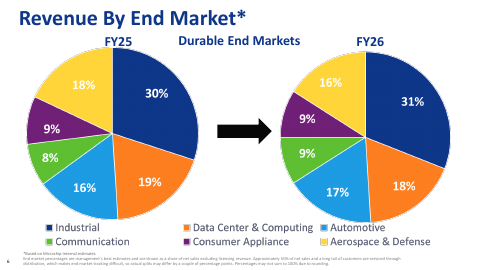
Showing the first 6 of 17 pages.
From Microchip Technology investor relations
SEC filing
up 42.2% from a year ago and up 9.2% sequentially
up from $13.9 million in the prior year's second fiscal quarter
up from $0.03 a year ago
up from $0.35 a year ago
up from 56.7% a year ago
up from 55.9% a year ago
up from $277.2 million a year ago
up from 24.3% a year ago
| Segment or metric | Value | Change |
|---|---|---|
| Industrial (share of net sales excl. licensing) | 34.6% | net sales up 50.3% year over year |
| Data center (share of net sales excl. licensing) | 16.7% | net sales up 55.7% year over year |
| Aerospace and defense (share of net sales excl. licensing) | 16.1% | net sales up 41% year over year |
| Automotive (share of net sales excl. licensing) | 14.2% | net sales up 19.3% year over year |
| Communication (share of net sales excl. licensing) | 8.2% | net sales up 43.5% year over year |
| Data center business unit net sales | over $250 million | |
| PCIe Gen6 switch and retimer design wins | 24 | up from 12 at the end of the June quarter |
Copied from the press release ↗ and other documents in the SEC filing ↗. A figure is published only if its sentence is in those documents.
| From the filing | Q2 FY2027 | vs year ago | vs last quarter |
|---|---|---|---|
| Revenue | $1.6B | +42.2% | +9.2% |
| Operating income | $464.5M | +422.5% | +37.9% |
| Net income | $401.4M | +862.6% | +74.7% |
| Diluted EPS | $0.68 | +2166.7% | +83.8% |
| Free cash flow | $396.1M | +667.6% | −20.4% |
| Gross margin | 65.9% | +10.0 pts | +2.7 pts |
| Operating margin | 28.6% | +20.8 pts | +5.9 pts |
Calculated by code from XBRL, not by the model.
| Metric | Outlook given with Q1 FY2027 | Reported | Result |
|---|---|---|---|
| Revenue | $1.589 to $1.618 billion | $1.6B | above the range |
| EPS (non-GAAP) | $0.91 to $0.95 | $0.97 | above the range |
Compared with the company's own guidance, not analyst estimates, and only where the outlook and the reported figure are the same measure on the same basis. Ranges are worked out by code from the company's wording. How this works.
| Metric | Period | Outlook |
|---|---|---|
| Net sales | third quarter of fiscal 2027 | $1.573 to $1.638 billion |
| Non-GAAP gross margin | third quarter of fiscal 2027 | 64% and 65% |
| Non-GAAP operating expenses (% of sales) | third quarter of fiscal 2027 | 26.5% to 27.0% |
| Non-GAAP operating margin | third quarter of fiscal 2027 | 37.0% to 38.5% |
| Non-GAAP diluted EPS | third quarter of fiscal 2027 | $0.87 to $0.95 |
| GAAP diluted EPS | third quarter of fiscal 2027 | $0.47 to $0.50 |
| Capital expenditures | quarter ending December 31, 2026 | about $35 million |
| Capital expenditures | fiscal 2027 | approximately $100 million |
| Non-GAAP cash tax rate | fiscal year 2027 | 6.5 % |
Microchip's Gen6 PCIe switch and retimer wins rose from 12 at the end of June to 24, and management expects almost all of them in production by the start of 2028. The company lost the Gen5 cycle, so it is regaining share in data center interconnect.
Management cancelled its two in-house microprocessor AI products and merged the microprocessor unit with Hailo, saying Hailo accelerates the roadmap by five years. Hailo is not yet profitable, but management cites a multi-hundred million dollar funnel.
Lead times now range from six to 32 weeks as AI customers displace Microchip at outside assembly and test houses. Orders inside the lead time go unsupported, and fixes such as qualifying new suppliers take months.
Management says broad customer groups still show no desire to build inventory and are slow to place longer-dated orders. It is asking customers for more backlog to match the new lead times.
The data center solutions unit moved out of the networking and connectivity pillar to report to Steve Sanghi. Data center is 16.7% of sales excluding licensing, and management argues a data center slowdown would hit Microchip less than pure-play peers.
Fourth quarter worked out from the annual figure.
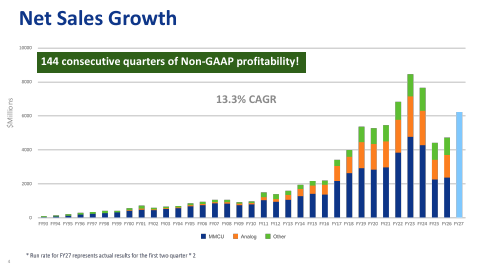
| Q3 FY25 | $1.0B |
| Q4 FY25 | $970.5M * |
| Q1 FY26 | $1.1B |
| Q2 FY26 | $1.1B |
| Q3 FY26 | $1.2B |
| Q4 FY26 | $1.3B * |
| Q1 FY27 | $1.5B |
| Q2 FY27 | $1.6B |
| Q3 FY25 | -$0.10 |
| Q1 FY26 | -$0.09 |
| Q2 FY26 | $0.03 |
| Q3 FY26 | $0.06 |
| Q1 FY27 | $0.37 |
| Q2 FY27 | $0.68 |
Fourth-quarter EPS appears once the press release is read; filings report it only for the full year.
| Q3 FY25 | 3.0% |
| Q4 FY25 | -10.3% |
| Q1 FY26 | 3.0% |
| Q2 FY26 | 7.8% |
| Q3 FY26 | 12.8% |
| Q4 FY26 | 16.6% |
| Q1 FY27 | 22.7% |
| Q2 FY27 | 28.6% |
| Q3 FY25 | $253.4M |
| Q4 FY25 | $191.7M |
| Q1 FY26 | $257.7M |
| Q2 FY26 | $51.6M |
| Q3 FY26 | $318.9M |
| Q4 FY26 | $242.8M |
| Q1 FY27 | $497.6M |
| Q2 FY27 | $396.1M |
Operating cash flow minus capital expenditure, from cash flow statements.
Each quote matches the transcript word for word.
“In power, our digital power controllers are winning across AI data center power applications from server power supplies to battery backup units.”
Shows data center demand reaching beyond the new PCIe switches into power products.
“Lead times for the majority of our standard products historically have been four to eight weeks. But now, with our dye inventory substantially reduced and foundry and OSEC capacity constraints, we are seeing lead times broadly stretch out on many of our products.”
Describes the shift from inventory digestion to supply shortages across the portfolio.
“Where the crowding out is is not in demand. The crowding out is in capacity.”
Frames how AI buildouts affect Microchip's non-data-center business through supply, not demand.
Lengthening lead times push high-margin orders into next quarter, and the March backlog is much better than December's was at this point. — Steve Sanghi
Shipments began last quarter and rise each quarter, with almost all 24 designs expected in production by the start of 2028. — Steve Sanghi, Eric Bjornholt
Bookings were strong through September and October, backlog kept growing, and excluding the $53 million of one-time items December is up about 2.3% sequentially. — Eric Bjornholt, Steve Sanghi
Capacity allocation rises each quarter but demand exceeds it, so orders slip into later quarters and more capacity arrives by the June quarter. — Steve Sanghi
Industrial is broad and recovering with new design wins in many areas, and Microchip is early in data center with Gen6 regaining share. — Steve Sanghi
No, the large reduction seen last quarter will not repeat this quarter, with more improvement expected in later quarters. — Eric Bjornholt, Steve Sanghi
Pricing was expected to offset the one-time items, but high-margin products cannot ship, and supplier price increases from January mean gross margin is not projected back to 66.5%. — Steve Sanghi
Non-data-center demand looks fine, and a data center slowdown would affect Microchip little and could free up capacity. — Steve Sanghi
Defense grew 41% and orders are arriving, but scheduled to when primes add capacity, so growth will be steady rather than a hockey stick. — Steve Sanghi
Microchip plans to absorb them for now rather than raise prices again so soon after its mid-August increase. — Steve Sanghi
The front end is ramping but back-end assembly will be less utilized, and outside assembly capacity constraints also affect internally made wafers. — Eric Bjornholt, Steve Sanghi
No hardware acceleration; Hailo accelerates the roadmap by five years, so the internal microprocessor products were canceled and the units merged. — Steve Sanghi
Broadly no; customers are slow to place orders at the new lead times and only react once their lines are in trouble. — Steve Sanghi
Last quarter's assumption of holding gross margin near 66% was too aggressive, so management is resetting to the 65% long-term target. — Steve Sanghi
There is no single trigger; the supply picture is complex across roughly 40 factories, with some nodes constrained and others not. — Steve Sanghi
Auto grew 19.3% year over year with many design wins that reach production in about three years, but management does not expect more from it. — Steve Sanghi
Yes, operating expenses rise, Vorago is small and profitable, and Hailo is investing heavily in R&D without yet making money. — Eric Bjornholt, Steve Sanghi
No; data center is 16.7% of sales and broad-based exposure is about 8%, so Microchip should outperform data-center-only companies. — Steve Sanghi
Management was careful with its small increase, lost no customers, and does not want to push further because margins are comfortable. — Steve Sanghi
The board wants leverage lower first, so the dividend stays put and the topic returns as fiscal 2028 begins. — Eric Bjornholt
Non-data-center demand looks healthy with a good March backlog, and data center upside is largely not in Microchip's numbers. — Steve Sanghi
Microchip is considering bringing some assembly inside but is not planning a new 300 millimeter fab because it views the problem as short term. — Steve Sanghi, Eric Bjornholt
It varies: a new assembly supplier enters production mid next quarter, other programs come online over the next quarters, and more capacity arrives from June. — Steve Sanghi
Yes, though volumes could be slightly lower, and the impact on Microchip would be a fraction of that on data-center-only companies. — Steve Sanghi
Its PCIe Gen6 switch and retimer design wins in data centers grew to 24 from 12 at the end of June, and management expects them to start ramping next year.
Hailo adds accelerated edge AI processors and replaced Microchip's own planned edge AI processor roadmap, which management says it advances by five years. Vorago adds radiation-hardened microcontrollers and microprocessors for aerospace and defense.
Supply, not demand. Lead times now run six to 32 weeks, AI customers have crowded out outside assembly and test capacity, and some high-margin orders cannot ship until capacity is added.
It raised prices mid-quarter without losing customers and plans to absorb a new round of supplier increases for now rather than raise prices again so soon. It still targets 65% gross margin over the long term.
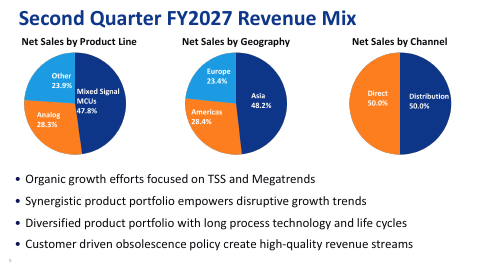
Data center is 16.7% of sales excluding licensing, and about half of that comes from broad-based products. Management says a slowdown would affect it far less than pure-play peers and could free up supplier capacity.
Call recording on YouTube ↗. Official replay ↗. Timestamps jump to the moment.
As a reminder, this conference is being recorded. I will now turn the conference over to Eric Bjornholt, Senior Vice President and CFO. Thank you, Eric. You may begin.
All right. Thank you, and good afternoon, everyone. During the course of this conference call, we will be making projections and other forward-looking statements regarding future events or the future financial performance of the company. We wish to caution you that such statements are predictions and that actual events or results may differ materially.
We refer you to our press releases of today, as well as our recent filings with the SEC that identify important risk factors that may impact Microchips business and results of operations. In attendance with me today are Steve Sanghi, Microchips President and CEO, and Sajid Daudi, Microchips Head of Investor Relations. I will comment on our second quarter fiscal year 2027 financial performance, and then Steve will provide commentary on our results and discuss the current business environment as well as our guidance.
We will then be available to respond to specific investor and analyst questions. We are including information in our press release and on this conference call on various GAAP and non-GAAP measures. We have posted a full GAAP to non-GAAP reconciliation on the investor relations page of our website at www .microchip .com and included reconciliation information in our earnings press release, which we believe you will find useful when comparing our GAAP and non-GAAP results. We have also posted a summary of our outstanding debt and leverage metrics on our website.
I will now go through some of the operating results, including net sales, gross margin, and operating expenses. Other than net sales, I will be referring to these results on a non-GAAP basis, which is based on expenses prior to the effect of our acquisition activities, share-based compensation, and certain other adjustments as described in our earnings press release and in the reconciliations on our website. Our non-GAAP financial results met or exceeded the guidance we provided on August 6, 2026.
Net sales in the September quarter were $1.622 billion, which was up 9.2 % sequentially and up 42.2 % from the September 2025 quarter. We had several infrequent items that positively impacted net sales by about $53 million in the September quarter that we do not expect to repeat in the December quarter. These items were all at 100 % gross margin and included approximately $21 million impact of our pricing change on inventory and the distribution channel, $22 million in licensing revenue from patent licensing transactions in excess of what we expect in the December quarter, and a $10 million benefit from a long-term contract with a customer.
We have posted a summary of our net sales by product line and geography on our website for your reference. On a non-GAAP basis, gross margins were 66.5%, including capacity underutilization charges of $26.6 million. Non-GAAP gross margins were positively impacted by higher licensing revenue in the quarter, as well as the impact of our pricing change that was implemented in the September quarter. Non-GAAP operating expenses were at 27 % of sales and operating income was 39.5 % of sales.
Non-GAAP net income was $559.2 million and non-GAAP earnings per diluted share were $0.97, which was $0.04 above the midpoint of our guidance. On a GAAP basis in the September quarter, gross margins were 65.9%. Total operating expenses were $603.5 million and included acquisition and tangible amortization of $90.2 million, special charges of $7.9 million, which was primarily driven by our activities associated with our closure of Fab 2 and acquisition-related expenses.
Share-based compensation of $62.2 million and $5.3 million of other expenses. The GAAP net income attributable to common shareholders was $373.6 million, or $0.68 per share, and included a tax benefit of $0.13 per share related to a valuation allowance release on tax attributes. Our non-GAAP cash tax rate was 5.7 % in the September quarter, and we expect to have a tax rate of about 6.5 % for fiscal year 2027.
Our tax rate is down from our previous forecast for a variety of reasons, including the impacts of a reduction in inventory reserves and a higher percentage of our taxable income being in jurisdictions with lower tax rates. Our inventory balance at September 30, 2026 was $1.117 billion. We had 184 days of inventory at the end of the September quarter, which was up nine days from the end of the June quarter. Inventory increased in the quarter as we received some high dollar value wafers from our foundry partners in anticipation of future growth and built some finished goods inventory.
Included in our September quarter ending inventory was 12 days of long life cycle, high margin products whose manufacturing capacity has been end of life by our supply chain partners. Inventory at our distributors in the September quarter was at 25 days, which was flat compared to the June quarter and at the lower end of what we have experienced historically. Our cash flow from operating activities was $419.2 million in the September quarter. Our adjusted free cash flow was $377.1 million in the September quarter.
As of September 30th, our consolidated cash and total investment position was $457 million. Our net debt decreased by $31.7 million during the September quarter, and this is after funding the acquisition of Hailo. Our adjusted EBITDA in the September quarter was $705.4 1,000,043.5 % of net sales. Our trailing 12-month adjusted EBITDA was $2.162 billion. Our net debt to adjusted EBITDA was $2.36 at September 30, 2026. We expect our net debt to adjusted EBITDA to continue to reduce as we progress through fiscal year 2027.
Capital expenditures were $23.1 million in September quarter, and we expect capital expenditures for fiscal year 2027 to be about $100 million. Depreciation expense in the September quarter was $36 million. I will now turn it over to Steve, who will provide some additional commentary on our September quarter results and our guidance for the December quarter. Steve?
Thank you, Eric, and good afternoon, everyone. I will reflect a bit on our performance in the September quarter. The September quarter was an excellent quarter for microchip with broad-based growth as we beat the high end of our guidance in net sales and our non-GAAP financial metrics like gross margin percentage, operating expense percentage, operating profit percentage, and earnings per share all met
or beat our guidance. Our industrial and data center end markets were the two biggest drivers of our growth. Across our end markets, new design wins are increasingly supporting that growth. Our end market split for the September quarter as a percentage of net sales, excluding licensing revenue, was industrial at 34.6%, data center at 16.7%, aerospace and defense at 16.1%, Automotive at 14.2%, Communication at 8.2%, Consumer Appliances at 7.3%, and Compute at 2.9%.
From the September quarter 2025 to the September quarter 2026, net sales from industrial grew 50.3%, data center grew 55.7%, aerospace and defense grew 41%, automotive grew 19.3%, communication grew 43.5%, consumer appliances grew 26.7%, and compute declined 1.6%. Net sales from our data center business unit was over $250 million in the September quarter and is well on its way to be $1 billion in calendar year 2026. For calendar 2026, about half of our data center business comes from our standard products and about half comes from a data center solutions business unit.
On the standard product side, design wins are building across many products. In power, our digital power controllers are winning across AI data center power applications from server power supplies to battery backup units. In system management, we offer the parts that sense, control, and connect a server or rack, and our gigabit Ethernet switches and USB hubs are gaining design win momentum in management networks. With respect to our Gen 6 PCIe switch and retimer products, we had 19 design wins at the end of September quarter, up from 12 design wins at the end of June quarter.
As of today, we now have 24 total design wins. These incremental wins will begin to ramp net sales next year and help position us across a growing range of next generation data center platforms. As these deployments scale, so does our opportunity across the broader data center portfolio. including timing, security, and networking. I would like to give one more organizational update. As you know, after my return to Microchip as CEO two years ago, I reorganized the company into five pillars.
These pillars were microcontrollers, analog and power, networking and connectivity, high-performance compute, and AI on the edge. There's a senior vice president heading up each of these pillars. Our data center solutions business unit reports into the networking and connectivity pillars. Because of a focus on our data center solutions business unit called the DCS, I have decided to pull up the DCS business unit to report directly to me at the executive staff level. The head of that business unit is Brian McKesson, who has spoken at these earnings calls before and will now report directly to me.
Our design wins are not limited to data centers. In aerospace and defense, we're winning designs across regions, products, and applications, from satellite communications and laser terminals to unmanned systems by adapting our commercial technologies for space and defense. In one recent case, a defense technology company selected our radiation-tolerant secure FPGA over its incumbent supplier for two space avionics programs. As defense production rates ramp, so does our opportunity. Security requirements are also growing across our markets, from data centers to defense to the edge.
At the edge, a leading enterprise network provider recently selected our security solution to protect its wireless networks where quantum-resistant encryption became a requirement. Together, data center, aerospace and defense, industrial, robotics, automotive, and the intelligent edge are the circular trends we see driving growth over the long term. I will now talk about our business environment and the guidance going forward. Our bookings were very strong in the September quarter and our book to bill ratio remained well above one.
We started the December quarter with a higher backlog compared to when we entered the September quarter. The September quarter saw a pivot in the business environment with customers completing their inventory digestion to shortages appearing in certain areas because of lengthening lead times at foundries, OSEC supplies, and in our own fabs. Lead times for the majority of our standard products historically have been four to eight weeks. But now, with our dye inventory substantially reduced and foundry and OSEC capacity constraints, we are seeing lead times broadly stretch out on many of our products.
Our customer requests for expedited shipments have increased significantly from a few quarters ago. We are receiving many orders for requests inside the lead time and they are going unsupported in the quarter. We are advising our customers to give us longer term backlog to help better match our new lead times which vary a lot across our product lines. Our new lead times are anywhere from six weeks to 32 weeks. Eric just explained three infrequent items in the last quarter.
First, it was an unusually strong quarter in our licensing group with a couple of large deals closing in the September quarter. Our licensing business is usually lumpy. The second item was the one-time effect of our recent price increases, which raised the value of our distribution inventory. The third was a revenue recognition from a long-term customer contract. Those infrequent items are not present in the December quarter. Our December quarter is also our weakest quarter seasonally because there are a lot of holidays in the quarter.
Therefore, the guidance for December quarter should be viewed in that context. Our December quarter also includes the impact of two small acquisitions that we completed, Hailo in the AI on the edge space and Vorago in the A &D space. We expect that Hailo will add about $4 million to our sales in the December quarter and Vorago will add about $6 million to our net sales in the December quarter. Taking all of these factors into account, we expect our net sales in the December quarter to be between down 3 % and up 1 % with the midpoint of minus 1%.
At the midpoint, this would be up 35.4 % from the year ago quarter. December quarter is usually seasonally down 3 to 5%. This seasonal effect combined with the infrequent items we experience in the September quarter puts our December quarter guidance about 5 % to 7 % above normal seasonality. We expect our non-GAAP gross margin to be between 64 % to 65 % of net sales. This is because of several reasons. First, the three infrequent items in the September quarter were all at 100 % gross margin.
Secondly, our net sales guidance is lower than what we would have expected a quarter ago. Currently, we have substantial unsupported backlog on high-margin products that our supply chain cannot fulfill. And finally, we're running lower level of utilization internally than what we were planning a quarter ago. All these factors are impacting our gross margin guidance. We expect our non-GAAP operating expenses to be between 26.5 % and 27 % of sales. We expect our non-GAAP operating profit to be between 37 % and 38.5 % of sales.
We expect our non-GAAP diluted earnings per share to be between 87 cents and 95 cents per share. At the midpoint, non-GAAP earnings per share would be up 107 % over a year-ago quarter. Regarding our long-term model, we maintain our long-term model on a non-GAAP basis to be 65 % gross margin, 25 % operating expense, and 40 % operating profit. With that, operator, will you please call for questions?
We will now be conducting a question and answer session.
If you would like to ask a question, please press star 1 on your telephone keypad. A confirmation tone will indicate your line is in the question queue. You may press star 2 if you would like to remove your question from the queue. For participants using speaker equipment, it may be necessary to pick up your handset before pressing the star keys. So that we may address questions from as many participants as possible, we ask that you limit yourself to one question and one follow-up.
If you have additional questions, you may re-queue, and time permitting, those questions will be addressed. One moment, please, while we poll for questions. Our first question comes from the line of Timothy Arcuri with UBS. Please proceed.
Thanks a lot. Steve, I was wondering if you could help unpack a lot of these puts and takes. It seems like you said that December revenue is a little lower than what you would have thought three months ago and fab utilization is also a little lower, yet bookings are stronger.
Is this due to constraints that are downstream from you and maybe does that give you more visibility into March? so you could maybe give us a sense. Maybe normal seasonal, I think, in March is up like three. So it sounds like maybe you feel a little bit better about March as a result of all this. If you can just unpack that for us, that would be great. Thanks.
Yeah, so I think if you look at the last quarter, it was kind of noisy.
The three items that we talked about were in our guidance. The licensing deals were in our guidance. The recognition of $10 million of customer contract was in a guidance, and so was the price increase. So the upside last quarter came from product sales, so we did very well. Now, when you look at the current quarter, you know, lead times have stretched out, and a lot of the, you know, high-margin bookings we received on a lot of advanced products in pretty much every business segment cannot be fulfilled in this quarter.
So some of them are scheduled for next quarter. So as a result, I think we're guiding the December quarter to be a tad lower than we would have thought about a quarter ago. The backlog for March quarter today is much better than December quarter was at the same point in time. So, you know, currently we're optimistic. We're not giving any guidance for the March quarter. But I think, you know, I think some of the constraints we're talking about are now scheduled into March quarter.
So we are hopeful that March quarter will be a stronger quarter.
Thanks a lot. And then just as a quick follow-up. So on the PCIe Gen 6 wins, I think, Steve, you said 14 design wins coming out of June, and it's now up to 24. Sounds like you're building some high-value inventory for that stuff, too. So when did that start to become really big revenue? And if you can kind of size what the income model could be from those wins, if possible, that'd be great.
So we were unable to dollarize the wins. You know, the part went into production last quarter and we have small amount of shipments in the current quarter and they will increase every quarter from here on. Actually, there is sizable shipment this quarter and they start increasing then from the next quarter on. The design wins are very strong and they're turning on at various times next year. So by the start of the 2028, you can expect almost all 24 designs to be in production.
And we're winning essentially a design a week almost.
Yeah, just one clarification to the way Tim asked that question is he said PCIE Gen 6 and the 24 design wins is both PCIE and the retimers. So just wanted to clarify that.
That is correct. I think we are basically keeping them together. They are very much in the same application. Many times, Retimer goes with the PCIe. We don't always win the both. In some cases, customer doesn't need the Retimer.
They only need the PCIe switch. But they are, you know, very much products are in sync. In the past, we have broken out how many on PCIe Gen 6 and how many on Retimer. and I don't have that today, but we have no problem in breaking that out.
Okay, Steve. Thank you very much.
Our next question comes from the line of Matthew Crisco with Cantor Fitzgerald. Please proceed.
Hey, guys. Thanks for taking the question. I guess to start, if you could maybe discuss order linearity in the quarter and maybe what you've seen through October and November thus far and any color you can offer on those booking trends across end markets would be appreciated.
Thanks.
So I think bookings were quite strong all the way through September, so nothing really to point out there. And then October was another good month of bookings where overall backlog continued to grow. November's just been a few days, but nothing odd to report.
Yeah, so bookings have continued well. The backlog has continued to build. The best way to look at our December quarter is to take the $53 million out of the September quarter, which were the three infrequent items.
And if you do that, then our December quarter is up about 2.3 % from our September quarter versus normal seasonality for December quarter is down 3 % to 5%. So therefore, I think we got no issues in how the quarter is, how the product chip backlog is, how the bookings are, all that continues well. But two licensing deals, a unique customer program that added $10 million of revenue recognition last quarter, and this strange effect of when you ship the inventory to distributor, you assume there's a certain amount of distaste price protection on that, and then the rest of it you recognize as a revenue.
When you increase the price, then that distaste price protection becomes less, and you have to capture that as a one-time revenue in the quarter. and that was about $21 million. So, you know, those items made it very noisy, but if you peel through all that and we're giving you complete visibility, you know, if you take those out, then the quarter is up 2.3 million, 2.3%. Now in that 2.3%, there's $10 million from two acquisitions, 4 million from Hailo and 6 million from Vorago.
We broke that out too. So take that out too if you like, and the 2.3 will go down to maybe 1.5 or something. Versus down 4 % at the midpoint. So there's no problem in how the business is doing, and we remain optimistic for the next quarter. Backlog is good. Bookings are coming in. That's how you should view the quarter in that context.
Very helpful. Thank you. And then maybe you can offer some more color on what you're seeing in terms of those constraints today.
How have those foundry OSAT constraints changed over the last 90 days? And I believe you added internal constraints this quarter. So how are you responding to these constraints overall, and how do you expect that situation to evolve as we look into 2027?
So, you know, incrementally we have additional capacity allocation, you know, every quarter, you know, which will continue to provide growth, but we could use more than that. So on various different nodes, we have more capacity the following quarter, therefore some of the orders from this quarter are scheduled into next quarter.
And I believe some of the orders from the next quarter will move into the June quarter where we have more capacity. We're not unique. I think the entire industry is seeing it. Demand is stronger than the capacity available. With whatever is happening in the market right now with data center, AI infrastructure, concerns whether they will all be built or not built, I think there's a silver lining in it. And the whole thing was just too much hot air.
And if some air comes out and capacity becomes available at OSATs and foundries for broad-based business, I think there is still silver lining in it.
Our next question comes from the line of Joe Quattrochi with Wells Fargo. Please proceed.
Yeah, thanks for taking the question. You saw a nice acceleration in the industrial demand. I was wondering if you could just talk about, you know, what you're seeing there and maybe just on that last line you said, you know, how do we think about your exposure to just everything around the data center infrastructure build, like maybe outside of the data hall?
So, I think, you know, when it comes to industrial, industrial is the broadest, market segment there is. I mean, you know, what is industrial? It's not a narrow set of things. Industrial is factories, cities, hotels, lighting, robotics, medical. Industrial is very, very broad, and, you know, we're seeing opportunities in industrial. Some of it got driven by industrial was sort of the last one to recover, I think, two or three quarters ago. So, you know, it's seeing substantial recovery from that point.
And a lot of new design wins in every single area, robotics, medical, process control, factories, farming, equipment, appliances, you know, everything is growing. So it's very, very difficult to kind of explain industrial beyond that because it's so broad. The second point of your question is on the data center. So, you know, we are early in the data center penetration, you know, because we didn't have a lot of Gen 5 switch revenue, and you have known from past that we were very late to market on it, and therefore we lost the Gen 5 business.
So our, you know, with Gen 6, we are regaining a lot of the market share, and a lot of it is not in our revenue. So for us, it's all upside, where if it slows down, it could be downside for the people who have a lot of that business. In terms of other half of our data center exposure, which is through microcontroller, analog, power, switches, security, USB, Ethernet, these are very broad-based products where data center is really a, you know, small portion of the overall shipments to all the end markets.
And if certain data centers won't get built, you know, a lot of that upside is not in a forecast.
Thanks. And as a follow-up, as we're thinking about just kind of the gross margin puts and takes into the December quarter, how should we think about this underutilization charges as a nice improvement this quarter. Do you keep thinking that's somewhat linear as we move forward?
So, you know, it will not be linear. You know, this quarter we are not anticipating any sort of big improvement.
We actually built finished goods last quarter and don't really want to do this again this quarter. So, we're slowing down some of the assembly and test operations. We're We're still doing the ramp in our wafer fabs where Steve had mentioned in his prepared remarks that die inventory is getting low in certain cases. So it's a balance, but you will not see the large reduction in utilization or underutilization charges this quarter that you saw last quarter. But that's still upside in front of us in future quarters.
December quarter historically is kind of weak. So, you know, we took the ramp cautiously, but it will accelerate again next quarter because then we go into good March quarter followed by two strong September and June and September quarters before we get another week December quarter next year. So, utilization should start to improve, but not linearly.
Our next question comes from the line of Chris Casso with Wolf Research. Please proceed.
Yes, thanks. Good evening. The question is on pricing and the impact on the December quarter from some of the pricing actions that you took previously.
What was the magnitude of that in December quarter? and I seem to recall from last quarter, that was one of the factors you had expected to be an offset because again, as you said, you knew some of those three items that would not recur in the December quarter. I seem to recall that pricing was gonna be one of the offsets for the December quarter.
So you are correct. We expected that to be offset. And the remaining pricing is being effective this quarter because pricing change was done in the middle of the last quarter.
You know, however, because of what we described before, some of the fairly large dollar item, you know, products with very high margin, supply chain cannot fulfill this quarter, which is kind of offsetting the improvement we would have seen.
Right. Okay. So, and I guess then going forward, would it be right to assume that as you, as supply improves, as you get the ability to supply some of these higher margin products, perhaps some of the products where the price has gone up, but you can't ship it right now, that you would see some of that benefit as you go into calendar 27.
Is that the right way to think about it?
Are you talking about benefit in revenue or benefit in something else?
Well, I guess benefit in revenue, you know, from obviously being able to ship the product and the higher price, and then I guess more importantly from the margin side, because I think I understand what you're saying is that you didn't see as much of the pricing benefit that you had expected in the December quarter because you couldn't ship those products.
So therefore, as you finally were able to ship those products, do you get that margin benefit?
We suddenly get the revenue benefit and we get some of the margin benefit, but the pricing in the industry from our suppliers has continued to go up. There's another round of price increase across the industry, you know, starting basically in January from, you know, most major foundries and OSATs. So some of that will, you know, because some of that we countered in our price increase when we did the price increase.
So that's why you're seeing a very good gross margin for the September quarter and pretty good gross margin in December quarter. If you're expecting it to go back to 66 and a half, we're currently not projecting that. Our long-term target is 65, and we think we're going to have to fight that price increase with the suppliers and figure out how we deal with it, whether there is a check on our gross margin or we pass it on to the customers further.
We haven't figured all that out yet.
Okay. Thank you.
Our next question comes from the line of Vivek Aria with Bank of America Securities. Please proceed.
Thanks for taking my questions. Steve, I wanted to start with more of a macro question based on your industry experience. You know, when you look at all these, you know, the volatility in semiconductor stocks, do you think that signals to you there are, you know, earnings cuts coming? Are we at peak demand?
Just kind of what is your crystal ball telling you in terms of where we are in the cycle? And, you know, do you think all these worries are justified based on what you are seeing on the ground?
Well, Vivek, I think there is data center and non-data center. There is nothing to worry about in the non-data center. You know, industrial is doing fine. You know, automotive is continuing to recover. its unit count is not growing as much, low single digit, but the content is growing significantly and we're winning across new architectures across the board and we're doing very well.
Aerospace and defense is doing well, industrial is doing well, automotive is doing well, communication is doing well. So the issues in data center, it was, you know, all that just, I've been kind of seeing it, it could not be true. It's just the demand was, you know, explosive. You can't just have that large of a percentage of economies at a rate everybody expected it to grow. So I think some of that is coming in check, whether it comes in check that the, you know, The real estate of data centers can't be built or the power can't be supplied or the new Congress wouldn't let it happen or, you know, circular financing finally, you can't do it anymore.
It's not cost effective or people can't monetize. Whatever the reason is or a combination of reason is, you know, the second derivative on data center has to come down substantially. And I think you see market voting on it. To me, it's not new. I think it was predictable.
So what do you think that means for Microchip? Because I think in your commentary, you used the phrase that you thought September was a pivot, right? And you're seeing lead times get stretched out.
Do you think a lot of that demand is coming because there's a crowding out from the data center? Or do you think there's a kind of real kind of demand upturn? So more specifically, if you look at the next several quarters of microchip, do you think there is still the possibility of above senior growth?
Yeah, I think yes. Like I said, there is data center and non-data center. The non-data center demand is normal. You know, it's doing well.
Data center demand has been explosive. If that comes down, its effect on us would be very small because we're very much in the early stage. We're not doing billions of dollars of revenue in the data center. And all of the rest of the markets are growing and data center is 16.7 % of our business, not 100 % like many of the other companies. Where the crowding out is is not in demand. The crowding out is in capacity.
Data center has been crowding out capacity for trailing edge nodes, you know, because of power requirements and analog requirements and all these other things, microcontrollers and others. So data center has been crowding out capacity at the OSAT and in many cases we have lost capacity where some of it we had to bring it inside, some of it we had to move it elsewhere and it takes time to re-qualify and therefore the backlog could not be served and will be served some in the next quarter, some in the quarter after.
So I think a deceleration on the data center will probably have a positive effect on our business because, you know, some of that capacity frees up.
Our next question comes from the line of Vijay Rakes with Mizuho Security. Please proceed.
Hi. This is just a quick question on the aerospace defense side. It's kind of grown in line with Microsoft's overall growth. When we actually see aerospace defense orders start to come back, like are these long lead orders where you have good visibility?
And a quick follow-up.
Okay. Well, so, you know, aerospace and defense grew 41%, you know, September over September. So we think it's, you know, growing very well. The demand for aerospace and defense is very strong at the primes, but primes have to build up capacity, some starting from real estate. Some of them are being asked to increase the missile production by 5X or 4X. Well, they don't have the floor space to ramp the production to 4X.
So they're adding capacity, buildings and machinery and all that. And we're starting to get the orders, but they're scheduled out when they need it. So I think it's, you know, aerospace and defense is not a data-centric kind of business, you know, 10 million today and 200 million tomorrow. It will grow consistently, but it's not a hockey stick because, you know, the industrial complex cannot grow at that rate.
Got it. And then on the price increases, you mentioned foundry or set price increases.
how much flexibility do you have to kind of pass through? What are you anticipating in terms of the impact of those as you look at 27 in terms of margin or any headwinds there? Thanks.
Well, we consider our gross margins very healthy. I mean, our last quarter, because of some infrequent items, was higher than target, otherwise it's very close to target, you know, within 100 basis points of that. And, you know, we don't want to take a second price increase to our customers so quickly when we just did a price increase in the middle of August.
So just like we did that last time, we absorbed it for a while, and if the cost kept going up then we passed the price increase. I mean, we're kind of doing similar. Right now, we're planning to not do a price increase and absorb it. And at these kind of gross margins, we don't feel that the gross margins are low.
Got it. Thanks. Our next question comes from the line of Harlan Shirt with J .P. Morgan.
Please proceed.
Yeah, good afternoon. Thanks for taking my question. Book the bill is strongly above one. your backlog even now continues to grow and i assume that this strong demand profile is across not just advanced boundary based products but across your internally manufactured products as well right your overall lead times are extending so your front end utilizations i would have expected to move higher this quarter especially with your commentary on low die bank inventories as well so why wouldn't front end utilization charges continue to decrease this quarter i I understand back-end utilizations might be stepping down a bit, but why aren't front-end utilizations continuing to increase here in December and therefore lower underutilization charges?
So, Harlan, the front end is reducing in the current quarter, but the back end is not going to be as fully utilized as it was the quarter before. So, it's the combination of those things, and we don't expect a material change in the overall underutilization charge in the court.
I think one other point is that there's a perception that on in-house built fab products, there should be no constraint and there should be no lead time issue.
The problem is the inside produced wafers also go through the OSAT. Some of it goes to an internal factory, but some of the packages we don't do, it goes to OSAT. So it sees the same constraints that our foundry wafers see. And in a lot of cases, some of the capacity at our major OSAT suppliers has been displaced. AI companies, you know which ones, came in and took over the whole factory and they pushed everybody out.
We brought some in, we brought it to other O-SAT manufacturers, but that is the crowding lot of AI. It's affecting processing of inside wafers as well as outside wafers in assembly and tests. And we are rapidly improving that situation. You know, ordinarily we do an inside versus outside analysis when there's a payback to do inside. You know, not everything we can do cheaper inside. Sometimes we cannot keep the tool fully busy because, you know, we cannot fully utilize the tool, so therefore we keep it outside.
But when we get displaced outside, we can't produce it. You know, a very good margin product, then cost doesn't matter. Then we want to bring it in and produce it. So we're making those moves, but those moves take six months. And some of this displacement only happened, you know, just a couple of months ago. So those are the things we are struggling with, and that's why I said that, you know, some deceleration of the AI demand actually would be quite positive early on.
Got it. Okay, I appreciate that. And then as my follow-up, Steve, we are seeing a lot more adoption overall of integration of machine learning and AI capabilities into all of these sort of embedded applications across industrial, automotive, even consumer, right? And for many of these applications, you don't need a standalone MPU like your acquired product family from Hailo, but you could leverage embedded MPU accelerators, right? Can you just remind us, you're a 32-bit MCU product line.
Do you have product families with embedded MPU? And are you seeing accelerated adoption of MPU-based MCUs for these types of embedded like machine learning AI applications?
So our in-house microcontroller and microprocessor product lines did not have AI acceleration in them. No hardware acceleration. We had some software acceleration. We did have some hardware acceleration available on our SPGAs and our data center solutions business unit, but not on our microcontroller business units and the microprocessor business unit.
We did not. When we bought Hailo in our microprocessor business unit, we were developing products. The first of those products was going to be available in about two and a half, three years. And the second of them was going to be available in about four, four and a half years because they were serial in nature. The product line that Hailo brought to us accelerates the roadmap by five years. So therefore, we have canceled the two products that we were developing in the MPU business unit, because they have been replaced by Hailo.
In fact, I have merged the Hailo and MPU business unit together, and we are advancing the Hailo roadmap, and we have canceled our MPU roadmap in the microprocessor business unit. That's how important Hailo has been for us.
I see. Okay, that makes a lot of sense. Thank you, Steve.
Our next question comes from the line of Jim Snyder with Goldman Sachs. Please proceed.
Good afternoon. Thanks for taking my question. I was wondering if you could maybe broadly characterize the customer willingness to build, the OEM customer willingness to build inventory on the balance sheet at this point, given the extended lead times.
Is that something that some customers and some verticals are willing to do, or is it more broad-based than that? And maybe just give us a sense about are they even able to do that given the supply constraints you've talked about?
Amin, you know, right now in broad-based of customers, we do not see a desire by them to build inventory. We can hardly get them to place orders with our new lead time. Seems like number one, lead times are moving rapidly.
Secondly, semiconductor manufacturers are always telling their customers, I want more backlog, I want more backlog. It kind of becomes a broken record, you know, like the wolf is coming, wolf is coming. And they don't respond to it. They don't. And they don't respond to it until they get in trouble. where lead terms rapidly go out. They don't have the product. They try to expedite it. We cannot serve it. The lines are down for eight weeks, and that's when there is a fire behind them and they start to place orders.
We are not seeing that yet.
That's helpful, Culler. And then just as a follow-up, just going back to the gross margin question, And, you know, it seems like, you know, previously you talked about some of the higher margin products, what you thought would benefit you in the December quarter. You talked about the reasons why those are constrained. Just wanted to make sure that I understand is the new piece of information that those higher margin products will come back into the mix over the next couple quarters, but perhaps the input cost increases are not going to be offset on the broader base of products.
Yeah, I think our assessment last quarter that we can keep the gross margin in the 66 % range by more high margin products coming in, the rest of the price increase kicking in and completely offsetting the higher licensing revenue and a couple of other infrequent items, I think that turned out to be more aggressive than the reality has turned out. So we have backed off from that assumption. Now, we still told you always that a long-term gross margin was 65%, and there'll be times in the good times when it will go over, there will be times in the bad times when it will go under, but we didn't guide you to a higher than 65 % gross margin.
But we did say that we could maintain it in the December quarter. Now, various things have happened, you know, partially driven by some of the high margin products pushing out because of constraints. We can't quite get there. The question is then why are we not getting there in March or June because some of the further price increases from our suppliers is kicking in, whether we're able to offset that or not, we're not able to model it today.
So that's why we're basically resetting that and saying, you know, think of 65 % as a long-term gross margin and we will work very hard to get there and maintain it, but not any higher than that.
Very clear. Thank you. Thank you.
Our next question comes from the line of Blaine Curtis with Jeffries. Please proceed.
Hey, good afternoon, guys. I wanted to ask on the trigger to pull back utilization. Is there a certain level of inventory?
You don't want to grow it on an absolute basis or a certain number of days you're targeting? I'm just trying to understand that trigger. I think most people, I know the stock market's terrible lately, but expect a continued recovery. So I'm just trying to understand how you're thinking about managing that.
I think the equation is very, very complex. We build hundreds of thousands of SKUs. You know, our product including internal fabs and outside foundries come from almost 40 different factories around the world.
And it's a very complex equation. On some nodes we have plenty of capacity, on other nodes we are heavily constrained. Some of the nodes where we have enough capacity, it's the kind of product goes into where packages like VGA and others where the capacity is constrained. In some cases, we cannot get the substrates. In some other cases, we don't have the assembly capacity. In other cases, our test capacity has been confiscated by the AI crowd. So it's a very, very complex equation.
And despite that, I think we're growing. Our business is up nicely. We'll be up again next year. for solving these problems, bringing some inside, some moving it from foundry to foundry. It's noisy. I get it. I'm frustrated by it too. And with the kind of questions you guys are asking, I get it. The only thing that's going to help is AI decelerating.
And then I wanted to ask on the auto channel, I think there's some hope that maybe that could be better.
I'm kind of curious what you're seeing, any evidence of restocking in any areas of strength in auto.
So, I mean, our auto business was up 19.3 % year over year. I mean, for auto, you know, that's very good. For auto, that's excellent. Auto is never going to grow 100%, 50%, 40%. You know, the auto unit volume grows two or 3% best case. And, you know, our auto was up 19.3 percent. We're getting lots of auto design wins.
And when you get a design win, it goes to production in three years. So we're harvesting some of that was designed two or three years ago. And there's a good amount of growth coming in with future designs next year and year after. but don't expect any more out of auto. It grew 19.3%. In fact, that's more than entitlement in auto.
Our next question comes from the line of William Stein with Tourist Securities. Please proceed. Great.
Thanks for taking my questions. First quick one is, I'm wondering if there's any meaningful influence of the two acquisitions on either cost of goods or OPEX in the near term.
So there is. I mean, there's OPEX that come along with both of these acquisitions. You know, we aren't going to break out profitability for either of these small acquisitions. acquisitions, but Hailo is investing pretty significantly in their R &D efforts, and we are definitely doubling down on that.
The Vorago products are good products in aerospace and defense with high gross margins, and we're excited about the opportunity on that. But there absolutely is an impact on OpEx in the current quarter by having a full quarter of Hailo and almost a full quarter of Vorago in the numbers, and that's obviously built into our guidance.
I think we can give you a little more color. Vorago gross margin is higher than microchips, but with $6 million revenue contribution, it doesn't move the needle in the current quarter.
Hailo margins are lower than microchips, but with $4 million in revenue, that doesn't move the needle either. In the area of OPEX, Vorago OPEX is small and gross margins are very high, so Vorago is actually very profitable. So that's doing very well, but with such a small revenue, it doesn't move the needle. Hailo doesn't make money yet. They have very high R &D and small amount of revenue, and we're seeing huge opportunity. There is a multi-hundred million dollar funnel on it already in a very quick period of time.
So we will do very well in HILO over time, but short term we're having to absorb its higher op-ex.
Yeah, that's very helpful. Steve, I wanted to follow up on another question you answered earlier. You didn't quite say that, hey, we've been in an AI bubble, but effectively what one might infer from what you said about all the various challenges with data center. And when you responded about how to think about the influence on your business…
I didn't say no.
Okay. I'm sorry to hear those. No, no. Okay. That's good. I appreciate that. But in terms of how to interpret, how to think about the go-forward model, you encouraged us to think about data center versus not, and you talked about the silver lining. But I wonder if you consider or if you think your business may be influenced from a couple of other factors. For example, data center drives some industrial demand probably for your business. You know, probably it's certainly responsible for some of the price inflation we've seen.
And by the way, there's a similar dynamic in aerospace and defense if you consider a lot of what's going on now, the unwind, you know, potentially related to lower spending in aerospace defense to which you're highly exposed. So if we were in a bubble in AI data center, couldn't this be more broadly problematic for your business?
No, I don't think so. You know, data center is 16.7 % of our business, and half of that 16.7 is broad-based products, and half of that are the data center business, solutions business unit.
The data center solutions business unit is in the retooling phase, having lost the Gen five regaining market share from the Gen six. So there, there's all upside. And in the broad-based business that we have, that would be roughly 8 % of our business out of the hundreds. So I think this is the time if the data center were to correct our broad-based exposure in industrial and automotive and aerospace and defense in appliances and consumer and computing would be very, very helpful.
And microchip should outperform in that kind of environment compared to the companies that are kind of all data center. Got it. And yes, if I didn't say it, I'll say it again. I have been saying it, that data center is in the bubble. There we have it.
Our next question comes from the line of Joshua Wuchalter with TD Cowan. Please proceed.
Hey, guys. Thanks for taking my question. You know, I guess, Steve, you mentioned sort of a reluctance to raise pricing so close to the previous increase.
And, you know, in the spring, you were also mentioning, given some of the relationships you were trying to rebuild after PSP, that reluctance. You know, I guess big picture, you know, you are seeing pressure from input costs rising. Like, how are you philosophically thinking about pricing from a high level? Like, how should we expect you from a competitive standpoint to react as a lot of your competitors are raising prices?
So I think, you know, we were very careful in raising prices.
We immediately didn't jump on it back in January, February. We were in the process of repairing our relationships, which we have done it very successfully. You know, that's delivering, you know, 40 % growth year over year. And when we became comfortable that our relationship was such that we can handle a price increase, we implemented it very carefully. It was small in nature, and we've been successful. We haven't lost customers. And now we're in the same mode.
I think we don't want to push the luck so much. We're not greedy. We are comfortable and happy with the gross margins we have. have. The other point I would make is our operating margins are higher than some of our competitors' gross margins. I mean, look at STMicro. So it's not that our product prices is low. We are a premium price company. We make very good product, high quality. We fight for every cent and you know our margins are very high which means you know you know I don't know if our costs are lower than those companies I you know actual costs are very hard to compare we don't really know but if the cost were to be equivalent our
prices are very good you know our operating margin is higher than STMicro's gross margin you got to give us some credit for there?
No, I hear you on that. Maybe for Eric, you know, leverage is down at below 2.4x. You know, how should we be thinking about when's the right time when you'll be able to start returning cash investors via raising the dividend and repurchases again? Thank you both.
Yeah, it's a good question. We get a lot and it is a discussion in the boardroom, but the board definitely wants us to continue to take leverage down.
We had a pretty big scare during the last downturn and leverage went way, way too high. And so I think we're going to take a cautious approach, Keep the dividend where it's at for now and probably evaluate this. As we move into next fiscal year, have a good discussion with the board and keep investors abreast of our thoughts. Next couple of quarters, for sure, continue to get the leverage metrics down.
Welcome. Our next question comes from the line of Christopher Rolland with Susquehanna.
Please proceed.
Thanks for the question. So, Steve, you're always good with insights like on the cycle. This one seems hot and maybe getting hotter, but if you could probably talk about, you know, how you see or when you see the cycle perhaps ending. Doesn't seem like we have of inventory builds and safety stock building and stuff like that that we had in COVID. So probably we have some to go. And maybe adding in there if this, if the AI data center bubble does slow here, in your words, is that going to be enough to prolong this cycle?
Well, you know, I will go back to data center and non-data center. I do not see any issues in non-data center. Like I said, even our current quarter on a product basis is sequentially up 2.3 percent where seasonality is down three to five. So I don't see any issues. And we have a very good March backlog. I think cycle continues on the non-Data Center. On the Data Center side, like I said, on our solutions business unit, Data Center solutions business unit is in the retooling phase.
I mean, they are winning lots of designs. If we had those designs all on Gen 5 and we're re-winning them on Gen 6, it will not be incrementally as positive, but we would have gotten revenue before it would be a lot higher. But we lost them two years ago, and now we are winning it. We have won 24 designs on Gen 6. So for us, I think it's incrementally positive. And if the cycle decelerates, much of that upside and bubble is not in our numbers.
It's in everybody else's numbers. It's not in our numbers.
Understood. So, you know, given the constraints that you guys have in the expanding lead times, it does seem like this is from external manufacturing as opposed to internal. Does any of this give you reconsideration on the mix of external versus internal? And it was a long time ago that you were potentially considering a 300 millimeter fab, but would you consider even at the front end perhaps planning for a new fab?
I mean, you know, we are an IDM, you know, integrated device manufacturer. Our bias always is what we can produce inside, we produce inside. But let's take package first and I'll take the fact. We largely do packages where we do not have enough volume to do it cost effectively inside. In some cases, the volume as such, we can't even keep one set of tools, one pilot line busy. And if you can't, then your utilization will be very low and the cost will be higher.
So those are the ones we do outside. We never had an issue with it. This is sort of the first time where AI is crowding it out and having us think through even bringing some things inside, you know, which may be slightly higher cost, but at least we'll have the capacity. Now if you come on the fab side, when we were considering a 300 millimeter fab during the post-COVID years, our plan was to do it under a license with a major foundry, because all of wafers ran in the foundry and the foundry was saying they will not add any trailing as a capacity and therefore they were agreeing to give us a license at 300 millimeter to bring those
processes inside. When the COVID cycle busted and they had enough capacity, then we didn't want to spend a couple $1 billion or more of CapEx nor did they want to give the license so that program went away. So today the problems are not as big and they're not as severe and they're not multi-year problems where we have to go back and build a few $1 billion of capital to build 300,000,300 millimeter fab and seek a license again.
We're not thinking that because we don't think the problem is that long. It's just a short-term issue.
Yeah, I just want to add one piece of clarification to the way you asked the question. We do have capacity constraints with some of our internal production also, right? There are certain products where we're behind, we can't meet customers' lead times, and we're working as hard as we can to bring on capacity. And as Steve mentioned before, even when we bring on that capacity.
Sometimes if it's outsourced for assembly tests, we've got capacity constraints even when it comes out of our fab. So these constraints have grown beyond just being an outside foundry issue for us. Thank you, guys. Thank you.
Our last question comes from the line of Tori Savenberg with Stiefel. Please proceed.
Yes, thank you. So, Steve, I had a question on the OSAT capacity, the external capacity that's impacting your front-end capacity. How much visibility do you have there?
I mean, is it a matter of just being on a location and waiting to get the allocation, or do you have a fairly good feel for when that's going to open up so that you can actually start ramping your own front-end utilization?
You know, there are multiple answers to that question. In some cases, our allocation at that OSET is not increasing. So we are qualifying a different OSET in a different country and some of that is scheduled to be in production in the middle of next quarter.
So we'll get some incremental for half the quarter and then have more even in the June quarter. In some other cases, the current OSET is, you know, is asking us to load it with a minimum batch size because, you know, when the batch sizes are smaller, you know, it takes more capacity, less efficient for the manufacturer. So they're asking us to do minimum batch sizes. our volume on those packages is small and we cannot meet the minimum batch size.
So therefore either you pay the extra price for breaking the batch size or you load it infrequently, you know, once every two weeks so you can bundle up and meet the minimum batch size, which again then pushes some revenue outside the quarter because you can't meet the batch size. In some other cases, we're tooling up that capacity inside and several different programs and some are in production next quarter, some will even take a quarter longer. So it's like it's all over the place, but more capacity becomes available next quarter, June quarter, and from there on.
That's very helpful. Thank you. And that was my follow-up and maybe back to the sort of AI bubble and rebalancing of, you know, data center across, you know, your seven segments. Is there anything that you could, you know, give us confidence that, you know, if data center does slow down, you know, I understand that it won't impact you as much as others, but what about, let's say, the 24 designers you have in PSA Gen 6, are they still going to go to production?
Any sort of color you could share with us there to give us that confidence?
Yeah, so 24 design wins will go to production, but its volume could be slightly lower than if the bubble were to continue. And we don't always know the customer who we have design wins with when they go to production, are they shipping into a data center which already exists, or they're shipping into a data center in Ohio, you know, that the local governor is going to put on hold?
We don't know that, right? It's all over the place, but it's a much smaller portion of our business, so the impact on us from that slowdown would be, you know, a fraction of what it would be compared to somebody who's 100 % business is in data center.
Yeah, that's fair. Thank you very much.
And the fact that on many of the products like the Gen 6 switch and the timer, it's largely all outside for us because we have no business in it.
The other comment I want to make is if you conservatively model fiscal year 28 that begins on April 1, with whatever assumptions you have, you know, even in the extreme conservative case, I come up with over $4 of earnings. The stock is at 15 times earnings. Sounds good. I tell you, I'm tempted to buy it myself. And Mike.
That concludes today's question and answer session. I would like to turn the floor back over to Mr. Sanghi for closing comments.
So thank you for attending our conference call. I think next conference we go to will be UBS, right? Saj is at a conference next week. But, yeah, we'll have a large microchip presence at UBS with a larger group of executives. We'll see some of you there. Thank you very much.
Thanks, everyone. This concludes today's teleconference. You may disconnect your lines at this time. Thank you for your participation.