Summaries and transcripts are machine-generated and can contain errors.
In brief
LSEG turned its AI-ready data strategy into a commercial framework, with over 200 customers engaged on MCP access and AI Search now generally available across Workspace.
LSEG pushed its data into the places customers now build AI: partnerships with Amazon Quick and Google Gemini, an MCP server that gives AI agents direct access to its data, and cloud platforms such as Snowflake and Databricks. Workspace gained AI Search, Deep Research and Company Intelligence, plus tighter Microsoft Teams and Copilot links. Markets added Private Securities Market deals, DiSH settlement, TradeAgent and the LSE 24 announcement.
Management is steering LSEG toward being the trusted, model-agnostic data partner for banks and asset managers building AI, charging through AI licences, MCP access fees and Workspace usage tiers. The tension is timing and proof. MCP revenue is described as minimal in 2026, customers are still testing, and token and cloud costs rise with usage, while the company must show AI strengthens demand rather than eroding it.
up 6.9% reported; up 8.4% organic constant currency
Reported operating profit · GAAP
£1,428 million
up 34.6%
Adjusted EBITDA · non-GAAP
£2,527 million
up 14.1% organic constant currency
Adjusted EBITDA margin · non-GAAP
52.7%
up 320 basis points from 49.5%
Profit for the period · GAAP
959.0M
up from 761
Diluted EPS · GAAP
163.1p
up from 122.0p
Adjusted EPS · non-GAAP
244.9 pence
up 17.2% from 208.9 pence
Operating cash flow
£2,135 million
up from £1,782 million
Segment or metric
Value
Change
Data & Analytics
£2,061 million
up 5.1% organic constant currency
FTSE Russell
£504 million
up 9.1% organic constant currency
Risk Intelligence
£310 million
up 9.7% organic constant currency
Markets
£1,920 million
up 11.9% organic constant currency
Annual subscription value growth
6.1%
up from 5.9% at December 2025
Revenue retention rate
92.8%
up from 92.4% at 2025 year-end
Workspace AI Search active users
17,000
Customers engaged on MCP
over 200
since December 2025 launch
Where each number comes from
Total income (excl. recoveries): “On a reported basis, total income excluding recoveries of £4,799 million was up 6.9%, reflecting a 1.5% headwind from currency translation effects.”
Reported operating profit: “Reported operating profit grew 34.6% to £1,428 million on a headline basis.”
Adjusted EBITDA: “Adjusted EBITDA rose 14.1% to £2,527 million, with the adjusted EBITDA margin increasing by 320 basis points to 52.7%”
Adjusted EBITDA margin: “Adjusted EBITDA rose 14.1% to £2,527 million, with the adjusted EBITDA margin increasing by 320 basis points to 52.7%”
Profit for the period: “Taxation 6 (319) (230) Profit for the period 959 761 Profit attributable to: Equity holders 814 649”
Diluted EPS: “Basic earnings per share 7 163.8p 122.7p Diluted earnings per share 7 163.1p 122.0p”
Adjusted EPS: “Adjusted basic earnings per share (AEPS) was 244.9 pence (H1 2025: 208.9 pence). The 17.2% increase in AEPS year-on-year”
Operating cash flow: “These factors supported operating cash flow of £2,135 million (H1 2025: £1,782 million), an increase of £353 million year-on-year.”
Data & Analytics: “Total revenue excluding recoveries of £2,061 million grew by 5.1%, driven by broad-based strength across business lines.”
FTSE Russell: “Total revenue of £504 million grew by 9.1%, driven by strong performance in asset-based revenues.”
Risk Intelligence: “Total revenue grew by 9.7% to £310 million. Screening delivered robust growth, supported by continued demand for AML and KYC solutions”
Markets: “Total income, including Net Treasury Income, was £1,920 million, also up 11.9%.”
Annual subscription value growth: “ASV growth was 6.1% at June 2026, up from 5.9% at December 2025, consistent with the acceleration in subscription revenue growth”
Revenue retention rate: “Revenue retention rate improved from 92.4% at the 2025 year-end to 92.8% at the end of June, reflecting continued improvements to our products;”
Workspace AI Search active users: “Our flagship AI tool, AI Search, went into general availability in July. We now have 17,000 active users, with very positive customer feedback.”
Customers engaged on MCP: “Since launch in December 2025, we have engaged with over 200 customers on access to our MCP server”
Organic constant currency growth in total income (excl. recoveries)
2026
7.0-7.5%
Constant currency EBITDA margin improvement
2026
around 100 basis points
Capex intensity
2026
c. 9.5%
Equity free cash flow
2026
at least £2.7 billion
Underlying effective tax rate
2026
24%-25%
Net finance expense
2026
around 300 million
Cumulative underlying EBITDA margin increase
2027-2029
c. 150 basis points
Capex as share of total income (excl. recoveries)
2029
c. 8%
Key takeaways
MCP and AI partnerships widen data distribution
LSEG added Amazon Quick and Google Gemini partnerships and has engaged over 200 customers on its MCP server, with tool calls up nearly five times from May to June. It matters because AI channels are becoming a new route to market for LSEG data.
AI use of data is now priced
LSEG set a framework of recurring AI-use licences, an MCP access charge with usage bands, Workspace fair-use caps and Deep Research as a premium add-on. Management says MCP revenue is minimal in 2026 and will build slowly.
Workspace is gaining AI tools and Microsoft reach
AI Search has 17,000 active users, Deep Research has 7,000, and Workspace is available in Teams and coming to Copilot, where its top 50 customers have 1.5 million users. This positions the desktop as one of several ways to reach LSEG content.
Markets is launching new venues and platforms
LSEG held its first Private Securities Market transactions, launched DiSH and TradeAgent, announced LSE 24 for H1 2027, and signed an HSBC MoU on digital gilts. These open new markets beyond today's trading and clearing volumes.
Enterprise agreements are the defence against AI disruption
LSEG Data Access Agreements now drive 18% of D&A revenues, up from 16%, and management says AI-related sales cycles are not lengthening. Large customers are co-building agents with LSEG forward-deployed engineers.
What management said
Each quote matches the transcript word for word.
“AI has enhanced the value of LSEG. AI has increased the need for, and therefore the value of our data because our data is verifiable, it's auditable, and it's proprietary.”
This is management's central argument that AI strengthens rather than threatens its data franchise.
“MCP, for sure, will be monetized. By the way, we are already sending some invoices because the client actually asked us to have a price framework for the rest of the year, but it's minimal.”
It shows MCP billing has begun but is immaterial for 2026.
“AI Search is included in the Workspace subscription with the value reflected in the annual price review, but will also be subject to a fair use policy reflecting a certain number of prompts per month.”
It explains how LSEG packages AI inside Workspace and limits its cost exposure.
How has AI actually affected LSEG over the past year versus expectations, positively and negatively?
The biggest issue was perception versus reality; AI has raised demand for LSEG's verifiable, proprietary data, with new sales 10% higher and retention better. — David Schwimmer
Transcript · Hubert Lam, Bank of America · MCP monetisation
How much can MCP add to growth, and is its monetisation incremental to the subscription growth target?
MCP will be monetised but is minimal in 2026 as the focus is usage, and it is one more engine for subscription acceleration, with MCP about a third of AI discussions. — Michel-Alain Proch, David Schwimmer
Transcript · Mike Werner, UBS · Subscription growth
What gives confidence in second-half subscription acceleration, and is MCP incremental to 2027 growth?
Record gross sales last year and a better product lineup support about 6.7% in H2, and 2027 should see slow, steady adoption without a big spike. — Michel-Alain Proch, David Schwimmer
Transcript · Benjamin Goy, Deutsche Bank · MCP channels
Why is the share of direct MCP connections to LSEG rising rather than via LLM providers?
It is customer demand rather than a push, with customers choosing direct, API or cloud routes, which management sees as a strength of LSEG Everywhere. — David Schwimmer
What share of revenue do the 202 MCP clients represent, and which OTC areas drove growth?
MCP users range from very large customers to smaller funds, agents use roughly 10 times the data humans do, and OTC growth was double-digit across SwapClear and RepoClear. — David Schwimmer, Michel-Alain Proch
Transcript · Oliver Carruthers, Goldman Sachs · Data & Feeds
Where could Data & Feeds growth go from here and what are the aspirations for it?
Data & Feeds has outgrown Workflows as expected, demand for data is decoupled from headcount, and AI adds new distribution channels that should sustain good growth. — David Schwimmer
Transcript · Ian White, Autonomous Research · FTSE Russell
Why is subscription growth guidance unchanged at 6.5% despite higher ETF assets lifting asset-based fees?
Asset-based revenue is small, part of it is a flat fee, and the effect is about 10 basis points, so guidance stays circa 6.5% with 6.7% in H2. — Michel-Alain Proch
Transcript · Julian Dobrovolschi, ABN AMRO · MCP timing
When will the MCP strategy generate meaningful revenue and what client count is needed?
Management declined to be specific, saying the monetisation framework is out, some customers are already paying, and it will be a steady contributor to growth. — David Schwimmer
Transcript · Thomas Mills, Jefferies · LDAs and sales cycles
What is the LDA pipeline and are AI-related sales cycles lengthening as a competitor suggested?
A couple more LDAs were signed with none huge, and LSEG is not seeing longer sales cycles because LDAs make it the default first call for AI work. — David Schwimmer
Transcript · Michael Sanderson, Barclays · Gross sales, fees
Is gross sales seasonal, and do customer AI builds bring one-off set-up fees?
Gross sales matched December's stepped-up level, which management sees as positive, and implementation fees are sometimes embedded in LDAs and sometimes charged separately. — Michel-Alain Proch, David Schwimmer
Questions
What is LSEG Everywhere and how is it progressing?
It is LSEG's strategy of delivering AI-ready data wherever customers work, including MCP, multi-cloud and direct integration into customer AI stacks. Over 200 customers have engaged on MCP, and partnerships with Amazon Quick and Google Gemini were added.
How will LSEG charge for AI use of its data?
It plans a recurring licence for using data sets with AI models, an MCP access charge with usage bands, and Workspace AI Search included in the annual price review with extra charges above a usage cap. Deep Research is a premium add-on.
How are customers adopting LSEG's Workspace AI tools?
AI Search has 17,000 active users and Deep Research 7,000, and Company Intelligence is generating about 3,000 reports a week. Workspace is also in Microsoft Teams, with Copilot access coming.
What is new in LSEG's Markets business?
LSEG completed its first Private Securities Market transactions, launched DiSH and TradeAgent, announced the 24/5 LSE 24 venue for H1 2027, and signed an MoU with HSBC for digital gilt issuance by Q1 2027.
Does management see AI as a competitive threat?
Management says AI increases demand for verifiable proprietary data, citing higher new sales and retention, and says it is not seeing longer sales cycles. It stresses a model-agnostic, regulated approach while acknowledging customers' token cost and cyber concerns.
Good morning everyone, and welcome to LSEG’s H1 results presentation. Thank you for joining us. As usual, I’m joined by MAP, our CFO, and Peregrine Riviere, our Head of IR.
I’ll give you a few highlights of the first six months, then hand to MAP to talk through the numbers in detail. After that, I am going to spend some time talking specifically about our progress in D&A, and our deep engagement with customers as they adapt to an AI world. And then, of course, we will be happy to take your questions.
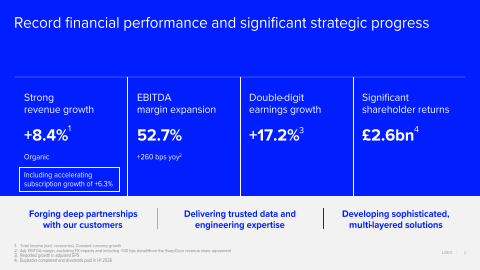
It has been a great first half. We achieved organic revenue growth of 8.4%, with strength across the board. Subscription growth accelerated to 6.3%. Our EBITDA margins improved very strongly and we’re raising guidance to the top of the 80-100 basis point range. The top-line and margin improvement delivered 17% earnings per share growth, and exceptional growth of 37% in free cash flow per share. We made record returns to shareholders, around £2.6 billion across dividends and buybacks, and are back in the market from today with our next buyback tranche.
This performance and the presentation we are going to share with you today show just how deeply we are engaged with customers, across a wide range of data and multiple products, increasingly involving co-development of agents, and delivered via both existing and new infrastructure. This engagement demonstrates our deep institutional partnerships, the trust in our data and our engineering expertise. Demand for financial data and analytics is as strong as ever: in fact segment spend has more than doubled in the last 17 years, while industry headcount has fallen by a quarter. The value of data has decoupled from the number of people using it.
I’m going to talk upfront about our Markets businesses because my progress update later will focus exclusively on AI and the D&A business. Remember that Markets is 40% of LSEG revenue.
All our venues have had an exceptional six months. Following a very strong Q1, we’ve seen solid follow-through in Q2, comping a pretty extraordinary prior period in 2025 as well. These platforms are not just about volatility, almost all of them have strong underlying growth drivers too, and we have invested in them over the years to expand their reach, access new asset classes and develop new protocols to meet customer needs.
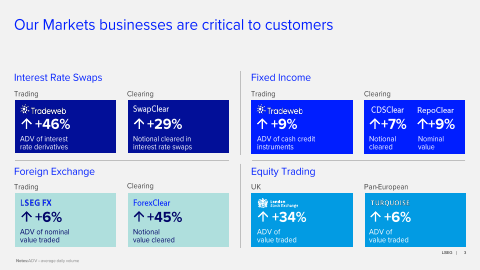
To highlight a couple of really notable performances, SwapClear and Equities both maintained very strong momentum from Q1 into Q2. Total interest rate swap notional cleared was up 29% across H1, and equities average daily volume on the LSE was up 34%.
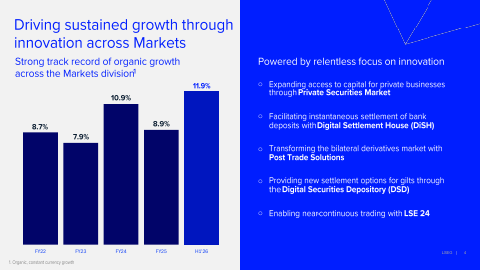
Some may think that whether a Markets business does well is just a function of market volumes, but LSEG Markets has been doing great for the last five years, showing the strength and consistency of execution, and the growth drivers we have aligned the business with. Annual growth has averaged almost 10% over this period, and it’s also been consistent. There have been strong years and really strong years, but no weak years.
We fully intend to maintain that momentum, and we’re investing behind it. In the last six months, we’ve done our first Private Securities Market transactions, including two high-profile UK unicorns this month; we’ve launched DiSH, our platform for real-time settlement which bridges on-chain and off-chain; and in Post Trade Solutions we launched Trade Agent. We just announced our MoU with HSBC to support the UK’s first Digital Gilt Instrument, and LSE 24, our 24/5 equity trading platform. We’ll do a deep dive on our work on the digitalisation of market infrastructure, covering all of this, in early December.
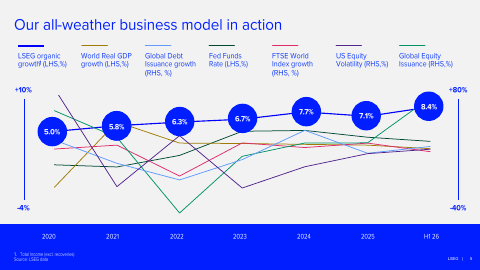
This all translates into our all-weather model. On this slide, we’ve shown our organic revenue growth over the last six years, compared to the change and volatility in a number of measures which could be seen as drivers of our business: GDP growth, market volatility, equity or debt issuance, for example. As you can see, particularly on the right-hand axis, these measures can bounce around a lot, but you wouldn’t know it to look at our revenue growth.
The message is clear: solid and accelerating subscription growth plus attractive Markets exposures across multiple asset classes generate strong and consistent top line growth, irrespective of the external environment. Plus, whichever way you look at it, the gradient of growth from left to right is clearly trending up.
Thanks David, and good morning to all of you. As you heard from David, we delivered an exceptionally strong financial performance in the first half: organic revenue up 8.4%, adjusted EBITDA up 14%, adjusted EPS up 17%, and free cash flow per share up 37%. I will now walk you through the building blocks of that performance, starting with revenue growth.
Organic revenue growth accelerated to 8.4%, and with a 1.5% headwind from FX, reported revenues grew 6.9%. All four divisions made a strong, positive contribution to that growth, as we see on the next slide.
D&A was up 5.1%. FTSE Russell and Risk Intelligence both grew between 9% and 10%. Taken together, the subscription businesses accelerated growth to 6.3%, well on track for our 2026 target of 6.5%. Markets had a very strong half, growing 12%.
I will now talk through each of these divisions in more detail, starting with D&A. Workflows continued its good performance, growing 2.8%. Workspace users are responding very positively to the AI tools introduced in the first half, driving additional engagement with the platform. We continue to expand the power of Workspace, integrating FXall more deeply, working towards more seamless Tradeweb integration, and expanding initiatives like Open Directory.
Growth in Data & Feeds is accelerating, up 7.5%, driven by our continued innovation and the demand it is supporting across both our real-time and pricing and reference data. I will come back to this on the next slide.
Increasingly, customers engage with our D&A product as a single solution as part of our LSEG Data Access Agreements, or LDAs. These enterprise-wide agreements now drive 18% of D&A revenues, up from 16% at the end of last year. Our largest customers benefit from access to our solutions at scale, and in return, they give us many years of visible revenue and growth.
Returning to data and feeds, customer appetite for our data continues to grow extremely fast. Roughly half of our revenues here come from our real-time services, where our strengths across the latency spectrum position us as the provider number one globally by some way. We continue to see rapid growth in the volume of data on this platform, up 70% year-on-year in June, with that big spike driven by global fund flows and some big market transactions, and up four-fold in 10 years. Demand for historic pricing data continues to grow strongly, too, with 39% annual growth in Tick History usage over the last 2 years. Appetite for our cloud-based solution here is particularly strong.
Turning to FTSE Russell, we continue to see strong demand for our flagship equity indices and benchmarks and good momentum in new products. Subscription revenues grew 6.2%, and we expect this to accelerate to high single-digit growth in the second half. Asset-based revenue performed well, up 15%, driven by higher asset prices and strong inflows.
During the half, we launched 52 new ETFs, up 24% from H1 2025. We also announced the introduction of the Russell 9000 index series, expanding the Russell framework from US to global equity markets.
Moving to Risk Intelligence, that delivered another good performance, up 10%. Demand for our World-Check was a primary driver of growth, although digital identity and fraud was also very strong, with volumes up more than 20% in H1.
Looking now at the KPIs we introduced at the start of the year. As a reminder, these give additional insight into our three subscription businesses: D&A, FTSE Russell, and Risk Intelligence. Starting with retention, which rose slightly in the half at almost 93%, that speaks to the value we provide to clients as well as the long-term non-discretionary nature of most of our services.
Gross sales of £482 million continue to be strong, increasing 11% compared to June last year. Lastly, the New Product Vitality Index, which is a very healthy 25%, highlighting the high level of innovation across our businesses and customer receptivity to our new or enhanced products. These are the building blocks of our growth that feed through to ASV growth of 6.1% as we exited Q2, up from 5.9% we reported at year-end.
Our Markets division performed exceptionally in H1, particularly given the incredibly strong prior year comparator. Tradeweb and our OTC derivative businesses grew double digits, and our FX business also had a strong performance, growing 8%. For simplification, we show equities on this slide with some other Markets' activities. The equities business grew 12% in H1, driven by strong secondary markets activity. We are also seeing traction building across recent initiatives with an encouraging pipeline for our private securities market.
Looking at the whole P&L now, you can see our combination of top-line strengths and focus on cost discipline and efficiency is delivering good operating leverage throughout the P&L. As I already mentioned, revenue growth of 8.4% translates into 14% growth in EBITDA, 17% growth in operating profit, and 17% growth in EPS, all that on an organic constant currency basis.
Taking a closer look at costs on this slide. The 2.5% fall in cost of sales reflects the change to the SwapClear revenue share agreement at the end of last year. This revenue share was at 30% in H1 2025 and is now at 10%. Excluding this, cost of sales grew 8.6%, in line with revenues. Operating expenses grew well below our revenue growth at 4.6%. Our cost equation looks at labour cost as a percentage of total income; that continues to improve, falling from 30% to 28.1%. It is supported by our workforce insourcing program, through which we are internally mobilizing more of our talent and improving our agility and efficiency. As we continue to execute on that program, 77% of our headcount is now internal.
We double-click on the EBITDA margin expansion on the next slide. After adjusting for FX, the improvement in margin is 260 bps. 140 bps of this relates to the change we made to the SwapClear agreement last year, leaving 120 bps of underlying margin expansion in H1. As you can see, this performance derives mostly from a disciplined management of the group labour cost, helped by the strong market performance in Q1 that flowed to the EBITDA. On the 120 bps, I assess the group operating leverage at circa 80 bps and the flow-down to the Markets activity at 40 bps.
Let me now walk you through our margin expectations for the rest of the year. As you may have read in the RNS, we are raising our EBITDA margin guidance from 80 to 100 bps improvement to around 100 bps improvement in constant currency. Given the strong margin performance in H1, that implies a year-on-year slight decline of about 50 bps in EBITDA margin in H2.
This is due to the mathematical impact of the SwapClear revenue share change, which in 2025 was all booked in Q4. That creates a 70 bps headwind in H2. Aside from that, we expect to make continued strong underlying progress in operating leverage in line with H1. We budgeted in H2 around 25 million of one-off costs to accelerate the continued transformation of the group.
Last year's figure benefited from 35 million of gain from a bond repurchase and the end of a hedging instrument. The underlying increase was just under 50 million and is mainly driven by the impact of higher global interest rates. Rates have typically been 300 basis points higher as we have refinanced over the last 12 months.
Through that combination of top-line strengths, cost discipline, and operating leverage, we delivered first-half adjusted EPS of 245 pence per share. You can see the strength of this performance for yourself with first half EPS up 17% year-on-year and representing 15% compound annual growth over the last 3 years. The significant allocation of capital to buybacks has seen EPS growth consistently outstrip profit growth.
Now, turning to non-underlying items. These continue to reduce as expected, with the amortization of intangible assets relating to the Refinitiv acquisition 5 years ago, the main item.
On to cash flow, which grew very strongly, up 29% in H1 to £1.2 billion. Large cash items like working capital and CapEx were unchanged year-on-year. The big increase in our cash flow simply reflects our increased EBITDA, converting directly into our equity free cash flow. This is the cash-generative nature of our business model in action. The ongoing buyback means this 29% growth in free cash flow translates into a record 37% growth in free cash flow per share.
We continue to be very active in our allocation of cash, which you can see on this slide. We returned 2.6 billion to shareholders in H1: 2.1 billion via buybacks, and 500 million through dividends. We pushed particularly hard on the buybacks given the dislocation we saw in our share price for much of the first half. We planned to execute a further 1.4 billion in share buybacks by the time of our full-year results in February 2027. Just today, we have kicked off the latest tranche of this buyback.
With our results today, we announced a 17% increase in our interim dividend to 55 pence per share, consistent with our progressive dividend policy. Shortly after the period end, we reached agreement to acquire a further roughly 1% of LCH Group from minority shareholders for €70 million. We expect that to complete in the second half. We ended June with net debt to EBITDA of 2.1 times, in the middle of our stated leverage range.
We are very confident of delivering on all our financial guidance for 2026. At Q1, I said the very strong market performance meant it was likely our full-year revenue growth would be in the upper half of our 6.5-7.5% guidance range. With strength continuing, we are formally raising guidance for revenues to grow between 7% and 7.5% this year.
As explained earlier, I'm also raising our margin guidance and expect a full-year improvement of around 100 bps. We are on track to deliver full-year capital intensity of around 9.5% of total income and equity free cash flow of at least £2.7 billion.
In conclusion, we are executing well on our strategy, and we are very confident of delivering on all our promises for 2026. Aided by the multi-year contractual visibility and growth of our LDA agreements and the deep partnership we have with our customers, we are also confident in our medium-term delivery as laid out on this slide. I will hand back to David to talk more about our strategic progress, particularly in AI.
Thank you, MAP. A really strong financial performance in H1. As I mentioned at the start, I'm going to talk about how we are becoming an increasingly critical partner to our customers in Data & Analytics, and how that is playing out in our customer engagements.
First, a quick recap. The basic ingredients for AI are data, compute, i.e., chips and data centers, and the model. What we can all see over recent months is that compute is an arms race, but ultimately driven by supply and demand. The model landscape is also shifting. Cheaper models are often open-weight and are closing the performance gap on frontier models. Businesses will orchestrate and optimize.
As for data, data is more important than ever, making LSEG the enduring partner of choice in an AI world. 90% of our data revenues come from real-time or data that is proprietary. We have always had unmatched global reach as well as breadth and depth of data. We have for decades been embedded in customer workflows and are becoming more embedded, providing regulated, integrated, and secure solutions. Our data is structured to optimize AI performance, driving repeatable and deterministic outcomes.
Now we have added massive new distribution through our partnerships across the AI ecosystem. We are becoming an increasingly critical partner for the industry, much more than just a data provider. We are partnering with customers to design and implement multifaceted AI strategies with our data at the center of them, and engineers from LSEG, Microsoft, and AWS helping to deploy them.
Our customers are facing complex challenges in adopting AI into their processes and workflows, and the landscape is evolving rapidly. Let me highlight why LSEG is so well-placed to help our customers navigate these challenges.
First, regulation. The industry is already heavily regulated, and the pipeline of new regulation is growing day by day. In the appendix, we've produced a summary of the various regulations that govern the use of data in the financial services industry. It gives you a good sense of the regulatory weight and complexity our customers face. This is a core capability for us, given our decades of experience supporting customers to manage regulatory risk and change.
Next, cyber risk. The latest models are highlighting cybersecurity vulnerabilities in seconds. LSEG is already deeply embedded in the processes and systems of the world's biggest financial institutions and brings a critical market infrastructure mindset to the provision and protection of data. Resilience and security are non-negotiable.
On IP protection, customers are concerned about the risk of commingling their data in a multi- cloud or frontier model environment, or giving away their thinking through their prompts. We have worked with customers' confidential information for decades. They know we'll provide them our trusted data and work with their confidential information in a secure environment.
Similarly, on AI sovereignty, global businesses need to maintain flexibility to use different models in different markets. Our open approach, model- and platform-agnostic, meets that need, whether
Accuracy, I think, speaks for itself. You all have experienced the limitations of even the best LLMs when based on internet data: answers that are often incomplete, inconsistent, or made up. With our accurate, auditable, and semantically linked data, you are getting the same outputs time after time.
Finally, of course, token costs and ROI. A number of companies have spoken about the challenges emerging here. We can make a big difference in helping customers manage token spend. Partly, it's about being model agnostic, so customers aren't using frontier models for simple prompts. And partly, it's the way our data is structured and presented to models, which reduces superfluous information and repeat tool calls. Our head of AI, Emily Prince's recent blog on this topic is worth a read for more detail on this.
In summary, some have been too quick to project the rapid consumer adoption of AI chatbots, or the dramatic impact AI has had on coding, onto the enterprise AI space. As we've said before, our sector moves slowly. Given the range and complexity of issues to address, this is a marathon, not a sprint, and LSEG is the best running partner.
Next, I want to give you a sense of how AI solutions are evolving. You may remember we showed a diagram like this at the Innovation Forum last November. This framework continues to evolve. We've also shown on the right-hand side the customer considerations at each level of the framework to tie into the previous slide. A couple of key points. One thing that hasn't changed: LSEG's trusted content from data, indices, and analytics is a key foundation.
On distribution, we are seeing larger customers, in particular, choose to leverage our existing distribution to bring data into their own AI stacks, with MCP as an add-on in specific use cases. In the consumption layer, we are seeing a blurring of lines and an increasingly hybrid approach. Workspace is stretching beyond the core user interface. Customers are now looking to access it via the Microsoft Teams app, which will allow deep interoperability with Open Directory and other Microsoft products.
We're also working with some customers on what the software industry refers to as a headless approach, enabling them to access the intelligence and content of Workspace in any environment and UI. You'll see that clearly from the case studies, some customers are taking that hybrid approach to AI adoption, combining our UI with their own solutions and third-party platforms.
To take stock on our progress with AI-ready data and product, let's start with MCP, where interest continues to be strong. We've engaged with over 200 customers on MCP since launch late last year, with a good spread by geography, customer type, and channel. Usage is really ramping up as customers, both humans and agents, engage with the data. We saw tool calls increase nearly five times from May to June. We're adding a lot more data over the next few months, which is a key ask from customers.
It is not just D&A. We're rolling out MCP access across the group. The FTSE Russell fixed income sandbox, which we demoed to you last year, is available via MCP, and we're getting some good lead generation out of it. Broader FTSE data is coming soon. In our Markets business, MCP will be a key interface for LSE 24, which we announced last week, as we see agents playing a greater role in trading in the future.
MCP is an important new distribution channel, but I should emphasize it represents around a third of our current AI-related commercial discussions. Although there's been a lot of focus on MCP as an AI channel, AI usage of our product is accessible by more than MCP. You'll see that shortly in the depth and breadth of our customer engagements.
Turning now to Workspace. We have seen a very strong pace of development, both in AI and more widely. Our AI Search tool is now generally available, rolled out to all Workspace customers during July. Although we have not marketed it widely to customers yet, we already have 17,000 active users, with these numbers growing every day. For the Deep Research tool, which many of you have tried, the number of users has quadrupled from Q1. Both Search and Deep Research are built on leading models. We're adding more data and enhancing workflows on both tools.
We also have a third AI product in Workspace, Company Intelligence. This is actually the grandchild of Meeting Prep, the first prototype that came out of the Microsoft partnership, and our customers really like it. We're seeing users pull 3,000 or so detailed company reports per week from multiple underlying sources. You can see examples of feedback on the right here, but we have much more. We get plenty of feedback asking for additional functionality, which just helps us make the product even better.
As you know, Workspace is way more than the AI tools we're building. It remains a critical workflow tool for traders and a rich source of community and data, and the impact of the enhancements we are making continues to scale. In H1, we've integrated the vast majority of FXall functionality into the platform, driving a 10% uplift in engagement. We've invested in the messaging function, which has 40,000 monthly active users. A thousand customers are piloting our new private markets datasets. In H2, we'll be rolling out interoperability with Tradeweb. That work went into production this month.
As I mentioned earlier, Workspace is also breaking out of its traditional UI as we make its data, intelligence, and tools available in customers' own environments as well as the Microsoft ecosystem. There's real product momentum with Microsoft. The Workspace app is already available in Teams, offering all the AI functionality of the main desktop and deep interoperability between the two. It will shortly be available in Copilot, too, which is significant, given the 1.5 million Copilot users in our top 50 customers. Open Directory rollout is also continuing, with over 20 customers onboarding. We're now using it as the default communications platform for new TORA OEMS customers, with three signed up, and will make it interoperable with LSEG Messenger's 40,000 active users in H2.
We've made significant investment and progress on the product side. The pace of innovation across LSEG is at its fastest for many years. This table lays out how we are monetizing this investment, and this is likely to continue to evolve. We are out in the market with this framework today. In fact, customers are demanding it. While we are primarily focusing on adoption, some customers really want to understand what the cost will be as they are signing up.
For use of LSEG data in AI applications, the basic commercial model is an additional use case license. This is consistent with how we charge for data on any new or additional use case. Where customers take a bulk feed or stream data, we don't have instant visibility on usage. That's the category on the far-left column. Where customers are accessing data via API, either directly or through our MCP, that will attract an additional usage-based charge. As AI and MCP drive cross- sell, we expect customers to take additional datasets over time as well.
For our Workspace AI tools, we're taking a slightly different approach. AI Search is included in the Workspace subscription with the value reflected in the annual price review, but will also be subject to a fair use policy reflecting a certain number of prompts per month. Above that, there will be additional usage-based charges. We are positioning Deep Research as a premium add- on with usage-linked tiers. As you would expect, our pricing structure reflects our costs. These new products and use will drive additional cloud costs for LSEG. On the AI-ready data, we incur some data platform fees, and on the Workspace AI functionality, we incur token costs. These costs are fully factored into our midterm margin guidance.
Let's look at how we are working with customers to implement their AI strategies. The first case study is a global bank with a longstanding enterprise agreement for LDA. We're working with them on multiple fronts, which will involve our own forward-deployed engineers.
The customer is building a couple of platforms for different user groups that combine their own data with our data. One of these will help relationship managers prepare for meetings, bringing their own internal regulatory and product data together with LSEG news and market data. Another will help the banking and capital markets teams access deal intelligence and client-related news flow. We're also supporting them with MCP access to news, fundamentals, and ownership for their wealth advisory business. As per the previous slide, we will monetize this through the AI license and the MCP capability license, including tiered pricing for consumption.
Case study two features our work with a sovereign wealth fund client. We already provide them with significant foundational data to support investment management insights. Our new collaboration goes much further. We are combining our entity, symbology, and ownership data with the customer's own data and other sources to underpin three specific use cases: a risk intelligence agent to identify emerging threats and potential portfolio impacts, a counterparty agent to help risk managers identify credit risk factors, and a C-level dashboard, bringing together a number of sources of data and intelligence in one place for portfolio monitoring.
We're delivering data both via MCP and directly through our existing API. Again, the commercial model reflects this. Note that there is a separate and additional AI license for Risk Intelligence.
The third, a longstanding industrial customer, which may surprise some of you. We're helping them build FX hedging workflows, combining multiple data sources and AI, and also providing treasury insights from structured and unstructured content. This example highlights the potential that our AI and data have for all companies, not just financial institutions, and shows how supercharged distribution and usability can open up new markets for LSEG's data.
We picked three case studies. I could have shared a lot more of similar depth and breadth. They all demonstrate the value we're bringing to customers, the longevity of our relationships, the importance of our trusted data in a highly regulated sector, our open and flexible approach, and our platform-agnostic stance to distribution. While these examples do leverage MCP, this is not just simple plug-and-play. These are complex, sophisticated, and multi-layered solutions.
Reflecting on the whole AI disruption story, the market has been debating these topics in great detail for the last 12 months and having what we could call the terminal value debate. In the appendix, we have addressed five common misconceptions about the future of our business in an AI world. You've heard us make many of these points in meetings and Q&A, but we have pulled them together in one place as a reference source.
To wrap up, financial performance is very strong, with 8.4% organic revenue growth, accelerating subscription revenue growth, strongly improving margins, and 37% free cash flow per share growth. We're driving an unprecedented pace of innovation across the business. We will come back later in the year with a deeper dive on that innovation in Markets. We have returned £2.6 billion or over 5% of our market cap to shareholders in H1 alone, with more to come in H2 starting today.
Just as importantly, you'll notice today the clear shift we are driving in the AI debate based on what we are seeing day-to-day on the ground with hundreds of customers. AI in financial services can drive enormous value, but it comes with significant challenges for our customers. We are the trusted partner to help them address those challenges. We have the infrastructure, the data, the trust, the regulatory expertise, and the institutional history. LSEG is even more valuable in an AI world. Now, we will be happy to take your questions. Peregrine?
Hi. Thanks for taking the question. It's been a year since the AI disruption narrative really took hold. Could you please provide a little bit more color and specific examples about how LSEG has been affected by AI during the period? What are the biggest changes versus your expectations 12 months ago, both positively and negatively? Thanks.
Thanks, Andy. Really, the biggest issue by far has been dealing with the perception of the impact of AI versus the reality of the impact of AI. More recently, over the last couple of months, I think it's fair to say the level of understanding about AI's potential, what it's good at, what it's not good at, that has matured a lot. I think people now recognize that a frontier AI company is not a data provider, not directly providing what we do. In fact, it's now well understood that for an AI company
Over the past year, there has been speculation that AI would wipe out large parts of our business. In fact, it's just the opposite. AI has enhanced the value of LSEG. AI has increased the need for, and therefore the value of our data because our data is verifiable, it's auditable, and it's proprietary. If you look at our performance, our performance demonstrates exactly that. If you compare where we are today versus a year ago, our new sales are 10% higher. Our retention is better. Our subscription revenue growth has accelerated from 6% last year to 6.3% now.
We're seeing more consumption of our data than ever before. We've got new distribution channels and new products that we didn't have a year ago, and we're getting great traction with them, with thousands of users. We are more closely engaged with our customers than we were a year ago. We're creating value from that engagement. That's why we talk about LSEG being a lot more valuable in an AI world.
I think it is fair to say the world is moving faster today than a year ago, and it has been a challenge for our people to keep moving faster, to really integrate new tech into our products and processes and meet customer expectations in this really dynamic market. But I think we're really rising to that challenge very well. I expect us to do that more and more, and better and better, going forward.
Thank you for the presentation. Thanks for taking my question. Going back to MCP, how much can MCP add to growth going forward? Is MCP monetization incremental to that 7% subscription revenue target you have for next year? If so, do you see upside to that now that MCP monetization is starting? Thank you.
Hey, Hubert. It's MAP. I think we've said very clearly in Q1, and we are reiterating that our priority for this year and for the second semester is to concentrate on usage. Our clients are still very
much trying MCP, very different use case. For us, the most important is to make sure that we have the setup which is the most powerful and valuable to them. MCP, for sure, will be monetized. By the way, we are already sending some invoices because the client actually asked us to have a price framework for the rest of the year, but it's minimal. We will see that more in 2027, but certainly it won't move the needle in 2026.
Maybe, Hubert, the other point I would just add, as we just went through in the presentation, is that MCP is important, but it is really about a third of the commercial discussions that we're having with our customers. There are other aspects to this as well.
Thanks, guys, for the presentation. Just a question on the subscription businesses. We saw 6.3% revenue growth in the first half of this year. You guys are guiding to, I think, 6.5% for full year, so we need to see another, let's call it 30, 40 basis points of acceleration in the second half. I was just wondering what gives you the confidence? What will get you to that 50 basis points of acceleration? Then, just to clarify your answer before, when it comes to the subscription revenue growth and the 50 basis points of acceleration in 2027, my understanding is that MCP and the like would be incremental to that, not included in that. If you could just confirm that, that'd be helpful. Thanks.
First on 2026, your math are right, so 6.3 in the first semester, acceleration to 6.7 in the second semester. As we said, circa 6.5 on the year. We're very confident to reach this 6.5% for the year, fundamentally for two major reasons. One is that we had gross sales which were at a record level, if you remember, in Q4 last year. These gross sales are executed not only at the beginning of the year, but for some of them in the second half of the year. It's something that we already know. It's giving us good visibility on the installation pipeline over the coming quarters. The second reason is that we have improved massively, as you've seen in David's presentation, our product lineup, not only for D&A, but for the three subscription businesses. We have a far better product lineup. The combination of better product and the pipe that we know is going to be executed in H2 is giving us this confidence. As for 2027, you want to cover it, David?
Sure, happy to. Mike, with respect to 2027, the way this will play out is that we will see slow, steady adoption of these products, and therefore the revenue associated with that. We don't expect, and you shouldn't expect, a big spike at any point. I think we've been really consistent about that in terms of how this industry works. But you have seen us very consistently turning the dial up over the last several reporting periods. You can hear MAP's confidence in terms of what this year will look like for subscription revenues, and we expect that to continue going forward with that slow, steady adoption curve, if I can put it that way.
Good morning. Also a question on the MCP connector, please. I noticed that the share of direct connections to LSEG has moved up again rather than via the LLM. Just wondering whether this is now the sales force is in place and you're pushing the product more directly, or what is driving that? Is that a strategic target for you? Thank you.
It's not something that we are pushing. It's really customer demand. This is how we see the market evolving. There are some customers who want to access our data through MCP, and then there are other customers who may want to access some of our data via MCP and some of our data
through other channels. They may want to take it through a regular API. They may want to access it in, for example, a Snowflake or Databricks environment.
We're just seeing this market continue to evolve and continue to develop. This is in many ways one of the strengths of LSEG Everywhere. We are in a position to serve our customers across the different channels they want to use to access our data. As I mentioned earlier, MCP is the channel in about a third of our commercial discussions right now.
To your point on direct versus other providers, that's also what we're seeing in the marketplace. In other words, a number of our customers are choosing to go direct instead of using one of these model channels. This will continue to evolve. We'll continue to share with you all what we're seeing in the way that our customers want to access our data. From our perspective, it's all good.
Good morning. Just another question on MCP usage: 202 clients, it's a big number. I'm just wondering if you could give us a bit of an indication as to what share of revenues these clients represent of your revenue base. I assume it's the largest clients that are adopting. If I may, a quick follow-up. You highlighted OTC revenue growth being really strong. I'm just wondering if you could pick out which areas within OTC are seeing the strongest contribution to that growth. Thanks.
Sure. I'll touch on the MCP question, then MAP can answer your second question. It's actually all over the map in terms of the customers that we are seeing access our data via MCP and via these other channels that I'm talking about. We have seen a number of our very large customers doing some interesting things. We have mentioned this in one of the case studies. We're also seeing a lot of smaller funds, hedge funds, asset managers that are really interested in the product and accessing our data in this way. It’s also really interesting to see..
It's not fully transparent to us, but we can tell pretty much which users of the data are humans versus agents. It's very interesting to see the... I think you all asked us on one of the prior calls
what the differences were in terms of consumption of our data by agents versus humans. Take this as anecdata. This is not scientific, but what we see so far is that agents tend to consume roughly 10 times the amount of data that humans do through the MCP channel. I think it continues to evolve.
Maybe the last point I would just reiterate is that MCP is at this point just about a third of the AI access and the AI commercial discussions that we're having. Important, a great new distribution channel, but part of what we're seeing and part of the opportunity set that we are taking advantage of with our customers.
On the OTC derivative, it was indeed a great semester with both volume and new products. We see the growth being double-digit on both SwapClear and RepoClear. It was very much distributed between our different platforms.
Hi there. Oliver Carruthers from Goldman Sachs. Just one question for me. On Data & Feeds, the organic constant currency growth rate has now risen 100 basis points over the last two quarters. It's now running at 7.7%. It looks like it's set to overtake Workflows as your biggest revenue single- line item by the end of this year. It was only 3 million shy of this in the second quarter. I think slide 10 looks pretty compelling to me in terms of the client consumption of some of your key offerings in the here and now. As you say, potentially future AI consumption may be additive to this. Just in the context of this 7.7% growth rate, just how should we think conceptually about where this growth rate could go from here and some of the aspirations for this line item? Thank you.
Thanks, Oliver. If you go back to our original Investor Day or Capital Markets Day after we acquired Refinitiv, we talked about the growth rates of these two businesses, and we expected at that point, Workflows to be low single digit. I think we talked about Data & Feeds to be higher than that. I think at that point, we talked about it being in mid-single digits. That has played out over the last several years.
I think we've got this in our materials in one of the appendices, a graph that shows how we have seen a significant reduction over the last 15, 20 years in the number of headcount, the number of people in this industry. Yet we've seen a doubling of the amount of data consumption and data spend. You have had a clear decoupling of the demand for data from the number of people in the industry. That all predates AI. It's important to be really clear about that. That dynamic was long before any of us were talking about the impact of AI on our business.
I think going forward, we continue to see a really attractive opportunity for our Workspace interface, and that includes this notion of a headless construct, if you will, in terms of we already have Workspace available through Teams. Workspace is going to be available through Copilot with a million-plus users among our top 50 customers. We have that flexibility, that modularity, to make the Workspace content available for our customers in the way that they want to consume it effectively through their user interface. We think that flexibility is a great opportunity for Workspace for a human interface.
To the specifics of your question, Data & Feeds has been a great business. We have been adding a lot to it in terms of both new datasets and new distribution channels. AI really just turbocharges that. I think it adds new distribution channels, whether it's MCP or other ways of consuming our data via AI models. We are seeing good, strong growth there already, and I expect to see that continue.
Hi there. Thanks for the presentation and taking my question. Just given the tailwind from rising markets on the asset-based fees, since we last spoke at 1Q results, why is the outlook for subscription-based revenues not improved from the 6.5% that you indicated at 1Q? To put it really precisely, the ETF AUM is 17% higher, quarter on quarter at 2Q. That should be about a 20-30
bps increment to overall subscription-based revenue growth in 2026. Why is the ambition not higher now than the 6.5% it was previously, please? Thanks.
There are two reasons for this. The first thing is that our asset-based revenue is relatively small, as you have seen. Even if you have in there a growth which is more than expected, it's not moving the dial at subscription business completely. That's the first reason. The second reason is that the part of the agreement we have in that business is not directly linked to volume, and it's a flat fee. The combination between the two is why we confirm the 6.5% for the year with an acceleration at 6.7 in H2.
If I can possibly just come back on that. Without wanting to get into too much detail, the R2 between your ETF AUM and the asset-based fees one quarter ahead is greater than 0.9, so there is quite a strong link between the ETF AUM and revenues in the subsequent periods. As I say, just taking where we are at 2Q and running ahead, that's 20-30 basis points on the entire subscription base. That is significant in my mind. Is it just something that you've not factored in, or is there something going in the opposite direction that gets us back to 6.5 for the year, please?
I think it depends on the mix between US and global, really, in terms of asset base. We don't have the same agreement for one and the other. We look into H2 with confidence. I understand your calculation. Again, we're talking about 10 basis points at the subscription businesses' level, and we said circa. I think we are already relatively precise, or at least I'm not going to be more precise than that.
Morning, gentlemen, and thanks for taking my question. I'm sorry to come back on the MCP, but I really want to get something straight there. I understand that it's not really a driver for '26. It's a small one for '27. At the same time, the operational momentum you reported already on is really strong in my view, and you also anticipate this to be robust in the future. My question is, when should we really expect the MCP strategy to generate meaningful revenue? Also, how can we cross-check that with the critical mass on the client base? I'd say you have 200 now. What will be a level of client base that would be a good reflection for generating meaningful MCP revenue?
Guys, you're all trying to build mathematical formulas into models as to exactly how this is going to play out in 2027. Let me just tell you we have great confidence in the client adoption of our channels. We are seeing consistent, steady acceleration of both the consumption. We have put out the monetization framework today. It is the framework that we have already seen some of our customers engaging on. As MAP mentioned earlier, we are already monetizing that. It will be a consistent, steady contributor to our growth. As MAP has already indicated, we have driven acceleration of our subscription revenue over the past several quarters, and we expect to continue driving that. We're not going to give anything more explicit or more specific than that. We, of course, understand why people are asking, but that is how we expect this to play out. We have lots of customer engagement and customer proof points to demonstrate that.
Good morning, guys. Thanks for the presentation. Could you talk a bit about momentum around LDA wins? I guess we've seen a few less of those publicly announced of late, but could you give
us a sense of what's happening beneath the surface? We've seen LDA contribution to D&A ASV increase from 16% to 18%, half on half. Could you also comment how the pipeline looks?
Then slightly adjacently, one of your competitors has recently spoken about sales cycles getting blown out due to the complexity of negotiations around AI-related data consumption. I think you've alluded to something similar. Do you have any sense of when we might expect that to start to normalize when commercial models become more standardized? Thank you.
That's really interesting. I'm going to link the two parts of your question there. First of all, on LDA, we've signed up a couple more this year. As you said, the percentage has gone from 16% up to 18%. No huge ones in the first half of the year, continuing ongoing discussion and dialogue with various customers. I would say, with respect to the sales cycle commentary from one of our competitors, I don't agree with that, actually. We're not seeing that. Some of that may be due to the strength of our LDA relationships. What I mean by that—again, you can see this in one of our case studies—is that when we have an LDA arrangement in place with one of these customers, that significantly accelerates the engagement with that customer. We are basically the first call, the default provider, and we can immediately start engaging with them as to how to build this capability for them.
In a few cases, we have our people, and in some cases, partnering with, for example, Microsoft people. The industry calls these forward-deployed engineers. We've had it for a number of years as our implementation team, but happy to call them FDEs, working on the premises with our customers, building new agents, building new capabilities, making sure that they have access to our data through these new channels. We have not seen the sales cycle extending, and we continue to have really good, really robust dialogue with both existing LDA customers, but also with a number of new customers who are attracted by our offerings.
Before we continue on to our next question, a reminder: if you would like to join the queue to press star one. Your next question is from the line of Michael Sanderson of Barclays. Please go ahead.
Good morning. Just a single question, as expected, but a small add-on, if that's all right. The single question was obviously talking a lot about the momentum and sales development. I'm just interested if you can talk me through the gross sales numbers that you talked about in your new set of metrics, versus end of last year versus June now, minimal progress. Is there a seasonal element that we should see acceleration in the second half of the year, given all the discussion you're talking about, I suppose, in that metric, just to understand?
The small add-on, if you will allow me, was just you're obviously working very closely with your clients on setting up tools and building out solutions. Does this translate into any one-off fees, set- up fees, et cetera, that you get to benefit from, or is it all rolled into a longer-term subscription model that you obviously run for the most part?
Thanks, Michael. I'll take your second question, and then MAP can answer the first question on the gross sales. With respect to set-up fees, as you call them, or implementation fees, it depends, is the short answer. For example, in a typical LDA arrangement, there are often embedded in that these kinds of consulting services, where we will commit to a certain number of hours, if you will, of our consulting team going in there and helping build capabilities. In other cases, it is a separate cost to the customers, and we charge for that. That can be a one-off or in some cases more periodic implementation fee. We see that in terms of both modes, where sometimes it's included and sometimes it's incremental.
Michael, on the gross sales, I reckon it's a new indicator that we are giving you, so you're trying to get your head around it. I think the important thing to have in mind that it's a 12-month rolling that we are giving. Actually, the way I look at it is we had a step-up, as you remember, in December 2025 of about 50 million compared to June 2025, so going roughly from 430 to 480. Actually, I was extremely pleased to match this 480 in June, meaning that the step-up is now behind us. I see that as a positive, to be clear.
Thanks everyone for all the questions. I'll close just by touching on one of the themes of the earlier questions. Here we are a year after the first wave of perceived AI disruption hit last summer. There's now a year of evidence on the impact of AI. I can't speak for the whole industry, but I can certainly speak for LSEG.
We, as an organization, are moving faster, we're more efficient, and we roll out new products more quickly. We are seeing more consumption of our data. We're monetizing new distribution channels and new products, and we are doing more with our customers. You all can see that in our results. We have higher growth, higher sales, higher retention, higher margin, and we feel as if we are just getting started. With that, thank you for joining today. MAP and I look forward to seeing many of you over the coming days and weeks to continue the discussion.