
Lemonade (LMND) · Insurance
Lemonade Q2 2026 earnings: summary, key numbers & outlook
Results filed 29 Jul 2026 · Quarter ended 30 Jun 2026
Slides (35 pages)Press release ↗Investor relations ↗
Summaries and transcripts are machine-generated and can contain errors.
In brief
Lemonade's claims-handling cost fell to a record-low 5% of premium as AI and automation absorbed growth across Car, Pet and Homeowners, while it expanded Car and reworked reinsurance.
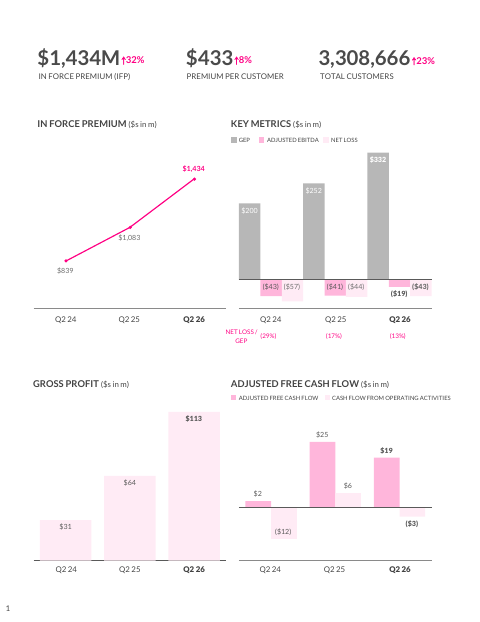
Lemonade added about 166,000 customers in the quarter, taking the base to 3,308,666, and premium per customer rose to $433. Pet and Car are the growth engines: Pet in force premium reached $543 million and Car $239 million. Claims automation, including higher instant claim rates in Pet and Renters and AI-assisted workflows, cut claims-handling cost to a record low. The company launched 14 additional state-product combinations in the past 100 days.
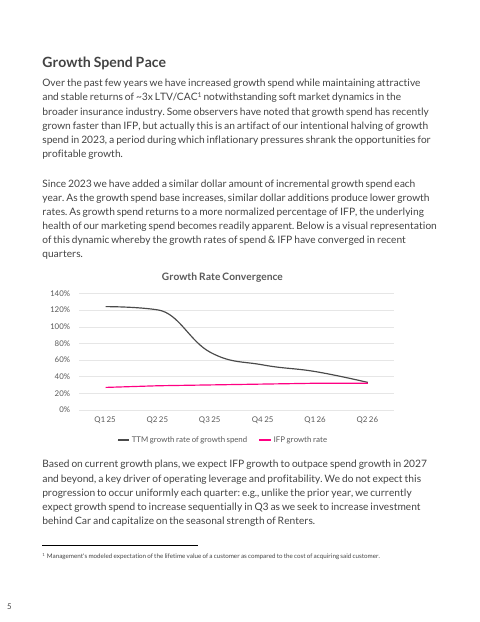
Management is steering toward more Car availability, with a stated aim of reaching most US drivers before the end of 2027, and toward a reinsurance structure that keeps more of the economics while protecting against catastrophes. Growth spend is set to rise sequentially in Q3 behind Car and seasonal Renters demand. The tension is that faster spending must be matched by in force premium growth to deliver the first positive Adjusted EBITDA quarter expected in Q4 2026.
No call transcript for this quarter, so this summary also draws on: The Motley Fool ↗, MarketBeat ↗.
Slides & documents
Open the shareholder letter (PDF, 35 pages) ↗

Showing the first 6 of 35 pages.
SEC filing
Key numbers
- Revenue · GAAP
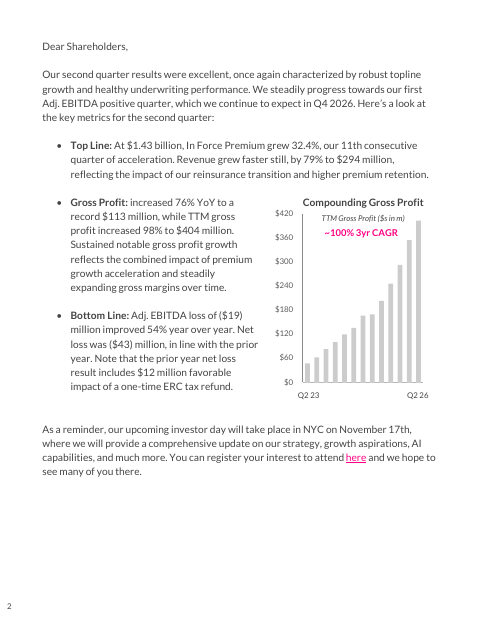
- $294.4 million
- Net loss · GAAP
- ($43.4) million
- Net loss per share, basic and diluted · GAAP
- ($0.56)
- Adjusted EBITDA · non-GAAP
- ($18.7) million
- Gross profit · GAAP
- $113.2 million
- Adjusted free cash flow · non-GAAP
- $18.8 million
up 79% from a year ago
compared with ($43.9) million a year ago
compared with ($0.60) a year ago
compared with a loss of ($40.9) million a year ago
up 76% from a year ago
compared with $25.0 million a year ago
| Segment or metric | Value | Change |
|---|---|---|
| In force premium | $1.43 billion | up 32% from a year ago |
| Customers | 3,308,666 | up 23% from a year ago |
| Premium per customer | $433 | up 8% from a year ago |
| Annual dollar retention | 85% | up 1 percentage point from a year ago |
| Pet in force premium | $543.0M | from $350 million a year ago |
| Car in force premium | $239.0M | from $150 million a year ago |
Where each number comes from
- Revenue: “Second quarter revenue of $294.4 million increased by $130.3 million or 79% as compared to the second quarter of 2025”
- Net loss: “Net loss in the second quarter was ($43.4) million, or ($0.56) per share, as compared to ($43.9) million, or ($0.60) per share, in the second quarter of 2025.”
- Net loss per share, basic and diluted: “Net loss in the second quarter was ($43.4) million, or ($0.56) per share, as compared to ($43.9) million, or ($0.60) per share, in the second quarter of 2025.”
- Adjusted EBITDA: “Adjusted EBITDA loss was ($18.7) million, as compared to an Adjusted EBITDA loss of ($40.9) million in the second quarter 2025.”
- Gross profit: “Second quarter gross profit of $113.2 million increased by $48.9 million or 76% as compared to the second quarter of 2025”
- Adjusted free cash flow: “Adjusted free cash flow in the second quarter was $18.8 million, as compared to $25.0 million in the second quarter of 2025”
- In force premium: “IFP, defined as the aggregate annualized premium for customers as of the period end date, increased by 32% to $1.43 billion as compared to the second quarter of 2025.”
- Customers: “Customer count increased by 23% to 3,308,666 as compared to the second quarter of 2025.”
- Premium per customer: “Premium per customer, defined as in force premium divided by customers, was $433 at the end of the second quarter, up 8% from the second quarter of 2025.”
- Annual dollar retention: “was 85%, a 1 percentage point increase from the second quarter of 2025, and flat from the first quarter of 2026.”
- Pet in force premium: “Homeowners multi-peril $523 $531 $530 $540 $554 Pet $350 $394 $439 $490 $543 Car $150 $163 $187 $214 $239”
- Car in force premium: “Homeowners multi-peril $523 $531 $530 $540 $554 Pet $350 $394 $439 $490 $543 Car $150 $163 $187 $214 $239”
Copied from the press release ↗ and other documents in the SEC filing ↗. A figure is published only if its sentence is in those documents.
| From the filing | Q2 2026 | vs year ago | vs last quarter |
|---|---|---|---|
| Revenue | $294.4M | +79.4% | +14.1% |
| Net income | -$43.4M | +1.1% | −21.2% |
| Diluted EPS | -$0.56 | +6.7% | −19.1% |
| Free cash flow | -$8.0M | — | −95.1% |
Calculated by code from XBRL, not by the model.
Outlook
| Metric | Period | Outlook |
|---|---|---|
| Revenue | third quarter of 2026 | $323-$326 million |
| Revenue | full year 2026 | $1,214-$1,220 million |
| Adjusted EBITDA loss | third quarter of 2026 | ($23)-($20) million |
| Adjusted EBITDA loss | full year 2026 | ($51)-($47) million |
| In force premium | third quarter of 2026 | $1,537-$1,540 million |
| In force premium | full year 2026 | $1,632-$1,639 million |
Key takeaways
Claims handling cost hits record-low 5%
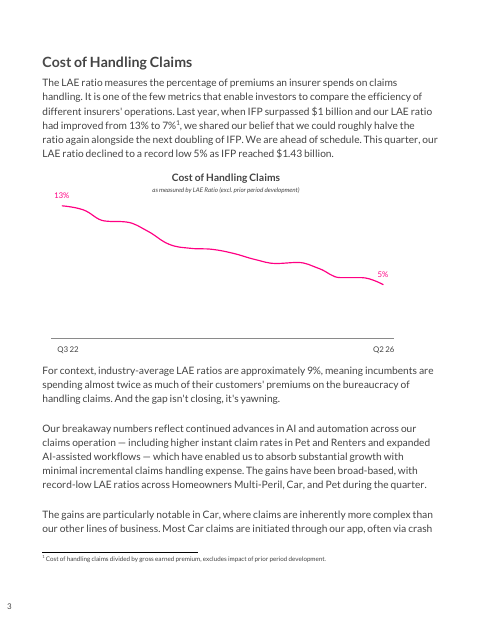
Lemonade's LAE ratio fell to 5% as In Force Premium reached $1.43 billion, versus an industry average of about 9%. Management credits AI, higher instant claim rates in Pet and Renters, and AI-assisted workflows, and says the same systems run sales, service and underwriting.
Pet and Car lead the product mix
Pet in force premium grew from $350 million to $543 million and Car from $150 million to $239 million over the past year. Homeowners multi-peril grew more slowly, from $523 million to $554 million, shifting the mix toward newer lines.
Car claims benefit from app and crash detection
Most Car claims start in the app, often through crash detection, enabling faster first notice of loss and better triage. Car's LAE ratio was 7% even though Car claims are more complex than other lines.
Reinsurance shifts toward catastrophe protection
The July 1 program cuts the effective quota share cession from about 20% to about 18%. It adds up to $40 million recovery per event, subject to a $100 million aggregate limit, plus named-storm protection that the prior structure excluded.
Hannover Re financing extends growth spend runway
The synthetic agents program is extended from January 2027 with up to $250 million of capital at a cost of about 9.8%, down more than 600 basis points. Management says growth spend still earns about 3x LTV/CAC and expects IFP growth to outpace spend growth in 2027 and beyond.
Charts
Fourth quarter worked out from the annual figure.
Data
| Q4 2024 | $148.8M * |
| Q1 2025 | $151.2M |
| Q2 2025 | $164.1M |
| Q3 2025 | $194.5M |
| Q4 2025 | $228.1M * |
| Q1 2026 | $258.0M |
| Q2 2026 | $294.4M |
| Q3 2026 | $336.1M |
Data
| Q1 2025 | -$0.86 |
| Q2 2025 | -$0.60 |
| Q3 2025 | -$0.51 |
| Q1 2026 | -$0.47 |
| Q2 2026 | -$0.56 |
| Q3 2026 | -$0.56 |
Fourth-quarter EPS appears once the press release is read; filings report it only for the full year.
Data
| Q4 2024 | $10.6M |
| Q1 2025 | -$49.5M |
| Q2 2025 | $3.4M |
| Q3 2025 | $2.6M |
| Q4 2025 | $17.6M |
| Q1 2026 | -$4.1M |
| Q2 2026 | -$8.0M |
| Q3 2026 | $1.9M |
Operating cash flow minus capital expenditure, from cash flow statements.
Questions
What drove Lemonade's lower claims-handling costs?
Management points to AI and automation in claims, including higher instant claim rates in Pet and Renters and expanded AI-assisted workflows. The LAE ratio fell to a record 5% versus about 9% for the industry.
Which product lines are growing fastest at Lemonade?
Pet in force premium rose to $543 million from $350 million a year earlier, and Car rose to $239 million from $150 million. Homeowners multi-peril grew more slowly to $554 million.
How is Lemonade changing its reinsurance?
The new 12-month program from July 1 lowers the effective quota share cession from about 20% to about 18%. It also expands catastrophe protection to up to $40 million per event with a $100 million aggregate limit, and adds named-storm cover.
What is Lemonade's plan for Car?
Management plans to increase growth spend behind Car in Q3 and says Car should be available to the majority of US drivers before the end of 2027. The company also launched 14 additional state-product combinations in the past 100 days.
How is Lemonade funding customer acquisition?
It extended its synthetic agents program with Hannover Re, effective January 2027, providing up to $250 million at about 9.8% cost of capital. Management says growth spend continues to return about 3x LTV/CAC.