Transcript · Mervin Song, JPMorgan · DSS growth
How is the Decarbonisation & Sustainable Solutions business growing?
It grew slightly year on year, and its long-term contracts are now worth $8 billion and are indexed against inflation. — Cindy Lim
Transcript · Mervin Song, JPMorgan · Gas supply
Did Keppel have to source elevated-price gas from SLNG, and will that continue?
Replacement gas was sourced in April after an upstream force majeure, and Sakra's timely start more than offset the cost. — Cindy Lim
Transcript · Mervin Song, JPMorgan · Spark spreads
What is the view on spark spreads and long-term versus short-term contracts?
Spreads have normalised from 2022-2023 highs and stay volatile, so the focus is on long-term contracts across the 1.9 GW capacity. — Cindy Lim
Transcript · Mervin Song, JPMorgan · Gas costs
Was replacement gas sourced at elevated prices for 2H 2026?
Not so far, though management says the situation is still fluid. — Cindy Lim, Loh Chin Hua
Transcript · Rachael Tan, UBS · Power contracting
How much of the 1.9 GW power capacity is contracted?
Not all of it is, because regulation requires a spinning reserve, but Sakra is fully contracted for 2026 and 2027. — Cindy Lim
Transcript · Rachael Tan, UBS · SSCI definition
Which funds are still 100% owned by Keppel?
Those that are still fundraising. — Kevin Chng
Transcript · Rachael Tan, UBS · Rig accounting
Will RigCo losses appear in SSCI?
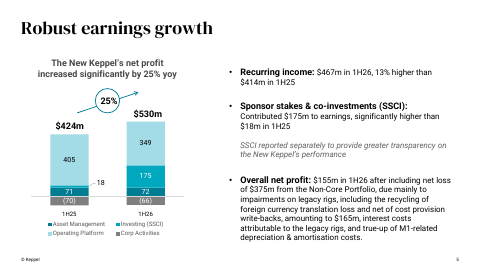
Current impairments stay in the Non-Core Portfolio, and Keppel's retained 50% of the six rigs will later be accounted under SSCI. — Loh Chin Hua
Transcript · Brandon Lee, Citi · Monetisation pace
Does the rig sale remove the need to bring forward other divestments?
No, Keppel keeps a 2030 target for the Non-Core Portfolio but will sell earlier if it can. — Loh Chin Hua
Transcript · Brandon Lee, Citi · Rig valuation
What do the rig valuation ranges and sensitivities in the financial statements mean?
They explain how recoverable amounts are set using industry experts and independent valuers. — Kevin Chng
Transcript · Brandon Lee, Citi · Rig impairment risk
Does a delay in selling the remaining four rigs risk a $390 million impairment?
Only if there is a delay, and Keppel is not planning for one. — Kevin Chng, Loh Chin Hua
Transcript · Joy Wang, HSBC · Fundraising and fees
How will July fundraising turn into deployment and fees?
Fees can be estimated from the FUM raised and the fee-to-FUM rate, and they start to kick in during 2H 2026. — Christina Tan, Loh Chin Hua
Transcript · Joy Wang, HSBC · Rig impairments
Will there be more rig impairments and interest costs?
Impairments cannot be forecast, and the six rigs going into the fund will be deconsolidated. — Loh Chin Hua
Transcript · Tan Xuan, Goldman Sachs · M&A
How does Keppel judge whether an acquisition is strategic?
It looks broadly at asset manager platforms and at infrastructure, digital and connectivity deals the funds can join. — Christina Tan
Transcript · Tan Xuan, Goldman Sachs · Non-core assets
Why does the Non-Core Portfolio include $2.4 billion of cash and receivables?
It includes cash needed to complete the remaining rigs and property project receivables, which return when assets are sold. — Kevin Chng
Transcript · Tan Xuan, Goldman Sachs · Offshore fund
Could the Keppel Offshore Fund's return guarantee create recourse to Keppel?
Apollo's yield is roughly matched by charter dayrates, so management sees no recourse scenario. — Loh Chin Hua
Transcript · Mayank Maheshwari, Morgan Stanley · LNG sourcing
How is the LNG sourcing portfolio positioned over the next one to three years?
Needs are covered by existing pipeline gas and LNG contracts, and future long-term LNG sourcing in Singapore will go through GasCo. — Cindy Lim
Transcript · Mayank Maheshwari, Morgan Stanley · Contract pricing
How are power contracts priced as some expire?
Pricing is fuel pass-through, commodity-indexed or fixed with hedging, and GasCo does not change that. — Cindy Lim
Transcript · Mayank Maheshwari, Morgan Stanley · Capital deployment
Where will the Aermont and sovereign wealth fund capital be deployed?
Aermont capital goes to Europe with fees on committed capital, and sovereign money goes to flagship funds plus co-investment pots. — Loh Chin Hua, Christina Tan
Transcript · Mayank Maheshwari, Morgan Stanley · Working capital
What drove the working capital increase?
Infrastructure, M1, non-core property projects and Keppel Technology Solutions, with nothing seen as abnormal. — Kevin Chng
Transcript · Alexander Han, Jain Global · Sakra utilisation
What is Sakra's utilisation and ramp-up schedule?
It is fully committed other than for spinning reserves. — Loh Chin Hua
Transcript · Alexander Han, Jain Global · SSCI drivers
What drove the Infrastructure SSCI operational profit increase?
Higher Keppel Infrastructure Trust distributions, lower interest costs and higher private fund returns, with performance fees still small. — Kevin Chng, Loh Chin Hua
Transcript · Alexander Han, Jain Global · FUM leverage
How much FUM is equity versus debt?
FUM is on a gross asset value basis, and portfolio leverage averages no more than 60%. — Kevin Chng
Transcript · Tom Taylor, PEI Media · Fund updates
What are the updates on Keppel Infrastructure Fund and Data Centre Fund III?
The infrastructure fund made its first investment in Global Marine Group, and Data Centre Fund III is close to or above its US$2 billion target. — Christina Tan, Loh Chin Hua
Transcript · Tom Taylor, PEI Media · Geographic scope
Is Keppel Infrastructure Fund looking beyond Asia?
Yes, because infrastructure such as cables and cable-laying vessels is global. — Christina Tan
Transcript · James Druce, CLSA · FUM raised
Where did the $13.5 billion of FUM raised come from?
About 45% is for the Aermont fund and about $3.3 billion is from a sovereign wealth fund, both on a committed basis. — Christina Tan
Transcript · James Druce, CLSA · Rig write-down
How much of the rig write-down relates to rigs 11 to 13?
No breakdown is given, though the earlier announcement cited just below $100 million within the total $165 million. — Loh Chin Hua
Transcript · Lim Siew Khee, CGS · Rig dayrates
What dayrates are assumed for the rigs?
Keppel does not disclose them. — Loh Chin Hua
Transcript · Lim Siew Khee, CGS · Bareboat charters
Can market rates be used instead?
Not directly, because Keppel's charters are bareboat and market rates would need operating costs backed out. — Loh Chin Hua
Transcript · Lim Siew Khee, CGS · Rig charters
Do charters need to be found before the four rigs are sold?
Enquiries have been active and shortlists of charterers have grown, so management is cautiously optimistic about restarting rig completion. — Cindy Lim
Transcript · Lim Siew Khee, CGS · Infrastructure
Did Infrastructure operating profit grow even without Sakra?
Yes. — Cindy Lim
Transcript · Lim Siew Khee, CGS · Contract renewals
What share of the one-to-three-year contracts were signed before 2H 2024?
No breakdown is available, but the Middle East crisis created re-contracting opportunities, some already won in 1H 2026. — Cindy Lim
Transcript · Lim Siew Khee, CGS · Customer contracts
Are customers with one-to-three-year contracts approaching Keppel?
It goes both ways, as Keppel is also prospecting high-value customers to de-risk their contract expiries. — Cindy Lim
Transcript · Lim Siew Khee, CGS · Sakra performance
Was Sakra's plant load factor normal from day one?
Availability and heat rates have been on point since commissioning, supported by Keppel's in-house operations team. — Cindy Lim
Transcript · Lim Siew Khee, CGS · Realised monetisation
Would realised divestments reach $1.17 billion by year-end including the rig proceeds?
Yes, that is correct. — Loh Chin Hua
Transcript · Lim Siew Khee, CGS · Monetisation timing
Which assets could complete by end-2026 to reach $2 billion realised?
Management cannot give projections, but previously announced deals completing in 2H 2026 will add to the total. — Loh Chin Hua
Transcript · Lim Siew Khee, CGS · Monetisation pipeline
What assets other than the four rigs will complete by end-2026?
The four rigs will not, and other assets are not disclosed. — Loh Chin Hua
Transcript · Rachael Tan, UBS · Special dividends
Is the special dividend basis the monetisation value realised in cash?
Yes, it is based on what is realised in cash. — Loh Chin Hua
Transcript · Rachael Tan, UBS · Special dividends
For a 50% cash, 50% non-cash deal, would the special dividend come only from the cash part?
Yes, and the later non-cash portion would also count when it is encashed. — Loh Chin Hua
Transcript · Rachael Tan, UBS · Special dividends
How is the 10% to 15% special dividend basis calculated?
The non-core definition is fixed, and the payout will be based on that monetisation over time. — Loh Chin Hua
Transcript · Dexter Low, Bloomberg · Real estate losses
Where did the Real Estate non-core losses come from?
Mainly operating losses on existing investment properties, alongside last year's one-off gains. — Louis Lim, Loh Chin Hua
Transcript · Dexter Low, Bloomberg · Fund lifecycle
Are any funds near the end of their lives?
Fund life is typically eight to 10 years, and older real estate funds are running off as new funds come in. — Christina Tan, Loh Chin Hua
Transcript · Dexter Low, Bloomberg · Apollo deal
How did the Apollo deal come about?
It was a bilateral deal with no bidding process, like the Aermont acquisition. — Loh Chin Hua
Transcript · Dexter Low, Bloomberg · Fund guarantees
Will Keppel offer performance guarantees in future funds?
No figure is given, and most funds lack the feature, which here trades downside protection for more upside to Keppel. — Loh Chin Hua
Transcript · Tan Xuan, Goldman Sachs · Connectivity
What drives Connectivity revenue and how should it be forecast?
Subsea O&M revenue and a topline-driven technology solutions business whose margins Keppel is working to improve. — Manjot Singh Mann
Transcript · Tan Xuan, Goldman Sachs · Segment debt
How is debt allocated between segments?
The interest lines reflect cross-borrowings within the group, which are eliminated. — Kevin Chng
Transcript · Brandon Lee, Citi · Aermont
What is Aermont's FUM today?
It rises to just below $30 billion from about $24 billion once the new fund is included. — Christina Tan
Transcript · Brandon Lee, Citi · China properties
Can the China investment properties be monetised through C-REITs or funds?
Keppel is leasing them up first and will then explore options such as a China REIT or China-for-China funds. — Loh Chin Hua
Transcript · Brandon Lee, Citi · M1 plan
What do M1's cost savings imply and does the plan preclude a sale?
The $70 million is a 2028 run-rate target, and management does not need to wait for the plan to finish to discuss a sale. — Manjot Singh Mann, Loh Chin Hua
Transcript · Lim Siew Khee, CGS · DSS targets
Is the 30% yearly growth target for DSS still in place?
No, the focus is now on the book-to-bill ratio, with AI used to improve leads, proposals and margins. — Cindy Lim
Transcript · Lim Siew Khee, CGS · SSCI drivers
Why did Infrastructure SSCI operational profit rise?
Higher distributions from Keppel Infrastructure Trust and a private fund, and lower interest costs. — Kevin Chng
Transcript · Lim Siew Khee, CGS · Subsea cables
What is the plan for subsea cables beyond the fifth fibre pair?
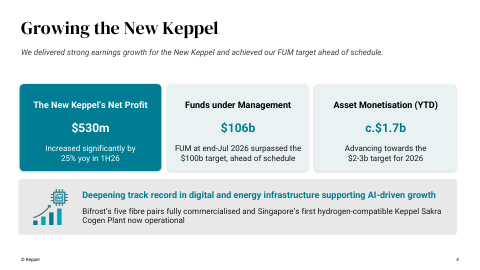
Keppel builds with funds, takes gains on fibre pair sales and keeps 25-year O&M contracts worth about $1 billion for Bifrost. — Loh Chin Hua
Transcript · Lim Siew Khee, CGS · Cable targets
Are there more fibre-pair sale targets?
Yes, but not in 2027, since pairs must be built before they can be sold. — Loh Chin Hua
Transcript · Lim Siew Khee, CGS · M1 savings
Will the $10 million M1 savings flow to profit, and has it started?
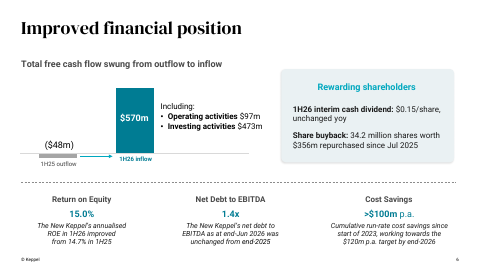
Most will flow through, and about $4 million has already been realised. — Loh Chin Hua, Manjot Singh Mann
Transcript · Mervin Song, JPMorgan · Fund upsizing
Are there plans to upsize existing funds in 2H 2026?
Fundraising is still open, investors keep signing up across strategies, and another data centre investor signed the day before. — Christina Tan
Transcript · Mervin Song, JPMorgan · M1 outlook
What are M1's restructuring costs, ARPU and subscriber trends, and sale process?
Restructuring costs are within the $70 million, ARPU shows no uplift but early signs of bottoming, and regulators are not seen as an obstacle. — Manjot Singh Mann, Loh Chin Hua
Transcript · Joel Siew, DBS · SSCI split
How much of SSCI is recurring versus event-driven?
$48 million is operational, as shown on slide 19. — Kevin Chng
Transcript · Joel Siew, DBS · Fee-paying FUM
What share of the $106 billion FUM is fee-paying?
Keppel considers it 100%, since fees are charged whenever funds are raised. — Christina Tan
Transcript · Sook Leng Lee, Retail investor · FUM growth
What is the biggest constraint to growing FUM further?
The target is $200 billion, and management is not worried about fundraising demand or deal supply given its own origination capability. — Loh Chin Hua, Christina Tan
Transcript · Sook Leng Lee, Retail investor · Net debt
How should investors think about net debt as monetisation continues?
Net debt is expected to fall as monetisation proceeds fund deleveraging, investment in the New Keppel and shareholder rewards. — Loh Chin Hua
Transcript · Mervin Song, JPMorgan · Share buybacks
Will Keppel upsize its share buyback or save capital for acquisitions?
It will focus on using the remaining capacity of the current $500 million programme first. — Loh Chin Hua