Summaries and transcripts are machine-generated and can contain errors.
In brief
Inditex kept stores supplied through Middle East disruption and kept reshaping its store base across 44 markets, as Spring/Summer collections drew a strong customer response.
Inditex's Spring/Summer collections were well received, and growth came from selling more units rather than raising prices. Retail optimisation (refurbishments, relocations, new openings and absorptions) ran in 44 markets, and the store count fell to 5,456 from 5,562. The Middle East was hurt by geopolitical conditions, but the group's spread across markets offset it. Management said it rerouted supply by air, sea and land to keep stores stocked. Self-checkout and soft tags are now fully rolled out in Zara stores.
Management plans to keep growing gross space by around 5% in 2026 and to spend about €2.3 billion on stores, technology and online platforms. It argues that low market share in fragmented markets means growth is "in our hands". The main risk is cost pressure on that plan. The weaker-dollar sourcing benefit should fade, higher transport and fuel costs will reach cost of goods sold with a lag, and last year's comparisons get tougher in the second half.
Store and online sales in constant currency, 1 May to 1 June 2026
11.5%
vs the same period in 2025, helped by calendar effects
Total stores
5,456
vs 5,562 a year ago
Zara stores
1,495
vs 1,545 a year ago
Lefties stores
217
vs 209 a year ago
Where each number comes from
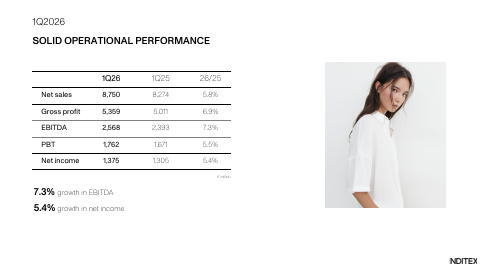
Net profit (€m): “Net profit 1,375 1,305 Net profit attributable to the Parent 1,375 1,305 Net profit margin 15.7% 15.8% Earnings per share, euros (**) 0.441 0.419”
Earnings per share (€): “Net profit 1,375 1,305 Net profit attributable to the Parent 1,375 1,305 Net profit margin 15.7% 15.8% Earnings per share, euros (**) 0.441 0.419”
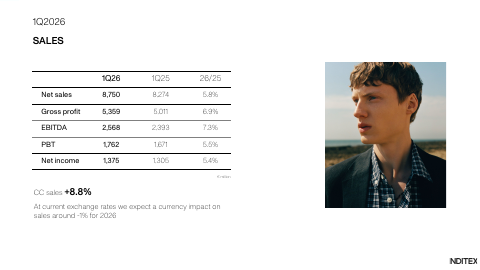
Gross margin: “Gross profit increased 6.9% to €5.4 billion. The gross margin reached 61.2%, +67 bps versus 1Q2025. All expense lines have been tightly controlled”
EBITDA (€m): “Other losses and income, net (12) (6) EBITDA 2,568 2,393 EBITDA margin 29.3% 28.9% Amortisation and depreciation (812) (752)”
Sales growth in constant currency: “Sales grew 5.8% to reach €8.7 billion. Sales in constant currency grew 8.8%. In 1Q2026, Retail Optimisation activities (refurbishments, relocations, new openings and absorptions)”
Store and online sales in constant currency, 1 May to 1 June 2026: “Store and online sales in constant currency between 1 May and 1 June 2026 increased 11.5% versus the same period in 2025, positively impacted by calendar effects”
Total stores: “At the end of the period Inditex operated 5,456 stores. A list of total stores by concept is included in Annex I.”
Zara stores: “Concept 30 April 2026 30 April 2025 Zara 1,495 1,545 Zara Home 376 388 Pull&Bear 792 804”
Store network is being reshaped, not just expanded
Retail optimisation covered 44 markets in the quarter, and the store count fell to 5,456 from 5,562 while gross space is still planned to grow around 5%. Management is betting on better locations and larger or refurbished stores rather than more doors.
Supply chain rerouted to protect store availability
Management said diversified sourcing and switching between air, sea, land and multimodal transport kept stores supplied despite geopolitical disruption. It presents this logistics flexibility as a structural strength of the model.
Middle East franchise stores open but sales hit
Around 480 stores operate in the region under a franchise model and all are open, but geopolitical conditions are hurting sales there. Management declined to quantify the effect and pointed to the group's diversification.
Growth is volume-led with stable pricing
Management said growth, including in the US and at Zara, comes from volume rather than price, under a stable pricing policy that holds relative price position in each market. In the US it is pursuing selective growth.
Self-checkout fully rolled out in Zara
Management said Zara's self-checkout hardware and soft tags are fully rolled out and customer use is rising significantly. It did not update the roughly 30% share of Zara in-store sales cited a year earlier, and says AI is increasingly embedded across operations.
What management said
Each quote matches the transcript word for word.
“our demonstrated ability to rapidly adapt transportation methods, whether through air freight, sea freight, land transportation, or a combination of each of these, we've ensured an uninterrupted supply of high fashion products to all of our stores globally.”
It shows how management handled supply disruption and how it describes its logistics model.
“growth from the Group is coming from volume and not through prices. You know, we have a stable pricing policy that can adjust in any market in order to maintain our relative price position.”
It states that demand is unit-driven and that pricing is used only to hold relative position.
“we're executing a strategy of selective growth in the market. And I think that, despite the good results that we're seeing in the online and the physical stores, we still see more opportunities for growth”
It sets out the US strategy and management's view of remaining headroom.
How should we think about the gross margin shape, including the FX sourcing benefit and limited freight impact, over the rest of the year?
The CFO said the weaker-dollar sourcing tailwind will shrink in coming quarters, higher freight costs reach cost of goods sold with a lag, and the current environment is within the full-year gross margin guidance. — Andrés Sánchez
Beyond business model execution, are there mitigation levers such as price increases for higher transport costs, and what was the calendar effect in current trading?
Management pointed to sourcing and multimodal transport flexibility as its main lever, and said the four-week trading period was helped by calendar effects and faces tougher comparisons later in the year. — Gorka García-Tapia, Andrés Sánchez
Where is operating expense inflation coming from, given it grew slightly ahead of sales?
Management said both lines grew around 6%, that it aims for stable margins in the medium term while reinvesting in customer experience, and that currency effects are not symmetrical down the P&L. — Gorka García-Tapia
Transcript · Anne Critchlow, Berenberg · Middle East
How large was the Middle East impact on first-quarter and current-trading growth?
Management did not quantify it, saying the roughly 480 franchise stores are all open and that conditions affect the region's countries differently. — Gorka García-Tapia
Are you seeing upward pressure on product costs such as polyester given higher oil prices?
Management confirmed higher cotton and other raw material costs but said textile costs are not a significant part of cost of goods sold, and that 27% of its raw materials are polyester, almost all recycled. — Gorka García-Tapia
Transcript · Richard Chamberlain, RBC · Pricing and US
Is growth, especially in the US, still volume-driven, and how do average and like-for-like selling prices compare?
Management said growth is volume-driven everywhere under a stable pricing policy, and called the US a relevant market with a selective growth strategy. — Gorka García-Tapia
Transcript · Grace Smalley, Morgan Stanley · Depreciation
What drove depreciation and amortisation being higher than expected, and how should it be modelled?
The CFO said D&A rose 8% on extraordinary capex from 2024 and 2025 now in use, right-of-use asset depreciation, and the retail optimisation programme, and declined to give precise 2026 guidance. — Andrés Sánchez
Transcript · James Grzinic, Jefferies · Self-checkout
What share of Zara's in-store sales now goes through self-checkouts, versus about 30% a year ago?
Management said usage has increased and that self-checkout hardware and soft tags are fully rolled out, but gave no updated percentage. — Gorka García-Tapia
What is the update on consumer behaviour and the potential impact of inflation in the US or Europe?
Management said it sees no significant impacts anywhere and that growth depends on spotting trends and reacting quickly, given low market shares. — Gorka García-Tapia
Is there potential for higher average selling prices at Zara?
Management said Zara is primarily volume-driven, that its pricing policy is stable and that it adjusts by market only to maintain relative price position. — Gorka García-Tapia
Questions
How is Inditex changing its store network?
It ran retail optimisation (refurbishments, relocations, new openings and absorptions) in 44 markets, ending the quarter with 5,456 stores versus 5,562 a year earlier. It still plans annual gross space growth of around 5% in 2026.
Is Inditex's growth coming from higher prices?
No. Management said growth, including in the US and at Zara, is volume-driven, and that it keeps a stable pricing policy that adjusts only to maintain relative price position in each market.
How did Inditex handle supply chain and Middle East disruption?
It used a diversified sourcing model and switched between air, sea, land and multimodal transport to keep stores supplied. The Middle East was hurt by geopolitical conditions, but all roughly 480 franchise stores there are open.
Where is Inditex investing in 2026?
It expects ordinary capital expenditure of around €2.3 billion, mainly for store space, technology integration and online platforms. Management also said AI is increasingly embedded across operations and that Zara's self-checkout is fully rolled out.
Should the strong start to the second quarter be extrapolated?
Management cautioned against it. Sales from 1 May to 1 June rose 11.5% in constant currency, but that covered only four weeks and was helped by calendar effects. Comparisons also get tougher in the second half.
Buenos días a todos, good morning. We would like to extend a warm welcome to all of those attending the presentation of Inditex’s results for the first three months of financial year 2026. I'm James O'Shaughnessy, Investor Relations.
Going forward the first quarter and the third quarter results presentations will place greater emphasis on the financial and operational performance of the business over the period. With this in mind, today’s presentation will be hosted by our Chief Financial Officer, Andrés Sánchez, together with the Director of Investor Relations, Gorka García-Tapia.
Once the presentation itself is complete, we will commence the usual Q&A session starting with questions received over the phone, followed by those received via the webcast platform. Let's take the disclaimer as read.
As you may have seen from the financial press release posted earlier this morning, Inditex has generated a strong performance over this first quarter. This is particularly relevant given the wider macroeconomic and geopolitical uncertainty we have all been reading about in the newspapers in recent times.
For now, let me highlight that Inditex’s strong financial results were not only driven by a robust commercial performance, but also, importantly, by the strength and consistency of our operational execution. We'll comment on this further in a few moments, and I'm sure some of you will have questions on this.
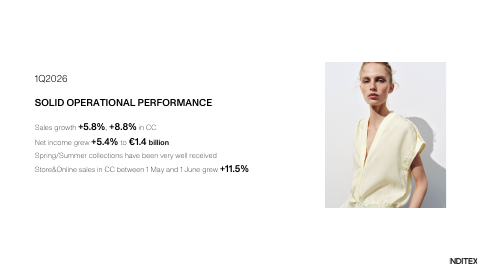
Firstly, Spring/Summer collections so far this season have been very well received by our customers. Sales over the period increased by 5.8%, or by 8.8% in constant currency.
This execution has translated into a strong gross margin performance, driven by the effective execution of our business model. At the same time, we have maintained a disciplined approach to cost management, enabling us to successfully contain costs across the business.
And now to current trading. The very satisfactory performance of the first quarter has continued going into the second quarter. Store and online sales in constant currency between the first of May and the first of June grew 11.5%, positively impacted by calendar effects.
In the context of recent events, close management of the supply chain has been of paramount importance. This factor, as you can see, in conjunction with executing well, has led to a very robust performance in terms of gross margin.
Likewise, operating expenses have been well managed over the period and this has resulted in operating expenses growing by 6.4%, very much in line with the sales performance of the business.
this performance was the robust execution of the business model. With this in mind, the gross margin reached 61.2%, representing an increase of 67 basis points over the first quarter last year. You should take into consideration the FX sourcing benefit from the weaker US dollar and a limited impact in the quarter from higher fuel prices, due to the lagged effect of transportation costs in COGs. In the wider context, I would say that we have exhibited a high level of flexibility and adaptability as reflected well in the results today.
Passing over to operating expenses, we continue to be very vigilant regarding costs across the whole Company, whether by department or by business line.
The discipline and flexibility of our operating model continues to support a strong working capital profile and efficient inventory management across the Group.
I think the results speak for themselves. They represent a very strong set of numbers, which are underpinned by the healthy execution of our business model across the Group.
This performance is even more noteworthy when considered against the backdrop of the wider macroeconomic and geopolitical challenges seen in recent months.
These conditions have had an impact on the sales of the middle east region, however the group has continued to deliver overall sales growth at a global level reflecting the strength of our collections and the broad diversification of our business. We have once again demonstrated a remarkable degree of adaptability, not
Thanks to the diversification of our supply chain and our demonstrated ability to rapidly adapt transportation methods, whether through air freight, sea freight, land transportation, or a combination of each of these, we've ensured an uninterrupted supply of high fashion products to all of our stores globally.
From a longer-term strategic perspective, our ongoing Retail optimisation strategy, which focuses on important new openings, enlargements and the refurbishment of stores in the best global locations, remains very much the focus of our efforts. We are expanding all of our concepts into new cities and new territories, while at the same time launching new services aimed at enhancing the customers' shopping experience.
Currently, we have operations in 215 markets, with a relatively low market share in each of these. Let's not forget the highly fragmented nature of almost all of these markets. All this offers us substantial future growth opportunities.
With this in mind, Retail Optimisation activities, you know, refurbs, relocations, new openings and absorptions, have been conducted in 44 markets over the period. All concepts, including Zara, continue to deliver exciting new openings in key locations around the world.
As has always been the case at Inditex, our strategy looks very much to the long-term. Investments made, aim to scale our capabilities, to drive ongoing efficiencies and ultimately to enhance our competitive proposition.
The growth of annual gross space in 2026 is expected to be around 5%. Over this same time period, Inditex expects space contribution to sales to be positive, in conjunction with a strong evolution of online sales.
For 2026, we estimate ordinary capital expenditure of approximately 2.3 billion euros. We continue to focus the ordinary capital expenditure on our global store base, the online platform, and the roll out of technology programs aimed at enhancing the level of integration.
The dividend will be made up of two equal payments: On the 4th of May 2026 Inditex made a payment of €0.875 per share. The remainder, €0.875 per share will be payable on the 2nd of November 2026.
The telephone Q&A session starts now. If you would like to ask a question, please press Star-5 on your telephone keypad. If you wish to withdraw your question, please press Star-5 again. We request that you limit yourself to only one question per turn so we can maximize the number of participants in the session. If you have further queries, you may press Star-5 again after the next person's question has been addressed. Please ensure your phone is not on mute.
Hi, good morning, team. Thanks for taking my question. Thanks, James. Andrés, can I just pick up a comment you made? I think you talked about gross margin, the shape of it, FX sourcing benefit, and limited impact from freight in Q1. Any thoughts at all on how we should think about those aspects in the rest of the quarters, please? I realise you reiterated the guidance. Any help in terms of the shape, would be incredibly helpful. Thank you.
Thank you, Sreedhar. Thank you for your question. I would say that a strong start to the year and the gross margin performance were mainly driven by the effective execution of our fully- integrated business model. It is important also to highlight the ability of our teams to respond quickly to customer demand. In any case, in the current environment, I think it is worth to highlight that we have been able to rapidly adapt our supply chain to ensure uninterrupted product flow to our stores globally, using a combination of different means of transport, guaranteeing that we are able to feed our central inventory position.
To complete the analysis of the gross margin performance, I think it's important also to highlight a few key points. First of all, in relation to proximity sourcing, I would say that diversification of our sourcing model, in terms of origin of goods and a combination of proximity and non-proximity sourcing, continues to be key to give us flexibility and to adapt rapidly our supply chain.
Secondly, and in relation to transport cost; please keep in mind that there is a lag effect between the transportation of goods and their impact on the cost of goods sold, which means that the impact on the higher transport costs and fuel prices in the first quarter has so far been limited.
And third, and as we mentioned during the presentation, I think it's also relevant that we have benefited from an FX sourcing tailwind in Q1. From a weaker US dollar, which, as you will assume, will be reduced over the next few quarters.
All in all, I think it's important, as a final remark, to highlight that we have to reiterate that the current environment is included within our gross margin guidance of ±50 basis points for the full year. Thank you.
Hi, thank you. Just following on from your comments about the transportation higher costs coming in future quarters, just wondering if, other than sort of general execution of the business model, if there are mitigation opportunities that you're considering around, maybe pricing increases or other kind of new levers of efficiencies in the business, please.
If you could also just help us understand the calendar effect you mentioned in the current trading period, that would be really helpful as well, please. Thank you.
Hi, Georgina. Thank you for your question. So, I think the first part of your question, I think what's important here is the operational capacity that we have at the Group. I think you're seeing, as we are, the current geopolitical situation. But I think that one of the key strengths for the Group is the sourcing and logistics model that we have. And I think that, naturally, in the current environment, it requires a very high level of operational coordination and flexibility. But I think in our view, this is, actually, precisely one of the structural strengths that the Inditex business model has. So I think one of the capacities that we have is that flexibility and adaptability, not only in terms of where we're sourcing the goods, proximity plays a role here, obviously, but I think also in terms of adaptation of the transportation methods. And I think these are one of the things that we've been trying to highlight, the fact that we're using different combination of modes and even, in certain cases, multimodal solutions where we think it's appropriate. I think you had a second question related to calendar impacts in the trading. So I think maybe, Andrés, you want to cover that?
Regarding the trading update, we would like to say that we are very pleased with the strong evolution of the sales at the start of Q2. It is clear that this continues to reflect the good reception of our spring/summer collections, and of course, the remarkable execution of our business model across all channels and markets.
All in all, we do believe it is important to interpret this short trading period with caution, which means that this is only four weeks. So, remember that last year we provided five weeks. So firstly, and as we mentioned in the press release, this short trading period has been positively impacted by those calendar effects that came in later in the previous year. And secondly, I think it's also important to highlight, in 2025, comparables get progressively stronger as the year goes on, most notably, as you perfectly know, in the second half. So going forward, the growth algorithm for the Group hasn't changed, and you should consider this when thinking about the growth for the rest of the year. Thank you.
flagged that they grew broadly in line with sales. They did actually grow a little bit ahead of sales, although only a little bit. Where, perhaps, is the inflation coming from? Is it because of strong online growth or maybe the acceleration of space, or maybe it's because of the new distribution logistics centers coming on stream? Maybe just comment around the growth of OPEX, please.
Sure. Thanks, Warwick. So I think with regards to OPEX, I mean, you're right. What we pointed to was basically at the top line, we're seeing growth of around 6% and OPEX growth, the same, around 6%, right? I think you have to remind yourself that the objective that we have in the company is to have stable margins in the medium term. So, there's a lot of reinvestment activities that we're doing focused on the customer experience in the group. And I think we've talked about this in the past. But you should also take into consideration, for example, the FX impact. In a quarter where you have a strong FX impact on the top line, you have to remember that it's not symmetrical as you go down the P&L. And so, in that sense, when you take that into consideration, I think you'll better understand our comments. Thank you.
Good morning. Thank you. Would it be possible to give an idea of how great the impact of the Middle East performance was in Q1 and current trading? So, for example, could you give us an idea of constant currency sales growth in Q1 and current trading, stripping out the Middle East? Thank you.
Great. So I think with regards to the Middle East, let me just preface by saying, you know, we have around 480 stores in the region. We're operating under a franchise model, which I know that you guys are all aware. Today, all of these stores are open. I think the geopolitical conditions are having an impact on the sales in the Middle East region, but I'd also highlight the fact that it is a diverse region and that there are different countries having different impacts. All in all, what I think the main message that we're trying to send is that the group has been able to perform in the first quarter, deliver a strong growth, and I think that's a good reflection of the broad diversification that the business has.
Hi, morning. Thank you for taking my question. I just had one question. As we think a little bit more about that evolution of the gross margin through the year on product costs. So, whether or not, you know, conversations that you're having with suppliers at the moment, you're seeing some upward pressure on product costs, particularly, around polyester pricing, just given the oil price impact we've seen?
Thank you. So I think you're right, we have seen increasing costs, for example, in cotton and other raw materials in the last few months. However, you have to take into consideration that these costs of textiles that you're seeing in the market don't really have a significant, or they're not a significant part of the cost of goods sold as it's built up, right? So, I think the biggest driver for us for gross margin, and I think that this covers most of the questions that we've had up to now, is really the performance and the execution of the business model.
In terms of raw materials, to give you a little bit more color, I think 57% of the raw materials that we consume are biological, and we have 27%, which are polyester. And I think an important point to highlight here is that almost all of that polyester is recycled. Thank you
Yeah, thanks, James. Morning, everybody. My question is on pricing, please. I just wonder what you're seeing there, particularly in the US market. Is mainly the growth still volume-driven? And are you seeing a big difference in average compared to like-for- like selling prices? Thank you.
Great. Yeah, I think, you, you hit the nail on the head there. I think what we continue to see, not only in the US but broadly speaking, is growth from the Group is coming from volume and not through prices. You know, we have a stable pricing policy that can adjust in any market in order to maintain our relative price position. But I think that's the key point there. It's volume-driven.
the past, we're executing a strategy of selective growth in the market. And I think that, despite the good results that we're seeing in the online and the physical stores, we still see more opportunities for growth because we do have a low market share and it's a fragmented market. And I think that the growth in that sense is in our hands and it's not really dependent on the performance of the broader market. Thank you.
Hi. Good morning. Thank you for taking my question. I just have a quick one on D&A, please, which was slightly higher than we expected in the first quarter. Could you just help us with if there's any drivers in particular to call out within that, and if there were any one-offs, for example? And then just what are the factors we should be considering when modeling that D&A line going forward? Thank you very much.
Thank you, Grace. Thank you for your question. As you have seen, D&A increased by 8% in Q1 2026, following a 3% increase in fiscal year 2025. There are several factors behind this evolution. However, it is difficult to provide, in this sense, precise
One of the main drivers of the evolution, as you can imagine, in Q1 is the extraordinary CAPEX executed in 2024 and 2025, which is now in use. Secondly, I think it's also important to mention that we have here, in this line, the depreciation of the right-of-use assets, which represents a significant component of the D&A line. And this is influenced by the length and the structure of the lease contracts, including, of course, break clauses, also the variable rent component, and the impact of the renegotiations and the interest rate-related assumptions.
And finally, you have also to consider that when looking to D&A line, we have to take into consideration that we continue executing our retail optimisation program, which may also affect, taking into account, the quarterly evolution of this figure. Thank you.
Yeah, thank you, James. Morning all. Just a super quick one, really, and I guess it goes to the point that you just mentioned on the retail optimisation program. I think it was about a year ago that you told us that 30% of ZARA's physical sales, in-store sales, were through self-checkouts. Can you please update us on what
So I think I can confirm that the numbers have, of course, increased. I think we're fully rolled out in terms of the self- checkouts, the hardware, and the soft tags, more importantly. I think that the combination of all of those is really what helps to drive. What we're seeing is that everywhere that it's implemented, the uptake and the use by the customers is increasing significantly. I think that's what we can tell you at this stage.
That concludes the questions for today. Let's move over to webcast questions, the first of which relates to the state of the consumer. “Can you give us an update on consumer behavior, potential impact from inflation in the US or Europe, please?”
I think I touched on part of this question before, with Richard's question. I mean, what we're seeing is that a lot of growth opportunities, we have low market shares, and we really do think that the growth is in our hands. We're not seeing anything at this stage, and we think that it's more dependent on the execution of the business model, having the capacity of identifying the trends and really reacting in a short period of time in order to capture that growth. So, we're not really calling out any significant impacts anywhere. Thank you.
The next question in the webcast platform relates to ZARA and potential higher average selling prices. Perhaps you can give us some color on this, please.
Yeah, again, I think I answered this related to the US, but basically, broadly speaking, in ZARA, everything is primarily volume-driven. And the authority that we have in the market is through the product, the fashion proposition, and not the pricing. So, there hasn't been a change here at all. As I mentioned before, we have a very stable pricing policy that, of course, can take into consideration some adjustments in any given market, but basically with the objective -from a commercial perspective, to maintain our relative position in each of those markets. Thank you.
It was good to see so many people participating in today's presentation. For any additional questions, feel free to get in touch with the Investor Relations Department. And we look forward to welcoming you back in September for the first-half 2026 results.