OpenNashEarnings
AIY

iFAST Corporation (AIY) · Financial Services

iFAST Corporation Q3 2026 earnings call: transcript, summary & key numbers

Results filed 26 Oct 2026 · Quarter ended 30 Sep 2026 · Call 82 min · Lim Chung Chun (CEO), Terence (CFO)

Read the transcriptSlides (58 pages)Press release ↗Investor relations ↗

Summaries and transcripts are machine-generated and can contain errors.

In brief

iFAST Global Bank's customer deposits passed S$2.04 billion and the UK digital bank turned solidly profitable, while a planned Hong Kong ORSO pension launch slipped into 2027.

iFAST's wealth platform kept attracting assets, with record assets under administration (AUA) in Singapore, Hong Kong, Malaysia and the UK. Stocks and ETFs grew fastest, helped by new SGX ETFs. The UK bank iFAST Global Bank drew deposits through personal and business accounts and is rolling its multi-currency debit card out to seven markets. B2C grew faster than B2B, and Hong Kong costs levelled off as ePension onboarding finished.

Management wants to become a truly global bank-plus-wealth platform, aiming for S$100 billion of AUA by 2030 and a UK bank with a S$15 billion deposit base. The bank's growing weight, a rising loan-to-deposit ratio and heavy dependence on remittance fees add risk. Market downturns would slow AUA, and the Hong Kong ORSO launch has slipped to the second half of 2027.

Slides & documents

Open the slide deck (PDF, 58 pages) ↗

iFAST Corporation Q3 2026 slide deck, page 1iFAST Corporation Q3 2026 slide deck, page 2iFAST Corporation Q3 2026 slide deck, page 3iFAST Corporation Q3 2026 slide deck, page 4iFAST Corporation Q3 2026 slide deck, page 5iFAST Corporation Q3 2026 slide deck, page 6

Showing the first 6 of 58 pages.

Results documents

Key numbers

Total revenue
S$167.01 million

up 23.0% YoY

Net profit
S$32.37 million

up 24.5% YoY

EBITDA
S$51.59m

up 22.8% YoY

Segment or metricValueChange
Group assets under administration (AUA)S$36.76 billionup 20.0% YoY
Net inflowsS$1.24 billiondown 16.9% YoY
B2B AUAS$23.60 billionup 18.3% YoY
B2C AUAS$13.16 billionup 23.4% YoY
iFAST Global Bank pretax profitS$3.29 millionup 964.7% YoY
iFAST Global Bank customer depositsS$2.04 billionup 31.2% YoY
Where each number comes from
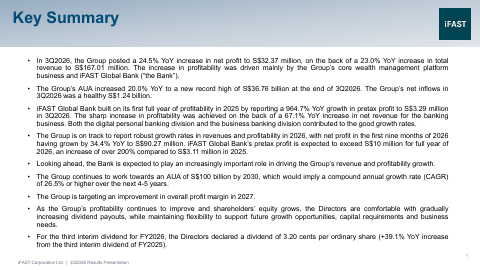
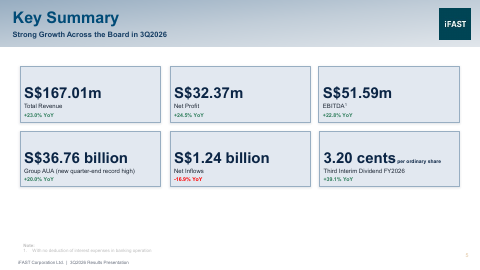
  • Total revenue: “In 3Q2026, the Group posted a 24.5% YoY increase in net profit to S$32.37 million, on the back of a 23.0% YoY increase in total revenue to S$167.01 million.”
  • Net profit: “In 3Q2026, the Group posted a 24.5% YoY increase in net profit to S$32.37 million, on the back of a 23.0% YoY increase in total revenue to S$167.01 million.”
  • EBITDA: “S$167.01m S$32.37m S$51.59m Total Revenue Net Profit EBITDA1 +23.0% YoY +24.5% YoY +22.8% YoY”
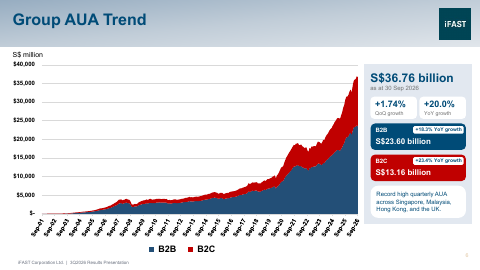
  • Group assets under administration (AUA): “The Group’s AUA increased 20.0% YoY to a new record high of S$36.76 billion at the end of 3Q2026.”
  • Net inflows: “The Group’s net inflows in 3Q2026 was a healthy S$1.24 billion.”
  • B2B AUA: “B2B +18.3% YoY growth $20,000 S$23.60 billion $15,000 B2C +23.4% YoY growth $10,000 S$13.16 billion”
  • B2C AUA: “B2B +18.3% YoY growth $20,000 S$23.60 billion $15,000 B2C +23.4% YoY growth $10,000 S$13.16 billion”
  • iFAST Global Bank pretax profit: “iFAST Global Bank built on its first full year of profitability in 2025 by reporting a 964.7% YoY growth in pretax profit to S$3.29 million in 3Q2026.”
  • iFAST Global Bank customer deposits: “The customer deposit amounts for iFAST Global Bank (iGB) increased 12.2% QoQ and 31.2% YoY to S$2.04 billion as at 30 September 2026.”

Copied from the press release ↗ and other documents in the company's results page ↗. A figure is published only if its sentence is in those documents.

Outlook

MetricPeriodOutlook
iFAST Global Bank pretax profitfull year of 2026exceed S$10 million
Group AUA targetby 2030S$100 billion
iFAST Global Bank net interest margin targetbank target125 to 150 basis points
iFAST Global Bank cost-to-income ratio at S$15 billion deposits2030 scenario35 to 40%

Key takeaways

  1. UK bank becomes a real growth engine

    iFAST Global Bank's deposits grew across both Digital Personal Banking and Business Banking, and management says the bank will play an increasingly important role in group growth. It is targeting a S$15 billion deposit base by 2030 under its scenario planning.

  2. Global bank pitched at mass-affluent savers

    Management positions the bank as a multi-currency, borderless offering for mass-affluent and retail customers, including non-residents and migrants, whom most banks ignore. The multi-currency debit card is being extended to seven markets, and payment services are a priority.

  3. Ecosystem lending funds the bank's assets

    The bank lends mainly through product financing and premium financing to customers from iFAST's own platforms, mostly in Asia, while keeping most assets in bonds and cash. Loan-to-deposit is expected to reach 20-plus percent by year-end and about 30% by end of next year.

  4. Hong Kong ORSO launch slips to 2027

    The ORSO business will not add AUA in 2026, and management now assumes the second half of 2027, citing industry-wide changes after eMPF onboarding. Hong Kong headcount peaked mid-2026, so costs are flat even as the pension project is still being run at full staffing.

  5. ETFs and a stake in Financial Alliance

    iFAST is launching its own SGX ETFs, working with fund managers for products and using its own distribution. It also took a 30% stake in Financial Alliance to help build a listed Singapore financial advisory firm, which would strengthen its B2B channel.

What management said

Each quote matches the transcript word for word.

“there is an opportunity in Singapore for a listed financial advisory firm, a sizeable, growing and listed financial advisory firm, because till today there isn't one.”

Gives the rationale for the Financial Alliance stake and its link to the B2B platform.

0:51:11 · Lim Chung Chun (CEO)

“I think it's important that we have a business model, an ecosystem that allows us to grow organically.”

Shows organic growth is the starting point, with M&A used selectively.

0:48:59 · Lim Chung Chun (CEO)

“The reason for the delay is related to the fact that the whole pension industry in Hong Kong has gone through this big change in the last couple of years.”

Explains why the Hong Kong ORSO launch has been pushed back.

0:53:57 · JP (Investor Relations)

Analyst Q&A

  1. 0:15:48 · Analyst · Remittance flows

    Which remittance currency corridors are driving the most flows at the bank?

    Remittances originate in dollar-linked GCC currencies and pay out in local currencies of corridors such as Pakistan, Bangladesh and India. — Terence

  2. 0:16:22 · Analyst · Revenue mix

    What does the bank classify as non-recurring income, given that remittance renewals look recurring?

    Recurring income is net interest income plus hedging-related FX effects, while non-recurring income is FX and remittance revenue, with EzRemit the largest part. — Terence

  3. 0:18:08 · Analyst · Bank costs

    How should the bank's cost base and cost-to-income ratio evolve after the profit jump?

    Cost-to-income is about 80% this year and management would target 35 to 40% at a S$15 billion deposit base by 2030. — Terence

  4. 0:20:00 · Analyst · Bank lending

    Will the bank lend, or stay mainly in bonds and money market funds?

    It already lends through product financing and premium financing, with loan-to-deposit expected at 20-plus percent by year-end, and invests the rest in bonds. — Lim Chung Chun

  5. 0:21:32 · Jayden · Hong Kong costs

    How will Hong Kong costs evolve now that the pension ramp-up is largely done?

    Headcount peaked in mid-2026 and group staff costs fell about 3% quarter on quarter, so no major new cost escalation is expected. — Terence

  6. 0:24:52 · Jayden · Cost optimisation

    Can Hong Kong costs actually come down rather than stay flat?

    Management is looking for process optimisation but will not prematurely cut resources while it focuses on executing the project well. — Terence

  7. 0:25:29 · Weikong · Bank positioning

    How is the UK bank positioned to keep attracting strong deposit growth?

    It positions itself as a global bank for mass-affluent and retail savers, including non-residents, and is improving payment services. — Lim Chung Chun

  8. 0:30:59 · Weikong · Hong Kong ORSO

    Is the Hong Kong ORSO launch on track for the fourth quarter?

    No, it will not add AUA by the end of 2026 and is now expected sometime in 2027. — Lim Chung Chun

  9. 0:30:59 · Weikong · ETFs

    How should investors view recurring fees from the four new SGX ETFs?

    iFAST earns a management fee at the ETF level, net of any rebates passed back to the fund, plus market-making components over time. — Lim Chung Chun

  10. 0:34:45 · Zixian · UK bank revenue

    What drove the roughly S$5 million quarter-on-quarter jump in UK bank net revenue?

    Deposit growth, higher EzRemit and transaction banking fees, and a reclassification that moved FX effects from operating expenses into revenue. — Terence

  11. 0:38:38 · Zixian · Hong Kong eMPF

    Has Hong Kong eMPF revenue declined sequentially, and will it continue?

    Onboarding benefits have faded but the revenue base remains high and is a strong recurring income business. — Lim Chung Chun, Terence

  12. 0:41:38 · Zixian · 2030 AUA target

    Does the 2030 AUA target assume a consistently favourable market?

    No, it assumes markets rise over the long run with periodic dips, and that iFAST grows faster than the market. — Lim Chung Chun

  13. 0:43:27 · Dana · Margin financing

    Are the bank's margin financing customers mostly existing wealth customers?

    Yes, most borrowers come from iFAST's ecosystem in Asia, including FSM, B2B platforms and advisers. — Lim Chung Chun

  14. 0:45:08 · Dana · Customer mix

    What share of bank customers are resident versus non-resident?

    A majority of personal banking accounts are non-resident, from over 100 countries, but more than half of deposits come from residents. — Lim Chung Chun

  15. 0:46:49 · Dana · Lending rates

    Are margin financing rates tied to the UK risk-free rate?

    Rates depend on the borrowing currency, and lending in currencies such as Swiss franc is swapped, which adds FX revenue. — Lim Chung Chun

  16. 0:48:28 · Dana · M&A

    What is iFAST's M&A strategy, including the Financial Alliance stake?

    Organic growth comes first, and acquisitions are strategic, such as the UK bank and Financial Alliance, which aims to build a listed Singapore advisory firm. — Lim Chung Chun

  17. 0:52:29 · Akash · Hong Kong ORSO

    What caused the Hong Kong ORSO delay, when will it start, and how big will it be?

    Industry-wide pension changes caused the delay, timing is assumed in the second half of 2027, and the incremental growth will not substantially change the group's profit growth. — Lim Chung Chun

  18. 0:56:57 · Akash · Hong Kong margins

    Is Hong Kong's current net revenue to AUA a sustainable level?

    ePension revenue does not depend on AUA, so the ratio is not representative and quarterly moves reflect the end of onboarding benefits. — Terence

  19. 1:00:18 · Akash · ePension margin

    Can ePension's estimated 35% PBT margin move back toward 40%?

    Revenue is at full operations, so any margin gain would come from slightly fewer people through efficiency, not dramatic cuts. — Terence

  20. 1:02:39 · Akash · Bank growth drivers

    What will drive the bank's growth toward S$15 billion of deposits?

    Both personal banking and business banking, including transaction banking for e-money and payment firms, with lending kept at a modest loan-to-deposit ratio. — Lim Chung Chun

  21. 1:07:18 · Raywin · Loan-to-deposit

    What is the current and 2030 loan-to-deposit ratio, and can bank yields exceed 200 basis points?

    Loan-to-deposit is in the high teens, heading to about 30% by end of next year, and the revenue margin is currently about 2.6% versus the 200 basis point plan. — Lim Chung Chun, Terence

  22. 1:11:18 · Sheryl · Interest rates

    How do higher interest rates affect the different parts of the group?

    Higher rates are positive for the bank and for the bonds business, and on balance likely positive for the group. — Lim Chung Chun

  23. 1:14:12 · Sheryl · China

    How dependent is the China business on Chinese equity sentiment?

    Short-term AUA is affected by volatility, though the structural positioning should hold, and onshore customers are mostly exposed to the local market. — Lim Chung Chun

  24. 1:15:51 · Analyst · UK deposits

    What attracts UK locals to deposit with iFAST Global Bank?

    Interest on current accounts, multi-currency accounts with attractive rates, and a strong proposition for migrants and non-residents. — Lim Chung Chun

  25. 1:18:15 · Kelvin · 2027 outlook

    What are the growth prospects for 2027?

    Management targets robust growth, with banking profitability rising substantially, modest ePension growth, and wealth management aiming for over 20% a year barring a bear market. — Terence

  26. 1:20:14 · Lin · B2C vs B2B

    Why is B2C growing faster than B2B?

    FSM has grown well in Singapore, and all UK bank deposits are currently classified under B2C. — Lim Chung Chun

Questions

What is the main strategic story at iFAST this quarter?

iFAST Global Bank is scaling quickly, with deposits of S$2.04 billion and a pretax profit it expects to exceed S$10 million for 2026, and management says it will play an increasingly important role in group growth.

How is iFAST positioning its bank against traditional banks?

It pitches a multi-currency, borderless digital bank to mass-affluent and retail savers, including non-residents and migrants. The multi-currency debit card is being extended to seven markets.

What is happening with the Hong Kong ORSO pension launch?

It will not add AUA in 2026. Management attributes the delay to industry-wide pension changes and now assumes the second half of 2027.

Where is demand for iFAST's platform coming from?

Record AUA in Singapore, Hong Kong, Malaysia and the UK, with stocks and ETFs growing fastest and B2C growing faster than B2B. The group's AUA ambition is S$100 billion by 2030.

What is iFAST doing with acquisitions and new products?

It is launching its own SGX ETFs with existing fund managers, expanding its debit card, and holding a 30% stake in Financial Alliance to help build a listed Singapore advisory firm. Organic growth remains the priority.

Transcript

Official recording from iFAST Corporation Ltd. on YouTube ↗. Timestamps jump to the moment.

0:00:00
JP (Investor Relations)

Hi everyone. Welcome to iFAST Corporation's third quarter 2026 and nine months 2026 results presentation. I am JP from the Corporate Comms team. From the iFAST team, we also have our Group CEO, Chung Chun, and our Group CFO, Terence, with us. We also have members from our Corporate Comms and Finance team. So I will run through the key summary as well as the business update before having Terence go through the financial results. And thereafter, we will have the Q &A session.

0:00:34

So I'll start off with a key summary. So in Q3, 2026, the group posted a 24.5 % year-on-year increase in net profit, which stood at $32.37 million. This is on the back of a 23 % year-on-year increase in total revenue to $167 million. The increase in profitability was driven mainly by the Group's Core Wealth Management Platform as well as our bank in the UK, which is iFAST Global Bank. The Group's Assets Under Administration, or AUA, increased 20 % year-on-year to a new record high of $36.76 billion at the end of third quarter.

0:01:14

Our net inflows in third quarter 2026 was a healthy $1.24 billion. iFAST Global Bank built on its first full year of profitability in 2025 by reporting a 964 % year-on-year increase in pre-tax profit to $3.29 million in third quarter of 2026. The sharp increase in profitability was achieved on the back of a 67 % year-on-year increase in net revenue for the banking business. Both the Digital Personal Banking Division as well as the Business Banking Division contributed to the good growth rates in our bank.

0:01:51

The group is on track to report robust growth rates in revenues and profitability in 2026, with net profit in the first nine months of 2026 having grown by 34.4 % year-on-year to $90.27 million. iFAST Global Bank's pre-tax profit is expected to exceed $10 million for the full year of 2026, which would be an increase of over 200 % compared to the $3.1 million in 2025. Looking ahead, the Bank is expected to play an increasingly important role in driving the Group's revenue and profitability growth.

0:02:27

The Group continues to work towards an AUA of $100 billion by 2030, which will imply a compound annual growth rate or CAGR of 26.5 % or higher over the next four to five years. The group is targeting an improvement in overall profit margin in 2027. And as our profitability continues to improve and our shareholders' equity continues to grow, the directors are comfortable with gradually increasing dividend payouts while maintaining flexibility to support future growth opportunities, capital requirements, and business needs.

0:03:03

For the third interim dividend for FY2026, the directors declared a dividend of 3.2 cents per ordinary share, which is 39 % higher compared to last year. On the next slide, most of the data here have been mentioned. The only one to just highlight would be the EBITDA number, which is at $51.59 million in third quarter 2026, which represents a year-on-year growth rate of 22.8%. For our Group AUA trend, as mentioned just now, it's at $26.76 billion.

0:03:37

It's a record high. It's up 20 % year on year. And on a Q-on-Q basis, it's up 1.74%. The contribution from our B2B and B2C divisions are at respectively $23.6 billion for B2B and $13.16 billion for B2C. So about 64 % of our Group AUA comes from our B2B division, with 36 % coming from our B2C. Both divisions have grown well, with B2C growing at a slightly faster pace year-on-year of 23%.

0:04:07

The next slide shows our AUA breakdown by markets and products. So I think if you look at the AUA breakdown by markets, Singapore remains the largest market at 68%, followed by Malaysia and Hong Kong at roughly about 11 plus percent each, and 8 % composing of China and our UK bank business. In terms of products, UNIT Trust remains the mainstay in terms of the contribution to our AUA, so it has a 55 % share in terms of our AUA, followed by stocks and ETFs.

0:04:44

And if you look at this pie chart, you'll notice that stocks and ETFs have been growing at the faster clip compared to the other products in our ecosystem. The net inflows trend, I talked about the third quarter number coming in at $1.24 billion. So for nine months of 2026, our net inflows stand at $3.8 billion. So year on year for third quarter, that's up 2.3 % for nine months in terms of net inflows.

0:05:15

And if you look at our unit trust numbers, so in terms of the subscription, for nine months we're at $10.43 billion, which is up 33 % year on year. So I think for each of the quarters this year, we've done consistently over $3 billion in terms of UAT subscriptions. I'll go to the business updates and highlight the key points. so i think i mentioned about the bank's progress and report card which came in strongly and looking at this slide in terms of the profit and loss so uh thank you pbt for the bank at 3.29 $1 million that's up year on year by 964% and for nine months of this year pbt stood at 5.9 million

0:05:59

dollars which is a year-on-year increase of 193% in terms of some of observations we've noticed from the bank. So I think the sharp increase in profitability. So we've seen that coming from both, as I mentioned just now, from our B2C division, which is the digital personal banking division, as well as our B2B, which is the business banking division. In terms of the profit expectation, the bank's top line growth puts the bank on track to exceed pre-tax profit of $10 million for the full year of this year.

0:06:32

And we've previously communicated that the bank targets a net interest margin of 125 to 150 basis points, which reflects the deposit-taking side of the bank's business. If we include the non-interest revenues, such as fee income from our remittance business, the bank's overall targeted revenue margin is higher at 200 basis points. The other development at IFOS Global Bank is that the bank is in the midst of broadening the reach of its multi-currency debit card to seven markets.

0:07:06

So in March 2025, we announced that the debit card was launched in IPAS Global Bank, but it was just for UK customers. But I think this is a broadening of the service for more customers globally. So in this case, to customers from these seven markets are mentioned here. For the dividend information, so for third quarter, I mentioned just now 3.2 cents per ordinary share. So that's 39 % higher year on year. And for FY2026, we have previously also communicated that we're looking at expected dividend of 12 cents or more, and that would be a year on year increase of 43 % or higher for FY2026.

0:07:52

The next slide shows some of the additional details regarding the dividend schedule. So payment date will be on 19th of November, 2026. I'll wrap up with some of the statistics here. I won't run through everything for the individual markets updates, but I mentioned just now that AUA was at a record high for the group. And if we look at the different individual markets, it was a record high quarterly AUA for almost all of them, Singapore, Hong Kong, Malaysia, and the UK.

0:08:22

The only exception was China. And you can see the various growth rates for the business divisions within each of the wealth management centers. I think if you look at Singapore, for example, the B2C did pretty well, 22 % year on year increase in AUA. And if you look at the Hong Kong, the B2B also had a pretty stellar year on year growth rate in terms of AUA at 22.5%. And for Malaysia, if you look at our B2B, iFAST Global Markets Division, as well as B2C, all The growth rate actually grew pretty strongly year on year.

0:08:55

And of course, the UK business saw the highest growth rate Q on Q in AUA at 12%. And the deposits AUA has exceeded $2 billion for our UK business division. I will now invite Terence to carry on with some financial results. Terence K.

0:09:13
Terence (CFO)

Thanks, JP. Very good morning to everyone. I'll just take you very briefly through some of the key highlights of the financials. So we can jump to slide 17. So this shows the third quarter performance year on year.

0:09:29

So I think you can see all the measures of profitability, the revenue, total revenue, net revenue, PBT, and of course net profit, all increasing more than 20 % year on year. So this is a very good reflection of the kind of progress that the group has been making on the wealth management business as well as the banking business, which I think you've heard some points about previously. So on the next slide, you will see that this is the nine-month performance.

0:09:56

So very similarly strong performance. I think the same measures all up in excess of 30 % year on year. So very good growth and profitability for the group, driven by, again, those same reasons and factors. So if you jump ahead to the progress over the years, you can see these numbers. So I think the main observation there is that if you're looking at whether it's net revenue, profit before tax or net profit, they're all approaching levels that we have achieved for the full year of 2025.

0:10:27

So this is just nine months of performance. So I think it's very clear that we are on a track to deliver the very robust growth rates in both revenue and profits that we've been highlighting right in the previous quarter as well as in this quarter i'd like to spend a bit of time talking a bit about the geographical segment breakdown right so just to give you a bit of color in terms of how the different countries and business lines are progressing right so i think the the first part you've heard about a very strong wealth management growth i think for singapore and malaysia these are of course very pure core wealth management businesses.

0:11:04

So you can see very good profit growth there, both nine months as well as for the third quarter. So this is a very good reflection of the kind of operating leverage because these markets have definitely been benefiting from that strong growth in AUA. It's translated to very good net revenue growth. And of course, the profit growth you can see are much stronger than those revenue rates of growth. So that's the first comment there. I'd like to highlight also for Malaysia, I think JP also pointed out a few of the divisions have done really well.

0:11:36

I think Malaysia on the whole grew very strongly, I think almost 30 % year on year in terms of the AUA growth. So I think for Malaysia, there was also an added benefit of some IT development revenue. So they actually added to the overall revenue and profitability from Malaysia. So you are seeing quite exceptional performance there. But also just to highlight that if we strip that out, then Malaysia has also still demonstrated very good profitability and revenue growth even without that addition of this IT development income.

0:12:06

Just moving on to talk about Hong Kong, I think you can clearly see that while we have done really well even on a nine months or year-to-date basis, profits are higher. I think just want to point out for the third quarter why there's this bit of a I guess of a flatlining or slight dip in the profitability probably just want to remind our investors here that for Hong Kong the business is not purely wealth management there is a large e-pension division inside that is a significant revenue and profit contributor especially over the past couple of years to the group so for the Hong Kong business I think what we have highlighted previously was there was a we

0:12:46

had an addition of headcount since i think the second quarter of 2025 that has continued all the way till the middle of this year so clearly the cost base on the hong kong business has increased by quite a fair bit compared to the year ago period right but i think just also want to point out that we have also mentioned that headcount has peaked in the middle of this year right so and if you look at our third quarter uh staff cost line right which we report every quarter as well, you will see that that line has actually flat.

0:13:15

There's been a flat lining of staff cost there. And on a Q &Q basis, actually, that measure is down about 3%. So I think clearly the hit count has peaked already. And you're not seeing these further increases or large increases on this particular expense item. I just want to also highlight the China operations. So I think China on an AUA growth basis has done really quite well. even though it's not at record highs for the end of the third quarter, but it's still up in excess of 50 % year on year.

0:13:48

So that has given us, I guess, very strong footing to get towards a more break-even situation eventually. So I think you can see the losses narrowing on the Hong Kong geographical segment. So moving on to the UK, right? So this is our banking operation. I think we've heard a bit of detail earlier from JP. So I think a couple of things that we've mentioned new in this quarter. So I think we're talking about this net interest margin of 125 to 150 basis points.

0:14:18

So I think the further clarification we've given here is that that's not the overall margin we expect on the bank. So we're actually saying the bank are targeting something like 200 basis points if we include the fee income component. And actually the bank has done really well. So if you look at our year-to-date numbers, if you look at the recurring income base, So I think if you look at that against the deposits or the average deposits over the period, I think the overall margin has been in excess of about 2.5%.

0:14:45

So I think the bank has done really quite well this year. At the same time, just look at the recurring income side, that margin is probably in excess of about 1.5%, 1.55%. Total net revenue for the bank in excess of 2.5%. So I think the recurring to non-recurring split of the bank is currently about 60 to 40. So these are some of the highlights for the different businesses. I just want to point out also the tax expense line.

0:15:15

I think this is something we've mentioned in previous quarters. Tax expense is not growing as quickly as profit before tax. That's really because we are recognizing a bit of a deferred tax asset related to past losses at the iFAST Global Bank entity. So now that the bank has turned profitable, we are recognizing a deferred tax asset that actually reduces the tax expense at the group level and accrues to net profit after tax. So these are some of the things I just wanted to highlight and probably pass it back to JP and we will go into the Q &A.

0:15:48
JP (Investor Relations)

Thank you, Terence. So we will now move on to the Q &A segment of our presentation. So it's a hybrid presentation. So I think maybe what we can do is to invite our investors in the boardroom to perhaps kickstart with any of the questions you have. And we would then also invite those online to either raise hand or type your questions for us.

0:16:12
Analyst

Maybe just to zoom in on the bank. So on the remittance business, can you give us a sense where are you seeing the most flows?

0:16:22

Is it like sterling to yen or sterling to sink?

0:16:26

Kevin Schieff, on your comment, split between recurring and non-recurring for the bank, what would you classify as non-recurring because a business like Renewal also tends to be recurring?

0:16:36
Terence (CFO)

I'll take the second question first. So the bank, I think recurring income is quite clear cut. This is the net interest income component. I think one of the changes in the way we have presented these numbers in the recent quarter is also to add on this FX related impact due to certain hedging activity that adds on an interest rate differential.

0:16:58

So I think this is related to I guess some of the loans business where the funding currencies are not the same as the loan currency and therefore there's a there's a hedge implemented and this actually accrues to recurring income right so this is part of the deposit taking business. The non-recurring income is related to FX revenues remittance revenues and like you rightly mentioned the easy remit division that's also a very large contributor on the fee income side of things so that's actually the largest component of non-recurring revenues for the bank the earlier question on the kind of currencies yeah i think the the currencies we have to explain a bit about the remittance operations so i think the

0:17:41

the way we look at it is there's origination done and there's also termination done right so i think the termination is in the local currencies of large remittance corridors. So I think if you're aware, some of the largest corridors, at least in Asia, South Asia, probably the likes of Pakistan, Bangladesh, India is also a very large remittance corridor, right? So those remittances will be paid out in those local currencies. The funding currencies are actually in the GCC currencies.

0:18:08

So these are all currencies that are essentially packed or very closely linked to the US dollar. So in a way, that's where the remittances originate, right? And then the payouts are actually in those local currencies of the remittance corridors. Hopefully that clarifies.

0:18:26
Analyst

So if I may follow up on the bank. So I will assume that the big jump in profit is also largely driven by operating leverage. So when I look at your last year 2025 numbers for the bank itself, your cost income ratio is about 90% your cost base is about 18 million pounds so how should we expect this cost base going forward and the kind of cost income ratio that you are targeting

0:18:57
Terence (CFO)

yeah so the bank

0:18:59

clearly is in the initial years of profitability still i think we expect that the ramp up with profitability can be quite rapid from where we are but in a sense we're still some distance from the optimum. We do have our internal planning in terms of how we want to target our cost to income. I think for the current year it's still I mean the cost to income is probably by 80 % but we internally we look at it and we say okay let's say by 2030 right 2030 and in our scenario planning we say okay we have maybe we can achieve a deposit base of say 15 billion sink dollar right and when the scale has gone up at that

0:20:00

kind of scale, what kind of cost to income ratio should we be targeting? We feel that we should be targeting a cost income ratio of 35 to 40% at that point in time. The banking business in a sense for us our model is I would say relatively straightforward relative the most bank so uh yeah as a scale builds up i think the cost income ratio can improve quite significantly and then we get a benefit of that flowing down the bottom

0:20:32
Analyst

so maybe last one from me so um the way you're invested on the asset side is still mainly going to be bonds money market funds do you expect to be lending anytime soon i think there's one slide on

0:20:47

um yeah do you expect

0:20:49
Lim Chung Chun (CEO)

We currently do have some lending and that is essentially in the form of product financing and premium financing. Product financing is the margin financing on the collateralized on the stocks, UT, ETF, etc. And premium financing that's collateralized on the insurance

0:21:12
Analyst

So that means for the bank.

0:21:15
Lim Chung Chun (CEO)

For the bank. Yeah, the bank is actually the main lender for this part of the business. Because the client will open an account with the bank and that's actually doing so.

0:21:32

So I'll say that maybe by the end of this year, you'll be looking at loan to deposit ratio of 20 plus percent in the bank. So that's where we are. So it's essentially these two categories of loans. And then the rest we invested in investment grade bonds, government bonds, Bank of England, etc. That's where things are.

0:22:00
JP (Investor Relations)

Thanks Chang-Shee for your questions. We have someone who raised hands from our Zoom session i think it's jayden

0:22:09
Jayden (Analyst)

hi james can you hear me okay

0:22:13
JP (Investor Relations)

yes uh we can hear you jayden

0:22:16
Jayden (Analyst)

great yeah thanks for the opportunity um and and well done on a solid quarter i just wanted to ask a bit about the cost side and especially on the hong kong

0:22:32

uh side so um i think the overall opex was pretty steady you know versus the second quarter and i think um the hong kong profitability was was a bit lower year on year um can you sort of remind us what the expectations are for the evolution of costs um now that we're sort of through all the the bulk of the um the pension um you know sort of ramp up um it'd be great to have some views there thank you

0:22:59
JP (Investor Relations)

um maybe I'll just rephrase a little bit I I believe you're asking about the evolution of costs for our Hong Kong division especially with ePension in mind?

0:23:09

Because I think Terence was giving some colours just now on how that has been changing, especially Q1Q and Yon.

0:23:16
Terence (CFO)

Thanks, Jaden. Sorry, I couldn't really catch the question in full. So I think the evolution of costs at the ePension division, which is related to Hong Kong. So I think Hong Kong, as I explained earlier, there's a wealth management business, but of course the ePension division is quite a sizable part of that segment. So I think the main cost we're talking about on the e-pension business is really headcount related.

0:23:42

So I think that's where you're seeing most of the cost escalations on a year-on-year basis compared to the lower base in 2025. Because I think what we communicated back then was from first quarter of 2025, that's when we said we're going to add on quite a considerable number of new people working on this project. I think we have also basically said that headcount has peaked in the middle of this year. And I think if you look on a quarter-on-quarter basis, as I mentioned earlier, you're actually seeing that headcount costs, and this is the overall group headcount cost, which includes even growing areas of the group, right?

0:24:18

So there could be some areas where we're adding headcount, but I think the communication we've done so far is that by 2028, just to remind everyone that we are saying that hit count will be lower. So I think that there's this progress towards being more efficient on the hit count side of things. This also applies to the e-pension division. So I think in terms of that cost thinking, I think it's quite obvious to see that if you're not adding on a lot of new hit count, then you probably would not expect any cost escalations on this front.

0:24:52

So I'm not sure if that gives you sufficient context, but But that's really the thinking on Hong Kong expenses.

0:25:01
Jayden (Analyst)

Yeah, thanks, Terrence. Can the costs actually come down, though?

0:25:06
JP (Investor Relations)

Sorry, the question was, have the costs come down a bit? Can the costs come down, or should we just assume that they're flat? Can the costs come down? Okay, can the costs come down?

0:25:21
Terence (CFO)

Yeah, so I think we are always looking for a bit more optimization in the processes.

0:25:29

So I think that's something we are planning for. But of course, I think as we have said in previous quarters, we don't want to prematurely make any large reductions in the resources we have on this project, because we are still very keen on making sure we execute well. So I think that's consistent with the comments we've made previously. Okay, thank you.

0:25:52
JP (Investor Relations)

Yes, we have Weikong.

0:25:54
Weikong (Analyst)

I have a few questions on separate parts of the business. I think firstly, maybe we can start off with the UK Banking Division.

0:26:03

I guess now we are seeing that operating leverage kick in when it comes to your deposits taking business. But I just want to understand in terms of the positioning of this Personal Banking and Business Banking Division that has kind of allowed iFAST to continue attracting such kind of strong deposit growth that we see quarter on quarter. what kind of positioning we are in the market to actually attract the flows.

0:26:31
Lim Chung Chun (CEO)

So, from perspective of the deposit side of the business, there are two main business unit there.

0:26:37

One is the personal banking, the other one is business banking. On the personal banking side, which today contribute the majority of the deposit, the The positioning is that of Global Bank. So we call it iFAST Global Bank because we feel that in today's world, there's no reason why banking businesses should continue to be essentially confined to the geographical market. The world has changed and for sure banking business will change as well. So it's our belief that in time to come, investors and deposit savers and so on from various countries around the world will look for the best in class web management platform and digital banking platform and put some of the money there.

0:27:36

So that from our perspective is a huge market, it's a tremendous market. The comparison I've always made is to the, I spoke about Netflix and Spotify, but I think in the banking world, the comparison I typically make will be to the private banking in Singapore. Private banking is actually a global business. The private banks are based here, but customers come from various parts of the world and put lots of money here. Singapore has done very well in that area and I think most of the local banks as well have done very well in this area.

0:28:17

But this globalised model essentially in today's industry tend to be seen only in the high net worth space. So private banking is a key example. Our belief is that in the internet world and increasingly, the world is driven more by AI, the huge opportunity really will be for customers who are one or two not just not just high net worth but massive fluent as well as retail customers. That is a segment that is very much underdeveloped because most banks aren't too interested in developing this part of business.

0:29:05

But there's also where you see the least amount of competition. And that's the area where we feel give the best growth potential for IFE Global Bank. So if you look at our personal banking division in iFAST Global Bank, I would say the majority of the deposits are actually still coming from local residents, but we do have quite a sizeable percentage coming from non-resident. And of the non-resident as well, then you also have people who have come from other country and then they migrated to UK, settled there.

0:29:45

and this segment i think we've been quite strong in that particular segment especially among the asian yeah so the positioning is that of a global bank and as part of that vision we have been beefing out our services so that we can serve a global customers better I would say that we are still in the process of improving the services. We have made quite substantial progress in the last few years, but there are still areas for us to improve on and we continue to do so.

0:30:22

So one key part of course is the ability to not just deposit money in the bank, but the ability to then use it in various countries that they are in to make payments, etc. So that payment related services, therefore, is something that increasingly we have been looking at as a group. And that will basically help to bring about the overall vision that we have of a global model and allow things to accelerate better as we move.

0:30:59
Weikong (Analyst)

Maybe just a second one. I wanted to ask about the Hong Kong side of things. when it comes to the also progress whether we are on track for fourth quarter or are we actually pushing it

0:31:13
Lim Chung Chun (CEO)

unfortunately yeah for also uh uh this uh further delay all right in terms of when this project will kick off the current expectation sometime next year so you won't be there uh in the fourth quarter this year i think there's also a question online as you're asking about this and would a eua be added in 2026 so the answer is no right the eua will not be added by the end of 2026 so the current expectation sometime 2027

0:31:45
Weikong (Analyst)

and lastly just wanted to um

0:31:47

ask about the launch of the four new etfs that we have on sgx recently um how should we look at the nature of the recurring fees that are generated through them um should we look at the size of the issuance on sgx only and how are the fees kind of stick between yourselves and extractors for example

0:32:11
Lim Chung Chun (CEO)

so for the uh yeah etf so i'll i think globally we've seen the etf market segment has been growing very strongly in us europe you know various countries that's actually been growing.

0:32:25

In Singapore, the volume on SGX has been growing quite well in percentage terms as well in recent times. But I believe is that we're still at the initial stages of where things are. The number of ETFs in Singapore is still very few because most fund managers just prefer not to have to worry about having to launch an ETF and manage all the operational IT issue, market making, etc. But I think we are in a position to really do this well.

0:32:59

And that's why we decided to go into this part of business. Our approach really is that we will continue to work with the various fund managers, because there's no reason for us to want to reinvent everything. I think there are lots of farm managers we've been working with that have very good products from around the world with a scale already. So we are looking at models where we can tap into that part of capability and product base that they already have and use our distribution capability to the best of our attention.

0:33:40

So I think we are therefore in a good position, I would say, to be able to become over time an important player in Singapore. So that is the prop thinking. In terms of revenue base, I would say that some... Yeah, so there is the management fee that we charge at the ETF level. So if you look at the management fee that has been charged, then that probably gives some reflection of the kind of margin that we could be taking.

0:34:15

When we feed it into the other funds, like Xtrackers and so on, for some of the funds, there are some rebates of the management fee that comes from the Xtrackers or whichever fund manager will work with. The rebate then would typically be put back into the fund. then our fee will be the separate management fee that we charge. So that should be a way to look at the fee that we'll get on the management fee side.

0:34:45

But I think ETF business is one where, yeah, there are also some other components of fee that will come about market making and so on, over time when the scale is. So that's the way to get this.

0:35:01
JP (Investor Relations)

I'll go back to our virtual attendees because a few of you have raised hands to ask questions. So we'll start with the Zhe Xuân. Zhe Xuân

0:35:11
Zixian (Analyst)

Hello, am I audible?

0:35:13
JP (Investor Relations)

Yes, Zhe Xuân.

0:35:14
Zixian (Analyst)

Thank you so much for the opportunity and congratulations on your results.

0:35:19

I just want to dive in on the UK Bank a little bit more, which has performed incredibly this quarter. If I look at the net revenue, I assume that's net interest income plus the fee income that sequentially have moved about 5 million. Do you mind break us down a little bit between NII and non-II movement quarter on quarter that contributed to that 5 million increase?

0:35:51
JP (Investor Relations)

Hi, Zixian. So the question was the breakdown of the 5 million increase.

0:35:59

So you're talking about Q on Q, is it?

0:36:02
Zixian (Analyst)

Q on Q, UK net revenue. That's about 30 to 35, sorry, 5 million increase, right? 10 million last quarter. And then about 15 million this quarter, right? Net revenue.

0:36:14
Terence (CFO)

I think as I mentioned earlier, without going to the specifics of the numbers, I think one of the things we have tried to do this quarter was to bring back some of that FX impact. Earlier I mentioned this on the interest rate differential.

0:36:33

So we have actually included this in the third quarter. So actually the third quarter you do see a bit of a more significant year-on-year increase in the net revenue number. So I think the more representative number to look at is actually the nine months effect. So the nine months effect, I think the net revenue, if you look at that versus the deposit growth and all that, then I think it does align a bit better.

0:36:55

And then I think some of the margin numbers I mentioned earlier in terms of the NIM or the kind of revenue percentage on deposits, I think that's really off the nine month figure. So I think the main effect on the third quarter, other than the strong growth in the performance of the bank, there was also a reclassification of some of the operating expenses at the bank. So the effects used to be on an operating expense line and then we have brought that into revenue.

0:37:24

So I think that explains part of the increase in the third quarter. But again, on the full year basis or year-to-date basis for nine months, I think that number is a lot more representative.

0:37:37
Zixian (Analyst)

So adjusting for that reclassification, the Q on Q net revenue increase is roughly how much?

0:37:42
Terence (CFO)

I don't have that figure with me, but I think definitely there was a good progress on a Q on Q basis.

0:37:50
Zixian (Analyst)

And that's driven by, and the core Q on Q revenue improvement is driven by net interest income or driven by fee income?

0:38:00
Terence (CFO)

It was actually driven by a combination of both. So the deposit growth was quite healthy. So of course that added the net interest income component. On the fee income side, I think one of the things we've been talking about is, of course, the easy remit business where I think margins were naturally high previously. Then we went through a period where the margins normalised. And I think we have been pointing to the progress on that business as well, where we have started recognizing again more revenue and more profitability on that part as well so i think sequentially on a q on q basis there was also good progress on the fee income side of things also coupled with i guess adding

0:38:38

more customers on the transaction banking side of things where there are certain fee fees that we do charge on those accounts whether it's for fx or for payments so i think all that put together we actually saw quite a good third quarter got it

0:38:54
Zixian (Analyst)

That's very clear. And on the Hong Kong EMPF business, I know you guys don't disclose the exact revenue and the cost number, but it seems like the revenue have declined quarter-on-quarter for the Hong Kong EMPF business.

0:39:07

Is that correct? And then also, I mean, we saw a little bit of decline last quarter as well, if I recall correctly. So is that trend going to continue?

0:39:22
Lim Chung Chun (CEO)

I would say that sometimes on a quarter-on-quarter basis, there are certain adjustment items. So for instance, third quarter last year, there was a quarter where there was a bit of some additional revenue. there was a book. And then today, you know, when you look at it on a year on year comparison, then it looks like this.

0:39:53

Yeah, it's not as good. But on the whole, yeah, the revenue base for the business is one where for the year as a whole, you essentially still be growing. But quarter and quarter, a certain part of the recognition sometimes changes a little on a quarter basis.

0:40:16
Zixian (Analyst)

Sorry, I get it. Because, so let me put it this way. The EMPF revenue for Hong Kong, which I assume, it seems to have declined sequentially for the second quarter, right?

0:40:31

I'm just trying to confirm whether that is the case.

0:40:35
Terence (CFO)

Sorry, maybe I'll just add on to that. So I think we haven't made public the revenue recognition model, right? I think we have mentioned that this is linked to the operational work that we do. And of course, I think to Chang-Chun's point earlier, I think the revenue base that we earn on this project is already at quite a high level. So I think the first quarter and second quarter, if you recall the onboarding schedule, I think onboarding of the largest trustees finished by January in 2026.

0:41:11

And then I think going into April, I think there were still certain small schemes that continue to be onboarded. So there were still some onboarding effects on the overall revenue recognition. When you get to third quarter, essentially these effects are no longer there. But I think you can clearly see that the revenue base is still very high. So I think this is pretty consistent with what we've been communicating, that this is again a very strong recurring income business for us.

0:41:38

It's just that we are losing parts of the onboarding benefit, although it's again not materially different. So I think the earning space is still quite sizable there.

0:41:47
Zixian (Analyst)

Got it, that's very clear, Terence. And last question, if I can, is on the median term plan. So we have the 100 billion AUA, of which we talked about a little bit over 20 % CAGR for Singapore AUA. Now we have been doing that quite consistently over the last eight quarters.

0:42:05

So this quarter where the market is relatively less conducive, we saw 17 % AUA growth in Singapore. So I'm just wondering to achieve that 30 % sorry, that 2030 AUA target and 20 % CAGR, are we assuming a decently conducive market on a sustainable basis?

0:42:28
Lim Chung Chun (CEO)

I would say that we are assuming that we'll continue to see a market that does well sometimes and doesn't do so well at other times. Markets, financial markets are volatile all the time, but in the long run, of course, it tends to grow.

0:42:49

So on an overall basis, you will be able to see growth in the overall market, but we tend to be able to grow better than the growth of the overall market. So these numbers that we have assumed, the 20 over percent, basically has taken into consideration the fact that markets will tend to move up in the long run, but from time to time you go through some negative patches that will, you know, short term, you know, decelerate the AOA group.

0:43:27

That's the kind of pattern that we've been seeing all along.

0:43:32
Zixian (Analyst)

Thank you so much.

0:43:33
JP (Investor Relations)

Thanks, Juxian. We'll move on because we have a few of you online as well, with raise hands we'll go to Dana. Dana can you hear us?

0:43:46
Dana (Analyst)

Hello, am I audible?

0:43:48
JP (Investor Relations)

Yes, we can hear you now.

0:43:50
Dana (Analyst)

Perfect, thank you so much. Thanks a lot for the opportunity. I just wanted to ask two questions. Just firstly, I just want to understand the bank a little bit more because just now I was mentioned that you know on the asset side we have been doing some lending including product financing and margin financing of which we have collateralized on the stocks UT and ETF so for the customers of these

0:44:24

margin financing are they mostly like people like customers of our wealth segment who are also now a customer of the bank. Is this the right way to understand this?

0:44:40
Lim Chung Chun (CEO)

Most of the customers actually, most of the customers who are borrowing money from iFAST Global Bank actually come from Asia because these are customers that come from our ecosystem. So because we're in a well-matched business, then we do have a natural advantage in the product financing and premium financing space.

0:45:08

We work with customers who are already using us, our FSN listeners, B2B listeners, and then we have all the various advisors that we're already working with, Singapore, Hong call, etc. So that's why for this part of the lending business to grow, that actually comes quite naturally for us because it's an ecosystem.

0:45:35
Dana (Analyst)

I see. Would you be able to share what's the percentage of our customers for the bank that is resident versus non-resident?

0:45:46
Lim Chung Chun (CEO)

if you're taking uh you're talking about the loan uh

0:45:51
Dana (Analyst)

no just general like uh generally like of all the accounts of all the um accounts in terms of our banking customers so if i

0:46:03
Lim Chung Chun (CEO)

yeah so there are different parts of business so the the personal banking

0:46:10

if i take the personal banking business In terms of the number of accounts, if I go by number of accounts, a majority are actually non-resident. That's what we have. But if I go by amount of deposit, I would say more than half are still coming from the resident. Because the resident would tend to put a bigger pool of money. But number of accounts, we have customers coming from over 100 countries, but Asia contribute disproportionately a bigger amount.

0:46:49

And so non-residents are an important customer segment for us. Because if you take the business banking side of the business, then it still tends to be UK institutions who are bringing in the business for us because we do transaction banking. So most of them are UK EMI's who are working there.

0:47:18
Dana (Analyst)

I see. So like say for these margin financing, the rate would be tied to UK's risk-free rate,

0:47:28
Lim Chung Chun (CEO)

The manual financing and premium financing business, the rates will depend on what currency they're borrowing in and you reflect the interest rate environment for that particular currency.

0:47:43

So our natural base of deposit tend to be more of sterling and US dollar. And that form a natural base. But we do land out in other currency as well. For instance, in Swiss franc. But in doing so, we will actually do a swap into the Swiss franc. And because there is such an activity, that also explains the reason why there is an increasing amount of the Fx revenue that we are recognizing in recent times. Understood.

0:48:28
Dana (Analyst)

Thanks. Just last question from me is, I just want to ask what is our M &A strategy? Because obviously we've been doing really well, we're building up capital as well. and I noticed earlier this year we made an acquisition, acquired a 30 % stake in Financial Alliance. Can you maybe talk a little bit about that and then going forward, how should we be thinking about M &A opportunities? Thanks a lot. The acquisition strategy. Yeah, M &A strategy.

0:48:59
Lim Chung Chun (CEO)

So I suppose the way we plan the business, typically the starting point is that we want to make sure that we do have a business model that will allow us to grow organically. And I think it's important that we have a business model, an ecosystem that allows us to grow organically. And because if we can't grow organically, then it's telling us that our business model isn't strong enough because we need to be able to grow at robust pace is just based on the organic growth itself.

0:49:40

Having said that, along the way, we do make some acquisition from time to time. Some of it is related to strategic reason. It could be because of the fact that we want to get into a certain business segment. I think the best example would be the UK bank. So early 2022, we acquired the UK bank and that was our way of getting into the banking business because if we're not already in the banking business, trying to apply for a banking license is something that's actually very difficult.

0:50:22

So that acquisition was first and foremost for a strategic reason and then from there we build on it and evolve from there. There are also times whereby we look at acquisition if it helps to increase the pace at which we are able to grow but because our business model tend to be relatively unique then the number of businesses that fit in perfectly probably aren't too many. There are other acquisition such as for the financial alliance case whereby we are doing it because we feel that that will help to strengthen the overall ecosystem in the market that we're working in.

0:51:11

So specifically for financial alliance our belief is that as we move on there is an opportunity in Singapore for a listed financial advisory firm, a sizeable, growing and listed financial advisory firm, because till today there isn't one. We are of the belief that there can be one, at least one, that will be able to do well and big enough to be listed and will continue to grow. So we believe that Financial Alliance is an entity that can do that, especially if we take a stake and then we work more closely together to achieve that mission.

0:51:57

So when we do so, then we feel that that will make the overall financial advisory industry more vibrant. So we basically are trying to play a part in making the whole industry more vibrant. And when the industry is more vibrant, then that will actually be good for the B2B part of our platform business. So that is overall thinking for us. So it is in a sense, a bit of a strategic reason. But of course, from an investment perspective, we expect that we should be able to make good long term return from that investment as well.

0:52:29

So the acquisition, there are different parts of our consideration. But typically, strategic reason is an important consideration when we do make some acquisition.

0:52:42
JP (Investor Relations)

Okay, maybe we'll just clear a couple more questions from our virtual attendees who raise hands before we move on to questions in the boardroom once again. So, we'll go to Akash.

0:52:58
Akash (Analyst)

Hi, thanks for taking my question. I hope you can hear me.

0:53:04
JP (Investor Relations)

Yes, we can hear it.

0:53:07
Akash (Analyst)

Great. So the first question also, are you able to say what is exactly causing the delay?

0:53:16

And you said it will start showing up next year, but any more specific timing on that, which quarter can we expect also to come through? And also if you could just remind us, what is the magnitude of the revenue and AUA that one should expect from this new income line? and then i have a couple more questions after this maybe we can go one by one

0:53:38
JP (Investor Relations)

i guess we can't hear you very clearly but maybe i'll just uh rephrase what you asked just now for your first question i think it was related to hong kong also uh is that right and basically some some colors as to uh why there was a delay in the implementation and specific timing like

0:53:57

which quarter next year should we expect this to start coming through

0:54:04
Lim Chung Chun (CEO)

The reason for the delay is related to the fact that the whole pension industry in Hong Kong has gone through this big change in the last couple of years. EMPF onboarding, of course, has been the key change the whole industry has gone through. Of course, the EMPF business and the ORSO business are somewhat different segments of the business but because the entities involved are the same entity, the industry player are the same entity.

0:54:49

So from overall industry consideration, I think there is that consideration along the way by both the company as well as regulators to do any further changes at a time when things have settled down a lot better. That really is the key overriding reason why there's been some of that delay. As to which part of next year, it's a bit difficult for me to pin down the the exact date but I feel let's assume that it will be sometime in the second half of next year.

0:55:35
Akash (Analyst)

Great, thank you. What about the magnitude of revenue and AUEA?

0:55:41
Lim Chung Chun (CEO)

I would say that given that the group as a whole has actually grown quite a bit in the big time, I think since we started talking about old flow, it's been three years. And in the meantime, the group's business have grown, not just because of Hong Kong EMPF, but overall management platform business have grown quite a bit. The banking business has also grown substantially from being a negative contributor to bottom line.

0:56:21

Now it's contributing quite well on a positive side and we're expecting further repulse growth. So if you take order into consideration then the incremental profit and revenue that we expect from this also business there will be additional growth that we're going to see but I don't think it's something that will substantially change the magnitude of the growth profit once it kick off. Yeah, because the overall base of the group's business have actually grown in all the various sectors.

0:56:57
Akash (Analyst)

Okay, got it, thank you. On the Hong Kong business, if you look at the net revenue to assets over the last few quarters, so it's roughly declined by around 100 basis points in the last few quarters. So this is net revenue to AUEA for the Hong Kong business. And I think you said that there were certain specific one-offs in the onboarding process which might have resulted in a higher revenue. I'm just wondering is the current level of net revenue to assets, is this the number we should use going forward?

0:57:28

Is this a sustainable level?

0:57:30
Terence (CFO)

Yeah, hi Akech. Yeah, maybe I'll just take this one. So I think for the markets like Singapore and Malaysia, which are wealth management centers for us, so I think the net revenue to AUA definitely is quite representative of the business. I think in the case of Hong Kong, as I mentioned earlier, I think because of that very large e-pension contribution, the e-pension business doesn't contribute to our AUA. So I think there are some nuances on that business as the revenue profile changes.

0:58:00

It does not have a direct link to the AUA on the Hong Kong business. And then therefore, I think you're seeing some of these things that cannot be explained by the AUA alone. So hopefully that helps to clarify.

0:58:12
Akash (Analyst)

But has that revenue profile stabilized now because the onboarding process has been completed for a couple of quarters? Or do we still think that revenue line can change materially?

0:58:22
Terence (CFO)

Yeah, so I think as we discussed briefly earlier, I think there were some questions on why I guess you see a slight dip, queue on queue for the third quarter for the Hong Kong revenue segment.

0:58:35

Again, this is also because of that very large contribution from the e-pension division. So even if the progress on the wealth management side is not enough to cover some of these effects from this particular project. I think that being said, I think the points made earlier were that there was some onboarding benefit to the revenue side of things. I think for first quarter, second quarter, we still saw a bit of that. Third quarter, I think quite clearly there's no longer any onboarding.

0:59:01

And then therefore you still see some of those Q &Q changes. But I think more importantly, I think the way we plan for the Hong Kong business is not on a quarterly basis. I think we've also had some of these questions about expenses on a Q &Q basis and so on. And probably also take the chance to sort of answer this because I also see some questions in the Q &A, right, on why the margins on a Q &Q basis get some improvements, some decreases here and there.

0:59:27

But at the same time, I think the way we've tried to explain this is, I think on a quarterly basis, you do see some fluctuations, right, some lumpiness sometimes on the expenses side. Revenue profile, as I've mentioned earlier, sometimes you do see a bit of changes. But I think again, because we already have that very large base of operations, which allows us to recognize high levels of revenue. I think the right way of looking at this is over a longer period.

0:59:53

I think we have mentioned, like if you look at this over a year, then the margins and the expenses, the revenue all make sense. Q on Q, some of these differences are sometimes a bit hard to explain, very specific to some of the changes in the quarter. So I think we've even included a comment on the under-operating expenses for third quarter. We did say there were some slight adjustments on some of the accruvals done previously on expenses that we have then reversed.

1:00:18

So I think that there is still some of these things that happen Q on Q, I think on a full year basis then the numbers will make sense against the revenue as well. Yeah.

1:00:28
Akash (Analyst)

Okay, thanks. And then if you include costs into this, and if you just look at the e-pension business, so we can roughly estimate what the PBT margin is, which has gone up quarter on quarter, because as you also said earlier, costs have come down.

1:00:42

But this PBT margin, which we estimate to be around 35%, still remains below the 40 % level that we've also seen in the past. I'm just trying to get a sense. is this 35 % heading towards 40 % in the coming quarters? Or as you said, there's not much more reduction in cost, so we should assume a 35 % sort of level from here. This is the PBT margin for ePension.

1:01:08
Terence (CFO)

Maybe I'll take a step at this.

1:01:11

So the nature of the Hong Kong operations, so the wealth management side, you will see some benefit of operating leverage. So as you scale the assets, of course, there'll be some benefit. That has already been hidden because of the very large contribution from the ePension side of things. The ePension side, I think the revenue profile, I think we've established that we are not looking at very large potential increases in revenue on this business because we are already operating at what we consider full operations on this business.

1:01:41

So I think the other factor in the margin number would then be the cost. I think the cost then relates to what we have communicated in terms of the headcount. So we did bring on quite a lot of people on this business to make sure we got past the finishing line to onboard all trustees. Now that we are in a more steady state operations, I think many of the times we hear this question about what are we doing to improve profitability there.

1:02:08

I think one of the things that we can do is of course with higher efficiency, we can do the same amount of work with slightly fewer people. So I think emphasis on slightly. So I think we have clarified we're not looking to dramatically reduce headcount and resources there. But I think over time, it's quite natural that we will become more efficient at what we are doing there. And then of course, that will reduce the expenses. So the potential on the margin expansion side would then relate to some of these costs, particularly on the headcount.

1:02:39
Akash (Analyst)

Okay, got it. Just a very last question on the banking business. as you scale the business to 15 billion deposits and 40 % cost to income from the current 70 % cost to income, what lines in the income are going to scale? What are the major growth drivers for this business? Maybe the top two that you can talk about. What will be the major growth drivers for the bank as we scale scale towards the 2030 target of $15 billion for IGP.

1:03:17
Lim Chung Chun (CEO)

So for the bank, we have the two main division, the personal banking and we have the business banking. and you know that there's a lending but lending of course in a sense uses the deposits that's brought in by personal banking and business banking we do expect both personal banking and business banking to actually have quite a good growth going forward we're still at the stage where we feel that the scale at which we are operating at is actually quite small.

1:04:00

If I may just use a comparison to the Singapore example. Actually the deposit base that we have currently is like 2 plus building. And I think in the scenario planning that we put up last quarter and now I think it's in the appendix. We have this slide. We talk about one possible scenario is that the deposit at iFAST Global Bank goes to 15 billion. So 15 billion from the current 2 billion may seem like a substantial growth.

1:04:42

But if you take a step back, you think of the banking business, the banking industry. Actually, 15 billion, to look at it in context, is actually equivalent to 3 % of the deposit that OCBC has or UOB, right? So each of the local banks. Today's deposit that they have, you take 3 % of that, that's 15 billion. Question is, for us running an iFAST Global Bank business, looking out the next four years, and we grow to 15 billion in terms of size, I would say that if you look at the overall ecosystem that we've been building up, look at the potential of how the world is changing and the demand for global digital banking and wealth management, then I would

1:05:39

say that truly the growth potential is actually there. So we are still, I would say, at the very early stages of the growth path for us. The business banking as well is an area that we feel have a very substantial potential. So within business banking, then the transaction banking part of the business, the main client base there are the electronic money institutions, payment-related businesses, that is an area that we believe will continue to be able to grow and then there are various different kinds of corporates that we're also targeting and I think that will form a quite good growth potential for us as well and as our overall deposit base grow then our ability to land out comfortably, accordingly,

1:06:44

be growing. We are not aiming to have very high loan deposit ratio. I've been saying, yeah, we want to run a bank where we can withstand big swings in the amount of deposits. And, you know, that means being able to keep the balance sheet liquid, to deposit ratio if it just grow to 30 % or so, we're fine with that. So that's a way we look at how we want to grow the banking business. Okay, thank you.

1:07:18
JP (Investor Relations)

Thanks for the questions. Thank you Akash. And one last question from our virtual attendee Ray Win before we go to Geron. Raywin are you there?

1:07:29
Raywin (Analyst)

Hello can you hear me?

1:07:31
JP (Investor Relations)

Yes we can hear you Raywin.

1:07:33
Raywin (Analyst)

Thanks, just two questions shortly, I think there was some mention on current, sorry the target LDR by end of the year is 20 % at IGB, can we have a sense of what is the current LDR and what kind of LDR are you expecting in 2030 when you plan for your internal planning for your cost to income to hit 30 to 40% and lastly is there expectations that revenue yields can actually outperform that 200 basis points that you have spoke about given that

1:08:10

we have room to reprise the short duration assets as well as into a higher interest rate environment next year. Thank you.

1:08:21
Lim Chung Chun (CEO)

On the loan to deposit ratio, our current ratio, I believe it's in the high teens. At the end of year, we expect it to be around 20 plus percent for loan to deposit ratio. In terms of internal planning, we're looking at something like 30% end of next year or low-to-deposit ratio as a current plan.

1:08:54

The other part of the...

1:08:56
JP (Investor Relations)

The question was whether it's possible to outperform the 200 basis points.

1:09:00
Lim Chung Chun (CEO)

Right, yeah. We are currently actually well above 200 basis points. Do we have a number?

1:09:06
Terence (CFO)

Yeah, so maybe I'll just offer some colour on this. yeah so i think this year uh the bank uh as i mentioned has done quite well so we are above the 200 basis points uh internal planning right so i think we're currently at about 2.6 percent i think on on uh if you look at the average deposits over the the nine month period uh i yeah so i think the the thinking for us is really as the bank gets larger in size right then you will have

1:09:37

ability to definitely improve your pricing power. I also saw a question on the interest rate environment. So I think generally higher interest rates are good for banking. It allows us to generate slightly more net interest income because I think depositors don't really feel the impact if you give them quite a sizeable deposit rate already. But the actual base rate or where you can deploy those deposits, the use are actually much higher. So I think part of the thinking on the 200 business points is what we are planning today.

1:10:13

But of course, there are certain factors. One is the interest rate environment. I think, but the other more important one is, of course, as we start scaling up, and of course, the interconnectivity, the types of customers that depend on the bank and use those services, then you become more and more, or should I say, they become less and less interest rate sensitive. So the deposits become stickier and that's also an opportunity to then expand margins over time.

1:10:38

So I think this is more general but that's what we are thinking about for the bank. So not answering directly whether we can outperform this on any immediate target. At the moment we are above 200 but we still communicate that 200 basis point planning. In the short term, currently this year, next year, we are in a situation where the easier remit contribution to the business is still quite sizable. And that adds on in terms of basis point margin relative to the deposit base.

1:11:19

But as our deposit base gets bigger, then we assume that maybe the easier remit, your commission income may not grow at the same pace. That's why we allow for some potential reduction in the margin to say, the current basis point. But in terms of where we are currently, we are comfortably above 200.

1:11:50
JP (Investor Relations)

Rewyn, do you have one more question?

1:11:54
Raywin (Analyst)

No, thank you.

1:11:56
JP (Investor Relations)

Okay. Thank you, Rewyn. We'll go to Sheryl.

1:12:01
Sheryl (Analyst)

Okay. Thanks, JP. Just two questions for me.

1:12:06

First of all, it's regarding the higher interest rates. So Terence just gave us some elements, but more broadly, what is the impact of the higher interest rates on the different segments of the group on wealth management maybe on the corporate bone brokerage on the margins

1:12:24
Lim Chung Chun (CEO)

yeah so so for the three for banking uh i think higher interest rate generally is positive for iphone's google bank for two reasons one is a there should be a potential you know uplift in margin for us but the other uh factor that's also important is that at this stage in our growth path, when we're trying to grow at rates that are well above the overall growth rate of our industry, then having a higher

1:12:54

absolute interest rate environment would actually help us to scale up better because a lot of the traditional banks, they next to nothing for your current account. So if your interest rate is say 1%, and then even if you compare 1 % to 0, it's a pick up 1%. But if interest rate is 4%, relative to that 0 or 0.5, then let's pick up 3.5%. And that will then allow us to accelerate the growth path at a faster pace.

1:13:30

So a higher interest rate generally should be something that we seem to be positive for the bank right that one should be quite clear for the wild management i would say that um uh depends on which segment of business as well uh for the stock market of course it's a more complicated kind of uh uh part because you know sometimes investors are afraid of uh high interest rate and the market doesn't do well so there's all that related effect But if you take some segments of our business that we have, like the bonds business, I would say the high interest rate would be a positive effect because then investors can have better investment opportunity in the bond.

1:14:12

So a generally high interest rate environment would actually be something that actually helps us. So for the group as a whole, on balance, I would say that higher interest rate is actually likely to affect us positively.

1:14:28
Sheryl (Analyst)

okay second question is regarding our china business so to what extent this business is dependent on the sentiment on chinese equities because of course we have seen chinese equities down recently so does this have a negative impact on our progress

1:14:46
Lim Chung Chun (CEO)

i think in the uh in the short Short term, certainly it does affect the short term number of the business because the Chinese market can be quite volatile.

1:14:59

So first and foremost, it really affects the absolute level of the EUA. So that's the short term effect. But I think longer term then, we expect that to be a market that will evolve sometimes and move down sometimes. but it's a structural positioning that actually matter that should allow us to work with our chinese customers

1:15:27
Sheryl (Analyst)

they are mostly exposed to the domestic market or do they have a more a broader exposure to global markets

1:15:37
Lim Chung Chun (CEO)

uh both right for for for those that are in uh in china on shore then i'll say that they are still mostly exposed to the local market.

1:15:51

There are some that have money on the offshore part that will actually be more diversified. Okay, thanks.

1:16:01
JP (Investor Relations)

Okay. Are there any more questions?

1:16:04
Analyst

Just to check on the UK deposits, especially from the locals, what's the attraction to to deposit with the IFR's global bank? Do you just risk for, do you actually fix deposits or like current accounts?

1:16:24
Lim Chung Chun (CEO)

I think for the local, I suppose the biggest differentiating factor will be firstly, you take current account. I think most of the main banks still pay, either zero or very little on the current account.

1:16:44

And if you want to have interest rate, then you move it from your current account to the savings account. So there are still some of those kind of differences. I would say the other part of it would be multi-currency. Because multi-currency is something that is actually not well developed in most markets, including even Singapore, I think for retail customers to open a USD account and get good interest rate on that, I think it's not quite there.

1:17:21

So I think iFAST Global Bank offer a multi-currency current account as well as deposits. So the rates generally would actually be more attractive. In our initial years, before our payment services are fully developed, then perhaps the differentiation between us and others may not be as obvious, but as the services continue to improve and even overtake a lot of the local banks, then it becomes increasingly clear that we offer good propositions. And then for another growth customer, the new migrants or those who are non-resident, then I think that segment is very clear.

1:18:15

I think we offer a very good proposition because most banks are not even keen on that market segment.

1:18:22
JP (Investor Relations)

Are there any more questions from the analysts in the boardroom? If not, we'll wrap up with a couple more questions from the Q &A from our virtual attendees. So I think most of the questions that have been asked have been answered by Chung-Chun and Terence, so we won't repeat them. But we'll just wrap up with a couple of questions.

1:18:44

I think there was one from Kelvin on 2027 growth prospects for iFAST. I think that's one.

1:18:54
Terence (CFO)

I think in 2027, we continue to target robust growth on an overall basis. I think if I take the e-pension division, we are not expecting huge growth, but we still do expect some growth. But we do expect quite a strong growth to continue on the banking business. I think as scale increases, as a different division continue to progress, we expect that profitability can actually pick up.

1:19:32

And I suppose by 2027, the contribution from banking business is reaching a level where It's making a bigger impact on the overall group number. I think in third quarter of this year, we expect the banking business to be the third biggest contributor to us. I think the banking business profitability can grow quite substantially in 2027 and beyond. So that will help the overall growth rate of the group. So, wealth management platform, of course, is something that we always have been targeting to grow at a robust pace.

1:20:14

The caveat is, of course, that if market goes through a big bear market, then that will affect our short-term profitability. Otherwise, the various growth initiative has always been there, and that's something that we aim to be able to grow at over 20 % per year all the time. So yeah, on the whole, I think we are looking forward to good growth for 2027.

1:20:42
JP (Investor Relations)

And one last question from Lin. Can you comment on generally higher growth rates for B2C versus B2B?

1:20:57
Lim Chung Chun (CEO)

I think the B2C part of business in recent time seems to be growing at higher pace. I would say probably two main reasons. One is that FSM have actually grown quite well for us, especially in Singapore in recent times. So that is showing up in the higher contribution. The other reason would be the fact that for UK, the deposit that we have, that actually gets parked under B2C. So as of today, we have included the whole amount under B2C, even though we do have a business banking part of the business.

1:21:46

But the way we have classified today comes out B2C. So that of course is growing at a faster pace. So that's the other reason that caused the overall number to grow faster on the B2C side.

1:21:59
JP (Investor Relations)

Thank you, Chung Chun. Are there any more questions from those of you here in the boardroom? If not, thank you so much for joining us and take care. See you soon.