Summaries and transcripts are machine-generated and can contain errors.
In brief
Howmet now expects industrial gas turbine sales to double within three years, as customers' order books fill through 2031 and drive a major capacity build-out.
Howmet grew in every end market this quarter. Commercial aerospace was driven by both new-engine builds and spare parts, defense by legacy fighter spares, and commercial trucks by the North American recovery. Industrial gas turbines grew 45%, which management credits partly to market share gains as data centers, oil and gas, and industrial users compete for power. Fastening Systems added CAM and Brunner, while Engineered Structures shed the Savannah disk forging plant to focus on higher-return work.
Management is steering toward more capacity for engine blades, gas turbine blades and future product generations, with capital spending staying elevated through 2027 and likely 2028. It has also guided 2027 revenue to about $11.5 billion. The main tension is timing. Management says it must avoid overbuilding if data center power demand stutters, and defense missile ramp-ups still await final contracts and a defense budget.
up 41% year over year; 10% excluding CAM and Brunner
Engineered Structures revenue
$295 million
down 4% year over year; up 8% excluding Savannah
Forged Wheels revenue
$327 million
up 32% year over year
Gas turbines market revenue growth
45%
year over year
Commercial aerospace market revenue growth
32%
year over year
Spares revenue
approximately $570 million
up 30%
Where each number comes from
Revenue: “Howmet Aerospace reported third quarter 2026 revenue of $2.70 billion, up 29% year over year with organic growth of 25%, and Adjusted EPS of $1.46, up 54% year over year.”
Net income: “Income before income taxes | 721 | 649 | 495 Provision for income taxes | 154 | 115 | 110 Net income | $567 | $534 | $385”
Adjusted EPS: “Howmet Aerospace reported third quarter 2026 revenue of $2.70 billion, up 29% year over year with organic growth of 25%, and Adjusted EPS of $1.46, up 54% year over year.”
Engine Products revenue: “Engine Products reported third quarter 2026 revenue of $1.45 billion, an increase of 33% year over year, driven by growth in the commercial aerospace and gas turbines markets.”
Fastening Systems revenue: “Fastening Systems reported revenue of $630 million, an increase of 41% year over year, driven by growth in the commercial aerospace and defense aerospace markets.”
Engineered Structures revenue: “Engineered Structures reported revenue of $295 million, a decrease of 4% year over year, principally driven by the divestiture of the Savannah disk forging facility.”
Forged Wheels revenue: “Forged Wheels reported revenue of $327 million, an increase of 32% year over year, driven by higher volumes in the commercial transportation market and an increase in aluminum cost pass through.”
Gas turbines market revenue growth: “Revenue was driven by 32% growth in the commercial aerospace market, 10% growth in the defense aerospace market, 45% growth in the gas turbines market, and 28% growth in the commercial transportation market.”
Commercial aerospace market revenue growth: “Revenue was driven by 32% growth in the commercial aerospace market, 10% growth in the defense aerospace market, 45% growth in the gas turbines market, and 28% growth in the commercial transportation market.”
Spares revenue: “Total spares revenue was up 30 % to approximately $570 million and represented approximately 21 % of total revenue in the quarter.”
Compared with the company's own guidance, not analyst estimates, and only where the outlook and the reported figure are the same measure on the same basis. Ranges are worked out by code from the company's wording. How this works.
Outlook
Metric
Period
Outlook
Q4 revenue
fourth quarter of 2026
2.75 billion
Q4 adjusted EBITDA
fourth quarter of 2026
900 million
Q4 adjusted EPS
fourth quarter of 2026
$1.50
FY 2026 revenue
full year 2026
10.3 billion
FY 2026 adjusted EBITDA
full year 2026
3.33 billion
FY 2026 adjusted EPS
full year 2026
$5.50
FY 2026 free cash flow
full year 2026
$2 billion
FY 2027 revenue
full year 2027
$11.5 billion
Key takeaways
Gas turbine plan: double sales within three years
Management shortened its earlier three-to-five-year doubling target for gas turbine sales to three years and sees possibly 2.5 times within five years, about $2.5 billion by the end of the decade. Growth of 45% is attributed to market share gains on top of strong industry demand.
New gas turbine capacity is already sold out
Management says capacity currently being installed is sold out, major turbine customers say 2031 is sold out, and 2032 may follow soon. Howmet expects capital spending to stay elevated through 2027 and likely 2028, and is already discussing a new large blade for a customer that starts in 2031.
Engine makers' vertical integration is a watched risk
Asked about GE's acquisition of CPP and Pratt's Asheville investment, Howmet said its relationships with engine customers are strong and it is adding capacity for GE. It argued that gas turbine spares growth in a single year such as 2031 would outweigh losing the first blade on its largest narrowbody engine.
Spares demand strengthens across aerospace and defense
Spares revenue was about $570 million, roughly 21% of the total, with demand lifted by legacy and next-generation engine programs and legacy fighter platforms. Management does not expect the Middle East conflict to dent spares, citing shop-visit backlogs and next-generation narrowbody engine issues.
Defense missile ramp awaits budget clarity
Howmet is being asked to increase missile-part production significantly but final agreements are not concluded, and its outlook assumes no inventory replenishment. Management expects defense sales up in 2027 and clearer visibility after the midterms and a defense budget.
Charts
Revenue$2.7B+29.4% y/yQ3 2026
Fourth quarter worked out from the annual figure.
Data
Q4 2024
$1.9B *
Q1 2025
$1.9B
Q2 2025
$2.1B
Q3 2025
$2.1B
Q4 2025
$2.2B *
Q1 2026
$2.3B
Q2 2026
$2.5B
Q3 2026
$2.7B
Diluted EPS (GAAP)$1.42+49.5% y/yQ3 2026Data
Q1 2025
$0.84
Q2 2025
$1.00
Q3 2025
$0.95
Q1 2026
$1.44
Q2 2026
$1.33
Q3 2026
$1.42
Fourth-quarter EPS appears once the press release is read; filings report it only for the full year.
Operating margin28.7%+2.8 pts y/yQ3 2026Data
Q4 2024
23.5%
Q1 2025
25.4%
Q2 2025
25.4%
Q3 2025
25.9%
Q4 2025
22.6%
Q1 2026
32.6%
Q2 2026
27.9%
Q3 2026
28.7%
Free cash flow$562.0M+32.9% y/yQ3 2026Data
Q4 2024
$378.0M
Q1 2025
$134.0M
Q2 2025
$344.0M
Q3 2025
$423.0M
Q4 2025
$530.0M
Q1 2026
$359.0M
Q2 2026
$479.0M
Q3 2026
$562.0M
Operating cash flow minus capital expenditure, from cash flow statements.
What management said
Each quote matches the transcript word for word.
“More recently we've seen major gas turbine customers state that 2031 is now also sold out and indeed 2032 will likely be sold out in the next one or two quarters.”
It shows how far ahead gas turbine demand is already committed, which underpins Howmet's capacity plans.
“So what I see now is that whereas our prior commentary had been around a doubling of IGT sales from 2025 as the base year within a three to five year period, we now see this as being achieved in three years”
Management pulled forward its gas turbine growth target, signaling accelerating demand and market share gains.
“The most important growth factor as a percent of sales of the one sector of defense sales is that of missile parts. We are being asked to increase production significantly, albeit final agreements have yet to be concluded.”
It identifies missile parts as the next defense growth driver and notes the contract risk still attached.
“In fact, we expect solid demand given the time-honoring issues experienced by the new generation of narrow-body engines and also the backlog of aircraft engines which are scheduled for shop visits and the ongoing underbuild of aircraft compared to plans.”
It explains why management expects spares demand to hold up despite higher fuel costs and travel disruption.
0:19:53 · Christine Livock, Morgan Stanley · Vertical integration
How do engine makers' vertical integration moves, such as Pratt's Asheville investment and GE's CPP acquisition, change competition and Howmet's share and pricing power in blades and vanes?
Plant said relationships with all engine customers are excellent, Howmet is adding capacity for GE, and gas turbine spares growth in a single year such as 2031 would outweigh losing a narrowbody first blade, while he rated CPP strong in structural castings. — John Plant
How does the possibility of SpaceX insourcing affect the gas turbine market?
Plant said SpaceX is turning to gas turbines for data center power, Howmet supplies blades for the turbines being installed, and blade availability is the industry bottleneck, so demand reaches broadly beyond any single customer. — John Plant
How much growth comes from technology content versus volume and price, and what does supply and demand look like in 2030 and beyond?
Plant described hotter, higher-pressure blade upgrades for the LEAP and GTF engines, a LEAP-1B launch expected around the first quarter of 2027, more frequent replacement cycles, and plans to add engineers again in 2027. — John Plant
0:42:44 · John Corden, Citi · Defense replenishment
How large is the defense opportunity from inventory replenishment, which is not in the outlook?
Plant said replenishment and missile production are likely but unquantified, depend on final contracts and a defense budget expected to clear after the midterms, and he expects defense sales to be up in 2027. — John Plant
0:46:21 · Doug Hahn, Bunston · Gas turbine margins
When will the next gas turbine contract tranches arrive, and how will gas turbine margins trend versus aero engines?
Plant said gas turbine and aero margins are roughly similar with some volume leverage, he aims for healthy profitability and long-term customer partnerships, and he expects higher capital spending in 2027 and continued high levels into 2028. — John Plant
0:51:32 · Ron Epstein, Bank of America · Demand durability
How does Howmet get comfortable that demand will still be there in 2030 when it invests now, and did it expect all end markets to be this strong?
Plant cited data center power needs, liquefied natural gas, European electricity demand and customer contract protections, and said he never expected aerospace, defense and gas turbines to rise together, which is straining the company. — John Plant
Questions
What is Howmet's new outlook for its gas turbine business?
Management now expects gas turbine sales to double from the 2025 base within three years rather than three to five, and possibly reach 2.5 times within five years, about $2.5 billion by the end of the decade. Revenue in the market grew 45% this quarter, which management attributes partly to market share gains.
How does Howmet view GE's acquisition of CPP and other engine-maker vertical integration?
Management says it has excellent engine-customer relationships and is adding capacity for GE, and it rates CPP strong in structural castings. It argues that gas turbine spares growth in one year such as 2031 would outweigh losing a narrowbody first blade.
Is the Middle East conflict hurting Howmet's aerospace business?
Management does not expect an impact on spares deliveries through 2027, citing engine shop-visit backlogs, issues with next-generation narrowbody engines and an aircraft order backlog. It does flag high jet fuel prices as a possible drag on some airline schedules this winter.
What is happening in defense for Howmet?
Defense demand is solid, with legacy fighter spares and F-35 spares healthy, and Howmet is being asked to boost missile-part production significantly. Final agreements are not concluded, replenishment is not in the outlook, and management expects clarity after the midterms and a defense budget.
How is Howmet investing to meet demand, and what are the risks?
It is adding engine and gas turbine blade capacity, including for GE, with seven new plants and three more under consideration, and expects elevated capital spending through 2027 and likely 2028. Management says it wants to avoid overbuilding if data center power demand stutters, and is reviewing contract protections and other markets such as liquefied natural gas.
Good day and welcome to the Q3 2026 Howmet Aerospace On In-Conference Call. All participants will be in the listen only mode. Should you need assistance, please signal a conference specialist by pressing the star key followed by zero. After today's presentation, there will be an opportunity to ask questions. To ask a question, you may press star and one on a touchstone phone. To withdraw your question, please press star then two. Please note, this event is being recorded.
Thank you, Danish. Good morning and welcome to the Howmet Aerospace Third Quarter 2026 results conference call. I'm joined by John Plant, Executive Chairman and Chief Executive Officer, and Patrick Winterlich, Executive Vice President and Chief Financial Officer. After comments by John and Patrick, we will have a question and answer session. I would like to remind you that today's discussion will contain forward-looking statements relating to future events and expectations.
You can find the factors that could cause actual results to differ materially from these projections listed in today's presentation and earnings press release and in our most recent SEC filings. In today's presentation, references to EBITDA, operating income, and EPS mean adjusted EBITDA, adjusted operating income, and adjusted EPS. These measures are among the non-GAAP financial measures that we've included in our discussion. Reconciliations to the most directly comparable GAAP measures can be found in today's press release and in the appendix in today's presentation.
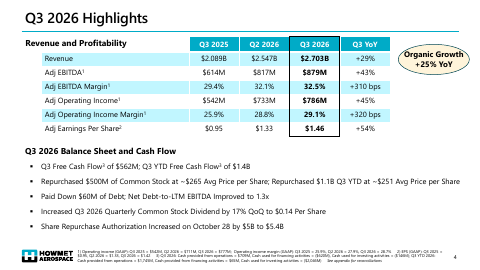
Good morning, everybody, and welcome to Howmet's Q3 Earnings Call. Let's start with the highlights on slide four. Howmet's performance in Q3 was solid in all dimensions. Revenues at $2.7 billion were up 29 % year over year and up 25 % through organic growth. EBDA was $879 million and was up 43 % with a margin rate of 32.5%.
margins were at 40 basis points from the second quarter, and year-over-year incrementals were 43 % after the dampening effect of the CAM acquisition. Pre-cash flow in the quarter was $562 million after capital expenditure of $147 million, which was a quarterly record. A strong cash flow supported by share buybacks of $500 million, and in addition, gross debt was reduced by $60 million in the quarter and we ended with approximately 1.3 times net debt to EBITDA.
We have repurchased $1.1 billion of shares to date of which is $400 million more than the total repurchases in 2025. I would like to note that our deleted share count fell to just below 400 million outstanding shares at 399.5 million at the end of Q3. Over the last eight years, the share count has been reduced by in excess of 100 million shares. Earnings per share were $1.46, a 54 % increase year over year, and this sets us up well to achieve the remainder of our 2026 objectives.
Good progress was made on several fronts, with new business being booked in line with our outlook expectations in commercial aerospace, defense aerospace, and industrial gas turbines. A particular note in the quarter was the 45 % gas turbine revenue growth, which demonstrates both the extraordinary addition to output and even more importantly, the increased market share. Further commentary will be provided during the outlook section of the call. I'll now turn the call over to Patrick who will provide further commentary on end market growth and segment performance.
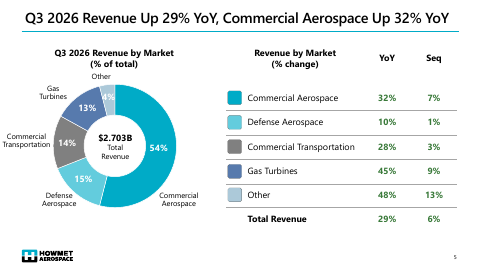
Thank you, John. Good morning, everyone. Please move to slide five. Howmet delivered another strong quarter with all end markets growing. We are well positioned for the future and continue to invest for growth. Total revenue was up 29 % in the third quarter. Excluding the net impact of the three transactions we completed this year, revenue was up 25 % year over year, an acceleration from the 21 % organic growth rate in the second quarter and 19 % in the first quarter.
Commercial aerospace growth was very healthy at 32%, with organic growth of 27%. driven by demand for both OE and SPARES. Commercial aerospace SPARES demand continues to increase significantly, driven by both legacy and next-generation engine programs. Defence aerospace growth was 10%, with organic growth of 3%, driven by SPARES demand, particularly on legacy fighter platforms. Commercial transport revenue was up 28%, reflecting both volume increases as the North American market recovery continued and the pass-through of higher aluminum costs.
Gas turbine growth was very strong at 45 % as end market demand remains robust. Growth in other markets of 48 % was largely driven by the Brunner Fastnet acquisition completed in February. Spares growth remained robust across HowMets markets. Total spares revenue was up 30 % to approximately $570 million and represented approximately 21 % of total revenue in the quarter. In summary, continued strong performance in commercial aerospace, defense aerospace, gas turbines, and commercial transportation. Moving to slide 6, starting with the P &L.
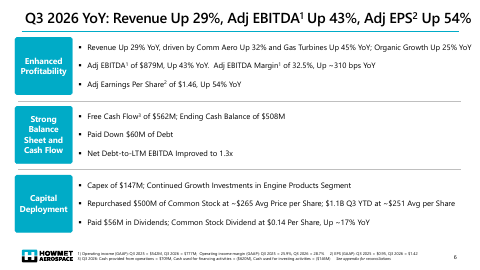
Third quarter revenue, EBITDA, EBITDA margin and earnings per share all exceeded the high end of guidance. On a year-over-year basis, revenue was up 29 % and 25 % organically, the strongest quarterly growth rate on record for Howmet. EBITDA continued to outpace revenue growth up 43%. EBITDA margin increased 310 basis points to 32.5%. Incremental flow-through of revenue to EBITDA was solid at 43 % year-over-year. Earnings per share were $1.46, up 54 % compared to Q3 2025.
Now let's cover the balance sheet and cash flow. The balance sheet remains a source of strength for Howmet. The quarter-end cash balance was $508 million, with quarterly free cash flow of $562 million. dollars. Net debt to trailing EBITDA improved to 1.3 times. During the quarter, we paid down $60 million of commercial paper. Liquidity remained strong with an undrawn $1 billion revolver complemented by a $1 billion commercial paper program with $390 million outstanding from the $450 million that was drawn to support the CAM acquisition.
Turning to capital deployment, CapEx was $147 million. The majority of our capital spend continues to be in the engine product segment as we continue to invest with growth in both aerospace and gas turbines markets. Investments are backed by long-term customer contracts. In the quarter, we repurchased $500 million of common stock at an average price of $265 per share. This brings year-to-date repurchases to $1.1 billion at an average price of $251 per share.
We continue to be confident in strong future free cash flow. we increased the quarterly stock dividend in Q3 by 17 % from $0.12 per share to $0.14 per share. Now let's move to slide 7 to cover the segment results for the third quarter. The Engine Products team delivered exceptional performance again across revenue, EBITDA, and EBITDA margin. Revenue grew 33 % to $1.45 billion. Commercial aerospace was up 39 % and gas turbines was up 44%.
Demand continues to be strong across both original equipment and spares. EBITDA outpaced revenue growth with an increase of 57 % to $567 million. EBITDA margin increased 580 basis points to 39.1 % while absorbing approximately 520 net new employees in the quarter, positioning us well for future growth. Please move to slide 8. Fastening systems delivered another solid quarter. Revenue increased 41 % to $630 million, including the impact from the CAM and Brunner acquisitions. Commercial aerospace was up 42%, and defense aerospace was up 66%.
Commercial transportation was up 6 % year over year. Excluding the impact from acquisitions, total fastener's growth was up 10%. EBITDA increased 34 % to $185 million. EBITDA margin declined 140 basis points year over year and 70 points sequentially, reflecting the increased revenues from CAM, which we acquired in April. Moving to slide nine, the engineered structures team continues to drive improvement in the business. Revenue declined 4 % to $295 million due to the divestiture of the Savannah disc forging facility.
Excluding the impact of Savannah, revenue growth was 8%. We continue to focus on higher margin and stronger return opportunities in the business. Sequentially, revenue was up 10 % from the second quarter, driven by increased commercial aerospace OE demand. EBITDA increased 9 % year over year despite the revenue decline, and EBITDA margin expanded 290 basis points to 23.7 % as we continue to focus and optimize the structure segment to maximize profitability. Please turn to slide 10.
Forged wheels delivered another solid quarter. Revenue was up 32%, driven by higher volumes in addition to increased aluminum cost pass-through. Volumes also increased sequentially from Q2 as the North American market recovery continued. EBITDA was $86 million, an 18 % increase year over year. EBITDA margins declined year over year and sequentially, reflecting the significant dilutive effect of sharply higher aluminum cost pass-through. We continue to outperform the market, driven by our premium products. Now let me turn the call back to John.
Thanks, Patrick. And let's move to slide 11 and turn the call to the outlook. Firstly, of course, we provided guides for Q4. Our glide path continues towards the conclusion of another good year for Howmet. The specific numbers will be commented upon in a few moments, plus our initial sighting chart of 2027. Regarding commercial aerospace, the flight schedules and load factors held up well during the summer months, both for domestic and international travel. Naturally, the Middle East was lower given the Iran conflict and its fallout.
Oil prices, notably jet fuel and diesel, are especially high. And with the resultant effect on ticket prices, overall travel will potentially impact some schedules as we go through the winter into 2027. Having said that, we do not expect there to be any impact on our spares deliveries during this period and indeed throughout 2027. In fact, we expect solid demand given the time-honoring issues experienced by the new generation of narrow-body engines and also the backlog of aircraft engines which are scheduled for shop visits and the ongoing underbuild of aircraft compared to plans.
And also this means that spares demand will continue to be very robust. The current extraordinary aircraft OE order backlog will ensure that new aircraft production continues and increases throughout 2027 and beyond. We expect volume increases for the 737, the A320, the 787 and the A350 to be healthy. and they help to underpin our commercial aerospace business outlook. Defence sales continue to be strong with further increases likely in legacy aircraft build and spares. Notably, F-35 spares continue to be healthy with an expanding fleet of aircraft.
We have not yet assumed in our forward look the replenishment of inventories which have been depleted as a result of the Iran conflict. The most important growth factor as a percent of sales of the one sector of defense sales is that of missile parts. We are being asked to increase production significantly, albeit final agreements have yet to be concluded. We believe that how much technological and operational leadership position in the industry, coupled with our ability to develop the most sophisticated turbine blades at scale in both commercial and the defense aerospace sectors will ensure that Howmet's market position and strong financial performance will continue well into the middle of the next decade and beyond.
Industrial gas turbines growth and the growth we continue to look forward to with customers will strengthen and we look forward to further increasing volumes into the future beyond the previous expectations. This impact is likely to be felt in the outer years beyond 2028 since the new capacity currently being installed is totally sold out. More recently we've seen major gas turbine customers state that 2031 is now also sold out and indeed 2032 will likely be sold out in the next one or two quarters.
This growing level of demand continues into the 2030s and combined with the need for significant increases in future gas turbine spares provides us with even greater confidence. Further capacity is likely to be considered for addition, albeit within the framework of maintaining a high level of free cash flow conversion. Most importantly, the whole of the IGT growth serving broad-based demand across industrial, oil and gas, as well as data centers will be completed without adding any debt to the company.
Indeed, this year we will have completed two acquisitions for approximately $2 billion, spent half $1 billion on CapEx, and bought back shares in excess of a billion. And yet our leverage level at the end of 2026 is expected to be similar to the exit level of 2025. The commercial transportation sector continues to experience North American market recovery. Production volumes continue to climb after the Q1 low point with truck OEM build slots largely full in the second half and now into the first part of 2027.
The more gradual phase in of the 2027 NOx emissions regulations should also be supportive of industry volumes going into 2027. While I will comment on specific Q4 numbers in a moment, the new guide has been raised from the prior outlook. But perhaps the most important view is the initial growth outlook for 2027, which is seen at 12 % plus or minus half a percent, resulting in revenues of approximately $11.5 billion. Further refinement and underlying aircraft volume build assumptions will be provided during our February 2027 earnings call.
Finally, the share buyback authorization has also been addressed by the board and has been increased by a further $5 billion. dollars. Now moving to specific numbers for Q4. We envisage revenues to be approximately 2.75 billion plus or minus 10 million. EBITDA at 900 million plus or minus 5 million. Earnings per share at $1.50 plus or minus a penny. For the full year the guidance increased again across the board to revenues of 10.3 billion plus or minus 10 million, EBITDA at 3.33 billion plus or minus five, and earnings per share at $5.50 plus or minus a penny.
And free cash flow has been increased to $2 billion plus or minus 50 million. In terms of the full year commentary, we're pleased with our sales growth of 25%, including a 22 % organic growth so far this year and an earnings per share growth of over 45%. We know that free cash flow of around $2 billion represents a very healthy cash flow to revenue and the margin, a cash margin of over 19%, which is at a very high level.
Thank you so much. Ladies and gentlemen, we will now begin with a question and answer session. To ask a question, you may press star then 1 on your touchstone phone. If you are using a speakerphone, please pick up your handset before pressing the keys. If at any time your question has been addressed and you would like to withdraw your question, please press star then 2. At this time, we will pause momentarily to assemble our roster.
Good morning, everyone. John, Patrick, PT. You know, I guess blades and veins remain a critical bottleneck in aerospace supply chain, which seems to be driving OEMs to take greater control of their manufacturing capabilities. We saw this with Pratt when they invested in the Asheville facility and GE announced its acquisition of CPP. You know, John, you've previously highlighted the difficulty of replicating Helmet's technology, your manufacturing yields, and scale.
But how do you view these vertical integration initiatives reshaping the competitive dynamics in this aerospace blades and veins market? And what implications could they have for Helmet's future market share? And how do you think about pricing power?
Thanks, Christine, and good morning. I think the first comment I would like to make is that we have excellent relationships with all of our engine customers, so namely GE, Safran, Brutton-Whitney, Rolls-Royce, to name just a few. Our investments in technology, quality, and ability to invest in capacity have been fundamental to the increase in volume of modern jet engines and indeed support of the airline fleet's worldwide.
This capability has taken years if not decades to achieve and right now we're actually poised to further increase capacity for GE which will take two years to install and then there will be a multi-year runway after that. In fact regarding this particular capacity for GE. I was reviewing it yesterday for one of our sites and it is a significant investment. We're also in dialogue with what's been called the blue first blade and its future industrialization in the 2030s.
I know that this audience though likes to have quantification and numbers rather than just words and of course it's difficult to give dollar values since I also recognize that competitors are listening. So I thought I'd try to provide some views, some scales, some quantification of the central thrust of your question which was the GE acquisition of CPP. And I think I was thinking about so how do will move into the 2030s and beyond, especially given the investments I've talked about in commercial aerospace.
But also you've seen us make a lot of investments in this year and already talked to the planned increase in investment in 2027 and beyond in the IGT space. and so I thought maybe I could give some quantification of this by just think about the fleet of turbines that we are enabling to be built from like 2025 through 2030 and the large increase in the fleet of turbines which will produce for us spares demand into the 2030s.
And when we have done our modeling, we think about that increase in spares demand. They just pick, let's say one year. So I just picked at random like 2031 and what our expectations are in our planning assumptions is that we see the sales value increase in spares revenues from IGT in that one year. that would exceed the total value of the sales of the first blade of our largest narrow body engine blade to any of our customers.
So and if you think about it we don't expect to lose any of that business anyway but just to try to divide and put the context you know should we lose a first blade to a narrow body engine is that that would be more than compensated by just one thing which would be the spares increases in the IGT segment in one year and then of course we're expecting similar values of increases in 2032, 2033, 2034 and beyond given the continued build out that we envisage.
So let me just turn back from the quantification to back to some some more, I'll say, thoughts around CPP. And when we consider their capabilities, we see them to be probably the higher order in structural castings. And that's probably augmented recently by the acquisition of Prezikast from Switzerland that they closed in the last month or so. And when I think about the industry, we've heard a lot about forgings and castings, which seems to be the word that people reach for immediately.
And in fact, structural castings have probably been the main pain point of the industry that commercial aerospace has suffered in recent years. And therefore I consider the capabilities that maybe CPP has in structural castings to be possibly of any more important relevance. And when I think about it, even though Hamath has been increasing our market share and we're actually currently considering a further build out of another manufacturing plant in this area, maybe it'll affect the scale of the plant that we're considering and indeed where we'll place that investment.
So we expect that we'll continue to grow even in this segment with the relative strength that CPP may have in the future. And then I think just turning the call into like a broader perspective for what Hamit's going to do over the next few years, I think I'd at least like to return to that IGT theme. And I think it may be worthy of updating our guide regarding growth that I provided, I think during last year, especially in the light of our growth in 2026.
And as you know, it's been above expectations. In fact, growth accelerated in the third quarter from the 30 % plus revenue increases in the second quarters to a 45 % level. And as I commented earlier, that level of growth is clearly well in excess of the land based gas turbine industry and a result of further market share increments that we've achieved during the course of the negotiations that I referred to in recent calls. So what I see now is that whereas our prior commentary had been around a doubling of IGT sales from 2025 as the base year within a three to five year period, we now see this as being achieved in three years, so two years right at the
front end of that, and maybe it'll rise to two and a half times inside five years, which would take those sales to about $2.5 billion by the end of the decade. So hopefully I've covered the perspective of the investments we're making commercial aero, the investments that we're anticipating making right now for GE and the way that those investments will bring additional capacities on towards the end of this decade and into the 2030s.
And also the impact should something like a first blade, you know, have a different destination, albeit we don't think it does. And we see growth in both commercial aero and IGT as we go into the next decade.
Hey, thanks very much and good morning. Maybe just to round that out, and this might be kind of a quick one in light of your prior comments, but it might be a good time to round out.
You kind of addressed fairly directly the potential impact from CPP on your plans and Aero. When you think about the IGT plant, how do you think about the role of potentially insourcing at SpaceX and what that might mean for the IGT market?
Thanks, Seth, and good morning. I think first maybe the comment I should make is that SpaceX is indeed an extraordinary company which has almost limitless access to capital. And I guess fundamental to their current plans as the company indeed is the build out of their data center business, I think referred to as Colossus 1 and 2.
And if you study that part of SpaceX in detail, then it's clear that they sold capacity of those, let's say, ultra-modern data centers with the latest, say, custom silicon in them to other frontier AI companies such as Google and Anthropic, to name a couple. I think it's important, again, to note that for those cutting-edge data centers, the gross margins on the tokens that you use, like AI tokens, is exceptional. And I'm sure you're aware of how high those are.
and hence the uptime and keeping those data centers going is fundamental. And indeed you can't have interruption of service to that really important revenue stream with that level of margin. And I'm sure it's in their contracts with those frontier AI companies. Specific to that is on their recent earnings call at SpaceX. They talked about power and specifically behind the meter power and its acquisition which is so fundamental to achieving that compute increase and switching the compute capabilities on.
So to solve those power issues and to get to today's level of compute power, which is using about approximately one gigawatt, then SpaceX bought the APR company and its fleet of mobile gas turbines to solve the problem. And so these 69 mobile gas turbines were installed and are situated just across the state line to support Colossus. and that power is needed in addition to what power was available from the grid. And then I guess you know that by the middle of next year, those mobile turbines have to be relocated and therefore replacement is required and I think currently to approximately 1.2 gigawatts of power level to support the Colossus Centre.
And so my understanding from scouring of the internet and knowing a little bit about the inside of the industry, there are some 33, I'll say fully-fledged Titan turbines from solar or Caterpillar being installed and a further 10 Pro Energy 6000 series turbines. And you're probably not surprised when I say that Hamet does supply those turbine blades to both Titan and to the LAM6000 series of aero derivative turbines. Getting a bit deeper into it, then on the recent call, Elon Musk talked about his plans going forward for 2027.
And he talked about the plans to get 20 gigawatts of power capabilities to provide you this to turn on further compute capabilities. And this is by various means, obviously IGT, wind, solar, the grid, et cetera, et cetera. So it's not coming from one singular source. But part of this was that gas turbines were fundamental to it. And if it's not 20 gigawatts, then maybe the thought was at least 10 gigawatts of power could be achieved on top of getting to a three gigawatts capability by the mid-year and to be able to turn on that additional compute capacity and then earn those high profits.
And he did comments that to do this new turbines were required but he realized the problem is that the availability of those turbines was restricted in the industry by the availability of turbine blades and it was commented on the call by SpaceX that these might take another 18 months to two years to achieve and therefore maybe that SpaceX could accelerate the ability of power by providing the blades to those turbines which turbine could be built but the availability of the blades wasn't there.
And my understanding is that one Asian turbine manufacturing company has agreed to supply turbines without the blades and I assume that those are central to the capability of casting that SpaceX talks about with their special casting capabilities. So I think the SpaceX can take that step and maybe even if those blades are not quite at the level that would have been for the original equipment they can operate at a power rating maybe below the full power rating of the turbine and it's full durability, but the important thing, it gets power.
And if you think about it, this is all about power acquisition. And what we see generally, both for SpaceX and across the industry, that data centers are and constructors are reaching out to get power from any source. And whether it's buying prior generations of turbines, I think going back to like an E-series turbine, not today's F-series or the more modern H-series. Just go to E-series E. And in addition to that, you've probably read about several startups, venture companies, they're looking to get into this segment and launch new companies to provide power using aero derivative engines, which are really at the end of life, or aero engines and repurpose them off, let's say, all 737s as an
example. And our thought is that the niche power, those companies will exist and they will start, but maybe they'll become less necessary when additional turbine capacity is brought on stream towards the end of the decade and into the next decade. So I'm trying to give a specific SpaceX answer to your question and then broaden it out into to the needs of power to achieve the compute levels which are being planned. And then I took notes and you probably took notes from the G, the Nova call yesterday, their earnings call which said that now they see that their 2032 order book is largely filled.
And that obviously, if you think about it, we've talked about being good through 28, good through 2030. Now it's looking at 2031, 2032 looks to be pretty booked. And so, you know, our views are now turning towards the middle of the next decade for this level of capacity. And my thought is as we see each of those, then today's level of investment that we're envisaging is probably not enough. So I don't know whether that covers your specific question, Seth and then broadened it out into a wide perspective.
Ladies and gentlemen, in order to ensure that the management will be able to address all the questions from the participants, we request you to please limit your question to one question per participant. If we have a follow-up question, please rejoin the queue. Our next question comes from the line of Shalia K .O. Glue with Jeffries. Please go ahead.
John, you mentioned the Blue Blade coming in the 2030s. That's the first time we've talked about that. Obviously, your technology edge is what provides you additional content on the Leap and GTF, and I'm sure you're first in line for the next-gen Leap Blade. Maybe can you quantify for folks how much of your growth is coming from that technology edge, content increases versus just volume and price? And perhaps to that kind of question, as you think about the industry players, perhaps starting from a more square one, how do you think about what supply demand looks like today versus 2030 and 2035 and 2040?
Okay, so I guess thematically what we've been trying to do is step up to the needs for fuel efficiency in the industry and providing a level of capability, particularly at the front end of the hot section of the turbine, which can achieve performances at considerably higher temperatures and indeed the pressure those turbine blades are under and therefore the structural integrity of them. And we've been doing that and increasing it with each generation or part generations and updates during the course of the life of the engines.
And everybody's familiar with the upgrades currently going on in the – for the LEAP part of the hot section for CFM, you know, led by GE. And that's already been launched for the LEAP-1A engine for Airbus last year. And we are currently now building in considerable volumes for the LEAP-1B, albeit those volumes I think, you know, going through then all the normal processing which will probably lead to a launch sometime during the first quarter of 2027.
At the same time we're also building and increasing our levels of production for the gear turbofan advantage and again with a similar theme of increasing the thermal performance capabilities for the turbine blades for that engine. And because that has to operate at even a higher temperature level. I've already described on previous calls about how we're approaching that. And indeed, when you think about what's going to drive the economics of aircraft going over the next let's say decade given the fact that inside the decade is probably unlikely that we're going to see totally new aircraft from Boeing or Airbus is that further improvements of fuel efficiency will be required and hence the need to continue to upgrade those parts of the
turbines to provide that increased fuel efficiency given the especially today given the cost of jet fuel and maybe what it will cost during that period of time. So thematically, it's just the same. What we envisaged is that further OE production will be required over the next few years with the increases envisaged by the airframe manufacturers and the engines to be supplied to them, whether it's for Boeing or indeed Airbus. And, you know, if you think about it, you know, those things are not going to stand still.
those up for going to be further content increases. And so I expect that we'll see during the next decade the further capacity that's been going to be required for OE, further capacity that's going to be required to service these new, I'll say new fleet of engines and their improvements. And I also think that fundamentally when you put higher temperatures, higher pressure into engines is that the replacement cycles actually become more frequent. And so we do envisage a very healthy spares demand over that same period of time.
And you can see that by the build out of further MRO shop capabilities by, in fact, by all of the engine manufacturers. You can look at GE, Safran in particular, and also Pratt & Whitney. Everybody is building that capacity for the MRO, you know, refurb capabilities. So, you know, the broad view is we're gonna increase capacity, increase revenues into the aero segment, you know, during the next five years and 10 years and just keep the same thing going and continue to develop our technology.
And here we are again, having already recruited in the last five years, probably several hundred engineers, is we're going to increase our engineering staffing again in 2027 by a similar number that we did in 2025 and 2026 as an example to keep ourselves at the forefront of all the developments. Great. Thank you.
follow-up on the outlook for the defense portfolio. John, you flagged that you don't have any replenishment of inventories kind of in your outlook, but the demand signals are very strong.
It feels like not long ago we were talking about IGT in a similar way. Maybe you can talk about, you know, the scale of the opportunity there and just give us whatever color you're sort of willing to offer. Thank you.
Yeah. Right now, defense is difficult to really give absolute clarity on in terms of expectation. Apart from thematically, what we're seeing is both a need for replenishment of inventories and parts. Of course, to some degree, we're not clear on the numbers of missions which have been flown over the last three months, but I think you can assume that they've been extensive and are going to require us to provide and provision for a replenishment of spares during as we go
through 2027, the degree to which will probably be also guided by the the defense budget rather than the current situation where we have a continuing resolution of the existing level of expenditure. So I expect that sometime after the midterms that might become more clear. At the same time, there's a lot of other questions that have to be answered in terms of truly definitizing all of the missile work that's there. It's there before us. You know, we've been spending a lot of time with the existing large primes and indeed some of the, I'll say, newer defense companies getting ready for really putting that into production, albeit, again, waiting for final definitization of every aspect of the contract as we do that.
So again, probably my thought is that given the situation regarding missiles is that at some point after the midterms then that will get resolved as Congress comes back. The bipartisan agreement is achieved to give us a clarity regarding the defense budget for 2027 and indeed going forward given we're now talking about not individual lots but multi-year contracts which are also critical to investment in this area. So while I'm sort of optimistic, I think it's going to be good for us in our planning round.
We know we see the opportunity, it's difficult to be precise about it but we do expect our defense sales to be up in 2027 for what we already know but with an agreed budget it may become more robust for us.
So, John, when you talk about IGT demand, it's really, it seems like a pretty extraordinary profile going forward. You're up 45 % in the quarter, which suggests you've already built ahead of some of this demand a substantial amount of capacity, and yet I think these seven contracts that you set with the one in Japan being first, that's not even kicked in yet. So I guess looking forward to this demand profile, can you give us a sense of sort of when these next tranches would come in but I think more importantly given your position and the supply demand imbalance how should we expect margins to trend on IGT going forward relative to the rest the business and particularly the aero engine
I've thought about margins in the past I guess seeing really that our IGT margins and our airspace margins are roughly similar I mean it should the rate of growth continue in the IGT space then we probably would have a little bit of leverage that volume just against the fixed cost associated with that segment. But I see it more as a continuing, I'll say a continuum of development looking for revenue growth with healthy profitability. Because we really look to have long-term relationships with our customers, never seek to take advantage and because there's always tomorrow to think about.
And we try to be really good partners, not only with the AeroEngine customers I listed earlier in response to the first call, but also for our IGT customers. And that's whether it is, as you've mentioned, Mitsubishi for Japan, or whether it's GVinova or Siemens, or is it solar, you know, Baker Hughes and, you know, Doosan. We try to work with all of them in a very consistent way. And, you know, in terms of growth rates, it's also, you know, it's been trying to, you know, pin something on what's been a moving target.
market. And in fact, we're already in discussions for the willingness to capacitize for additional demand and indeed also introduce new product developments for the industry as we go through the end of the decade into the early 2030s. And so in fact, this week it was looking at a new product introduction for a particularly sophisticated type of large IGP blade for a customer that doesn't start until 2031. And so we're looking at all of that and trying to empathize for it, recognizing that no matter what we do, it seems like we're not going to be able to totally satisfy what the demands appear to be for or 2027 as an example.
So, you know, we're gonna be investing, we've invested this year, we're gonna invest again at a higher level in 2027. And the way things are shaping is, I sense that we're gonna have a very continuing high level of capital expenditure into 2028. And we keep reevaluating it, But for ourselves is that given we try to take a very clear-eyed view of capacitization is that for every year we see an elevated capex then give us a bit of confidence about that future growth and its solidity going into the next decade.
And so clearly, you know, we're not going to invest at this sort of levels in 28 and if we're not sure about those revenue increases that are going to happen in the in the 2030s.
I mean, I think you've talked about this in the past with when you try to think about where the market could be in 2030 or whatever, and you have to make investments up front here. How do you get comfortable that it's still going to be there in 2030? You know what I mean? When you actually execute a decision.
and think about it in relation to both what we see the fundamental demand in terms of construction of data centers, permitting. We saw a few months ago there's a lot of questions about data centers in space and what would that do and try to understand that part of the demand. I'm also spending time thinking about the future generations of chips and, for example, the degree to which they'll require the same amount of cooling and therefore electricity consumption and what's the growth rate that's anticipated by the likes of an anthropic or an open ai or grok or any of the other uh i'll say frontier models and and it's it's it's obviously it's complicated in terms of kind of put it
all together um and then we fall back on okay so So given the needs for power, what other segments could be there for us if it should stutter? And then we go to look at, for example, liquefied natural gas and the U .S. providing energy security to Europe and all the shipping of gas across the ocean, but of course it will have to be liquefied. And so compressors used for liquidation of gas, then it's also you've got to get the liquified gas from the source through pipelines to the ports and terminals.
And then indeed what's going to be the demand in Europe as we see not only the likes of short term El Niño, but also fundamental changes that might be going on in climate and hotter experiences in the summer and need for air conditioning. And therefore, what does that do to electricity demand? And therefore, additional turbines, which are the only realistic means of addressing them in the next decade to any substantial degree. And so it's a very big picture involving many different aspects to try to bring together.
And then finally, okay, what are the customer contracts that we'd like to see to make sure that we have it feel secure in providing that capacity with underpins around corridors of volumes, et cetera, while also being responsive to our customers' needs? So, you know, I'm trying to give you like all the things we think about without being like past time about any one of them because, you know, the assumptions do move. And the, I will say, just the picture has been emerging for all of us over the last couple of years.
But it's also something that we feel absolutely justified. We should play in this sector and we have the capabilities, in fact, some quite unique capabilities to achieve the performance required of turbine blades of this scale and this size. And also, as you can imagine, what are the turbines being considered for the future, even beyond the current version of the current H-class turbines? And how big do they become? And are they all going air-cored blades?
And how sophisticated they are? and the critical change of technology which needs to be brought to bear to achieve that. So there's a lot going on on this one, Ron.
Yeah, and then maybe just one quick following. When you look at the end markets that you're confronted with today, I mean, just at a very high level, how strong are they? Did you ever expect to have so much demand out of all the end markets you're in between Arrow, IGT, Defense?
Yeah. No, we did not. I used to think to myself, well, we're sort of fortunate in one sense that airframe manufacturers weren't able to build everything because we were able to continue to drive our company forward and improve our level of earning capability when times are really tough. and demand was going to be more robust in the future because of the lack of build of aircraft.
So I used to turn that negative into a positive about where I thought. And so, you know, I'm always looking for like, how does, can this be better for us in the future? And how do we maximize that technology build out combined with the volume build out? I never thought that IGT would look like it is. And so, you know, I think sometimes in life you get lucky. And this is one of the things where I feel as though we've had some good luck.
But on the other hand, you know, I temper that with all of the things that go against you. And you have to power through them. And so maybe I've got to take a bit of the smooth, a bit of the rough. And so I quite like it. But I just don't, at the same time, I don't want to get giddy about it. and certainly overcapacitize. And that's why I spent a long time talking about the factors that I need to think about in terms of that capacitization.
And some of that was exactly the conversation that I led our board through, I'd say, 10 months ago. And trying to say to them, you know, these are all the potentials, these are the issues, these are the risks, and this is what I think we need to do. and we've all coalesced into this is something that we can do, should do, and it's good for us. But you're right, I never thought that we would be seeing, I'll say, defense, land-based gas turbines and aerospace all moving in a positive way, and it's straining us.
I mean, you think about hundreds of engineers, thousands of production operatives. We're probably now at seven new manufacturing plants and considering three more. So there's a lot going on. I mean, you know, growth can be tough as well. Yeah. Yeah. Well, thank you for that, John.
Ladies and gentlemen, that was the last question for today. The conference has now concluded. Thank you for attending today's presentation. You may now disconnect. Goodbye.