0:20:27 · Guy Stebbings, BNP Paribas · Hong Kong deposits
How did Hong Kong deposit behaviour evolve through the quarter, is HSBC negatively geared to HIBOR rising, and what makes up the Basel 3.1 benefit?
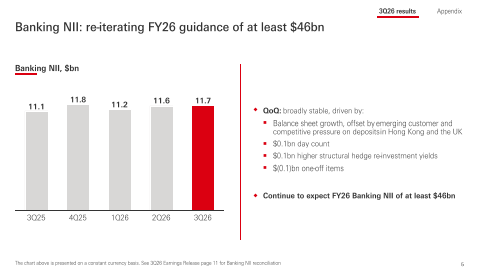
Time deposits rose about two points to 38%, mostly late in the quarter; higher HIBOR is still positive for banking NII, and Basel 3.1 gains come from sovereign, SME and large-corporate risk weights. — Pam Kaur
0:23:59 · Ben Toms, RBC · Credit costs
Is keeping ECL guidance at 45bps conservative, and is consensus reflecting disposal revenue headwinds?
Nothing of concern is seen for the fourth quarter and the books stay open to January; disposals cut $2.2bn of revenue cumulatively, with $0.9bn more in 2027. — Pam Kaur
0:27:30 · Joe Dickerson, Jefferies · Deposit mix
Is there a ceiling on Hong Kong time-deposit mix, and is deposit growth outpacing NII acceptable?
The 40% figure was a past peak versus 38% now, HSBC's mix stays better than the market's, and deposit growth remains NII-positive. — Pam Kaur
0:30:45 · Analyst, Barclays · UK deposits, Wealth
How will UK deposit competition affect lending appetite, and what is the Wealth growth run rate?
Hong Kong matters far more than the UK for NII, lending stays within risk-return hurdles, and Wealth is a long-term growth area with quarterly mix swings. — Pam Kaur
0:35:13 · Andrew Coombs, Citi · Capital deployment
Is the Basel 3.1 relief earmarked, and will reallocated costs earn more than the lost revenue?
Capital priorities are unchanged: a 50% payout, organic growth and buybacks, and redeployed costs should earn that revenue back quickly after a short lag. — Pam Kaur
0:38:08 · Kian Apussein, JPMorgan · Hong Kong customers
Has Hong Kong customer acquisition slowed, and how do lower transaction volumes and mainland rules affect the franchise?
Acquisition normalised near 100,000 a month after a May–June spike, Hang Seng mainland account openings more than doubled, and no product-mix change was seen from mainland rules. — Pam Kaur
0:43:10 · Melissa Kuang, Goldman Sachs · Deposits, net new money
How intense is Hong Kong deposit competition, and is the strong net new money sustainable given India?
The shift to time deposits is typical of higher rates and is not expected to extend unusually; the FCNR window closed in August but net new money was broad-based. — Pam Kaur
0:46:56 · Rob Noble, Deutsche Numus · Capital
Why run below the capital target, and why hold so much in the hold-to-collect-and-sell book?
HSBC is comfortable buying back at the lower end of its 14%–14.5% range, and its hold-to-collect-and-sell structural hedge portion is only one-sixth with a shorter duration than in 2022. — Pam Kaur
0:49:47 · Amit Ghul, Mediobanker · Deposits, costs
Why has the deposit competition language changed, and how should variable pay in CIB be viewed?
The pressure comes from customers shifting to time deposits, not quarter-end spikes, and any extra variable pay is decided in January and may only add rounding to 2026 cost growth. — Pam Kaur
0:53:29 · Ed Verth, KBW · Costs
Would consensus revenue trigger extra variable pay, and is roughly 5%–7% cost growth in 2027 too high?
No 2027 cost guidance is given; simplification savings are already in the baseline, and variable pay depends on the quantum and quality of outperformance, not consensus. — Pam Kaur
0:56:14 · Alistair Waugh, Autonomous · Wealth, UK deposits
Does the Chinese regulatory document change the Wealth story, and what should be expected for UK deposits?
Guidance reiterates existing compliance requirements and a level playing field helps HSBC; UK retail is a small part of a deposit base with the lowest loan-to-deposit ratio. — Pam Kaur
0:59:28 · Xinyu Wang, China Securities · Net new money
What drove the strong Asia net new money and what is the long-term Wealth revenue outlook?
The $41bn total, of which $38bn in Asia, included $14.5bn of India FCNR deposits offset by Australia outflows, with broad-based growth from customers using multiple products. — Pam Kaur
1:01:00 · Kendra Yan, CIBC · Loan growth
What drives loan growth, how much is AI-related, and will deposit costs constrain growth?
Growth is broad-based, data center lending is very small, and deposit growth is not a constraint because lending is governed by risk appetite and hurdle rates. — Pam Kaur
1:04:33 · Catherine Lay, JPMorgan · Hong Kong strategy
Has HSBC changed its Hong Kong deposit strategy, and is the CASA-to-time-deposit shift front-loaded?
HSBC wants to grow with Hong Kong after the Hang Seng privatisation, supported by lending growth, and does not treat the time-deposit trend as permanent. — Pam Kaur