“we saw ASIC AI server shipments increase by 1.5 times YoY in the third quarter, higher than the approximately 70% growth in GPU AI servers.”
It shows custom-chip racks growing faster than GPU racks at Foxconn.

Hon Hai (Foxconn) (2317) · Consumer Technology
Results filed 12 Nov 2026 · Quarter ended 30 Sep 2026 · Company's own call transcript · Young Liu (CEO), David Huang (CFO)
Read the transcriptSlides (42 pages)Press release ↗Investor relations ↗
Summaries and transcripts are machine-generated and can contain errors.
AI servers now drive more than half of Foxconn's business, and new-generation racks have begun shipping with higher market share and a wider customer base into 2027.
Cloud and Networking Products, driven by AI servers, grew to 54% of revenue and is now Foxconn's largest business. Both GPU and ASIC AI server shipments grew, and new-generation racks began shipping with higher market share than the previous generation. Management says it has seen no sign of customers slowing AI spending. Consumer electronics is entering peak season, while computing products are held back by tight memory supply. EV deliveries have started under the Mitsubishi tie-up.
Management is steering toward more AI racks, more Neocloud customers, more in-house components and more custom ASIC work, with EVs and robotics as later growth options. It expects AI rack shipments to grow at a high double-digit rate in 2027. The main tension is capital: bigger, pricier racks tie up working capital, and operating cash flow is negative. Management also flags tight chip and memory supply and whether customers' data center sites are ready.
Open the slide deck (PDF, 42 pages) ↗

Showing the first 6 of 42 pages.
Results documents
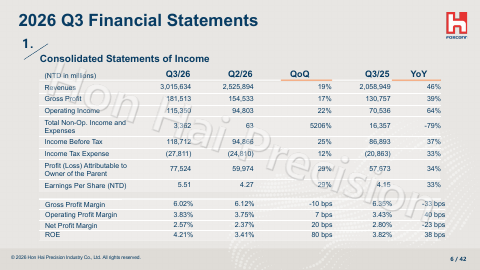
up 46% from a year ago
up 64% from a year ago
up 34% from a year ago
up 33% from a year ago
down 33 bps from a year ago
up 40 bps from a year ago
outflow, vs (49,536) a year earlier
outflow, vs (162,335) a year earlier
| Segment or metric | Value | Change |
|---|---|---|
| Cloud and Networking Products share of revenue | 54% | increased further |
| ASIC AI server shipments | 1.5 times YoY | vs approximately 70% growth in GPU AI servers |
| Vertically integrated components business, 2026 | exceeding NT$1.6 trillion | vs approximately NT$1.3 trillion last year |
Copied from the press release ↗ and other documents in the company's results page ↗. A figure is published only if its sentence is in those documents.
| Metric | Period | Outlook |
|---|---|---|
| Operating margin above prior year | full-year 2026 | 3.2% |
| Operating margin target | medium to long term | above 3% |
Cloud and Networking Products rose to 54% of revenue on strong AI server demand, and management expects it to exceed 60% over the next three to five years. Foxconn is now mainly an AI infrastructure supplier.
ASIC AI server shipments grew 1.5 times YoY against about 70% for GPU servers. Custom ASIC racks need tailored power, cooling and interconnect work, which suits Foxconn's vertical integration.
Customers own the chips in many ASIC projects and some GPU ones, so revenue grows more slowly than rack units. Management accepts this because it cuts working capital needs.
New-generation racks have begun shipping with higher market share than the previous generation, and more Neocloud customers are expected to join in 2027. Large CSPs remain the primary customers.
Management sees the shift from electrical to optical interconnects continuing and points to micron-level manufacturing, with CPO switches already shipping. EVs get a smaller share of investment than AI, via the Mitsubishi Electric Mobility stake.
Each quote matches the transcript word for word.
“we saw ASIC AI server shipments increase by 1.5 times YoY in the third quarter, higher than the approximately 70% growth in GPU AI servers.”
It shows custom-chip racks growing faster than GPU racks at Foxconn.
“many ASIC projects adopt the consignment model. This is because the ASIC chips belong to the customers, so they use the consignment model.”
It explains why reported revenue will understate AI rack shipment growth.
“Large CSPs will continue to be our primary customers, but we also expect more Neocloud customers to join next year, which will help us further increase our market share in AI servers.”
It shows how the AI customer base is widening beyond the largest cloud providers.
“I think we will continue to invest in EVs. However, the proportion of investment allocated to EVs will certainly be relatively smaller compared with AI.”
It sets the capital priority between AI and EVs.
“Based on what we are seeing, there are no signs of demand slowing down. We have not seen any slowdown.”
It addresses investor concern about AI spending by CSPs and Neocloud customers.
“last year our business scale was approximately NT$1.3 trillion. This year, we are exceeding NT$1.6 trillion, with a margin of more than 15%.”
It sizes the in-house components business that management is counting on to lift overall profitability.
Order momentum is very strong and automation and vertical integration have sharply reduced manufacturing issues, though data center site readiness, especially after the midterm elections, needs watching. — Young Liu
The move from electrical to optical interconnects will continue, and Foxconn's micron-level precision and range from cables to CPO switches make it optimistic. — Young Liu
ASIC shipments grew 1.5 times YoY versus about 70% for GPU, both should grow in 2027, and ASIC may grow faster as inference expands, with consignment lowering reported revenue share. — Young Liu
EV investment will stay smaller than AI and is a long-term strategic position, with EVs and robotics seen as second and third growth engines. — Young Liu
No slowdown has been seen, with demand from model makers and CSPs strong, while Foxconn declined to comment on the foldable phone and referred to the customer. — Young Liu
Consignment, which can apply to some GPU solutions as well as ASIC, is the biggest factor separating shipment growth from revenue growth, though unit shipments still grow at a high double-digit rate. — Young Liu
Higher-margin in-house components, customized ASIC parts and operating expense control support margins, so staying above 3% is very achievable, though keeping up with high double-digit growth is the challenge. — Young Liu, David Huang
AI servers are the engine: Cloud and Networking Products rose to 54% of revenue, and AI rack shipments grew at a high double-digit rate QoQ as new-generation racks began shipping.
ASIC AI server shipments grew 1.5 times YoY versus about 70% for GPU, and management expects both to grow in 2027, with ASIC possibly faster as inference demand rises.
Management expects AI rack shipments to grow at a high double-digit rate and market share to rise, with more Neocloud customers joining. It said it has seen no slowdown in demand.
Tight supply of chips and memory, data center site readiness and policy uncertainty after the midterm elections. Larger racks also raise working capital needs, which management says it will manage through consignment, financing and cash conversion.
EV investment will be smaller than AI, though Foxconn holds a 50% stake in Mitsubishi Electric Mobility and EV deliveries have begun. Robotics, digital health, semiconductors and satellites are positioned as further growth options.
TRANSCRIPT 2317.TW – Q3 2026 Hon Hai Precision Industry Co., Ltd Investor Conference Call EVENT DATE/TIME: November 12th, 2026 Taipei time 3:00 P.M. (New York: November 12th, 2:00 A.M. / London: November 12th, 8:00 A.M.)
Investor Conference Call on FY26 Third Quarter Financial Results
Corporate Participants
Young Liu Hon Hai Technology Group – Chairman David Huang Hon Hai Technology Group – CFO James Wu Hon Hai Technology Group – Spokesperson Kristen Fang Hon Hai Technology Group – Senior IR Manager
Conference Call Participants
Laura Chen Citi Securities - Analyst Jack Kuo Blackrock - Analyst Dylan Hou Commercial Times – Reporter Randy Abrams UBS Securities - Analyst
Presentation
Hello to all the investors and media. This is Kristen. Welcome to Foxconn’s Q3 2026 Investor Conference. Joining us today, are Chairman Young Liu, CFO David Huang, and Spokesperson James Wu. The conference is scheduled for one hour, starting with our presentation, followed by Q&A session.
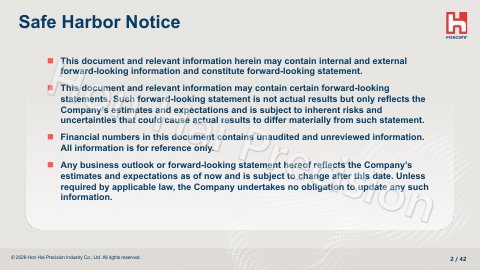
As usual, please carefully read the safe harbor notice on the next page before we start the meeting.
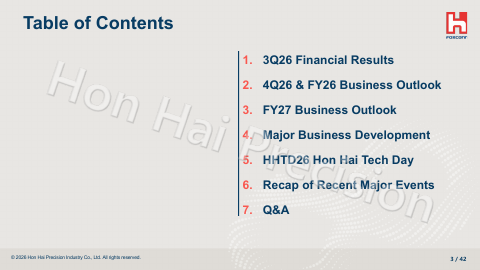
We will now proceed to the first session, the presentation. This time, we will cover six topics, including the performance review of the third quarter of 2026, the business outlook for the fourth quarter and full year, the outlook for 2027, major business developments, highlights from Hon Hai Tech Day, and recent major events.
Before moving into the financial figures, we would first like to share the key highlights of this quarter.
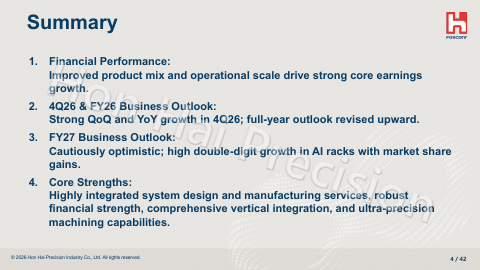
First, operating profit for the third quarter and the first nine months increased by 64% and 65% YoY, respectively.
Second, looking ahead to the fourth quarter, we expect strong growth both QoQ and YoY. We have upgraded our full-year 2026 outlook for all four major product segments.
Third, we remain cautiously optimistic about the outlook for 2027. We expect AI rack shipments to achieve high double-digit growth, with market share increasing further.
Fourth, leveraging more than 50 years of experience in managing talent, capital, and supply chains, we will maintain our industry leadership through our four core strengths.
I will now invite CFO David Huang to walk everyone through the financial performance for the third quarter. Thank you.
Thank you, Kristen. Hello everyone. I am David Huang, CFO of Hon Hai Technology Group. I am going to start with some highlights on Hon Hai's financial results for the third quarter of 2026.
First, please turn to page 6 of the presentation for the income statement for the third quarter of 2026.
Revenue for the third quarter reached NT$3.02 trillion, representing 46% YoY growth and 19% QoQ growth, setting a new record high for a single quarter in the company’s history. This demonstrates the continued expansion of the Group’s operating scale.
Gross margin was 6.02%, down 0.33 ppts YoY, mainly due to changes in product mix and rising raw material prices.
However, as revenue scale expanded, gross profit still reached NT$181.5 billion, up 39% YoY, demonstrating continued improvement in our gross profit generation capability.
More importantly, operating margin for the third quarter reached 3.83%, an increase of 0.40 ppts YoY.
Operating profit reached NT$115.4 billion, up 64% YoY and 22% QoQ, setting a new record high for a single quarter.
The growth rate was also higher than both revenue and gross profit growth. This demonstrates that the expansion of operating scale, improvements in operating efficiency, and a lower operating expense ratio have generated operating leverage benefits, allowing operating profit to grow faster than revenue.
Next, looking at non-operating items, this quarter recorded a non-operating gain of NT$3.4 billion, down approximately NT$13.0 billion from the same period last year.
This was mainly due to lower investment gains, higher net interest expense and foreign exchange costs, as well as asset disposal gains recorded in the same period last year.
Among these, investment gains decreased by approximately NT$5.3 billion YoY, mainly due to share price fluctuations in certain investment holdings.
Net interest expense increased by approximately NT$3.3 billion, reflecting the funding costs required to support business expansion.
At the same time, however, this expansion also drove an increase of NT$44.8 billion in operating profit compared with the same period last year.
The effective tax rate for the quarter was 23.4%.
Net profit after tax reached NT$77.5 billion, up 34% YoY and 29% QoQ.
EPS was NT$5.51, an increase of NT$1.36 compared with the same period last year.
In summary, third-quarter revenue, operating profit, net profit after tax, and earnings per share all reached new record highs for a single quarter.
Next, please turn to page 7 for the income statement for the first nine months of 2026.
Revenue for the first nine months reached NT$7.66 trillion, up 39% YoY.
Operating profit reached NT$285.8 billion, up 65% YoY.
Net profit after tax was NT$187.4 billion, up 30% YoY.
EPS was NT$13.35, up 29% YoY.
Operating profit growth was significantly higher than revenue growth, demonstrating that as operating scale expands, profitability is also improving.
Gross margin for the first nine months was 6.10%, down 0.18 ppts YoY, mainly due to rising raw material prices. However, gross profit still increased by 35%.
At the same time, operating margin increased to 3.73%, up 0.57 ppts YoY, reflecting the continued benefits of economies of scale driven by expanding operating scale and improved expense efficiency.
In terms of non-operating items, cumulative non-operating gains for the first nine months reached NT$1.8 billion, down NT$35.7 billion YoY. This was mainly due to lower investment gains, interest and foreign exchange factors, as well as higher asset disposal gains in the same period last year.
Despite the decline in non-operating gains, overall profitability continued to grow, driven by our core operations.
The effective tax rate for the first nine months was 24.2%, slightly higher than the same period last year.
This was mainly because profit growth at subsidiaries also led to an increase in estimated income tax provisions for earnings repatriation.
Cumulative ROE for the first nine months reached 10.44%, an increase of 1.66 ppts YoY, demonstrating that profit growth has also contributed to improving returns on shareholders’ equity.
Looking back at the first nine months, our operating scale, core business profitability and efficiency, and returns on shareholders’ equity all continued to improve.
Next, please turn to page 8 of the presentation for the balance sheet.
As of the end of September 2026, cash and time deposits on the books totaled approximately NT$1.45 trillion. Our liquidity remains sufficient, providing flexibility to support business growth and strategic investments.
Net cash for the quarter was negative NT$21.5 billion, a decrease of approximately NT$112.4 billion compared with the same period last year.
This mainly reflected increased working capital requirements driven by the growth of the AI business, as well as higher capital expenditure to support future expansion.
The cash conversion cycle for the third quarter was 40 days, an improvement of three days compared with the same period last year.
Excluding the impact of accounts receivable management tools, the cash conversion cycle was 48 days, still an improvement of two days YoY. This demonstrates that, while our business is growing rapidly, working capital management and cash conversion efficiency are also improving. Looking at our business model, Foxconn actually possesses relatively low-risk characteristics.
First, we primarily serve major global tier-1 enterprises. These companies have strong market positions and financial capabilities, which help reduce our accounts receivable credit risk.
Second, procurement and production are mainly arranged according to customer orders and product specifications. Inventory risks borne by the company are also reduced through customer commitments or contractual arrangements.
As for capital expenditure, investments are made very prudently based on customer demand, order visibility, and capacity planning. We also continuously evaluate investment benefits and recovery periods, including what we refer to as the payback period, to reduce the risks of idle capacity and mismatches between investment and demand.
The debt ratio for the period was 64%, slightly higher than the same period last year. This was mainly due to increases in accounts payable driven by revenue growth, as well as higher short-term borrowings required for operations.
Overall, we maintain sufficient cash and a reasonable capital structure, allowing us to support growth while preserving long-term financial resilience and strategic flexibility.
Finally, please turn to page 9 of the presentation for the cash flow statement.
For the first nine months of this year, operating cash flow was a net outflow of NT$125.7 billion.
This was mainly because rapid business growth drove increases in accounts receivable and inventory, resulting in higher working capital requirements.
Capital expenditure for the first nine months reached NT$161.7 billion, up 43% YoY.
This was in line with the expectation of more than 30% growth that we provided at the previous investor conference.
Capital expenditure was mainly used to support AI-related businesses, expand capacity, and strengthen our global footprint.
As a result, free cash flow for the first nine months was a net outflow of NT$287.4 billion, representing an increase in cash outflow of NT$125.1 billion compared with the same period last year.
In summary, Foxconn is currently in a stage of rapid business growth and capital
investment. Increases in working capital and capital expenditure will affect cash flow in the short term. However, we will maintain sufficient liquidity, improve working capital turnover efficiency, and strictly manage the benefits and payback periods of capital expenditure.
Our goal is to ensure that these investments translate into future profitability and cash flow, generate returns above our cost of capital, and support high-quality, sustainable growth.
Here I conclude the summary of the financial statements for Q3 2026. Now, I would like to turn over to Chairman Liu.
Young Liu Hon Hai Technology Group – Chairman and CEO Thank you, David. Good afternoon, everyone. This is Young Liu. It has been a long time since we last met.
Today marks the first time since the pandemic that we have arranged an in-person investor conference, allowing us to have more direct interactions with everyone. I am, therefore, very pleased to be here today, to see all of you in person, and to have the opportunity to communicate directly. I would also like to welcome all the investors joining us online.
I also hope that everyone joining us online will have the opportunity to attend these in- person meetings in the future. Going forward, we plan to hold our investor conference around this time every year, combining both in-person and online participation, so that we can share the Group’s latest developments and outlook for the coming year with everyone.
Next, I would like to review our operating performance for the third quarter.
Third-quarter revenue reached a new record high for a single quarter in the company’s history, achieving strong growth both QoQ and YoY. Overall performance was also better than expected.
Among our four major product segments, Cloud and Networking Products benefited from strong AI server demand, with actual growth exceeding our previously optimistic expectations. As a result, the segment’s revenue contribution increased further to 54%. This also reflects that AI servers have become Foxconn’s most important growth engine. We will continue to optimize our revenue and customer mix.
In terms of profitability, third-quarter operating profit exceeded NT$100 billion for the first time in a single quarter. At the same time, net profit after tax and EPS also reached new
record highs for a single quarter. More importantly, operating profit grew faster than revenue. This demonstrates that AI-driven growth is continuing to translate into improved profitability in Foxconn’s core operations.
This is also the result we hope to achieve through our transformation: as our operating scale continues to expand, our profitability should improve at the same time.
As AI products and technologies continue to evolve, we will further strengthen our vertical integration capabilities and increase Foxconn’s value within our customers’ supply chains. This will allow us to build growth on a more competitive foundation and create long-term, stable, and sustainable returns for our shareholders.
Next, I would like to discuss our outlook for the fourth quarter.
Overall, AI operations will continue to grow, while ICT products will enter their traditional peak season. Therefore, we expect strong revenue growth both QoQ and YoY in the fourth quarter.
For Cloud and Networking Products, with shipments of new-generation AI server racks, we expect AI server revenue to continue growing QoQ in the fourth quarter. General servers are expected to maintain moderate growth, driving significant QoQ growth and strong YoY growth for Cloud and Networking Products.
For Smart Consumer Electronics, the fourth quarter will enter the peak shipment period. Together with solid product demand and higher shipment ASPs, we expect strong growth both QoQ and YoY.
For Computing Products, the segment continues to be affected by tight supply of memory. Therefore, we expect a slight decline QoQ. However, price increases for certain components have also driven higher shipment ASPs. As a result, we expect significant revenue growth compared with the same period last year.
For Components and Other Products, shipments of components related to our major businesses continue to increase. Therefore, we expect this segment to achieve significant QoQ growth.
In terms of the full-year outlook, our current visibility is even better than it was at the investor conference in August. Therefore, we have upgraded our outlook for all four major
product segments.
Overall, our full-year operating performance this year has almost entirely exceeded our previous expectations. We expect this trend to continue into next year.
Over the past few quarters, we have continued to share several important financial indicators with you. In particular, everyone is very interested in how much actual profit contribution the rapid development of the AI business can bring to Foxconn.
First, let us look at ROE, which is an indicator that we place great importance on.
During the period when Smart Consumer Electronics and Computing Products were our main businesses, our ROE was generally below 10%. However, since Cloud and Networking Products became our largest revenue contributor last year, our ROE has exceeded 11%.
In the first three quarters of this year, ROE has already reached 10.44%, representing a significant improvement compared with the same period last year and moving increasingly closer to our full-year target of 12%.
This shows that our investment in the AI business is not only driving significant revenue growth, but is also gradually translating into better profitability and capital efficiency.
Investors are very concerned about whether our ROE can continue to improve. The answer is certainly yes. Therefore, internally, we have already begun discussing setting a higher ROE target for the next stage. We hope to continue creating better returns for our shareholders.
Next, I would like to share some progress in terms of profitability.
The increasing contribution from AI servers is also reflected in the Group’s profit performance. From 2024 to 2025, the growth rate of operating profit for the first three quarters not only outpaced revenue and gross profit growth, but the gap also continued to widen.
In the first three quarters of this year, operating profit increased by 65% YoY, higher than revenue growth of 39%. This reflects our continued improvements in vertical integration, automation, and operating efficiency, together with increasingly evident economies of scale,
which continue to strengthen our core profitability.
These results are also reflected in our operating margin performance. Although rising shipment ASPs have had a considerable impact on margins, our operating margin for the first three quarters of this year further increased to 3.73%, representing a significant improvement compared with 3.16% in the same period last year and substantially exceeding the 3% floor that we have set.
Next, I would like to discuss another very important financial indicator, which is EBITDA.
Today, capital markets are paying greater attention to corporate cash flow than ever before. In particular, as the scale of investment in AI infrastructure continues to expand, investors are not only concerned about how much revenue and profit a company can generate, but are also increasingly focused on whether this growth can generate sufficient cash flow to support our continued expansion in the future.
Therefore, I would like to use EBITDA to measure the Group’s cash generation capability from its core operations. First, Foxconn’s EBITDA in 2025 reached nearly NT$357 billion, more than doubling compared with 2020. This demonstrates that, as the scale of the AI business expands, the growth trend in cash generated by our core operations has become very evident.
Looking at this year, our cumulative EBITDA for the first three quarters has already exceeded the total for the entire previous year, reaching NT$369.2 billion, an increase of NT$123.6 billion YoY, or 50.3%. This was higher than the 43% increase in capital expenditure during the same period.
The second key point is that, as everyone can see, the gap between EBITDA and the combined amount of capital expenditure and cash dividends is also gradually widening. This means that, as the AI business grows, cash generated from our core operations is not only sufficient to cover future capital expenditure requirements, but also allows us to continue increasing cash dividends to reward our shareholders.
At the same time, it can further strengthen our financial position and provide the financial flexibility needed for future development.
Next, I would like to share some of our views on 2027.
Based on the customer demand into which we currently have visibility, we remain very confident in our operations next year. I believe we will continue to grow.
However, in addition to developments within the industry itself, there are several external variables that deserve our continued attention.
Looking at the AI and consumer electronics supply chains, tight supply of chips, memory, and certain key components is currently a common challenge facing the entire industry. Although supply bottlenecks will gradually ease as new capacity comes online, looking ahead to next year, overall demand is still expected to exceed supply. The tight supply- demand situation may continue for some time.
In addition, over the past few years, the global political and economic environment has remained highly uncertain. Fluctuations in inflation, interest rates, and exchange rates may also affect companies’ operating costs, investment decisions, and global supply chain deployment.
In the face of these external changes, a company’s own management capabilities become even more important.
The reason Foxconn has been able to become a global industry leader is precisely because of the core advantages we have accumulated over the long term in managing people, capital, and supply chains. This is also a very important reason why we remain positive about the outlook.
The market is very familiar with Foxconn’s supply chain management capabilities. However, in fact, we are equally competitive in global talent management and capital management.
At this year’s Hon Hai Tech Day, I also shared several figures to help everyone better understand Foxconn’s R&D and design capabilities.
Everyone knows that we have approximately one million employees. What many people may not know is that we actually have more than 120,000 engineering professionals globally, covering areas including system design, component development, and manufacturing process technologies.
Last year, we obtain approximately 2,492 patents globally, and we currently hold around 25,000 active patents. Taking last year as an example, we carried out more than 900 NPI
projects, meaning New Product Introduction projects. More than half of these were products designed and manufactured by the Group through ODM or JDM models.
These figures demonstrate that Foxconn is not simply an assembly manufacturer. Rather, we possess comprehensive capabilities in R&D, design, manufacturing, and components, enabling us to provide customers with highly integrated system design and manufacturing services.
Turning to capital management, we have always emphasized one very important principle: matching long-term funding with long-term needs, and short-term funding with short-term needs.
Long-term investments need to be supported by long-term funding, while short-term operating requirements can be met through the flexible allocation of short-term funds, allowing us to improve capital efficiency. Our debt ratio is approximately 64%, reflecting our solid financial structure.
Looking ahead, we still have room to raise additional funds through the issuance of corporate bonds. We will also utilize equity-linked financing instruments, primarily convertible bonds at this stage, while taking into account diversification of funding currencies and funding costs.
For short-term funding, in addition to borrowing, we can also improve the efficiency of working capital utilization through cash conversion cycle management. The significant increase in the ASP of new-generation AI racks presents a major challenge to companies’ capital management capabilities. This is not only about the scale of funding required.
More importantly, it is about whether we can effectively manage funding requirements throughout the entire production cycle, from assisting customers in procuring key components and arranging inventory to completing production and shipments. These capital management advantages allow us to capture larger-scale and higher-value AI business opportunities during this rapid growth stage.
Of course, after discussing talent and capital, I would lastly like to talk about supply chain management, particularly our upstream and downstream vertical integration capabilities.
Whether in smartphones, PCs, or the AI racks that are receiving the most attention today, we do not simply provide assembly and validation services. We are capable of
manufacturing more than half of the components in-house. More than 50%.
This is also where we can create value for our customers. This is where we create value through Time to Market and Time to Cost: shortening the time from product development to mass production, and optimizing the cost structure to improve competitiveness.
To achieve such comprehensive vertical integration capabilities, precision manufacturing technology is also a very critical element.
Our four major metal processing capabilities already cover five different levels of manufacturing precision.
For example, our precision mold manufacturing can achieve an accuracy of 2 micrometers. For optical lenses and optical communication components, we can achieve ultra-high- precision manufacturing accuracy of less than 1 micrometer.
The next generation of AI servers will also have increasingly stringent precision requirements for optical communication chip connectors and micro-optical components. Therefore, the technological expertise and manufacturing capabilities we have accumulated over the long term have also become important core advantages for entering the market for key components in future AI systems.
That concludes the main points I wanted to share with everyone. Next, I will invite James to walk everyone through some of our major business developments. Thank you.
Next, I will share our latest views on AI.
In the third quarter, both our GPU and ASIC AI server businesses continued to grow, driving AI rack shipments to achieve our target of high double-digit QoQ growth.
Shipments of new-generation racks have also begun. As the degree of automation has increased, production yields have already reached a very high level. In addition, our market share in new-generation racks has also increased compared with the previous generation.
Therefore, we expect AI rack shipments to maintain high double-digit QoQ growth in the fourth quarter. This will also drive continued sequential growth in AI server revenue, in line with our expectation that the AI business will grow quarter by quarter.
Looking ahead to 2027, major CSPs will continue to expand their AI investments. The market is currently still in a period of rapid expansion.
Of course, we will also closely monitor the progress of customers’ AI datacenter construction. Based on the orders and customer demand into which we currently have visibility, we remain confident that AI rack shipments can maintain high double-digit growth in 2027.
In addition to expanding shipment volumes, we will also provide diversified AI solutions to meet the needs of different types of customers. Large CSPs will continue to be our primary customers, but we also expect more Neocloud customers to join next year, which will help us further increase our market share in AI servers.
Next, I would like to share the latest developments in 3+3+3.
First, in EVs, through our strategic alliance with Mitsubishi Electric, we are strengthening our capabilities in motor and control technology and software. As for the vehicle model developed in cooperation with Mitsubishi Motors, deliveries of new vehicles have already begun.
In Digital Health, we continue to work with Taipei Veterans General Hospital on the joint development of multimodal medical models, promoting the application of AI in healthcare settings.
In robotics, an important development this year is that our in-house-produced robots have begun to be introduced into AI server production lines in the United States and Taiwan. At the same time, we have also launched an intelligent robotics platform to accelerate model training and deployment.
In addition to internal applications, our joint venture is also accelerating its mass production capabilities for embodied AI robots.
Turning to the three core technologies, we are taking the lead in introducing 800V DC power supply technology into datacenter construction.
Our proprietary AI model also continues to strengthen its ability to understand localized knowledge.
Construction of our two overseas semiconductor packaging and testing plants is also progressing.
Our wafer fab in Japan is also operating close to full capacity, with order visibility extending into next year.
Our 1,200V silicon carbide technology and automotive MCUs have also achieved certification and entered mass production, respectively.
In next-generation communications, we are extending our satellite technologies into communications modules, antennas, and end products.
Moving on to the three smart platforms, the Genesis platform under Smart Manufacturing is scheduled to begin trial operations in December.
AI agents are also continuing to be introduced into our production lines.
In Smart EV, the electronic and electrical architecture, or EEA, that we are developing for customers is expected to begin mass production early next year.
In Smart City, CityGPT has advanced 13 use cases in Taiwan. We are also assisting Bac Ninh Province in Vietnam in launching its five-year development plan.
Next, I would like to briefly introduce the seventh Hon Hai Tech Day, which we held two weeks ago.
This year's event reached another record high in scale, with more customers and partners participating in the exhibition. The public open day also attracted more than 13,000 visitors.
The Chairman opened the event by sharing Foxconn's core advantages, while several of our partners also attended in person to discuss trends in AI and next-generation electric mobility.
This year, we had a total of nine major exhibition areas, and the number of exhibits increased by more than 40% YoY. The largest exhibition area was the AI Token Factory, which fully demonstrated Foxconn's integration capabilities across AI, from L1 to L12. We also showcased 20 key precision manufacturing technologies for the first time.
In EVs, we introduced three SUVs and light commercial pickup trucks. To date, we have accumulated 12 reference vehicle models.
This year, we also expanded our cooperation with international partners, including Google and Morgan Stanley, to organize dedicated forums.
In addition, the most popular technology education pavilion was held for the first time this year. On the open day, the pavilion attracted more than 6,600 parents and children.
Through cross-industry cooperation, we also provided more opportunities for Taiwanese enterprises and the public to participate in Hon Hai Tech Day.
Having covered Tech Day, I will now walk everyone through several other important recent events.
First, we jointly developed energy storage solutions with three otherpartners in Taiwan.
At OCP, we also showcased our integration capabilities for new-generation AI racks. FIT Tech Day focused on the development of optical communications technologies in the AI era, as well as their large-scale applications.
In Kaohsiung, we also announced plans to establish a new production base for key next- generation AI products.
We also demonstrated the results of our space technology applications in southern Taiwan.
In addition, we are bringing AI into frontline long-term care services and have begun pilot programs across three major applicationsites. We have also developed an intelligent service platform for government document processing, which is part of our Smart City solutions and will help improve government operations.
Turning to recent awards and recognition, our technological innovations received the German Red Dot Design Award and the Future Tech Award, and we were also selected for FOCS, as the only company from Taiwan.
The Chairman also received the CEO Image Award and the Online Reputation Star Award.
Our Chief Campus Operation Officer, Kathy Yang, was also named one of Asia's Most Powerful Women for the second consecutive year.
In terms of sustainability, we received recognition through corporate citizenship and talent sustainability awards. We also received awards for our environmental initiatives.
Another important achievement is that we received recognition in four award categories from HR Asia.
We are also leveraging technology and open data to promote ocean governance and bringing AI courses into high schools. Through Foxconn's scholarships, we are providing the next generation with more resources needed for technology education.
That concludes today's presentation. Thank you.
Questions and Answers
Thank you, James. Next, we will move to the Q&A session. We’ll go through questions that were raised in advance of today’s call and answer those first. After that, we will open the floor to any questions.
Question 1: The first question is for the Chairman, regarding the outlook for 2027. The presentation just now mentioned that component supply will be one of the uncertainties this year. Could you explain how this factor will affect the outlook for the four major product segments, and what we believe will be the main growth drivers for each of these segments?
Thank you. Looking ahead to 2027, we maintain a cautiously optimistic view of the Group’s operations. The IMF estimates that global economic growth will reach approximately 3.4% in 2027, higher than this year’s 3.1%. However, we also believe that global industries will continue to show a K-shaped development trend next year.
AI-related industries will continue to benefit from global demand for computing power and investment in infrastructure, with growth momentum remaining very strong. However, other ICT products may be affected by tight supply of memory and rising component costs, resulting in more divergent performance.
Looking at the four major product segments, Cloud and Networking Products will remain the most important growth driver in 2027. Major global CSPs will continue to expand AI-related capital expenditure next year, further driving demand for our AI servers and high-speed networking equipment, and creating more growth opportunities for us.
This year, Cloud and Networking Products already accounted for more than 50% of our revenue. We expect this contribution to increase to more than 60% over the next three to five years.
For Smart Consumer Electronics, as our major customers’ products are primarily focused on the high-end segment, the impact from memory supply shortages is relatively limited. In addition, customers continue to have demand for new product development and specification upgrades. Therefore, we expect the overall performance of Smart Consumer Electronics to remain relatively stable in 2027.
Our view on the PC market is relatively cautious. In addition to tight memory supply, rising component prices may affect the selling prices of end products and consumers’ willingness to replace their devices.
In EVs, our customers’ overseas projects will gradually enter mass production and delivery stages next year. Together with the commercialization of more new vehicle models, we expect EV-related revenue to continue growing.
In summary, we are very confident that the Group’s operating performance will maintain double-digit growth in 2027. AI will remain the most important growth engine, while ICT will deliver stable performance. At the same time, we will continue to improve profitability by increasing the proportion of components we supply .
Thank you. After the next Q&A, we will open the floor for live questions. Those online who would like to ask questions may click the "raise hand" button and wait.
Question 2: The second question is for the CFO, regarding operating margin and cash flow management. Given rising interest rates, higher component prices, and significantly higher prices for new-generation AI servers, how does the Company view the long-term OPM trend, and what measures are being taken for cash flow management? Can free cash flow for full-year 2026 remain positive?
Thank you. In the first three quarters of this year, the Group’s operating margin reached 3.73%, an increase of 0.57 ppts from 3.16% in the same period last year, demonstrating continued improvement in profitability. We also expect our full-year operating margin to exceed last year’s level of 3.2%.
From a medium- to long-term perspective, as AI server performance and ASPs increase, component costs and product complexity will also rise. We will continue to improve operating efficiency and earnings quality through product mix optimization, economies of scale, automation, and vertical integration of key components.
Our medium- to long-term target of maintaining an operating margin above 3% remains unchanged, and we will continue to improve earnings quality and operating efficiency.. In terms of transaction models, we will continue to negotiate cooperation models with customers, including consignment, taking into account both customer requirements and the benefits of cooperation, in order to reduce working capital requirements and improve capital efficiency.
Capital management will also be aligned with business growth, following the principle of matching short-term funding with short-term needs and long-term funding with long-term needs.
As the Chairman mentioned earlier, we will utilize operating cash flow and competitive financing instruments to support funding requirements over different periods. At the same time, we will strengthen the management of accounts receivable, inventory, and accounts payable to improve cash conversion efficiency. Through cash flow forecasting and prudent capital expenditure management, we will balance business expansion with financial stability.
As the AI business grows rapidly, revenue and profitability increase, but inventories of high- end components, inventory levels, and accounts receivable also expand accordingly. Together with capital expenditure required for capacity expansion, this will lead to increased capital investment. However, our current cash expenditures are necessary investments to capture opportunities in AI infrastructure. These investments are supported by clear orders and long-term demand from tier-1 customers. Therefore, we focus not only on revenue and profit growth, but also on cash conversion efficiency.
Capital expenditure will be arranged prudently based on customer demand, order visibility, and project progress, allowing capital investment to translate into future operating benefits.
As for whether full-year free cash flow in 2026 can remain positive, this will still depend on the progress of shipments and collections in the fourth quarter, as well as the actual execution of capital expenditure.
We will continue to improve operating cash flow and strictly manage capital expenditure and working capital requirements, so that growth in the AI business will not only drive revenue and profitability, but also gradually translate into actual cash flow and shareholder value.
Thank you, David. We will now open the floor for live questions. Please state your questions completely in one turn. Each participant may ask up to two questions. English questions are also welcome.
For the first question, we will invite Laura to ask her question.
Laura Chen Citi Securities -Analyst Question: Thank you. Hello, Chairman, CFO, James, and Kristen. First, I would like to thank the Chairman for explaining the outlook for next year, particularly the growth prospects for AI. Especially under the current political and economic environment, where uncertainties remain relatively high. The Chairman also mentioned that new-generation AI racks are preparing to ramp up. I would like to understand whether you are seeing any transition- related issues during this ramp-up process, and how you are managing them. At the same time, Foxconn has substantial production facilities in the United States and is therefore able to observe customers’ AI datacenter infrastructure build-outs firsthand. Based on what you
are seeing now, are these projects all progressing on track? That is my first question.
Thank you. Regarding our firsthand observations of customers’ order momentum, we believe demand remains very strong. Very strong. If you look at the latest financial report from the company referred CoreWeave, you can see that its gross profit margin is quite good. Therefore, because of their business requirements, the customers we work with continue to have very strong order momentum.
As for whether rack manufacturing is still facing some of the traditional issues seen in the past, first, through automation, and second, by leveraging the Group’s vertical integration capabilities, we have been able to continuously increase the degree of automation in both racks and servers.
As a result, many of the traditional issues previously encountered in server manufacturing have been reduced very significantly. So, we believe the situation will only continue to improve.
Looking ahead, the key issue may be whether datacenter sites are ready to deploy these racks. This is something we will need to monitor closely, particularly after the midterm elections. As for how the situation will develop after that, I really do not know. We will have to continue observing. That is my response to your first question.
Laura Chen Citi Securities -Analyst Question: Thank you, Chairman. My second question is also related to the developments we saw at Hon Hai Tech Day, as well as the progress in optical technologies that the Chairman mentioned earlier. I understand that Foxconn is also an industry leader in developing CPO switches, which have already begun shipping. I would like to understand how you view the growth potential of this business next year. Also, how will this contribute to our vertical integration capabilities? Because optical technology could become a very significant new technological development over the next few years, particularly from the year after next onward. Thank you.
Regarding CPO, as large language models continue to grow in size, their requirements for memory bandwidth are also increasing. Therefore, the trend of transitioning from electrical
interconnects to optical interconnects will not change. The reason is simply that the demand is there.
The next step is to resolve the related engineering challenges. These engineering challenges involve everything from optical fibers and fiber-optic connectors to optical-to- electrical converters, among other components. These are precisely Foxconn’s strengths.
As I mentioned earlier, one of our strengths is our ability to achieve micron-level precision manufacturing capabilities. This means manufacturing precision at the micrometer level.
In the past, the precision requirements for products such as smartphones may have been relatively limited. However, for optical applications, particularly where precise optical alignment is required, the demands on precision manufacturing capabilities are significantly higher.
All of these optical fibers need to be precisely aligned within such a small space. This requires highly specialized technology. This is precisely where Foxconn Group can fully demonstrate its capabilities in ultra-precision manufacturing.
In this regard, I believe the trend of transitioning from electrical interconnects to optical interconnects will not change. As for the ultra-precision manufacturing and vertical integration capabilities required for this transition, Foxconn Group already possesses both.
At this year's Hon Hai Tech Day, we also demonstrated our comprehensive capabilities, from cables all the way to CPO switches. The Group is capable of providing the entire range of products. Therefore, from Foxconn's perspective, we are very optimistic about the growth opportunities in this area.
Next, I would like to first open the floor to one of our major shareholders for a question. After that, due to time constraints, we will invite the reporter from Commercial Times to ask a question, followed by Randy. I wanted to let everyone know the order so you can prepare.
Jack Kuo Blackrock - Analyst Question: Hello, Chairman and management. This is Jack from Blackrock. My first question is about the AI rack business mentioned earlier. I would like to ask about the progress of our ASIC AI rack business this year. Also, what opportunities do we see in the component business within ASIC AI servers? In addition, could you share how we view the revenue
contribution from GPU and ASIC AI servers next year, including their respective proportions?
We are seeing major CSPs and AI model developers continue to increase their investments in proprietary chip development, namely ASICs. I believe everyone has also seen a great deal of news about this. It is said that developing an ASIC chip now takes only around nine months. In other words, it can go from specifications to a completed ASIC in approximately nine months.
In addition, AI applications are gradually expanding from model training into inference. Therefore, demand for ASIC is growing very, very rapidly. At present, we have different levels of cooperation with major CSP customers on ASIC projects.
We also place great importance on the long-term growth and added value that these projects may bring. Because ASICs are application-specific, there are many different types and they usually involve a greater degree of customization. These customization requirements cover everything from system architecture and motherboard design to power supply, liquid cooling, high-speed interconnects, and overall rack integration. There are many customization requirements across all of these areas. This is precisely where Foxconn can leverage our advantages in vertical integration. It is also one of the very important reasons why many CSPs developing ASICs come to us for cooperation.
As the ASIC business grows, we also hope that the increase will not only come from assembly operations, but that our component business will continue to expand as well. As for the growth of GPU and ASIC, we saw ASIC AI server shipments increase by 1.5 times YoY in the third quarter, higher than the approximately 70% growth in GPU AI servers. We believe both GPU and ASIC will continue to grow in 2027. GPU will remain the mainstream solution for large-scale model training and general-purpose computing. However, as inference demand increases, particularly with the growing adoption of applications such as AI agents, ASIC may have the opportunity to grow even faster.
Looking at overall market shipment trends, research institutions estimate that ASIC AI servers' share of total AI server shipments will increase from 27.8% in 2026 to approximately 40% in 2030. Therefore, we can see that growth is extremely rapid.
As for our product mix, many ASIC projects adopt the consignment model. This is because the ASIC chips belong to the customers, so they use the consignment model. As a result,
the revenue contribution you see in our financial statements may be relatively lower than the shipment contribution. That is because the cost of ASIC chips is not included on our side. However, we believe this transaction model is very beneficial to us. It helps reduce working capital requirements and, in turn, improves our capital efficiency. That is essentially the difference.
Jack Kuo Blackrock - Analyst Question: Thank you, Chairman. I would also like to ask another question. Earlier, we mentioned that, in addition to AI investment, we are also investing in areas related to electric vehicles. I would like to ask about the expected investment returns and benefits from our investment related to Mitsubishi Electric's mobility business. Also, given that AI demand remains very strong, will investment in the EV sector create competition for capital allocation within the Group?
I think we will continue to invest in EVs. However, the proportion of investment allocated to EVs will certainly be relatively smaller compared with AI. We have also been closely observing the development of the overall EV industry. We hope to choose the appropriate timing so that, when we are ready, we can enter the EV market on a large scale.
As for our cooperation with Mitsubishi, this is based on a long-term investment perspective. Through this type of strategic long-term investment, we hope to position the Group for future development and growth. Although we are currently seeing very good growth, when looking toward the future, we still hope to identify a second and third growth engine. EVs are clearly one of these options. Of course, as everyone knows, robotics will also be one of them.
Next question comes from Dylan from Commercial Times, please.
Dylan Hou Commercial Times - Reporter Question: Hello, Chairman, CFO, and James. This is Dylan from Commercial Times. I have two questions. First, as the Chairman mentioned earlier, the international political and economic environment may become somewhat more unpredictable after the midterm elections. At the same time, there are also some concerns in the market regarding the funding and cash flow positions of CSP customers. From your personal perspective, Chairman, has the Group observed any signs that customers are slowing down their investments in AI?
You also mentioned order visibility earlier. Could you provide some further details on the visibility that the company currently has?
My second question is about the foldable smartphones from a U.S. customer, which have already begun shipping. There was some discussion recently regarding production yields. Could the Chairman comment on the current yield situation for these foldable smartphones? Have yields stabilized, or is there room for further improvement? Also, how does the overall order and shipment momentum for smartphones from U.S. customers this year compare with last year? Thank you.
Regarding the question about foldable smartphones, as it involves a specific customer and a specific product, our general principle is not to comment on such matters. As for the current situation regarding that product, I would suggest attending our customer’s investor conference for further information.
As for your first question, what we are seeing is that AI demand continues to increase. This demand comes from end users. We broadly divide these users into four categories. The first is model makers. The second is CSPs. The third is governments. And the fourth is enterprises.
At present, we are seeing that the majority of major computing power users are primarily model makers and CSPs. Governments and enterprises are still considering and exploring how to utilize AI. This includes our own company. We are also working on the internal adoption of AI and have elevated AI to one of our top strategic priorities. Therefore, we are seeing extremely strong demand from end customers.
This demand, in turn, drives the requirements of computing power providers, including CSPs and Neocloud companies. Based on what we are seeing, there are no signs of demand slowing down. We have not seen any slowdown.
As for the midterm elections and some of the changes taking place in the industry, I believe the impact may be relatively limited in the short term. However, we will need to continue monitoring the potential long-term implications.
In the short term, customers that have already placed orders for datacenters and committed to building computing capacity may actually accelerate their deployment plans to bring that
computing power online more quickly. Therefore, we have not seen any significant impact in the short term, and we do not expect the impact to be substantial.
However, over the longer term, policy changes and some of the uncertainties that have recently emerged in the market may have an impact. We will need to closely monitor how significant these long-term effects may be.
Due to time constraints, we will now invite Randy to ask his questions.
Randy Abrams UBS Securities - Analyst Question: Thank you. My first question is about your high double-digit shipment guidance, both for the fourth quarter and for 2027. For the fourth quarter, I am curious about the fact that you are guiding for high double-digit shipment growth, but for Cloud and Networking Products, your outlook indicates significant growth rather than strong growth. Could you discuss the factors behind this? Is it because of a greater ASIC mix, increased adoption of consignment, or perhaps the transition to higher-ASP GPU racks, as mentioned in an earlier question? That is regarding the fourth quarter.
For 2027, you are also guiding for high double-digit growth in AI rack shipments. We understand that the ASP of Rubin racks could increase by a high double-digit percentage, potentially almost doubling. What does this imply for the revenue outlook for the AI server business?
I think the first reason is the increasing adoption of the consignment model. The consignment model is not limited to ASIC projects. It may also be applied to certain GPU solutions. Therefore, I believe the biggest factor affecting the relationship between shipment growth and revenue growth will come from consignment.
Even taking this into consideration, we still expect high double-digit growth in AI rack shipment volumes, measured in units. Again, we do not see any significant transition issues in the manufacturing of our new products. That would be my answer to your question.
Randy Abrams UBS Securities - Analyst Question: My second question is about margins. I think originally, you were expecting some seasonality in margins following the relatively high base in the first half. However, your operating margin expanded further in the third quarter. First, looking at the fourth quarter,
what are the key factors that will help sustain this strong margin performance? Then, as we look ahead to 2027 and transition to higher-ASP racks, you mentioned a long-term operating margin target of 3%.
However, do you think there are sufficient vertical integration opportunities to allow the company to maintain margins at these higher levels, perhaps in the 3.5% to 4% range, in the nearer term and into next year?
In terms of margins, we are not only working on product mix, but are also very aggressively strengthening our vertical integration capabilities.
Let me give you some figures to illustrate how much progress we have made this year compared with last year. In terms of vertically integrated components, last year our business scale was approximately NT$1.3 trillion. This year, we are exceeding NT$1.6 trillion, with a margin of more than 15%. Therefore, the more we expand our component business, the more our overall average margin will improve. This is one of the areas where we are putting a great deal of effort.
In particular, as I mentioned earlier, ASIC Compute Trays and ASIC racks require a significant amount of customization, especially in customized components. This is very beneficial to us. With all these efforts, we believe that maintaining an operating margin above 3% is certainly very achievable.
However, next year, as we mentioned, we expect high double-digit revenue growth. The challenge for us will be how to keep up with such a high level of revenue growth. Therefore, we are working very hard on this.
In addition to what the Chairman mentioned regarding the contribution of vertically integrated components to our margins, another key point is operating expense control. When looking at operating margin, you should also consider how effectively we control our operating expenses. This is where economies of scale can provide additional benefits. I would like to offer that as another point for your consideration.
As the time is now 4:07pm, we will end our investor’s conference here.
Disclaimer This English version is a non-verbatim translation of Mandarin transcript for reference only.
Hon Hai Precision Industry Co., Ltd. (the “Company”) reserves the right to make changes to content, or other
information in this document without obligation to notify any person of such changes.
In the conference call upon which this transcript is based, the Company may make projections or other
forward-looking statements regarding a variety of items. Such forward-looking statements are based upon
current expectations and involve risks and uncertainties. Actual results may differ materially from those stated
in any forward-looking statement based on a number of important factors and risks. Although the Company
may indicate and believe that the assumptions underlying the forward -looking statements are reasonable, any
of the assumptions could prove inaccurate or incorrect and, therefore, there can be no assurance that the
results contemplated in the forward-looking statements will be realized.
THE INFORMATION CONTAINED IN THIS TRANSCRIPT IS A TEXTUAL REPRESENTATION OF THE COMPANY'S CONFERENCE CALL AND WHILE EFFORTS ARE MADE TO PROVIDE AN ACCURATE TRANSCRIPTION, THERE
MAY BE MATERIAL ERRORS, OMISSIONS, OR INACCURACIES IN THE REPORTING OF THE SUBSTANCE OF THE
CONFERENCE CALLS. IN NO WAY DOES THE COMPANY ASSUME ANY RESPONSIBILITY FOR ANY INVESTMENT
OR OTHER DECISIONS MADE BASED UPON THE INFORMATION PROVIDED IN ANY TRANSCRIPT.
Email : [email protected] | Website : https://www.honhai.com/en-us/