0:25:50 · Erica Najarian, UBS · 2027 outlook
Are the guidance cuts finished, and what did management get wrong when it first set the 2027 target?
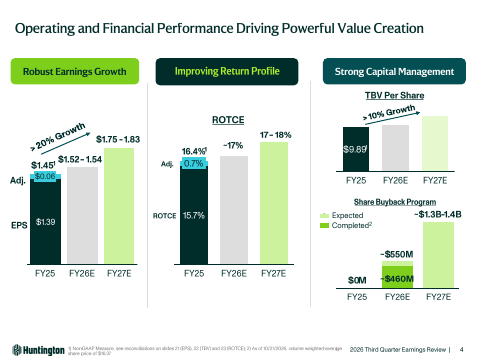
Management said rate hikes instead of cuts, higher inflation and much tougher competition drove the reset, and an EPS bridge of cost synergies, buybacks and about 8% to 9% core growth supports $1.75 to $1.83. — Steve Steinour, Eric Wasserstrom
0:30:38 · Erica Najarian, UBS · CRE runoff
Did CRE runoff come from new-market deals that failed Huntington's standards or from rates?
Most of it was refinancing into Fannie and Freddie from the existing franchise, plus some to debt funds, and construction commitments fell about 8% as a risk management step. — Steve Steinour
0:33:22 · John Arfstrom, RBC · Loan growth
What would change the competitive lending environment, and what is the right loan growth pace given the new markets?
Management expects higher rates to stay and pricing to remain tight, will keep its risk appetite and capital discipline, and is relying on strong commercial pipelines for a stronger fourth quarter and 2027 growth. — Steve Steinour, Brant Standridge
0:37:20 · John Arfstrom, RBC · Credit appetite
Is the pullback purely about competition and not a credit concern?
Yes, it is a capital allocation and return decision in CRE and indirect auto, and underwriting standards have not changed. — Steve Steinour
0:38:41 · Ken Usedin, Autonomous Research · Credit and buybacks
What credit, tax rate and buyback assumptions sit behind the 2027 bridge?
Credit is expected to stay stable with no reserve release in 2027, no tax rate change is expected, and buybacks of about $1.8 to $1.9 billion are planned across this year and next. — Brendan Lawler, Eric Wasserstrom
0:40:55 · John Pancare, Evercore ISI · Acquisition retention
How has banker and customer retention gone in the Texas acquisitions, and has it affected pricing?
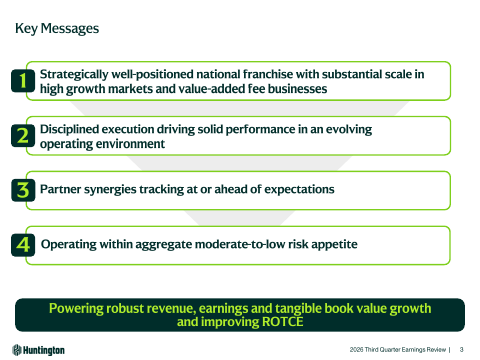
Retention is within expectations, top Cadence leadership stayed, revenue synergy expectations were raised, and the team is still adding commercial and wealth hires in Texas and the South. — Brant Standridge, Steve Steinour
0:45:30 · John Pancare, Evercore ISI · Deposit costs
What is happening with deposit costs and what deposit beta is assumed?
Competition is stable but intense, with CD pricing aggressive, and management assumes a beta of 50 to 60%, at the higher end of peers. — Brant Standridge, Eric Wasserstrom
0:50:30 · Manan Gosalia, Morgan Stanley · C&I demand
Where will C&I demand come from if rates rise further?
Growth is expected from both new geographies and national specialty verticals, with strong capex and pipelines, and equipment finance benefits from accelerated depreciation. — Brant Standridge, Steve Steinour
0:53:33 · Manan Gosalia, Morgan Stanley · Net interest margin
Could NIM expand from here given rising rates and back-book repricing?
Management anchors to a stable NIM near 3.25% because it assumes conservative deposit costs, with any upside depending on the curve and on easing competition. — Eric Wasserstrom
0:55:56 · Scott Seifers, TD Cowen · Pricing discipline
Where does Huntington aim to sit on loan and deposit pricing relative to peers, given skepticism about the competition argument?
Management wants value-for-value pricing and will take less volume where returns fall short, noting it grows about 6% organically with a nearly 17% ROTCE versus peers at 7%. — Brant Standridge, Eric Wasserstrom
0:58:47 · Scott Seifers, TD Cowen · Fee income
Why was the full-year fee guide trimmed, and what supports the fourth-quarter figure?
Higher rates dented capital markets and mortgage activity in the quarter, but capital markets, payments and wealth momentum still support about $750 million in the fourth quarter. — Eric Wasserstrom