Summaries and transcripts are machine-generated and can contain errors.
In brief
DFI's digital ecosystem turned profitable and drove about 35% of sales growth, and the Cody HK deal extends DFIQ Media retail advertising into Hong Kong outdoor media.
Price reinvestment and a refreshed product mix brought Convenience and Home Furnishings back to growth. Health & Beauty kept winning share on wellness, and Wellcome's Hong Kong basket moved from a premium to a discount against nearby Shenzhen. Ready-to-eat food, collectibles and the Food Bar rollout drew traffic to 7-Eleven. Online sales penetration reached 6.9%, and DFIQ Media revenue tripled.
Management wants to turn DFI from a portfolio of formats into an omnichannel operating company, with retail media and customer data as higher-margin profit pools. It is also scaling AI tools and keeping central overhead low. The tension is that price and promotion investment, such as in Malaysia, and the new advertising business must pay back without eroding format margins. Leadership changes across three formats add execution risk.
Operating cash flow after lease payments: “The Group reported operating cash flow after lease payments of US$178 million, 16% higher than the prior year period, driven by underlying operating profit growth.”
Free cash flow: “Free cash flow for the period was a net inflow of US$85 million, down 5% year-on-year, due to increased capex investment”
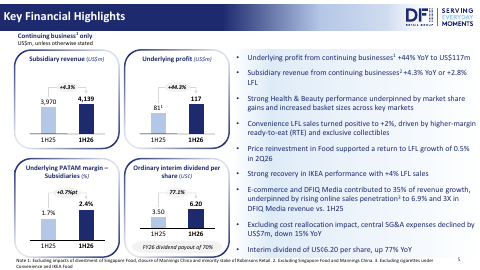
Underlying profit from continuing businesses: “Underlying profit from continuing businesses1 grew 44% to US$117 million”
Health & Beauty sales: “Health and Beauty 1,381.5 1,290.6 Convenience 1,178.8 1,129.4 Food 1,148.1 1,545.2 Home Furnishings 339.8 328.0”
Convenience sales: “Health and Beauty 1,381.5 1,290.6 Convenience 1,178.8 1,129.4 Food 1,148.1 1,545.2 Home Furnishings 339.8 328.0”
Food sales: “Health and Beauty 1,381.5 1,290.6 Convenience 1,178.8 1,129.4 Food 1,148.1 1,545.2 Home Furnishings 339.8 328.0”
Home Furnishings (IKEA) sales: “Health and Beauty 1,381.5 1,290.6 Convenience 1,178.8 1,129.4 Food 1,148.1 1,545.2 Home Furnishings 339.8 328.0”
Online sales penetration: “Grew online sales penetration to 6.9%2 as of 1H26, with a mid-term target of up to 10% by 2028”
Loyalty members: “Total loyalty members of 36m, including 6m yuu members in HK”
Food Bar stores in South China: “a broader rollout of the Food Bar to 453 stores as of June 2026, up from 325 at year-end 2025”
Organic revenue growth (excluding Singapore Food and Mannings China)
full year 2026
between 3.0% and 4.0%
Underlying profit attributable to shareholders
full year 2026
between US$285 million and US$305 million
Return on capital employed
full year 2026
11 – 13%
Ordinary dividend payout
full year 2026
70%
Key takeaways
Digital ecosystem turned profitable and drives growth
E-commerce and DFIQ Media contributed approximately 35% of sales growth, with online penetration at 6.9% and DFIQ Media revenue up 3 times. Management says this ecosystem earns higher margins than in-store product sales, which supports the case for retail media and data monetisation.
Cody HK buys access to outdoor advertising budgets
DFI is acquiring 100% of Cody Hong Kong, which holds multi-year exclusive advertising rights with KMB and Hong Kong Tramways, to build full-funnel advertising for DFIQ Media. Management says it is a way into media budgets, not a pivot into outdoor media, and expects it to be mildly dilutive in year one.
Price reinvestment flipped Hong Kong food positioning
Wellcome's basket moved from a premium to a discount versus the Greater Bay Area. This was helped by the Everyday Value range, now nearly 500 items, and by direct sourcing. Volume rose, and Food like-for-like sales turned positive in the second quarter.
Convenience and IKEA returned to growth through mix
7-Eleven Hong Kong ended ten consecutive quarters of like-for-like decline using ready-to-eat food and exclusive collectibles. IKEA like-for-like sales rose 4% after a 6% decline a year earlier, helped by price, local relevance and IKEA Food innovation.
Health & Beauty wellness lead faces Malaysia pressure
Health & Beauty kept gaining share, with Indonesia and Vietnam near 20% like-for-like growth and the Holland & Barrett distribution deal added. Margin slipped on promotions in Malaysia, where competitors also benefited from government cash aid vouchers that excluded health and beauty stores.
What management said
Each quote matches the transcript word for word.
“you have to meet the customer where the customer wants to be met. These offline stores that refuse to engage with platforms and digital are not, I think, playing the right strategic game.”
It shows management's conviction that offline retailers must work with online platforms, even though e-commerce dilutes margin.
“we are not getting into outdoor advertising through the Kodi acquisition. What we are doing is we are accessing a pool of media dollars that we were not able to break into without having that ability to drive.”
It limits the scope of the Cody HK deal to retail media access, not a move into the outdoor media business.
“I believe now with that 3 % discount and certainly the price comparisons that we do to our competitors here in Hong Kong, we don't need significant investment in price.”
It signals that Hong Kong food price investment is ending and attention shifts to Own Brand and value share.
“I see the flexibility and the scale of our business is actually a competitive advantage because we don't have to have a trade-off between a strategic investment and our return to our shareholders.”
It explains how management plans to fund AI, pricing and format investment while keeping its commitments to shareholders.
What is the margin outlook for the second half, and what is the rationale for the management changes across formats?
Management expects second-half margins to be better in Health & Beauty, Convenience and Food, and says the leadership moves prepare the next phase of competitiveness driven by AI, technology and customers. — Scott Price, Tom van der Lee
Will Hong Kong food price investment continue, and what is driving the Malaysia health and beauty promotions?
Management says the 3% discount to Shenzhen means little further price investment is needed, and Malaysia promotions are a temporary response to government vouchers that excluded health and beauty stores. — Scott Price, Tom van der Lee
Management did not give details, but said growth was mainly in 7-Eleven China and Indonesia, with new-store payback of around two years. — Tom van der Lee, Scott Price
0:44:37 · Matt Candy, CGS International · Cody HK, targets
Does stronger 2026 revenue open upside to the 2028 targets, and how does outdoor advertising fit the DFIQ Media strategy?
Management is not revising guidance yet but expects at least the top end, and says Cody HK gives access to media budgets without making DFI an outdoor media company. — Scott Price, Tom van der Lee
0:47:09 · Jayden Venterakis, Macquarie · Overhead, retail media
How large was the overhead reallocation to formats, and how much revenue does retail media contribute?
Roughly $9 million of overhead moved to the formats, and management will not disclose a separate retail media figure beyond saying the digital ecosystem is about 35% of revenue growth at higher margin. — Scott Price, Tom van der Lee
0:50:47 · Macreed Wang, Bank of America · Segment margins
What drives the better second-half Health & Beauty margin, and why is Convenience margin flat despite more ready-to-eat and online sales?
Health & Beauty should recover as the Malaysia investment proves episodic, while Convenience margin held because of competitive pricing in China and a mix of stabilised cigarette sales. — Scott Price, Tom van der Lee
Management expects overhead to fall further, with multi-year savings programmes and another started this year, and is confident of beating the 2028 overhead target. — Tom van der Lee
0:56:16 · Online analyst, HSBC · Cody HK turnaround
How will Cody HK, which lost money in 2024 and 2025, be turned around within 12 to 18 months?
Management plans to run it at much lower cost without unneeded overhead, retain key management, and bring more revenue into its retail media business, expecting breakeven within 18 months. — Scott Price
Questions
What is the Cody HK acquisition and why did DFI make it?
DFI is buying 100% of Cody Hong Kong, an outdoor advertising provider with exclusive rights with KMB and Hong Kong Tramways, to build a full-funnel advertising offer in DFIQ Media. Management says it unlocks media budgets and is not a pivot into outdoor media.
How is DFI's digital and retail media business doing?
Overall digital turned profitable, with e-commerce and DFIQ Media contributing about 35% of sales growth, online penetration at 6.9% and DFIQ Media revenue up 3 times. Management says this ecosystem earns higher margins than store sales.
How did DFI turn around Hong Kong food and IKEA?
Wellcome cut prices on core items, expanded Everyday Value to nearly 500 items and used direct sourcing, moving its basket from a premium to a discount versus the Greater Bay Area. IKEA focused on value, local ranges and food innovation, and like-for-like sales rose 4%.
Why did Health & Beauty margin fall while sales grew?
DFI invested in strategic promotions to defend share in Southeast Asia, especially Malaysia, where government cash aid vouchers could not be spent at health and beauty stores. Management expects a better second half.
What is DFI's strategy for growth and AI?
DFI is building the DFI Omni Platform that links stores with digital, retail media and insights, expanding stores through capex-light franchising in South China and Indonesia, and scaling GenAI tools across markets. Capex is guided to US$200-220m, partly for omnichannel, technology and AI.
Good morning everyone and thank you for attending the DFI Retail Group 2026 half-year results presentation. I'm Karen Chan, Strategy and Investor Relations Director. Joining us today is Mr. Scott Price, Group Chief Executive Officer, and Mr. Tom Vander Lee, Group Chief Financial Officer, who will be providing prepared remarks on our half-year results, followed by a Q &A session. Today's presentation is being webcast in its entirety. In addition, the full text results and presentation slides are already uploaded onto the IR website.
Before we start, I would like to remind you of the following forward-looking statement. The information about to be presented is for information purposes only and is not intended to be investment advice for any person. There's no intention to invite for any dealings in any securities. There may be forward-looking statements mentioned in the presentation materials which include statements regarding our intent, belief, or current expectation with respect to the company's business operations and market conditions. You are expressly advised not to rely on these forward-looking statements as they are subjective views which are subject to risks and uncertainties.
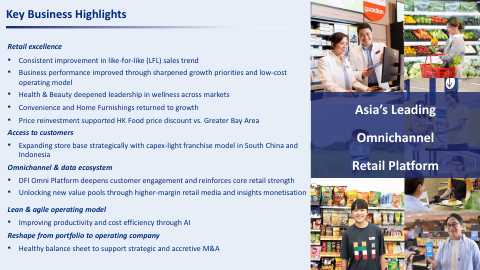
Thank you, Karen, and good morning, everyone. Welcome to the DFI first-half results. Let me first take you through some key highlights. Overall, solid performance on revenue, a consistent improvement in our like-for-like, and that includes a 3 % with the impact of cigarettes as well included, and quite pleased with that performance. Overall margins improved across for the most part in the business.
We're comfortable where we sit and on our way towards the midpoint guidance that we gave in December of last year in our investor day. So see margin expansion as an opportunity continuing moving forward. Health and beauty deepened its penetration of wellness products. And for those of you who have attended previous events or have been to one of our stores with the Derma, we see great margin opportunity coming out of the health and beauty. Convenience and home furnishing through 18 to 24 months of effort behind not only assortment, but also investment in pricing.
Both of those formats return to growth. And our Hong Kong food business, where 18 months ago we sat at roughly a 15 % premium to a basket in Greater Bay Area of Shenzhen for formats. We set it about a 3 % discount. So we removed the value of anyone going across the border. During the first half, we gained volume share, meaning absolute volume. We're going to look now through our efforts of that increased traffic to gain value share moving forward.
Access to customers continue to open stores and focus on CapEx Lite in South China and Indonesia. The digital ecosystem, I'll talk about that in a few more minutes in more detail, though, that I think has done very well. And we'll talk a bit about not only the retail media, but the overall digital ecosystem, P &L. Lean and agile, we continue to drive everyday low cost. It is an important part of our business model that allows us to not only take those savings to invest back into pricing for customers, but to also invest in increased margin for shareholders.
And finally, we end the first half with a very strong balance sheet and allowing us, therefore, flexibility as we see inorganic opportunities moving forward. A bit more highlights in terms of the key financials before I turn it over to Tom. So overall, underlying profit increased 44%. Subsidiary revenue grew 4.3 % or 2.8 % on a like for like. Very strong health and beauty performance in terms of market share gains across all of our key markets.
A convenience store like for like at a plus 2 % driven by the higher margin ready to eat and exclusive collectibles versus the replacement of much lower margin tobacco sales. we did as I mentioned invest in pricing and achieved a like in Hong Kong a 0.5 % like-for-like growth in the second quarter even though overall for the for the first half it was flat very strong performance in IKEA we put quite a bit of work in that talk about that in a couple more minutes but a 4 % growth like for like in a category that is generally seen as challenged I think we have the right formula there.
E-commerce, DFIQ media, 35 % of our revenue growth. And now that ecosystem is margin accretive to stores, meaning that the margin out of that digital ecosystem is higher than our store margins. 6.9 % penetration of e-commerce, and we have a 300 % increase in our DFIQ media. Excluding the impact from cost reallocation, we declined 15 % our SG &A. So again, as I said, a consistent and constant focus upon everyday low cost. And then finally declaring an increase to our interim dividend of 77 % to $0.0620 and reaffirm our guidance on a 70 % dividend policy.
Thank you, Scott. Let me take you through the key financials. Starting with the income statement, a very strong first half of 2026, and it shows that we are delivering the strategy which we set out at the investor days. And this puts us firmly on track to deliver the top end of our 2028 guidance we've given last year in December. To ensure an apple to apple comparison, we provided a restated 2025 base that excludes the divestment of Singapore food, the closure of Mannings China and the disposal of Robinson retail.
We are starting with revenue from subsidiaries, 4.1 billion up 4 % year on year. The same for maxims, 1.4 billion also here up 4 % year on year. So both Maxim and the subsidiaries strong growth on top line. On the underlying profit from subsidiaries 101 million up 49 % adds on the back of a strong earning recovery of IKEA, food and lower SG &A and financing costs. Maxim is up 15 % to $16 million and it gives a total underlying profit of $117 million up 44%.
As you can see the bottom, the interim ordinary dividend per share is 6 cents 20. That's up 77 % and it reflects a more even distribution between the interim dividend and the full year dividend. We still reconfirm our guidance of 70 % full year payout on dividend. And we can pay more in interim because the momentum is very strong, cash generation is very strong and we are able to pay out this in October. Going into a bit more detail on the sales slide, you can see here we continue to deliver a strong growth in margins and returns, all of which are key building blocks for driving our TSR.
Subsidiary like for like sales showed a consistent improvement to 3 % growth in the first half of 2026. Strong momentum in health and beauty, return to growth in convenience and home furnishing, as well as continued improvement in food. Some comments on the key formats, health and beauty, 8 % growth or 6 % like for like, we continue to gain share in wellness, strong tourist and airport sales growth, e-commerce growth in Southeast Asia. On a constant currency basis, it's 7%.
Then on convenience, 4 % up like for like or 2 % like for like. And here the focus is on higher margin non-sig categories with RTE being the focus. Cigarettes though have stabilized, so cigarette sales stabilized year on year. Food broadly stable if we exclude the divested businesses. We see continued improvement in the second quarter of this year on the back of our EDLP pricing in Hong Kong and that supported a 1.2 % volume growth in the first half, despite ongoing pivot to value for our consumers.
Home furnishing, a very sharp turnaround, initiatives in price investments, expanding our food range and online presence resulted in a 4 % life for life sales, compared to a 6 % decline in the first half of last year and a 3 % decline in the second half of last year. So a turnaround for IKEA. And in Maxence up 4 % on the back of strong sales in Southeast Asia and returned to growth in China mainland. Hong Kong though was quite soft for Maxence.
We're going to profit, operating profit by format. Now as part of our overhead optimization exercise, our cost reduction exercise, certain resources have been reallocated from the group to format level and that drives greater agility and more accountability. As a result of that we have restated also prior year figures to make the year on year comparisons easier and understandable. Starting with Health and Beauty, operating profit of 109 million up to 2 % year on year. The margin though declined slightly with 40 basis points mainly because intensified competition in Malaysia and the growth of online from third-party marketplaces like TikTok and Joppy.
However, we are confirming that the guidance we've given for 28 % of 9 to 11%, we are on track to deliver that. You will see the second half is going to be better than the first half for health and beauty. Convenience up 2 % to $37 million with margins broadly stable. Food, here operating margin reached $17 million or 27 % up year on year and the operating margin improved 30 basis points year on year to 1.5%.
In Hong Kong margins are stable as we invested in price and the price investments were paid for offset by lower cost price. We do more direct sourcing with lower cost prices and help us to pay for the margin investment in price. Also, very strong cost discipline in the format to keep operating costs low for the first half. Cambodia doubled the operating profit on the back of double-digit growth of sales and strong improvement in margin rate.
IKEA, the strongest improvement, 85 % up year on year, $215 million for the first half. Top line growth, strong and cost optimization both on rental and overhead across the business drove the underlying performance for IKEA. The operating margin rose 200 basis points to 4.3%, so strong performance for the first half for IKEA. But then move on to the sub profit and underlying profit. The underlying profit for subsidiaries 101 million up 49 % at a 2.4 % margin up 70 basis points against the same period last year.
Key drivers won earnings recovery in IKEA and food as I highlighted before, the SG &A savings, improving economics for digital including retail media and our reduced financing cost. The total underlying profit including maximums went up 44%, $217 million for the first half of this year. And as G &A cost declined on a like-for-like basis, 15 % year on year. And we expect more reductions to come in the second half and the next years. Cash flow.
Operating cash flow up 16 % for the first half of the year. Free cash flow is slightly down to $85 million. That's because we have stepped up our capex in line with our full year forecast. And I'll share a bit later on where we've invested the capex in. As we said in the Investor Day last year, our capital allocation principles are firm and we follow those. So those principles are we first invest in our core.
So making sure we continue to renovate our stores, continue to grow our stores. We invest in the future. We are investing in AI and digital to make sure the future profits are secured. We are growing our dividends in line with our policy and our top-line and bottom-line growth and we pursue only TSR accretive M &A. If we can't find those, we will return the money back to the shareholders. In capital expenditure, I've now shared a bit more breakdown of where we spent the capex on.
So the cap is up to $93 million in line with our full year guidance of 200 to $220 million. So we are on track to deliver that commitment. We invested in a few key areas. So if you look at Omnichannel and technology, the first dark blue building block, we added 1,200 screens in our stores in the first half for retail media. We have now 11,500 screens in all our stores across all our markets on track to have 18,000 screens by the end of 2028.
We invested in AI-enabled replenishment technology in all our markets, and we are rolling out electronic shelf labeling in Hong Kong in our welcome that helped us to reduce our store labor and improve productivity. On store refurbishments, we renovated 157 H &B stores to drive wellness. For food, we are remodeling our largest stores in Hong Kong, driving top-line growth. For convenience, we have larger refurb in Hong Kong and we added 128 new food bars in China.
Alas for new stores, we opened 119 new stores in the first half of this year, up from 154 in the first half of last year. We also closed some stores, but the capex represents the gross investment in new stores. Then on shareholds, as announced earlier, our interim dividend will be 6.20. Again, our full year guidance will remain 70%, but that's a better balance between the interim and the full year dividend. And the return on capital, 11.7 % in the first half, up from 9.4 % end of last year.
and we are on track to deliver 15 % by 2028 as we shared and committed in our Investor Day last year. And with that, I turn it on to over to Scott for the strategy and updates.
Scott Scott Thanks, Tom. Just want to spend a few minutes on the operating segments in a little bit more detail. So I'll start with health and beauty. So 8 % growth in sales. obviously we've opened some new stores so the like-for-like store sales is plus 6% representing market share gains across all of our key markets interestingly Hong Kong Macau growth that plus 5% one is the wellness leadership but also now we're seeing higher value tourists come back to Hong
Kong our tourist stores had revenue growth of roughly 10% And I think that this is a bit of a trend that we're seeing, which is people are still traveling, but they're traveling closer to home. Southeast Asia business, very pleased with the growth that we're seeing there. Plus 9%, and you'll see in Indonesia and Vietnam, we had close to a 20 % light for light growth. We're seeing a pretty significant positive reaction to the health proposition that we're bringing forward.
wellness Gen Z which a few of you probably in this room are Gen Z maybe at the outer edge of it far more attuned to wellness than necessarily previous generations exclusive distribution now announced with Holland and Barrett which is a great brand we're very pleased with that and believe that that will be a great part of our assortment as we expand that across several of our markets In-store coverage now has expanded across our skin and scalp assessment tools.
So that is an AI-driven tool that we developed in conjunction with Samsung. And as I mentioned previously, a significantly higher basket value than a customer who does not participate. We've done about 20,000 of those. Over a 20 % improvement. Our own brand offers value in key commodities. So although we are expanding into wellness, we are keeping in mind the value-based customer. So our own brand plays that position in the assortment and a great improvement in productivity.
Importantly, though, in margin as well. Open 41 stores in the first half. We'll continue on that path, including two new franchise stores in Indonesia. We're working very hard to ensure that the Indonesia market will have a profitable franchise model so that as we expand that out across second tier cities, we have confidence that franchisees will become long-term businesses as opposed to in and in and out. Again, margin doesn't concern me at all. We strategically invested in the Malaysia business.
We have a competitor who likes being number one. I'm competitive. I'd like to be number one. So we're strategically investing where it's necessary. We have the margin flexibility to be able to do that in Malaysia. So, again, it was a thoughtful investment and I think the right investment. Moving on to the convenience format. So, again, as I mentioned, great performance as we return to growth. 4 % year on year 2 % like for like as we increase our ready-to-eat sales penetration which is now 24 % or if you exclude the cigarettes from our revenue base a 34 % penetration was very small years ago a couple years ago we've done a great job of bringing in a bit
of a Japan themed it seems like every second person in Asia every other person in Hong Kong has been to Japan three times this year so clearly there is an affinity and we believe that that is having a very positive impact overall a Hong Kong like for like great final impact in terms of putting behind us 10 consecutive quarters of decline the team there did an outstanding job pivoting away from you know not too many years ago guys we were 50 % of our revenue in convenience stores with cigarettes.
Very low margin, but that is a revenue driver. We've now balanced out that assortment with not only a high level of ready-to-eat penetration, but collectibles. I am not the customer. I still don't get la boo-boo. But K-pop, these sorts of collectibles, it's bringing new traffic, new customers, and I think a new energy to our Hong Kong stores, and it's going very, very well. Overall Singapore again a great performance, 8 % with the same collectible strategy and as well some great promotions.
We increased our store base by 112 in South China to nearly 2,000 and see a pathway to continuing to invest. We really in Guangdong province have just the three main cities covered. We see lots of opportunity now to expand out and broaden the portfolio. Overall, the food bars are going well in southern China. We are giving QSRs a run for their money in terms of value meal. We have the convenience of the click and collect as well set up.
We have tens of thousands of orders a day. I think that's right. So 110,000 orders a day across our stores of click and collect each day of a convenience meal. You pick up a breakfast and a coffee or a breakfast and a beverage, pop in, grab it as you're on your way into the office. Good growth of online sales. Generally, this has been dilutive. I'll talk about that in a couple minutes when we get to the Omni, but we're very pleased with the performance here.
you have to meet the customer where the customer wants to be met. These offline stores that refuse to engage with platforms and digital are not, I think, playing the right strategic game. And then overall higher margin categories in franchise stores means that we continue to see opportunity to increase our margin as we think about the next couple of years to the guidance that we gave in December of last year. If I move on to food, food has probably been the most challenging format over the last couple of years.
We have dealt with not only a divestment, but also just the fact that you see now, in particular, in our market of Hong Kong and Macau, you have Shenzhen and Zhuhai right across the border, and a relatively convenient way to go and shop. There was a lot of noise, say, 18 months ago about that traffic happening. Overall, we've done well. I'm really pleased with where we have landed. We were not in a good competitive position 24 months ago, 18 months ago.
I think we're in an incredibly good competitive position. So if you were to look at overall continuing a 1 % growth, light for light plus 0.5 in the second quarter, so we are accelerating the improvement. Volume share first, then value share second. big price investments as a result of resetting our structure of our supply chain and where we source our goods Hong Kong has been controlled by lots of trade and middlemen and various and sundry exclusive partnerships we have worked our way around those gone direct meaning that we're able to get much lower costs that we can pass on to our customers so that margin has now been protected through that direct sourcing.
And from 18 months ago, when we were about a 15 % premium to Shenzhen, so if you pick, say, 250, 200 items, the biggest selling items in Hong Kong, and you went across the border to Shenzhen and picked four retailers, and you shop there, it was 15 % cheaper to go across the border. Hong Kong's now 3 % cheaper. Now, one would say, how does that happen? It's because those retailers have to use the higher margin tier one city to pay for some of their lower margin loss-making tier two cities.
We don't have that problem. We're only in Hong Kong. We've got the ability to deliver not only to our customers, but also to our shareholders. So C-margin expansion is a great opportunity as well for the food business. Accelerating our omni-channel with a 35 % increase in online orders. Quick commerce, which are smaller baskets, but we're able to charge a premium is a good part of that growth. And then finally, our Cambodia business is just growing by an extraordinarily high level.
So we're very pleased with that business. We are the only real modern food retailer in Cambodia, and we're seeing great financial performance. And then finally, on to IKEA. Last but not least, it has been in the last few years a bit of a problem. and child. The reason being that we didn't necessarily have the right assortment at the right pricing with the right proposition. We didn't necessarily have the strength in the categories that we needed to have in.
So great credit to the team that has been running this IKEA business. So a strong turnaround, life for life sales growing at 4%. That was negative 6 % a year ago. Hong Kong, positive growth of 3%. Big pivot upon value, local relevance, food. Hong Kong years ago launched the durian ice cream, another thing I will never get. But in any event, we have taken that concept of how do you take the intersection of Scandinavian in life and local taste and create some interesting food opportunities, which we're driving, including Swedish-themed breakfasts in our stores.
We're now seeing the traffic, and we're now seeing the progress from that. Taiwan, again, continues to be a stronghold for us, a great growth, and we see store expansion. We do not have yet the penetration that we could in terms of number of stores. So we're back into investing in store growth in Taiwan. See, again, Omnichannel, where we went on to Shopee, first ever franchisee, where we went out and put our proposition. We have stores in Jakarta.
We have stores in the major cities. It's a huge country, 250 million plus people. We can't possibly get into all of the islands. Shopee is profitably allowing us to expand. good food innovation as I mentioned and that Nordic theme Scandinavian theme is drawing some some great traffic into our stores overall think that we have got through some of the efforts that we've made of divesting or eliminating assortment that was not relevant to our Asian markets investing in items that in collaboration with the franchise or I think have had powerful impact and then you know people still want little treats right still again you know the number one selling IKEA item across our Asian markets again I don't understand lamps why
lamps don't know but if it makes you feel good we'll sell it to you right and And so again, that allows us to have deep insight as to how the average consumer is really starting to understand where can they afford to give them some treats. Apparently I was on CNBC a little bit earlier and I didn't know this, but apparently that's the first thing decorators start with, their lamps. So there you go. That explains it and we have got lots of great lamps at IKEA.
And then again, we are focused on the portfolio and closing stores that we do not think are profitable. Finally, just wanted to talk a little bit about our digital ecosystem. We've talked about quite a bit. So our digital ecosystem is made up of all of our e-commerce transaction, generally dilutive. For 50 years, the customer did the fulfillment and the last mile delivery for free. Now you've got to pay somebody to do it. So you take those transactions.
We have worked very hard at investing in technology that helps us make that very efficient. That business is relatively break-even and for the first time after five years we have now pushed that into break-even but the ecosystem is then made up of the YUU profitability our retail media profitability and the ability to with 20 million transactions a week we've got the ability to know more about our customers and we're able to sell that data that ecosystem was 35 % of our revenue growth and is a higher margin than selling product in-store.
To me, this is what represents what a true omni-channel player does. Now, what right do we have to play in media? It's a bit challenging in Asia, very fragmented market. The media buying agencies generally do pan-Asia. So that led us to the decision to buy Kodi. Kodi is the advertising agency that controls contractually all of the All of the media that you see on the buses the K &B buses the and the subways here in Hong Kong And it was a little bit hard to break in now what happens with the close of this business We see an opportunity to be able to bundle deals So new product launches promotions, whatever it is they come in they want
access there We then add it with the thousands of screens that we have in store across our formats here giving us, I think, quite a competitive advantage to be able to really move quickly in Hong Kong in terms of retail media. It's a minor investment. I don't know that we've announced the investment amount, so I'm not going to say it so I don't get into trouble later with Tom and Karen. But look, it is mildly dilutive in the year one.
I think within 12 to 18 months it'll be profitable. but if you add it up into the overall retail media P &L, it's a great accretive part of that business and we'll continue to look for those inorganic opportunities that to me represent a very strategic chance to continue to build not only our proposition for customers but also for shareholders. And with that, I'll turn it back over to Tom.
So based on a very strong first half, we are revising upwards our guidance for sales and for profit. So sales, the previous guidance was 2-3 % organic growth, we up to 3-4 % for the full year. The same for the underlying profit between 270-300, the previous guidance, the current guidance will be 285-305. And we are confident that we're going to make sure we're going to deliver those numbers. CapEx, Dividend and ROSI, those all remain unchanged.
Thank you Scott and Tom. And with that, we'll open up the floor for Q &A. If you wish to ask a question, please raise your hand and we'll have someone to assist you. We kindly ask you to please indicate your name and the company name you represent. And for those participating online, you may submit your question on the platform, and we will direct them to the speakers.
Yes, this is Brian from Citi. Hi Scott, hi Tom. I have two questions. First question is about the margin profile. If I use your numbers in the presentation, we can see that the health and beauty margin is pressured by the Malaysia price promotion, right? And the convenience stores drop a little bit. I don't know if that's a rounding issue or not. And food improved on direct sourcing. I mean, could you share more color on the margin profile progress we had in the first half?
And in the second half, what should we be looking at? And is there any, I mean, we shared a lot about the margin initiative that we are doing. But is there any other factors that we're missing that might harm our operating margin for that? That's the first question on margin. My second question is about the management change. We have some, you know, quite a big change in the management, and I wanted to know the rationale behind it.
A quote from the filing, it says, for the next phase of growth, so I just wanted to know what that is. Because, you know, Angel is from Health and Beauty, right, and it was a high-growing business and it's switching to IKEA. So, and we have any other changes. So I just want to know if for health and beauty, are we, I mean, are we having, are we not accelerating or, I mean, I just want to know the rationale behind all these management changes.
Great. That's true. Well, I'll answer the second question first and then turn the margin over to Tom. So the first, retail is fast moving. And my job is to develop our leadership team and develop the skill set of our leadership team in conjunction with our board. Each one of our formats compared to two years ago, I call it we went from DFI 1.0 to DFI 2.0. AI, technology, competition, customers means that we have to focus on this next phase of competitiveness.
And I call it DFI 3.0. Each one of our businesses have great skills and new leaders bring in a different perspective. And so I can tell you, as Andrew goes into IKEA, he sees enormous opportunity to take some of the things that he learned in health and beauty and grow. Curtis, the last time I looked, is an intensely competitive human being. sometimes we have to coach him not to be so competitive. I'm joking. I've never done that.
But, you know, he comes out of JD. He comes out of Walmart. His job has been fixing the food business. Tom is now going to challenge himself to grow that business. And so I think, you know, overall, we're in good position to be able to test our leadership and our management while continuing to be able to deliver to shareholders. And as I said in December, I am a big under-promise and over-deliver and I think our first half reflects we're moving from strength to strength and I think with this leadership team who are an A team, best team I've ever worked with, we will continue to do that on the margin piece.
Yes on the margin so let me just take you over the key form it's a health and beauty a slightly lower margin However, Malaysia will recover at some point. We expect that intensity will calm down at some point and margins in Malaysia will recover. The other point on healthy beauty is the e-com platforms. We are driving really hard our own e-com platforms where margins are much better. So that's the growth opportunity that will improve margins.
For healthy beauty, we expect the second half to be much better than the first half and will end up in the range of giving you in the investor day for healthy beauty. Same for convenience, it's a small rounding for the first half. For convenience the second half, as you can see in the past, is always significantly better than the first half. So we also expect that to happen for this year and margins will be better for the full year.
And we are on track over the next few years as we grow RTE and grow non-food, margin mix improves and we get to the range we also indicated in our analyst presentation on the investor day last year. Same for Foote, he also expects margins to improve in the second half and the key will be flat. So overall the second half is going to be better than the first half and we are on track to deliver the margins we indicated in our investor day last year in December.
The question on headwinds, look there's always headwinds and if you ask CFO I only see risks, but on the headwinds you see that cost prices do increase sometimes of the oil price increases. So we are first of all pushing back on cost price increases to our suppliers. And secondly, if we pass them on, we've been selective. So we will not hurt margins, but we also don't want to hurt demand. So it's an art to make sure that's the right balance.
But even that, in the first half, we have played that really well and we see the margins actually are quite stable and demand is still there, which is most important.
The only thing I'd add is, as a retailer, the worst thing you can do is to have a margin expansion commitment with no levers to pull. The reality is we have an enormously agile portfolio. We are fully focused on daily essentials. No matter what happens, people are going to eat, they're going to bathe, they're going to want a bottle of water, and for some reason they want a new lamp.
In that environment, we have the flexibility to continue to meet our market commitments while also ensuring we have the ability to invest in market in a particular format that we think deserves the attention to gain share. We have the ability to invest in AI as we think about the ability to grow our business and personalize relationship to our customer and make strategic investments without harming that commitment to the market. So I see the flexibility and the scale of our business is actually a competitive advantage because we don't have to have a trade-off between a strategic investment and our return to our shareholders.
Thanks Scott, thanks Tom. This is Jeff from CLSA. So again just going back to first on food. So now I think we are seeing our basket size is trading at discount to the GBA area. So just trying to pick your brain on how do we think about price investment going forward. Is it going to stabilize or are we still going head to head on onshore retailers here? That's my first question. And the second is more on the Malaysia health and beauty promotional spending.
So on the first question, we have achieved the right margin mix and price to customers, where I believe now with that 3 % discount and certainly the price comparisons that we do to our competitors here in Hong Kong, we don't need significant investment in price. As a result now, we have the ability to pivot maybe more towards own brand and continue to expand our own brand.
We may look at potentially opening new stores again for the first time in a long time here in Hong Kong. I believe, again, margin expansion is an opportunity here in Hong Kong. We don't see the need now to invest into further volume share without value share and positive revenue growth. On Malaysia, it is a highly promotional market. You know, as an everyday low price proponent, I find over-promotion confusing for customers. You know, you go in, you buy one, you get one for free.
Well, all that does is it goes in your pantry. If I get, you know, buy one, get one free shampoo, I'm not washing my hair more often, right? You're forcing me to put more dollar in my pantry than an everyday low price. So we are looking how do we strategically migrate towards that, understanding we're not number one in the market. We've got a competitor who loves that kind of, you know, I think superficial value. And we are selectively investing in those promotions where we have to, but also in terms of moving more towards an everyday low price model.
Jeff, one more thing on Malaysia. The Malaysian government issued vouchers called SARA and those vouchers are only we spend at supermarkets, not in healthy beauty stores. Some of the volumes on basic shampoos and basic H &B items moved away from healthy beauty channels to supermarkets. And as a result of that, it intensified the competition within the H &B channel.
That we think is temporary because those vouchers are not being issued every week. This year they might stop at some point in the future. So it is temporary, but we're going to make sure as we can, we have to hold on to market share in this period. We can say, oh, we want to drive profit, but if you drive profit today, you might be at a big loss tomorrow. So it's a balance. Next question.
This is John Lenn from UBS. I just have one question. It's more about the store count by segment. So I'm not sure if management could share about the store addition and also the store closure by each of the segments. Just want to gauge about your capex attitude by different segments.
I don't have the details, John, but where we see the store, look we always closing stores, right? Every retailer, unprofitable stores we will close, right? At the same time we're growing stores.
The major growth in the first half this year is mainly in China 7-Eleven, where we can on franchise or also own stores. And secondly is Indonesia. Yes, we also grow in stores in Malaysia and other markets, but the bigger growth goes from those two markets in line with our growth ambitions we set out earlier last year. We see still that the payback for new stores is very strong. So we see that around two years for new store payback.
Just adding on to that, you know, Asia is quite unique, which is the opportunity to own stores is pretty low. You go to major mature markets around the world and a big retailer for the most part will own a portion of the real estate. It's all rental. And if we go back a couple of years ago, we talked about the fact that we brought rents down.
But we have three plus three. So we have a good part of our portfolio every year up for renewal. And that gives us the opportunity when the landlord comes in with a rent increase potentially to say, you know what, we can go somewhere else. So it gives us a great flexibility. We do want to increase our store count where we see opportunity to continue to grow market share. But what we're finding is that as we have refined our assortment, as we have increased our transactions, and we've increased our market share, landlords want us in their malls.
Landlords want us in their businesses, which has given us a greater negotiating position, and as a result, I think, ends with the ability to continue to grow profitably in terms of shareholder returns.
Yeah, maybe last comment on Indonesia, because people are very concerned about Indonesia. Actually our health and beauty in Indonesia is the best performing business across all the markets. Life for life is really really high, profits are exceptionally high too. And because people still want to spend the little money they have on those things that make them feel good.
Be it lipstick, be it cosmetics, be it vitamins. That is still very very essential. So these stores in Indonesia across all our formats and all our areas for HMD to do particularly well. So we're actually quite confident that growth will continue. And a big part of that assortment is locally sourced and therefore does not have the currency risk if you are an entirely import-driven business. A bit of a challenge for us on IKEA, but we've mapped a path that we think works well.
I have two questions. and Fest, given the stronger revenue outlook for 2026, does that change your thinking on the 2028 targets? Specifically, could that be room for upside to your 2 % to 3 % three-year revenue CAGO guidance? My second question is on the Kodi Hong Kong acquisition. Your retail media strategy so far has centered on apps, in-store screens, and on a channel.
While Kodi brings outdoor ad inventory on buses and trams, could you help us understand how out-of-home advertising fits into the broader DFIQ media strategy? Thank you.
So I'll answer the second one and then pass the first one to Tom. So look, we are not getting into outdoor advertising through the Kodi acquisition. What we are doing is we are accessing a pool of media dollars that we were not able to break into without having that ability to drive.
So this should not be seen as DFI suddenly wanting to be in the media business in terms of terrestrial out of home. Very little interest. And it's an industry that I think is volatile and again, not something that is part of our core proposition. It was a very good strategic buy. And I made clear, I think, in our investor day and potentially this time six months ago, So we have got a history of having purchased many minority positions where you influence them.
It just doesn't work for us. We are going to stay Asia-focused. We are going to stay in the formats in which we are in. We are going to look for retail media that drives the app and the in-store opportunity for growth. And we are not going to acquire anything unless it's TSR creative in the short term. And that is, I think, a good set of principles. and Kodi will fall to within that. It does not signal a sectoral pivot in terms of where we want to put more capital.
On Kodi, I can say some numbers. So we spent less than $4 million in the U .S. It's a very, very minor acquisition. And it will be close to breakeven next year. So it will not be dilutive. So it's a very small investment, won't be dilutive, but it unlocks a lot of potential for our retail media across all our formats. So I think it's... Hopefully P &L, that retail media. Absolutely. So that will help to drive the over.
Back on the first question on guidance, we're not ready to revise our guidance, but as I said earlier, we are quite confident that we will deliver at least the top end of the guidance. And when we are ready, we'll come back to the community to share our revised guidance, but for now, the top end I think you should take into account.
How much was that impact in absolute terms, and where did most of the allocations go? Second question on retail media. How much was the current revenue contribution from retail media, given it's now contributing close to 35 % growth? And where this was recognized, please.
So I was trained, I call it the foot of Walmart. Sam Walton was a great guy. and there are a lot of very powerful truths in their economic model. And the first powerful truth is that every dollar of overhead must be correlated to profit.
And if you can't, you shouldn't be spending it. We had a quite general liberal view as to what our overhead is. Tom and the finance team went through a very disciplined process and said, where is this adding value in the P &L and If that is adding value to the food P &L then the food needs to pay for it Not have it allocated to health and beauty or to 7-eleven If everyone believes that they're getting value from it, then we all have to agree their allocation has a return on investment and that process resulted in a very very clean P &L where we started at 1.8%, I think we announced, with a commitment by 28 to get
that 1%. So shared overhead will be less than 1%. Everything else is directly attributable to the margin path each one of our format and business segments have committed to. So very, very comfortable that we have the right model. And it is going to be, to me, the best way as we think about AI and technology investments is making sure that the technology team is investing dollars, that the cost of that investment is going to be borne by those P &Ls and not buried in general overhead, which to me is very dangerous as an everyday low-cost player.
When it comes to the retail media, my second lesson from Walmart. It's a shadow P &L. We manage it internally. We'll talk about it in generally. We report only segments. So I'm not going to talk about a retail media P &L. I'm going to have data monetization P &L. I'm going to have YUU P &L. That doesn't help us serve our customers better, and nor does it help us guide our shareholders better. So in general, we'll talk about that media as a part of that digital ecosystem.
Maybe on the overheads, more detail. So, Jaden's question. So we allocate overhead to the formats because they can make it more agile. So they can take it on them and they can lower the cost. That's the first principle. If you look at the allocation, it's roughly $9 million, which we reallocated from the center to back to the formats.
By format, roughly $3 million for health and beauty. Similar amounts for food. $2 million for convenience, about 0.6, 0.8 to IKEA. You can do the numbers for that. It's not only just trying to make it look better for the center, but making sure that the formats can deal with overhead to reduce them and to make sure they are put at work.
I just want to follow up on segment margins on health and beauty. Can you elaborate a little bit more about drivers to drive a much better health and beauty margin in second half? Second question is on CVS. Despite higher RTE and online sales penetration versus first half of last year, can you elaborate on the reason why margin remains broadly stable year on year?
I don't know exactly what the change would have been if we had not made that investment. I know numerically we're tracking that. But to Tom's point, this is episodic, which is as we grapple with the decision by the government to offer, excluding health and beauty, a set of free vouchers to the average Malaysian. It had an impact. We pivoted. We strategically invested as I mentioned if you look at the midpoint that we guided on health and beauty in December of last year We're still below that You know midpoint is a good starting point in terms of where we would obviously want to be in in 2027 and so You know we are continuing to invest in own brand.
We're continuing to invest in wellness, which have higher margin We're continuing to invest in in the AI that is bringing in new traffic, health pods bringing in new traffic. There's a lot of upside on the margin. This was a one-time event in the first half and very confident moving forward. In terms of the CVS margin, we again are rebalancing our go-to-market strategy. So as we mentioned, you know, in Hong Kong, we had 10 quarters of negative growth, which meant that of course overhead as a percent of revenue was going up labor costs as a percent of revenue is going up you have all of these headwinds when you're not growing a business and so the fact that
we have pivoted to growth in in in hong kong that we had great performance in singapore means that it's the virtuous cycle of retail which is revenue goes up your gross Profit improves as a result of that going up give the ability to reduce the overhaul Costs as a percent of revenue which means that you've got the ability to to increase your margins It was pretty stable because again, we still have I think a pretty pretty significant Competitive situation in some of our markets China is incredibly competitive as you think about the platforms and the battles that the platforms have been under in terms of Alibaba, JD, Meituan, et cetera.
We have been very thoughtful of how we engage and as a result have had to invest in pricing, though. And China is an incredibly competitive market, as you know, but that's the value of a portfolio. We can pull levers here and there, still deliver an overall, I think good performance. Same as health and beauty. If you look at where we guided in December of last year at the midpoint, we are below that. And I think that's a reasonable target as a guideline as we think about 2027.
On health and beauty, on CVS, what's, I mean, maybe surprised a bit in the first half, that cigarette sales are stable. Actually, cigarette sales in Singapore increased. Singapore government bans vaping. We're really strict on it. And what do people do? Go back to cigarettes. Where can they buy them? In 7-Eleven. Yes, it's lower margin, but every dollar counts. So I'm okay with lower margin percentage if that means more margin in the bottom line. So that's, I think, what we saw a decline in the last few years.
We expect that those cost savings we started last year, they are coming through as you can see them life-like down 15%, and we expect more to come in the second half. These cost saving programs are large and they're multi-year. So the first results you see now, the next few years you see probably more. We started another saving program at the start of this year where we see results next year coming through. So I'm confident that we will definitely beat the target we set ourselves for 2028 on overheads.
Not only overhead on the total level but also overheads in the formats. Now, some of that we might reinvest in AI or reinvest in price, but we need that flexibility for us to make decisions. So to answer the question, yes, Overt will come down further in the periods ahead.
Thank you, Tom. Due to the interest of time, we'll be taking the last question from online of HSBC South Vienna. Her question is on Kodi Hong Kong. Given the business was lost making in 2024 and 2025, what's the plan around turning the company around and achieve positive accretion within the next 12 to 18 months?
Yeah, so first, it is a standalone business with overhead we don't need, systems we don't need, etc. So we have the ability to bring it in in terms of revenue. It is gross profit positive in terms of the contracts that they have with the out-of-home providers. So as we've looked at it, we're very clear that we have the ability to run it just at a much lower cost. We have signed on management, which is, I think, important to bring over that key management personnel.
We don't acquire anything unless we believe in the business case. And as Tom mentioned, we believe that business should be break even within 18 months. But it is, from day one, bringing more revenue to a very, very healthy margin retail media business across all of our stores. We're not yet ready to announce at some point. I think it'll be an important statistic as you look at the totality of our screens across all of our markets We're at 12,000 roughly.
We've got a commitment to get to 18,000 We're selling 10 20 and 30 second segments. We're open 10 hours a day 12 hours We have calculated the total capacity So at some point we're going to be ready to talk about what is the capacity utilization in terms of paid media right now We're not ready for that because it's not high yet. Huge upside. Now, we do fill it with our own brand. We fill it with promotions, etc.
That'll also be part of the balance. So a good part of this Kodi acquisition is giving us the opportunity to be able to increase the paid media penetration that we have across all of our stores here in Hong Kong.
Thank you. Ladies and gentlemen, this would conclude our section today. As a small token of appreciation, please remember to take a goodie back before you leave. And for those participating online, you may now disconnect. Thank you and we look forward to seeing you at the next hand was breathing.
Before anyone disconnects, my microphone is off, it's back on. So to thank Tom for his two years of services Chief Financial Officer, he adds up pretty well. So it's gone well and welcome to Kaizhi Wu, who will be sitting here with me six months from now.