OpenNashEarnings

DBS Group (D05) · Banking

DBS Group Q2 2026 earnings call: transcript, summary & key numbers

Results filed 6 Aug 2026 · Quarter ended 30 Jun 2026 · Company's own call transcript · Tan Su Shan (CEO), Chng Sok Hui (CFO)

Read the transcriptSlides (5 pages)Press release ↗Investor relations ↗

Summaries and transcripts are machine-generated and can contain errors.

In brief

DBS passed the SGD 500 billion mark in Wealth assets under management and is building wealth centres across its core Asian markets, aiming for SGD 1 trillion by 2030.

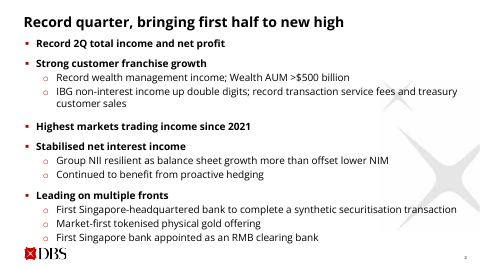
Wealth management drove the quarter. Wealth segment assets under management passed SGD 500 billion for the first time, and customers put more money into equity products, structured products, funds and insurance. Corporate clients added to growth through cash management, custody and treasury products. Corporate lending was boosted by one-off financing such as the Sembcorp-Alinta bridge loan. DBS also completed Singapore's first bank-led synthetic securitisation and launched a tokenised physical gold offering.

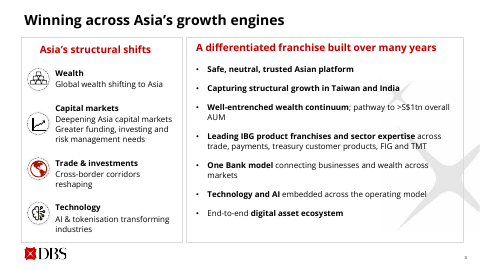
Management is aiming for SGD 1 trillion in wealth and retail assets by end-2030. It plans to get there with 18 new wealth centres, 36 upgraded ones, digital wealth tools and growth in Taiwan and India. The main tensions are that wealth fees depend on market activity and that China's cross-border measures are changing wealth flows. Lending growth was also helped by deals that management says it cannot predict.

Slides & documents

Open the slide deck (PDF, 5 pages) ↗

DBS Group Q2 2026 slide deck, page 1DBS Group Q2 2026 slide deck, page 2DBS Group Q2 2026 slide deck, page 3DBS Group Q2 2026 slide deck, page 4DBS Group Q2 2026 slide deck, page 5

Results documents

Key numbers

Total income · GAAP
SGD 6.09 billion

up 6% from a year ago

Net profit · GAAP
SGD 3.08 billion

up 9% from a year ago

Diluted earnings per share (SGD) · GAAP
4.33

vs 3.98 a year ago

Return on equity
17.9%

Segment or metricValueChange
Wealth segment assets under managementSGD 516 billionup 16% in constant-currency terms
Treasury customer sales and other income (commercial book)SGD 681 millionup 30% from a year ago
Net fee incomeSGD 1.46 billionup 25% from a year ago
Markets trading incomeSGD 469 millionup 12% from a year ago
Customer loansSGD 469 billionup 8% in constant-currency terms
Customer depositsSGD 638 billionup 11% in constant-currency terms
Where each number comes from
  • Total income: “Total income rose 6% to a new high of SGD 6.09 billion despite a challenging rate environment, driven by higher non-interest income”
  • Net profit: “DBS Group achieved record net profit of SGD 3.08 billion for second-quarter 2026, 9% higher than a year ago.”
  • Diluted earnings per share (SGD): “Per share data ($)3 Earnings2 Basic 4.35 3.98 4.19 Diluted8 4.33 3.98 4.17 Reported earnings Basic 4.35 3.98 4.19”
  • Return on equity: “2Q net profit up 9% YoY to record $3.08b, ROE at 17.9% and ROTE at 19.6%”
  • Wealth segment assets under management: “while Wealth segment assets under management rose 16% in constant-currency terms to SGD 516 billion.”
  • Treasury customer sales and other income (commercial book): “Commercial book other non-interest income increased 30% to a record SGD 681 million driven by treasury customer sales”
  • Net fee income: “Net fee income rose 25% to SGD 1.46 billion, the second-highest quarterly level on record.”
  • Markets trading income: “Markets trading income rose 12% to SGD 469 million, benefiting from volatile markets and lower funding costs.”
  • Customer loans: “Loans rose 8% or SGD 35 billion in constant-currency terms to SGD 469 billion led by broad-based growth in lending to large corporates.”
  • Customer deposits: “Deposits increased 11% or SGD 61 billion in constant-currency terms to SGD 638 billion, with Casa balances accounting for about three-quarters”

Copied from the press release ↗ and other documents in the company's results page ↗. A figure is published only if its sentence is in those documents.

Outlook

MetricPeriodOutlook
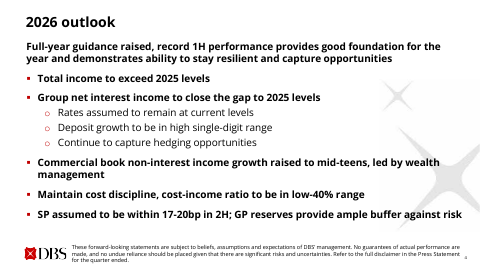
Total incomefull year 2026to exceed 2025 levels
Group net interest incomefull year 2026to close the gap to 2025 levels
Cost-income ratiofull year 2026low-40% range
Specific allowances (basis points of loans)second half of 202617-20bp

Key takeaways

  1. Wealth franchise crossed half a trillion in assets

    Wealth segment assets under management reached SGD 516 billion, with net new money of SGD 11 billion in the quarter. Management targets SGD 1 trillion across wealth and retail by end-2030.

  2. DBS is building wealth centres across Asia

    DBS is adding 18 wealth centres and upgrading another 36 across its six core markets, including China, while saying it has no plans for a new onshore market. It wants to serve clients both onshore and offshore as China tightens cross-border rules.

  3. Taiwan wealth is a standout growth market

    Management ties Taiwan's growth to the semiconductor and AI ecosystem and to the Citi Taiwan franchise, which came with wealth relationship managers and a high-end card base. It expects strong double-digit growth there.

  4. First Singapore bank synthetic securitisation completed

    DBS spent more than a year preparing the deal and sees it as one tool among several for managing credit risk-weighted assets. Management suggests two to three such deals a year could ease risk-weighted asset growth.

  5. Loan growth included one-off deal financing

    Non-trade corporate loans grew about SGD 11 billion, of which management put underlying growth at SGD 5 billion and opportunistic deals at about SGD 6 billion. These included Sembcorp-Alinta bridge financing, Singapore land-sale financing and short-term technology, media and telecom loans in Taiwan.

What management said

Each quote matches the transcript word for word.

“Our purchase of the Citi Taiwan franchise has been quite timely because the franchise came with wealth lines, wealth RMs, as well as a high-end credit card franchise that we have used to uncover potential UHNW customers.”

It shows how the Citi Taiwan acquisition is feeding DBS's wealth growth in Taiwan.

Transcript · Tan Su Shan (CEO)

“For us, it is just one tool in the capital management toolbox. There are other tools like direct loan sell-down, syndications and various other ways to manage our credit risk and our credit RWA.”

Management frames synthetic securitisation as one of several capital tools, not a strategy shift.

Transcript · Phil Fernandez (Executive)

“We are building 18 additional wealth centers and upgrading another 36 existing ones. These are across all our core markets.”

It sizes the physical expansion behind the wealth growth plan.

Transcript · Shee Tse Koon (Executive)

“In terms of what we do on data centers, we are involved in a lot of underwriting but we typically sell down a huge chunk of it and that is where we make the fees.”

It explains how DBS participates in AI-related data centre financing while limiting the balance-sheet risk it keeps.

Transcript · Han Kwee Juan (Executive)

“The $1 trillion is optimistic, but not unrealistic. We have the ambition, we just need to execute.”

It shows how management characterises its 2030 wealth and retail assets target.

Transcript · Tan Su Shan (CEO)

“When we sell these products and solutions to our customers, we cannot book them as fees as they are manufactured in- house.”

It explains why the treasury customer sales line grew: more of the products sold were made in-house.

Transcript · Chng Sok Hui (CFO)

Analyst Q&A

  1. Transcript · Tan Yong Hong, Citi · Wealth AUM target

    How much of the SGD 1 trillion AUM target comes from net new money rather than market gains?

    Management says wealth and retail AUM combined is about SGD 680 billion, with net new money of about SGD 40 billion a year making the target achievable by 2030, helped by digital wealth and Taiwan. — Tan Su Shan, Shee Tse Koon

  2. Transcript · Tan Yong Hong, Citi · Cost discipline

    How should the cost-income ratio look over the next five years?

    Management aims to keep costs disciplined, with expense growth around 4%, using AI and reskilling, and to hold the ratio in the low-40% range. — Tan Su Shan

  3. Transcript · Tan Yong Hong, Citi · China regulation

    What is DBS's exposure to China's offshore trust tax and other cross-border wealth measures?

    The trust amount for China nationals is quite small, and management sees the measures as levelling the field for regulated banks and possibly boosting onshore business. — Tan Su Shan, Shee Tse Koon

  4. Transcript · Nick Lord, Morgan Stanley · Wealth mix, SRTs

    What is the invested-assets split of wealth AUM, what drove treasury customer sales, and how will SRTs be used?

    Invested assets rose to 59% of AUM from 58%, treasury sales grew as more in-house products were sold, and SRTs are one capital tool that could ease risk-weighted asset growth at two to three a year. — Tan Su Shan, Han Kwee Juan, Chng Sok Hui, Phil Fernandez

  5. Transcript · Melissa Kuang · Taiwan, NII sensitivity

    What is driving Taiwan's growth, what is the Mainland Chinese contribution, and has NII sensitivity changed?

    Taiwan growth is driven by semiconductor and AI wealth and the Citi Taiwan franchise, nationality splits are not disclosed, and NII sensitivity is unchanged at $11 million per basis point for SGD. — Tan Su Shan, Shee Tse Koon

  6. Transcript · Aakash Rawat, UBS · China clients

    Where are Mainland Chinese clients domiciled and have inflows changed recently?

    DBS does not disclose nationality or domicile but says it is winning share in offshore portfolios and has onshore franchises in all core markets. — Shee Tse Koon

  7. Transcript · Aakash Rawat, UBS · Onshore China

    How big is the onshore China business relative to offshore?

    Management declined to give that detail but says it has a robust onshore wealth franchise. — Shee Tse Koon

  8. Transcript · Aakash Rawat, UBS · Insurance sales

    How much insurance sales go to Mainland Chinese clients?

    DBS does not break this down but says insurance is sold onshore in each market through regulated partners. — Shee Tse Koon, Tan Su Shan

  9. Transcript · Aakash Rawat, UBS · Onshore vs offshore

    Is the offshore business very different from the onshore business?

    International centres like Singapore and Hong Kong offer a fuller product suite, and DBS sees growth in both, with offshore assets in these centres expected to rise from US$5 trillion to US$7.9 trillion by 2030. — Shee Tse Koon, Tan Su Shan

  10. Transcript · Aakash Rawat, UBS · Net new money

    Has uncertainty in the Hong Kong-China corridor led to more net new money for DBS?

    Management points to wealth creation in Asia, interest from Europe and the Middle East, and Singapore's stability and One Bank model as broader drivers. — Shee Tse Koon, Tan Su Shan

  11. Transcript · Jayden Vantakaris, Macquarie · Capital return

    Can the Capital Return dividend be sustained beyond next year?

    Management does not intend the Capital Return dividend to be a continual feature, since excess capital is a finite amount. — Chng Sok Hui

  12. Transcript · Jayden Vantakaris, Macquarie · Share buyback

    How much of the buyback programme remains and when does it expire?

    About SGD 2.6 billion of the SGD 3 billion programme is unused, with an end-2027 deadline, and it may be converted into a Capital Return dividend subject to board approval. — Chng Sok Hui

  13. Transcript · Sukriti Bansal, Bank of America · Wealth fees

    How do you see wealth management fee growth going forward?

    Growth depends on markets, customer and net new money growth, expansion into new products and AI-driven productivity, and management expects to keep gaining share. — Tan Su Shan, Shee Tse Koon

  14. Transcript · Sukriti Bansal, Bank of America · Market expansion

    Is DBS expanding onshore booking centres to new markets?

    No; DBS has six core markets plus a securities business in Thailand and is not planning a new onshore market. — Shee Tse Koon

  15. Transcript · Tan Yong Hong, Citi · Loan growth

    What drove the strong loan growth and how sustainable is it?

    About SGD 5 billion was underlying growth and about SGD 6 billion was opportunistic, including Sembcorp-Alinta bridge financing, Singapore land-sale financing and Taiwan technology, media and telecom loans. — Han Kwee Juan

  16. Transcript · Tan Yong Hong, Citi · Loan outlook

    Should this growth rate be expected for the rest of the year and next year?

    Steady-state corporate loan growth is SGD 4 to 5 billion a quarter, and repayments and opportunistic deals cannot be predicted. — Han Kwee Juan

  17. Transcript · Kok Wai Fai, HSBC · July momentum, provisions

    How was wealth momentum in July and could there be more general provision writebacks?

    July wealth momentum was up year-on-year and within expectations, and further general provision releases depend on an unpredictable external environment. — Tan Su Shan, Shee Tse Koon, Chng Sok Hui

Questions

What was the main product or strategy story at DBS this quarter?

Wealth management. Wealth segment assets under management passed SGD 500 billion for the first time, and management is targeting SGD 1 trillion across wealth and retail assets by end-2030.

How is DBS expanding its wealth business?

DBS is adding 18 wealth centres and upgrading 36 across its core markets, relaunching a digital wealth offering for retail customers, and pushing growth in Taiwan and India. It has no plans for a new onshore market beyond its core markets.

What is DBS doing about China's cross-border wealth measures?

Management says its trust exposure to China nationals is small and sees the rules levelling the field for regulated banks. It is building both onshore and offshore wealth franchises in case wealth stays onshore.

What new capital and digital products did DBS launch?

DBS completed the first synthetic securitisation by a Singapore-headquartered bank and launched a market-first tokenised physical gold offering. It was also appointed the first Singapore bank RMB clearing bank.

What drove corporate loan growth and is it repeatable?

Management put underlying growth at about SGD 5 billion and opportunistic deals at about SGD 6 billion, including Sembcorp-Alinta bridge financing and Singapore land-sale financing. It sees steady-state growth of SGD 4 to 5 billion a quarter.

Transcript

Official transcript (PDF) ↗

Speaker

Edited transcript of DBS second-quarter 2026 analyst call, 6 August 2026

Nicholas Teh (Investor Relations)

Nicholas Teh We can go straight to Q&A.

Tan Yong Hong (Citi)

Tan Yong Hong (Citi) I have three questions on wealth. First, your $1 trillion AUM target implies wealth AUM grows at about 11% cagr through 2030, could you share some color on net new money versus mark-to-market impact?

Tan Su Shan (CEO)

Tan Su Shan Okay, I will kick off, and Tse Koon will follow. When we said $1 trillion AUM, it includes the wealth and retail segments. The current AUM for the wealth segment, which includes Treasures, Treasures Private Client and PB, is $516 billion. The retail segment is around $160 billion. Retail here is defined as AUM of $30,000 and above. So, wealth and retail combined is around $680 billion. Net new money has been contributing about 8% growth for the wealth segment. The retail side has been snowballing and growing quite nicely. There are a few levers that the team are pushing, from digital wealth, regular savings plans, CDP, CPF, et cetera. So, there are a lot of levers we can pull, including Taiwan. The $1 trillion is optimistic, but not unrealistic. We have the ambition, we just need to execute.

Shee Tse Koon (Executive)

Shee Tse Koon Building on what Su Shan said, it is around $680 billion today and the $1 trillion target is by end of 2030. It is not easy, but it is quite achievable if we continue on the trajectory that we have. For discussion's sake, we are at $680 billion, while our net new money covering Treasures, TPC, and PB has been about $40 billion per annum. Since we are talking about another four full years, it equates to net new money of about $160 billion over that time, which gets us to $840 billion even before adding any growth to retail. Additionally, our AUM growth is a function of both net new money as well as the impact of market movements on investment. We still need to work hard, but it is something that is achievable. Then, building on what Su Shan has said, there are quite a number of levers that we are pulling. We have seen good traction with the relaunched our digiWealth last year for the retail space. This does not involve any RMs and simply uses technology and AI nudging. The uptake of customers getting into investments and insurance has been very encouraging. So, this ability for us to use AI, and to use technology and to harmonize it with human beings is very real.

Tan Yong Hong (Citi)

Tan Yong Hong How should the Group’s cost-income ratio look like over the next five years?

Tan Su Shan (CEO)

Tan Su Shan In recent quarters, we have kept our expense growth at around 4%, sometimes slightly below, while we have also been able to keep the structural growth engines firing. This means we are still hiring, and we are still getting our people to go up the curve to do more. With AI tools, we can do more. Myself, my managers and their management teams, are all expecting to do more with the tools we have. A lot of it is re- skilling our own staff into higher order jobs. For example, if you used to be a level one production engineer, you now learn to become a level two production engineer and a wealth

tech engineer. But that means you have to learn domain knowledge and wealth management, and you have to keep using AI and technology. It takes time to train but after we train them, they become more productive and they get paid more. We are trying to do more with less, but we are growing where we need to grow and we are also shrinking where we need to shrink. So, I see us being disciplined around costs and trying to keep cost- income ratio in the low-40% range.

Tan Yong Hong (Citi)

Tan Yong Hong In the context of China announcing 20% tax on offshore trusts, can you comment on the exposure of offshore trusts to Mainland Chinese and any broader thoughts on the impact of the various cross-border measures on wealth?

Tan Su Shan (CEO)

Tan Su Shan There are a few measures including the 837 directive around outbound investments, and announcement no. 21, which affects offshore trusts. The trust amount for China nationals is quite small. On the insurance measure that was reported by media last night, there has been nothing official and nothing conclusive yet. We just have to keep our eye on the ball. But, we are building both offshore and onshore wealth franchises. Also, we always abide by regulations. We are not a Fintech subject to lower regulations. We do all our CRS reporting, all our client declarations. That means that sometimes we are handicapped, as we are slower to onboard, and we could take longer versus a Fintech or an online brokerage. So, the measures do two things. One is equalise the playing field which is not bad for a regulated bank like us. Second, we are also onshore, which means if wealth stays onshore, there could be a boost to our onshore business growth.

Shee Tse Koon (Executive)

Shee Tse Koon Some of these regulations are around the requirement for residents to report for their own personal tax purposes. The reasons and the purposes for which customers avail themselves to services, including trusts, is not just about tax. It is also for family governance, transition, legacy planning et cetera. It is the more holistic solutioning and advice that we offer.

Nick Lord (Morgan Stanley)

Nick Lord (Morgan Stanley) A couple of questions for me. First on the wealth management numbers. Could you give us a split between invested assets and deposits within the $516 billion AUM. Also, within non-interest income, treasury customer sales growth was quite high in the quarter, was there anything specific on product or investment behavior driving that? Secondly, on SRTs, it looks like we are in a higher loan growth environment which is going to consume capital, so can you just talk a little bit about how you might use SRTs going forward and what sort of impact that might have on risk-weighted asset growth versus loan growth?

Tan Su Shan (CEO)

Tan Su Shan The proportion of AUM in investments went from 58% to 59% this quarter. So, one percentage point up on the quarter. But, our overall growth was not just in wealth. It was also in IBG (institutional banking). On the growth of wealth management fees, the first half was led by equities and equity structures. Like the US investment banks, we benefited from volatility and new IPOs in the markets, whether that is structural or cyclical remains to be seen, but we are getting a boost in both cash equity and equity structured

products. There was also a strong, double-digit growth in funds. Our CIO has a barbell discretionary portfolio, and that has been doing very well, growing by double digits. We have also launched quite a few discretionary products that were very well received. In private equity, we did some pre-IPOs that were also well received. In the corporate banking side, it was transaction banking which had a strong pipeline. For syndicated loans, we had a very strong first quarter and first half last year so loan-related fees were down a bit year-on- year. There was also stronger ECM and M&A fees as well.

Han Kwee Juan (Executive)

Han Kwee Juan On the IBG side, the growth comes primarily from deepening our relationship with our clients. So, transaction services fees are up, and a lot of the growth comes from underlying cash management fees that are generated from trade finance, and from custody fees as well. In the second quarter, we also saw fees from financing and advisory.

Tan Su Shan (CEO)

Tan Su Shan Both IBG and CBG (Consumer Banking / Wealth Management) have seen very strong banca sales as well. Sales to SME, business owners and wealth clients.

Chng Sok Hui (CFO)

Chng Sok Hui On the growth in treasury customer sales. For accounting purpose, we split the lines. Our GFM (Global Financial Markets) team manufactures products such as equity structures or equity derivatives that customers want. When we sell these products and solutions to our customers, we cannot book them as fees as they are manufactured in- house. In contrast, if the product or solution we provide was manufactured by a third-party, we book the income as a fee. We are on an open platform architecture. It just happened that more products this quarter were manufactured in-house.

Phil Fernandez (Executive)

Phil Fernandez For the SRT, this is just us opening a new product in our market. As you know, we pioneered the first covered bond many years ago, and now it is a fairly established feature in the Singapore market today. So, similarly with SRT. For us, it is just one tool in the capital management toolbox. There are other tools like direct loan sell-down, syndications and various other ways to manage our credit risk and our credit RWA. But we felt that this was a product that was worth bringing to Singapore. We spent more than a year preparing and doing all the groundwork to ensure that we could process the transaction. So, we did a bit of groundbreaking for the market. On credit RWA, if you look at our past trends, the risk weight-density has been relatively constant, but we will see how the SRTs scale.

Chng Sok Hui (CFO)

Chng Sok Hui Depending on how many SRTs we launch, maybe two to three per year, it may benefit the growth trajectory of RWA.

Melissa Kuang (Analyst)

Melissa Kuang Firstly, can you share a little bit more detail on Taiwan’s growth. Secondly, can you share what the Mainland Chinese contribution is to net new money and banca sales? Thirdly, any change to the NII sensitivity?

Tan Su Shan (CEO)

Tan Su Shan We do not divulge net new money by nationality. In PB/TPC, we have over 110 different nationalities. So, it is well diversified. On Taiwan’s structural growth, it is driven by the ecosystem for semiconductors, from AI. That is structural growth firing on all cylinders. The wealth creation is relatively new. There are families that have been in business for a long time but their wealth pickup has been very sharp, and now they need solutions. It is quite concentrated and it is mainly onshore, though they need both onshore and offshore solutions. They need planning for the next generation, et cetera. For the onshore side, there is the new Kaohsiung wealth centre. Our purchase of the Citi Taiwan franchise has been quite timely because the franchise came with wealth lines, wealth RMs, as well as a high-end credit card franchise that we have used to uncover potential UHNW customers. We are also experimenting with the use of AI, transcription together with propensity models, at the cards call center, to unearth this potential. We think that we will see strong double digit growth. So, it has been one of our best performing markets.

Shee Tse Koon (Executive)

Shee Tse Koon Suffice to say, the Citi Taiwan franchise has added additional skills to our wealth business. More importantly, because of our ability to bring in a holistic investment and insurance solution onshore, what we have discovered is that the same cohort of customers will do more with us than they had done with Citi. So, we are way beyond just the proforma addition of the two franchises.

On Banca contribution to wealth fee, it is about 20%.

Tan Su Shan (CEO)

Tan Su Shan On NII sensitivity, it is still $11 million per basis points for SGD and minus $4 million per basis point for USD.

Aakash Rawat (UBS)

Aakash Rawat (UBS) So I have two sets of questions. The first one is on the China regulations. I understand you do not share the breakdown of net new money by nationality, but can you say where your Mainland Chinese clients are domiciled? Are they mainly offshore? And have you seen any change in inflows from this clientele in the past one to two months?

Shee Tse Koon (Executive)

Shee Tse Koon We do not disclose details of either nationality or domicile. But having said that, our wealth franchise is both onshore and offshore. So, for the onshore Treasures franchises, these are in all our core markets. The net new money for these franchises would all be onshore. If you are talking about our offshore wealth franchise, these are predominantly booked in Singapore and Hong Kong as they are traditional international wealth centers like Switzerland, London and the US. There are various numbers on international wealth flows into these centers but the wealth is already offshore and circulating within these markets. So, if you are asking, how much money has flowed from onshore to offshore, the fact is that in these offshore markets, we are winning market share from other banks’ offshore portfolios.

Aakash Rawat (UBS)

Aakash Rawat Is it possible for you to share some relative size of the onshore China business versus offshore China business?

Shee Tse Koon (Executive)

Shee Tse Koon We do not want to go into that level of detail. But we do have a robust onshore wealth franchise.

Aakash Rawat (UBS)

Aakash Rawat On insurance sales, could you give us a sense of how much of these sales are to Mainland Chinese clients?

Shee Tse Koon (Executive)

Shee Tse Koon We do not break it down, but again suffice to say within each of those markets, there is an insurance offering onshore. Whether in Singapore, Hong Kong, Taiwan, India, Indonesia and China, there are regulated insurance partners that we work with. These are all advised, distributed and booked onshore. Likewise, in our offshore wealth centers, there are insurance solutions and a fair amount of legacy planning.

Tan Su Shan (CEO)

Tan Su Shan The difference between DBS and a global bank is that we are in these six core markets in Asia. So, we are onshore, we have onshore partners, we have branches, we have wealth centers and we have RMs. If they need offshore solutions, we are there for them too.

Aakash Rawat (UBS)

Aakash Rawat Is the nature of the offshore business very different from the onshore business?

Shee Tse Koon (Executive)

Shee Tse Koon In international centres like Hong Kong and Singapore, clients have access a holistic suite of products and solutions. If you go to certain other markets, there may be less products and solutions available. But it is still sufficient for us to tap into onshore wealth opportunities. So, we have seen growth across all our onshore franchises. If you look at what the market is saying about international wealth in Singapore and Hong Kong, it is already worth about US$5 trillion today of AUM and it is growing at a fast pace. By 2030, this US$5 trillion is expected to reach US$7.9 trillion. So, the offshore proposition continues to grow. Meanwhile, the onshore has always been there and is also growing in our core markets. Overall, Asia is generating a lot of wealth and Asia is attracting a lot of wealth.

Tan Su Shan (CEO)

Tan Su Shan We are ready for that growth with products like MRFs (mutually recognized funds), we have got SIPs, we have DBS securities onshore. We are active in, onshore insurance policies. So, I think you need to build both onshore and offshore to be a holistic wealth offering in Asia. And that is exactly what we have been doing. That gives us a diversified client mix. If one channel goes down, the other goes up. That gives us the diversified client mix. A brand name like DBS in China has a good chance of success because we were not involved in any of the trust products where customers lost a lot of money. We have stayed away from selling CDOs and CDSs, et cetera. We have been pretty holistic in our wealth offerings onshore and we have a good reputation for being a safe bank and a smart bank and a digital bank. So, I think we have upside onshore, which is

why Tse Koon and his team are building wealth centers in China. if, the money stays onshore, they will be looking for wealth solutions there.

Shee Tse Koon (Executive)

Shee Tse Koon We are doing it not just in China. We are building 18 additional wealth centers and upgrading another 36 existing ones. These are across all our core markets. We are hiring and we are using technology to enable our people.

Aakash Rawat (UBS)

Aakash Rawat Has all this complexity and uncertainty in the Hong Kong-China corridor, led to more net new money flows for DBS?

Shee Tse Koon (Executive)

Shee Tse Koon I would look at it from a much broader lens, which is the reason we are confident about the wealth opportunity. Firstly, there is a lot of wealth being created in Asia, and secondly, we are seeing a lot of interest from customers outside of Asia, namely from European countries, from the Middle East, et cetera. That links to what I mentioned earlier on that US$5 trillion of AUM going to US$7.9 trillion. It is about international wealth flowing to Asia as well as Asian wealth that is being created. DBS also benefits from the fact that we are a Singapore-headquartered bank, and Singapore is a jurisdiction that comes with an exercised rule of law, stability, et cetera. That is part of the reason why we have been named by Euromoney as the best private bank in the world among other accolades. It is also the sum of many of macro trends, such as geopolitical instability, which tends to benefit us given our Singapore branding.

Tan Su Shan (CEO)

Tan Su Shan I think the differentiator for DBS is also the One Bank solution where our corporate bankers are very much part of their business growth with supply chain diversification, connectivity opportunities et cetera. Being there to connect customers’ business growth means that you then have an early start in their wealth management journey as well. So, our teams work together and hunt in packs.

Jayden Vantakaris (Macquarie)

Jayden Vantakaris (Macquarie) The business is in great shape and you have increased the guidance. The Capital Return dividends will continue through this year and then next year. Any thoughts on being able to sustain it even longer or think about a revised dividend path?

Chng Sok Hui (CFO)

Chng Sok Hui If you look at the Capital Return dividend, we set it up because we wanted to return excess capital, and by definition, the excess capital should be a finite amount. So I think we will continue to calibrate. But I would say that we do not intend to keep the Capital Return dividend as a continual feature of our capital management.

Jayden Vantakaris (Macquarie)

Jayden Vantakaris You have a buyback programme. Can you remind us how much is remaining and what the expiry date for the programme is?

Chng Sok Hui (CFO)

Chng Sok Hui We set out to do $3 billion of share buybacks and we have done around $0.4 billion. So there is 2.6 billion unutilised. The time frame is by end-2027. We think that at this level of price-to-book, it is a bit challenging to do a share buyback as there

is potentially better deployment of the capital. We still have one and a half years to go before we make any decision. So we are thinking about options. It is subject to board discussion and approval, but it is possible that if we do not utilise the $2.6 billion, we may convert it into a Capital Return dividend, because that amount is excess capital that we had calibrated to be paid out. But this is subject to further discussions at the board level.

Sukriti Bansal (Bank of America)

Sukriti Bansal (Bank of America) How do you see wealth management fee growth moving forward?

Tan Su Shan (CEO)

Tan Su Shan Wealth management fee growth is a function of a few things. Firstly, it's a function of the markets. The good thing is global markets do not tend to move together. Sometimes, the US goes up while Asia is down. Sometimes, Asia goes up and US goes down. AI stocks go down, gold goes up. So, fee income is cyclical and market dependent, but if you are not just geared to a single stock or a single country or product, if have a diversified offering, you will have some volatility, but you should still have growth. Then the second component of fee income is the number of customers and net new money. If you continue to grow that base, you should get growth in your fee income. The third component is new to product. Clients start with one product and then they buy more. So, it is the velocity or inclination to expand into new products. The fourth component is AI. Your productivity is as good as your tools and your people and your ideation. AI helps all three. It can help on ideation, it can help you nudge your customers, it can help you inform your RMs and your investment counsellors, it can also help fulfil trades. So, if you use AI smartly along the customer wealth journey, you can amplify your fee income. These four things taken together should mean that if you have a holistic grounding for your wealth clients and you are able to give them ideas, you can asset reallocate, you shift with the markets, you help them make money, and you keep them safe for when their chips are down. You will keep customers diversified, and keep their portfolios healthy, then you will gain market share. That is what we intend to do. The good news is, whilst we are already large, the gap between us at number one and two is still very big. The structural wealth growth is still there, we still have a lot of white space to cover and the team is working very hard to grow.

Shee Tse Koon (Executive)

Shee Tse Koon A lot has to do with diversification of various investments and insurance solutions. We already have a pretty comprehensive suite of products and services. So whichever way the market goes, I do think that we have sufficient solutions, and we have seen how customers rotate in and out. There is an element that is recurring while there is some that is episodic or driven by ongoing distribution. There are multiple drivers that contribute to this fee income. So, I think that it is something we can continue to sustain. Then whether it is onshore, offshore, we have a full suite of products. I do not see anything imminent that suggests a different kind of trajectory.

Sukriti Bansal (Bank of America)

Sukriti Bansal One quick follow up on wealth — are you expanding the number of onshore booking centers to new markets?

Shee Tse Koon (Executive)

Shee Tse Koon We have our six core markets plus a securities business in Thailand, so we have six plus one. No immediate thought about adding a new onshore market that has the same level of presence as our core markets. When I mentioned the wealth centers earlier, these are all within our core markets. No new entry market in that sense.

Tan Yong Hong (Citi)

Tan Yong Hong Loan growth was very strong this quarter. Could we get some color on the key drivers and how sustainable it is?

Han Kwee Juan (Executive)

Han Kwee Juan Growth in the second quarter for non-trade loans was very strong. If you unpeel that, $5 billion is what we would normally do based on underlying activity. Then there was opportunistic growth in the second quarter of about $6 billion. Part of that came from the Sembcorp-Alinta acquisition where we did the bridge financing. There were also opportunities from the GLS (Government Land Sales) financing for real estate in Singapore. On the TMT side, there were a lot of short-term financing taken up by customers in Taiwan. There was a little bit of data center financing in Singapore and a small project in the US. In terms of what we do on data centers, we are involved in a lot of underwriting but we typically sell down a huge chunk of it and that is where we make the fees. So, all of our data center financing is very well structured with triple net leases for those in the US, with no pre- term and the counterparties are very strong on the underlying, on the take up and so not too much concern. So overall, the momentum goes with what we see in the general macro environment, which is some in AI, some in ERI (Energy, Renewables and Infrastructure) and in real estate, primarily in Singapore. We were also supporting some other clients in other acquisition in the aircraft leasing industry.

Tan Yong Hong (Citi)

Tan Yong Hong Should we expect this kind of growth rate for the rest of the year and even into next year?

Han Kwee Juan (Executive)

Han Kwee Juan The underlying growth momentum for corporate loans is somewhere between $4 to $5 billion per quarter. That is the steady state that we aim for. The amount of repayments and opportunistic growth is what we cannot predict.

Kok Wai Fai (HSBC)

Kok Wai Fai (HSBC) Can you comment on the wealth management momentum in July, and how should we think about the potential for more GP writebacks?

Tan Su Shan (CEO)

Tan Su Shan Wealth management momentum was okay in July, it is still up year-on- year. It was pretty decent across the board.

Shee Tse Koon (Executive)

Shee Tse Koon It was fairly robust and within expectations.

Chng Sok Hui (CFO)

Chng Sok Hui On GP, we continue to stress test our portfolio. The macro environment is quite uncertain. We have always taken a prudent approach to anticipate what might be needed. So, we had taken general provisions for Hong Kong real estate and when there were repayments it led to a release of some general provisions. So that tells you that we have always taken a prudent approach and we will continue to stress test. It depends on the

external environment, which continues to be very unpredictable, and that will guide us on our decision of what GPs we can release.

Nicholas Teh (Investor Relations)

Nicholas Teh Okay, that is it for the call. Thank you everyone for joining. We will speak to you again next quarter.