China Mobile (0941) · Telecom
China Mobile H1 2026 earnings: summary, key numbers & outlook
Results filed 13 Aug 2026 · Quarter ended 30 Jun 2026
Slides (37 pages)Press release ↗Investor relations ↗
Summaries and transcripts are machine-generated and can contain errors.
In brief
China Mobile pushed deeper into computing and AI, with intelligent computing revenue up 130.1% and AIDC revenue up 486.1% as its core mobile business came under pressure.
China Mobile is reshaping itself around three businesses: communications, computing and AI. Computing services grew 14.0% and public cloud ranked top three in China for the first time. Newly signed intelligent computing contracts exceeded RMB 21.0 billion. Customers kept growing, with 5G network customers up 44.74 million, and handset data traffic grew 16.0% after plans raised data allowances.
Management wants to become a "world-class sci-tech service enterprise", adding over 48,000 PFLOPS of intelligent computing capacity this year and building a token business around its MoMA model platform. The tension is that communications services revenue fell 5.7% while AI services grew only 0.9%, and VAT scope changes add uncertainty, so the new businesses must scale quickly enough to offset the old ones.
No call transcript for this quarter, so this summary also draws on: Gloom ↗.
Slides & documents
Open the slide deck (PDF, 37 pages) ↗
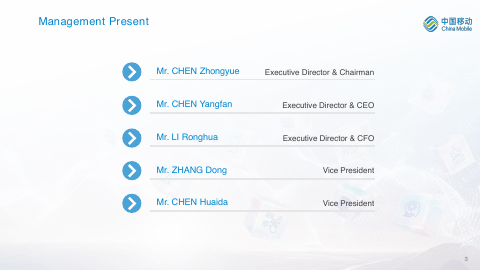
Showing the first 6 of 37 pages.
Results documents
Key numbers
- Operating revenue · GAAP
- RMB538.0 billion
- Profit attributable to equity shareholders · GAAP
- RMB78.9 billion
- Diluted earnings per share · GAAP
- RMB3.62
- Net cash from operating activities · GAAP
- RMB114.9 billion
- Free cash flow
- RMB53.9 billion
- EBITDA
- RMB173.6 billion
down 1.1% year-on-year, with growth on a comparable basis
down 6.3% year-on-year, with growth on a comparable basis
from RMB3.87 a year ago
up 37.0% year-on-year
up 111.6% year-on-year
down 6.6% year-on-year
| Segment or metric | Value | Change |
|---|---|---|
| Communications services revenue | RMB350.4 billion | down 5.7% year-on-year |
| Computing services revenue | RMB52.9 billion | up 14.0% year-on-year |
| AI services revenue | RMB49.3 billion | up 0.9% year-on-year |
| Intelligent computing services revenue | RMB5.3 billion | up 130.1% year-on-year |
| International market revenue | RMB18.2 billion | up 30.1% year-on-year |
| Mobile customers | 1,011 million | net increase of 5.88 million |
| 5G network customers | 687 million | net increase of 44.74 million |
| Mobile ARPU | RMB45.1 |
Where each number comes from
- Operating revenue: “the Company recorded operating revenue of RMB538.0 billion, representing a year-on-year decrease of 1.1%, while achieving growth on a comparable basis”
- Profit attributable to equity shareholders: “Profit attributable to equity shareholders was RMB78.9 billion, down by 6.3% year-on-year, while achieving growth on a comparable basis.”
- Diluted earnings per share: “Earnings per share – Basic 10(a) RMB3.64 RMB3.90 Earnings per share – Diluted 10(b) RMB3.62 RMB3.87”
- Net cash from operating activities: “Net cash generated from operating activities was RMB114.9 billion, an increase of 37.0% year-on-year.”
- Free cash flow: “Free cash flow was RMB53.9 billion, an increase of 111.6% year-on-year.”
- EBITDA: “EBITDA was RMB173.6 billion, down by 6.6% year-on-year, and EBITDA accounted for 38.4% of revenue from principal businesses.”
- Communications services revenue: “our communications service revenue in the first half of the year was RMB350.4 billion, down by 5.7% year-on-year”
- Computing services revenue: “computing service revenue reached RMB52.9 billion, representing a year-on-year increase of 14.0%.”
- AI services revenue: “In the first half of the year, revenue from AI services was RMB49.3 billion, representing a year-on-year increase of 0.9%.”
- Intelligent computing services revenue: “Revenue from intelligent computing services reached RMB5.3 billion, representing growth of 130.1%”
- International market revenue: “international market revenue reached RMB18.2 billion, representing year-on-year growth of 30.1%”
- Mobile customers: “Mobile customers reached 1,011 million, with a net increase of 5.88 million; integrated broadband network customers reached 337 million”
- 5G network customers: “5G network customers reached 687 million, with a net increase of 44.74 million.”
- Mobile ARPU: “Mobile Internet customers reached 895 million, with a net increase of 11.45 million, and mobile ARPU (average revenue per user per month) was RMB45.1”
Copied from the press release ↗ and other documents in the company's results page ↗. A figure is published only if its sentence is in those documents.
Outlook
| Metric | Period | Outlook |
|---|---|---|
| Addition to total intelligent computing capacity | full year of 2026 | over 48,000 PFLOPS |
Key takeaways
AI data centers are the fastest-growing business line
AIDC revenue rose 486.1% and intelligent computing services revenue rose 130.1%, contributing 46.1% of computing services' incremental growth. Cumulative contracted data center capacity reached 7 GW.
Large intelligent computing contracts signal enterprise demand
Newly signed intelligent computing projects were worth more than RMB 21.0 billion, and utilization of in-service intelligent computing resources exceeded 90%. Total capacity reached 112,700 PFLOPS (FP16), with over 48,000 PFLOPS more targeted for 2026.
Token operations become a new product line
China Mobile set up a Token Office, built a dedicated MoMA computing resource pool and launched subscriptions bundling tokens, models, data, devices and benefits. AI-native application pilots are running in multiple regions.
AI assistants and apps are reaching mass usage
The Lingxi smart agent has more than 130 million monthly active users, and the China Mobile App has 340 million, up 25.5%. AI-customized device sales reached 2.30 million units cumulatively.
Mobile revenue pressure persists despite customer growth
Communications services revenue fell 5.7% year-on-year, which management attributes to the shift in growth drivers, market conditions, raised data allowances and the VAT scope change. The company is leaning on data traffic operations and Family Network, with over 380 million members, to stabilize value.
Questions
What is driving China Mobile's computing growth?
AI data centers and intelligent computing. AIDC revenue rose 486.1% and intelligent computing services revenue rose 130.1%, while public cloud revenue ranked top three in China for the first time, per IDC.
What is China Mobile's token strategy?
It aims to produce, distribute and use AI tokens at scale, building a token factory on its cloud and AIDC resources and distributing models through its MoMA platform. It has established a Token Office and launched subscriptions bundling tokens, models, data and devices.
How is China Mobile using AI in consumer products?
Its Lingxi smart agent has more than 130 million monthly active users, and it launched a Communications channel in the China Mobile App integrating calling, Family Network and AI functions. AI-customized devices have sold 2.30 million units cumulatively.
Where is China Mobile expanding internationally?
International market revenue grew 30.1% to RMB 18.2 billion, including consolidated revenue from Hong Kong Broadband Network. It now has 463 POPs and 437 Tbps of international transmission capacity, and inbound roaming traffic rose 59.9%.
What are China Mobile's main strategic risks?
Communications services revenue is declining 5.7% while AI services grew only 0.9%, and VAT scope changes add uncertainty. Management is also scaling capital expenditure flexibly to AI needs, so demand must keep pace with its capacity build-out.