Transcript · Mervin Song, JPMorgan · Non-core divestments
What is the timeframe for the S$7-9 billion non-core divestment, how much will be returned to shareholders, and how will REIT stakes be pared down?
Management will share timing later, expects at least half reinvested and at least a third returned, and will use block trades rather than a distribution in specie. — Paul Tham, Lee Chee Koon
Transcript · Derek Tan, DBS · Ascott, platforms
Does CLI need to hold 100% of Ascott, and will it unlock value first or buy new platforms at the same time?
CLI does not need 100% of Ascott and prefers buying operating capabilities over expensive fund platforms, while staying disciplined on both divestments and acquisitions. — Lee Chee Koon, Andrew Lim
Transcript · Joy Wang, HSBC · Platform structure
What is the ideal structure for operating platforms held at group level versus fund level?
There is no one-size-fits-all approach, and logistics and data centres in India are being scaled with clearer pathways due within months. — Lee Chee Koon, Kishore Moorjani
Transcript · Joy Wang, HSBC · Fee growth, buyback
Can double-digit fee growth be underwritten, and is a share buyback on the table?
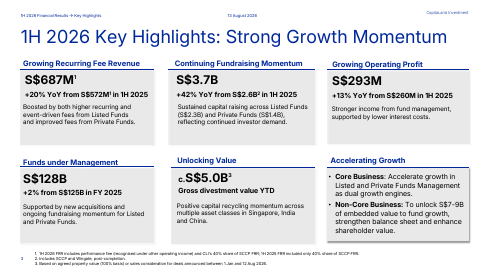
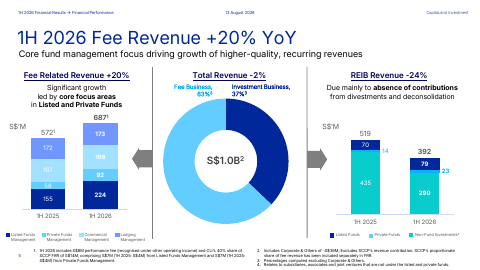
Management is comfortable with double-digit fee revenue growth and prefers dividends to buybacks if capital is not reinvested. — Paul Tham, Lee Chee Koon
Transcript · Rachel Tan, Macquarie · Geographic mix
What will the geographic split look like, and how is the S$7-9 billion divided?
About two thirds is China and 30-40% is private funds, with a cap of about 20% per market except Singapore and growth in Australia, Japan and India. — Paul Tham
Transcript · Rachel Tan, Macquarie · Europe and US
Is there no plan to grow in Europe and the US?
Focus stays on Asia, but CLI would buy a platform in Europe or enter the US at the right entry point. — Paul Tham, Lee Chee Koon
Transcript · Rachel Tan, Macquarie · Divestments, dividends
Should divestments like the China private REIT point to special dividends, and will there be more in the second half?
More divestments are planned in the coming months, and capital return plans will come at Investor Day. — Paul Tham, Lee Chee Koon
Transcript · Brandon Lee, Citi · Execution, REIT growth
What is the impact of the S$7-9 billion on core earnings and NAV, how will execution speed up, and how will REITs achieve 3-4% growth?
The core platform is about 75% of earnings, the China vehicles now exist to speed exits, and REIT growth options include short-term warehousing and joint deals. — Lee Chee Koon, Paul Tham, Andrew Lim
Transcript · Tan Xuan, Goldman Sachs · Lodging margin, guidance
Is lodging management in the non-core bucket, why did its EBITDA margin fall, and has operating PATMI guidance changed?
Ascott is core and excluded, the margin drop reflects prior-year one-offs, and mid-single-digit guidance is unchanged. — Paul Tham, Lee Chee Koon, Kevin Goh
Transcript · Tan Xuan, Goldman Sachs · Lodging margin
What is a normalised EBITDA margin for lodging?
Lodging is at about 20% and aims for about 30% as unopened properties add operating leverage. — Kevin Goh, Lee Chee Koon
Transcript · Mervin Song, JPMorgan · Fee margins
How high could the fee business margin go excluding legacy or sub-scale funds?
Listed funds should earn 60%+ and private funds 30-40%, so the blended margin should be about 50% once stable. — Paul Tham
Transcript · Mervin Song, JPMorgan · REITs, legacy funds
How aggressive will CLI be on REIT listings, privatisations and taking losses on legacy funds?
More offshore or Singapore listings are planned, with the full plan and any adjustments deferred to Investor Day. — Paul Tham
Transcript · Wong Yew Kiang, CLSA · Write-downs
How much of the S$7-9 billion has been written down?
The China portfolio has been written down about S$1.6 billion cumulatively, typically 20-25% per asset, while REIT units have risen in value. — Paul Tham
Transcript · Wong Yew Kiang, CLSA · Ascott ownership
Does CLI need to hold 100% of Ascott?
No, CLI is open to bringing in investors and does not need to own 100%. — Lee Chee Koon
Transcript · Wong Yew Kiang, CLSA · Ascott ownership
Is it critical to remain the majority owner of Ascott?
CLI still wants to own it, but the stake needed is a question and does not have to be 100%. — Lee Chee Koon
Transcript · Dexter Low, Bloomberg · China fund wind-down
Is the development fund that held LuOne being wound down?
Yes, LuOne is the second of five assets sold from CapitaLand Mall China Development Fund III, with the final three planned for divestment per the fund timeline. — Puah Tze Shyang
Transcript · Dexter Low, Bloomberg · China land, LP demand
Will China land tenure extensions require more premiums, and are LPs shifting to co-investments and joint ventures?
It is too early to judge the new land policy, and LPs want a mix of commingled funds, co-investments and managed accounts, with credit demand strong. — Lee Chee Koon, Kishore Moorjani, Andrew Lim
Transcript · Rachel Tan, Macquarie · Ascott target
What happens to Ascott's S$500 million target, and when will it be reached?
Counting the 40% of signed contracts not yet open, the target is already exceeded, and revenue will come in over the next couple of years. — Kevin Goh, Lee Chee Koon
Transcript · Rachel Tan, Macquarie · Ascott pipeline
How soon will the unopened 40% of contracts open?
Conversions open within about 12 months, brownfield around 24 months and greenfield about three years, with some slippage. — Kevin Goh
Transcript · Mervin Song, JPMorgan · Interest costs, fund size
Where will interest costs settle in the second half, and what private fund size does CLI target?
Borrowing costs fell about 40 basis points and should be similar or slightly lower in 2H, while CLI targets S$3-5 billion of capital raised a year. — Andrew Lim, Paul Tham