OpenNashEarnings

BP (BP) · Energy

BP Q3 2026 earnings call: transcript, summary & key numbers

Results filed 30 Oct 2026 · Quarter ended 30 Sep 2026 · Call 55 min · Meg O'Neill (CEO), Kate Thomson (CFO)

Read the transcriptSlides (47 pages)Official transcript (PDF) ↗Press release ↗Investor relations ↗

Summaries and transcripts are machine-generated and can contain errors.

In brief

BP is shrinking to its integrated core, closing the Gelsenkirchen sale and nearing the Castrol sale, while using strong refining and trading to pay down debt ahead of a December strategy reset.

BP held upstream output at about 2.2 million barrels of oil equivalent a day, and upstream plant reliability and refining availability both improved on the prior quarter. Refining and trading, helped by a high-price, high-margin environment, drove the quarter. BP completed the Gelsenkirchen refinery sale, agreed to sell its Austrian mobility and convenience business, and began marketing its North Sea and Archaea businesses. It also brought partners into prospects in Brazil, the Gulf of America and Iraq, and signed offshore gas agreements in Venezuela close to its Trinidad LNG facilities.

CEO Meg O'Neill calls the balance sheet BP's number one job. A strategy update on 15 December will set out the next plan, a capital frame and targets, designed to be resilient at low commodity prices. Excess cash is now earmarked for remaining Deepwater Horizon liabilities. The tension is execution: the Castrol sale and other disposals are still to close, $4.0 billion of impairments in transition businesses show past investments missed their returns, and fourth-quarter customers and trading results are expected to be weaker.

Slides & documents

Open the slide deck (PDF, 47 pages) ↗

BP Q3 2026 slide deck, page 1BP Q3 2026 slide deck, page 2BP Q3 2026 slide deck, page 3BP Q3 2026 slide deck, page 4BP Q3 2026 slide deck, page 5BP Q3 2026 slide deck, page 6

Showing the first 6 of 47 pages.

From BP investor relations

SEC filing

Key numbers

Profit attributable to bp shareholders
$4.7 billion

compared with $1.2 billion in the third quarter of 2025

Underlying replacement cost profit · non-GAAP
$8.5 billion

compared with $5.7 billion in the previous quarter

Underlying RC profit per ADS (dollars) · non-GAAP
3.26

compared with 0.85 in the third quarter of 2025

Operating cash flow
$14.8 billion

compared with $7.8 billion in the third quarter of 2025

Net debt · non-GAAP
$13.9 billion

compared with $22.3 billion at the end of the second quarter 2026

Segment or metricValueChange
Gas & low carbon energy underlying RC profit before interest and tax$3,183 millioncompared with $1,519 million in the third quarter of 2025
Oil production & operations underlying RC profit before interest and tax$3,534 millioncompared with $2,299 million in the third quarter of 2025
Customers & products underlying RC profit before interest and tax$6.9 billioncompared with $5.0 billion in the second quarter 2026
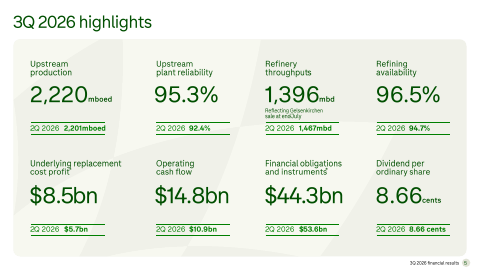
Reported upstream production2.2mmboe/dunchanged from 2Q 2026 at 2.2mmboe/d
Upstream plant reliability95.3%up from 92.4% in 2Q 2026
Refining availability96.5%up from 94.7% in 2Q 2026
Refining throughput1,396mb/ddown from 1,467mb/d in 2Q 2026, reflecting the Gelsenkirchen divestment
Where each number comes from
  • Profit attributable to bp shareholders: “Profit attributable to bp shareholders in the third quarter and nine months was $4.7 billion and $12.4 billion respectively, compared with $1.2 billion and $3.5 billion in the same periods of 2025.”
  • Underlying replacement cost profit: “Underlying RC profit* for the quarter was $8.5 billion, compared with $5.7 billion for the previous quarter.”
  • Underlying RC profit per ADS (dollars): “Underlying RC profit per ordinary share* (cents) | 54.37 | 36.92 | 14.24 | 112.06 | 37.98 Underlying RC profit per ADS* (dollars) | 3.26 | 2.22 | 0.85 | 6.72 | 2.28”
  • Operating cash flow: “Operating cash flow for the third quarter and nine months was $14.8 billion and $28.5 billion respectively, compared with $7.8 billion and $16.9 billion for the same periods in 2025.”
  • Net debt: “At the end of the third quarter, net debt* was $13.9 billion, compared with $22.3 billion at the end of the second quarter 2026 and $26.1 billion at the end of the third quarter 2025.”
  • Gas & low carbon energy underlying RC profit before interest and tax: “the underlying RC profit before interest and tax* for the third quarter and nine months was $3,183 million and $6,641 million respectively, compared with $1,519 million and $3,978 million for the same periods in 2025.”
  • Oil production & operations underlying RC profit before interest and tax: “the underlying RC profit before interest and tax* for the third quarter and nine months was $3,534 million and $9,096 million respectively, compared with $2,299 million and $7,456 million for the same periods in 2025.”
  • Customers & products underlying RC profit before interest and tax: “the underlying RC profit before interest and tax (underlying result) for the third quarter was $6.9 billion, compared with $5.0 billion in the second quarter 2026.”
  • Reported upstream production: “3Q 2026 upstream plant reliability 95.3% (2Q 2026 92.4%); reported production 2.2mmboe/d (2Q 2026 2.2mmboe/d); refining availability 96.5% (2Q 2026 94.7%)”
  • Upstream plant reliability: “3Q 2026 upstream plant reliability 95.3% (2Q 2026 92.4%); reported production 2.2mmboe/d (2Q 2026 2.2mmboe/d); refining availability 96.5% (2Q 2026 94.7%)”
  • Refining availability: “3Q 2026 upstream plant reliability 95.3% (2Q 2026 92.4%); reported production 2.2mmboe/d (2Q 2026 2.2mmboe/d); refining availability 96.5% (2Q 2026 94.7%)”
  • Refining throughput: “refining throughput 1,396mb/d (2Q 2026 1,467mb/d) reflects the divestment of Gelsenkirchen refinery.”

Copied from the press release ↗ and other documents in the SEC filing ↗. A figure is published only if its sentence is in those documents.

Outlook

MetricPeriodOutlook
Reported upstream productionfourth quarter 20262,090 to 2,230mboe/d
Refining throughputfourth quarter 20261,160-1,210mb/d
Income taxes paid versus third quarterfourth quarter 2026$0.8 billion
Reported upstream production20262,210 to 2,250mboe/d
Refining throughput20261,390 to 1,400mb/d
Depreciation, depletion and amortization2026$17.0-17.5 billion
Underlying effective tax rate2026between 31% and 34%
Capital expenditure2026$13.5-14.0 billion
Divestment and other proceeds2026around $8 billion
Other businesses & corporate underlying annual charge2026around $1.0 billion
Gulf of America settlement payments2026around $1.6 billion

Key takeaways

  1. Integration of refining and trading amplified the quarter

    Management credits refining and trading working together, with better refining availability and utilization, for capturing the high-price environment. Trading is typically weaker in the fourth quarter, so this is not guaranteed to repeat.

  2. BP is rapidly selling businesses to simplify

    Gelsenkirchen is sold, the Austrian mobility and convenience business is agreed, and Castrol is expected to close imminently. North Sea, Archaea and Lightsource bp processes are underway, with Lightsource bp taking longer because it is large and complex.

  3. Partners are being brought in to de-risk exploration

    BP farmed down Tupinambá and Conifer to Shell, brought partners into Kirkuk and kept operatorship in several of them. It is holding out on the Paleogene farm-down until it can get fair value.

  4. Transition-business impairments trigger tighter investment discipline

    BP took $4.0 billion of impairments, mainly Lightsource bp and offshore wind. Management says investment decisions now get more downside stress-testing, and exits will not be rushed.

  5. Excess cash now targets Deepwater Horizon liabilities

    After agreeing with Louisiana to accelerate its settlement commitments, BP intends to use excess cash flow to address remaining Deepwater Horizon liabilities in full. Buybacks wait until the balance sheet is stronger, with details promised for 15 December.

What management said

Each quote matches the transcript word for word.

“This is the value of our trading business being utterly integrated with our refining business and then all the way through to our customers business.”

It captures management's core argument for keeping BP integrated and why trading and refining results reinforce each other.

0:08:04 · Kate Thomson (CFO)

“we need to be designing a company that is resilient to a low commodity price.”

It previews the principle behind the December financial frame and capital allocation.

0:34:37 · Meg O'Neill (CEO)

“It is a big and complex business, and so finding a buyer who has the capability to take on the totality of the business has been challenging.”

It explains why the Lightsource bp sale is slower than other disposals.

0:29:24 · Meg O'Neill (CEO)

“We just need to get that culture embedded across the business. So that's the real opportunity for us is to take what we've done in BPX and and embed it everywhere else.”

It shows the operating model management wants to replicate beyond bpx energy.

0:17:58 · Meg O'Neill (CEO)

“The successes that we've seen thus far, of the 15 or so discoveries that we've made, about 10 of them are close to existing infrastructure.”

It shows an exploration strategy weighted toward quick-to-production near-field barrels.

0:41:49 · Meg O'Neill (CEO)

“we have a variety of different outlets for fuels, sales, and the machine in its totality generates more value than the component parts would.”

It is the CEO's direct rebuttal to break-up talk and defence of the integrated model.

0:53:46 · Meg O'Neill (CEO)

Analyst Q&A

  1. 0:03:36 · Alejandro Vigil, Santander · Divestments

    How is momentum on the divestment pipeline beyond the imminent Castrol closing?

    Castrol and the Austrian mobility and convenience sale are expected to close this year, while Lightsource bp, the UK North Sea and Archaea processes are all underway. — Meg O'Neill

  2. 0:04:42 · Doug Leggett, Wolfe Research · Financial obligations

    Does BP need financial obligations in line with competitors, and what is the right level?

    Peers are a useful calibration point, but BP will design its financial frame to be resilient at low prices, with the dividend as first call on capital and buybacks possible once the balance sheet is stronger. — Meg O'Neill

  3. 0:06:58 · Michele Della Vigna, Goldman Sachs · Trading and freight

    How do BP's tanker contracts support trading profits while freight rates are high?

    BP runs operated, chartered and spot vessels as a portfolio, and its trading is integrated with refining and customers, with US refineries advantaged by pipeline crude access. — Kate Thomson

  4. 0:09:28 · Lydia, Barclays · Investment discipline

    What has changed in how BP approaches investment decisions to avoid further write-downs?

    BP is more data-driven and stress-tests downside cases harder, with investment committee discussions raised since the CEO joined. — Meg O'Neill, Kate Thomson

  5. 0:11:40 · Biraj, RBC · Deepwater Horizon

    How will BP use excess cash to settle remaining Deepwater Horizon liabilities?

    BP did not detail the mechanism but will update the market as it executes, aiming to remove the roughly $1 billion annual second-quarter outflow and improve resilience. — Kate Thomson

  6. 0:14:21 · Fergus Neve, Rothschild · Cost reduction

    Is there more to deliver on structural cost reductions, and will a post-2027 target be set in December?

    BP has delivered $4 billion but it was absorbed by inflation, acquisitions and activity choices, and it remains confident in an absolute cost base of around $18 billion in 2027, with a further update in December. — Kate Thomson

  7. 0:16:13 · Josh Stone, UBS · bpx culture

    Could other parts of BP benefit from being separated like bpx energy?

    bpx energy benefits from being part of the group, and the goal is to spread its culture of ownership across the whole business. — Meg O'Neill

  8. 0:18:32 · Al Saim, Citi · Retail demand

    What is behind the decline in retail fuel sales in the US and Europe?

    Demand has softened with prices and consumer pressure as customers change habits, but the network is holding up well against market volumes.

  9. 0:19:35 · Martin, Morgan Stanley · Financial obligations

    Is the 33-35 billion year-end obligations guide conservative or is there a big fourth-quarter outlay?

    The bridge reflects lower production, softer prices, seasonally weaker customers and trading, higher capex and $0.8 billion higher cash tax, with no single large outlay. — Kate Thomson

  10. 0:23:22 · Henry Tarr, Berenberg · Impairments

    What detail is there on the impairments and capital still held in low carbon?

    The $4 billion is mainly Lightsource bp and offshore wind, BP will not rush exits, and it gave no guidance on future impairments. — Kate Thomson

  11. 0:25:13 · Matt Lofting, JPMorgan · Brazil exploration

    What is the status of the Tupinambá well and the move to Bumerangue?

    Oil shows were found in the shallower post-salt target, drilling continues to a pre-salt target, and the rig should move to Bumerangue by year end if all goes to plan. — Meg O'Neill

  12. 0:26:21 · Mark Wilson, Jefferies · Bumerangue appraisal

    What is the Bumerangue appraisal plan and is concept select by end-2027 still possible?

    Flow-back testing is planned with a likely second appraisal well, but it is premature to promise a concept select date before appraisal data. — Meg O'Neill

  13. 0:28:35 · Chris Coupland, Bank of America · Divestments

    Will the long Lightsource bp process also apply to Archaea and the UK North Sea sales?

    Lightsource bp is large and complex, whereas the UK North Sea process is very competitive with offers on the table and should move faster. — Meg O'Neill

  14. 0:30:00 · Lucas Herman, BNP · Hybrids and gearing

    Where do hybrids stand, and why does BP use a different gearing metric?

    The gearing slide compares BP's obligations with peers without targeting their level, and S&P allows hybrids to fall to $9 billion without losing equity treatment, with about $10.5 billion remaining. — Kate Thomson

  15. 0:33:02 · Jason Gableman, TD Cowen · Strategy update

    Why was the strategy update brought forward, and does it focus on efficiency or growth?

    Hitting the net debt target was a signal, and December will cover a financial frame resilient at low prices and how integrated upstream, downstream and trading create value. — Meg O'Neill

  16. 0:35:18 · Bertrand Odey, Kepler · Trading

    Is trading outperformance of roughly $4 billion year to date a fair estimate?

    Trading is trending above its long-run uplift after strong oil, LNG and US gas and power results, but the fourth quarter is typically lower in volatility and liquidity. — Kate Thomson

  17. 0:38:09 · Kim Fusti, HSBC · Portfolio and capex

    Has the stronger balance sheet changed BP's willingness to keep higher equity stakes in upstream projects?

    It gives room to delay the Paleogene farm-down until fair value is available, while partners were brought into Kirkuk, Tupinambá and Gulf of America exploration to manage risk. — Meg O'Neill, Kate Thomson

  18. 0:39:54 · Ahmed Bensalem, Oddo · Buybacks

    What must happen before BP materially increases buybacks now that net debt is below target?

    Leverage is still too high, so BP will finish strengthening the balance sheet and explain in December how it shares upside, including buybacks.

  19. 0:41:01 · James West, Melius Research · Exploration

    How is BP balancing frontier and near-field exploration spending?

    About 10 of roughly 15 discoveries are near existing infrastructure for quick cash, balanced with greenfield plays like Bumerangue and Namibia. — Meg O'Neill

  20. 0:43:04 · Maurizio · Louisiana settlement

    How complex or lengthy was the Louisiana coastal restoration settlement?

    The litigation ran for roughly a decade, and settling it alongside accelerating Deepwater Horizon payments lets BP restart its relationship with Louisiana. — Meg O'Neill

  21. 0:44:52 · Martin, Morgan Stanley · Iraq

    Can BP's Iraq production recover in line with the Iraqi export recovery?

    Part of the roughly 100,000 barrels a day curtailed has returned, and Kirkuk is gaining momentum with an operating entity set up and the first well spudded. — Meg O'Neill

  22. 0:46:43 · Chris Coupland, Bank of America · Valuation gap

    Is Archaea as complicated as Lightsource bp, and what about the valuation gap with US majors?

    Archaea's sale process has only just started, and management argues consistent performance and a resilient balance sheet are the self-help route to closing the valuation gap. — Meg O'Neill

  23. 0:49:05 · Henry Tarr, Berenberg · LNG

    How is the LNG business shaping up for the fourth quarter?

    BP gave no guidance, saying European weather and storage plus China restocking will drive pricing and that it stays well placed to optimise cargoes.

  24. 0:50:26 · Lucas Herman, BNP · Working capital

    What explains the $2.8 billion permanent working capital build?

    It reflects Deepwater Horizon payments, decommissioning payments and the assets-held-for-sale treatment of Castrol, with about $0.5 billion of release still expected. — Kate Thomson

  25. 0:52:36 · Doug Leggett, Wolfe Research · Breakup

    Did board members consider or prefer a breakup of BP?

    The CEO categorically denied any such conversations and said board discussions reaffirmed the case for an integrated oil and gas company. — Meg O'Neill


Questions

What is BP's strategic direction after this quarter?

BP is simplifying its portfolio toward assets that fit its integrated upstream, downstream and trading model, and prioritising the balance sheet. It will present a financial frame and targets at a strategy and outlook update on 15 December.

Which businesses is BP selling or farming down?

BP completed the Gelsenkirchen refinery sale, agreed to sell its Austrian mobility and convenience business, and expects the Castrol sale to close imminently. Processes are underway for the North Sea, Archaea and Lightsource bp, and partners joined Tupinambá, Conifer and Kirkuk.

Where is BP finding growth in upstream gas and oil?

BP agreed to take Calypso in Trinidad and Tobago to 100% with operatorship and received a Loran Phase 2 licence in Venezuela with about 4 trillion cubic feet of recoverable gas. It is also appraising Bumerangue in Brazil and ramping up Kirkuk in Iraq.

What is BP doing about Deepwater Horizon liabilities?

BP agreed with Louisiana to accelerate its settlement commitments, including a $350 million settlement whose payment timing is undetermined. It intends to prioritise excess cash flow to address the remaining liabilities in full.

What does BP expect for customers and refining in the fourth quarter?

Customers is expected to deliver a significantly lower result on seasonal volumes, a weaker midstream and lower Castrol earnings. Refining throughput is guided to 1,160-1,210mb/d after Gelsenkirchen's exit, with margins elevated but sensitive to market conditions.

Transcript

Call recording on YouTube ↗. Official replay ↗. Timestamps jump to the moment.

BP also publishes its official transcript (PDF) ↗.

0:00:00
Craig Marshall (Investor Relations)

Welcome, everyone, to BP's third quarter 2026 financial results call. I'm joined by Meg O 'Neill, Chief Executive Officer, and Kate Thomson, Chief Financial Officer. We'll be focusing today's call on the third quarter performance and our disclosures and video that I hope many of you will have seen by now. Before we start with questions, let me hand over to Meg for a few opening remarks. Meg.

0:00:24
Meg O'Neill (CEO)

Thanks, Craig. And thank you to everyone joining the call. I'll keep my opening remarks brief so we can get to your questions.

0:00:33

This quarter, we maintained upstream production at around 2.2 million barrels oil equivalent per day, with improved upstream plant reliability compared to the second quarter. Underpinned by good refining utilization, our refining business delivered a very strong result, which alongside the higher trading contribution highlights the value of our integrated oil and gas business. The improved operational performance across the business enabled us to effectively capture the higher commodity price environment. Strong earnings and cash flow resulted in a significant reduction in our net debt, which is now below our targeted range.

0:01:13

Structural cost reductions delivered are now within our target range, and we have line of sight to delivering the remaining two of the four primary targets ahead of the end of 2027. While this is good progress, our financial obligations remain too high, and strengthening the balance sheet further continues to be our number one priority. Last week, we announced an important step with the agreement with the state of Louisiana to accelerate the delivery of our Deepwater Horizon settlement commitments.

0:01:44

Our intention now is to prioritize the use of excess cash flow to address our remaining Deepwater Horizon liabilities in full. Deepwater Horizon was a tragedy. Eleven men lost their lives, and communities and the environment across the Gulf Coast were impacted. We will never forget it changed BP. Its legacy guides us in how we operate today, with safety at the heart of everything we do. We are also moving at speed to simplify BP's portfolio, focusing on assets that best fit our integrated model and deliver the most competitive cash and returns.

0:02:26

In the quarter, we agreed the sale of our Austrian mobility and convenience business, we completed the sale of the Gelsenkirchen refinery, and announced plans to market our North Sea and Archaea businesses. We expect the Castrol transaction to close imminently. We have also de-risked exploration and production prospects in Brazil, the Gulf of America, and Iraq by bringing in partners. And in Venezuela, we signed agreements to advance an offshore gas development. As we move forward, we will continue working with urgency to turn this strong set of results into strong performance quarter after quarter.

0:03:03

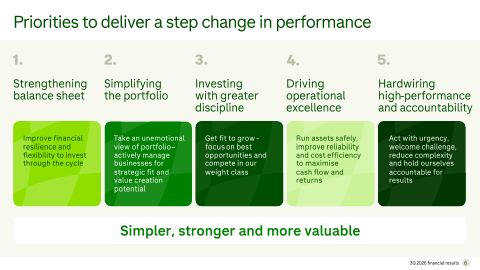
We have much more to do on the five priorities we have set out to deliver a step change in performance and realize the full potential of BP. The strategy and outlook update in December is an important milestone in updating the market on our next steps to deliver a simpler, stronger, and more valuable BP. We will explain our strategic direction, the business drivers that underpin it, and the financial framework that will guide delivery. And we will set out the metrics and targets that we'll hold ourselves accountable to for delivery.

0:03:36

Back to you, Craig.

0:03:38
Craig Marshall (Investor Relations)

Craig Marshall Thanks, Meg. So we have around an hour for Q &A. As usual, I'm going to ask everybody to poll for one question, please, per person so that everyone gets a chance to ask. And then with the time remaining, I'm sure we can cycle back to follow-up questions. So with that, let me turn to Alejandro Vigil at Santander for the first question. Alejandro. Alejandro Vigil

0:04:02
Alejandro Vigil (Santander)

Yes. Thank you for taking my questions and congratulations for the strong results.

0:04:07

My question is about the divestment process. It's basically just the Castrol divestment you mentioned is imminent, but you can elaborate about how you see the momentum on the other divestments you have in your pipeline.

0:04:22
Meg O'Neill (CEO)

Yeah, thanks, Alejandro. So as I said, Castrol closing is imminent. As we announced in the quarter, we're divesting the Austria Mobility and Convenience business. We expect that to close this year as well. And then other processes that we've announced continue to be in flight.

0:04:42

So that includes the divestment of Light Source BP, the UK North Sea business and Archaea. So all of those processes are underway.

0:04:52
Craig Marshall (Investor Relations)

Thanks Alejandro. So we'll turn next to Doug Leggett at Wolf. Doug.

0:04:58
Doug Leggett (Wolfe Research)

Good morning, everyone. Or good afternoon, I should say. I'm looking at your slides, Meg. Slide seven on your comment about the financial obligations still being too high. It would seem, if I just eyeball that, you're suggesting you need to be somewhere in the range of your competitors to be not too high.

0:05:23

Is that the right read? How do you get there and what is the right level of obligations that you see within that target?

0:05:32
Meg O'Neill (CEO)

Yeah, thanks, Doug. And look, I fully appreciate the investment community. The market is very interested in this. And maybe if I speak first, Doug, to the philosophy. So, we produce commodities over which we have no control of the pricing. And whilst the pricing is strong now, we know that the price of oil and natural gas will drop at some point in the future.

0:05:56

So, as we think about how we design the financial frame and the equity versus debt structure, we need to design it to be resilient for a low-price environment. So, the performance and the gearing levels of our peers is useful calibration points, but what we're very focused on is getting BP's financial frame designed well. And I might also point you to look at the sources and uses of cash slides. So, we continue to have too much cash that is allocated to servicing financial obligations.

0:06:31

We need to pull that down to ensure that we are more resilient in a low-price environment. So that's the thinking that underpins our philosophy. Shareholder returns obviously are at the heart of the design, and we need to make sure that we are able to consistently deliver dividends through the cycle. So, the dividend is the first call on capital. We need to be able to continue to invest in the business so that we can cover an increasing dividend over time.

0:06:58

And then we, of course, have the opportunity when we get our balance sheet in better shape to be able to reward shareholders with increased share of the rewards through things like share buybacks, which is an important tool in the toolkit.

0:07:15
Craig Marshall (Investor Relations)

Thanks, Doug. Doug, we'll turn next to Michele Della Vigna at Goldman Sachs. Michele.

0:07:21
Michele Della Vigna (Goldman Sachs)

Thank you and congratulations on a quarter of exceptional delivery. If I could ask a question more relating to your trading business, we are seeing extraordinary freight rates at the moment, especially in the crude tanker market.

0:07:36

Having effectively long-term rates on tankers is like a gold mine at the moment. And my understanding is that you've got quite a few that are on the long-term lease. I was just wondering if you could help us understand what is the makeup at the moment of the contracts behind your fleet and how helpful that can be to continue to sustain exceptional trading profits in your oil and oil product business in the fourth quarter. Thank you.

0:08:04
Kate Thomson (CFO)

Yeah, Michele, hi, it's Kate. Let me take that one. So, yes, we have seen elevated freight rates since the beginning of March, particularly the sustaining in the crude area. The product tanker rates are a little bit more muted and as we observe LNG tankers are pretty much back to pre-conflict level. We run a combination of operated, chartered and spot vessels and we manage that as a portfolio. This is the value of our trading business being utterly integrated with our refining business and then all the way through to our customers business.

0:08:46

We have opportunities to optimise our access to a portfolio of different ways to supply both equity and third party barrels into our refineries. And of course, we work that really hard and I think we've done a great job so far. And then if you think about our US refineries, I would position those as particularly advantage with regard to their ability to access significant input crude from pipelines. So that feels good. I guess the way I would hold it is when you look at the level of earnings we have been able to generate in the third quarter in our products business, which is refining and trading.

0:09:28

For me, that's the demonstration of the amplification impact you can have on earnings when the integrated trading and refining businesses are really working in harmony.

0:09:38
Craig Marshall (Investor Relations)

Thanks, McKeeley. We'll turn next to Lydia at Barclays. Good morning, Lydia, or afternoon.

0:09:44
Lydia (Barclays)

Thank you, Craig, and good morning, everybody, and thanks again for the results. I'll say a quick one, but I think, Meg Kay, in the slides you talk of the need for more rigour in the investment process and partly so that we can finally avoid the write-downs.

0:10:03

Can you just Talk through what, if anything, has changed in the process in which you look at projects, whether you look at those decisions going forward. Thanks.

0:10:13
Meg O'Neill (CEO)

Yeah, thanks, Lydia. So, obviously, anytime you take an impairment, that's a signal that you've made a decision that has not yielded the returns that were expected and have not delivered value for shareholders. So, we absolutely need to be more rigorous in how we make our investment decisions, how we stress test those decisions, how we make sure that decisions we make are leading to a BP as a company that is stronger.

0:10:43

So, I'm a big believer that we need to be data-driven in all of this. We need to look at the numbers and we need to be asking ourselves every time we make an investment or a divestment opportunity, is this the right decision? Is this a decision that is going to strengthen BP? I'll invite Kate to comment because, you know, Kate's been part of the organization for a bit longer and she can share some examples.

0:11:06
Kate Thomson (CFO)

Yes, thank you, Meg.

0:11:08

The way I feel we're moving towards is a far more data-driven way of making decisions, and in particular, working hard to stress test the downside. So how could these investment decisions play out in a way that doesn't deliver the value that we expect and really getting very robust on our depth of understanding of each investment case. So I think the conversations that we have in our investment committee have gone to another level over the last six months since Meg's joined.

0:11:40

And I think that's incredibly important because writing off shareholder capital is a demonstration that we have invested in things that have not delivered the returns our shareholders expect. And we have to write that. And that comes back to the very essence of how we make investment decisions and then how we execute on them.

0:12:04
Craig Marshall (Investor Relations)

Thanks Lydia. We'll turn next to Biraj at RBC. Biraj.

0:12:08
Biraj (RBC)

Hi, thanks for taking my question. I want to ask about the Delta Mexico payments and liabilities and your comments this morning about using excess cash to pay those in full.

0:12:22

Just trying to understand what you mean and how this works, would you need to negotiate a new payment schedule with the individual states or is it a case of putting a pile of cash into an SPV and then moving that liability off balance sheet? Just trying to understand the sort of mechanisms and the end goal here, any parameters on that would be helpful. Thank you.

0:12:44
Kate Thomson (CFO)

Yeah let me take that one Biraj, thank you for the question.

0:12:49

Meg's already referenced the nature of that event and how tragic it was of course it shaped how we operate it also had a profound financial impact on us as a company i think the way that we are contemplating it is this year's cash flow gives us an opportunity now to address all the remaining state and federal liabilities in a way that is going to create the best value for us as a company it's a very important moment for us as a company and it will allow us to move forward.

0:13:22

I'm not going to go into the whys and wherefores of how we will execute. As we execute and put it into place, we will then update the market on exactly what have we done and how will we disclose it moving forward. And that will give you the transparency I think you're after. As you allude to, Baraj, there are a number of different ways we could choose to execute this, but you should rely on us doing it in a way that is going to deliver the best value.

0:13:48

At the end of the day, this will create a more financially resilient company going forward. If you remember, it's probably the last 10 years now that at every second quarter, we've had to talk of in excess of $1 billion leaving the company to fund remaining liabilities on Deepwater Horizon. So, it will be an important improvement in our resilience and in our break even moving forwards.

0:14:16
Craig Marshall (Investor Relations)

Thanks, Kate. Thanks, Baraj. We'll turn next to Fergus Neve at Rothschild.

0:14:21

Fergus.

0:14:21
Fergus Neve (Rothschild)

Yeah, good afternoon, everyone, and thank you very much for taking my question. I just wanted to touch on the structural cost reductions. It's great to see that you've now delivered reductions which are within the target range. I was just wondering whether you think there is still more to deliver there and whether perhaps we should expect an update for the target beyond 2027 at December's event. Thanks.

0:14:50
Kate Thomson (CFO)

Yeah, thank you, Fergus. It is good progress. It's clear that we've now delivered another one of our key targets out of the four that we put out in February 2025.

0:15:03

I think, though, the way I hold it is the bottom line performance is key here. And as you can see, there's not enough impact coming through to our absolute cost reductions. So since 2023, we have delivered the $4 billion of structural cost reductions, but that has gone to offset a number of headwinds. So we've had inflation running at about 2.5 % per annum. That's $1.5 billion. We've chosen to acquire assets, which has brought in cost base of about 800 million.

0:15:33

And we've made activity choices. So that's around 700 million. And one example of that I could give you would be around BPX production. But at the end of the day, our group production is flat. So whilst we may be bringing in costs to drive higher production in BPX, we're not offsetting that with lower costs in assets where our production is declining. And so it requires continued focus. So the way I would describe it for you is we are fully focused on making sure that every part of our business is cost competitive and that the impact of what we are stepping through area by area, team by team starts to show up more profoundly in the bottom line.

0:16:13

And as we stand here today, we've still got confidence in the delivery of our absolute cost base of around $18 billion in 2027, as you see the full impact in particular of the Castrol and Gelsenkirchen exit coming through for a full year in 2027. So hopefully that helps and we'll update you any further in terms of how we think about cost in December.

0:16:37
Craig Marshall (Investor Relations)

Thanks, Fergus. We'll turn next to Josh Stone at UBS.

0:16:41
Josh Stone (UBS)

Yeah, thanks, Craig. Meg, in your press release comments, you made a comment that BPX Energy has a culture of ownership driving stronger returns, which I thought was quite a striking comment because one of the features of BPX is it's been carved out from the wider conglomerate.

0:16:59

So I wonder if it begs the question of whether you think there could be other parts of your company that could benefit from being separated out, Or is it the case that actually BPX is a more unique situation in that regard? Thanks.

0:17:12
Meg O'Neill (CEO)

Yeah, thanks. Thanks, Josh. Look, I think it's important to acknowledge that whilst BPX has some different attributes to the rest of the upstream, at the end of the day, it very much is part of the group and benefits from being part of the group.

0:17:27

I think the opportunity for us more broadly is to ask, how have we set things up to allow greater decision-making and that clarity, that real sense of ownership in BPX, and how do we take that mindset to the group writ large? So, in my mind, it needs to be a learning process between every part of the organization and the other parts of the organization. You know, we see other great examples where parts of the business are showing that culture of ownership.

0:17:58

Drilling is a great example where you've got tremendous ownership, you've got a strong commitment to deliver on commitments and deliver on the plans that have been laid out and drive that continuous improvement. We just need to get that culture embedded across the business. So that's the real opportunity for us is to take what we've done in BPX and and embed it everywhere else.

0:18:26
Craig Marshall (Investor Relations)

Thank you, Josh. We'll turn next to Al Saim at City. Al. Thanks, Craig.

0:18:32
Al Saim (Citi)

Hi, Megan. Can I just ask about what you're seeing in retail sales? If I look at the data, you're sort of showing the 2 % reduction in the US and 8 % reduction in Europe. I'm just sort of wondering if that's in terms of refined products and just wondering if that's an underlying same-store basis or any sort of color you can get on the demand picture would be helpful. Thank you.

0:18:58
Executive

Hi, Al. Yeah, thank you for your question.

0:19:01

Yeah, there has been some softening in terms of demand across fuels retail. Of course, largely due to prices and the pressure on consumers. It does vary a bit by region. I think what we're seeing largely is customers just adjusting their habits. So whether that's reducing the discretionary travel or changing how they fuel up and where they choose to fuel up. What I would say is that the fuels retail network is still pretty resilient. The way it's performing, we're comfortable with it.

0:19:35

It's holding up very nicely against the market volumes that we're seeing across the regions in which we operate. So I'm pretty pleased with how the business is performing in terms of volumes.

0:19:49
Craig Marshall (Investor Relations)

Thanks, Al. We'll turn next to Martin at Morgan Stanley. Martin.

0:19:54
Martin (Morgan Stanley)

Yeah. Hi. Hello. I wanted to ask you about the slide that shows the total financial obligations falling to 33 to 35 billion by the end of the year. That's about a $10 billion decline, sort of quarter and quarter.

0:20:12

But disposals are already seven of that, which means that the underlying increase is sort of like three. But in this quarter, we saw a $9 billion drop in obligations, and that had no meaningful contribution from either working capital or from divestment. So, look, a $10 billion drop quarter and quarter is nothing to be sniffed at. But it's not that difficult if the macro environment stays broadly as it is, which is also what you're showing on the right of the slide in terms of assumptions, to get a number that is meaningfully lower than that sort of 33 to 35.

0:20:51

It could even be in the high 20s. Now, I'm totally aware that forecasting commodity prices is horrendously difficult and that you would put on the slide like this with a degree of conservative and built in. But can I just ask, is it just conservatism built in or is there something in the fourth quarter in terms of a big outlay that I might have overlooked and that might be worth flagging?

0:21:17
Kate Thomson (CFO)

Yeah, let me take that one, Martin.

0:21:19

So, So as I bridge from 3Q to 4Q, I think we've given the market the key components of how to get there. And let me just step it through, right? So we're guiding to lower production. So we've taken a 20 MBD hit in the Gulf of America due to the weather impact earlier in the quarter. We're also guiding to our BPX production being down, which is not unusual in the fourth quarter due to phasing. we've got lower throughput in refining really due to the completion of Gales and Kirken.

0:21:50

And then we're guiding across refining and across upstream to softer prices. And you can see the prices we have used for modeling. That's not a prediction of prices. That's just to help you see how to get there on a rule of thumb. And then if I step down through to customers, so we're seeing seasonally lower volumes as you would expect in the fourth quarter. And of course, we have an imminent close of the Castro transaction, which will also feed through to earnings and cash flow in the fourth quarter.

0:22:19

And then the last component of earnings before I talk about two other elements which we have highlighted is typically in the fourth quarter, we would expect trading to be delivering a lower number. It's typically less volatile. And what we have observed over the last few years is a fall in areas of the market in terms of liquidity. Now, I would say the market for the first month of the quarter has been less volatile than it was in 2Q and 3Q.

0:22:48

I think it's incredibly difficult to predict what will play out. The trading team manage very carefully in terms of a disciplined deployment of risk through volatile moments. But we will be watching what happens to the liquidity in that market going forward. So, we don't guide forward on trading, as you know, because it's almost impossible to predict. But I would say it is very much typically a weaker quarter than we have seen to date. And then the other two components which should help you get back to the numbers, and if not, then IR can help sweep because the bridge works for me, is capex.

0:23:22

So we've given you a full year range. If you take the year to date off, that's signalling higher capex by about one to one and a half versus the third quarter. And we're also signalling 800 million higher cash tax payments in the fourth quarter than the third quarter. all of those components. Sorry, it's quite a lot to step through, but that gives you the bridge.

0:23:48
Craig Marshall (Investor Relations)

Thanks, Martijn. We'll turn next to Henry Tarr at Berenberg. Henry.

0:23:52
Henry Tarr (Berenberg)

Hi there, and thanks for taking my question.

0:23:56

Just on the impairments, is there any sort of further colour on those? Obviously, they're quite substantial in the quarter and then what's still held as capital employed in the low carbon business at this point thank you

0:24:11
Kate Thomson (CFO)

i'll take that one as well thank you henry um um you know my view on impairments i won't reiterate it but it it's very much the fact that um these investments have not delivered um what our shareholders need us to do to deliver we have taken a further 4 billion and we have been clear that that is primarily transition and primarily light source BP and offshore wind.

0:24:39

As we step forward through the portfolio and the remaining areas of our consideration of our portfolio, it's very important that we make the right decision for BP going forward. And we will execute on those portfolio decisions with a view to the best realisation of value. where we are seeking to exit certain areas of the portfolio. We will not be doing it in any rush to get out. I think that would be poor decisions. So, we will continue to high grade the portfolio and make the right decisions for BP for the medium, long term and our shareholders.

0:25:13

But I won't be able to guide you on forward impairments. We will update you as we step through.

0:25:20
Craig Marshall (Investor Relations)

Thanks, Henry. We'll take the next question from Matt Lofting at JP Morgan. Matt.

0:25:26
Matt Lofting (JPMorgan)

Thank you. BP published an update on the Tupinambá well in Brazil earlier this week. I wondered if you could just expand on the status of drilling there, what you've seen to date and latest timing on the next steps in terms of moving the equipment across to Boomerangie.

0:25:46
Meg O'Neill (CEO)

Sure. Thanks for the question, Matt. We did announce that we have oil shows in the Tupinambá well. So just to give a little bit more color on technically what we're targeting, so there are two targets in this wellbore. One is shallower in the section. So if you go from the subsea mud line, the shallower section is what we've hit. That's post-salt, and that's where we've seen the oil shows, so that's certainly encouraging news. We're drilling ahead, so we will drill through the salt to the second target, which is a pre-salt target.

0:26:21

So that's going to take a bit of time. Once we complete drilling this section of the Tupanambo well, we will then be able to move over to Bumerangue. If all goes according to plan, that should happen by the end of this year, but we'll be continuing to watch very closely.

0:26:42
Craig Marshall (Investor Relations)

Thank you, Matt. We'll turn next to Mark Wilson at Jefferies.

0:26:46
Mark Wilson (Jefferies)

Well, it's a perfect lead in. Excellent progress on liability reduction, but I would like to ask on that, Bumerangue appraisal plan in Brazil, which will start up.

0:26:57

I do recall sitting at third quarter 25 results and a target of a concept select for Bumerangue by year end 27 was discussed. So could you give us a view of the appraisal program? Is it one well? Will it be this extended flow test? And indeed, is a concept select by year-end 27 still possible?

0:27:21
Meg O'Neill (CEO)

Well, thanks, Mark. So, the plan after Tupanambo is to move over to Bumerangue. The appraisal campaign, one of the key pieces of data is understanding the dynamic data.

0:27:33

So whilst we have the static information, we've got fluid characterization, we've got logs, we do need to understand how well do fluids move through this reservoir. So, we will be doing flow back testing in the appraisal well, and that's really incredibly important data for us. We are likely to do a second appraisal well, but it'll depend to a certain degree on the results from the first. And all of that is going to get very rapidly fed into the engineering team's work.

0:28:03

And the engineering team is working on two paths. One is looking at early production systems and what sort of opportunity might present itself to accelerate revenue from this discovery, as well as then the full-field development. So it would be premature to promise a date on concept select. We really need to get the appraisal data. I mean, again, much to like. It's big. So big is a good starting point, but it's got technical complexity, and so we'll get the appraisal data.

0:28:35

That'll be really important to shape both the early production idea as well as the full-field development.

0:28:42
Mark Wilson (Jefferies)

Thank you. I'll hand it over.

0:28:44
Craig Marshall (Investor Relations)

Very good. Thanks, Mark. We'll turn next to Chris Coupland at Bank of America. Chris.

0:28:50
Chris Coupland (Bank of America)

Thank you very much. Can I ask on disposals? I, to be honest with you, don't quite know how long LightSource has been on the list of assets that you've been trying to sell. And I just wonder So whether you can update us a little bit on whether the length of that procedure is something that may have to be applied to Archaea, to the UK North Sea process as well, or how different competition is shaping up for some of these assets.

0:29:24
Meg O'Neill (CEO)

Thanks, Chris. Look, I'd say LightSource BP has been in market for a while, and Kate might be able to elaborate how long. It is a big and complex business, and so finding a buyer who has the capability to take on the totality of the business has been challenging. I'll be upfront with you. We would, I think, have liked to have moved faster, but we want to make sure we're getting good value. And so, we've been taking steps to try to make sure that we can really maximize shareholder value as we go through this divestment.

0:30:00

If I contrast it, the UK North Sea, for example, that process is well underway, very competitive. I'm very pleased with the level of market interest and I'm very pleased with the offers that are on the table. So, I expect that one will move forward with a bit more pace.

0:30:21
Craig Marshall (Investor Relations)

Thanks, Chris. We'll turn next to Lucas Herman at BNP. Lucas.

0:30:25
Lucas Herman (BNP)

Yeah, thanks very much, Craig. And Kate, probably one for you. Can you just remind me where we are in terms of the hybrids and the pay down of those and at what point you lose the equity status?

0:30:42

And just aligned with that, going back to the chart on debt or your gearing position relative to peer, it started to talk much more about, I'm slightly surprising ways that you should look at gearing rather than talk towards you know dead over ffo um particularly given you know the other observation around the potential write downs and the extent to which those those have undermined for want of a better phrase cash flow relative to balance sheet value okay any observations there hybrids and use of a gearing metric um

0:31:15
Kate Thomson (CFO)

yeah hi lucas let me deal with the gearing one first so um what we're trying to do on that slide is just demonstrate through a metric how the the totality of our

0:31:27

balance sheet liability stack is seen in comparison to that of our peers and don't don't take it that we're trying to target the same as our peers but i think as we design the right balance sheet for BP it's important that we have a view based on our absolute and relative levels so we will come back to that with regard to hybrids, we have agreement from S &P that we can take our stack down to $9 billion without losing the equity treatment.

0:31:57

Having said that, I think it's important where we are right now with the level of cash we are generating this year to take a rigorous look at every component of that financial obligation stack and see where we can derive maximum value for shareholders. And as I look at the hybrid stack from the corporate hybrid perspective, we've got around $10.5 billion remaining. We've already guided that we will redeem the $1.6 billion that matures in 2Q of next year.

0:32:31

And then beyond that, we've got about $3 billion maturing in 29 and about $2.5 in 2030. So over the next few years, there's around 7 out of 10. But look, I think it's important as we step through some of the choices on the deployment of excess cash that we are value driven and also opportunistic. So there may be moments in the hybrid market where it is sensible to contemplate buying back hybrids in advance of their maturity dates.

0:33:02

But we just have to be on the watch for that because that can come and go quite quickly. It's a fickle market. But all of these decisions must be grounded in best value.

0:33:17
Craig Marshall (Investor Relations)

Thanks, Lucas. We'll take the next question from Jason Gableman at TD Cowan.

0:33:23
Jason Gableman (TD Cowen)

Thanks for taking my questions. Good afternoon. I think the market was a bit surprised, pleasantly surprised that you moved up or announced this strategic update before the end of the year. And so I'm wondering how much of that was driven by, you know, hitting your net debt target versus wanting to express a larger pivot within the business.

0:33:50

and kind of tied to that as you move forward, how much do you see the strategy as continuing to make the business both operationally and financially more efficient versus actually growing it, seeing some of the upstream resource opportunities you have in front of you? Thanks.

0:34:08
Meg O'Neill (CEO)

Thanks, Jason. It feels like you're trying to get to the punchline of December a little bit early. Look, a couple of comments. So, hitting the net debt target was clearly a signal for us, and we know the market wants to understand how do we think about designing the balance sheet, how do we think about providing value to shareholders and investing to deliver sustained value growth through the cycle.

0:34:37

So we know that that is imperative information that we need to get out to the market. Look, I'll pre-signal it. We put a slide in, so this shouldn't be surprising. we need to be designing a company that is resilient to a low commodity price. So, we'll elaborate on that with the financial frame, but that mindset is going to be at the heart of what we decide. The second point, which also won't surprise you, is we need to clarify how we see value generation through an integrated oil and gas company, with upstream, downstream, and trading all working together to deliver shareholder value over the long term and through the cycle.

0:35:18

So those are some of the important things that we intend to discuss. Look, we really look forward to seeing everybody in December.

0:35:30
Craig Marshall (Investor Relations)

Thanks, Meg. Thanks, Jason. We'll turn now to Bertrand Odey at Kepler. Bertrand.

0:35:37
Bertrand Odey (Kepler)

Yes, hello. Thank you for taking that question. A question around trading performance so far this year. So I remember that Q1 for oil was exceptional, Q2 similar, Q3 similar. And in terms of trading gas and LNG, it was average Q1, Q2, likely exceptional in Q3.

0:36:01

So when I take all that, I can draw a line where your outperformance in terms of trading compared to average is roughly around $4 billion year to date on operating profit. Is that a ballpark right calculation or any comments you may add to that?

0:36:26
Kate Thomson (CFO)

Hi Bertrand, let me take that one. Yes, so if you go back to how we describe trading, and we have now for six years delivered the 4 % uplift on ROAC over six years and year to date, I think you'd be right in saying we're trending above that.

0:36:54

It's been very good performance from our trading businesses right across the piece. It was good to see the gas trading performance picking up in the third quarter, particularly driven by LNG, where they were able to capture real value from the price move, but also from continued optimisation and volatility in that market. And then the US gas and power businesses has just traded nicely through the quarter and oil continues to do well. I mean, the philosophy that the trading team have had ever since the end of February has been one of we prioritise contractual commitments for our customers and they have focused on integration with our refining businesses to be able to move products around the world to make sure that

0:37:42

we were there for our customers. And that's incredibly important in terms of the reputation of us as a company and us as a trading organisation. I'm very proud of how the teams have showed up in that regard. So, yes, they've done really well. let's see how the fourth quarter plays out. As I said earlier, it's typically a lower volatility, lower liquidity quarter. So let's see.

0:38:04
Craig Marshall (Investor Relations)

Thanks for your question, Bertrand. We'll turn next to Kim Fusti at HSBC.

0:38:09
Kim Fusti (HSBC)

Hi, good afternoon, everyone. I just wanted to ask about portfolio and capex. Has your stronger balance sheet changed your willingness to retain higher equity interest in some upstream projects? And without really asking you to give any quantified guidance on CAPEX, how would that affect your thinking about capital programs going forward?

0:38:31
Meg O'Neill (CEO)

Yeah, thanks, Kim. So in the second quarter, we commented we made an adjustment to our CAPEX guidance for this year, and part of the decision there, part of the driver, was we've delayed bringing a partner into our Gulf of America paleogene projects, and that is very much a value-based decision.

0:38:52

And the strength of the balance sheet does give us a bit more room to be very disciplined. And I think that's a good example. Those assets between the two of them, Cascada and Tiber, it's called circa $10 billion of investment in a very material resource that we view as having quite a bit of future running room. And so, we want to make sure that if we farm down those critical assets, we will get fair value. So, we've been disciplined on that.

0:39:23

But perhaps I can point you to other places where we've brought partners in. So, Iraq, Krakuk, Tupinambá and some Gulf of America exploration, we've brought partners in. And the reason we've done that is to help manage the risk and the future capital exposure. So we'll be value driven in all of these decisions.

0:39:42
Kate Thomson (CFO)

Maggie, if it would be okay to add one just quick comment on that, Kim. So, we've created over the last 18 months or so a significant increase in our hopper of opportunities moving forward.

0:39:54

And I guess the point I want to convey is that that doesn't necessarily lead to higher capital. What it does lead to is a higher returns threshold as we force everything to compete for the marginal dollar in terms of capex. And I think it's important you hold that in terms of how we think about it.

0:40:14
Craig Marshall (Investor Relations)

Thanks, Kim. I'm actually going to move to online. We've got Ahmed Bensalem from Oddo who's asking a question. He says, hello, thank you for taking my question.

0:40:24

With net debt already below your 2027 target range, what specifically needs to happen before you feel comfortable materially increasing buybacks?

0:40:32
Executive

Yes. So, thank you for the question, Ahmed. As you can see from the slide in our materials today, our leverage is still materially higher than we want it to be. We need to drive to a balance sheet that is right for us as a company and that gives us the financial resilience going forward. It's incredibly important we remain focused on what we have started and finished the job with regard to deploying cash to the balance sheet.

0:41:01

We'll explain in December more holistically how we think about sharing upside, including through the use of buybacks with you.

0:41:10
Craig Marshall (Investor Relations)

Thanks for the question, Ahmed. We'll come back to the phones. James West at Milius Research. James.

0:41:17
James West (Melius Research)

Thanks, Craig. And Meg, curious about your capital allocation towards exploration at this point. Your exploration team has been fairly busy the last couple of years.! And I'm curious to hear how you're thinking about pure rank exploration versus more exploration in plays that are at least somewhat understood and how you would look to add to resource as we start to think about the next decade of growth.

0:41:49
Meg O'Neill (CEO)

Yeah, thanks. Thanks, James. Look, the exploration team has done well. We've had quite a few successful discoveries over the last year and a half. And as I've spent time with the team, I've been very pleased with the capability and the investment in technology that we've made. The strategy is to make sure we have a balance between, call it ILX or near-field exploration and greenfield. The successes that we've seen thus far, of the 15 or so discoveries that we've made, about 10 of them are close to existing infrastructure.

0:42:32

And the plus about that is it means you can go very quickly from discovery to cash and to bringing the production online. Now, we do always want to have a balance as well with some green fields. Those are fewer, but pleased also with the success on that front. Boomerangui in Brazil is probably the most notable example with 8 billion barrels of oil potential potential between the oil leg and the rich gas condensate. Namibia is another greenfield opportunity that we've discovered, also needs a bit of appraisal.

0:43:04

So I think the team's got a good balance between things that can be commercialized rapidly and then greenfield opportunities that represent future value creation for the company.

0:43:18
Craig Marshall (Investor Relations)

Thanks, James. We'll turn next to Maurizio

0:43:22
Maurizio (Analyst)

Thank you very much for taking my question. And as a shareholder, congratulations for the strong results and genuine appreciation for continuing to implement a sound, a disciplined strategy. I have a question on the settlement you reached on the Louisiana coastal restoration. I'm fully aware that the terms of the agreement are confidential, but is it possible to have some call on how complex or lengthy the negotiation process has been?

0:44:02
Meg O'Neill (CEO)

Well, thanks, Maurizio. The Louisiana coastal litigation has been underway for years, and I'm going to look to Kate and Craig. I think it's probably close to a decade, but this is something where the individual parishes in the state of Louisiana and the state itself have been bringing challenge to the oil and gas industry around coastal erosion. And I'm very pleased that we've been able to achieve this settlement. Between settling this matter and accelerating the Deepwater Horizon payments, it puts us in a place with the state of Louisiana, which is an incredibly important state for our business between the Haynesville onshore business and support for our offshore, you know, much of our offshore activity hubs out of Louisiana.

0:44:52

It allows us to move forward. So, pleased to have these two agreements in place and looking forward to, you know, starting things afresh with Louisiana.

0:45:04
Craig Marshall (Investor Relations)

Thank you, Maurizio, and thank you for the feedback. We'll cycle back now to some follow-up questions. Firstly, Martin, again at Morgan Stanley.

0:45:15
Martin (Morgan Stanley)

Yeah, I briefly wanted to ask you about Iraq because it's quite intriguing. We've really seen quite a big recovery in exports from Iraq over the last couple of months.

0:45:29

And of course, BP is in Ramayla, near Basra. You're now the operator of Kirkuk, which goes north. I was wondering if the general trends that we see in Iraqi exports is also something that we can project on BP, as in is BP also able to effectively get its barrels out and increase production again?

0:45:53
Meg O'Neill (CEO)

Yeah, thanks for the question, Martin. So you'd probably be aware when the conflict started, significant curtailment of production, and we provided some insights, I think, in the first quarter about the impact to our production, which was about 100,000 barrels a day impact, largely with the fields that export through the strait.

0:46:17

Now, a portion of that has recovered, so pleased to see those barrels come back online. Kirkuk is actually quite interesting because it feels like we're really starting to get some momentum going in Kirkuk. And you may have seen, I think it was on some of our socials, we've now signed some agreements to set up the operating entity there. We have a rig in country, so we've just spud the first well that we're looking after in Kirkuk.

0:46:43

We're taking steps to increase production out of that field through improved technology around reservoir management. So moving ahead with pace in Iraq.

0:46:54
Craig Marshall (Investor Relations)

Thanks, Martijn. We'll turn next to Chris Coupland again at Bank of America. Chris.

0:47:00
Chris Coupland (Bank of America)

Yeah, thank you very much. Meg, I think you didn't mention Archaea earlier in your answer. So I think I've got to come back. By not mentioning the disposal process, does that mean it's equally complicated, as you mentioned, LightSource has been. And yeah, I just want to ask the classic question again, if you don't mind.

0:47:27

I think you've been very vocal about the value of the integrated nature of BP. So we'll park the ideas of a breakup. But can you remind us what your thoughts are around the valuation gap between European and U .S. super majors and whether you're for contemplating a move wholesale to the US.

0:47:51
Meg O'Neill (CEO)

Thanks, Chris. Kind of a lot in that. Look, the reason I didn't mention Archaea is that process is more nascent. So North Sea is well underway.

0:48:03

Archaea is just getting started. So when we get to a point to update you more, we will, but it's kind of a lap behind in the race. Look, I know there's always a lot of interest in the valuation gap. One of the things that I look to is underlying business performance and resilience through cycle. And part of why we are so focused on tackling the balance sheet is to ensure that we are resilient through cycle so we can reward shareholders through cycle.

0:48:33

And unfortunately, our track record is we've not been able to do that. So that's exactly the situation that we are trying to remedy. The second factor that's really important for us is to have consistent, steady performance quarter in, quarter out. I think the third quarter was a great outcome. We do have tailwinds, fair call on that point, but the team delivered. So upstream, downstream trading really delivered and took advantage of the opportunity that was presented. We need to do that quarter in, quarter out.

0:49:05

So I'm a firm believer that there's a lot of self-help we can do that will help address the valuation gap with some of our competitors.

0:49:20
Craig Marshall (Investor Relations)

Thanks, Chris. We'll turn to Henry at Berenberg again. Henry. You there, Henry?

0:49:28
Henry Tarr (Berenberg)

Hello. Hi. Yeah. We can go. Thanks for having me back on the call. I just wanted to ask about the LNG business and how it's shaping up for Q4. Pricing looks very favourable, obviously. Do you have cargoes available to take advantage from a trading perspective?

0:49:58
Executive

Yeah, good try, Henry. I'm not going to guide forward. We remain very confident in our LNG position globally. That team have done a really good job in the third quarter of capturing the price move. Prices are pretty high. They're not as volatile at the moment as they were last quarter. But look, I think the big unknowns through the fourth quarter are going to be two things. One, how does European weather play out? As everyone knows, the storage levels are very low.

0:50:26

And the dynamic between European storage and China restocking is going to be the two big factors that determine what happens in the LNG pricing market. I'm not going to call that, but we remain well positioned in terms of our ability to optimise our cargoes.

0:50:44
Craig Marshall (Investor Relations)

Thanks, Henry. We'll go to Lucas again at BNP. Lucas.

0:50:48
Lucas Herman (BNP)

Yeah, thanks very much, Craig. And sorry, Kate, another one for you. I'm just trying to understand the working capital moves, the permanent build of 2.8 billion, which is obviously a large chunk of your balance sheet value actually.

0:51:05

Please explain. It doesn't feel as though the business has grown that much that you'd be putting in 2.8 billion of permanent build.

0:51:14
Kate Thomson (CFO)

Yeah, so the 2.8 of permanent build is fairly straightforward to explain, Lucas. It's about 1.4, 1.5 $1 billion of Deepwater Horizon, about 600 million, I'm going from memory now, of decommissioning payments so far this year. And then there is an impact of assets held for sale. So at the end of the third quarter, of course, Castrol is an asset held for sale.

0:51:41

And you see that flowing through the working capital numbers as well. I guess more broadly in terms of working capital if you step right back. It's incredibly difficult to forecast this year with event-driven macro moving around the way it is. And at the end of the second quarter, I thought there'd be two to 3 billion of release still to come through the end of the year. But at that point, Brent was 70. We're now at the end of third quarter at 120.

0:52:08

So, of course, you've seen seasonal volume and and inventory draws play through, but that's been offset by the price move up. So it's incredibly difficult to determine exactly how this will play out. My best estimate as we sit here today is about a half a billion still to release from the remainder of our working capital. But the realised crude and product prices are going to be the driving factors of where our working capital ends up at the end of the year.

0:52:36
Craig Marshall (Investor Relations)

thanks kate thank you lucas and the current final question we have is from doug leggett wolf research

0:52:42
Doug Leggett (Wolfe Research)

okay i was afraid of that hi everyone um meg you've been there now for about six months and i hate to be so blunt about this but there was an article in the last few days that the board had some members of the board had considered or preferred a potential breakup of the company. I wonder if you could offer your perspectives and affirm whether that is now off the table if it was ever on the table.

0:53:08

Thank you.

0:53:09
Meg O'Neill (CEO)

Well, let me start, Doug, by categorically denying any conversations of that nature. The discussions we've had with the board about the strategic direction really reaffirm almost the imperative of having an integrated oil and gas company where you have value generation from upstream, downstream, and trading. And the results this quarter illustrate the impact and the opportunity that that provides. We see strong results in all three parts of the business, and we see the strength of those results because we have all three parts.

0:53:46

We're able to deliver more value in trading because we have a good physical footprint, both in upstream production and supply and refining. In customers, we have a variety of different outlets for fuels, sales, and the machine in its totality generates more value than the component parts would. I think that's very clear in the results. If you look at bottom line, we've really delivered this quarter, and I think that's a very solid proof point around the direction we're headed.

0:54:25
Craig Marshall (Investor Relations)

thank you Meg I think it's a great place to close the call thanks so much for the questions to everybody thank you for dialing in we're obviously looking forward as Meg said to seeing all of you who will be joining us at our strategy and outlook update event in New York on the 15th of December and IR will be sending out further details on that in the coming week so thank you again for listening and we'll look to close the call now.