“fiber is the best experience, this is what leads to the stickiest customers, and the best value creation in the long term”
Explains why Airtel is prioritising fiber over fixed wireless in home broadband.

Bharti Airtel (BHARTIARTL) · Telecom
Results filed 4 Nov 2026 · Quarter ended 30 Sep 2026 · Company's own call transcript · Shashwat Sharma (CEO), Soumen Ray (CFO)
Read the transcriptSlides (1 pages)Press release ↗Investor relations ↗
Summaries and transcripts are machine-generated and can contain errors.
Airtel pushed premiumization with record postpaid additions, bought land for a data centre build toward one gigawatt, and pivoted home broadband to fiber over fixed wireless.
Airtel moved customers up the value ladder this quarter. Postpaid added a record 1.2 Mn customers, helped by Fast Lane, cheaper international roaming and Apple's expanded iCloud+ bundle. A prepaid price change lifted ARPU but also raised churn. In homes, Airtel is prioritising fiber and has scaled back fixed wireless expansion. Airtel Business signed an ITI partnership, and Africa is rolling out Airtel's own technology stack.
Management wants new growth engines beyond mobile: data centres, Airtel Cloud, financial services and AI. The new land parcel can hold at least 400-500 megawatts, and Airtel Money Africa listed in London in October at about $7 billion. The tension is cost: data centre and cloud spending will rise, funding will mix debt and possibly equity, and lasting ARPU growth depends on wider industry pricing reform.
Open the slide deck (PDF, 1 pages) ↗
Results documents
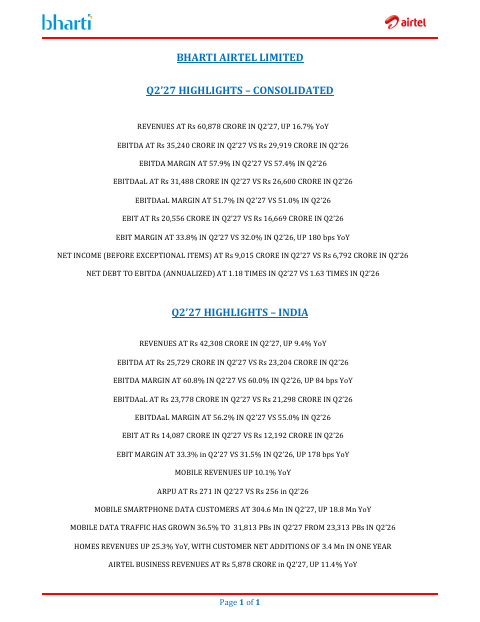
up 16.7% YoY and 4.0% QoQ
up from Rs 6,792 crore in Q2’26
vs 11.30 in the year-ago quarter
up from 32.0% in Q2’26
EBITDA margin 57.9%
excludes Rs 2,826 crore for a data centre land parcel
| Segment or metric | Value | Change |
|---|---|---|
| India revenue | Rs 42,308 crore | up 9.4% YoY and 2.7% QoQ |
| India mobile ARPU | Rs 271 | up from Rs 256 in Q2’26 |
| Postpaid customers | 31.2 Mn | record net additions of 1.2 Mn |
| Smartphone data customers | 304.6 Mn | up 18.8 Mn YoY |
| Mobile data usage per customer | 36.5 GB per customer per month | up 36.5% YoY |
| Homes customers | 15.4 Mn | 676 K net additions in the quarter; revenue up 25.3% YoY |
| Airtel Business revenue | Rs 5,878 crore | up 11.4% YoY |
| Africa customers | 193.9 Mn | revenue up 20.6% YoY in constant currency |
Copied from the press release ↗ and other documents in the company's results page ↗. A figure is published only if its sentence is in those documents.
Postpaid net additions reached 1.2 Mn, the strongest in any single quarter, and postpaid has made up nearly 30% of net adds over four quarters. Management points to Fast Lane, premium content, cheaper roaming and the Apple iCloud+ bundle, and sees large headroom to upgrade more customers.
ARPU reached Rs 271, with the prepaid ladder change already played out. Management said it temporarily hurt customer continuity, and it argues lasting ARPU growth needs an industry shift to charging for data consumption.
Airtel is accelerating fiber home passes and has scaled back fixed wireless expansion to an interim role. It is correcting low-quality acquisition, which weighed on home ARPU and margins, and says home net adds still need to accelerate.
Airtel invested Rs 2,826 crore in a land parcel that supports at least a 400-500-megawatt plant, toward its one-gigawatt ambition. Management expects lumpy capex and a mix of debt and possibly equity, while still studying GPU-as-a-service.
Airtel built an in-house agent platform, Agent Bridge, and added GPU capacity in its data centres. It reports over 10 billion next best actions, anti-spam screening of over 100 billion calls and AI-driven network energy savings.
Each quote matches the transcript word for word.
“fiber is the best experience, this is what leads to the stickiest customers, and the best value creation in the long term”
Explains why Airtel is prioritising fiber over fixed wireless in home broadband.
“the architecture correction is a much broader correction that is required in the industry to charge for data in many ways”
Shows management sees durable ARPU growth as dependent on industry-wide pricing reform, not Airtel's moves alone.
“GPU bare-metal leasing, which is a commoditized business and right now there is froth and that is just a capex to opex game”
Signals caution about the lowest-value layer of AI infrastructure while Airtel studies higher-value GPU services.
“we will not shy away from investing in the new businesses to drive growth because this is what will bring, what we say, double-digit growth consistently, for the years to come”
Shows management will spend on data centres and cloud even without capex guidance.
“we have not seen yet an economy of tokens playing out at scale where customers are paying for tokens at scale in India”
Management sees no scaled consumer market yet for selling AI tokens in India.
“today, the AI traffic on our networks is very, very small and it will grow.”
Indicates AI-driven uplink demand is not yet a material network or capex driver.
The prepaid ladder change has already played out, and further ARPU growth is expected from plan upgrades, postpaid, international roaming and top-ups. — Shashwat Sharma
AI traffic on the network is still very small, so Airtel is building capabilities and will invest as needed. — Shashwat Sharma
Fiber is the core of the home strategy and FWA will only serve fringe demand until areas are fiberized, so this is not a stop-start approach. — Shashwat Sharma
The Rs 299 pack was an experiment on Airtel's own base, the architecture fix needs the whole industry to charge for data, and postpaid is a differentiated premium offer Airtel is happy with. — Shashwat Sharma
Core capex continues as guided, while data centres and cloud are where Airtel will invest for growth, and no further guidance was given. — Soumen Ray
There was some softness in upgrades as entry-level prices rose, partly offset by a growing refurbished phone market. — Shashwat Sharma
Not so far, because almost 92-93% of new smartphone shipments are now 5G. — Shashwat Sharma
Airtel did not split out drivers, credits overall postpaid differentiation, and sees large headroom as its models show many postpaid lookalike customers. — Shashwat Sharma
The land can host at least 400-500 megawatts, Airtel is compressing build times, and it is studying GPU-as-a-service and a full AI stack while calling bare-metal GPU leasing commoditized. — Gopal Vittal
Yes, mostly data centres, with lumpy capex over the next 12 to 18 months including the Vishakhapatnam build-out, while cloud capex is more graded. — Gopal Vittal
Gross debt should trend down opportunistically, the capex gap reflects large data centre projects, and current tax run rates can be assumed going forward. — Soumen Ray
Nxtra builds data centres as its business, funding will mix cash from a recent equity raise with debt, and Airtel already buys chips for internal use while still observing GPU services. — Soumen Ray
No, there is no intention to buy out those stakes.
Churn reflects Q2 seasonality and the pricing intervention, competitive intensity is unchanged, and Airtel says it has been gaining share. — Shashwat Sharma
Airtel keeps adding partner subscriptions such as Adobe for engagement, but sees no scaled token economy in India yet. — Shashwat Sharma
Homes is in an investment phase with heavy fiber and CPE spend, and corrections to low-ARPU acquisition also hurt short-term EBIT. — Shashwat Sharma
Management declined to speculate, saying it sees no constraint on headroom and tariff hikes have worked well with its customer base. — Shashwat Sharma
The home ARPU drop is a one-off pull-through of past low-ARPU acquisition, and capex growth will mostly go to data centres and cloud alongside buybacks and rising dividends. — Shashwat Sharma, Soumen Ray
Look at trailing 12-month capex, no per-megawatt figure was given, and monetizing data usage requires an industry shift to charging for consumption. — Soumen Ray, Shashwat Sharma
Management says the pricing move helped revenue growth, Airtel Business growth rose from about 7% to 11.5% as digital offsets commodity messaging, and homes is judged by net add acceleration. — Shashwat Sharma, Gopal Vittal
More than 200 million. — Shashwat Sharma
The pricing intervention and severe Northeast weather hurt continuity with early signs of improvement, and the postpaid increase of about Rs 50 should largely flow through to ARPU. — Soumen Ray
Customer mix and affordability differ, and Northeast disruption prevented recharges. — Soumen Ray
Management would not give forward guidance, says homes will focus on fiber-led quality customers, and suggests judging access charges on a trailing 12-month basis. — Soumen Ray
The voice-only cohort is small and unlikely to move headline ARPU, and the capex difference will be followed up later. — Soumen Ray
Airtel invested in a land parcel that gives it the option of at least a 400-500-megawatt plant, as part of its ambition to build one gigawatt of capacity over the next few years. It is also working on faster modular builds and edge data centres, and is studying GPU-as-a-service and a full AI stack.
Management says fiber gives the best experience and the stickiest customers, so FWA will be only an interim fringe solution until areas are fiberized. It is accelerating fiber home passes and correcting low-quality acquisition.
ARPU rose to Rs 271 from Rs 256 a year ago through postpaid upgrades, premiumization and a prepaid pricing change. The trade-off was temporary churn, and management says lasting growth needs the industry to charge for data.
It built an in-house agent platform called Agent Bridge, added GPU capacity in its data centres and reports over 10 billion next best actions for customers. AI also powers anti-spam screening, network energy savings and internal processes such as KYC and recruitment.
Management expects a mix of debt and equity, noting Nxtra recently raised about $800 million in equity and has cash on hand. It said a further equity raise would be a later treasury decision, while core business capex continues as guided.
Conference Call Transcript
Event: Transcript of Bharti Airtel Limited and Bharti Hexacom Limited Q2 ended September 30, 2026 Earnings Webinar
Event Date/Time: November 06, 2026/12:00 Hrs
-1-
CORPORATE PARTICIPANTS
Mr. Gopal Vittal Executive Vice Chairman, Bharti Airtel Limited
Mr. Shashwat Sharma Managing Director and Chief Executive Officer (Airtel India), Bharti Airtel Limited
Mr. Soumen Ray Group Chief Financial Officer, Bharti Airtel Limited
Mr. Akhil Garg Chief Financial Officer (Airtel India), Bharti Airtel Limited and Director, Bharti Hexacom Limited
Mr. Naval Seth Executive Vice President – Group Investor Relations, Bharti Airtel Limited
Mr. Karthikeyan Velu Group Financial Controller, Bharti Airtel Limited and Chief Financial Officer, Bharti Hexacom Limited
Good afternoon, ladies and gentlemen. I am Vaidehi Sharma, the moderator for this webinar. Welcome to the Bharti Airtel Limited and Bharti Hexacom Limited Q2 ended September 30, 2026 Earnings Webinar. Present with us today is the senior leadership team of Bharti Airtel and Bharti Hexacom Limited. I must remind you that the overview and discussions today may include certain forward- looking statements that must be viewed in conjunction with the risks that we face. Post the management opening remarks, we will open up for an interactive Q&A session. Interested participants may click on raise hand option on the Zoom application to join the Q&A queue. The participants may click this option during the management opening remarks itself to ensure they find a place in the queue. Upon announcement of name, participants to kindly click on unmute myself in the pop-up screen and start asking the question post-introduction. With this, I would now like to hand over to Mr. Soumen Ray for his opening remarks.
Thank you, Vaidehi. Welcome to the Q2 FY2027 Earnings call. I have with me Gopal, Shashwat, Akhil, and Naval. I will start with an update on our Q2 performance, then move to our portfolio, including new growth bets post which I will hand over to Shashwat to talk about our India business, including the strategic priorities.
We delivered another quarter of strong and consistent performance across India and Africa. Consolidated revenue came in at about Rs.60,900 Crores, growing 4% sequentially. Africa delivered yet another solid performance with constant currency revenue growth of 6.7% sequentially. India, excluding passive infra, recorded a strong growth of 3.2%. Consolidated EBITDAaL came in at about Rs 31,500 crores, growing at about 5.5%. EBITDAaL margin stood at 51.7%. Capex for the quarter was about Rs.12,500 Crores, leading to a robust operating free cash flow, which is EBITDAaL minus capex, of over Rs.19,000 Crores. Our strong performance continues to be enabled by sharper execution, operational discipline, and continued cost efficiencies through War on Waste.
India EBITDAaL, excluding passive infra, came in at over Rs.20,400 crores, growing 4%. EBITDAaL margin stood at 52.7%, a 0.4% improvement. Capex for the quarter was Rs.7,430 Crores. Operating free cash flow, which is EBITDAaL minus capex, was almost at about Rs.13,000 Crores. In addition, we invested about 2,900 Crores in a strategic land parcel to pursue our one-gigawatt data center capacity ambition. You will hear more on this in the quarters to come. India Mobile delivered another quarter of strong growth, underpinned by continued portfolio premiumization. Homes maintained its growth momentum, aided by our convergence strategy. Airtel business continued to perform well, while our digital portfolio sustained strong double-digit growth. More details on our strategy will be shared by Shashwat. Our consolidated Net debt to EBITDAaL improved to about 0.70, with India excluding passive now below 1, at 0.96. Prudent capital allocation, disciplined capex and continued operational excellence underpins the strength of our balance sheet.
Our diversified and resilient portfolio continues to deliver strongly, and I will explain that. Performance across India and Africa was strong. Africa now accounts for about 30.5% of our revenues, India mobile about 51%, India non-mobile is about 13%, and Indus at 6%. We are building a future-ready Airtel by deepening our digital network capabilities strengthening the core portfolio and scaling digital growth engines.
Let me move on to the new growth bets and let me start with our financial services portfolio. First, on Airtel Money, as mentioned in the last quarter call, we went live with our lending services in Q2. The business is gaining strong momentum as we expand our offerings to newer geographies. Whilst we are in early days, we see a large opportunity ahead of us to serve financial needs of customers in a simple, secure, and accessible manner. At the heart of this ambition is our commitment to reimagine the lending experience through customer-first journeys, benchmark against global best practices, and deliver through a seamless, intuitive, and frictionless digital platform. Airtel Finance, the storefront of our financial services business, continues to scale strong with monthly loan disbursement run rate now, about Rs.770 Crores. This momentum is underpinned by the strength of our digital platforms, advanced
-2-
data analytics capabilities, and disciplined operating model. Together, these capabilities provide our NBFC with a strong foundation to democratize access to financial services at scale. Airtel Payments Bank, the third pillar of our financial services portfolio, continues to deliver strong growth, deepening its reach and engagement with customers. It ended Q2 with monthly transacting users of over 125 million. Annualized revenue run rate is now over Rs.3,500 crores, growing at 9% year-on-year. Deposits remain strong at over Rs.4,400 Crores, growing at 10%.
Let me now move to data centers and cloud. Nxtra continues to deliver strong revenue growth, driven by capacity expansion and new contract wins. We are progressing well on our ambition to build one gigawatt capacity over the next few years. As I mentioned earlier, we have invested in a large land parcel in a strategic data center hub. This holds us on a strong footing on our ongoing expansion. We believe this is only the beginning of a multi-year growth journey in our data center business.
Airtel Cloud is gaining strong momentum with almost all critical services now live on our platform. Our customer logos have further strengthened with new wins. With continued expansion of our services portfolio, our go-to-market proposition is getting sharpened. We see a large growth opportunity ahead of us.
Lastly, let me give an update on group synergies. This is an important area of unlock for us. We run multiple charters to enable synergies across technology, network, operations, supply chain, and talent. We are increasingly working as one integrated platform, deeper cross-business alignment, sharper execution and stronger operating outcomes. We have already realized tangible benefits in terms of growth in homes and B2B as well as savings in capex and opex in Africa. Indus expansion will further bolster value creation for Africa business.
Let me spend also a moment on the progress of Indus Towers in India. The focus is centered around two workstreams. The first is digital operations transformation where Indus is adopting Airtel’s telco-grade platforms that are proven at scale. The workforce management platform is bringing greater rigor to workflows, improving field productivity, and enhancing execution visibility. The second is energy optimization. Indus is working on a goal to eliminate diesel from sites through solarization and deployment of battery banks. Initial results are encouraging with meaningful scope to scale further.
Finally, a landmark milestone - In October, Airtel Money Africa got listed on the London Stock Exchange at a valuation of about $7 billion and reported as one of London’s largest IPOs. With this, two of our subsidiaries, Airtel Africa and Airtel Money, are now listed in London. With this, I will now hand over to Shashwat for an update on our India business.
Good afternoon, everyone. I will first share an update on the ESG and then on each of our business segments, followed by an update on our strategic priorities. Let me start with ESG. Our ESG progress is closely aligned with our business strategy and the choices we make to build a more sustainable, efficient, and future-ready enterprise. We are using technology and digital innovation to improve the way we operate, reduce resource intensity, and drive greater efficiency across the business. A key priority in this journey is to increase the share of energy from alternate and renewable sources. This is reflected in our continued expansion of solar-powered deployment and reduction in diesel consumption across our network infrastructure. Over the last two years, we have accelerated solarization across our network, which is now operational on about 50,000 sites.
Let me have a quick run-through on each of our businesses. Mobile, in Q2, we added 0.7 million revenue-earning customers and 2.9 million smartphone data customers during the quarter. Our post-paid segment delivered yet another quarter of solid performance, with the highest ever net ads of 1.2 million. Post-paid customers now account for 8.3% of our total customer base, and over the past 4 quarters they have accounted for nearly 30% of all customer net adds. ARPU for the quarter came in at Rs.271, up from 264, benefited by one extra day in the quarter as well.
In homes, we delivered net adds of 670,000. Its momentum is building up from the last quarter. We are seeing strong and consistent traction on the connected homes, driven by our convergence agenda.
Digital TV, we lost over 4 lakh customers during the quarter led by the DTH business, while our IPTV adoption continues to remain strong. Our IPTV take rates continue to deliver on our convergence agenda and you will hear more about it in the coming quarters.
Airtel business revenues came in at about Rs.5,800 Crores, growing 3.8% sequentially and 11.4% over last year same quarter. During the quarter, we secured large deal wins across both Core Connectivity and the digital portfolio. We continue to see strong funnel and order bookings in the business.
Our digital portfolio delivered another quarter of solid performance, with revenue growth of about 4% sequentially. We are seeing strong traction across our portfolio including cloud, cybersecurity, IoT, digital platforms, and CPaaS and we saw some notable deal wins during the quarter.
Let me now provide an update on our strategic pillars. First, winning quality customers. Let me start from homes. We continue to see a significant penetration-led growth opportunity here. Growing smart TV adoption, greater in-home data usage, and rapidly growing digital content consumption continue to fuel the need for high-speed broadband connectivity. As I mentioned earlier, demand remains concentrated in the top 1000 cities, and we have sharpened our acquisition strategy to scale our presence in these towns. Targeting customer cohorts with stronger engagement and retention. Our strategy is centered on building a high-quality customer franchise by delivering a superior connectivity, differentiated offerings, and a seamless service proposition. We are investing in fiber home pass
-3-
expansion at an accelerated pace, as I want to reiterate that fiber remains the best experience for in-home connectivity. We have scaled back our FWA-led expansion, and it will only serve as an interim solution to capture demand till we can fiberize a particular area. Encouragingly, these actions are already translating into improvements in our portfolio quality and customer durability. Convergence remains a key differentiator of our home strategy. The One Airtel plan brings our services together in a unified experience, offering customers greater convenience and flexibility. As adoption grows, convergence is deepening our customer relations, driving engagement across our portfolio, and strengthening customer lifetime value.
Let me now switch to mobile. Our focus remains on accelerating ARPU growth through portfolio premiumization while maintaining a healthy customer acquisition. Leveraging deep customer insights and serving them with more precision through personalization will continue to drive our customer value and monetization. We continue to see strong traction in post-paid upgrades, driven by a differentiated proposition that brings together exclusive experiences, premium content, affordable international roaming, and a superior network experience powered by Fast Lane. As I mentioned earlier, the long-term ARPU growth ultimately depends on a more rationale pricing structure where the industry is able to monetize the continued growth in data consumption more effectively.
Let me now move to B2B. We see large growth opportunities across both core connectivity and our digital portfolio. Our execution agenda is anchored on three priorities. First, is to strengthen our infrastructure backbone to meet the demanding needs of enterprise customers. This includes sustained investments in network quality, reliability, and resilience, with a clear focus on delivering a world- class B2B network. Second is sharpening our offerings around customer needs across industries and segments, building capabilities across cloud, cybersecurity, and IoT, and strengthening our account management to translate the breadth of our portfolio into deeper customer relationships and a larger share of wallet. And third, is strengthening our delivery and service assurance through digital platforms and AI. The focus is on disciplined delivery, automated root cause analysis, and proactive fault resolution to deliver consistently superior customer experience. These priorities underpin our ambition to capture a larger share of the enterprise opportunity and drive sustained growth across our portfolio.
Moving on to the second pillar of our strategy, which is obsession to deliver brilliant customer experience. Customer experience underpins everything we do, from how we invest in our networks to how we design our digital journeys. On the network, we are building for quality and resilience, we are strengthening a transport layer beneath the 5G network and building edge data centers that make the network more resilient. Capabilities such as Fast Lane built on 5G network slicing add a differentiated experience where customers need it most in busy networks. In homes, our focus is on getting the fundamentals right across installation, service, and workmanship. Our AI-led workmanship tools running on the field engineer's own handset are helping standardize the quality of our execution on ground. Underpinning all of this is our unified customer data platform, which brings the customer’s journey across channels and touchpoints into a single view. At the core is our Converge Data Engine, which combines data, AI, and analytics to bring real-time context to every interaction, anticipating customer needs and delivering a personalized experience at scale. The result is a simpler, more relevant interaction, and a deeper relationship with our customers.
The third pillar of our strategy is to build and leverage our digital capabilities. AI is increasingly woven into the fabric of our business. Over the past two quarters, we have laid the foundation to embed AI at the heart of Airtel’s digital platforms. We have built a homegrown agent platform called Agent Bridge and added GPU capacity across our data centers. This is enabling us to activate AI use cases much faster across both customer-facing and internal journeys. In parallel, we have run several AI experiments to reimagine our operating models with an intent to redesign how work gets done at Airtel. Going forward, our focus is on scaling the use cases already creating strong value.
Let me share a few highlights. For customers, our real-time, context-led decision engine has now generated over 10 billion next best actions and is scaled across key inventories across our channels. We use individual-level context to deliver more than a billion personalized content and recommendations. Since launch, our AI-led anti-spam solution has identified over 100 billion calls for spam, and nearly 5 billion messages, and blocked over 1.7 million fraudulent links. For networks, AI is helping us lower our fuel and power wastage, which reduces operating costs while also improving customer experience. Our AI-enabled RAM dynamically orchestrated over 14 million sleep hours each day across our network sites during Q2, reducing energy consumption and generating some cost savings. We see substantial headroom to further optimize our energy costs as these capabilities scale across the network. The third area is internal functions where AI tools are now changing the way our internal processes are. Call center bots were the early use case we adopted. Now, AI-led processes are changing across areas like quarterly financial book closure, recruitment, mass interview screening of candidates, and our video KYCs for our customer acquisition. As we scale AI across Airtel, we are also remaining focused on clear guardrails around customer safety, privacy, and data sovereignty.
The fourth pillar of our strategy is War on Waste. Cost discipline remains core to how we operate and as cost pressures build, funding the growth will depend on how much waste we take out of the system. The War on Waste initiative continues. We are also looking beyond efficiency towards innovation that changes the cost equation itself, in areas like energy and in virtualizing set-up boxes for IPTV, for example. These initiatives are helping us mitigate inflationary pressures arising from ongoing geopolitical headwinds.
So, to sum up. Overall, we have delivered another quarter of strong performance, underpinned by our portfolio premiumization, razor- sharp execution, and sustained operational excellence. We remain confident in the growth potential across our businesses, supported by continued ARPU expansion in mobility, deeper penetration of homes, and the increasing scale of our B2B portfolio. Our investments are channelized towards future-proofing Airtel. AI is now becoming integral to the way we work, enabling us to enhance productivity and improve agility. At the core of all these investments and initiatives is a relentless focus on delivering superior customer experience. With that, let me hand this back over to Vaidehi for the Q&A session.
-4-
Thank you very much, Shashwat. We will now begin the Bharti Airtel Q&A interactive session for all the participants. Please note that the Q&A session will be restricted to the analyst and investor community only. Due to time constraints, we would request if you could limit the number of questions to two per participant to enable more participation. Interested participants may click on raise hand option on your Zoom application to join the Q&A queue. Upon announcement of name, participants to kindly click on unmute myself in the pop-up screen and start asking the question post-introduction. Participants are also requested to limit their questions to Bharti Airtel till 1pm as the management will start the Q&A discussion on Bharti Hexacom from 1pm onwards. With this, the first question comes from Mr. Piyush Choudhary. Mr. Choudhary, you may please unmute your side, introduce yourself, and ask your question now.
Piyush Choudhary - HSBC
Good afternoon. Piyush, from HSBC. Thanks for the call and opportunity. Two questions. Firstly, on mobile ARPU, can you share what proportion of increase sequentially came from the adjustment to product offering like discontinuation of your 299 plan and what is driven by premiumization factors and do we see, kind of, residual impact coming in Q3 and how much would that be? Second question is on the network side, we saw in Thailand, with rising AI demand, higher uplink capacity, AIS has expanded its 5G advanced uplink coverage to improve customer experience. Do you think Airtel would also need to strengthen its uplink capacity, and any capex implications when you strengthen the uplink capacity? Thanks.
Hi, Piyush, thank you for that and let me just take that. On ARPU, we continue to see significant headroom for growth on ARPU levers that we have spoken about and which is a mix of upgrades of plans, postpaid, international roaming and top-ups. Overall, the intervention that we have taken on pricing on prepaid ladder in Q2 has already, kind of, played out and now we are looking at all the other levers forward in terms of continuing to grow ARPU steadily over the coming quarters. I see a sustained growth of ARPU possible on the base as we continue to unlock these levers. For AI demand, yes, two things I want to call out, Piyush here, which is, look, today, the AI traffic on our networks is very, very small and it will grow. We are watching this space very carefully, you are right about the fact that AI traffic requires much higher uplink, and we are building all capabilities as well as the investment needed to sustain this growth of capabilities required here, but at this point of time, it is not substantial, it is too small and as required, we will keep investing on this space.
Piyush Choudhary - HSBC
Thank you, Shashwat.
The next question comes from Mr. Manish Adukia. Mr. Adukia, you may please unmute your side, introduce yourself, and ask your
Thank you for taking my question. This is Manish Adukia from Goldman Sachs. My first question is a follow-on to Shashwat, what you mentioned in your prepared remarks about you scaling back your FWA led expansion. Two questions there: one, is this, like, a short-term measure and over time you expect to scale it back up again? Two, is this a function of your expectation of what the TAM or the depth of the profit pool would look like for this particular sub-sector of FWA? If you can throw some light on what drives this scaling back of FWA expansion.
On FWA, see for us, fiber is the clear area where we are focusing. It is the heart and center of our home strategy. What we are seeing, it is globally and for our own customer base as well, fiber is the best experience, this is what leads to the stickiest customers, and the best value creation in the long term. So, this is not a stop-start strategy in that sense. I think we have seen what the market is playing out as well as the experience that we have got. We are clear that we have to go all out on fiberizing the country and expanding the market on fiber. As we expand, there will be some augmentative needs of some wireless capture of demand which FWA can play on the fringes, and we will however fiberize each of those areas where we see density of demand coming up, so that is the play we are absolutely focused upon and we will stay there. I do not think this is a play which is a stop-start, contextually, in that sense.
-5-
Got it. Thank you for that. My second question is follow-on to Piyush’s question earlier. You have talked about, in this call and in the past, about fixing the pricing architecture, the intervention that you made in the month of August, would you call it a step towards that, fixing pricing architecture and in your opinion, is there like more room to go for you to fix that architecture and a related question also on the postpaid side, some of the changes that you made, I think, last month, in postpaid in particular you are the market leader, and you are the pricing leader there, so in postpaid at least, is it safe to say that you do not think there is a need to meaningfully address the pricing architecture, and over time you may see some interventions, but postpaid, you are happy with where things are.
Yes, so I think, just to take those two questions. Look, when we speak about pricing architecture in the industry, it is largely got to do with the fact that it is a very flat architecture and at very low ARPUs, you are giving away unlimited usage and data, and you are not monetizing consumption in any way. The data is, in that sense is not charged and, therefore, that change of architecture will require, like, I think the industry to move more decisively. So, in that sense, I would believe that, aside saying, the intervention of Rs 299 pack is more of experimentation on our own base, keep moving ARPU up, but the architecture correction is a much broader correction that is required in the industry to charge for data in many ways. Postpaid, we are happy, in the sense, Manish, that I think, postpaid is a separate, is a more premium, differentiated offering that we want to create in the market and we have been working consistently to strengthen the proposition on post-paid and I think Fast Lane for us was a big intervention. We have now made more value for customers who are traveling overseas, and we have continued to strengthen our proposition and the differentiation of postpaid to have many more customers choosing postpaid as their service over time and premiumize. I think that is how we look at it.
Thank you. Just one last question from me. On capex, your overall India business ex of towers growing at double-digit revenue faster at the EBITDA level, and on capex, you are investing in home broadband and also in data centers, etc., but directionally when we think about capex over a 2-3 year period, would you say that given just the underlying earnings growth of the business is very strong that capex, at least, should not grow in line with what your revenue or EBITDA growth is. I am just trying to think where are the upside risks to capex in your opinion across your various businesses where you see, you may need to keep investing or keep increasing your capex over the next 3-4 years.
Manish, on capex, the core business will continue as per guidance. As you can appreciate, if there is a built-out strategy from 200- 250 megawatt to a gigawatt, we are dialing up our cloud capabilities. So, in some of these new growth bets, we will invest for growth for the future. At this point in time, I cannot give you guidance, of course, but we will not shy away from investing in the new businesses to drive growth because this is what will bring, what we say, double-digit growth consistently, for the years to come.
The new business when you refer to is on the enterprise B2B side, you are not referring to wireless or homes, their capex would continue as it is?
I am referring to data center, I am referring to cloud, these are the places which will need investments.
Alright, thank you. Thanks a lot for taking my questions, all the best.
The next question comes from Mr. Gaurav Malhotra. Mr. Malhotra, you may please unmute your side, introduce yourself, and ask
-6-
Thanks. This is Gaurav from Axis Capital. Just had a couple of questions. First of all, given the kind of price increase in smartphones that we have seen, have we started to see impact of this on the whole 2G to 4G upgrade cycle and maybe from 4G to, say, 5G smartphone cycle?
Gaurav, we have seen some softness in customer upgrades. I think entry-level smartphone prices have gone up substantially, and shipments have slowed; however, one other thing we are seeing also is, in India there is a very strong refurbished phones market, which is expanding, and is supporting the smartphone upgrades at the entry level. So, a little bit of softness was seen, but I still think in India the refurbished market is still bolstering this up.
Got it and what about the 4G to 5G because that also, that premiumization would also be getting impacted or that you are not seeing any softness as of now?
As of now, no, because almost 92-93% of all new shipments of smartphones are 5G now, so that shift on the OEM side is also helping. So right now no.
Thank you. That is it.
The next question comes from Mr. Sanjesh Jain. Mr. Jain, you may please unmute your side, introduce yourself, and ask your question
Good afternoon. Thanks for taking my question, I got a few of them. First, on the wireless business, we have seen a 1 million postpaid addition in previous quarter and 1.2 in this quarter, which is significantly more than what we were adding earlier at 0.8, almost a 50% rise there, how much is it aided by our Fast Lane or our priority service and do you think these numbers are sustainable?
Sanjesh, you have 3 questions, let us take the questions and then I will respond.
Second, on the B2B business, data center, we said that we have bought a land, and last quarter we mentioned that we are looking to still plan upon go-to-market strategy for 350 megawatt hour of capacity. What is this land pertains to and how much capacity can we add there and a related question there that now, it appears that adding new capacity in U.S. will become more and more challenging, which means we will have a larger opportunity opening up in India from an overseas market. How are we trying to think about that or cater that and related probably, we have always been averse to get into GPU-as-a-Service, I think, that market also becomes a little more attractive for Indians, how are we thinking holistically in terms of data center and GPU-as-a-Service in B2B and rest of the questions are bookkeeping, I will take after this.
-7-
Sanjesh, I will take the first one and maybe, Soumen, you can come in on the data center piece. So, on wireless, postpaid additions, Sanjesh, the way we look at postpaid is we have today 30-31 million postpaid customers, and our data models then look at what are the postpaid lookalike customer base in the market and we see a very large headroom in front of us to upgrade customers to postpaid. The real need there is, of course, our go-to market, as well as the differentiation of postpaid. So, we are not splitting out saying which element of differentiation is causing what level of growth, but overall differentiation of postpaid continues to accelerate, and this differentiation is helping us accelerate. So whatever acceleration we have seen is because of all the differentiation efforts that have happened. We need to do more because the headroom for growth is a lot, so my question is not about whether we can sustain it. We are, internally trying to see how much more can we accelerate the rate of postpaid upgrade. I think that is all, postpaid I will leave you with.
Yes, I can take that. I think on the data center side, I think, the land that we have acquired gives us the optionality of over time putting in at least a 400–500-megawatt plant, so it is a large tract of land, and also, it is concentrated in the right locations where the demand seems to be high. We will continue to look at other options for land and build-out, as you are rightly saying, some of that demand from the U.S. may get directed towards India. I think the third thing I would say on data centers is that we are also working to compress the time to build. There are several things we are doing in terms of putting together a toolkit for very fast build, with the right strategic partnerships, both on the build side as well as things like chillers and so on and so forth, so that we can kind of compress the cycle and have modular units that can keep getting created and the final thing I would say on data center is that the 56 edge data centers that we are consolidating from the 100-odd MSCs that we have, to state-of-the-art facilities, we are also looking at slightly higher, larger pieces of land at the edge, which gives us the option of building our data centers even at the edge, so that is really on the data center side. On the GPU-as-a-Service, I think there are 3 parts to this business, one is just GPU bare-metal leasing, which is a commoditized business and right now there is froth and that is just a capex to opex game. Counterparty risks remain, given the amount of crazy demand that is there, particularly amongst the smaller players. GPU-as-a-Service is where there is a little bit more software and orchestration that needs to be done, as some of the neo clouds do. That is an area which we are currently studying and the third thing, which is AI, where we are actually building it for our own use cases. For example, one of the things that we worked on is actually optimizing the model cost within the Airtel, sort of, use of AI, and we have built a platform that allows us to do that and the demand that we are hearing from our enterprise customers is, we also want you, as part of the cloud, to offer a full AI stack that allows us this, so, that is an area that we are looking at. I think it is still early days, but it is an area we are actively studying.
Right now our focus Gopal, remains largely on the colocation side of the business right, the entire capex, what we are investing today, is largely towards the colocation?
Mostly on the data centers, because these are lumpy capexes with land buys that you do, or let us say, the build-out that is going to happen in Vishakhapatnam will have some lumpy capex over the next 12 to 18 months as you build it out, but beyond that, I think on the cloud, it is more graded capex.
Great. Thanks, thanks for those initial answers. My remaining questions are largely bookkeeping. First, on the gross debt payout, for last three quarters, our gross debt has remained broadly in the same range as Rs.1,20,000 Crores. I know we have a larger debt towards spectrum and AGR, which has a longer payout period, but apart from that, do we intend to pay out remaining debt, now that we carry a lot of cash from the book, how should we think on gross debt coming down? That is one. Number two, on the absolute capex number, our cash flow capex is around Rs.13,800 Crores for last two quarters, our reported capex is around or capitalized capex is around Rs.10,000 odd Crores, how should we reconcile this, and when should this converge wherein we have a lot more cash flow coming in? One last question on the tax, now we are paying 4,300 Crores as the cash tax, have we exhausted all the accumulated losses, and now, current tax should broadly reflect in the cash outflow for us?
-8-
I will take those 3 bookkeeping, as you say, Sanjesh. Larger debt, this debt, there are some parts of operating debt, there are some operating country debts in Africa. We constantly look at reducing debt in all countries, subject to operations. This quarter, you would have seen a little bit of drop on gross debt. If the dividend payouts were not there, as you would appreciate in Q2, Indus, Airtel and Airtel Africa, all had very large dividend payouts, of course. So, gross debt, you will see directionally coming down, opportunistically, basis the country and the operations. Capex and WIP mismatch, well, this will continue to happen for large projects as we do more DCs, but core business, I can assure you there is no divergence, they continue to do at the same trend. If you look at the trend of capex on the BAU part, you will see a complete convergence between CWIP and capex spend and actual capitalization. On taxes, yes, you could take the current run rates as the going-forward run rates for tax provisions and payments. Thanks.
Thanks, team, for answering all those questions, and best of luck for the coming quarter, and Happy Diwali.
Next question comes from Mr. Sachin Salgaonkar. Mr. Salgaonkar, you may please unmute your side, introduce yourself, and ask
Thank you for the opportunity. First question is on data center. Just wanted to understand, again, and I know multiple questions were answered on data center but let me be specific on three subparts of the question. How much of the data center capacity currently is in-house versus external customers? How do we see that changing? Secondly, as we look to scale data center towards a one gigawatt, is it purely will be done by debt or is there a risk of an equity raising also, especially as we look to scale it up in much faster process? Gopal while you mentioned on GPU-as-a-Service, ideally should we also expect Airtel to buy NVIDIA or TPU chips, and hence, the capex associated with that?
Soumen, you want to take this?
Yes, I will take that. How much is external capacity - Nothing is external capacity. We build data center for a living; it is our business. We have not leased capacity to sell it to somebody else. So that answer is unequivocal. Equity versus debt: we have just done about $800 million in equity raise, which came in June, July. So, we, as of now, have cash in the bank. Will there be a mix of debt? Certainly, yes. These are large infrastructure projects, very high quality, long-term, so we will, of course, have debt to fund these. Will there be an equity raise happening? One year later, two years later, we will leave that as a treasury discussion between the cash that the three owners of Nxtra has, who have substantial versus what is the debt pricing, and we will take a treasury call at the opportune time, but certainly, there would be some debt which will come in, everything will not be built in by equity. Will Airtel go to buy GPU chips from NVIDIA or TPU chips? I think, we already have them. Shashwat, in his opening remarks, mentioned about the workloads that are running for internal use, so we have that. So, if we have to, but we are not, as Gopal explained, we are observing the space of either lending out bare metal, as you see, or GPU-as-a-Service, like a neocloud, or the full AI stack. So, as of now, I do not have anything to inform you. We are, of course, buying chips for our internal use.
Got it. Thanks, Soumen. The second question is on comments from Bharti Airtel promoter in one of the media interviews where he did mention that eventually BT and OneWeb which are long-term investments, will be consolidated under Bharti Airtel. Understand it is more a long-term thing, but how should one think about this transaction getting, sort of, transacted out there in the sense that, will Airtel be buying these stakes over a period of time, is there a incremental investment required for that?
No, there is no intention to buy out these stakes from Airtel.
-9-
Sorry, so, Bharti Airtel would not acquire these stakes from enterprises?
Yes, there is no intention to do this.
Okay, thanks for the clarification. Thank you.
The next question comes from Mr. Kunal Vora. Mr. Vora, you may please unmute your side, introduce yourself, and ask your question
Kunal, we cannot hear you.
Kunal, you may unmute your side, introduce yourself.
Okay, sorry. First question is on mobile business. We have seen a slight increase in churn, customer additions, prepaid sites were muted, tower sites were flattish quarter-on-quarter and this is happening at a time when the third player has started investing. I understand there is a large gap in the prior investments, but how should we think about incremental revenue market share between the three players, earlier we had two larger players gaining share, do you think it gets difficult now?
Look, the churn that we are seeing in Q2, is for us largely a combination of two things. There is some seasonality of Q2, which comes in, as well as the pricing intervention that we took, where there is always a temporary impact on customer continuity and we will keep playing this out in terms of ARPU versus base growth. Having said that, I think from a competitive intensity lens, I think, it remains the same, what we have seen for the last few quarters because the investment and the market aggression of three operators in, let us say, half the country, and then it is a two-operator market in the rest of the half of the country, has been in a set pattern, and we have been gaining share, so we are not shy of competition in that sense at all, Kunal. We will continue to focus on optimizing the market and gaining share by expanding it there, so I think that does not change for us.
Okay, second question on AI. So, Airtel was offering perplexity AI services, and I think the 12 months would have now expired, what is the plan now, do you see a need to continue with something similar and separately, some of the Chinese operators are selling AI tokens to customers, is this something which you would look at as a long-term opportunity?
I think two separate parts to this. One is really, in terms of bringing more and more value distribution play for various subscriptions, etc., to our customers, we keep doing it, we did Perplexity, we did some work with Adobe. Today, Adobe tool is available to our customers and these continue, we keep looking at opportunities of what else can we bring to the customer, so that is one part of the play, which is to drive more engagement and stickiness of our customer base with us. On the other side, this whole space of monetizing tokens, I think we have not seen yet an economy of tokens playing out at scale where customers are paying for tokens at scale in India. We are watching this space. If this economy were to develop, we will definitely look at ways of participating, but as of today, it is not substantial to think about.
- 10 -
Thank you. Just one last question. On home broadband, we have seen the EBIT margin deteriorate over the last one year, is it getting more difficult to acquire quality customers, and how should we think about growth and capabilities in home broadband from here?
Look, I think for me, if you look at home broadband, I look at this business from the lens, say, we are in acquisition and growth phase in this business, so we are doing everything that we need to do to expand this business properly. A lot of investment has gone into fiber as well as CPE which are the two big capex and play that comes in. So, as a result of which, EBIT has looked a little bit softer. Also, last quarter, I touched upon this topic that we had seen some issues in terms of quality of acquisition at low ARPUs, etc., in the market for a couple of quarters, which we are now correcting, which also impacted a bit of the short-term EBIT that has laid out on this business, but I would look at the larger picture on this business of saying, this is an investment phase of this business, and we really have to accelerate further.
Okay, that is it from me, thank you.
The next question comes from Mr. Ankur Rudra. Mr. Rudra, you may please unmute your side, introduce yourself, and ask your
Thank you, this is Ankur from JP Morgan. Firstly, just on your mobile business, it was very heartening to see the sharp ARPU recovery, quite healthy from the tariff action in the quarter. Now, should there be any sector-wide tariff hikes by peers over the next few quarters, will you be more constrained to participate, particularly at the low end of the pricing table, given these actions may have brought some of the benefits forward?
Ankur, anything else you have? If you have questions, then we can list them down, and then we can respond.
Sure. The second question is on the home side. Can you, maybe, comment a bit about how you think it is doing versus your expectations, I understand you have commented many times that you are focusing on high-quality customers, so, what explains the sharp ARPU decline we have seen, and the fact that additions are still a bit soft versus a few quarters ago? Is convergence a reason for the dilution on the ARPU side? Lastly, if you could just comment on the overall thoughts on capital allocation as it stands across capex for core business, new growth bets, purchase of any further stakes in subsidiaries like Africa or Indus, and shareholder returns?
Let me take the questions on both the business ARPUs, and then I will hand over to Soumen for capital application. So, look, on mobility, we have seen whatever comes on tariff, we come to it when it comes to it. Usually, tariff hikes have worked well for us with the quality customer base that we have, so I would not speculate beyond a point on this. I would say, I do not see a constraint in terms of the headroom or tariff growth, etc., that we have. If ever and when this happens, we feel strongly about the fact that we should really need this increase in ARPU, we will continue to, just, keep building industry-leading ARPUs in this business. On homes, I think I will just leave it at the fact that, look, ARPU this quarter is just a pull-through of what we had spoken about in terms of acquisition at certain low ARPU commissions, wrong sales practices, etc., that we had to correct last quarter and, this is a one-off, so I would not worry about this beyond a point.
- 11 -
Capital allocation piece, I would say that the core business, we have always mentioned, I think, over the last few quarters, that the radio capex has kind of moderated, and that will continue because a lot of the build-out has already happened. I think, if you look at the new towers being installed, it is almost very little now it is less than 1000, in the ballpark of five, six hundred sites this year, this quarter. Of course, there will continue to be some expansion of 5G. Core capex is a function of what happens to volumes and how much data consumption grows and that tends to be a small component and then, the transport capex tends to be a lumpy, not lumpy, a large capex because there is a lot of fiberization that is being done within the Company. So that will continue, but the core business, I would say, is, kind of, consistent, we do not see any spikes. A lot of the incremental capex would really go behind the growth bets, which is on data centers, as we spoke about and cloud. We have already announced a potential, continued buyback in Airtel Africa. We have also done that in Indus, so that will continue and we have also said in the past, and you see that reflected in our conduct that the dividend payouts will keep increasing over time. So, I think all of those we will work through.
The next question comes from Mr. Sumangal Nevatia. Mr. Nevatia, you may please unmute your side, introduce yourself, and ask
Sumangal Nevatia – Kotak Securities
This is Sumangal from Kotak Securities. Thanks for the chance, great quarter. I have two questions, one just continuing on capex. For the first time, if I am not wrong, the capex for the wireless business is lower than homes, Airtel business and DTH put together, even without the land purchase, so, can we extrapolate this trend now over the medium term till we get into 6G, and also, is it possible to share some ballpark capital intensity, say, per megawatt for the data center investment which we are doing? That is the first question. Second, it is quite encouraging to see that a data consumption per subs has been outperforming our peers since last few quarters, so the gap versus peer without adjustments, was around 35-40%, is now down to 20% odd, so, just want to understand how should we look at this trend, what is working well for us, and how are we looking at monetizing this beyond the plan rationalization which we did a few months back? Thanks.
Soumen, you just talk about capex.
Yes, I think on the capex bit look at a trailing 12 months number because, for example, I can tell you that the weather typically in Q2 is bad, so some of the wireless capex does not happen, do not get into that, look at 12 months, trailing, I think that will give you a fair idea. As far as per megawatt capex is concerned, I cannot give you a number, because there are very, very many vulnerabilities, changes that happen. It is about where is it located, what is the design, what is it fit for purpose. So, there is no thumb rule that I can give you that per megawatt my capex is going to be in this range only, so I cannot give you a number, but as you know, India is very competitive compared to some of the other developed markets in terms of capex per megawatt.
Sumangal, I think on data consumption per sub, I think it is a function of strengthening network, as well as upgradation that we have done of our customers on the plans. On this one, I feel in terms of how we monetize data consumption per sub going forward, I think it is back to what we discussed earlier, I think a very detailed discussion on what we need to do on pricing architecture. I think it is consumption has to be, like, people who consume so much must pay for data and that I think is the shift eventually the industry will have to make and if we are able to make that, it just gives us organic growth of ARPU, which is consumption-led and it will sustain us for many years to come. I think, that for me, is a pivotal shift that we need to make.
Sumangal Nevatia – Kotak Securities
Got it, thanks, and all the best.
- 12 -
The next question comes from Mr. Gaurav Rateria. Mr. Rateria, you may please unmute your side, introduce yourself, and ask your
This is Gaurav from Morgan Stanley. I have a couple of questions. On the mobility business, sequential revenue growth was close to 3%. ARPU increase just from the number of days itself gives us 1% and then there is always a mixed improvement led by the postpaid and other factors that drive some improvement in the overall revenue growth. So, when I look at the pricing intervention, I am not able to understand whether that has been really revenue accretive or not for us at the overall business level, it may be ARPU accretive, but has it been revenue accretive or not? My second question is on Airtel business portfolio: our mix must be changing in favor of the digital portfolio compared to, let us say, last year, but we have not seen the benefit of that accruing in the form of revenue growth accelerating in this business, so, what is the mark, or what is the level at which our digital portfolio reaches, and we start seeing the benefit in terms of the mixed change driving acceleration in the overall revenue growth? Lastly, on the home portfolio, how are you measuring the quality of the business, is there any retention metrics that you can share that help us to understand that the quality of the portfolio has improved compared to two quarters back and do we intend to go back to the historical high net adss that we used to add maybe two quarters back, in the coming quarters or not? Thank you.
Thank you, Gaurav for those questions. Let me just take them one by one. I think on the mobile ARPU piece, I think we are happy with the way the pricing interventions have gone. Overall, I think the overall plans, they really wanted this pricing intervention to play out did play out. So, I think in terms of what you feel on mobile revenue growth, I think it has helped us on the revenue growth side, so I would not comment beyond that.
On B2B, I think Gopal, would you like to add on the B2B bit?
Yes, I do want to come in here because we have talked about this in the past. Our portfolio comprises of four components. The first is the core business, which like we have always mentioned is growing modestly because the market grows modestly. The second is the commodity messaging and all of that, which has its own pressures because there is some traffic that moves to WhatsApp, there is also continued pricing pressure on that, and we are happy for it to either be flat growth or, kind of, marginally decline and then there is data centers, which we have spoken about already, and finally is the digital businesses. So, it is a mix of all of this, and that is what drives growth. Now, if you look at 11.5% growth that we have had, obviously, you can see that there is an acceleration that is happening on the digital side, which is actually compensating for some of that managed decline on the core commodity messaging and so on and so forth and, not a couple of quarters ago, this growth used to be about 7%. So, you can see a movement in the trajectory, and our hope is that this continues over the coming years.
Gaurav, your last question, which was on homes, I would just say that this is a business where we look at like, we have our strategy of fiber, and overall growth and acceleration in the net adds is for me right now the metric to look at on this business, so, I would just leave it there and say, we have to accelerate. There is a lot of work that is going on in terms of just expanding our fiber footprint, pivoting our GTM and marketing towards that and staying very focused on where the market growth is, and accelerating this piece. So, this will take a little bit of time, but we want to see the acceleration that you are also asking for.
Thank you for patiently answering all the questions. Just a bookkeeping question on 5G user base if you can provide. Thank you.
What is the question?
- 13 -
Sorry, can you repeat it?
5G user base if you can provide on the mobility business.
More than 200 million.
Thank you, everyone. I would like to remind the participants to kindly stay connected on the call for the next session on Bharti Hexacom. Now, I would like to invite Shashwat to give his closing remarks on Bharti Airtel.
I just want to say thank you for all your insightful questions and very detailed discussions on the results and thank you all for your engagement. So, with that, we bring the Bharti Airtel Limited discussions to a close.
Thank you very much, Shashwat. With this, I would now like to hand over the call to Mr. Soumen Ray for his opening remarks on Bharti Hexacom performance.
Thanks, Vaidehi. Good afternoon, everyone. Welcome to the Bharti Hexacom’s Q2 FY2027 earnings call. I have with me, Karthik and Naval on the call. Let me start with a quick update on our Q2 performance. We delivered strong performance with revenue of over Rs.2,580 Crores, growing at about 2.9% sequentially. EBITDAaL for the quarter came in at over Rs.1,250 Crores with a margin of 48.6%. We ended the quarter with mobile customer base of 29 million. Smartphone customer additions were strong at 48,000. ARPU for the quarter was Rs.264, which benefited, amongst other things, from one extra day in the quarter. Our homes, offices, and other businesses continue to see strong momentum with net ads of 71,000, resulting in revenue growth of about 3.7% sequentially. We continue to invest in 5G expansion, network modernization and growing our homes and IPTV businesses. Our operating free cash flow generation, which is EBITDAaL minus capex, came in at about Rs.920 Crores. Balance sheet remained robust with net debt excluding leases, at about Rs.1,575 Crores. With that, I would hand over to Vaidehi to open the floor for questions.
Thank you very much, Soumen. We will now begin the Q&A interactive session. Due to time constraints, we would request if you could limit the number of questions to two per participants to enable more participation. Interested participants may click on Raise Hand option on the Zoom application to join the Q&A queue. With this, the first question comes from Mr. Saurabh Handa. Mr. Handa, you may please unmute your side, introduce yourself, and ask your question now.
Saurabh Handa - Citi
Thank you for the opportunity. Just in terms of the subscriber additions in mobile, it is turned negative, now, you did speak about this on the Airtel call as well. The increase in churn, would this largely be due to tariff intervention and, also seasonality, and therefore, should this normalize from the current quarter? That is the first question. Secondly, on postpaid on the tariff intervention that you did earlier in this quarter, I think the net impact is roughly Rs.50 increase, is that what should flow through in terms of ARPU or there are some deductions in terms of what you were charging earlier for roaming if that goes away? So, these two questions, please.
- 14 -
Thanks, Saurabh. I will take the first one. Well, as all of us know, we have been in this industry for some time, whenever there is a pricing intervention, there is a temporary impact on customer continuity, so, that is given. We try to balance it out and the things are around being accretive to revenue, customer continuity, and value maximization, so, that did have an impact. But I think, compared to some others, the reason we are more negative is because of very adverse weather impacts primarily in Northeast, which impacted continuity very badly in the last quarter, and we are all aware of the unfortunate weather events that happened in that area. In terms of how we are seeing, we are seeing significant improvement versus what we had in the last quarter. So, let us watch this space for Q3, but we are seeing early signs of improvement. On the postpaid ARPU, yes, broadly, it is a Rs.50 increase, so barring a bit of ARPU, yes, certainly, there could be some access charges for the people who actually go on international roaming, but at ARPU level, yes, broadly, it should be a flow through.
Saurabh Handa - Citi
Thank you, Soumen.
The next question comes from Mr. Gaurav Malhotra. Mr. Malhotra, you may please unmute your side, introduce yourself, and ask
This is Gaurav from Axis Capital. Thanks for taking my questions again. I just had two questions. When we see the ARPU increase of Hexacom versus Airtel, Hexacom seems to have benefitted lesser from either premiumization or the tariff intervention and the reason why I am asking this is because Hexacom’s data consumption actually is higher than Airtel’s, so, if you can just give us some sense as to why the ARPU increase was slower for Hexacom?
Well, Gaurav, different kind of customers, different kind of mixes, different kind of affordability, to start off, the base ARPU itself is different between the two organizations, but if I had to call out one major reason, which impacted Bharti Hexacom as opposed to Bharti Airtel, it was around Northeast. Whilst I called out Northeast as a reason for having softer net adds because of this, it also impacted existing customers’ continuity because those days they could not recharge. I would not read too much into how is this exactly different to the last rupee? One day has come, which has come for Airtel as well as it has come for every player who is on a number of days pack, outside of that, it is the mix of customers and so on and so forth. So, would not read too much into it. Airtel did very good numbers in terms of their postpaid net adds, as percentage. Hexacom is going. So, there are a few changes. You cannot expect the exact number to get replicated.
Got it. Thank you so much.
The next question comes from Mr. Sanjesh Jain. Mr. Jain, you may please unmute your side, introduce yourself, and ask your question
Thanks, Soumen, for taking my question. First, on the mobile revenue, we have grown slower than Airtel, 2.7% quarter-on-quarter growth versus Bharti’s 3.4%. I understand you mentioned that Northeast had that disruption, which negatively hurt more to Hexacom but even for next two quarters, it is fair to assume that we will slightly underperform the Airtel just because Airtel has a larger base of postpaid customer, larger base of 4G, 5G customer, where both premiumization and price increase will have a higher impact, so, for temporarily we should underperform the Airtel, will that be a fair assumption?
- 15 -
So, first of all, Sanjesh, you and I both know that I cannot do forward-looking statements or guidances, but having said that, I could argue the other way that because there has been an unusual dip, let us say, on an average, in Northeast, an average customer could not be 3 days less recharge, so there could be a tailwind going into Q3. I know these are group companies, but the demographic profile, the geographical profile in which they operate are pretty different. So, my request would be, of course, you would benchmark, and we also benchmark, but do not interpret it other than structurally. For example, the point that you made around the postpaid. Yes, if somebody has lesser percentage of customers on postpaid, then the flow-through as percentage of top-line would be lesser that is arithmetic, but on the prepaid cohort, whether growth will lag Airtel or lead Airtel is something which will be played out in the market competitively, how is the market going, and so on and so forth. It is very difficult to predict that in the near future, Hexacom will either lead or lag or be equal to Hexacom.
I appreciate that, Soumen. Second, on the home broadband, the customer addition over the last two quarters has decelerated we were adding over 100,000 customers per quarter, now around 70,000, anything which has changed or it is a deliberate move to see that we add only a quality customer and this number over a period will accelerate for us?
I am referring to the Airtel call because I know you were there in the Airtel call, you asked questions, the issue is the same, the issue is there was a period where there was very high competitive intensity, and the customer acquisition was not appropriate, let me put it that way, but what we have now clearly decided that we will drive quality customers, driven primarily through fiber. Of course, Northeast, there are places where the fiber is a challenge, and so on and so forth, but we are working on that. Will this claw back? It will certainly claw back, but the claw back will be around potentially high-quality customers with a larger price and put-down, and all of that. So, this correction, you should look at being a step towards reinforcing our commitment to making a robust homes broadband business in Bharti Hexacom.
Got it. One last question, Soumen. On the access charges, that will remain slightly higher for us, because we are rolling out home broadband, it is growing very fast, and hence the access charges will remain higher for us, will that be a fair assumption?
Well, if home broadband grows a little too fast, yes, but I would say home broadband is a very small part of the business. If you look at the trend of access charges, IBR, look at it at a trailing 12-month basis because there is seasonality and all of that, there are a lot of other things. So, I would say you could directionally for some time in the future, look at it basis the growth in a trailing 12-month basis, and not dive too much into how much is it coming from homes, and so on and so forth.
Got it. Thanks, Soumen, for all those answers, and best of luck for the coming future.
The next question comes from Mr. Aditya Bansal. Mr. Bansal, you may please unmute your side, introduce yourself, and ask your
Thanks for taking my question. This is Aditya Bansal from Motilal Oswal. Just wanted to check again on the ARPU. So, given that minimum recharge or voice-only plans have been launched, like any quantification in terms of the ARPU that we can expect for Hexacom given that we talked about slightly inferior mix versus Bharti?
- 16 -
I won’t say too much because this cohort of people who are only on voice plans is very small, and it is coming down. We are talking of upgrades of feature phone to smartphone slowly or becoming fast, and so on and so forth. So, this is a very small cohort, and my estimate is that it would not make a significant difference in the headline ARPU of Bharti Hexacom Limited.
Thank you. The next question is around the difference in reported and cash capex for Hexacom. I can understand for Airtel, given that land purchase is there, but why is there a sharp difference for Hexacom?
Reported and cash capex. I do not have a ready answer for you, Aditya. Allow me to circle back to you on this one.
Thanks a lot, and all the best.
Thank you, everyone. Now, I would like to pass it on to Soumen Ray for his closing remarks on Bharti Hexacom.
Thanks all for joining the Bharti Hexacom Quarter, festivities around, wish you and your loved ones all the best and look forward to meeting up with you in Q3. Thank you.
Thank you, everyone, for joining us today. Recording of this webinar will be available on our Company website. Wishing you all a very Happy Diwali.
- 17 -