0:20:33 · Miles Walton, Wolfe Research · Free cash flow
How are the 2027 free cash flow building blocks sized, and what drives the step up in 2028 and 2029?
The $700 million DOJ payment does not repeat and cash margins improve, partly offset by a few billion dollars of lower customer deposits and $1 billion more capex. — Jay Malave
0:24:40 · Seth Seifman, JPMorgan · Unit margins
What is behind the cost growth in commercial programs and does it change unit cash profitability?
Rate adjustments and supply chain costs hit booking rates and abnormal costs continue into early 2027, but are already built into the cash plan and margins should reach about break even in early 2028. — Jay Malave
0:27:11 · Sheila Kyoglu, Jefferies · Fuel prices
How are higher fuel prices affecting customers, orders and demand, and what oil price is assumed?
No customer has replanned orders, and fuel prices are pulling forward demand for replacement aircraft, with any softness likely in growth capacity rather than replacements. — Kelly Ortberg
0:29:32 · David Strauss, Wells Fargo · Deliveries
What deliveries are assumed for 2027, and how risky is a 777X slip to the $3 billion target?
About 30 pre-built 737-7 and 737-10 aircraft deliver next year, total commercial deliveries are up 10% plus, and a short 777X slip could be absorbed. — Jay Malave, Kelly Ortberg
0:31:55 · Scott Micas, Melius Research · Production rates
Why will it take about two years to reach the higher production rates assumed in 2029, and are cash taxes or interest a factor?
Deliveries lag production, so the gap is upside to the $10 billion target, and cash taxes do not begin until the early 2030s. — Jay Malave
0:33:08 · Doug Harnett, Bernstein · 737 ramp
What has to happen for the 737 to stabilize at 47 and move to 52?
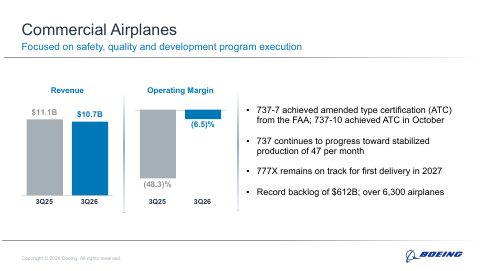
Wing back-shop flow improvements fell short and must prove stable, while Everett and Wichita fuselage output must also ramp before rate 52. — Kelly Ortberg
0:38:07 · Peter Arment, Baird · Spirit and margins
How is the Spirit Wichita ramp going and will commercial margins return to historical levels?
Integration is on plan with safety and quality work slowing Wichita slightly, and 737 margins will not reach 2018 levels while the 787 will exceed them by 2029. — Kelly Ortberg, Jay Malave
0:40:43 · Noah Papanek, Goldman Sachs · Capex and 777X
What is the capital plan for 2028 and 2029, and is the 777X cushion conservative?
Capex is about $5 billion in 2027 and around $4 billion in each of 2028 and 2029, and reserves allow certification to slip to mid-year 2027 within the program estimate. — Kelly Ortberg, Jay Malave
0:44:42 · John Godin, Citi · Long-term outlook
Has the long-term earnings power beyond 2029 changed given the lower near-term cash numbers?
No, it is roughly a one-year shift to the right with the same slope and endpoint, with growth continuing past 2029. — Jay Malave, Kelly Ortberg
0:46:28 · Ron Epstein, Bank of America · Defense growth
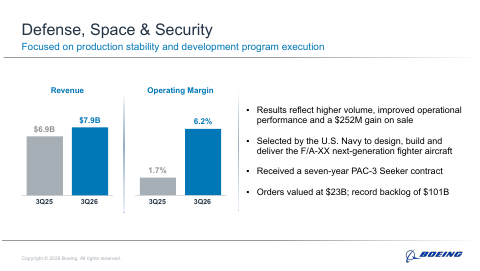
How do the F-47 and F/A-XX wins change growth and margins at Defense, Space & Security?
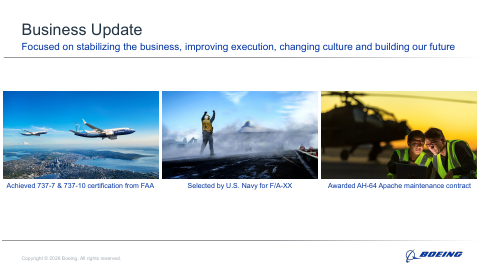
Growth should be mid-single digits or higher instead of low single digits, with better contract types; the F-47 is cost plus and the F/A-XX contract type is undisclosed. — Kelly Ortberg
0:49:55 · Gavin Parsons, UBS · New aircraft
Is there any change on a new single-aisle aircraft and is related spending in the 2029 cash guide?
Nothing has changed, a team is defining the aircraft and market timing, and the needed investment is included in the cash outlook. — Kelly Ortberg, Jay Malave
0:51:15 · Gautam Khanna, TD Cowen · Deferred production
How will deferred production balances move across the three programs through 2029?
The 737 and 787 balances flatten next year then become significant cash sources in 2028 and 2029, while the 777X balance grows. — Jay Malave
0:52:29 · Robert Stallard, Vertical Research Partners · Guidance confidence
What changed to give confidence to issue multi-year free cash flow targets?
Fixed-price development risk is reduced, both next-generation fighters are won and commercial ramps are underway, giving a better handle on risk. — Kelly Ortberg