OpenNashEarnings

AstraZeneca (AZN) · Pharmaceuticals

AstraZeneca Q3 2026 earnings call: transcript, summary & key numbers

Results filed 30 Oct 2026 · Quarter ended 30 Sep 2026 · Call 105 min · Pascal Soriot (CEO), Aradhana Sarin (CFO)

Read the transcriptSlides (46 pages)Press release ↗Investor relations ↗

Summaries and transcripts are machine-generated and can contain errors.

In brief

AstraZeneca is pairing its antibody-drug conjugates with Summit's ivonescimab via a $2bn equity stake, while 12 positive Phase III readouts widen its late-stage pipeline.

Demand is broad across cancer, respiratory and rare disease. Imfinzi, Enhertu, Tezspire and Ultomiris keep widening into earlier treatment settings, and four new medicines won their first approvals, including Etcamah and Baxfendy. The Baxfendy hypertension launch has reached 12,000 new patient starts, mostly in commercial plans. Tagrisso is being extended with Orpathys, and Datroway is gaining ground in breast and lung cancer. Farxiga and Brilinta generic competition is the main drag.

Management is steering toward a 2030 ambition and growth beyond it, backed by more than 20 high-value Phase III readouts in 2027. It is betting on antibody-drug conjugates, IO bispecifics, cell therapy, T-cell engagers and obesity and cardiovascular risk drugs. A new restructuring programme is meant to free money for this pipeline. The tension is that many bets are early, some Phase III trials have failed, and more generic competition and US drug-pricing rules are coming.

Slides & documents

Open the slide deck (PDF, 46 pages) ↗

AstraZeneca Q3 2026 slide deck, page 1AstraZeneca Q3 2026 slide deck, page 2AstraZeneca Q3 2026 slide deck, page 3AstraZeneca Q3 2026 slide deck, page 4AstraZeneca Q3 2026 slide deck, page 5AstraZeneca Q3 2026 slide deck, page 6

Showing the first 6 of 46 pages.

SEC filing

Key numbers

Total Revenue (Q3 2026)
16.2B

up 7% at CER

Reported EPS (Q3 2026, $) · GAAP
2.02

up 23% (26% at CER)

Core EPS (Q3 2026, $) · non-GAAP
2.79

up 17% (19% at CER)

Gross Margin (Q3 2026, %)
82

+1pp at CER

Reported Operating profit (Q3 2026) · GAAP
4.4B

up 22% (26% at CER)

Core Operating profit (Q3 2026) · non-GAAP
5.9B

up 17% (20% at CER)

Segment or metricValueChange
Oncology (Q3 2026)7.8Bup 17% at CER
Cardiovascular, Renal & Metabolism (Q3 2026)2.6Bdown 18% at CER
Respiratory & Immunology (Q3 2026)2.5Bup 11% at CER
Rare Disease (Q3 2026)2.6Bup 10% at CER
Tagrisso (Q3 2026)2.1Bup 12% at CER
Imfinzi (Q3 2026)2.0Bup 26% at CER
Enhertu (Q3 2026)969.0Mup 35% at CER
Tezspire (Q3 2026)429.0Mup 51% at CER
Where each number comes from
  • Total Revenue (Q3 2026): “Total Revenue | 16,209 | 7 | 7 | 16,209 | 7 | 7 | * See Tables 5 and 6 for Total Revenue by Therapy Area and by region”
  • Reported EPS (Q3 2026, $): “EPS ($) | 2.02 | 23 | 26 | 2.79 | 17 | 19 | + See commentary above”
  • Core EPS (Q3 2026, $): “EPS ($) | 2.02 | 23 | 26 | 2.79 | 17 | 19 | + See commentary above”
  • Gross Margin (Q3 2026, %): “Gross Margin (%) | 82 | - | +1pp | 82 | - | +1pp | + Positive product mix effects – Pricing headwinds, including those driven by loss of exclusivity and VBP in China”
  • Reported Operating profit (Q3 2026): “Operating profit | 4,387 | 22 | 26 | 5,855 | 17 | 20 | + See commentary above on Gross Margin, R&D, SG&A”
  • Core Operating profit (Q3 2026): “Operating profit | 4,387 | 22 | 26 | 5,855 | 17 | 20 | + See commentary above on Gross Margin, R&D, SG&A”
  • Oncology (Q3 2026): “Oncology | 21,889 | 47 | 18 | 16 | 7,765 | 48 | 17 | 17 - Cardiovascular, Renal & Metabolism | 8,728 | 19 | (11) | (14)”
  • Cardiovascular, Renal & Metabolism (Q3 2026): “Cardiovascular, Renal & Metabolism | 8,728 | 19 | (11) | (14) | 2,639 | 16 | (18) | (18) - Respiratory & Immunology | 7,268”
  • Respiratory & Immunology (Q3 2026): “Respiratory & Immunology | 7,268 | 16 | 12 | 10 | 2,518 | 16 | 11 | 11 - Infectious Disease | 735 | 2 | (11) | (12)”
  • Rare Disease (Q3 2026): “Rare Disease | 7,544 | 16 | 12 | 11 | 2,633 | 16 | 9 | 10 Other Medicines | 717 | 2 | (6) | (8)”
  • Tagrisso (Q3 2026): “Tagrisso | 5,862 | 13 | 10 | 8 | 2,087 | 13 | 12 | 12 Imfinzi | 5,538 | 12 | 28 | 27 | 1,990 | 12 | 24 | 26”
  • Imfinzi (Q3 2026): “Imfinzi | 5,538 | 12 | 28 | 27 | 1,990 | 12 | 24 | 26 Calquence | 3,009 | 6 | 18 | 16 | 1,065 | 7 | 16 | 16”
  • Enhertu (Q3 2026): “Enhertu | 2,688 | 6 | 36 | 33 | 969 | 6 | 36 | 35 Zoladex | 967 | 2 | 9 | 5 | 336”
  • Tezspire (Q3 2026): “Tezspire | 1,123 | 2 | 46 | 44 | 429 | 3 | 50 | 51 Saphnelo | 615 | 1 | 27 | 27 | 235”

Copied from the press release ↗ and other documents in the SEC filing ↗. A figure is published only if its sentence is in those documents.

Outlook

MetricPeriodOutlook
Core tax rateFY 202618-22%
Core R&D expense as share of Total Revenue2026upper end of the low 20%s range
Reshaping for Sustainable Growth one-time restructuring coststhrough end of 2029$2.0bn

Key takeaways

  1. Summit stake pairs ADCs with ivonescimab

    AstraZeneca completed a $2bn equity investment in Summit Therapeutics and began collaborations combining ivonescimab with sonesitatug vedotin and Datroway. Management expects ADCs to become the backbone of treatment across tumour types and wants the freedom to choose the best next-generation immuno-oncology partner for each setting.

  2. Orpathys combinations extend Tagrisso's franchise

    SAFFRON and SANOVO showed Orpathys plus Tagrisso works in MET-driven EGFR-mutated lung cancer, after progression and in first line. Management says this keeps patients on Tagrisso longer and protects it from newcomers.

  3. Tozorakimab US launch targeted for early 2027

    Phase III COPD data showed exacerbation reductions across eosinophil levels, including 23% in the low-eosinophil group where no biologic is approved. Management plans a US launch in the first quarter of 2027, subject to approval, with Part D coverage hoped for in 2028.

  4. Imfinzi and Enhertu moving into earlier settings

    Imfinzi grew 26% and Enhertu 35% at CER in the quarter, helped by newer indications such as VOLGA in bladder cancer and DESTINY-Breast09 and 05 in breast cancer. Moving earlier in disease is the oncology strategy, and Imfinzi subcutaneous is planned before intravenous Imfinzi loses exclusivity.

  5. Restructuring programme redeploys money into the pipeline

    The Reshaping for Sustainable Growth programme will cost up to $2.0bn and deliver $1.5bn of annual benefits by 2029, which management says will be reinvested mainly in the pipeline. It signals a push to fund cell therapy, bispecifics and obesity programmes without growing the cost base as much.

What management said

Each quote matches the transcript word for word.

“We believe ADCs will become the backbone of treatment across tumor types and this partnership gives flexibility to combine them with the optimal next generation immuno-oncology partner for each setting.”

It explains the logic of the Summit deal and AstraZeneca's ADC-centred oncology strategy.

0:05:40 · Pascal Soriot (CEO)

“We are also progressing our early launch preparations for Tozoracomab and currently anticipate US launch in the first quarter of 2027, subject to regulatory approval.”

It gives the timing of the next major launch in COPD.

0:30:17 · Ruud Dobber (Executive)

“we are progressing in finzi subcutaneous uh with good pace um and we do expect to launch a subcutaneous version prior to coming on or prior to uh loe for infancy”

It shows management is preparing a subcutaneous Imfinzi to hold share before loss of exclusivity as competitors shift to subcutaneous formulations.

0:59:32 · Steve Scala (Cowen)

Analyst Q&A

  1. 0:46:08 · Matthias Agblom, Nordea · Pipeline value

    Is the 2027 peak-year revenue potential spread evenly across the key readouts, and will cancer vaccines be partnered or built in-house?

    Management said no single readout, including AVANZAR, is make-or-break, and that cancer vaccines are being developed internally for now. — Pascal Soriot

  2. 0:49:14 · Simon Becker, Rothschild · Restructuring, B7H4 ADC

    What does the restructuring programme involve, is the $2 billion cash, and how does puxitatug samrotecan differ in the crowded B7H4 space?

    The programme realigns investment across units, such as the clinical trial footprint and cell therapy skills, and the $2 billion is mostly cash. Puxitatug samrotecan has broader B7H4 expression than folate receptor alpha, a stable linker and lower bone-marrow toxicity. — Aradhana Sarin, Susan Galbraith

  3. 0:53:31 · Sachin Jan, Bank of America · R&D, post-2030 growth

    Will R&D growth accelerate next year, and when will management quantify growth beyond 2030?

    The CFO declined to give 2027 guidance before February but flagged continued launch investment and headwinds; the CEO said a post-2030 target is undecided and too early. — Aradhana Sarin, Pascal Soriot

  4. 0:58:58 · Steve Scala, Cowen · Imfinzi SC, China

    Is there a subcutaneous opportunity for Imfinzi, and is China's biopharma push a headwind or tailwind?

    Subcutaneous Imfinzi is progressing and is expected to launch before intravenous loss of exclusivity; China is seen as both tailwind and headwind, hopefully net positive given AstraZeneca's position. — Dave Fredrickson, Pascal Soriot

  5. 1:03:00 · Richard Vosser, JPM · Tagrisso, saruparib

    How should Tagrisso grow from here, and what does the Lynparza first-line ovarian setback mean for saruparib?

    Tagrisso should keep growing through FLAURA2, TROPION-Lung14 and 15 and the Orpathys combinations. Saruparib is a PARP1-selective inhibitor with strong early prostate data and a trial designed to be powered for both HRRm and non-HRRm patients. — Dave Fredrickson, Susan Galbraith

  6. 1:08:37 · Graham Perry, Citi · Pipeline value, Etcamah

    Has internal pipeline value risen or fallen after the failures, and can Etcamah pricing hold in adjuvant breast cancer?

    Management said net pipeline value has gone up despite the two failures, and said Etcamah early-breast-cancer pricing will be decided after CAMBRIA-1 results. — Pascal Soriot, Dave Fredrickson

  7. 1:13:35 · Rajan Sharma, Goldman Sachs · 2027 launches

    How meaningful will Baxfendy, Etcamah and tozorakimab be next year, and what is the margin impact of the launches?

    Baxfendy has 12,000 new patient starts with Part D coverage expected in 2028, and Etcamah is seen as a blockbuster. Launch investment starts 18-24 months early and breakeven often takes several years. — Ruud Dobber, Dave Fredrickson, Marc Dunoyer, Aradhana Sarin

  8. 1:21:10 · Analyst, Morgan Stanley · CAMBRIA-1

    Which patient pool will feed CAMBRIA-1: those previously on CDK4/6 plus aromatase inhibitor, or aromatase inhibitor alone?

    CAMBRIA-1 is a switch design covering the prevalent pool of patients after two to five years of adjuvant therapy, whether or not they had CDK4/6 inhibitors. — Susan Galbraith, Dave Fredrickson

  9. 1:24:07 · Tranguin, RBC · CV combinations

    How are the oral cardiovascular combinations differentiated, and is a GLP-1 plus PCSK9 combination still considered?

    Laroprovstat plus rosuvastatin and elecoglipron plus dapagliflozin each address interrelated disease drivers, and a GLP-1 plus PCSK9 combination is under consideration. — Sharon Barr, Ruud Dobber

  10. 1:28:09 · James Gordon, Barclays · Investment, margins

    Which new technologies need the most investment, and can the cost programme support margin expansion?

    Technologies are at different stages, with cell therapy getting the most spend now. Management will try to protect operating margin but gave no new margin guidance. — Pascal Soriot, Aradhana Sarin

  11. 1:32:26 · Peter Verdult, BNP Paribas · Europe pricing, MFN

    Are European leaders likely to reward innovation better, and how was Baxfendy priced ex-US given MFN?

    Management sees Japan as encouraging and Europe as showing early green shoots; Baxfendy is getting good prices in the Middle East. — Pascal Soriot, Ruud Dobber

  12. 1:36:58 · Simas Fernandez, Guggenheim · Reinvestment, underappreciated areas

    Will restructuring savings be recycled into R&D, and where is AstraZeneca underappreciated?

    Savings will be reinvested and no long-term margin guidance will be given; the CEO cited weight management and cell therapy as areas where AstraZeneca is underappreciated. — Aradhana Sarin, Pascal Soriot

  13. 1:41:49 · Michael Luchten · Restructuring timing

    Why launch the restructuring programme now?

    Management cited Farxiga loss of exclusivity, pricing and launch pressures, trial-footprint changes and AI embedded in processes, and said planning began at the start of the year. — Aradhana Sarin, Pascal Soriot


Questions

What is AstraZeneca's Summit Therapeutics deal about?

AstraZeneca completed a $2bn equity investment in Summit and began collaborations to combine ivonescimab with sonesitatug vedotin and Datroway. It intends to add a broader development programme with other AstraZeneca cancer medicines, including more ADCs.

When will AstraZeneca launch tozorakimab in COPD?

Management anticipates a US launch in the first quarter of 2027, subject to regulatory approval. It expects Part B and commercial access first, with Medicare Part D coverage hoped for in 2028.

How is the Baxfendy launch going?

It is progressing to plan, with 12,000 new patient starts, mostly commercially insured, and a balance of primary care and specialist prescribers. Medicare Part D coverage is anticipated in 2028.

How is AstraZeneca defending Tagrisso?

It is building combinations around it: Orpathys in MET-driven disease (SAFFRON, SANOVO), FLAURA2 in first line, and Datroway combinations in TROPION-Lung14 and 15. Management says this keeps patients on Tagrisso longer.

What is the Reshaping for Sustainable Growth programme?

It is a three-year plan costing up to $2.0bn in one-time restructuring costs that is expected to deliver $1.5bn in annualised pre-tax benefits. The savings are meant to be reinvested mainly in the pipeline, and activities should be essentially complete by the end of 2029.

Transcript

Call recording on YouTube ↗. Official replay ↗. Timestamps jump to the moment.

0:00:00
Joris Ceylon (Investor Relations)

A warm welcome to AstraZeneca's nine-month and third-quarter 2026 presentation conference call and webcast for investors and analysts. I'm Joris Ceylon, Head of Investor Relations, and before I hand over to Pascal and members of our executive team, I would like to cover some housekeeping items. All of the materials presented today are available on our AstraZeneca Investor Relations website. Next slide, please. This slide contains our forward-looking statements, including the safe harbor provisions, which I would encourage you to take the time to read.

0:00:30

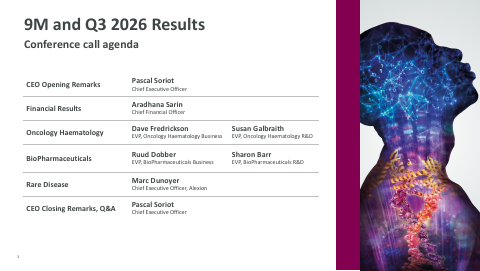
We will be making comments on our performance using constant exchange rates, RCR, poor financial numbers and other non-GAAP measures. A non-GAAP to GAAP reconciliation is contained within the results announcement. All numbers quoted are in millions of US dollars unless stated otherwise. Next slide please. This slide shows our agenda for today's call. Following our prepared remarks we will open the line for questions and as usual we will try to address as many questions as we can during the allocated time.

0:01:00

Although, please limit the number of questions you ask to allow others a fair chance to participate in the Q &A. And with that, please advance to the next slide and Pascal over to you.

0:01:12
Pascal Soriot (CEO)

Thank you, Joris, and welcome everybody. Next slide, please. I'm pleased to report that our strong growth momentum and pipeline delivery have continued through the first nine months of 2026. This reflects the progress we are making across our strategic priorities and above all the focus and the commitment of teams across our company.

0:01:31

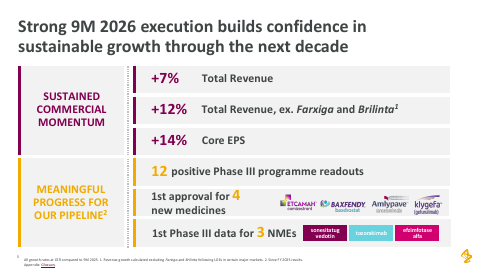
Total revenue grew 7 % and Core EPS increased 14%. Excluding Farxiga and Brilinta, total revenue grew 12%, demonstrating the underlying strengths of our board portfolio. Since our full year results in February, we've announced positive results from 12 phase 3 programs and we've achieved first approvals for four new medicines including at Kama in the US. This brings our total number of approved new molecular entities to 14 as we progress towards our goal of delivering to 20 new medicines by 2030.

0:02:08

We've also presented positive phase 3 data for three new molecular entities to the Racimab in COPD, F-Symphotez Alpha in HPP and and Sony V, our first whole year on the ADC, including 18.2 positive gastric cancer. With commercial momentum continuing and a deep late-stage pipeline advancing, we are increasingly confident in our ability to deliver our 2030 ambition, as well as sustainable long-term growth through the next decade. Next slide, please. Our strong performance is underpinned by the breadth of our therapy areas and our geographical footprint.

0:02:47

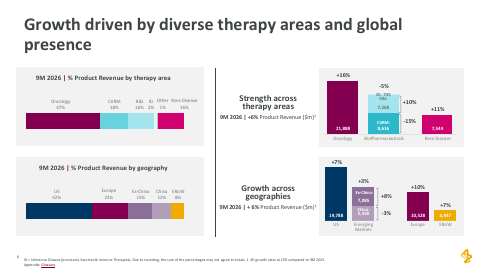
In the first nine months, oncology, rare disease and RNI all delivered double-digit growth. Together, they more than offset the expected headwinds we've seen from the loss of exclusivity of fast CIGAR and Brillanta and CVRM. We've also delivered robust growth across the US, Europe and the emerging markets outside of China. In China, growth continues to be impacted by volume-based procurement. But excluding this impact, China grew 13 % with growth across all therapy areas. Next slide, please.

0:03:23

Over the first nine months of the year, we saw positive results from 12 important phase 3 programs. Let me say a couple of words about some of this. Tozoracimab has enormous potential and we are now developing it beyond COPD. Viltomiris and I again is a blockbuster opportunity. I also want to come back on the Tagrisso franchise. A few years ago, we were told Tagrisso was going to be challenged by the launch of competitor regiments. Look at what we've done.

0:03:52

The combination with Orpatis has the potential to drive both broader first-line use, as well as longer Tagrisso-based treatment duration, keeping patients on Tagrisso rather than switching them off, and therefore protecting the franchise from newcomers. So we have really made tremendous progress with Tagrisso. Volga is another example of building the Imfinzi franchise. And lastly, if Symphotese Alpha and Sony V could both become $3 to $5 billion products, depending on the type of label we get.

0:04:27

So you can see that we have added quite a number of substantial opportunities to our growth potential. Together, this positive readouts represents more than $10 billion in non-risk adjusted PQR sales potential, maintaining the scale of opportunity we outlined at the start of the year. And importantly, with the positive data in hand, much of the risk behind these opportunities has now been removed. This shows the strength and diversification of our pipeline and underpins our confidence in achieving our 80 billion dollar ambition by 2030.

0:05:01

And as I will show you next, the platforms and technologies we are investing in today position us to keep growing while beyond that. Next slide please. This quarter we announced an equity investment in Summit Therapeutics together with clinical collaborations to combine Ivonesimab with Sonivy and Datraway and plans to broaden our collaborations further. Under the terms of the agreement, each company will contribute their respective medicine for the planned combination trials and jointly contribute to trial costs. Ivo is the leading PD-1 VGF by specific, a class we expect to play a role in selected tumor types.

0:05:40

It complements our own IO by specifics, Rilvigostomig and Volrostomig, which we continue to progress at pace. This is an example of how we are maximizing the value of our rapidly growing ADC portfolio. We believe ADCs will become the backbone of treatment across tumor types and this partnership gives flexibility to combine them with the optimal next generation immuno-oncology partner for each setting. This collaboration strengthens the core pillar of our oncology vision, building novel combinations and is of strategic benefit to the companies involved.

0:06:16

We look forward to updating you as this program progresses. Next slide please. Turning now to the longer term, our ambition is to keep growing well past 2030 and that is why we are investing today in the technologies we believe will change how a wide range of diseases are treated in the future. Across five platforms, the first nine months of 2026 have brought significant progress. Starting with weight management and cardiovascular risk factors, we expect the first phase three data for laroprofstat in the first half of 2027.

0:06:50

We now have phase 3 trials ongoing for helicoglipron and we've initiated phase 3 trials for our respective, our selective sorry amylin receptor agonist linbalintide. In ADCs and radio conjugates progress has been strong. Clarity G3C1 delivered an unprecedented overall survival benefit for sunivine second line and later gastric cancer. We expect the first phase 3 data for our second Holy One ADC PUSISAM in the second half of 2027 and we initiated three phase 3 trials for TorvusAM this year.

0:07:28

The summit collaboration I described previously is another way we are maximizing the ADC opportunity. For our next generation immuno-oncology by specifics we now have 15 phase 3 trials across nine tumor types, six of which combine our baspecifics with our EDCs. We expect the first phase 3 readouts for helvigostomic and volostomic in the second half of 2027. Our cell therapy and T-cell engager portfolios are also advancing. We have three ongoing phase 3 trials of SAD0120 in multiple myeloma and two phase 3 trials of serovatomic are progressing in B-cell lymphomas.

0:08:08

Both platforms have been extended into autoimmune diseases with early trials underway, underscoring their broader therapeutic potential. Beyond the sleep programs, we have four further clinical stage cell therapies and four additional T-cell engages in early development, which will help us reach more patients across more disease areas. Together, these programs form a deep late-stage pipeline of multi-blockbuster opportunities that will underpin our next wave of growth. And you can expect a steady flow of news, with more than 20 key phase 3 readouts planned for 2027.

0:08:46

I will say more about this when I close and with that I'll hand over to Aradhana to take you through our financials. Please move to the next slide.

0:08:57
Aradhana Sarin (CFO)

Thank you. Thank you, Pascal, and good morning, good afternoon everyone. As usual, I will start with our reported P &L. Next slide, please. As Pascal highlighted, we delivered continued top-line momentum in the first nine months of the year. Total revenue increased by 7 % with product revenue up 6%.

0:09:17

Alliance revenue increased by 32 % driven by higher profit sales from our partnered medicines in Her2, Datraway, and Tespire in markets where our partners record product sales. Next slide, please. Turning to the core P &L. Core gross margin was 83 % in the first nine months. As we indicated previously, we expect gross margin in the second half to be below the first half, reflecting the seasonal demand profile of lower margin medicines such as Flumest and Befortis.

0:09:52

We also expect to see the usual year-end impact of hospital budget capping and NRDL stock compensation in China in the fourth quarter. For the full year, we continue to expect core gross margins to be stable to slightly higher than in 2025. Core R &D expense increased by 5 % year-to-date, reflecting continued investment in the pipeline. R &D represented 23 % of total revenue in the first nine months, and we continue to expect it to be at the upper end of the low 20s percentage range for the full year.

0:10:26

We're continuing to invest behind the opportunities that drive long-term growth, including bispecifics, cell therapies, and T-cell engators, along with our ongoing investment in weight management and cardiovascular outcome trials. Core SG &A expense increased by 4 % year-to-date. This reflects the investment behind the U .S. launch of Baxfendy, preparations for the anticipated launch of tozerakimab next year and investment behind the launches of the 47 major market regulatory approvals received since the full year results in february overall core operating expenses increased by 5% in the first nine months as in prior years we expect a sequential step up in the fourth quarter versus third quarter in operating expenses other operating income was $618 million for the first

0:11:22

nine months, including $277 million in the third quarter. This includes the sale of Zorbi royalties for $100 million. We expect the other operating income in the second half of the year to be slightly higher than the first half. The core tax rate was 19 % year-to-date, consistent with our full-year expected range of 18 to 22%. percent core eps grew by 14 in the first nine months next slide please turning to cash flow and the balance sheet cash flow from operating activities was 10.9 billion in the first nine months lower than in the comparative period there are two principal factors behind that first the prior year period benefited from the limparza milestone receipt in Q1 2025.

0:12:12

Second, we have experienced working capital effects associated with the U .S. loss of exclusivity for Farsiga. As previously indicated, we expect these working capital effects to persist through the remainder of the year before normalizing. Capital expenditure was $2.3 billion in the period and we now expect full-year capex to increase by low teens percentage age compared to 2025. This is a change from prior indication driven as a result of some project starts now moving into 2027.

0:12:44

Deal related payments total 4.3 billion in the first nine months. This includes the 600 million upfront payment for the Dissalp collaboration which closed during the third quarter and other new deals during the year. Milestone payments relating to prior BD transactions amounted to around $2 billion in the first nine months, and we continue to expect this to be approximately $2.5 billion for the full year. This number does not include the $2 billion Summit equity investment which closed this month.

0:13:18

We expect finance expenses to be higher in the fourth quarter than in the third quarter, as this will include higher interest costs for the bonds issued in the third quarter, as well as lease expenses following the opening of our new Kendall Square R &D Center, where we are today. Fourth quarter finance expenses will also include a one-time expense relating to the premium paid for the Summit Equity Investment. Importantly, we remain comfortable with our current level of gross debt and our current net debt-to-EBITDA ratio is at 1.2 times.

0:13:53

Finally, we are reiterating our full-year guidance. We continue to expect total revenue to increase by a mid to high single digit percentage and core EPS to increase by a low double digit percentage. Today, we're also announcing the Reshaping for Sustainable Growth program, a three-year initiative to redeploy resources and strengthen capabilities across AstraZeneca's existing businesses and therapy areas. This program is expected to incur up to $2 billion in one-time restructuring costs and deliver $1.5 billion in annualized pre-tax run rate benefits.

0:14:32

The savings from this program will continue to be reinvested back into the company essentially in our pipeline. We expect activities to be completed by the end of 2029. So to summarize, we have delivered another strong quarter with continued momentum across our portfolio and new launches. At the same time, we're investing in the pipeline, manufacturing capacity, and BD opportunities that we believe can support sustainable growth through the next decade while maintaining a strong balance sheet. With that, I'll hand over to Dave to take you through the performance of our oncology business.

0:15:09

Next slide, please.

0:15:10
Dave Fredrickson (Executive)

Thank you, Aradhana. Next slide, please oncology total revenues grew 16% in the first nine months to 21.9 $1 billion with an impressive 17 growth in the business in the third quarter during the first nine months we saw double-digit growth across all major regions the us in particular delivered strong year-over-year growth of 18 demonstrating robust demand across our key brands with europe and emerging markets delivering mid-teens growth. Turning now to the quarterly performance of our key medicines, Tigriso delivered revenues of $2.1 billion in the third quarter, surpassing the $2 billion mark for the first time, representing 12 % growth on the prior year.

0:15:56

Demand was broad-based across indications and regions, reinforcing Tigriso's role as the backbone of care for EGFR-mutated lung cancer. We continue to see increasing adoption of combination regimens in the first line, with Flora 2 maintaining its leadership position in all major markets. We anticipate continued growth across all indications through the remainder of the year. This was another exceptional quarter for our I .O. franchise, with Infinzi and Imjudo delivering growth of 26 % and 25 % respectively, with combined revenues exceeding $2 billion for the first time.

0:16:32

As in previous quarters, growth was broad-based, with contributions from established indications and recent launches. Volga, which is currently under priority review in the U .S., will further expand the reach of Infinzi in the increasingly competitive muscle-invasive bladder cancer setting, and continued demand across indications positions us well to sustain this growth through year-end. Calquins is now the leading BTK inhibitor in the first-line CLL across the top eight markets, with total revenues increasing by 16 % to $1.1 billion in the third quarter.

0:17:09

In the U .S., we're seeing an increasing adoption of the fixed-duration Amplify regimen following its launch earlier this year, and uptake is rapidly expanding in major markets ex-U .S. With ongoing global readouts, we expect continued growth across key markets for the remainder of the year. And HER2 revenues grew 35 % in the quarter to $969 million. While performance was broad-based across regions, growth in the U .S. was particularly notable at nearly 50%, driven by demand in the established breast cancer indications, as well as meaningful contributions from Destiny Breast 09 and first-line HER2 positive disease, where nearly 4 in 10 patients are receiving in HER2, and the two early breast indications, Destiny Breast 05 and Destiny Breast

0:17:55

11. In the high-risk post-neoadjuvant setting, and HER2 is already establishing a leadership position with Destiny Breast 05. Strong growth of 40 % in the emerging markets was driven by new launches and expanded access for existing indications. We expect continued growth for an Hurtu through year-end. True cap revenues grew 9 % in the quarter to $210 million. As highlighted previously, the AKT P10 biomarker altered population is fully penetrated in the U .S., with launches in developed and emerging markets driving growth for the brand overall.

0:18:30

U .S. demand growth in the quarter was offset by unfavorable inventory movements resulting from the transition from bottles to blister packs. We're seeing early positive signals from the launch in prostate cancer and are working to establish P10 IHC testing to bring TRU-CAP to patients who may benefit. DATROA revenues reached $78 million in the third quarter. This reflects further uptake in late-line EGFR-mutated lung cancer, with DATROA maintaining a leadership position in the fragmented third-line plus setting.

0:19:02

In breast cancer, we're seeing continued uptake in the hormone receptor positive setting and a strong launch in the recently approved first-line triple negative indication based on the compelling and differentiated results seen in Tropion Breast O2. We are also seeing encouraging early signals for Etcamah following the U .S. launch for Serena 6 in September. These include strong willingness among HCPs to test during the first-line treatment alongside increasing test readiness and testing volumes. Finally, we were pleased to report our first revenues for Zegfrovy in the third quarter.

0:19:38

And earlier this month, we launched this medicine in the United States for patients with previously treated non-small cell lung cancer with an EGFR exon 20 insertion mutation. This launch marks an important step as we bring this oral treatment to a patient population with substantial unmet need while further building on our leadership in EGFR lung cancer. With strong momentum demonstrated across our portfolio in the first nine months, we are well positioned for continued growth through the year end as we deliver innovative oncology medicines to more patients.

0:20:10

With that, please advance to the next slide, and I'll pass over to Susan to cover key R &D highlights from the quarter.

0:20:18
Susan Galbraith (Executive)

Thank you, Dave. It's been an exceptional few months for our oncology pipeline. Across the World Conference on Lung Cancer last month and ESMO just a few days ago, we shared more than 140 abstracts including 38 oral presentations and five of our phase three readouts were presented in presidential symposia across these two congresses these data sets mark significant progress against our strategy to redefine cancer care intervening at earlier stages of the disease transforming outcomes through powerful new combinations and using novel ADCs to replace chemotherapy as the backbone of treatment.

0:20:55

Starting in EGFR mutated lung cancer, we presented two key phase 3 data sets. Firstly, Saffron, which addresses a significant unmet need for the one in three patients with met amplification and or overexpression following progression on TIGRISO. In these patients, adding all pathos to TIGRISO reduced the risk of death by 32 % versus platinum-based chemotherapy, extending median overall survival by nearly five months. Saffron is the first global phase three trial to show both a significant progression-free survival and overall survival benefit in this setting, and it does so with a biomarker-directed all-oral regimen.

0:21:36

Importantly, it also demonstrates the benefit of continuing to Grisso beyond progression in these selected patients, creating a treatment pathway across first and second line that further strengthens Tegresso's leadership. Secondly, Sanovo, which brings Orpathis Plus Tegresso into the first line setting for patients with met overexpression at diagnosis, a selected and well-defined subgroup with poor prognosis. In this trial, the combination extended median progression-free survival to more than two years compared to just over one year with TIGRISO alone, which demonstrates the poor prognosis of this patient population.

0:22:16

We also saw an encouraging 9.6-month improvement in median overall survival, highlighting the value of this combination up front. Together, these trials reinforced TIGRISO as the backbone therapy in EGFR-mutated lung cancer, on top of which we can build combinations, both in biomarker-selected patients as with Opathis and in broader populations as previously demonstrated with Flora 2. We're excited to build on this further with the Tropion Lung 14 and 15 trials which look at combining Datraway with Tigrisso in the first and second line settings.

0:22:52

Also in lung cancer, DESTINY Lung 04 marks the first phase 3 trial to demonstrate improved progression-free survival versus the global first-line standard of care Pembrolizumab plus doublet chemotherapy in HER2 mutant non-small cell lung cancer. Inher2 delivered a median progression-free survival of 14.3 months and an objective response rate of 70%, underscoring the potential of moving Inher2 earlier to the time of metastatic diagnosis when treatment has the greatest opportunity to improve outcomes. Turning now to small cell lung cancer, Delphi 305 evaluated Infimzi plus Imdeltra as first-line maintenance in extensive stage disease following Infimsy-based induction.

0:23:35

And the combination reduced the risk of death by 58 % versus Infimsy alone, with a median overall survival of 21.1 months, the longest ever reported in a phase 3 trial in this setting. Infimsy is the only immunotherapy to demonstrate a significant survival benefit in both limited and extensive stage small cell lung cancer and Delphi 305 reinforces infimacy as the backbone IO across this disease. Next in bladder cancer, vulgar is the first trial of perioperative immunotherapy with amfortamibodotin given only before surgery in patients with muscle invasive bladder cancer who are not candidates for or have declined cisplatin.

0:24:17

This regimen reduced the risk of recurrence, progression or death by 49 % and the risk of death by 42 % with nearly four in five patients alive at two years. Limiting Infortamab-Vidotin to the neoadjuvant setting makes this an optimised cytotoxic sparing regimen. Volga is now under priority review in the United States. Together with Niagara and Potomac, this trial reinforces Enfimsy as the immunotherapy backbone across bladder cancer and as a reminder we see bladder cancer as an overall blockbuster opportunity from PHIMSI.

0:24:53

Finally in gastric cancer Clarity Gastric O1 evaluated SunnyV in patients with previously treated Chlordin 18.2 positive advanced gastric cancer and is the first global phase 3 trial to show an overall survival benefit with a Chlordin 18.2 targeted ADC in this setting. In third-line and later-stage patients, SunnyV reduced the risk of death by 53%, doubling median overall survival from 5 to 10 months. SunnyV also reduced the risk of death by 42 % in the broader second-line-plus population.

0:25:28

Importantly, the benefit was consistent across Claudine 18.2 expression levels down to 25%, a much lower threshold than other Claudine 18.2 targeted therapies, meaning SunnyV could benefit approximately 60 % of patients in this setting. We see significant further potential for SunnyV. We've already initiated Clarity Gastric O2 in the first line setting and are exploring the opportunity for SunnyV in biliratract and pancreatic cancers. As Pascal mentioned earlier, we recently announced an exciting clinical collaboration with Summit Therapeutics to evaluate SunnyV in combination with Ivanesimab, a first-in-class PD-1 VEGF bispecific in gastrointestinal cancers, with trials expected to begin imminently.

0:26:17

Taken together, these data sets demonstrate the depth of our oncology pipeline, and with further readouts to come, we're confident that oncology will continue to drive AstraZeneca's growth through 2030 and well beyond. And with that, please advance to the next slide, and I'll pass over to Roode to cover Biopharmaceuticals' performance.

0:26:38
Ruud Dobber (Executive)

Thanks, Susan. Next slide, please. Our biopharmaceuticals business continues to navigate a period of transition with strong growth from our respiratory immunology portfolio, offsetting much of the anticipated headwind for Vasiga, Berlinta and Roxodustad in CVRM.

0:26:53

Overall biopharmaceuticals total revenue declined by 6 % in the quarter to $5.6 billion. dollars. RNI delivered another strong quarter with total revenue increasing by 11 % to 2.5 $1 billion driven by continued momentum across our key growth medicines. Fasenra grew 14 % to $602 million with particularly strong growth in emerging markets driven by Fasenra's inclusion on the national reimbursement drug list in China earlier this year. The clinical reach of of Fasenra has continued to broaden, with the four major market approvals for hyper-esonophilic syndrome in the second quarter.

0:27:35

Tespaya maintained its impressive momentum, growing 51 % to $429 million, with strong performance across all regions. Growth was driven by the expanded use of biologics in severe asthma and the launch of Tespaya in chronic rhinocitis with nasal polyps. The growing body of evidence supporting Tespaya's differentiated mechanism of action was further strengthened in the quarter by the positive readout from the crossing trial in eosinophilic ocephagitis. Breastry increased 14 % to $374 million, with a particularly strong performance in the emerging markets as growth accelerated in China.

0:28:18

The rest of the opportunity has broadened beyond COPD, with recent approvals in asthma, and that indication has seen rapid uptake in the United States since it launched in July. Safnello also continued its strong trajectory, increasing 32 % to $235 million. Growth was supported by the recent launches of Safnello's subcutaneous formulation in the United States, Europe and Japan. In the next 12 months, we have readouts anticipated for three additional indications. Lupus nephritis, systemic sclerosis, and cutaneous lupus erythematosus.

0:28:58

The strong performances from key respiratory medicines more than offset an 11 % decline for Symbicort, which generated $660 million in the quarter. This reflected a 25 % decline in the United States following the entry of a second generic competitor, while China continued to deliver growth. Turning to CVRM, total revenue declined by 18 % to $2.6 billion, reflected the anticipated loss of exclusivity headwinds. Fasica declined 23 % to $1.6 billion, reflecting loss of exclusivity in the United States and the impact of VBP in China.

0:29:41

demand remains strong in both Europe and established rest of the world both of which grew double digits. The launch of Baxfendy is progressing to plan with revenue of $9 million in the quarter. We are pleased with the uptake so far with a good balance of prescriptions from primary and specialty care and across resistant and uncontrolled patients. For the next few quarters, we expect the majority of Baxfendy's revenue to come from commercial customers as we continue to build access ahead of anticipated Medicare Part D reimbursement in 2028.

0:30:17

We are also progressing our early launch preparations for Tozoracomab and currently anticipate US launch in the first quarter of 2027, subject to regulatory approval. The initial focus will be on commercially insured and Medicare Part B patients, but as COPD tends to affect all the patients, we hope to see the first Medicare Part D reimbursement during the course of 2028. We are encouraged by the sustained growth of our R &I portfolio and the opportunities ahead from new indications and launches.

0:30:51

Finally, we are looking forward to an exciting year for the CVRM portfolio in 2027, with readouts anticipated by three NMEs, Belsidepa, Zibadepa and Lara Profstead, and the first lifecycle management opportunity for Baxfendy in primary aldosterism. I will now hand over to Sharon to take us through the latest developments in the biopharmaceuticals R &D pipeline.

0:31:15
Sharon Barr (Executive)

Thank you, Ruud. Next slide, please. At the European Respiratory Society Congress in September, we presented results from the Phase III Oberon and Titania studies for tozoracumab in COPD.

0:31:27

These data reinforce our confidence in tozoracumab as a $5 billion plus asset. Tozoracumab was studied in the broadest COPD population evaluated for a biologic to date, spanning the full range of eosinophil levels and lung function severity, broader than the population studied for currently approved biologics. We saw clinically meaningful reductions in exacerbations across eosinophil levels. The reduction was 23 % in patients with baseline eosinophil counts below 150 cells per microliter, 34 % in those with counts of 150 or higher, and 43 % in those with counts of 300 or higher.

0:32:08

Importantly, the 23 % reduction was observed in a population for which no biologic is currently approved. Overall, these results demonstrate highly clinically meaningful efficacy across a broad COPD population, with reductions and exacerbations of up to 34 % in former smokers, and up to 30 % in the overall population. In addition to these data for toziracumab, earlier this month at United European Gastroenterology Week, we presented Phase 3 data from the CROSSING trial of TESPIRE in eosinophilic esophagitis.

0:32:44

The prevalence of EOE has increased nearly five-fold since 2009, and nearly half a million patients are affected in the U .S. alone. Despite available first-line therapies and dietary interventions, nearly 50 % of patients continue to experience significant disease burden. This includes difficulty swallowing and a substantial impact on quality of life. Crossing evaluated two doses of Tespire, 210 mg and 420 mg every four weeks, in adults and adolescents with EOE. At week 24, both doses delivered statistically significant and clinically meaningful improvements on the co-primary endpoints of histologic remission, and the frequency and severity of difficulty swallowing.

0:33:30

Importantly, these improvements were sustained through week 52, marking the first time a biologic has demonstrated this durability in a placebo-controlled trial. In key secondary endpoints, TESPIRE also demonstrated statistically significant improvements in endoscopic features of EOE, and approximately a third of patients achieved total endoscopic remission. These data contribute to our belief that TESPIRE has multi-blockbuster potential across multiple indications. Beyond these two important readouts, I would like to highlight several additional advances across our biopharmaceuticals pipeline during the third quarter.

0:34:09

In dyslipidemia, we expect initial phase 3 results for laraprovstat monotherapy in the first half of 2027. We also expect results in 2027 from the first two phase 3 trials of the Dolaraprostat-Risuvastatin fixed-dose combination. These trials include both patients receiving background lipid-lowering therapy and treatment-naive patients. Within weight management, we have now dosed patients in 10 ongoing phase 3 trials with Alecoglipron. We have also dosed the first patients in three phase 3 trials for lenbolintide, formerly known as AZD6234, which is our selective amylin receptor agonist.

0:34:49

These trials are enrolling patients with obesity or overweight, with and without type 2 diabetes, including those receiving other incretin-based therapies. We look forward to sharing the phase 2 results for lenbalintide and AZD9550, our dual GLP-1 glucagon receptor agonist, both as monotherapies and in combination, at an upcoming medical conference. Beyond pipeline progress, earlier this month, we officially opened our newest strategic R &D center in Kendall Square, Massachusetts. This investment strengthens our presence in Greater Boston and places our scientists at the heart of one of the world's leading life sciences ecosystems.

0:35:29

And with that, please proceed to the next slide, and I'll pass over to Mark to cover rare disease.

0:35:38
Marc Dunoyer (Executive)

Thank you, Sharon. Next slide, please. rare disease total revenue grew by 11 % in the first nine months to $7.5 billion, underpinned by double-digit growth across all key medicines. This is driven by increased patient demand and continued global expansion following launches. In the third quarter, Pultomeris revenues were up 19%, driven by growth across indications, including continued momentum in neurology.

0:36:11

Soliris revenues continued to decline due to the successful conversion to Ultomiris, as well as biosimilar pressure. Strengthsick grew 34 % year-on-year, reflecting strong patient demand, continued global launches, and improved access. COSELUGO continues to deliver strong global momentum, supported by expansion in adult patients with NF1PN and the uptake of the granule formulation in recently launched markets. I wanted to highlight the multiple launch opportunities across rare disease. Ultomiris in Aigan recently received accelerated approval in the United States, with filings underway in Japan.

0:37:03

Klygefa, formerly Gefurilimab, is now approved in Japan for generalized Myrstena Gravis, has positive CHMP opinion in the United States and filed in other major markets. Amlypave, formerly Ancelamimab, has also been approved in Japan. And finally, our second generation enzyme replacement therapy, Esfinsvotase Alpha, has been filed across major markets and received priority review in the United States with a PDF-Fa date expected in the first half of 2017. Please advance to the next slide where I will talk more to some of these opportunities and others in the pipeline.

0:37:54

First, for patients with IgA nephropathy, our phase 3 Delta 4 ultomerase demonstrated rapid, complete and sustained terminal complement inhibition, which benefit consistent across patients. Our focus is on patients with higher risk of progression and inflammatory disease, which we estimate is approximately 20 % of IGAN patients. IGAN is important in the continued expansion of our C5 franchise, building on Ultomerase's established leadership across multiple complement-mediated diseases. We are confident this indication would reach blockbuster potential given or establish nephrology presence across AstraZeneca and Alexium.

0:38:47

Separately, we have also announced the discontinuation of ultomerase development in delayed graph function following a lack of consistent efficacy. Moving to Essence Photos Alpha, as highlighted at the ISVMR, we believe the totality of evidence from the Phase III program supports the potential to expand the treatment opportunity in HPP. With less frequent, lower volume dosing, improved tolerability and evidence across a broader range of disease manifestations, we see the potential to reduce treatment burden and support better treatment continuity.

0:39:33

Combined with enhanced manufacturing capabilities and continued global expansion, we believe these attributes can support broader patient reach versus intrinsic. We believe Sphinxotis Alpha has the potential to become the preferred treatment option for patient who's HPP. We expect growth to be driven by both the transition of patients currently receiving Slenzik and the expansion of the treated HPP population. And this underpin or peak year sales expectation of $3 to $5 billion for Encylspotase alpha. CLIRAMITUG represents a significant opportunity to address the residual disease burden in ATTR cardiomyopathy.

0:40:26

Despite currently available therapies, ATTR-CM remains progressive for many patients with ongoing clinical events and functional decline. CLIRAMITUG differentiated dipleter mechanism is designed to remove existing amyloid deposits with our phase 1b data showing positive cardiac premodeling. Importantly, around 90 % of patients in that study were already receiving tafamidis, providing early evidence of activity on top of standard of care. The phase III DEPITER trial builds on this, evaluating CLIRAMITUG on top of background therapy with hard clinical outcomes across all-cause mortality and cardiovascular events.

0:41:22

If successful, we see the potential for CLIRAMITUG to alter the course of disease and become an important complementary treatment in ATTRCM, representing a $3 to $5 billion non-risk-adjusted peak year revenue opportunity. Taken together with an exciting next phase of growth for rare disease, combining continued expansion of our established franchises with multiple new launch opportunities and a pipeline with the potential to reach significantly more patients. And with that, please advance to the next slide, and I will hand back to Pascal.

0:42:05
Pascal Soriot (CEO)

Thank you, Marc. Next slide, please. Before we move to your questions, let me close with why we are so confident about the road ahead. Our pipeline continues to deliver, and the momentum builds further in 2027. It's going to be a very, very rich year. We expect more than 20 high-value trial readouts and pivotal data for nine potential new medicines. If you look at the whole list of readouts on this slide, and of course not everything is going to work, you have a non-risk adjusted PQR revenue, more than $20 billion.

0:42:40

If you look at the right-hand side of this chart, it represents 40 % of that PQR revenue. I'm drawing your attention to this because there's a whole series of small and mid-sized readouts that tend to fall below the radar. But it's important to look at those because the potential of our company and our pipeline should be assessed in aggregate. It takes time to go through all these products and all these indications, but that is the best way to get a good view of the potential growth we have, not only to 2030, but more importantly, through the next decade.

0:43:13

A significant part of this more than 20 billion of PQR revenue should actually become reality over the next few years. Next slide, please. This slide shows that what I see as the foundation of our growth into and through the next decade. Our new molecular entities with pivotal data redarts before 2030. We have 12 programs with PQR revenue potential of more than $5 billion. We have already launched three of these medicines, Datroway, Carmine and Baxfendi. And we've seen positive phase three data for three more if simphotas alpha to the akimab and sony v in addition we have four programs with peak your revenue potential of between three and five billion dollars each which will support our strengths beyond 2030 and

0:44:07

again not everything is going to work but it's important to look at the aggregate progress of the pipeline across so many products and indications we expect our pipeline to more and offset the upcoming losses of exclusivity and to drive sustainable growth through the next decade. Next slide please. So let me bring this together. First, commercial momentum. Our medicines are in strong demand across CRP areas and geographies. The demand is driving growth across the company and more importantly it means more patients are benefiting from our medicines.

0:44:42

We are firmly on to deliver our 2030 ambition. Second, pipeline delivery. We have reported 12 positive phase reprogrammed readouts this year with a collective potential PQR revenue well in excess of $10 billion. And we've had approval for four new medicines. We have a very rich upcoming series of readouts in 2027 with a potential non-risk adjusted PQR revenue of more than $20 billion. dollars. Third, we are investing for the future. By focusing on transformative technologies and by partnering with companies like Summit, we're building the platform that will fuel growth into the next decade and beyond.

0:45:25

And that pipeline is already delivering, with pivotal data expected for nine new medicines next year. Thank you for your time and with that, we are ready for your questions

0:45:38
Joris Ceylon (Investor Relations)

as a reminder as yuri mentioned at the start of the call please try to limit the number of questions you ask to allow others a fair chance to participate please use the raise hand function on zoom and let's move to the first question that first question is from matthias agblom from nordea over to you matthias Matthias, can you hear us?

0:46:08

We don't hear you.

0:46:09
Matthias Agblom (Nordea)

Yes, I can. Yeah, I'm sorry for that. Thanks so much. Matthias, I'm going to be at two questions, please. So firstly, with regards to the slide 24 and the 20 billion, more than 20 billion on risk adjusted peak year revenue potential, and 60 % of that value derived from the six key events to the left on that slide, is it fair to distribute the peak revenue broadly average across the six key readout?

0:46:30

or is it rather so that perhaps some of Ansar carry an unproportional component of those 12 billion peak year revenue? And then secondly, regarding the comment on the ESMO call earlier this week that AstraZeneca would have appetite for personalized cancer vaccines, should we think of that as an area likely to include partnering or may it be so just like for ADCs that AstraZeneca has built in-house know-how and capacity? Thanks so much.

0:46:59
Pascal Soriot (CEO)

so thank you thank you very much for these two questions Matthias if I understand well the first one if your point was is that whole way representing a disproportionate portion of the total cells the answer is no that whole that's always an important product but I'm

0:47:17

trying to go back to set 24 yes to be sure I've got the right way yeah so that whole way as you can see it here is represented as 5 billion dollar plus opportunity across a variety of indications and avanza of course is a very important one but if you look at the rest i mean the lauroprostate is going to be big we have also the fixed dose combinations that come as our pipe so i that's always going to play an important role but but but it's uh it's it's not the one that is going to be a make or break.

0:47:51

We have a risk adjusted approach in our forecast and when we say that we can grow through 2030 and beyond and as I've said before our risk adjustment across the totality of the portfolio is about 60% so it's not very ambitious. We've done much better than that in the past so that's what also gives me confidence and then the other thing I said just to repeat is on the right hand side of this slide 24 40 percent of the two of the 20 billions are in these indications on the right hand side and and again you see that what that whole way there again in trump and in tropion language 7 or tropion length 15 but there's many more

0:48:34

indications um so i guess that's answers your question and to say that's always an important product but it's not the only one the second question is cancer vaccines we are for now looking at doing it uh internally we've got a infectious disease group that has worked over the last few years the last couple of years in particular on on the variety of technologies that we believe can give us a way forward but uh in this uh vaccine cancer vaccine space but But, you know, I'll leave it at that for today and you'll hear more about it in the next few months or years.

0:49:14
Joris Ceylon (Investor Relations)

The next question is from Simon Becker from Rothschild. Over to you, Simon.

0:49:19
Simon Becker (Rothschild)

Thank you, Pascal, for taking the question. Two quick ones, if I may, please. Firstly, one for probably for Aradhana. I wonder if you could give us a little bit more colour on the reshaping for growth strategy. I would assume that this is a transfer of OPEX from SG &A to R &D, but any colour you can give us there would be great. And also, is the 2 billion a cash cost or is it a mix of cash and non-cash?

0:49:47

And then a question for Susan on PuxiSAM. I wonder, B7H4 space is fairly crowded. I wonder if you could call out the points of differentiation that you would like to highlight on PuxiSAM versus some of the other competitive molecules in the space. Thanks so much.

0:50:06
Pascal Soriot (CEO)

Now, do you want to start?

0:50:08
Aradhana Sarin (CFO)

Sure. Thank you, Simon. So I'll give you a few examples in terms of what this program actually involves. First of all, it's not targeted to like one therapy area or one unit or one specific geography.

0:50:23

is really looking at across our units, where all we have opportunity to align our investments and employees, et cetera, to make sure we're creating room for future opportunities and future growth. So a good example would be, for example, clinical trial footprint. We run global clinical trials. And as you know, where the opportunities are for clinical trials, with sites, new sites are emerging in places like the Middle East, et cetera, reimbursements changing in different geographies. So we want to align our clinical trial footprint to where the future is similar, for example, cell therapy, which is an area we're investing in.

0:51:14

and that requires different skills and different investments. We're making technology investments in improving our process development. So those are the types of things that, you know, again, there's not one major thing. There's many different smaller initiatives. The 2 billion is more a cash cost. The benefits are, you know, again, it's a three and a half year program. So it's not sort of a one-time thing. The cost will come over this longer-term period, as will the benefits.

0:51:53

And the intention is, again, as I mentioned, to create room to continue to invest in new products and where the future growth will be. Susan?

0:52:03
Susan Galbraith (Executive)

Yeah, sure. So thanks for the question about PuxiSan. Just as a reminder, B7H4 is a transmembrane protein that's expressed highly in a number of solid tumors, including endometrial breast and ovarian cancer. And with PuxiSum, we have the first B7H4 ADC to enter a phase three registrational intent study, which is the Blue Star Endometrial O1.

0:52:27

We have FDA breakthrough therapy designation, which was granted based on the results that we've already seen and granted in the first half of this year. And we've seen efficacy, particularly in the prior IO patients, with a 60 % response rate and really good durability of response, which represents the Blue Star endometrial O1 patient population. And recognize that, you know, coming off ESMO, there were a number of other ADCs also targeting endometrial cancer. But B7H4 expression in endometrial is broader than, for example, folate receptor alpha.

0:53:00

alpha. And we're confident about the link of payload that we've got with PuxiSAM. We've got something that has very stable link of performance, and that leads to a lower rate of bone marrow toxicity than some of the other drugs that you see out there. That's going to be really important in the combinations, which is what we're building behind. So you'll see the opportunity for multiple combinations coming through with different mechanisms of action that will help build the potential brand value for PaxiSouth.

0:53:31

Thanks for the question.

0:53:33
Joris Ceylon (Investor Relations)

Thank you both. So the next question is from Sachin Jan and Bank of America. Over to you, Sachin.

0:53:39
Sachin Jan (Bank of America)

Thanks for my questions. Two, please. One short term and then one midterm. So the short term question I get for Radner, R &D growth year to date sort of 5%, which is also what consensus assumes for 27. A lot of what we've heard today is a lot of new phase three starts. So very simply thinking do we think about R &D growth accelerating next year and how that impacts the extent of margin expansion which currently stands at about 100 basis points in consensus.

0:54:07

The second one is to touch on Pascal's sort of mid-term post-2030 commitment to growth. So when do you think you'll be in a position or willing to quantify that? I guess my question is can you achieve that growth post 2030 based on what you already know today and if the 27 pipeline pays out as you hope for what kind of growth could you envisage thank you very much

0:54:31
Pascal Soriot (CEO)

that's a interesting question Sachin thank you so much the first one I think Arna maybe you want to answer just a clarification what you've heard from us today is a lot of readouts in 2027 we will also start new phase 3 but we have a lot of phase three readouts

0:54:49

that carry a lot of potential PQR revenue. But over to you, Arana.

0:54:55
Aradhana Sarin (CFO)

Sure. So, Sachin, I think your question was R &D specific. And R &D always sort of ebbs and flows because in one year, there will be studies starting and there will be readouts and so forth. But maybe if I can take this opportunity, and I'm sure others have this on their mind, So how we look at the year ahead. First of all, we still have one quarter remaining in this year.

0:55:25

So still need to get through that. Also, as all of you know, this is the time in the year when we go through our planning process, etc. So we're right in the middle of that. So we can't really give guidance. As you know, we'll give that in early next year. but you know if i look forward to next year there is you know the continued momentum that you've seen in the results today in all the growth brands um there were a number of lcms uh that were uh data was presented on that at esmo so you know that momentum i expect to continue into next year we also have a bunch of new launches you know we're really looking forward

0:56:08

to tozo launching back 20s in the market, at Camma, across many markets, Datto, and all of those will require continued investment because they're early in their launch cycle. There are also some headwinds, again, nothing surprising, things that you all are already aware of, generic competition in some markets and for SIGA, Simbacort, Rood covered, Calcon goes into IRA in 2027. Again, all the things that you're all very well aware of. We'll continue to invest in R &D and focus remains on executing and building the pipeline.

0:56:46

And we will share our guidance when we get to February of next year.

0:56:51
Pascal Soriot (CEO)

Thank you, Anna. So Sachin, your second question, the answer is really we haven't decided whether whether and when if we did it we would actually give a new number something we've sort of discussed but we haven't really landed and i think it's a little bit too early to be honest the and i'll explain why in a second the reason why we are confident of going past 2030 is is the strength of the pipeline we have in our hands so in our long range plan what we do is we forecast each of these products and indications at least those that we have a phase 3 plan for

0:57:32

and then we risk adjust and of course we include expected price pressures including mfn and we risk adjust all these projects and when we risk adjust this forecast we use as a cell roughly i mean each project has a different probability of success of course but the sort of average across the pipeline is about 60% so you can see it's not incredibly optimistic it's relatively conservative so of course we can be you know very unlucky and deliver less than 60% but we could also deliver more than 60% which is what we have done in the last few years but based on this average probability and the forecast we have we see ourselves grow through the post 2030

0:58:18

period now in terms of communicating more around this and quantifying it i think we need a little bit more time and probably go through next year and the readouts get more data on some of these critical technologies we're progressing like AZD0120 and cell therapy, the TCE and others. And then maybe at some point, we might be able to give a new sort of a target that we give ourselves, but no commitment here. And suddenly from a timing viewpoint, I could not tell you when we would be able to do that if we were to do it.

0:58:58
Joris Ceylon (Investor Relations)

Steve Scala at Cohen, over to you, Steve.

0:59:01
Steve Scala (Cowen)

Oh, thank you so much. Two questions. First, regarding Infinzi SubQ, Competitors have been quite successful in shifting business to the sub-Q formulations. Does AstraZeneca now see similar opportunity? And if so, is there time to execute the switch before the LOE of Infinzi IV? The second question is on China. So China recently laid out several ambitious goals for its domestic biopharma industry through 2030. Should they deliver on those goals?

0:59:32

would that be a headwind tailwind or a neutral for astrazeneca thank you

0:59:37
Pascal Soriot (CEO)

that's great so dave maybe you want to take the first one and uh you could take the second one the china one

0:59:46
Dave Fredrickson (Executive)

thanks steve for the question we are progressing in finzi subcutaneous uh with good pace um and we do expect to launch a subcutaneous version prior to coming on or prior to uh loe for infancy and as we move into more and more earlier settings, which you're seeing with the continued progress that we make, we think that that's going to be particularly valuable to have that subcutaneous version as an offering for HCPs in their patients.

1:00:19
Executive

So thanks for the question on the China. Let me frame it in two different parts. First, As you saw in our results, we have another strong quarter in China, and we see the strong underlying growth of our business in China. And if you exclude for the impact of the VBP for SIGA, Roxadustat, and Limparsa this year, the growth is at the level of the strong 15%. That definitely shows the strength of our current portfolio. But equally, we had a number of the positive regulatory news, and we expect new inclusions in NRDL next year, specifically for the few eligible drugs, new drugs like Datrave or Despire.

1:01:05

So we do believe that we have the both portfolio and pipeline coming in China that will continue to fuel our growth in China. When it comes to the overall policies, we see many of the positives there, specifically when it comes to the better IP protection and strong regulatory data protection for the innovation. And overall, new 15-5 -year plan that recognizes healthcare and innovation as a pillar industry and puts a lot of emphasis on the importance of the innovation in the biomedicines in China.

1:01:42

Of course, that also comes with a strong competitive pressure. And as you know, we see more and more local Chinese companies that are strong competitors in some parts of our portfolio, specifically in oncology. So I would argue that in our forecasting plans, we have both. So I would be hopeful that the overall impact would be neutral and will actually prove that our plans and optimism for the China forecast is in the right space.

1:02:17
Pascal Soriot (CEO)

And from a global viewpoint, Steve, I would say it's both a tailwind and a headwind, of course, because these companies are very competitive.

1:02:28

But I think it's overall more of a tailwind than a headwind for the companies that will be able to collaborate with chinese companies but also learn to compete with them and that's why we believe our position in china helps us do both of those both collaborate and compete learn to compete with them in terms of the speed at which they move etc and we've learned a lot and we have adjusted the way we operate not only in china but also globally based on what we learned watching how they operate.

1:03:00

But so I think overall, suddenly both tailwind and headwind for industry and suddenly hope that for us it's more tailwind because of our position in China and the way we are able to leverage our strengths there for China but also globally in terms of collaborations.

1:03:18
Joris Ceylon (Investor Relations)

Next question is Richard Vosser at JPM. Over to you, Richard.

1:03:23
Richard Vosser (JPM)

Thanks. Sorry, excuse me. Thanks, Pascal. Well, maybe a question on to Grisso development from here, please. I mean, obviously strong performance in the quarter, but just how we should think about the performance going forward, potential from the uplift from Saffron and Zenovo that was called out today and Edesmo, and actually thinking further beyond that, just what could the combinations with Datraway, TLO15, bring to

1:03:49

that franchise as well? And then a second question, just on the read from Limpasa to Saraprib, So we saw you today maybe not to proceed forward in first-line ovarian with Limpasa, given the regulator issues between BRCA mutated and the HRD positive setting. So just what's your thoughts on Cereparib as we think about the readout next year in both the HRRM patients and the non-HRM patients? Just thoughts on Cereparib next year. Thanks.

1:04:21
Pascal Soriot (CEO)

So maybe the first question, Dave, you could take, and then Suzanne, the second one.

1:04:28
Dave Fredrickson (Executive)

Yeah, absolutely. So thanks for the question. So Tigrisso with 8 % sequential growth, I think, is performing very well. And that strength is really coming on the back of a lot of good work that we're doing! to establish FLORA2 as the preferred regimen in frontline for patients with EGFR mutated disease. Now, what's really important on this and gets to your point, what we saw and I think is so key from Saffron is in addition to opening up an opportunity for combinations in the second line for the 34 % of patients who have met driven disease, we also now have the ability to be able to demonstrate and promote to starting with Tigrisso and staying with Tigrisso.

1:05:15

And this is something that really paves the way for what you asked about, Tropion 1-15. We also have an opportunity with Tropion 1-14 to be able to establish the DATUA combination in the frontline. And so as you begin to imagine kind of how the mindset becomes, we start with either Flora, Flora 2, or Tropion 1-14 in a frontline setting, there's an opportunity to then move to a Tigrisso-containing regimen post-progression on one of those, whether it is with Saffron or whether it's with Tropion Monk 15.

1:05:47

So all of this creates an opportunity for the Tigrisso franchise to continue growing in a meaningful way on its way towards, you know, well on its way towards the LOE time that it has. I'd also like to note that the acquisition of Zegfrovy gives us an opportunity to expand, not just within the EGFR portion, that's the exon 19, but also with the exon 20 insertions. And we think that this gives us an even stronger position within this important space.

1:06:20
Susan Galbraith (Executive)

Okay, so thanks, Richard, for the question about seroparib. Just as a reminder, seroparib is a highly selective PARP1-only inhibitor, as opposed to limparza, which inhibits both PARP1 and PARP2. So what that means is that you can get a much harder hit on PARP1 than you can achieve with limparza. And that's translated into an improvement in the efficacy that we have seen. And we published some data at the ASCO GU conference earlier this year in February.

1:06:53

And for example, in the castrate sensitive patient population, we are seeing really good activities. We published data in the Bertrana study as well in the castrate resistant setting, wherein both HRRM and non-HRM, and we see a PSA response rate in the 70 % range for both groups of patients. And if you just look at actual rhesus-based responses, we had 100 % response rate in the HRM patient population and an 85 % response rate in the non-inchillerm.

1:07:29

So we do see activity as we did with Olaparib in both the HRM and non-HRM. So just as a reminder of the Evapar Prostate-01 study, this is now in an earlier line setting than Propel. So it's in the metastatic castrate sensitive patient population, a setting where 50 % of patients progress within five years and 40 % die within five years. So this is still a higher met need. What we've done is we've taken the learnings from the Propel study.

1:07:59

So, you know, although we only received a BRCA mutant label in the US for Propel, we have got a broad label in Europe and it was successful in the overall patient population. And we did get a good hazard ratio for RPFS, including in the non-HRM population. So given the improved efficacy that we see with seroparib, including those data that I quoted from Bacchana, and the design of the study, which we're taking in a powered element for both the HRM and non-HRM as well as BRCA, which is one of the learnings that we took from the POPEL study, I think we've got a good opportunity in this setting to really improve the standard of care in the castrate-sensitive

1:08:37

patient population thank you susan next question is from gram perry at city over to gram

1:08:43
Graham Perry (Citi)

thanks taking questions um so on pascal slide seven um you flagged the 12 positive phase three readouts here to date i think the market's arguably focused more on two failures of wino and serena four so um on your internal estimates if you were actually looking at the risk adjusted MPV of those readouts that you were expecting as you went through the course of the year.

1:09:08

Is your projection now that internally you think the value of those has gone up rather than down on aggregate through the course of the year? Just talking to your point on thinking about the aggregate numbers. And then secondly on EPCOMR pricing there looks in line with the approved um oral serds um obviously both um serena six and uh second line have a shorter pfs and smaller patient populations than in earlier lines so in the event that you wish to see a positive readout on cambria one next year is that level of pricing something you think would be sustainable for the large adjuvant population uh with treatment for five years plus thank you

1:09:50
Pascal Soriot (CEO)

thanks graham so maybe we start with the

1:09:53

second question, Suzanne, so we have the time to load the slides so everybody can actually see it. Suzanne, do you want to call on? For the pricing of that, come on.

1:10:04
Dave Fredrickson (Executive)

Why don't I start first on the EdCama pricing question. So within that, I mean, first and foremost, what I'd like to just point out and use the opportunity, I think that the Serena 6 enthusiasm Enthusiasm is high across the globe. We've got over 30 markets with approvals.

1:10:21

We are seeing good enthusiasm from clinicians just off the back of ESMO. We had an opportunity to meet with a number of clinicians across the globe who are already incorporating ESR1 mutation testing into their regular practice. There's work that we're going to have to do on education, of course, but the demand increase that we're seeing in interest in ordering new lab results for ESR1 is certainly going in the right way. So that's really great. I would also say that we're seeing on pricing in general, some really encouraging movement in terms of setting a good value for medicine price in countries like the Middle East, but also most importantly within Japan.

1:11:08

And I think that that sets a good benchmark against which to think about that value for innovation and what we're seeing. We will approach early breast cancer when we see those results from Cambria 1. And obviously, also within that context, in some regards, we'll see other agents establish the early breast cancer price with some of the upcoming approvals that are going to be coming. And so we'll advise on that when we get to that point. Thank you, Dave.

1:11:38

So we've got the slide that I really can look at on Sir Graham's question. and there's no there's no doubt actually graham that if if we look at it in uh in net npv if you want we've uh we we've gone more we've we've gone up um net net of the two uh failed studies uh winua and also sarana four and let me tell you why first of all So it's important to remember, Winua is a shared product.

1:12:13

So we didn't own 100 % of the profitability coming out of it. The second is, of course, Serena 4 was a large opportunity, but some of that opportunity is replaced by Serena 6. And so the last point I will make, and if you look at many of these products, Toro Zorakima, I can tell you now because the product is positive, but our probability of success i think was 20 or 25% in our risk adjusted forecast and now it's of course 100 it's a big product and if you look at say epsimphotel is also a large product and many of the others are blockbuster opportunities like eigen is uh and and a number of others delphi is a big one

1:12:57

clarity of course we've just shown you a number so if you look at all of this and And I have to be careful because they're not yet approved, of course. Not all of those, I mean, many of those are in the approval process, but there's a good chance they get approved. The data for each of those is very strong. So if you assume they are approved, definitely the net NPV has gone up versus our risk-adjusted earlier forecast, even, you know, removing basically Renewa and Serena 4, but adding all those readouts you see here on the slide.

1:13:35
Joris Ceylon (Investor Relations)

The next question is from Raja Sharma at Goldman Sachs.

1:13:38
Rajan Sharma (Goldman Sachs)

Hi, thanks for taking my question. Just on some of the new or imminent launches that you kind of talked about there, you've obviously got Dax Fendi and Ektama this year and Tazarakma potentially next year if it's approved. Could you just maybe talk about how meaningful they will be from a revenue perspective next year in terms of drivers of growth and then for radna those are all sort of indications or areas where you have existing commercial infrastructure so how should we just think about the contribution to margins from those products both next year and beyond

1:14:12
Pascal Soriot (CEO)

thank you thank you thank you rajan so maybe road you can cover some of this

1:14:18

just as a reminder you know when we launch in the us of course you have to get access but I'm sure Woody is going to cover this in detail. So you have like Sandy, you have maybe Tozo you want to talk about and other things.

1:14:32
Ruud Dobber (Executive)

Yeah absolutely. So let's give a little bit of flavor. We have just started the launch in the United States at the first full quarter and the way I would describe it, it's quite an encouraging start.

1:14:43

We have already been able to to deliver 12,000 new patient starts. As expected most of those patient starts are in the commercial book of business because we don't have any coverage yet in part d and that will take some some time it's not unusual we have submitted our bids for part d to all the plans and hopefully we will see the coverage in 2028 coming through with bridging programs in place and what is very let's say pleasing to see is that both primary care physicians as well as specialists have started to prescribe bex fendi and likewise there's a very healthy split between patients for resistant hypertension as well as for uncontrolled hypertension so early days for sure we are

1:15:31

hoping to see more commercial access as we go on in the course of of 2028 and then full coverage if possible in in 2020 2027 for commercial and 2028 for Part D. Now likewise for for Tozo the situation there is slightly different because likewise we need to have Part D access as well for Tozo because the COPD patients are highly skewed to Part D but we will launch two formulations one the pre-filled syringe and that will give us access in Part B in the United States as well as the auto injection and that will give us access in Part D.

1:16:17

So it's a bit more of a mixed one. Clearly we are excited about the TOZO. Pascal already mentioned that. I think the data is very strong and there's a very clear mathematical need. So we will put our best efforts behind that launch as well as we go. But let's first see whether the regulators are going to give us the approval in the first half of 2027.

1:16:45
Pascal Soriot (CEO)

Thanks, Will. Do you want to comment on that? Do you want to comment on that?

1:16:54
Dave Fredrickson (Executive)

I think maybe I'll take a step back and just add to this. I think that if we take a look at the growth drivers for next year, definitely at Kama and Serena 6 is something that globally we see Rajan as a blockbuster opportunity. opportunity and i think that becomes also something that has continued growth behind it with serena 4 not being part of something that would cannibalize serena 6. remember serena 6 is the only uh study in a frontline advanced population and so it's really an opportunity for us to differentiate there i'd add to that that sunny v delphi 305 uh what we see with vulga together with the infinzi indications back to what pascal was speaking about earlier each

1:17:37

of those as blockbuster opportunities so we've got several really exciting growth drivers from just the catalysts that have read out that gave us opportunity for growth in the year ahead

1:17:50
Pascal Soriot (CEO)

since we covered the whole pipeline maybe we can also ask mark from a navigation viewpoint what are the major growth drivers for 2027

1:18:00
Marc Dunoyer (Executive)

yeah so we have uh the launch of Klygefa in the third generation C5 inhibitor. This will be in Viacena Gradis. I think this is going to be a new option for patient in the most dynamic part of the segment with an auto-injector on a weekly subcut with a low volume.

1:18:22

So I think we are quite happy to have another option apart from our infusion injectable soliris and eutomeris. We have also, you have heard that we have recently obtained the approval for eutomeris in IGAN. This is obviously a very interesting field where many new mechanisms are getting approved these days. We have good data on protein reduction and we do believe that the complement inhibition has plays an important role in many patients of IGAN. We have other, I mentioned in my prepared remark, we have other products being prepared for launch, but we're also very excited by the progress we are making in the development.

1:19:19

We do not know the results, obviously, for Cliramitug, and, you know, we believe... 27 growth. 27 was so this will not be for 27 years

1:19:29
Aradhana Sarin (CFO)

so maybe just to add uh i think your second question was around you know how how does it fit in terms of the cost and and the launch cost etc so i won't go into into every product but um few sort of uh you know big picture uh themes to think about first of all we start investing uh in in in front of every launch right and depending on what that launch is, we may start somewhere between 18 to 24 months in terms of whether it's market shaping activity, non-branded promotion, payer market research.

1:20:08

So there's a whole bunch of activities that are going on before an actual launch. When we actually launch, when a product breaks even on an annual basis depends on a number of different things. It may depend on, you know, in the biopharma space, you know, that can take, you know, for example, on average, you know, four plus years, first couple of years is really getting the access at the right place. And, you know, that's when your investment after that, you know, in year three, four starts breaking even.

1:20:39

In oncology and rare diseases, it may be sooner, you know, in a couple of years, but that's sort of the type of investment. There are obviously, you know, places where we have existing sales forces. For example, in Etcamah, we're already in the breast cancer space. For Tozo, we're already in that space, but it does require building that even further. Then there are also new areas we're entering in. So eosinophilic esophagitis, we don't have a presence in that space.

1:21:10

So that's where we need to build. So again, it's very dependent on those dynamics we obviously try to leverage where where we have the capabilities but it does require investment and it does require you know a few years before it breaks even

1:21:25
Joris Ceylon (Investor Relations)

thank you and now the next question is uh coming from uh thibault buttherin at morgan stanley over to you thibault

1:21:32
Analyst

yes thank you very much uh just a couple of pipeline question um the first one is on the Cumbria 1 opportunity.

1:21:41

So I understand it, it's in the setting for patients who already completed a cycle of adjuvant therapy on the CDK4-6 plus AI combo or AI alone for the patient not eligible to CDK4-6. Just see if you could give us an idea of what's the biggest pool of patients if it's coming from CDK4-6 combo plus AI or if it's the AI mono in terms of funeral coming into Cumbria 1 opportunity. And the reason I asked for this is because obviously a competitor is trying to address the AI mono.

1:22:14

So how does that impact the funnel of patients going into Cambria 1? So I'll just stop there. Thank you.

1:22:22
Pascal Soriot (CEO)

I want to start just first with making sure that we're clear on the design.

1:22:27
Susan Galbraith (Executive)

Yeah, so thanks for the question. So Cambria 1 is looking at camryzestrin in the extended adjuvant setting in patients with intermediate to high risk hormone receptor positive and HER2 negative breast cancer. So it's a switch design and it takes patients who've had already two to five years of adjuvant endocrine therapy with or without CDK4-6 inhibitor who obviously then need to remain free of invasive disease and are planning five further years of adjuvant endocrine therapy and then it randomizes them one-to-one to continuing their

1:23:00

current standard endocrine therapy and AI automoxifen and versus camisestrin 75 milligrams so that's that's the design of the study with the primary endpoint of invasive breast cancer-free survival and then perhaps Dave do you want to talk about the size of the opportunity?

1:23:17
Dave Fredrickson (Executive)

Yeah absolutely I think the important point to note on this is that Cambria 1 allows for us first and foremost to address the prevalent pool of patients and so So this is why it's such an important part of the strategy.

1:23:32

Cambria 2 is for the incident population pool. But I think that if we take a look then at Cambria 1, it allows, if the study's positive and if we get it approved, to be able to come in and make an offer to patients an option for patients they'll have today either being treated with an AI or an AI CDK4-6. On your question about what patients we expect to flow into this, I think in many respects this study anticipates and is protected against multiple futures because it includes prior adjuvant CDK4-6 patients.

1:24:07

If we see that grow, those are patients that would be eligible in the study. Or if monotherapy without the CDK4-6 is what we see prior, that as well is something that would be eligible within Cambria 1.

1:24:23
Joris Ceylon (Investor Relations)

Thank you, Dave. The next question is from Tranguin at RBC. Over to you. Frank, can you hear me?

1:24:32
Analyst

Yeah, sorry. I'm just taking mute off. Thanks for taking my questions. Just on your oral CV combinations. In the presentation, you highlighted the PCSK9 Crestor combination with phase two data expected in the first half next year.

1:24:49

Then we noticed in the appendix a GLP-1 DAPA combination as well. Just thinking about how you're thinking about the differentiation of these assets and their subsequent positioning. And we also didn't see a GLP-1 PCSK-9 combination listed. Is that still under consideration?

1:25:04
Pascal Soriot (CEO)

Thank you. Thank you. Sean, do you want to cover this? And maybe I would if you want to jump in on that.

1:25:12
Sharon Barr (Executive)

Sure. So I think you asked us three questions. The first was about the PCSK-9 and the combinations.

1:25:18

The second was about DAPA combinations, and the third was about olecoglipron plus PCSK9. So I'll try to break those down. Your first question was about laraprostat. That's our oral PCSK9, which we think is a very differentiated molecule. And you have noted that we're moving forward with multiple studies for that molecule in phase three as monotherapy and also in combination. The combination makes a lot of sense there. In our monotherapy studies, we're allowing patients to add this on top of background statins because we know that standard of care.

1:25:52

But that's a really important mechanistic interaction. And the mechanistic interaction is a theme for our fixed-dose combinations. What PCSK9 does is let the LDL receptors keep recycling. And that effect is additive to statins. And so it's a clear rationale to be able to combine those two things together. And therefore, it makes sense to build a fixed-dose combination with rosubastatin. Your second question was about combining dapogliflozin and our oral GLP-1, olecoglipron. So you can imagine why that makes sense.

1:26:28

When we think about patients that were living with complex interrelated cardiovascular, renal, and metabolic disease, they are dealing with multiple disease drivers. And by combining SGLT2, which is standard of care in diseases like heart failure, kidney failure, and type 2 diabetes. You're also dealing with patients who have interrelated disease that is driven by excess weight or obesity, which is effectively addressed by a GLP-1 receptor agonist. Only AstraZeneca has the portfolio that allows us to combine a small molecule GLP-1 receptor agonist together with an SGLT2 inhibitor.

1:27:06

So it is both logical for these patients to be able to address multiple disease drivers. And it's also a key feature in simplifying their patient care and making sure that they are not just maximizing the therapeutic window of each of these molecules, but deriving the at least additive benefit of these two put together. And then your third question was about why would we not combine our PCSK9 together with olecoglipron, and we have signaled that we are interested in that potential combination as one of the many combinations that we can partner with our oral GLP-1.

1:27:42

As you know, dyslipidemia is frequently a comorbidity of patients who are living with excess weight or obesity, and so that is a logical next step for us as we explore how we maximize the potential for olecoglipron. We've already demonstrated the positive phase 2 data and moved into an expansive phase 3 program for Alecoglipron as a monotherapy, and we are exploring fixed-dose combination opportunities for that molecule, as you mentioned.

1:28:06
Pascal Soriot (CEO)

Thank you, Sharon. Ruud, do you want to add?

1:28:09
Ruud Dobber (Executive)

No, the only piece, if I take it one step higher, is that our strategy is to address the comorbidities of the patients. Weight management, overweight is only one dimension of our strategy. I think as Sharon said we have a unique opportunity with our portfolio to combine and to address multiple morbidities at the same time I think that's a unique feature of our strategy

1:28:35
Joris Ceylon (Investor Relations)

thank you the next question is from James Gordon at Barclays over to you James

1:28:41
James Gordon (Barclays)

hello James Gordon from Barclays thanks for taking the question sort of two questions one is a new pipeline directions for Astra and the investment there so it sounds like quite a lot of exciting areas so the in-house ADCs, IOB specific, cell

1:28:57

therapy, cancer vaccine, VEGF, obesity, lots of new areas so which ones do you think would require the most incremental investment and the biggest growth potential when we're thinking about new ways to treat diseases and sort of connected to that so I know that there's new areas to invest in but then there's also what sounds like quite a big cost reallocation program and you've got top-line growth so if we put it all together is the message that the cost reallocation program and the top-line growth would be there to keep the margins above flat whilst you do all this investment or can you do all this investment and also have margin expansion medium long term?

1:29:32
Pascal Soriot (CEO)

Maybe let me just start the first part and I don't know you could take the second part or maybe not but the the first part actually James it's a good question but some of these technologies are different stages of development if you look at with cell therapy we are more advanced and we're spending more money in cell therapy right now of course because we are in full swing of our phase three programs and for easy zero one two zero but also looking at other car t and investing in in vivo cell therapy so you know different technologies here are different stages of progress but you know we believe that we can actually really balance the P &L it is of

1:30:17

course never easy when you have a pipeline of that magnitude it's it's a great problem to have we have many many projects but we will continue investing in those and and of course try to defend and protect our operating margin but beyond this I don't know I wonder that we want to be more specific about this operating margins we've given you our sort of objective in the past and i can't say that anything has changed

1:30:48
Aradhana Sarin (CFO)

yeah i just say i mean you know we look at sort of what we've done over the last several years right we've we've continued to drive operating leverage and um you know we made uh at our investor day we talked about this back in

1:31:06

2024 and we made a commitment to our 2026 margin and we did say at that time that you know going forward it'll depend on a variety of scenarios and you know we were at a place now where our pipeline is is very rich and uh will remain disciplined but we need to continue to invest in in things as they unfold and we'll give our guidance for next year in in february next year but maybe also something that may be obvious but it's maybe worth uh reminding everybody is that you know you have a certain number of new projects new technologies we're investing in but there's also a number of products that are for which the the uh life cycle and

1:31:52

the investment plan is declining if you look at the griso infinzi or or facena and some others because I guess the investment is over the next couple of years, of course, going to start to decline as we invest in new products. So you've got to really look at what is decreasing versus what is increasing, and that's how we manage it all. And of course, we constantly work on improving productivity so that we can invest more in our pipeline.

1:32:26
Joris Ceylon (Investor Relations)

So the next question is Peter Verdult at BNP.

1:32:30
Peter Verdult (BNP Paribas)

Hello, can you hear me? Yeah, go ahead. Can you hear me? Yeah, sorry. Yeah, go ahead, Peter, we can hear you. Good, good. Sorry, Pivotal, BNP Paribas. Wanted to continue a conversation we started at ESMO earlier this week. Just when we think about Europe, you know, how the European leaders reacting to one, you know the wave of innovation coming from china that was in clear evidence at esmo and you know your comments today build on what we're hearing elsewhere you know r d spend clinical trial recruitment manufacturing investments increasingly moving away from the region so when you interact with the leaders do you have any optimism that innovation going forward is

1:33:18

going to be better rewarded in europe and then just a much more simple question for rude heard all your your comments during the Q &A and prepared remarks about BaxFendi. But can you just remind us, how have you approached ex-US pricing in the UK and Mexico, where I think you've just recently launched versus the US, given MFN considerations?

1:33:39
Pascal Soriot (CEO)

Thank you, Peter. Maybe let me just give sort of an overall view and then Rod could comment on BaxFendi.

1:33:46

And maybe, Dave, if you want to comment also on the gamma, please feel free. but the overall view is that you you have to look at not only Europe but also Japan because they saw the countries that are in the reference um uh best kind of countries in MFN and I would say you know again historically uh Europe and Japan were very big sources of innovation and suddenly both of those have uh declined relative to the US and more recently China of course so So I would say in Japan, there is a clear recognition by the government that the ecosystem needs to become more attractive.

1:34:29

And I must say that there are some very positive feedback in terms of pricing level and access and reimbursement of new products. So I think Japan is really quite encouraging, I must say. In Europe, there are green shoots of progress in some countries. it's still early days so I think it's hard to be more definitive but I will say overall my sense is if you look at Japan and Europe there are countries where we can be a little bit more hopeful than we were some time ago in terms of adjusting improving access and improving pricing and reimbursement as a reminder by the way mfn doesn't require japan or europe to reach u .s prices it requires that it reaches uh

1:35:22

gdp adjusted u .s prices and again the logic of a mfn program is over time that u .s prices would you know decline a little bit and european prices would go up a little bit so that's really what we are trying to achieve with the various products but again I think I must say I'm a lot more optimistic, cautiously optimistic, they would say, today that it would have been a few months ago in terms of our ability to improve the!

1:35:52

environment in Japan and some countries in Europe. Rude?

1:35:55
Ruud Dobber (Executive)

Yeah, not a lot to add, Pascal, for obvious reasons. Of course, we're trying to bring our new medicines, our new innovation to as many as possible the patients around the world, including in Europe and the MFN dimension is one. Of course, we are now considering, but let's go through the process. Let's get the regulatory approvals there. The positive element is that we have, beyond the United States, we have launched also now in the Middle East.

1:36:25

And the good news is that we're getting good prices for back spending there as well. So hopefully that will also be a trigger moment for European governments to consider this important new medicine, helping patients with severe hypertension. So let's see how it's going to work out. But the European teams are working day in, day out, in order to get it in the hands of patients and physicians. So in the interest of time, we'll move on because there's a couple of questions that are left.

1:36:58
Pascal Soriot (CEO)

Simas Fernandez at Guggenheim. Simas, do you want to go?

1:37:02
Simas Fernandez (Guggenheim)

Yes. Thanks so much for the question. So, you know, Aradhana, just hoping you could clarify and help us think about the impact that the restructuring program could have on margins going forward. Is this going to be kind of fully sort of recycled back into R &D? And then as we just sort of think about the margin structure, are you comfortable with where the street is for the next couple of years as it relates to operating margins?

1:37:32

And then just as a quick question for you, Pascal, you know, one of the things that AstraZeneca has been extraordinarily good at is, you know, kind of coming from behind in the areas where there's high competition. can you just maybe help us think about the areas where you think Astra is uniquely underappreciated, but where, you know, areas like Farziga would provide a good example for us to think about as Astra as a come from behind player?

1:38:11

Thanks.

1:38:12
Pascal Soriot (CEO)

Great question. So maybe, Rana, do you want to call the first one?

1:38:17
Aradhana Sarin (CFO)

Yeah, so the answer to I think your first question is yes, we will look to reinvest. And again, it's not just about reinvesting, it's also, like I said, creating the capacity to do more without expanding our cost base as much. And technology will play a role. Obviously, some of this reinvesting, recycling, reshaping, all of that will play a role. So that's the answer to your first question.

1:38:49

Your second question, I won't go into, though I know everybody is very creative in asking the same question. We will not provide long-term margin guidance in spite of many ways and creativity in asking that question. And Pascal will get into the third question.

1:39:04
Pascal Soriot (CEO)

Thank you, Anna. well first of all i would say uh she must we are not always coming from behind we sometimes i'm the lead and we are in the lead in many places i would say that in the if you go back in history that agriso is in the lead pacific indication is in feeling the lead more recently tozo is in the lead so we are not always coming from behind as you say but if

1:39:30

i take your question about coming from behind i think there's maybe two examples i could give but there are more quite frankly because at the end of the day if you look at our if you look at the consensus forecast that uh you know it's public knowledge you can everybody looks at it sees us decline post 20 31 or 32 something like that it really shows that people don't necessarily appreciate the whole pipeline so maybe two places one is i don't like this world i think it's the wrong term actually weight management and and the reason I think we can actually make it there is in part because we're based on what would and Sharon have explained before we don't

1:40:10

see this as simply a weight reduction approach what we're trying to do is address the metabolic syndrome the insulin resistance and there are a lot of people around the world millions hundreds of millions who don't look obese they may not even sometimes look overweight but they have abdominal obesity their visceral fat and so these people they also need to they also often have complications like hypertension cholesterol pre-diabetes diabetes kidney disease low-level inflammation in their and their body that leads to other complications so we are really aiming at addressing this complex multi-form syndrome if you want by combining products that help people reduce the excess visceral fat they have will also address uh their kidney disease or their

1:41:04

prediabetes or their cholesterol and that's really what we're trying to do and i think if we do that well and i think we will do it well because we have a really strong phase three programs of indications that i think will differentiate us and of course combinations which i think will also differentiate us if we do that well then we actually can craft a very nice position in this market and also help patients around the world the second example i might give is cell therapy where we know that we're newcomers to the field but we're making rapid progress and azed0 went to zero is looking pretty good quite honestly so i think cell therapy is the other place today with

1:41:49

car t tomorrow is in vivo where because in we're also moving as fast as we can in vivo cell therapy that is I think it's another place but there are other examples but also examples where we are in the lead so in interest of time we'll move to maybe the last question Michael Luchten Michael over to you

1:42:08
Michael Luchten (Analyst)

oh thank you Pascal for squeezing me and just a very quick one on on RSG just interested in the interested in the timing of triggering that program now was there a gating item that triggered it why now you've always been very busy with the pipeline.

1:42:23

You could have triggered something like that earlier. Why now?

1:42:29
Aradhana Sarin (CFO)

So I think there's no ideal timing to pick for this, but when we looked across the company on you know, so the LOE for SEGA, which happened in the US, some of these, the trial readouts that we've had and, you know, launching, looking at, you know, how we need to think about, we've had questions on pricing and launches and the clinical trial footprint technology where, you know, about a year back, we had just started to embed and change many of our processes to enable AI being embedded.

1:43:17

Now when I say processes, not drug discovery research, but many of our other processes. So it was just a confluence of factors that we decided to make this into a program and start now.

1:43:31
Pascal Soriot (CEO)

Yeah, certainly. And we didn't decide this in the last two weeks, right? we've been working on this planning for this since the beginning of the year. But when you announce this, you need to be sure you have a good plan and you can implement it.

1:43:48

So it's not new. We've been working on this and essentially because we believe we have to redeploy resources. We believe we have a pipeline we need to support and then every dollar we can save we reinvest in the pipeline so we create future growth and of course today you have also ai that is helping in some some areas to make us faster smarter and then we can in some cases grow without growing is sort of the expression which is you grow without adding as many people as you would have if you didn't have the use of it so all these factors as radna said have taken us to this place today but we've been planning for this since the beginning

1:44:31

of the year so with this i'll maybe close the meeting and again thank you so much for your interest in the company and i wish you all a Have a good weekend.