“AI helps our agents work more effectively, identify customer needs more precisely and deliver more timely, personalised advice.”
Shows how AIA frames AI as an enabler of its human agency model, not a replacement.

AIA Group (1299) · Insurance
Results filed 20 Aug 2026 · Quarter ended 30 Jun 2026 · Company's own call transcript · Lee Yuan Siong (CEO), Garth Jones (CFO)
Read the transcriptSlides (71 pages)Press release ↗Investor relations ↗
Summaries and transcripts are machine-generated and can contain errors.
AIA reaffirmed its advice-led strategy, with Premier Agency growth, selective partnerships and AI tools for agents driving new business across Hong Kong, Chinese Mainland, ASEAN and India.
AIA's proprietary agency stayed the core engine, supplying 72 per cent of new business value, with more new agency leaders and recruits. Partnership channels (banks, independent advisers and brokers) grew faster. Hong Kong's growth came from domestic and new-resident customers while mainland visitor demand held steady against a high base. In the Chinese Mainland, agency-led growth and a shift to participating savings products continued, while bancassurance declined under heavier competition. Thailand returned to growth in the second quarter.
Management says its review reaffirmed a focus on life, health and long-term savings in its existing Asian footprint. It sees technology and AI as accelerators, mainly for agent productivity. The main risks are regulatory and competitive: new Mainland bancassurance rules, cross-border and tax headlines affecting Hong Kong visitor sales, and rivals pushing single-premium and short-pay products in Hong Kong.
Open the slide deck (PDF, 71 pages) ↗

Showing the first 6 of 71 pages.
Results documents
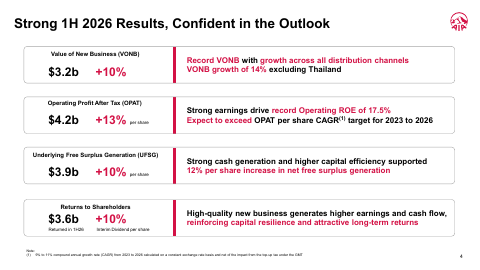
up 10% overall and 14% excluding Thailand
up 13% per share
up 65% per share
up 65% at constant exchange rates
up 10% per share
| Segment or metric | Value | Change |
|---|---|---|
| Hong Kong VONB | US$1,168 million | up 10% |
| Chinese Mainland VONB | US$937 million | up 20% |
| Thailand VONB | US$514 million | down 6% |
| Singapore VONB | US$294 million | up 10% |
| Malaysia VONB | US$232 million | up 10% |
| Premier Agency share of Group VONB | 72 per cent | agency VONB up 6% |
Copied from the press release ↗ and other documents in the company's results page ↗. A figure is published only if its sentence is in those documents.
| Metric | Period | Outlook |
|---|---|---|
| OPAT per share CAGR target (expected to be exceeded) | 2023 to 2026 | 9 to 11 per cent |
| VONB CAGR ambition for AIA China's regions entered since 2019 | 2025 to 2030 | 40 per cent |
| Capital return policy: share of annual net free surplus generation | each year | 75 per cent |
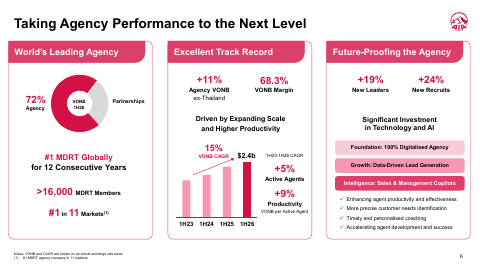
Agency supplies 72 per cent of new business value, and new agency leaders grew by 19 per cent and new recruits by 24 per cent. It is the base for AIA's strategy of advice-led distribution.
AIA is using data, digital tools and AI across recruitment, training, sales and service. The CEO said the greatest AI value will come from improving the productivity of the sales force.
Domestic VONB rose 23 per cent on deeper engagement with more than 3 million existing customers and new Hong Kong residents, while mainland visitor VONB was broadly stable against a high base. Management says demand drivers are intact despite regulatory and tax headlines.
Agency VONB rose 24 per cent with active agents up 14 per cent, but bancassurance VONB fell 6 per cent on intensified competition. Participating savings products are replacing non-participating products, and new Mainland bancassurance rules from July require product changes.
Partnership VONB rose 18 per cent, with bancassurance up 15 per cent and IFA and broker up 21 per cent. Thailand returned to growth in the second quarter, and Tata AIA Life in India grew VONB 31 per cent.
Each quote matches the transcript word for word.
“AI helps our agents work more effectively, identify customer needs more precisely and deliver more timely, personalised advice.”
Shows how AIA frames AI as an enabler of its human agency model, not a replacement.
“Personally, I do think that the greatest value that we can extract from AI will come from the improvement in the productivity of our sales force.”
Tells investors where management expects AI returns to concentrate.
“We reaffirm our, you know, growth strategy. We remain focused on life, health and long-term savings and we remain very, very focused geographically in our existing Pan-Asian footprint.”
Signals no strategic pivot after the board and management strategy review.
“I’m sure you see that many of our competitors, they may really go into that path, and the margin will experience a drop.”
Describes Hong Kong competitors chasing single-premium and short-pay volume at lower margins, which AIA says it avoids.
“there is a slight drop in the margin, which is mainly because we further shift more to the par.”
Explains why China's margin fell: a deliberate move to participating products in a low-rate setting.
“Tax is never a key driver for the demand of a long-term life insurance product in Hong Kong.”
Management's response to tax rumours affecting mainland visitor demand.
Management says Hong Kong demand drivers are intact and mainland visitor sales rose from the first to the second quarter, with June the strongest month. It gives no forecast and points to its existing capital management policy rather than discussing M&A. — Lee Yuan Siong, Jacky Chan, Garth Jones
The CFO cites low EV interest-rate sensitivity, a shift toward participating products and IFRS 17, and says the holding company cash level is broadly normal, with the second half usually higher. — Garth Jones
Management says visitor demand is unchanged, that tax is never a key driver, that its critical illness definitions largely match the voluntary guidance, and that refined bancassurance products suit its selective, affluent-focused model. — Lee Yuan Siong, Jacky Chan, Fisher Zhang
Management points to four growth engines and AI, says it avoids aggressive pricing, and attributes China's margin dip to a shift to participating products while agency margin is about 60 per cent and bancassurance 35 per cent. — Lee Yuan Siong, Jacky Chan, Fisher Zhang
The CFO calls it a flywheel from new business to CSM release, while the CEO says AI value will come from agent productivity, customer value and employee efficiency, and that a strategy review reaffirmed the current approach. — Garth Jones, Lee Yuan Siong
Hong Kong's mix is unchanged, with domestic case sizes up about 10 per cent. Thailand, Singapore and Malaysia all strengthened in the second quarter, and the CFO says earnings trajectory is now clear without announcing a new target. — Jacky Chan, Lee Yuan Siong, Hak Leh Tan, Garth Jones
Hong Kong participating business and equity markets were the main drivers, Thailand's margin rests on its protection-heavy mix, and India's health opportunity depends on a regulatory framework not yet notified. Management did not answer the bancassurance duration question. — Garth Jones, Hak Leh Tan, Leo Grepin, Lee Yuan Siong
AIA is embedding data, digital tools and AI in its agency, including sales and management copilots and data-driven lead generation. The CEO expects the greatest value from improving sales force productivity.
Visitor VONB was broadly stable against a high 2025 base and rose from the first to the second quarter, with June the strongest month. AIA added more than 25,000 new visitor customers in the half and says the structural drivers are unchanged.
Bancassurance VONB in the Chinese Mainland fell 6 per cent on intensified competition, and new regulations since July require product changes. Management says it is refining products and expects the market to become healthier.
No. Management says the review reaffirmed a focus on life, health and long-term savings in its existing Pan-Asian footprint, led by Premier Agency and complemented by bank and broker partners, with technology and AI as accelerators.
Thailand returned to growth in the second quarter, Singapore grew 10 per cent and Malaysia 10 per cent, and Tata AIA Life in India grew VONB 31 per cent. Agency and partnership channels both contributed.
TRANSCRIPT
AIA Group Limited 2026 Interim Results
Analyst Briefing Presentation
Overview and Business Highlights by Lee Yuan Siong – Group Chief Executive and President
Slide 2 – Disclaimer
Good morning and thank you for joining AIA’s 2026 Interim Results presentation.
We have delivered a strong set of results with double-digit growth across our key financial metrics. Value of New Business increased by 10 per cent to a record high of 3.2 billion dollars. We saw growth across all distribution channels and reportable segments, excluding Thailand which had an exceptionally high comparative, as previously disclosed. Underlying VONB growth was 14 per cent, adjusting for Thailand.
AIA’s consistent delivery of high-quality new business has accelerated growth in earnings. Operating profit after tax of 4.2 billion dollars was up 13 per cent per share, driving a record operating ROE of 17.5 per cent. And we now expect to exceed our 9 to 11 per cent OPAT per share CAGR target over 2023 through 2026. Operating cash generation grew strongly with underlying free surplus generation up 10 per cent per share and net free surplus generation up 12 per cent per share.
The Board has declared a 10 per cent increase in the interim dividend per share. These results demonstrate that our strategy is working as intended. We are growing fast, returning substantial cash to shareholders, generating higher returns on equity and maintaining a resilient balance sheet with low leverage. Sustained over time, that combination is the key driver of long-term value creation.
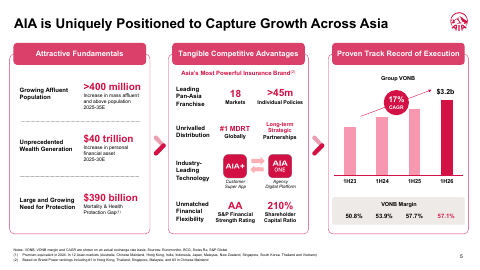
Our strong results are underpinned by our position as the leading pan-Asian life and health insurer. But what sets us apart is not just that we operate in the most attractive markets in the world, it is that we combine a long runway for growth with a unique business model and tangible competitive advantages that allow us to capture this significant opportunity consistently and profitably. Our proven track record of execution is demonstrated by VONB compounding at 17 per cent per annum over the last three years while maintaining strong margins.
AIA’s world-leading Premier Agency is at the core of our growth strategy, contributing 72 per cent of Group VONB. We train and develop the highest-quality agents, equipping them with the best possible tools to meet customer needs. This is why our tied agency has been the number one in MDRT globally for the last 12 years with more than double the members of our nearest competitor.
The success of our strategy is evident in our agency’s excellent track record of growth, achieved through consistent investment in growing active agent numbers and productivity. Continued disciplined execution of this strategy drove first-half VONB growth of 11 per cent, excluding Thailand, at a very strong VONB margin of 68 per cent.
The significant investments we have already made in technology and AI across recruitment, training, sales and service are delivering strong results. New agency leaders grew by 19 per cent and new recruits by 24 per cent. We are giving them the best possible opportunities to succeed, through structured career development and targeted schemes that identify and nurture our most promising talent. And as we bring more AI-powered capabilities into this platform, the opportunity multiplies. AI helps our agents work more effectively, identify customer needs more precisely and deliver more timely, personalised advice. That means the potential of Premier Agency can be unlocked faster than before — supporting continued value creation and sustainable performance over the long term.
Partnerships complement our Premier Agency, by extending our reach to millions of potential new customers. Our approach is selective and we focus on a small number of high-quality partnerships that share our ambitions to drive customer value and long-term growth.
Partnership VONB increased by 18 per cent in the first half, supported by double-digit growth in both bancassurance and IFA and broker channels. Bancassurance VONB grew by 15 per cent as we focus on driving higher share of wallet in the affluent and high net worth customer segments. This approach is translating into higher productivity for bank staff with VONB margin remaining healthy at over 45 per cent. We maintain a disciplined approach to distribution through IFAs and brokers. VONB from this channel grew by 21 per cent, supported by excellent performances in Hong Kong and Singapore.
AIA creates financial value by compounding layers of new business, which generate earnings and cash well into the future. Our first half results show that strong new business flows in recent years have driven a step-up in operating profit growth. As a result of this, we achieved OPAT growth of 13 per cent per share in the first half. Combined with consistent improvements in the efficiency of our balance sheet, the rise in profits led to a record operating ROE of 17.5 per cent. The strength of the momentum in our earnings gives us confidence in our outlook and we now expect to exceed our OPAT per share target. Strong new business flows are also driving growing cash generation, as you can see from our surplus generation numbers. Garth will address this in more detail later.
Moving now to the business highlights from our four growth engines.
AIA China delivered an excellent performance in the first half, with VONB growth of 20 per cent. The result was driven by our market-leading Premier Agency, which is our key competitive advantage in the Chinese Mainland. AIA’s agents are three times more productive than the market average, reflecting the depth of customer relationships built on the provision of personalised advice. Premier Agency achieved a 24 per cent increase in VONB and accounted for nearly 90 per cent of new business. We continued to build capacity for future growth, with active agents up 14 per cent and active new agents up 25 per cent. This stands out in an industry where agent numbers remain significantly below pre- COVID levels.
We also delivered excellent growth in capital-efficient participating products and protection, while maintaining an industry-leading VONB margin of around 60 per cent. We have built excellent momentum in our new geographies, contributing 11 per cent of AIA China’s VONB, and we remain on track to deliver our VONB target of 40 per cent compound annual growth to 2030. Together, these results demonstrate the strength of our differentiated model and AIA remains well-positioned to capture the long-term growth opportunities in the Chinese Mainland.
Turning now to Hong Kong, where we achieved another record first-half result. VONB of 1.2 billion increased by 10 per cent with margin remaining strong at 72 per cent, reflecting our financial discipline. Our Premier Agency accounts for the majority of our business and sets the standard for quality and professionalism. AIA Hong Kong was once again ranked the number one MDRT company globally. Around 30 per cent of agents are MDRT members, following an 18 per cent increase compared with the previous year.
First-half agency VONB remained stable at a high level, while we continued to invest in recruitment, development and leadership to drive future growth. Active new agents grew by 7 per cent and active new leaders by 22 per cent. Partnership distribution delivered excellent VONB growth. We saw strong performances in our IFA and broker channel as well as our strategic partnerships with Citibank and The Bank of East Asia.
Closer engagement and tailored propositions for affluent and high-net-worth customers are driving significantly higher sales productivity. More broadly, AIA Hong Kong’s performance reflects the quality of our distribution and the attractiveness of our products across key customer segments. Let me turn to these now.
Our domestic business performed very strongly, with VONB up 23 per cent. This was supported by deeper engagement with our more than 3 million existing customers, a large contribution from new Hong Kong residents and average policy sizes increasing by 10 per cent.
VONB from Chinese Mainland Visitors was stable against a high comparative, which benefited from a surge in demand ahead of product changes in the middle of 2025. Underlying demand remained strong. Second-quarter VONB was higher than the first quarter, with June the strongest month.
Customer flows also remained strong, with more than 25,000 new customers in the first half. Our customer base is diversified with around two-thirds coming from outside the Greater Bay Area. AIA’s products offer broad appeal to people seeking attractive long-term returns, protection and diversification.
Many customers have multiple policies with us and persistency remained high at 99 per cent while premium-financed business accounted for less than 1 per cent of VONB. Yet, with only 550,000 customers in total, the potential runway for future growth remains substantial.
AIA Hong Kong’s strong track record of growth across distribution channels and customer segments reflects the strength of our business and the depth of demand. Since these attractive fundamentals remain fully intact, I have every confidence that we can continue to deliver attractive long-term growth in this market.
AIA is the leading life insurer across ASEAN, which contributed almost one-third of Group VONB of more than 1 billion dollars. Our Premier Agency ranks number 1 for MDRT, and combined with high- quality partnerships, we have a very strong platform for sustained growth across the region.
In Thailand, our largest ASEAN market, VONB grew by 13 per cent in the second quarter. Premier Agency remains the core strength of the business, complemented by very strong growth from our partnership with Bangkok Bank.
Singapore delivered 10 per cent VONB growth, including a 19 per cent increase in the second quarter, with growth from both agency and partnership distribution.
Malaysia VONB was up by 10 per cent in the half with growth accelerating in the second quarter on the back of strong contributions from partnerships and continued improvement in agency momentum.
The strong performance across our major ASEAN markets reinforces our belief in the long-term growth potential of the region. Moving now to India.
Tata AIA Life delivered another excellent set of results, with VONB growth of 31 per cent in the first half, as we continued to capture the huge potential in the market.
Agency represents 55 per cent of our business in India and delivered excellent VONB growth of 38 per cent. We continued to build scale and invest in future growth, as evidenced by the strong increases in active agents, new recruits and new leaders.
We expanded our customer reach with bank and broker distribution and continued to see sales growth with VONB up 23 per cent across these channels. Tata AIA ranks number 1 in retail protection and persistency in India, reflecting our focus on delivering high-quality advice and products to our customers.
In summary, today’s strong results are a continuation of AIA’s exceptional track record of delivering growth across our key financial metrics. Our ability to deliver sustained strong performance reflects our unique position as the leading pan-Asian life and health insurer, delivering growth by capitalising on the huge opportunity set in the region.
We are focused on driving high-quality, profitable new business growth with attractive reinvestment economics that adds further layers of recurring earnings and cash generation. I am confident in our ability to continue to drive future growth and attractive shareholder value creation.
I will now hand over to our CFO, Garth Jones, who will take you through the details of our financial results.
Financial Performance by Garth Jones – Group Chief Financial Officer
Good morning. I’m delighted to take you through another strong set of results for AIA, demonstrating the quality of the business we have built over many years. Let me start by highlighting three things that I see as key in these results.
First, we achieved double-digit growth across new business, earnings and cash generation. Second, the profitable new business written over many years is now compounding visibly, driving higher operating profit and free surplus generation. Third, disciplined capital deployment is lifting returns to record levels and we have continued to both grow strongly and return capital to shareholders.
In combination, these results provide clear evidence that AIA’s growth model is creating sustained shareholder value.
Let me now take you through the results in more detail. VONB increased to a record 3.2 billion dollars, up by 10 per cent, with growth across all distribution channels, and reportable segments other than Thailand. OPAT increased to 4.2 billion dollars, up 13 per cent per share and operating ROE reached a record 17.5 per cent.
This strong result gives us confidence in the outlook, and we now expect to exceed our OPAT per share growth target. UFSG, our key operating measure of cash generation, increased to 3.9 billion dollars, up 10 per cent per share. During the first half, we returned 3.6 billion dollars to shareholders through dividend and share buy-back.
Based on this strong performance, the Board has declared a 10 per cent increase in the interim dividend per share, reflecting both our sustained strong performance and our confidence in the future.
Turning to new business, AIA is focused on writing large-scale, high-quality and profitable new business that creates value for both our customers and shareholders. Our proprietary Premier Agency accounted for 72 per cent of Group VONB, with partnership distribution contributing the remaining 28 per cent.
VONB margin stood at 57.1 per cent, broadly stable compared with prior year. The financial profile of our product mix is highly attractive. Traditional protection products generate underwriting profits, while participating and unit-linked products generate recurring fee-based earnings. Together, these products accounted for 96 per cent of Group VONB in the first half.
This high-quality product mix generates strong and predictable cash flows, with highly attractive returns on the capital we invest. Every dollar of capital invested in new business is expected to generate 4 dollars of distributable earnings within 10 years and with a rapid payback period of just three years.
The internal rate of return on our new business investment remains above 20 per cent. Our ability to write profitable new business at scale, while maintaining these attractive economics, is a key differentiator for AIA, and underpins our confidence in our ability to compound value over time.
Our embedded value clearly demonstrates the financial dynamics of AIA’s growth model, each cohort of profitable new business adds another layer of future earnings and cash generation, supported by prudent assumptions and disciplined management of the in-force portfolio.
EV operating profit increased to 6.6 billion dollars in the first half, up 12 per cent per share. Growth was driven by the higher VONB, increased expected return from our in-force and positive operating variances, reflecting the overall quality of our business and our focused operational management.
As a result, operating ROEV increased by 220 basis points to a record 18 per cent. Investment return variances added one billion to EV Equity, mainly from positive equity market performance in the period, while exchange rates and other non-operating items were small.
Overall, EV Equity increased by 9 per cent to 87.1 billion before returns to shareholders. After the 3.6 billion of dividend and share buy-back, EV Equity reached 83.4 billion dollars, up by 6 per cent per share over the first half.
AIA’s embedded value reflects the high quality of our in-force portfolio built from many years of profitable new business. Similar to our new business, future earnings from our in-force book are predominantly sourced from protection and long-term savings products, which provide recurring and resilient cash flows.
Our prudent assumptions and active management of the in-force portfolio have consistently resulted in positive operating variances. In the first half, these added 742 million dollars to EV operating profit. This included positive medical claims experience, reflecting claim savings of around 200 million dollars for the half.
At the same time, due to disciplined expense management and continued business growth, our expense ratio has improved by 130 basis points over two years to 6.9 per cent this half. Since our IPO, operating variances have been positive every year and have now added over 5 billion dollars to EV Equity.
This strong track record and the limited sensitivity to capital market movements demonstrates the prudence of our assumptions, and the quality of the in-force portfolio. Overall, our EV provides a prudent and reliable measure of the economic value created for shareholders.
Now moving to the IFRS results. First, on the left-hand side of the slide. The Contractual Service Margin, or CSM, represents the accumulated stock of expected future IFRS earnings from our in-force portfolio. Each new cohort of profitable new business adds a further layer to this stock, which is then released into earnings over time.
During the first half, new business added 4.9 billion dollars, while the expected return contributed a further 1.7 billion. After a release of 3.4 billion of CSM into earnings, together with small other items including variances and exchange-rate movements, the CSM balance increased to 67.8 billion dollars. Underlying CSM growth was 10 per cent, driven by our strong organic growth.
Turning to the right-hand side. Since the adoption of IFRS 17, new business and the expected return on the in-force portfolio have added 38.1 billion to the CSM. After releases of 20.5 billion into earnings, the CSM has increased by a net 17.5 billion dollars, thereby expanding our stock of future earnings, while the release rate has remained broadly stable.
This demonstrates how successive cohorts of profitable new business compound over time to support sustained growth in recurring earnings.
The CSM release is the principal contributor to OPAT, our core measure of operating earnings. The greater release into profit, due to a higher CSM, is the main driver of the 11 per cent increase in the insurance service result seen in the first half.
Positive variances also flow into this, reflecting continued disciplined management of expenses and claims, including progress in executing our integrated health strategy. The net investment result after expenses also increased compared with last year. Overall, OPAT increased to 4.2 billion in the first half, up by 13 per cent per share.
Strong earnings growth, together with disciplined capital management, drove operating ROE up by 200 basis points to a record 17.5 per cent. The growth in CSM, and the quality and resilience of our in-force portfolio, give us confidence in the earnings outlook and we now expect to exceed our 9 to 11 per cent OPAT per share CAGR target for 2023 to 2026.
The same compounding dynamic that drives earnings also underpins cash generation. Each new policy that we write adds a future stream of cash flows to our growing in-force portfolio, which emerges progressively over future years. At the end of the first half, we expect our in-force portfolio to generate 57 billion dollars of distributable earnings over the next 10 years. This is 15 per cent higher than at the end of the first half of 2025, reflecting the addition of profitable new business, together with an uplift from positive variances.
As these distributable earnings emerge, they drive higher operating cash generation. In the first half, UFSG increased to 3.9 billion dollars, up 10 per cent per share. After investment in new business and central costs, net free surplus generation increased to 2.8 billion dollars, up 12 per cent per share. The stronger growth in net free surplus generation than UFSG reflects the increased capital efficiency of new business written, in particular the shift in product mix towards participating business in the Chinese Mainland.
These results demonstrate the direct progression from profitable new business, to growth in the in-force portfolio, and then into higher earnings and ultimately cash generation.
We follow a clear and shareholder value-focused capital management framework. Our capital management policy targets the return of 75 per cent of annual net free surplus generation through dividends and share buy-backs. We also regularly review our capital position and return capital in excess of our needs.
Since 2022, we have returned 26.6 billion dollars to shareholders through dividends and share buy- backs, while continuing to invest in profitable growth. The shareholder capital ratio stood at 210 per cent at 30 June 2026, following the 3.6 billion dollars returned to shareholders during the first half, in line with our expectations.
Our capital position remains very strong, and we retain substantial financial flexibility given our low leverage and high financial strength ratings.
Consistent with our long-established prudent, sustainable and progressive dividend policy, the Board has declared an interim dividend per share of 53.9 Hong Kong cents, which represents an increase of 10 per cent over last year.
AIA has increased its dividend every year after IPO, ever since our very first dividend in 2011, and including during the COVID period. Our ability to sustain this track record reflects the resilience of our earnings and cash generation from the growing in-force portfolio. As a reminder, the final dividend and the balance of shareholder returns under our capital management policy will be determined and announced with the 2026 annual results, in March 2027.
To conclude, AIA has delivered another strong financial performance in the first half of 2026, with double-digit growth across new business, earnings and cash generation and record operating returns.
These results reflect the strength of AIA’s platform, the depth of our distribution, the quality of our product mix and the disciplined way in which we manage capital. AIA is exceptionally well positioned in Asia, the most attractive region in the world for life and health insurance.
I am confident in AIA’s outlook, with a clear strategy, a proven model, and a demonstrable ability to execute effectively. We continue to drive profitable growth and we are converting this into earnings, cash and shareholder returns with discipline and consistency. Thank you.
– End of Analyst Briefing Presentation –
Q&A Session
Sami Taipalus (AIA): Good morning, everyone, from AIA Central in Hong Kong, and welcome to AIA's 2026 interim analyst briefing. I'm Sami Taipalus, the Chief Investor Relations Officer of AIA. With me on the stage, I have Lee Yuan Siong, Group CEO and President, Garth Jones, Group CFO, and Regional Chief Executives Jacky Chan, Fisher Zhang, Hak Leh Tan, and Leo Grepin. We also have other members of the Executive Committee in the room with us. We will now begin the Q&A session. If you have a question to ask, please make sure you're logged into the Zoom call. Operator, over to you.
Operator: Ladies and gentlemen, if you wish to ask a question, please click the hand raising button and wait for your name to be announced. After I call your name, please press the unmute button shown on your screen and ask your questions. If any time you need to cancel your request, please unclick the hand raising button. Let's proceed. And our first question comes from Thomas Wang of Goldman Sachs. Thomas, please press the unmute button shown on your screen and ask your question.
Thomas Wang (Goldman Sachs): Thank you. Thank you for allowing me to ask questions. Maybe a couple. One, Hong Kong obviously is the focus for this result. Number came, I think, a little bit below consensus, and also there's a lot of news flow. So I just want to know whether you can give us some update on what's happening on the ground in Hong Kong, and I understand the kind of the CMV segment. I understand the basic. I'm just wondering whether you have sort of medium-term growth target in mind for the Hong Kong market, so we can better track because it's kind of been volatile over the last couple of years. And then second point, maybe on the capital planning part. Just wondering, we kind of inquired on the M&A front, what kind of target could be attractive for AIA. How are you evaluating that potential M&A opportunities? Thank you.
Lee Yuan Siong (AIA): Yeah, thank you for your question, Thomas. Now, we are confident about outlook for 2026 overall, and for our major markets, the demand drivers for our products remain intact, including for CMV business in Hong Kong. We have a very strong competitive advantages in the Hong Kong market, including our leading premier agency channel, our partnership distribution, our strategic bank partners – Citibank and Bank of East Asia. So, we remain very confident of our outlook for Hong Kong. I will hand over to Jacky to elaborate.
Jacky Chan (AIA): Yeah, Thomas, I'm very pleased that AIA Hong Kong and Macau delivered a set of very strong result in the first half. VONB up 10 per cent to a record 1.2 billion dollars. This was really supported by our strong underlying distribution channel, especially the premier agency. As we keep emphasizing, the key differentiation channel for AIA Hong Kong is our premier agents, and it achieved MDRT number one globally as a company for 24 years, and almost 30 per cent of our agents are MDRT. And as you have seen in our slide, in fact, after COVID, in the last three years, we have double-digit growth in our agency VONB and double-digit growth in our agency productivity. And that said, we also have a diversified channel. We have a strong partnership distribution channel. We have a strong bancassurance result in the first half of this year, and our IFA broker also grew strongly. I want to emphasize that the 10 per cent growth is against the first half of last year, it is a very strong, high growth due to product changes in the middle of the year, and our domestic customer segment in first half of this year actually grew strongly by 23 per cent, and our Chinese Mainland visitor channel VONB was broadly stable against a very high base in last year. In our CMV, Chinese Mainland visitor segment, our VONB growth is growing quarter to quarter, from first quarter to second quarter. June was the highest CMV VONB for the whole first half in AIA Hong Kong and Macau.
As you talked about the recent news flow, actually since those recent news flow in May, we continued to see good demand from Chinese Mainland visitor business in our Hong Kong result. As you can see that, and also all those kind of news regarding cross-border fund flow or taxation, those are always there. There is no change in those regulatory requirements. As I said before, the Chinese Mainland visitor business segment has been a major business segment in the Hong Kong life insurance industry for more than two decades, and the key reason for it is because of the strong underlying structural drivers, including the access of a diversified global investment opportunities, which supported our long- term life insurance product, and also the access to high quality advice and more flexible quality design product and proposition. Those structural drivers remain unchanged, and as you can see that, in the first half of this year there are more than 25,000 new Chinese Mainland visitor segment customers added to our portfolio, which now have roughly 550,000 customers in our in-force book. There is still a
big opportunity going forward to grow the CMV customer segment. In terms of the medium growth opportunity, I think you also know that we don't provide forecast, and as Yuan Siong pointed out, we see continued strong opportunity in Hong Kong, and AIA Hong Kong is well positioned to capture those opportunities.
Lee Yuan Siong (AIA): Thomas, on your question on capital management, as I said, we are very focused on driving strong new business growth that can translate to high-quality earnings and cash returns to shareholders. We have communicated our capital management policy and will remain focused on implementing this capital management policy as we have communicated. The first half results and the past year's results have demonstrated that our strategy is actually working. We have seen a strong VONB growth. We've seen this translate into strong OPAT per share growth. As we have said this time, we expect to exceed our OPAT per share CAGR target that we've communicated to the market, and we have also seen record levels of our ROE of more than 17 per cent, ROEV at record levels as well. May I hand over to Garth to elaborate further?
Garth Jones (AIA): Yeah, I mean we've seen the way in which we've executed the capital management policy has been exactly as we intended. The shareholder capital ratio has reduced as we've increased the buy-back, but remained strong. We've seen how we've returned 3.6 billion dollars to shareholders in the first half. And importantly, you see that, not only have we seen strong operational execution in the first half, on an ongoing basis, but also the way that our disciplined capital management has now also increased the ROE up to 17.5 per cent at a record level and up 200 basis points over the same half last year. So the capital management policy is working, and we see that in the numbers we're showing today. In these uncertain times, retaining financial strength is important, but as ever, we look at always to create value for our shareholders on an ongoing basis.
Sami Taipalus (AIA): Thank you, Thomas. Next question, please.
Operator: The next question comes from MW Kim of JP Morgan. MW please press the unmute button shown on your screen and ask your question.
MW Kim (JP Morgan): Thank you for the opportunity. I have two questions. Firstly, the long-term bond yield has continued to rise across a number of markets, including the US, while the broad macro environment remains volatile. This may create some non-economic volatility in the company's reported financial figures. Could you remind us the key actions that the company has taken in recent years to reduce that accounting and also the sovereignty volatility, and how effective these measures have been in recent market environment? And secondly, on the holding company cash base. The core earnings growth was very strong in the first half, but capital flow from the subsidiaries appears to have a much smaller than the first half of 2025. Could you help us to understand whether this mainly reflects the timing of the remittance, capital measurement choices at subsidiary level or any other drivers, thank you.
Lee Yuan Siong (AIA): Okay, for these are two financial questions, I'll hand over to Garth.
Garth Jones (AIA): Yeah, thanks, MW. Yeah, I mean the actions we're taking are not actions that are new; they're actions we've taken over many years. The first thing I'd point you to is our EV sensitivities to interest rates. You see, that's very low, and clearly that reflects the strong ALM management that we have, and the prudence in our assumptions also. Also, if you look at the earnings again, we have strong earnings growth. We saw 13 per cent per share earnings growth this year in our operating profit after tax. We always say look through to that rather than the net profit because of the volatility. But the change in product mix that we've had towards par products in China will help more generally, because the business will go into VFA rather than GMM. And as you look at our business, some of the things that we've done, even reducing the shareholder funds over time, will also reduce some of the noise between net profit and OPAT. The move to IFRS 17 actually has helped a lot with that noise, as IFRS 17 is more market-based. So, the actions we've taken, you see it in the product portfolio of the new business, and you see it in the product portfolio of the in-force, actually because it's been there for many years, and you see it in those sensitivities.
On the whole company cash, you have to go back to the first half of 2025. We had some capital flows, and it's really about strong liquidity management at the holding company. If you look at the rate for the first half, it's broadly in line with where it normally is. And I would remind you that the second half is normally higher than the first half, and also we look at it over the full year. But you can see that the flows from the businesses continue to be strong and meet our needs.
Sami Taipalus (AIA): All right, thank you, MW. Next question, please.
Operator: The next question comes from Michelle Ma of Citi. Michelle, please press the unmute button shown on your screen and ask your question.
Michelle Ma (Citi): Thank you for giving me this opportunity. This is Michelle Ma from Citi Research. First of all, congratulations on this set of results, despite a very high base for comparison. I have two questions. The first is to Jacky. Could you help us to understand how MCV customers’ mentality has changed after Decree No. 837? Do they feel more urgent to buy Hong Kong insurance products or more hesitant? And how do you access the impact from the recent rumor on the additional 20 per cent tax to be imposed on the Hong Kong insurance or overseas insurance participating products dividend. And also, there is regulatory changes in the coming September 1. The Federation of Insurers in Hong Kong will unify the definition of critical illness, and there may be a stricter standards applied to those kinds of minor critical illness or diseases. How do you see it change your competitive edge or product competitiveness over your major competitors? Second question to Fisher is about Document 65. We know that at the beginning of July, there was a lot of product redesign and new launch of products in bancassurance channel. There is a lot of business disruptions per our peers in Mainland. Even though bancassurance is not a major distribution channel of AIA China, how do you see it will impact your business going forward? Thank you.
Lee Yuan Siong (AIA): Thank you, Michelle. You have a question for Jacky on competition and demand in Hong Kong. As I said earlier, the demand drivers for CMV business remain intact. CMV customers come to Hong Kong to purchase insurance for access to international investments, diversification for access to better healthcare, better advice, so we continue to see good demand from CMV customers. Now, so I hand over to Jacky to elaborate on the product competitiveness.
Jacky Chan (AIA): Thank you, Michelle. So let me address the product competitive question. Yes, Hong Kong FI is launching a kind of unified definition on CI, and please note that this is a voluntary adoption for the insurance company. This is something to provide the advice guidance for the insurance company, so it is voluntary. And for AIA, we look at it and we find that in fact, most of our CI definition are broadly in line with those guidance, and we will continue to consider the innovative design in the proposition, including CI, going forward, as we have been doing more innovative product proposition in the past many years. May I just also add to the point about the CMV Chinese Mainland visitor business? We continue to see good demand since all those news flows, whether it is Decree No. 837 or cross- border, etc. Tax is never a key driver for the demand of a long-term life insurance product in Hong Kong. As Yuan Siong already pointed out, those drivers are really about the access to international diversified investment, which back up our long-term life insurance product and also more diversified or tailored design in proposition and quality advice, and we continue to see a strong good demand of our CMV business.
Lee Yuan Siong (AIA): On Mainland China, we are very pleased with the first half results, VONB growth of 20 per cent, we’re especially pleased with the performance from the agency channel, 24 per cent VONB growth, and this is supported by very strong foundation. Growth in active agents of 14 per cent, growth in productivity, growth in active new agents, you can see that we are investing into building up our premier agency in Mainland China, so I’m very confident of the outlook for China in 2026. Now I caution you to not focus too much on quarterly growth numbers because quarterly numbers, as you know, is affected by one-off factors and one-off events. So overall, for the year, we are confident of our performance and the outlook for China. Now I hand over to Fisher to talk a bit more in detail about China’s performance in the first half.
Fisher Zhang (AIA): Thanks for the question. Firstly, I want to emphasize the overall performance. As Yuan Siong said, we are very pleased about the excellent performance. Particularly, it’s driven by the structural growth driver and AIA China’s unique differentiated strategy, particular in the premier agency, and also our new BU's great performance, the unique geography expansion opportunity actually also given us a full confidence to deliver sustainable growth going forward. Your question about in the second half, if we need to refine a lot of products. Actually, it is mainly about the bancassurance. Maybe let me elaborate the bancassurance a little bit more. So, firstly, how we look at bancassurance. Actually, as we said several times, bancassurance with various new regulations in place, especially the PIR adjustment mechanism, the shifting to the par products, and “報行合一”, the bancassurance is getting more healthy, so we think there is a huge opportunity in the future. Secondly, our strategy is to build a differentiated profitable bancassurance. That’s why we say we collaborate with a selected bank partner, who have the same vision, same operating philosophy with us. We focus on those affluent and high levels customers, do more POS management, stringent active management, and very importantly customer relationship management. That's our target differentiated model. Since you mentioned, since July, the regulators strengthen the “報行合一”, which means the whole market, the bancassurance will shift from the previous, more fee-driven, to comprehensive capability-driven in future. The insurance company needs to do more on the POS management, on the customer management. That is exactly where you can find the direction of us. We have refined all the product to complying all the regular requirement, and this direction, although the home market will have a transition period, as I said, we are very well positioned to capture this long-term opportunity in future. So overall speaking, not just the premier agency, we also have full confidence in the overall business performance. Thank you!
Sami Taipalus (AIA): Thank you, Michelle. Next question, please.
Operator: The next question comes from Charles Zhou of UBS Securities. Charles, please press the
Charles Zhou (UBS Securities): This is Charles Zhou from UBS. I have a few questions. The first question is on the second page of your interim report. I know that Yuan Siong said the Group has achieved 17 per cent compound annual growth rate since the first half of 2023, which I believe this also exceed the investor expectations about a mid-teen of your business growth for the AIA Group. May I know how do you see this expectation about the mid-teen growth? Including for this year and also in the medium term, as we know, you only achieve 10 per cent in the first half, that means the growth probably have to accelerate in the second half to achieve this mid-teen expectations. Can you maybe just help us to understand in which market we will see better growth, and also in the medium term, as you know, Hong Kong, China is getting bigger and bigger. So, in the medium term, if we are going to achieve, say, mid-teen growth, do we expect the growth will come from Hong Kong, China, or maybe more from the Southeast Asia? So that's my first question. Second question is for Hong Kong. The competition in Hong Kong has intensified over the past few years, especially in bancassurance and broker channel, both are gaining shares in Hong Kong compared with agency based on industry data. How does AIA plan to sustain its competitive position given AIA’s agency dominant model, and how does AIA view the Hong Kong competitive landscape and rapid growth of the bank-backed insurers. Last, very quickly on AIA China, just regarding the margin, we saw the margin decline a little bit in China. Can you elaborate and talk about the margin? Thank you.
Lee Yuan Siong (AIA): Thank you, Charles, and thank you for bringing us to this slide, which is a very important slide because it exactly tells us that we are operating in the best region for life and health and long-term savings insurance business, which is our core business, and we are in the best region. We have very significant competitive advantages, and we continue to invest into strengthening these competitive advantages, including building up our premier agency, building up our strategic bank partnerships and our partnerships with selective brokers and IFAs. You go to slide 15, we have shown that over the long term, we are able to deliver a very strong record of consistent performance. In terms of VONB, there was a blip during the years of COVID, but COVID affected the whole world, and you can see that, in post COVID, we bounced back very quickly and continued trajectory of strong growth that’s translating to earnings, translating to cash returns to our shareholders. So, the investment thesis for AIA remains very strong, this is the first thing I’d like to say. Now, in terms of the growth engines, we operate in 18 markets, but we have identified our four key growth engines mainly, Chinese Mainland, Hong Kong, ASEAN and India.
These are our four growth engines, and these four growth engines continue to deliver good growth. The power of our diversified pan-ASEAN platform, the power of these four growth engines means that we can consistently deliver the kind of growth trajectory that you see in slide 15. On our competitive advantages, clearly, you know the key competitive advantage for us is premier agency. We have the best in the market. Jacky and the team have talked about the quality of our premier agency, the fact that we have the most number of MDRT globally for 12 consecutive years. We are number one in MDRT in 11 of our 18 markets, and all these have been very strong, consistent. It's not just one year or temporary performances, but consistent performances over the years. Going forward, we can further accelerate growth through the use of technology and AI. We believe that technology and AI can be a growth accelerator for our key distribution channels, and this is what we are investing into, and we are devoting a lot of time and energy on leveraging AI to improve productivity, to increase access to more customer segments, and to be able to reach customers at the right time in the right locations, so we remain confident in our outlook for 2026 and beyond. So that’s my answer to your first question.
On the second question about market competition, again I go back to the point that we are focused on delivering high-quality growth that translates to earnings and cash. And we believe that if we consistently focus on this high-quality growth, then in all our markets, we will become the leading in life and health insurer in the market. We are already the leading life and health insurer in many of our markets that we operate in, but we believe that this focus on delivering high-quality growth will anchor our ability to become the leading insurer in all the markets that we operate in. In Hong Kong, our strength is our premier agency and our bank partners including Citibank and Bank of East Asia, they delivered very strong performances in the first half of 2026. And as I said, we continue to be very focused on high- quality business. We are aware that in certain markets, there will be companies that will adopt very aggressive pricing strategies. There’ll be companies that will adopt some short-term incentives to drive market share growth. But as I emphasize again and again, we focus on high-quality growth, especially about Hong Kong, I will hand over to Jacky to talk about it.
Jacky Chan (AIA): Thank you, Yuan Siong. Charles, as you pointed out, Hong Kong competition is intense, but it’s always been there, because Hong Kong is an international financial center, and you see that there are almost all those major global financial institutions have business in Hong Kong, so no wonder there is keen competition here. As Yuan Siong pointed out, AIA in Hong Kong and Macau, we focus on delivering sustainable quality growth in our business in the long term, and we do see that our differentiated premier agency is the key differentiator, and we sell long term life insurance and long- term saving product through our premier agency channel, and we also have partnership with our exclusive bank partners, Citi and BEA, and they both also focusing on selling long-term life insurance and long-term saving product. And in the broker channel, we are also there. AIA Hong Kong is also having a multi-disciplinary channel because this is a very diversified financial center, and we selectively partnered with roughly 10 per cent of the brokers in Hong Kong who are also aligned with us in the value proposition of long-term life insurance product for our customers. I believe you see in the recent statistic in the Hong Kong life insurance market, there is a big growth in terms of ANP and mostly driven by single premium and short pay. Short pay meaning that premium paying period of less than five years, and I’m sure you see that many of our competitors, they may really go into that path, and the margin will experience a drop. But in the case of AIA Hong Kong, we delivered a set of strong VONB growth of 10 per cent amid a very strong margin of 72 per cent, this shows that our financial discipline and focusing on delivering long-term sustainable quality growth.
Lee Yuan Siong (AIA): On the China margin question, you need to look at it in terms of the bancassurance channel and the agency channel. We are very happy with the level of our VONB margin of our agency and bancassurance channel. For bancassurance channel, our VONB margin was 35 per cent. This compared to years ago, where it was like low single digit in the industry. This is a very healthy level of our VONB margin for bancassurance channel in the Chinese Mainland. Now, with the increased focus on “報 行 合 一” and other regulations and the moves by the regulator, we believe that the profitability of the bancassurance channel will continue to be at a healthy level, and as Fisher described it just now. Now, with the agency channel, our VONB margin stands at 60 per cent. This is a very attractive VONB margin, and we believe it is a market leading VONB margin for the agency channel in this low interest environment. If you look at the product mix of our Chinese Mainland business, it is a very attractive product mix. The 35 per cent of the new business is in protection business, 57 per cent in participating savings products, and 8 per cent in the tax incentivized retirement products. These are the products that we like in this low-interest-rate environment. I’ll hand over to Fisher to further elaborate.
Fisher Zhang (AIA): Basically, that’s all. Firstly, Charles, as you know, we manage the business by focusing on the growing the absolute amount of VONB. So, as you can see that, in the first half, we are very pleased to deliver excellent performance in the VONB, which is 20 per cent. Secondly, you can notice that there is a slight drop in the margin, which is mainly because we further shift more to the par. As you know, it's more healthy. I can give you a typical example. Last year, the first half of our CI product was still a non-par CI, but in the second half, we launched the par CI, which is very well received by the market. So, we continue to shift to a healthier product mix. That’s the main reason for the margin drop. Last but not least, as Yuan Siong said, we actually maintain a very decent margin, no matter if those from agency at around the 60 per cent or bancassurance at 75 per cent, these are all very well above the market, and very importantly, the product mix is healthy. We are very unique in the protection, with 15 per cent growth. Consider all of these, we have full confidence we can continue to deliver decent margin in future. Thank you.
Sami Taipalus (AIA): Thanks for the question, Charles. Next question, please.
Operator: The next question comes from Leon Qi of CLSA. Leon, please press the unmute button shown on your screen and ask your questions.
Leon Qi (CLSA): Hi. Thanks for taking my questions. This is Leon Qi from CLSA Research. Given a lot of my peer analysts had already asked quite a few questions on short-term quarterly dynamics. Today I would like to ask three questions related to a bit longer-term perspective if I may. First one on financials, second one on AI, third one on strategy and competitive edge.
My first question is on OPAT. Appreciate that, in our pre-prepared remarks that Garth mentioned that, we had a very strong OPAT growth. Finally, the very strong new business growth over the past few years are being released into, turning into higher CSM release ratios, which supports our OPAT growth. Does management think this is a sustainable trend? Or put it differently, are we now starting to see the benefits of this VONB growth over the past few years feeding to more visible reported earnings growth in OPAT and possibly in free surplus as well?
Second question is on AI. We highlighted that we have a lot of investments in different areas, including sales copilot, management copilot, and data driven lead generation across agency forces. How do we measure the economic return on these investments over time? Do you expect AI to be primarily reducing customer acquisition costs or improve agency productivity, increase cross-sell opportunities, or improve customer retention? In other words, if management could share that, which are the best KPIs that captures the value being generated from our AI investments.
And third one is on our strategy and the competitive edge. AIA has successfully combined a very productive agency model with investments in digitalisation and AI capabilities. But looking five years ahead down the road, where do you think are the greatest sources of competitive edge that comes from? Is it our proprietary distribution model or customer data or AI-enabled productivity, ecosystem partners or our brand trust? In particular, I guess this is probably a question for Yuan Siong, if possible. Given Yuan Siong, you have been in office for six years. Had your view towards this question changed over the past six years? Given actually the industry has changed a lot over the past six years. Thanks a lot.
Lee Yuan Siong (AIA): OK, thank you. I just hand over to Garth on your question on OPAT.
Garth Jones (AIA): Yeah, thanks Leon. Clearly, we are very pleased to see the step-up in OPAT growth to 13 per cent growth per share. And as we said, we now expect to exceed our OPAT growth target. I think that gives you some idea of the confidence we have. When you look at the OPAT growth, the biggest driver is the release from CSM. And you saw the 11 per cent increase in the insurance service result, with the flow-on from the CSM release. That's been fairly stable. And you can see how the successive layers of new business are really driving that OPAT growth. Clearly, our confidence in growing the new business is there. That will drive growth in new business CSM and that in turn will drive the CSM release and the OPAT growth. I think that what you see in these results actually is the financial flywheel that we have at AIA, where that new business growth translates into earnings and then ultimately into the UFSG in cash over time.
I think the other thing to point out in these results is the strong operating performance. You can see that the claims management has been strong. We’ve got good variances on the claims management with another 200 million of expense savings on the medical claims in particular. And the reduction in the expense ratio, I mean the reduction in the expense ratio by 130 basis points over 2 years. I think obviously that reflects a lot of our investment in technology and making the business more efficient, but it also is a reflection of the growth in the business as well. So I think, you know, we look forward to growing OPAT further. I think as you say, this getting the new business and then seeing that flow through, you’ll see how it comes through in the results as we go forward.
Lee Yuan Siong (AIA): Now on your two questions, one on AI and one on the strategy. You know, we are very excited about what AI can do for the business. We think there are huge opportunities that AI can, you know help us in terms of transforming the business. We see, you know the value from AI emerging in three areas.
One is the improvement in the productivity of our distribution channels, in particular our Premier Agency channel. Second is, it is in helping us to uplift the value from our customer base. We have an excellent and very, very high-quality customer base. And the third, clearly is to improve the, you know, efficiency and productivity of our employees. Garth talked about the reduction in the expense ratio. This is you know, the contribution of it, a lot of it came from our investments in technology over the past few years. And I think, AI has the potential to help us further improve our efficiencies of our operations. So overall, I think this is where we see AI creating value for AIA. Personally, I do think that the greatest value that we can extract from AI will come from the improvement in the productivity of our sales force. And this is an area that we are working on, you know, with our investments, into using AI to empower our Premier Agency channel, and to increase the skill and the productivity of this very, very important core advantage, competitive advantage for, strength for AIA in our markets.
Now, on your question about the strategy, it is interesting because, yes, I’ve been in AIA 6 years, more than 6 years now. And we also have a new chairman who’s been on board for 10 months. And since he has been on board, we have gone through a very extensive review of the strategy supported by our internal strategy team, led by Leo Grepin. And, I can say that we are fully aligned on the strategy of AIA. We reaffirm our, you know, growth strategy. We remain focused on life, health and long-term savings and we remain very, very focused geographically in our existing Pan-Asian footprint. So where we see that, you know, there is, there continues to be tremendous upside and opportunities for AIA as a whole. In terms of our strategic priorities, we can, you know, focus on continuing to meet customer needs through our professional Premier Agency force. And this is a channel where we have clear differentiation, and we are also, you know, align in terms of our focus of complementing our Premier Agency channel with our long-term strategic bank partnerships and the selective IFA and broker partners that we have. So, I think in terms of the strategy, this is how we are seeing it through the review. We believe that we can further accelerate our growth, you know, through the use of our technology. So, you know, the growth accelerators for AIA would be the use of technology and AI, in particular to, strengthen and empower our distribution channels, and our people and culture.
So this will be the other growth accelerators, and all these are anchored by, your know, our financial discipline. So, all in all, that was after extensive review of our strategy, and it’s the right time for us to review it and going forward.
Leon Qi (CLSA): Thank you very much. Very well said.
Sami Taipalus (AIA): Thanks Leon for the question. We’ll move to the next one please.
Operator: The next question comes from Richard Xu of Morgan Stanley. Richard, please press the
Richard Xu (Morgan Stanley): Thank you for the opportunity. Few questions from me as well. First of all, I just want to get back to Hong Kong a little bit. I just want to see the product mix and customer mix. Are we basically seeing mix, you know, from changing to more large ticket items, or you know, basically where the growth is concentrated, particularly in the CMV business, right? I mean, any changes in demand in terms of the structures? You know, I see there’s still healthy growth from a quarter-on-quarter perspective. I want to see if there is any changes there.
And then, for ASEAN, I think Charles touched on the question a little bit as well. I mean it’s healthy growth, but lagging, certainly lagging China and Hong Kong. You know, whether there’s any initiative to drive some further growth there. For example, in Malaysia, we’re seeing agent productivity, new recruits are up pretty decently. VONB 10 per cent seems to be lower than those headline numbers. What are the drivers behind that, and any potential pickup in ASEAN growth? And lastly, obviously we’re expecting to exceed OPAT per share growth target. Are we going to give some new targets after 2026? So, thank you very much.
Lee Yuan Siong (AIA): Thank you. I’ll hand over to Jacky on Hong Kong.
Jacky Chan (AIA): Yeah, very happy to talk about Hong Kong. So, when you ask about product mix, product mix is driven by customer need. So it is very clear in a domestic customer segment in Hong Kong. Due to ageing, the need for retirement saving, long-term saving, and health insurance, these fundamentals continue to drive the customer needs for the domestic segment. And, in terms of the Chinese Mainland Visitor segment, as I said before, get access to globally diversified investment, which back up our long-term life insurance and long-term saving product in Hong Kong, are really one of the key drivers for the CMV customers.
So, basically in our product mix, we don’t see a major change. We still sell a much bigger so-called percentage of sales of products in long-term life and long-term saving, which are fee-based participating products. And, including our long-term whole life and critical illness protection, they are also under this category. It’s fee-based participating product and they are generating good returns for us. And, in terms of the case size, as you asked, roughly you can see that our domestic customer segment, the average case size increased by roughly 10 per cent. It is mainly driven by higher case size from an increasing segment within the domestic customer segment, which we’ve mentioned before, those are the new Hong Kongers. The new Hong Kongers now make up roughly 30 per cent of our domestic customer segment and they are continuously growing.
And, in the Chinese Mainland Visitor customer segment, our average case size roughly stable, increased a little bit from 20,000 dollars to 21,000 dollars. So it is broadly, roughly the same since after COVID. So I would say that, those strong underlying structural demand for the customer needs continue to drive a very solid, good demand from both domestic segment and Chinese Mainland Visitor segment.
Lee Yuan Siong (AIA): ASEAN is the key growth engine for AIA, especially our key markets of Thailand, Singapore and Malaysia. ASEAN has consistently contributed to more than 30 per cent of our VONB. We have very, very strong brand power in this, in the ASEAN region. In Thailand, we are #1 for protection, we are #1 for unit-link. In Singapore, we are #1 for protection, we are #1 for corporate solutions. In Malaysia, similarly, we are #1 for protection and for corporate solutions. We have a leading Premier Agency channel. We have most MDRT in these markets. So clearly, a very, very important growth engine for AIA. And I will ask Hak Leh to talk a bit about these markets in detail.
Hak Leh Tan (AIA): Thank you Yuan Siong, thank you Richard for the question. Yes, ASEAN is a significant growth engine for AIA group, contributing to more than 30 per cent of the overall group VONB. Maybe starting with Thailand, as previously reported, the first quarter of VONB was lower because of extremely high comparative, same period last year. But we are very pleased that business returned to strong growth in second quarter, while VONB was up 13 per cent. If you look at the mix of our business, we continue to have a very healthy product mix, where 75 per cent of total VONB are actually from traditional protection business. In fact, we have more than 50 per cent of market share in Thailand for protection, particularly health and critical illness business. And second quarter this year, we see a strong return into growth on protection business overall in Thailand.
So, the fundamental of business in Thailand remains very strong. Our Premier Agency, which is market leading, continues to grow in number of new recruits as well as number of new leaders, riding on the very successful financial advisor programs have been in place for the last several years. And our business is also well complemented by our strategic partnership with Bangkok Bank. So overall, we are fully confident in AIA Thailand’s ability to meet protection and long-term savings needs of the Thai population. Maybe just moving on very quickly to Singapore. As you can see, Singapore continues to grow 10 per cent for first half, with stronger momentum in second quarter of 19 per cent. The 10 per cent first half growth of AIA Singapore was against a very strong base in first half 2025. As Yuan Siong
mentioned, we are the market leader in Premier Agency. And just like Thailand, the Premier Agency continued to grow. We are particularly encouraged by the strong growth in number of new leaders. That’s critical for the sustainable future growth of agency in Singapore. We also achieved good growth from our partnership distribution, particularly strong growth from Citibank, as well as strong support from the broker and IFA, reflecting the strength of our proposition, both protection and long-term savings propositions. So overall, we are pleased with our performance in Singapore. We believe that we are well positioned to ride on the growth potential.
Moving onto Malaysia. Malaysia went through a period, especially in the first half last year where our agency force has to devote the substantial proportion of their attentions and effort to advise our customers, as a result of the regulatory changes to the health insurance business in Malaysia. We are pleased that, since then the momentum of business in Malaysia has gathered, has increased quarter by quarter. The first half this year, our business grow by 10 per cent and there was also underpinned by a stronger growth of 13 per cent in second quarter this year.
So, as Yuan Siong mentioned, we retain our market leadership in Malaysia. We are #1 in protection, we are #1 in overall health insurance business. And we also extremely pleased to see the strong growth momentum from our agency channel, particularly in the number of new recruits. New recruits increased by 16 per cent first half this year, and that reflects the success of agency model in Malaysia. We should believe that will put us in a good position to meet both protection and long-term savings needs of our customers in Malaysia. Thank you.
Lee Yuan Siong (AIA): On the OPAT target, since we communicated the target externally, we have achieved 12 per cent per share in 2024, and then 12 per cent per share in 2025, and now the first half of 2026, 13 per cent per share. So we are, as I said earlier in my speech, we expect to, you know, exceed the 9 to 11 target that we put down over two years ago. I’ll hand over to Garth to talk further.
Garth Jones (AIA): Thanks Richard, thanks Yuan Siong. Yeah, clearly the context of the target that we gave out, and the context of the time was, we were coming out of COVID and I think the IFRS17 had just been introduced. So there was some confusion as to how the financial dynamics of the business would work, and how that would flow into the earnings, and what the trajectory would be. If we look now, we see that the dynamics I described earlier to Leon’s question are coming through. We’ve re- established our track record of growth. And from the results in this half, again you see how the VONB growth is translating into earnings growth, and then into cash and UFSG growth and so on. So you know, the earnings trajectory going forward is clear now and how IFRS17 works through the results is clear.
Sami Taipalus (AIA): Great, thank you. Richard, I think we’ve got time for one more question probably.
Operator: The last question comes from Michael Chang of CGSI Securities. Michael, please press the
Michael Chang (CGSI Securities): Thanks. I actually have three questions. The first one is just on the VIF monetisation. I know that the distributable earnings from the in-force business really accelerated this half. It's up 16 per cent. Full year last year was up 7 per cent. So, what's really driving this acceleration? Which regions and which cohorts of business that you have written in past years? Secondly, on the non-Hong Kong China regions, just a few questions. Thailand in the first quarter, I think it was mentioned that VONB margins can remain above 90 per cent. In the first half, you delivered 96 per cent. Thailand is one of the highest margin regions. How sustainable are those margins? Secondly, in relation to Singapore, wealth management is a very strong growth driver. Can I just understand the outlook on that front in terms of targeting that segment. Also, on the India health insurance opportunity, I think one of your peers is quite excited about expansion on the Indian market. And then finally, my last question will just be on a comment made by Fisher earlier on bancassurance being in a transition period in Mainland China. That obviously has been disruptive to sales in the second quarter. How long in terms of managing expectation, because we also have to talk to investors, how long should we be managing expectations of investors in terms of the duration of this disruptive period? Will it last until the end of the third quarter? Thanks.
Lee Yuan Siong (AIA): I think there are five questions. So maybe we just pick three questions to answer, in the interest of time. So, on distributable earnings, Garth, can you please talk about it?
Garth Jones (AIA): The distributable earnings we see coming from good results from Hong Kong, and clearly the equity market performance that we had has helped to drive that through the par business, in particular. Going forward, we also seen good growth from the other markets across the region, but Hong Kong would be one of the primary sources. We've also seen obviously good growth from China in the underlying free surplus generation because of the way that we have protection business and the way that flows through the numbers. So, it's a broad-based performance, but Hong Kong would be the one that really stands out, if anything.
Lee Yuan Siong (AIA): And then Hak Leh on the Thailand VONB margin.
Hak Leh Tan (AIA): Thanks, Yuan Siong. Thanks, Michael, for the question. As you know, our focus is always to grow the absolute dollar VONB as opposed to just the margin or ANP volume alone. I want to first state that the VONB margin of AIA Thailand remains very strong. As you can see, 70 per cent of business are from traditional protection, and we have a market share of more than 50 per cent in the protection business, particularly, health and critical illness. While there was a slowdown in first quarter because of the high comparative first quarter last year, we are very pleased to see that our protection business is beginning to grow again in the second quarter this year. And having said all that, we are also actively enhancing our long-term protection business to meet the increasing demand of the affluent and high-net-worth individuals in Thailand. So, overall, we really believe that the fundamental of business remains very strong. We continue to grow protection business through our market leading agency force, as well as to grow long-term protection to the affluent and high network segment through our bancassurance partnership with Bangkok Bank, as well as our agency force.
Lee Yuan Siong (AIA): And finally, India is a very exciting long-term opportunity for AIA. It's growing very strongly. We are increasing our presence in the market. We are the number one, in terms of retail sum assured, we have market leading VONB margin in India. Our agency channel contributes to 55 per cent of the VONB of the Tata AIA, and we are growing our Premier Agency force very strongly, and Leo, maybe you want to add a few points about India.
Leo Grepin (AIA): Yes. Good morning, Michael. More specifically, on your question around the opportunity and health. As you know, currently in India, under the current framework, life insurance companies can offer fixed benefit health products, as opposed to indemnity or reinsurance or reimbursement products. Now, within the Insurance Amendment Act of 2025, the IRDA now has the opportunity to add new additional classes of insurance business to various licenses, but they haven't notified of any new clarity around that at this point in time. So, within that framework, Tata AIA currently competes very strongly, offering a range of health and critical illness solutions that are complemented with wellness solutions like Vitality and Health Buddy, and that strategy has been very successful. We see tremendous upside potential in the Indian market, driven by very strong underlying growth drivers such as very strong demographics, increasing household income and low penetration of life insurance. So, Tata AIA is very focused on executing on that strategy. And as Yuan Siong has mentioned, that's been very successfully executed in the last several years. That's shown very strong growth, and again, the first half of this year delivered very strong results with 31 per cent VONB growth, well balanced across our Premier Agency with 38 per cent VONB growth, and our partnership distribution channel with 23 per cent growth. So we're very pleased with the performance of that business, and within the current framework, we see significant growth potential going forward.
Lee Yuan Siong (AIA): I'll just end by saying again that we are very confident in our outlook for 2026 and beyond. The demand drivers in this best region for life and health insurance remain powerful and intact, including for CMV business in Hong Kong. We have an excellent track record of delivering high- quality growth that translates to earnings and cash returns to shareholders. Thank you very much.
Sami Taipalus (AIA): Thank you, everyone, for dialing in. We have no more questions now, so we'll end it at that. Please get in touch with us in IR if you have any further questions. Thank you,
Operator: Ladies and gentlemen, this concludes AIA's 2026 Interim Results Q&A session. Thank you for your participation.
– End of Q&A session –
Disclaimer:
The transcript of the 2026 Interim Results Presentation Webcast held on 20 August 2026 has solely been provided for informational purposes only and may not be relied upon. In accessing this transcript, you acknowledge and agree that your use of this transcript is at your own risk.
This transcript should be read and construed in conjunction with the 2026 Interim Results Presentation slides, which is available on our website at http://www.aia.com/en/investor-relations/results-presentations.html.
No representation or warranty expressed or implied is made as to, and no reliance should be placed on, the fairness, accuracy, completeness or correctness of the information contained herein. The information contained herein has not been verified and is subject to change without notice. The accuracy of the information contained in this transcript is not guaranteed. None of the Company nor any of its affiliates or any of their directors, officers, employees, advisers or representatives shall have any liability whatsoever (in negligence or otherwise) for any loss howsoever arising from any information contained or presented in this transcript or otherwise arising in connection with this transcript.
This transcript contains certain forward-looking statements relating to the Company that have been made orally by management and are based on the beliefs and expectations of the Company’s management as well as assumptions made by and information currently available to the Company’s management. These forward-looking statements are, by their nature, subject to significant risks and uncertainties. The words “anticipate”, “believe”, “could”, “continue”, “estimate”, “expect”, “going forward”, “intend”, “may”, “ought”, “plan”, “project”, “seek”, “target”, “should”, “will”, “would” and similar expressions, as they relate to the Company or the Company’s management, are intended to identify forward-looking statements. These forward-looking statements reflect the Company’s views as of the date of the presentation with respect to future events and are not a guarantee of future performance or developments. You are strongly cautioned that reliance on any forward-looking statements involves known and unknown risks and uncertainties. Actual results and events may differ materially from information contained in the forward-looking statements. The Company assumes no obligation to update or otherwise revise these forward-looking statements for new information, events or circumstances that occur subsequent to the date of the presentation.